S. D. A. Publishing Association · Battle Creek, Mich. · Aug 24, 1887
MINING
By J. W. B.
The industry of mining dates back almost to the beginning of our earth's history; for we read in the Bible that almost 4,000 years before Christ, iron and brass were known and used for various purposes by the inhabitants of the earth. In Gen. 3:22 we learn that Tubal-cain was “an instructor of every artificer in brass and iron.” Thus we know that by some means these metals were mined from the earth, and converted into shape to be used in various ways, as they are today. Men had discovered their existence, and learned their value, and invented some method of utilizing them. No doubt their means and methods were exceedingly crude as compared with those employed at the present day.
In Job 28:1–11, is a very forcible picture of mining operations. Conant's translation of these verses is very striking: “For there is a vein for the silver, and a place for the gold, which they refine. Iron is taken out of the dust, and stone is fused into copper. He puts an end to the darkness; and he searches out to the very end, stones of thick darkness, and of death-shade. He drives a shaft away from man's abode; forgotten of the foot, they swing suspended, far from men! The earth, out of it goes forth bread; and under it is destroyed as with fire. A place of sapphires are its stones; and it has clods of gold. The path, no bird of prey has known it; nor the falcon's eye glanced upon it; nor proud beasts trodden it, nor roaring lion passed over it. Against the flinty rock he puts forth his hand; he overturns mountains from the base. In the rocks, he cleaves out rivers, and his eye sees every precious thing. He binds up streams that they drip not; and the hidden he brings out to light.” Certainly a most remarkable description, which gives evidence that the mining operations of those days were not wholly unlike those of the present, and that Job was familiar with them.
The Semitic desert contains the ruins of mining works, probably executed by the Egyptians. Abraham found gold and silver in use among them. And as we come down through history to still later years, we find that almost every nation, in nearly every country, has engaged more or less extensively in mining for the precious metals.
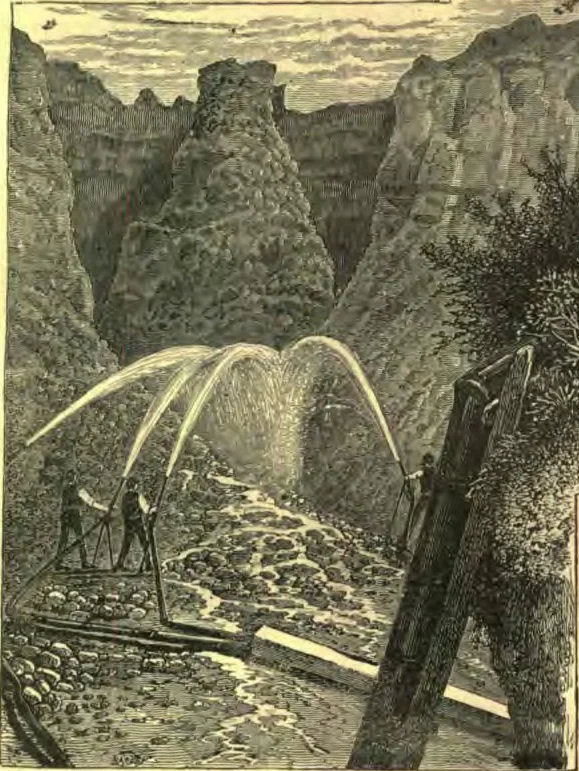
Mining is known under two heads, or kinds; viz., underground excavations, and open workings. Our illustration shows a scene in an open mine, where the earth and rocks have been loosened by blasting, and by the use of powerful streams of water are washed into the sluices prepared for them. This process is called hydraulic mining, and was invented in California in 1852. From a reservoir situated about forty feet above the mine, the water was drawn through a hose six inches in diameter, made of cowhide, and ending in a tin tube four feet long, the nozzle of which was an inch in diameter. This simple contrivance has long since given place to greatly improved methods of using the water, which have become of great value in aiding the miner in his operations. Water is conducted from the various streams high up in the mountains, into large reservoirs, and from thence to the mines through flumes and pipes; and by means of ingeniously contrived and regulated nozzles, streams six inches in diameter are discharged under pressure sometimes exceeding four hundred feet of hydraulic head, with a velocity of one hundred and forty feet and upward per second, delivering more than 1,600 lbs. of water in that time. The water issuing from the nozzle seems to the touch as hard as a bar of steel, and striking the bank in a solid, cylindrical shape, bores into it with immense power. The heavy boulders are thrown about like pebbles, and the earth, clay, and gravel are swept along into the system of sluices prepared for them.
While in every country on the face of the globe, mining is carried on more or less extensively, it is stated by competent authority that the United States exceeds every other country in the world in the extent of this industry, the estimate given for 1879–1880 being 360 million dollars, and that of Great Britain 325 million. Germany holds the third rank, followed by France and Russia. The United States produces 33 per cent of the gold yield of the whole world, 50 per cent of the silver, 22 per cent of the pig iron, 29 per cent of the steel, and about 25 per cent of the lead.
Not only has God's kind providence stored away in rich abundance, down deep in the bosom of our earth, these precious metals, so useful to man, and without which it would seem almost impossible to live, but he has also had thoughts for the comfort of his creatures, in providing for them other necessaries of life. And for these also the hardy miner toils by day and night, the same as for the gold and the silver. The words of a recent writer on this point are very forcible and beautiful:—
“Among the precious things of the lasting hills we may count the light which sheds its radiance upon us in the evening hours, and the warmth which cheers our homes when icy winter reigns through all the frozen North. The veins and beds of coal and the springs of oil which make our dwellings habitable, and keep all the fires of industry burning, were prepared in far-distant time against the day of need, and intrusted to the safe-keeping of the lasting hills. Down deep in the treasuries of the ancient hills God laid up of old, in black and solid mass, the bright effulgence which plays on the evening circle and kindles the classic page for the student's eye at the midnight hour.”
“In long-gone ages God made the mighty forests grow. He poured the sunshine upon the green leaves that every branch might treasure up a portion of embodied light. He sent forth great water-floods to sweep the fallen trunks of millions of trees into ravines and valleys between the hills. He covered them over and pressed them down with masses of sand and earth. He hardened the covering into stone, that the store-house might not be broken open till the time of need. In the process of ages the beneficent and divine Builder set his own hand beneath the hills and heaved up the rocky door. He opened the treasuries of darkness and the hidden riches of secret places, where light and warmth have been stored away in solid masses among the precious things of the lasting hills. Then the voice of his providence said to man, Behold the store-house which thy Father's hand hath prepared and filled of old for thee! Enter and possess thine own. And when the treasures of darkness fill thy homes and sanctuaries with light by night and warmth in winter, then offer thanksgiving to Him who thought of thee and provided for thy wants so long before the time of need came.
“Moses promised that the Lord God would bring the tribes of Israel into a land whose stones were iron. Speaking by divine inspiration, he recognized the mineral treasures of the earth as the means of spiritual blessing to man. And the coal and iron are among the most precious things which God hath stored up for us in the treasuries of the hills. More precious than fine gold and sparkling gems are the black coal and rusty iron that grime the face of the laborer with soot and sweat, and leave the signs of toil upon every hand that touches them. They keep all the wheels and hammers of industry in motion. They feed the hungry and clothe the naked and comfort the afflicted. They build houses for the homeless, they supply occupation162for the idle, they reward the industrious for their labor. They bridge our streams, build highways for travel, transport men and merchandise over land and sea with the speed of the wind and with the power of countless horses. They move the mightiest masses, and they finish the most delicate work. They hang the giddy track for the rushing train on the face of the mountain, and they stretch the connecting thread under all the waters of the great deep from continent to continent. They print our Bibles, give voice and melody to our songs of praise, and supply every comfort and convenience of public worship. If it were not for the treasures of coal and iron stored up of old by God's hand in the ancient hills, the grand march of science and social improvement, of civilization and Christianity, would be arrested, and the nations would go back to a state of utter ignorance and barbarism.”
J. W. B.
RECOMPENSE
By Cottage Hearth
How many things are clear to us to-day,
That yesterday we saw through mist of tears;
How many things are better than our fears,
What sunbeams through our self-wrought shadows play.
Not one fair, earnest hope is laid away
Within its shroud of weary, wasted years,
But from the tangled grass above it peers,
Full soon, some blossom redolent of May.
We stretch beseeching hands to Heaven and pray
That this, or that, be granted; whil'st we plead,
We turn with empty hands from prayer and say,
"We are unheard, forgotten, lost indeed!"
When lo! within our reach some priceless gift,
For which imploring palms we dared not lift.
—Cottage Hearth.
A SABBATH-SCHOOL LESSON.
By Pansy
Several of the boys were listening and laughing. “He drawls his words,” said Joseph, “and loses his place, and drops his lesson leaf; and never asks a question that isn’t right before him on the leaf. Oh! he is a rare teacher. I tell you what it is, when I get to be a man, I won’t teach a Sabbath-school class unless I have an idea of my own to give out now and then.”
Joseph’s sister Jean overheard this; it made her sad; she knew very well that Joseph’s teacher was a good man, but he did not seem to know how to teach a class of wide-awake boys. She talked with Mrs. Calland about it, and wondered if anything could be done. This was the way Mrs. Calland came to have her talk with Joseph.
“How much time do you give to the preparation of your lesson, Joseph?”
“Why, there isn’t anything to prepare; he just asks the questions, and we read the answers, when we can find them.”
“I know; but suppose you should come into my history class with as little preparation for reciting as you give to the Bible lesson; what would be the result?”
Joseph shrugged his shoulders. “Mrs. Calland, if you should come into the history class and do nothing but put on your spectacles and read from the book: ‘What did Moses then say? What did Moses do next?’ I don’t know what kind of a lesson we would get.”
“Tell me what Joseph Holbrook does to make the lesson interesting.”
“I!” said Joseph, astonished. “Of course I can’t do anything.”
“I don’t understand why; you certainly asked some good questions in the history class yesterday, which helped the interest very much.”
“Oh! that’s different,” said Joseph.
“I know it is different; you were interested in history, and wanted to know more about it; and you were interested because you had carefully studied the lesson.”
“I shouldn’t know a thing to ask in Sabbath-school,” declared Joseph, stoutly; but Mrs. Calland only smiled and went away. It was because of that talk that he stopped, astonished, over the third verse. “I will be with thy mouth, and teach thee what thou shalt say.”
“Queer!” said Joseph aloud. He meant it seemed queer to him that those words should be there just then. Was it a possible thing that the Lord might mean him, Joseph Holbrook, to consider them as spoken to him, about the Sabbath-school lesson? Was there anything he could say which might help?
It was this thought which made him read the next lesson over so carefully, that very night. There were some references in it which he did not understand, and he resolved the next day to look them up; this he did, and found himself growing interested.
He read the lesson over each day that week, and thought much about it, chiefly because he had become so interested that he could not help thinking about it. On Sabbath-day, as soon as the lesson was read, he asked—
“How many Israelites do you suppose there were at that time?”
The teacher looked astonished, but pleased, and was ready with his opinion.
This started more talk. Then the treasure cities grew very interesting; Joseph had been studying in history, that week, something which was connected with them, and the talk which was started was pleasant and profitable.
“Do you think it was a very wise plan which that old Egyptian king had?” Joseph asked. Then the boys each described the plan which he would have tried if he had been king; and altogether, the superintendent’s bell rang before they were half through with the list of printed questions.
“Didn’t we have a good time to-day?” said one of the boys, passing out. And the teacher pushed his spectacles on his forehead, and told Joseph it did his heart good to see how carefully the lesson had been prepared.
Joseph thought about it a good deal; and he had a little talk with Jean that night.
“I asked lots of questions in Sabbath-school to-day, and answered some, and had a real good time, because I was interested. Do you think, Jean, that the Lord might have put into my mind some of the things to ask? Because the others seemed interested in them right away.”
“I haven’t a doubt of it,” said Jean, heartily.
“He helps us in all sorts of quiet, little ways, as well as in great ones. Besides God promised, you know.”
Joseph sat silent and thoughtful; it seemed a wonderful thought that the Lord could possibly care what question he asked in Sabbath-school.
“I know one thing,” he said suddenly, “I shall always study my Sabbath-school lesson after this.”—Pansy.
THE NINTH COMMANDMENT.
By G. W. A.
This commandment warns against lying, deceiving, and untruthfulness of every description. It is found in the twentieth chapter of Exodus, and reads thus: “Thou shalt not bear false witness against thy neighbor.” The Saviour quoted this commandment when he told a certain young man what he must do in order to gain eternal life. See Matt. 19:18.
The ninth commandment is very frequently broken by children. It has been truly observed that truthfulness is one of the chief corner-stones of a good character; and that if it be not well laid in youth, there will ever after be a weak spot in the foundation. Some thirty-five years ago young children read at school in Webster’s Spelling Book, and one of its good maxims was, “A liar is not to be believed, even when he speaks the truth.” At the present day there are certain heathen nations and tribes who punish lying with death, or cutting out of the tongue.
The Scriptures mention the awful judgments which came upon three persons for lying. These were Gehazi, the servant of Elijah, and Ananias and his wife Sapphira. Read the sad accounts in 2 Kings and Acts, the fifth chapter of each. In one case, the punishment was a most loathsome disease for life; and in the other, it was instant death. In our country, the punishment for telling an untruth in court is State’s prison for a term of years.
History furnishes many cases where individuals for knowingly violating the ninth commandment have been suddenly overtaken by the awful judgments of God.
The Bible says very much in regard to truthfulness and lying. In Proverbs there are mentioned six things that the Lord hates, and one of them is a lying tongue. Chap. 6:16, 17. The psalmist says, “The mouth of them that speak lies shall be stopped.” Ps. 63:11. Again the question is asked, “Lord, who shall abide in thy tabernacle?” and a part of the answer is, “He that speaketh the truth in his heart.” Ps. 15:1, 2. In the book of Revelation we have the awful statement that all liars shall have their part in the lake of fire and brimstone. Chap. 21:8.
These are only a very few of the many texts which speak of this important subject. If the young reader will take the concordance, or a reference Bible, a score or more of passages may be found in harmony with the above.
The Scriptures tell us that Satan is “the father of lies.” John 8:44. So all who deceive, or tell falsehoods, or equivocate, become the children of the great deceiver. Awful thought! This is the reason why those who make up falsehoods, or even love them, will have no part in the Holy City. See Rev. 21:27; and 22:15.
Herodotus, in the first book of his history, says that the ancient Persians instructed their sons from the ages of five to twenty years in three things; namely, how to manage a horse, to shoot with a bow, and to speak always the truth.
The celebrated Dr. Johnson was remarkable for the correctness of his speech. Although one of the greatest conversers of his age, he would never allow himself in relating an anecdote to make the smallest addition merely to embellish the story. It was observed of him “that he always talked as if he was under oath.”
Almost every school child has read of George Washington, whose upright youthful reputation has been handed down to our own day as “the boy who could not tell a lie.”
Dear children, never defile your lips with an untruth.
G. W. A.
LITTLE THINGS.
We call him strong who stands unmoved—
Calm as some tempest-beaten rock—
When some great trouble hurls its shock;
We say of him, his strength is proved:
But when the spent storm folds its wings,
How bears he then life's little things?
About his brow we twine our wreath
Who seeks the battle's thickest smoke,
Braves flashing gun and saber-stroke,
And scoffs at danger, laughs at death;
We praise him till the whole land rings:
But is he brave in little things?
We call him great who does some deed
That echo bears from shore to shore—
Does that, and then does nothing more;
Yet would his work earn richer meed,
When brought before the King of kings,
Were he but great in little things.
—Treasure-Trove.
Morning in a German School.
It is always morning somewhere in the world, and children are always starting for school. While you are still asleep in your beds, at three or four o’clock, the German children are trudging along, with books under their arms, to their daily tasks.
In Germany the schools begin at eight in the morning. Here in America we find nine very early. During the short days, the sun does not rise until about eight, so that often it is quite dark in the room when school begins. But the scholars are always there, punctual and ready for a hard day’s work.
Let us see how it looks in one of the rooms of a girls’ school about this time in the morning.
The sun is just rising, and a sort of twilight is over all. Here and there are groups of neatly dressed girls, from eight to fifteen years of age, the oldest being those who are nearly ready to leave school forever.
Presently, at one minute to eight, a bell rings. All instantly take their seats without a word more of conversation, for these girls are brought up from infancy to obey in the strictest meaning of the word.
What a stiff, precise, but perfectly orderly picture they make, sitting there in rows, each with her hands folded on her desk! They all wear clean, plain dresses with white linen collars; and no matter how wealthy they may be, the wearing of jewelry in school is an unheard-of thing. It is only the Americans among them who do this.
As the teacher enters, all rise to greet her. Then she calls the roll, after which a hymn is sung and the Lord’s Prayer repeated. Now begins real work.
The geography of Germany and Palestine are made specialties, and mastered; but of other countries they know very little.
The Bible is one of the principal studies. Every one is taught to read French; and the literature of their own land they know thoroughly.—Selected.
THREE MAY BE NEEDED TO MAKE A TORCH.
By S. S. Classmate
In an old Hussite Liturgy are said to be three small pictures on one of its pages. There is Wycliffe, the English reformer, striking a light. Huss, that intrepid Bohemian soldier for the Lord Jesus, is blowing the flame. Then comes the great-hearted German, Martin Luther, bearing the shining torch. Recall the history of the great movements leading on to the Reformation, and we find Wycliffe kindling the gospel flame in England. Huss, the Bohemian, is stimulated by Wycliffe’s example. Martin Luther, fired up and consecrated at a later date, brings to a successful issue the labors of the others.
In our humble lives the same law may be illustrated. More than one may be needed to accomplish certain work for God; but what you do will not be thrown away. Look around you. What ought to be done? Say it shall be done. Kindle a light. Another, affected by your example, will blow your flame. A third will bear into the night some blazing torch. But you are looking for some great, conspicuous work. Take a humble yet important duty. There may be boys or girls on your street or in your school that may be neglecting the Sabbath. Ask them to church or Sabbath-school. Say some word for Jesus to another in the school who is yet out of Christ. It may only be the kindling of a little light, but in the providence of God it may be shown that you were getting ready a blazing torch. O, kindle a light this very day!—S. S. Classmate.
Keeping God in Your Mind
You are never out of God's mind. Let him ever have a place in your mind.
THE RULE OF THE ROAD.
The most of even our young readers know the rule of the road which, in this country, regulates the meeting of teams going in opposite directions,—that each is required to turn to the right; but how many know that in England the rule is just the opposite,—each must turn to the left? One who queried why our custom differs from the English, England being our mother-land, wrote to the publishers of the Inter-Ocean as follows:—
“The ‘rule of the road’ in the United States is ‘turn to the right,’ as the law directs. In England it is the reverse, and the idea is preferable, on several accounts, to our practice. They say there:—
“The rule of the road is a paradox quite—
For in driving your carriage along,
If you turn to the left you are sure to be right,
If you turn to the right you are wrong.’
“As most of our old customs come from England, can you tell how this change originated?”
The following is the Inter-Ocean’s reply:—
“The rule ‘turn to the right’ only holds in this country in the case where two vehicles going in opposite directions meet. When one vehicle overtakes another the foremost gives way to the left and the other passes by on the ‘off-side;’ and when a vehicle is crossing the direction of another, it keeps to the left and crosses in its rear. These two rules are the same in this country and in England, and why the rule concerning meeting vehicles should have been changed it is impossible to say. We find this point of difference noted by all authorities, but no reason for it is ever suggested. Perhaps it originated simply in the dislike with which our forefathers regarded all things that savored of ‘British tyranny.’ Probably, as it is easier to turn to the right than to the left, it was adopted as the more preferable custom in some of the early colonies, and in due time became embodied in local law, and thus was handed down to later times.”
THE CLOVE-TREE.
By F. B. C.
“That most elegant, most precious, and most beautiful of all trees,” the clove tree, is a native of the Molucca Islands, whose volcanic soil, and vapory clouds of mist, are peculiarly favorable to its growth and perfection.
The clove is a cousin to the myrtle-tree, though larger and more shapely. The dark, polished leaves are lance-shaped and evergreen. The clove blossoms are white, and deliciously fragrant. Often rising to a height of forty feet, the clove-tree sends out, midway, a profusion of thickly-leaved branches, which diminishing smoothly as they ascend, form a perfect cone of dense, glossy foliage, supported by a clean, straight stem.
Cloves, which in plain English mean nails, are called by some natives herb-nails, fragrant nails, and spice-nails. These cloves or nails, are not, as is generally supposed, the fruit of the tree, but the unopened flower blossoms. The stem of the spice is the calyx, and the head the folded petals. Clusters of these spicy, fragrant flower-buds spring from the end of every branch and twig, and when gathered by the natives are speedily dried in the shade, before their aroma is wasted on the careless winds.
One may imagine how plentiful clove-trees were on these islands, from the fact that five million pounds of these spice-nails were shipped from there in a single year. Although they were sold for the trifling sum of two cents per pound in Molucca, they brought five dollars a pound in London.
It was a sunny day for Molucca when the blue sky, bending over her picturesque islands, kissed the shining foliage that waved on every hill-side, and breathed out her fragrance in every valley. Then, of a rosy morning, the softest wind that crisped the sea, and only stirred the dewy clove and nutmeg thickets, would tell to distant mariners where lay the “Spice Islands.” But avarice has blotted the bright picture from the earth. When Holland grasped the Moluccas from Portugal, the East Indian Company ordered many young clove-trees to be transplanted to Amboyna. Also many of the natives were carried as slaves to Amboyna to cultivate the trees. Then companies of men and soldiers were sent to Molucca to cut down and destroy all the clove-trees on those islands, thinking to render this spice more precious and costly.
In vain did the people plead for their beautiful trees. Without them they could not live. Their tears were laughed at; their entreaties despised. Rank after rank of the precious trees were laid in the dust, and when the ruthless destroyers departed, not one clove-tree waved its branches on all the Molucca Islands. To this day annual uprooting expeditions are sent out to destroy any that may have sprung up from chance seeds. The inhabitants, deprived of their means of living, fled to other islands or died of starvation. Protected no longer by trees, the soil of these islands has been washed away by tropical rains, and parched by tropical suns, until now they are little more than dreary desert places.
Although carefully cultivated, the clove-trees of Amboyna are far inferior to those of Molucca, where they seemed to love the soil, and where they blessed the islands with a perfection and beauty they will never reach elsewhere. In tropical countries, the clove-tree is cherished in the gardens of the rich and great for its shapely beauty and fragrant blossoms. The emperor's gardens in Rio Janeiro, Brazil, are said to be enchanting when the clove-trees are in full bloom.—F. B. C., in Alden's Juvenile Book of Knowledge.
PRAYER
LESSON 3.—WHOSE PRAYERS ARE HEARD.
1. WHAT comforting statement is made in Psalms 34:15?
2. What contrast is made between the righteous and the wicked? John 9:31.
4. How is the same principle brought out in 1 Pet. 3:12?
5. How does God regard the prayer of those who are given to vanity? Job 35:13.
6. What is said of the prayer of the hypocrite? Job 27:8, 9.
7. What hope have those who cherish a love for anything which God has set down as iniquity? Ps. 66:18.
8. What is the effect of iniquitous conduct? Isa. 59:2.
9. How does God regard the prayers of those who willfully turn away from his law? Prov. 28:9.
10. What course was taken by some of the Israelites in ancient times? Zech. 7:11, 12.
11. What was the consequence of their refusing to hearken to the word of the Lord? Verse 13.
12. What reason does the Lord give for not hearing the prayers of the people in the time of the prophet Isaiah? Isa. 1:15, last part of the verse.
13. Must people actually shed blood in order to be condemned by this passage? 1 John 3:15.
14. What does the prophet say in another place to show why the Lord will not hear the prayers of those who persist in sin? Isa. 59:1, 2.
15. In what ways do men show forth the promptings of an evil heart? Verse 3.
16. What is said of the way of the wicked? Prov. 15:9.
17. What counsel is given to those who are in this sad condition? Isa. 1:16.
18. What invitation is given to the penitent believer?—“Come now, and let us reason together, saith the Lord.” Verse 18.
19. To what is this equivalent?—To an invitation to prayer.
20. What promise is made to those who accept this invitation? Last part of the verse.
21. What further assurance have we that God will hear the prayer of penitent sinners? 2 Chron. 7:14.
INDELIBLE DEEDS.
By Robt. Pollok
The deeds of reasonable men,
As if engraven with pen of iron grain,
And laid in flinty rock, they stand unchanged,
Written on the various pages of the past;
If good, in rosy characters of love;
If bad, in letters of vindictive fire.
—Robt. Pollok.
FIRE ENGINE HORSES.
By W. S. C.
Children of the Instructor family, who do not live in a city, or who have never visited one, will perhaps like to hear some things about the fire service in the great city of New York. Here engines are now operated by steam power, except to propel them through the streets. For this purpose two very strong, swift, and intelligent horses are used. The New York World had, recently, a long article describing these noble animals, from which I summarize what follows. First, I must premise that, at the engine houses, the horses are kept back of and over the engine, the harness hangs from the ceiling, by a gearing that is so arranged as to permit of its being dropped, accurately and instantly, upon the backs of the horses, when they take their places by the pole. The traces remain fastened always to the whippletrees, and the snapping of a few self-acting clasps places the harness securely upon the animals, inside of a moment’s time. Over the stable part of the engine house a gong is placed, connected by wires with the electric alarms in the stations. The men sleep overhead. At the first alarm, the horses move out, the men descend the stairs, horses and men take their proper positions about and on the engine, the janitor swings open the great doors and in an incredibly short time the engine is borne away at a break-neck speed toward the fire.
Great care is exercised in the selection of horses for this work. “Good blood” is not considered essential, but they are put upon a month’s trial, and exhaustive tests of their intelligence and endurance occur daily, in the great training stables at 125th St.
“Joe,” belonging to No. 7 engine in Chambers street, is considered the best trained and most intelligent horse in the department. When he hears the click of the alarm ticker he will pull the gong rope to wake the sleeping firemen, and then rush to his place at the engine, putting his collar on unaided. Crowds of ladies and children feed him daily with sweets and fruits. He shakes hands, will kiss you, and take an apple from your mouth as gently as a child.
“Jumbo,” that carries the “tender,” is the largest horse in the service. He too is a very knowing creature. When thirsty, he goes to the hydrant, turns the faucet, fills the pail, turns the supply off, and then deliberately drinks his fill; but he is such a prodigious snorer, that he is often voted to be a nuisance by the men, and possibly by his mates.
Another “Jumbo,” attached to engine No. 31, on Leonard street, frequently leaves his stall, and is permitted to go upon the streets. His favorite stopping place is a peanut stand on the corner. Here ladies, gentlemen, and children treat him to pears and other fruit, and in return he romps with the children, and tries to coax them to play roly-poly with him in the middle of the street.
“Jim,” attached to engine No. 16, is noted for his slyness in purloining articles from the pockets of bystanders, having acquired dexterity by being permitted to search the pockets of the men for sweets and fruit.
“Ginger,” with engine No. 21, can catch apples thrown to him as deftly as a catcher for a base ball club catches a ball, while “Jim,” who is attached to engine No. 25, is known as the “watermelon-fiend,” because he begs, like a child, for this fruit every time the men return from dinner, and clearly shows his disappointment if they return without any. W. S. C.
THE SACRED TOOTH OF BUDDHA.
Buddha was the founder of a very ancient religion, which was named after him. The Brahmins put a stop to it in India; but it spread to Japan, Thibet, and China, where it exists to this day, as well as in that curious and very beautiful island, Ceylon.
Buddha himself lived more than one thousand years before Christ; so that the preservation of one of his teeth for nearly three thousand years is, of itself, rather remarkable. After reading a description of it you can judge whether it is a human tooth or not.
This singular relic is preserved in Kandy, the ancient capital of Ceylon, in the temple of Dalada Maligawa, or the “Palace of the Tooth,” close to which is an immense artificial lake, a mile and a half long, and in some places a quarter of a mile wide, which is about seventeen hundred feet above the level of the sea. The sacred building is served by hundreds of Buddhist priests, all clad in yellow silk robes, leaving the right arm and shoulder bare. Their heads and faces are all closely shaven—not leaving a hair. The precious tooth is kept in a room only about eight feet square, hung with drapery, and lighted by lamps alone. In this treasury there are many precious stones, gold chains, and other valuable articles, the gifts of worshipers. The outside covering of the sacred tooth is a large, bell-shaped casket of silver, richly ornamented with precious stones and gold. Inside this is another similar one, and then another and another, all wrought and ornamented in the same way.
After these four covers are successfully raised, a little gold casket is seen, beautifully ornamented with rubies, sapphires, and diamonds. When the lid of this box is raised, the only mortal remains of the god are seen. And then comes the greatest wonder of all, for the “tooth” is a huge piece of ivory, apparently, and is about two inches and a half long, and about half an inch in diameter. It is smooth and rather cone-shaped, and reposes upon a lotus leaf of gold.
This sacred relic is considered the most precious thing in the whole world by millions of people. Hundreds of pilgrims visit the shrine every week, bringing offerings of money and other things; and for the privilege of transferring the relic to his capital, one of the kings of Siam offered the sum of five millions of dollars, which was refused. So that the offerings of the many worshipers must amount to a great deal.
It is needless to say that the place is very strictly guarded; for, in addition to the sacred relic and its valuable cases, they have there the largest emerald in the world, a huge gem three or four inches long and about two inches thick. This is cut into an image of Buddha. There is no doubt that the stone is a genuine one; but it is impossible to estimate what it is worth, as outsiders may not handle it. There is also in the custody of the priests a splendid sapphire, as large as a walnut, and very richly set, and an anklet set with huge diamonds, which used to be worn by the kings of Kandy.—Golden Days.
BIRDS CALMING THE SEA.
A Fiji correspondent writes to an English paper: “Often while sailing among the South Sea Islands, I have passed flocks of birds, principally terns and whale-birds, residing in vast numbers on the sea. It is remarkable that, however rough the sea may be at the time, yet where the birds rest there is not a ripple to disturb them. This must be caused by oil, but whether it is purposely deposited by the birds with the intention of quieting the water, or whether they do so from natural causes, is a question, the answer to which, I think, would interest many of our readers.”—Selected.