HOW I wish the INSTRUCTOR boys and girls could camp out for a whole summer in such delightful woods as I am in this warm afternoon! Great linden trees rise toward a hundred feet above my head, making a dense and cooling shade. The hot August sunshine can hardly find an entering place through this roof of green leaves. Among the lindens stand stout old oaks, gnarled and twisted with the storms of many winters. Tough little hickories, and ironwood, and sassafras fill up the chinkings left by the great trees; and if you should go with me up this old, unused road that runs through the woods, you would come across a beautiful clump of beech trees, whose smooth, spotted bark is scarred with the initials of many lads and lasses ambitious of leaving a name in the world, though it should be only in the rind of a tree.
The beeches, and the maples near them, spread out great friendly arms, and make a delightsome shade. Under their branches you may sit, and hear the waters of a pretty inland lake lapping, lapping on the restless pebbles of the shore.
When I sit under the trees quite still, almost as if I were asleep or dead, my little summer friends come out to see me. They have grown so well acquainted in the few weeks that we have been here, that now we may talk and move about, and still they will not run away. These friends are two tame gray squirrels that run up and down the bark of a great basswood tree, frisking their bushy tails over their backs, and chattering and scolding at a great rate to each other. They have no hesitation in talking about their family affairs, for they seem to understand that we will not tell.
Two little chipmunks have a burrow near the work table; and while we write, they dart out close to our feet, and sitting erect on their haunches, contentedly munch their breakfast of old beetles or some other inviting food. Their sharp black eyes look out with friendly interest on those who have intruded on their home.
Yonder flies a beautiful bird—a woodpecker, evidently. On his head he wears a brilliant red hood that fits closely under his chin. He has a vest of snowy white, and a coat of the glossiest jet black, with a white tail bound off in black. As the days go by, and he becomes certain that we do not mean to harm him, he is less timid, and works on the side of the tree where we can see him, though he keeps a good distance between us and him.
How strange a robin’s song sounds in the depths of the woods! Here is one who came to see us a year ago, and now he is hopping in a very contented way from the ground to the tent ropes, and down again to pick up the crumbs that have fallen from the table. Last year he brought his wife with him; but now he comes alone. We have wondered much if she were dead, or if she had gone off with some handsomer robin. Poor, down-hearted little fellow! See him sitting on the tent rope there, tilting his little head one way and then another, and looking at you so sorrowfully out of his black eyes, as if he craved human sympathy.
Don’t you wonder how a boy can want to stone the birds; and how he can take delight in chasing and frightening the timid squirrels? I don’t believe he knows what good friends he has among the wild creatures, nor what delight he would take in getting acquainted with them. You know it tells in the Bible about a good time coming when all the wild creatures shall be so tame that a little child can safely play among them. I wonder if we could not have a little of that good time here by being so kind to all creatures that they will have no cause to fear us.
I wish I could make all the boys and girls see what a beautiful world God has made for us, and how many interesting things he has given us to study about. Do you remember the story in your school reader, called “Eyes and No Eyes”? It is about two boys who went over a hill to take a walk. When they came home, their uncle questioned them about what they had seen. One boy could hardly find words to tell of all the delightful things he saw; but the other grumbled that there really was nothing to be seen, and that it was a tedious, hot morning’s walk. Well, there are a good many others who are like young Master No-Eyes. They will go all through life seeing nothing but disagreeable, hard work. And there are others who will find this world a pleasant place, full of good things which a kind heavenly Father has put here to make our home more attractive for us. Which sort of boy will you be? W. E. L.
Letter Budget.
ARNOLD HARE, of Auckland, New Zealand, is a little boy ten years old. He has written a story for his little friends of the INSTRUCTOR. It is this: “Long years ago, in 1814, a missionary came to preach to the Maoris, and to tell them of God; but they were a cruel people, and did not like this. The Rev. Mr. Marsden was the first minister who came to preach. After awhile he returned to Australia, and sent the Rev. Mr. Turner to try what he could do. This was about 1816. At that time the Maoris were a very bad people, and used to eat each other, and they were going to kill Mr. Turner and his wife and children. In the midst of these trials Mr. Turner’s baby died. In those days there were no boards in New Zealand, and Mr. Turner had to dig a deep hole in the ground and bury his child without any coffin. He simply wrapped it in a blanket before placing it in the ground. When the Maoris heard of this, they dug the child out of the ground, took the blanket for themselves, and then threw the babe down. After they went away, the father buried the child again, and had to go away that night to the Bay of Islands, a distance of thirty miles. To this day, this little grave is marked by a peg in the ground and a wild rose bush which covers the spot.”
“The Maoris are not cannibals now. A great many of them are Christians, and live as we do. Most of them can read the Bible, and one has been baptized by Eld. A. G. Daniells, is a Sabbath-keeper, and has the faith of Jesus.”
“I have three sisters and one brother, and I hope we shall all be ready to meet Jesus.”
A belief in the Bible always has the effect that it had for the Maoris,—to “clothe and put people in their right minds.” We once heard a German minister recommending the study of the word of God to the children of a large Sunday-school. Among other good things he said was, “Children, set it town tat te Piple is te pest pook in te werlt.” His words came from a heart made tender by the love of Jesus; and although his language was broken, it was forcible, and the whole congregation (Presbyterian) felt like shouting, “Amen!” As wise as Solomon was, he said there were a few things he did not understand. If he lived now, may be he would add to his list of mysteries, “I don’t know how an infidel who has been educated in a land of Bibles can condemn a book which always has the effect of elevating and refining those who listen to its teachings.” “Blessed Bible!” how it has withstood all that evil men and angels could bring to bear against it; and it will yet fulfill its mission,—bring out a remnant who shall be redeemed from the earth. Let us love and cherish the book, proclaiming its truths to the nations around us, that we may by and by join the victor’s song.
HERE we have a letter from a little boy whose father edits one of the papers published at the Review Office. It is from JOHNNY KOLVOORD, of Ottawa Co., Mich. He says: “I thought I would write a letter for the Budget. I am a little boy eleven years old. I have three younger brothers and one sister, who, with me, have kept the Sabbath with our parents about a year. We are the only Sabbath-keepers in a population of six or seven thousand, so that we cannot go to Sabbath-school. My sister and I have lessons at home in Book No. 2, and our mother teaches us. I have been reading the INSTRUCTOR about two years. We have a missionary jug, which now contains three dollars and thirty-seven cents, the amount we have saved since the first of January. We shall give it to the South African Mission. My sister and I go out strawberry picking, for which we receive a penny a quart. I was at the river the other evening, where I saw a man-of-war. It was a side wheeler, and had five cannon on deck. Papa is editor of the Holland paper, called the Bybel Leser (Bible Reader). He is at Battle Creek, where it is printed. I would like to see my letter printed, as it is my first.”
You have to shine on a great many people, don’t you, Johnny? We trust you keep a blazing torch, which will send its light a great way.
H. E. R
By H. E. R.
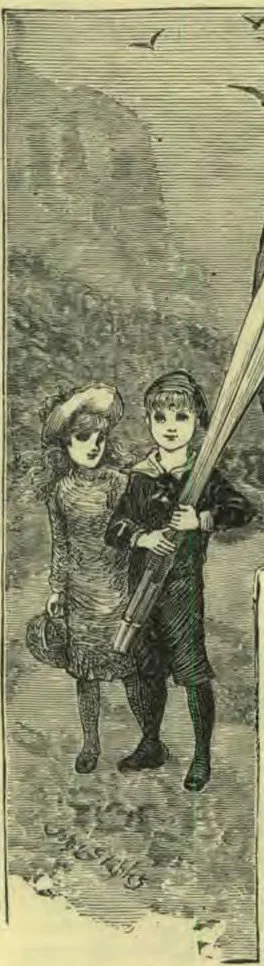
BY THE SEASIDE.
Beside the sea, beside the sea, life is so full of joy,
Come, leave the busy, weary throng, O city girl and boy.
Come, join us in our happy play, till summer days are o'er."
Thus sang the merry little waves that lap old Ocean's shore.
And forth from many a dusty street and many a heated hall,
With listless step, the children crept, in answer to the call.
But when they reached the fair seaside, with its wealth of golden sands,
Where all the downy daytimes glide as fresh from fairy lands,
Their listless feet kept beating time to every dancing wave,
And every breeze, to their pale cheeks, a warmer color gave.
Each day, all up the blue highway, the sun in splendor rolled,
And gloated o'er the shining beach as a miser o'er his gold.
The sands reflected back his beams, and with his splendor vied,
And the children dug the treasure up, and scattered it far and wide.
They challenged every breaker, and racing was a treat
When the big waves roared like lions, and the little waves kissed their feet.
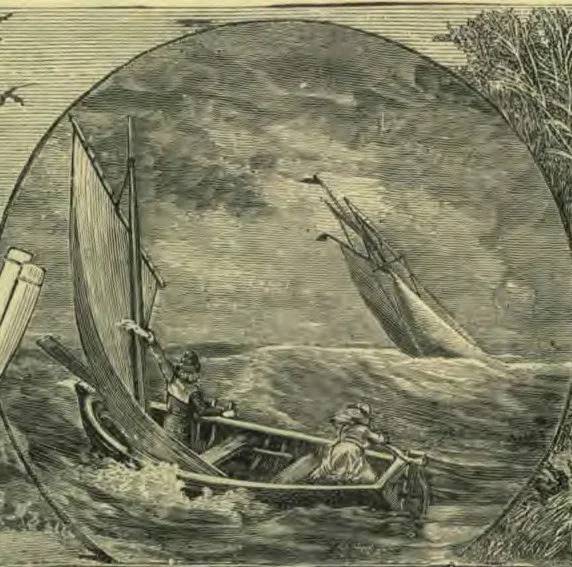
Or out on the bounding billow, like a bird upon the wing,
Where each white sail that skimmed the sea, seemed like a living thing.
But all too soon were ended the summer's days and joys,
When back to their homes in the city returned the girls and boys;
Not pale and lifeless creatures, but sturdy of life and limb,
To show that a stay by the seaside, had put them in living trim.
H. E. R
For the INSTRUCTOR.
The Youth's Instructor
By Editor
IS PUBLISHED WEEKLY BY THE
S. D. A. PUBLISHING ASSOCIATION,
Battle Creek, Mich.
Mrs. M. J. CHAPMAN.
Miss WINNIE E. LOUGHBOROUGH. EDITORS.
The Instructor is an illustrated, four-page sheet, especially adapted to the use of the Sabbath-schools. Terms always in advance.
Single copy, 75 cts. a year.
5 copies to one address, 60 cts. each.
10 or more copies to one address, 50 cts. each.