The Youth’s Instructor, Vol. 36, No. 37.

SEA CHANGES

The Youth’s Instructor

Sep 12, 1888

S. D. A. Publishing Association · Battle Creek, Mich. · Sep 12, 1888

SEA CHANGES.

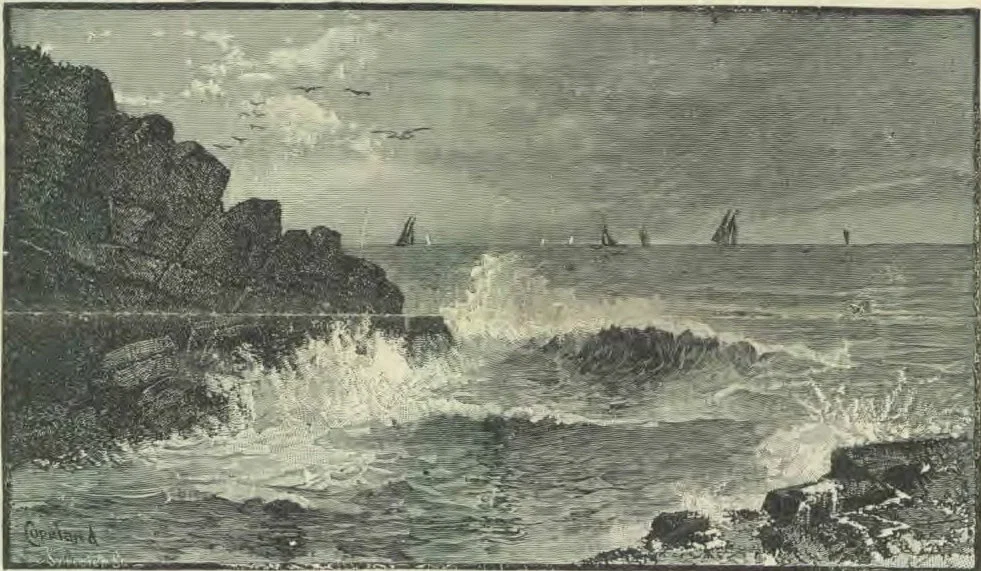
From shore to shore the waters sleep, Without a breath to move them; And mirror, many a fathom deep, Rocks round, and skies above them. I catch the sea-bird's lightest wail That dots the distant billow, And hear the flappings of the sail That lull the sea boy's pillow.
Anon, across the glassy bay The cat's paw gusts come creeping; A thousand waves are soon at play, In sunny freshness leaping. The surge once more talks round the shore, The good ship walks the ocean: Seas, skies, and men all wake again To music, health, and motion.
But now the clouds in angry crowds, On Heaven's grim forehead muster, And wild and wide sweeps o'er the tide The white squall's fitful bluster. The stout ship heels, the brave heart reels Before the whelming breaker; And all in nature quakes, and feels The presence of its Maker.
Oh, glorious still in every form, Untamed, untrodden ocean: Beneath the sunshine or the storm, In stillness or commotion. Be mine to dwell beside the swell, A witness of thy wonders; Feel thy light spray around me play, And thrill before thy thunders!
While yet a boy, I felt the joy To gaze upon thy glories; I loved to ride the stormy tide And shout in joyous chorus. With calmer brow I haunt thee now To feel sublime emotion. My soul is awed and filled with God, By thee, majestic ocean.
—Toledo Blade.

A WORD FROM A SLAVE.

He was a white slave, who lived about 1700 years ago, and his name was Epictetus, which means “bought” or “acquired,” and shows that he was a slave.
Epictetus was lame, and he was poor; but in spite of these hard things he was a wonderful man, and I will try to tell you a little about him.
His master was a learned man and the teacher of the Emperor Nero; and, like Nero, he was hard and cruel. I am sure all of his slaves had a hard time; for in those days, if a slave should chance even to sneeze or cough at the wrong time, drop a dish, spoil any food or cooking, his master could torture, behead, or kill him in any way he chose. And masters often did choose to kill their slaves by some slow, torturing process, which they watched with a cruel delight, strange as it seems to us.
I said that Epictetus was lame. Some historians say it was because his master, Epaphroditus, broke his leg as a punishment for some slight offense, but others suppose it was from a natural disease—so we will hope the latter is true. But however it happened, he was very lame, and small, and weak, and not good for hard work with his hands or body, nor pleasant to look at when beside well, strong men, excepting for his bright mind. And because of this bright mind and his unfitness for anything else, his master had him learn all things taught in those days, from a regular teacher.
This may seem strange to you, that a hard, cruel man, who would go so far as even to put to torture or death his slaves, should let one of these same slaves receive the best education of the times. But there was a selfish reason for this. Many men, in those days, who were too lazy or stupid to learn themselves, had their slaves taught, that they might be ever ready to give them information, or write discourses, for which the masters received all the credit.
So Epictetus was sent away to a learned, good philosopher, to be taught. He loved his teacher, and has written many kind things about his goodness and wisdom, and thanks him for the many things besides book-learning he taught.
At some period of his life, but how or when we do not know, Epictetus was freed by his master. This must have made him feel better in mind, but his life was just about as poor and hard as it was before. One writer, who knew him, says that all the furniture in his house was a bed, a cooking-vessel, and an earthen lamp. Pretty hard living we should most of us think that was!
“Well! what did Epictetus do with his learning and freedom? He spent his life in teaching what is called philosophy—that is, how men should live and think, and be good and brave, and make the best of all things. He taught until he was an old man; once being banished, because of his teachings, from Rome, the city he loved, only to go into another city and go on with his good work.
Many of the things he said have come down through all the years to our own time, and are just as sweet and strong to-day as when this good man said them 1,700 years ago. Just one of them will I give you to-day, and we will see what we can get out of it to think about.
“Which way is the wind?”
“North.”
“What do we want of that? When will the West wind blow?”
“When it pleases, friend, or when Æolus pleases; for Zeus has not made you dispenser of the winds, but Æolus.”
“What, then, is to be done?”
“To make the best of what is in our power, and to take the best as it occurs.”
“And how does it occur?”
“As it pleases God.”
This is what Epictetus wrote—and now what does it mean?
I think he showed us a good deal of the meaning himself. He was a slave, when he wanted to be free; lame, when he wanted to be straight and strong; poor, when money would have made life so much easier for him; banished from Rome, when he wanted to stay and go on with his work. Well, what did he do? Made the best of what was in his power, and took the rest as it occurred. People always found him cheerful and happy, and ready to help others all he could, so that every one who knew him loved him; and after he was dead, some one wrote for his epitaph,—
“I was Epictetus, a slave, maimed in body, and a beggar for poverty, and dear to the immortals.”
Was not this an honor, and worth all the trials and hardships of his life?
Well, boys, what do you think you will do? You want to play base-ball or cricket, or leap-frog, this afternoon. It rains. Are you going to sit in the house and mope? Not if you’re any kind of a cheerful, manly boy. Go to the shed or barn, and whittle out a boat or cane, or a toy sled. Stretch on the hay with other boys, and tell stories. Get a book and read. Do anything but grumble because the wind is north when you want it west.
You thought you were going to have pie for dinner; but it is wash-day, and there is nothing for dessert instead; well, what will you do? Epictetus would say, “Eat more bread, and look out for pie another day.”
Christmas comes, and you expect a nice knife; but, instead, Brother Ben gets a four-blader, and you get nothing but a hand-sled. What is to be done this time? Go coasting, and have as good a time as you can; lend Ben the sled, and ask him to let you take his knife.
You are poor, perhaps. Well, this is pretty hard where you see all the fine clothes, toys, and candy that money will buy; but just go to work and take what you can get—schooling, perhaps; a chance to run errands, pile up wood, or shovel up snow with a few pennies for pay.
May be you are lame, like Epictetus. Well, here’s a good chance to use your head as he did, and let other boys use their feet.
Perhaps you have an unkind father, ever ready to find fault with you. All I can say is, do the best you can; give him as few chances to find fault as you can, and some day he will be proud of you.
It may chance that you have a very hard time at home, want to go off somewhere and do for yourself, but instead have to work at home, and give your mother all you earn. Boys, this cannot last always. Do it as well as you can, and as cheerfully, and look out for something better.
There are ever and ever so many hard things that will and do come to all of us, but we must make the best of what is in our power and take the rest as it occurs. A lady writer in our own day says: “There are things that can be changed, and there are things that can’t. Let us tend to those that can.”
Be on the lookout to do something that comes in your way that can be done. Don’t waste your time grumbling and working over those that cannot. Keep busy trying to do this. Epictetus was a good, earnest man, loved through all the years that have passed between his life and ours, because he did just what I hope you are going to do—make the best of what is in our power, and take the rest as it occurs.
“And how does it occur?”—“As it pleases God.”—
Juniata Stafford, in the Church Union.

SOME OLD RELICS.

When we reached Korsor after our toilsome trip in the ice-boat, we went to the hotel, only to find it too full to hold another occupant. Our train did not leave until eight o’clock the next morning; and while we were wondering what to do, the captain sent word to a family of his acquaintance to know if they would keep us over night. Much to our joy, they cheerfully consented to entertain us, and they did it with a hospitality that bespoke well for our sojourn in this country.
The host showed us many old relics, and told us stories and facts connected with each one. In a small bottle tightly corked to keep its contents from the dust, was a perfect image representing the Virgin Mary and her child, cut from a piece of wood only seven-eighths of an inch long, and one-fourth of an inch broad. In another was a beautiful basket and wreath, cut from a piece of wood only three-eighths of an inch square with the handle attached and the wreath beneath. These small articles could be seen only with a magnifying glass, and yet they were carved with a nicety that was astonishing. They were several hundred years old.
This family had for a long time been associated with the royalty, and had many curiosities that they had obtained through this means. One of these was a double silver cup, that, when put together, looked like a cask with six hoops around it. This cup was once used by the king of Denmark, and given to the uncle of our host after he had faithfully served as inspector of customs for twenty-five years, between the countries then known as North and South Jutland, since united to form the kingdom of Denmark. This double cup was made two hundred and fifty years ago.
There was also an ancient seal once used by the king and court officials. It used to be a custom that when a man had mastered a trade, he should receive a diploma to that effect, sealed with one of these old seals. These seals differ from ours in that a small round box is made, and wax put in the box; a silk ribbon is then put through a hole in the paper to be sealed, the ends of the ribbon put on the wax, and a hot iron seal stamped on the wax. It seems strange that so much trouble should be taken to seal a paper in this way; for if the hole should tear, or the ribbon break, the seal would be useless, since it could not be known what was intended to be sealed by it. The paper shown us was a diploma signifying that Hans Benson had mastered his trade as copper-smith in the year 1732; and it was evident that this seal was not attached to papers until the person had in reality mastered his profession.
In these European countries, kings and queens are held in great admiration by the people, and it would seem that in many respects they are almost worshiped. Relics pertaining to these dignitaries are very highly prized. We were shown a piece of charred wood from a coffin in which one of the queens of Denmark was buried over one thousand years ago. It became necessary to remove her remains some time ago, and then this relic was obtained, and has been carefully cherished ever since.
There was also a flower taken from the ruins of Pompeii. It was over eighteen hundred years old, and had preserved its perfect form through all the calamities that had overtaken this ancient city.
Among other things, our aged host called attention to a picture of a man who had died in Korsor some twenty years ago. Before his death, he had wasted to a mere skeleton, so that now, as he lies in his coffin, his body has not decayed, and many go to see the remains. He was one hundred and forty-seven years old when he died.
The old man showed us many other interesting things, and enlivened the evening with stories; but as they were all in the Danish tongue, we could enjoy only what one of the party kindly interpreted for us. But the hearty goodwill manifested by our host in entertaining people who were entire strangers to him, and had no claims upon him, needed no interpretation, and we shall long remember the pleasant evening spent, and our hospitable introduction into a strange country.
R. A. HART.

IN ANOTHER'S STEAD.

An incident recently came to my notice, that reminded me of another event, which, though all are personally concerned in it, few seem to understand much about. Possibly this little occurrence may make more real that other instance of One who for our sakes chose to be a carpenter rather than a king; to labor for life's necessities and lack its comforts, rather than enjoy the luxuries at his command; to dwell among enemies who pursued him with abuse and tortured him even to the point of death, rather than accept honor and supremacy among those most congenial to him. This familiar story, which many think simple, is in reality a wonderful one; and even this small counterpart is such an unusual case as to occasion surprise. It is as follows:—
A bright little fellow of mere two years had stubbornly persisted in some naughtiness until it was necessary to inflict some corporeal punishment. But here a little four-year-old sister interposed in behalf of her tiny brother with the plea that she didn't “fink he feel vely well.” But she was a wise little body; and knowing that the situation demanded action, she begged that she might be punished in his stead, reasoning “it will make him solly; den I fink he will be good,”—the Christ-like spirit indeed.
The mother, affected by the pathos of the request, put off the punishment; but as the culprit persisted in his naughtiness, extreme measures seemed necessary. However, the little mediator still urged that she be allowed to receive the blows. The mother finally yielded, and having made the matter dear to the young transgressor, inflicted the blows on the meek shoulders of the little substitute, who, bravely striving to repress her tears, declared, “I a'n't doin' to try, 'cause I a'n't done anyfin naughty; but I didn't want my little brudder to be w'ipped.”
The effect was as anticipated—the tiny sinner was overwhelmed with grief when he witnessed the suffering endured on his account; and, like a true penitent, promised total amendment of life—as, indeed, who will delay to do, looking to One who has suffered such terrible punishment because of love for us?
MRS. ADA D. WELLMAN.

SUNSHINE LAND.

THEY came in sight of a lovely shore, Yellow as gold in the morning light; The sun’s own color at noon it wore And had faded not at the fall of night! Clear weather or cloudy,—’t was all as one, The happy hills seemed bathed with the sun. In secret the sailors could not understand, But they called this country Sunshine Land.
What was the secret?—a simple thing (It will make you smile when once you know): Touched by the tender finger of spring, A million blossoms were all aglow; So many, so many, so small and bright, They covered the hills with a mantle of light; And the wild bee hummed, and the glad breeze fanned, Through the honeyed fields of Sunshine Land.
If over the sea we two were bound, What port, dear child, would we choose for ours? We would sail, and sail, till at last we found This fairy gold of a million flowers. Yet, darling, we’d find, if at home we stayed, Of many small joys our pleasures are made; More near than we think, very close at hand, Lie the golden fields of Sunshine Land.
—Edith M. Thomas, in St. Nicholas.

GOOD LISTENERS.

“The Duke of Wellington,” wrote a contemporary, “listens always to others.” His royal master, George the Fourth, was deficient in this courtesy.
“The king never listens,” said the Duke, on one occasion, and he added, “George the Fourth is no gentleman, though an excellent actor of one for ten minutes; he can’t support it longer.”
An agreeable person in society is one who is as willing to listen as to talk. “A good listener,” says the author of “Social Customs,” “is better appreciated by nine people out of ten than the most brilliant talker.”
The good listener may be vain, but he mortifies his own vanity, so that other people may not mortify it for him. He does not talk about himself, nor does he talk to show how clever he is. Moreover, he really pays attention to what others say, and does not merely pretend to be interested. He does not allow his thoughts to wander, though he is forced to hear, unmoved, the old story of the social bore. Even the ill-bred person who talks “shop” will possibly give him some information worth hearing.
The most popular person is the good listener who can “draw out” people so as to put them at their ease, and make them do their best. He is a social king and she a society queen who is master of this art.
Henry Clay mastered men by sending them from his society with increased self-respect because they had done so well, and Mr. Clay had listened so attentively to their talk.
Irving, the eloquent London preacher, won the heart of a shoemaker by drawing him out to talk about leather. The man, being an infidel, had “forgotten what the inside of a church is made of,” but he began a regular attendance at Irving’s church, because, as he said to a comrade, “The man kens about leather.”—Companion.

A GOOD MOTTO.

Sometimes men are discouraged at the superiority of those who can do better than themselves in their chosen line of work. They see a height of excellence which they can never hope to reach, and are inclined to give up in despair. When Ole Bull, the renowned violinist, was staying in Paris, in 1840, he returned home late one evening from a concert; and, as the night was cold, he ordered his man to make a fire in his room. The latter dragged toward the fire-place a huge box, on which the word “Firewood” was painted in large letters. In answer to Ole Bull’s astonished inquiry, the servant told him that the box had been delivered that day at noon by his master’s orders, as he thought. On being broken open, the box was found to contain twenty-two violins and the following letter: “Great Master,—The undersigned, being members of various amateur philharmonic societies, hereby declare that they will henceforth cease to perform on the accompanying instruments. The same wood from which Ole Bull can draw life, love, sorrow, passion, and melody, is only to be regarded as fuel for the flames in the hands of the undersigned, who, therefore, request the maestro to make an auto-da-fé of the inclosures, and to look upon the ascending smoke as incense offered to his genius by penitent dabblers in the noble art.”
This curious epistle bore the signatures of twenty-two young men. Three days afterward Ole Bull gave a dinner to which he invited all the senders of the valuable “firewood.” Each guest had lying before him on the table one of the violins referred to, and by its side a gold ring with the inscription, “Solitude and Perseverance”—a piece of sensible advice to the faint-hearted amateurs and a symbolic indication of the means by which the virtuoso himself had attained to fame.
“Solitude and Perseverance” is an excellent motto for every one. It is good for study, and good for work of any kind, and good for prayer. It is well to be alone sometimes, where nothing can disturb us, to shut ourselves up to the work we have in hand, and then to keep at it until it is done.—S. S. Classmate.

TOUGHENING BOYS.

Prince Albert's father was of opinion that one of the most important things in education is to teach children to bear pain with composure. He never inflicted pain upon his sons, but if they suffered from toothache, or any other bodily inconvenience, he would not allow them to complain or cry out. They were expected to seek the proper remedy, but, in the meantime, bear it in silence; that is, without inflicting pain upon others.
Prince Albert followed this system in bringing up his own children, and his son, the Prince of Wales, acted upon it also. A guest at Sandringham was much surprised when one of the Prince of Wales' children fell upon an oaken floor with great violence, to see him get up, rub himself a little, and limp away without assistance or sympathy from any one, though both the child's parents were present.
The guest was informed that this was the rule of the house, the idea being to accustom the children to endure pain and inconvenience, of which princes and princesses have an ample share. There is, in truth, no profession in Europe more arduous and exacting than that of prince.
But we all have to bear an immense amount of pain. We all have to do many things that we do not want to do, and to abstain from doing many things we very much want to do. This is the human lot, and there is no possibility of avoiding it. No people suffer so much as those who rebel against this law of our being, and no people suffer so little as those who cheerfully accept it.
The hardening system can be carried too far, but surely it is an essential part of training to acquire the power to endure inevitable pains with some resolution and dignity.—Selected.

Taking Up Hard Matters by the Right Handle

EVERYTHING has two handles: one by which it may be borne, the other by which it cannot. If your brother be unjust, do not take up the matter by that handle, the handle of his injustice, for that handle is the one by which it cannot be taken up; but rather by the handle that he is your brother and brought up with you, and then you will be taking it up as it can be borne.—Epictetus.

THE THIRD ANGEL'S MESSAGE.

LESSON 13.—THE SEVEN LAST PLAGUES.

1. When the third angel's message shall have done its work, what voice will then be heard from the heavenly temple? Rev. 16: 1.
2. In addition to all these plagues, what awful famine will be upon men? Amos 8: 11, 12.
3. What will be the first plague? and upon whom will it fall? Rev. 16: 2.
4. What will be the second plague? Verse 3.
5. What will be the third plague? Verse 4.
6. Why will the rivers and fountains of water be turned to blood? Verse 6.
7. What will be the fourth plague? Verses 8, 9.
8. What will be the further effect of this? Joel 1: 18-20.
9. What will be the fifth plague? Rev. 16: 10.
10. Will those who love the truth of God be afraid in this time of darkness and dread? Ps. 91: 5-8.
11. What will be the sixth plague? Rev. 16: 12.
12. Does this refer to the literal river Euphrates, or to the nation that dwells in the country of the Euphrates? Ans.—The nation. Note.
13. What, then, does the drying up of the river mean? Ans.—Evidently the wiping out of the Turkish power,—the nation that now rules the Euphrates country.
14. What did the prophet see at this same time? Verse 13.
15. What are these spirits? Verse 14, first part.
16. What do they go forth to do? Last part of the same verse, with Rev. 19: 11, 15, 19.
17. When the seventh angel pours out his vial, what is heard? Rev. 16: 17.
18. What is this voice? Jer. 25: 30.
19. What will then happen to heaven and earth? Hag. 2: 21, 22; Heb. 12: 26; Rev. 16: 18, 20.
20. What then falls upon men? Rev. 16: 21.
21. What will the people of God do in this fearful time? Joel 3: 16; Isa. 25: 9.
22. Will any of these plagues afflict them? Ps. 91: 9, 10.
23. What will assure to all this perfect safety? Ans.—The love of the truth of the third angel's message. Ps. 91: 4; Zeph. 2: 3.
24. Then is not that message the most precious boon this world can know?

NOTE.

Question 12.—It is not possible that it should refer to the literal river, because never in all history have the waters of the literal river Euphrates been a hindrance to any kings either of the East or of the West. A thousand years before Christ, the kings of Assyria crossed it regularly every spring—at the very time when the waters were the highest—in their campaigns. In the year 269 A. D., Tiridates, king of Armenia, swam it with his armor on.—Gibbon, chap. 13, par. 21. The view that the reference is to the power that rules the country of the Euphrates, and not to the literal river, is strengthened by the fact that Isaiah, in speaking of the king of Assyria and his armies, plainly calls them “the waters of the river.” “Now therefore, behold, the Lord bringeth up upon them [the people of Judah] the waters of the river, strong and many, even the king of Assyria, and all his glory; and he shall come up over all his channels, and go over all his banks.” Isa. 8: 7.

EMANCIPATION IN BRAZIL.

In the Instructor for July 11, you were introduced to the emperor of Brazil, Dom Pedro, as one known and loved. Some of the effects of his good rule are shown in the following paragraphs from a late exchange:—
“About the middle of May, the Brazilian Chambers passed a law setting free every slave within the territory of the empire. This is the end to which the good emperor, Dom Pedro, has long directed his efforts, and in his aim he has been seconded and aided by his people.
“Gradual steps, looking to the final extinction of slavery, have been taken in Brazil for the past seventeen years. In 1871, at the time that the first law was passed, there were more than a million and a half of slaves, valued in money at nearly $600,000,000. The law of 1871 provided that all children of slave mothers should have their freedom, though they should still serve as apprentices until they were twenty-one years of age. These apprentices might appeal to the courts for protection in case they were cruelly treated. The law also established an emancipation fund. Meanwhile the Brazilian Government freed all the slaves it owned. The result of the law of 1871 did not content Dom Pedro, who was ardently desirous that the stigma of slavery should be removed from his empire as quickly as possible. By its slow operation only 27,000 slaves had been freed in fourteen years. So, in 1885, another law was passed, providing for the payment to owners of the adjudged value of their slaves, while all slaves over the age of sixty years were freed at a stroke.
“The third law, which has now been passed by both deputies and senators, and has received the assent of the Princess Isabel, regent, makes the redemption and freedom of all the slaves yet in bondage in the empire immediate. One of the striking features of this beneficent event is that slavery has been abolished in Brazil, not as was the case in this country, as a violent result of war, nor, as serfdom was abolished by Russia, by the fiat of an absolute sovereign, but by the force of a growing and finally victorious public opinion. The slaves are freed on moral grounds. The Brazilians have done with slavery, because they recognize it as a great wrong. Thus slavery disappears from the last Christian country in which it has existed, and from the American continent altogether.
“The news of the event reached the Brazilian Emperor in far-off Italy, where he lay stricken with a grave malady. At the time this article is written, Dom Pedro still lies ill. It is at least gratifying that he has lived to see the good cause of freedom, which he has so long championed, win the victory by the voluntary act of the representatives of his people. No monarch has lived in these times, indeed, more worthy of respect than Dom Pedro. He succeeded to the throne of Brazil in 1831, when six years old, and assumed the royal duties when he was fifteen. He is in his sixty-third year, and has actually reigned forty-eight years—a longer period than any European monarch, excepting Queen Victoria, has occupied the throne—and if we include the years of his minority, he is her senior as a sovereign by six years. His only living daughter and heiress, the Princess Isabel, married Prince Louis d'Orleans, a grandson of the French King Louis Philippe, and has three sons.
“Throughout his long reign, Dom Pedro has been truly the wise and kind father of his people. He has introduced many reforms, has always listened to the voices of the people's representatives, and has shown himself an enlightened ruler. He has traveled much; and wherever he has gone, he has sought to obtain knowledge which he might turn to useful purposes in his government. Under his sway Brazil has made great progress, has lived under the reign of peace and law, and has attained substantial material prosperity.”

Teaching the Slow of Understanding

THERE is both stimulus and cheer, both incentive and encouragement, in the fact that so many of those whom we are set to instruct, or who are about us in the daily walk of life, are dull of understanding and slow of comprehension. If all of them were keen of intellect and quick to catch the meaning of every word of counsel, how soon they would be beyond our power of help to them, and how surely our mission in behalf of others would be at an end. We are none too bright ourselves; and if indeed there were none below us in the scale of knowledge and ability, we should lack utterly the gain which comes to us through our efforts to be a means of upraising those who are not so favored as ourselves. God brings to us the stupid scholar and the backward learner, in order that we may not despair over our own stupidity and backwardness.—S. S. Times.

A Teacher's Starting Point and Stopping Point

WHAT a scholar already knows is his teacher's starting-point. What a scholar ought to know is his teacher's stopping-point. Let a teacher be careful not to confound his stopping-point with his starting-point, and begin with his scholar where he ought to expect to end.

SHELVING BOOKS.

It was much the practice of portrait-painters, earlier than a hundred and fifty years ago, to represent literary people against a background of library shelves, on which the books stood with their front edges exposed to view. This arrangement looks strange at the present day. Many persons have never seen them set otherwise than with their backs outward, and having their titles upon the back.
Mrs. Leck, in her “Iberian Sketches,” says of the library of the Escurial that, “as the books are all arranged with their backs to the wall, there is not much information to be gathered from them in passing. No one can give any reason for this arrangement, except that it has always been so, a quite sufficient reason to a Spaniard.”
A reason for this can be found in the practice of early printers and binders. Most of their publications were what we call large copies, quartos and folios. These were bound in pig-skin, of single thickness, without boards.
The front edges of the covers, which were limp as cloth while fresh, though stiff enough now from their age, were fastened by strings or ribbons tied across the front of the leaves. The heavier books were bound in boards, and had clasps of metal in front.
Clasped books were set with their backs to the wall, so that the metal work need not scar the binding of their neighbors when they were taken down or replaced upon the shelves.
In the case of those not bound in boards, the advantage of having them stand back to the wall was that the heavy volume need not be removed from the shelf for consultation. It was only necessary to draw it forward, untie the strings, and bend the leaves and flexible covers back until one could read the whole page. Libraries were more for reference, and less for circulation, than they are now.
This method of binding was practiced by Spanish book-makers longer than by those of any other country. No doubt the library of the Escurial is made up chiefly of books bound in pig-skin, with or without metal clasps. It is not so strange, then, that for the sake of uniformity, modern books stand back to the wall.—Companion.

YZALCO

The volcano of Yzalco, in San Salvador, is for many reasons the most wonderful mountain upon the globe. It rises several thousand feet high, almost directly from the sea, and is surmounted by an immense column of smoke broken with masses of flames, a thousand feet in height, and rising with such regularity that the mountain has been called “The light-house of San Salvador.”
Rumbling and explosions are constantly going on within Yzalco, and are audible at the distance of a hundred miles. Its discharges are very regular, but it is chiefly remarkable as being the only volcano which is known to have originated in America since its discovery by Columbus.
In 1769, the region now occupied by it was a level plain, forming one coffee and indigo plantation of Senor Don Balthazar Evazo. In December of that year, the gentleman was absent from home, and his servants became so alarmed by frequent earthquakes that they fled from the place. When they returned, a week or two later, it was to find that large craters had been opened in the ground, giving vent to smoke and flame.
On the twenty-third of February, 1770, a series of terrific explosions took place, the crust of the earth was lifted several hundred feet, while flames and lava issued from the rent in its surface. An hour later, there was another convulsion, which hurled into the air rocks weighing thousands of tons, and elevated the earth about three thousand feet.
Discharges of lava and blistered stone continued for several days, and in less than two months the level field had become a mountain of very considerable height. Constant discharges from its crater have since raised it to over four thousand feet above the sea.—Youth's Companion.

PRIVATE TELEGRAPH WIRES.

LEWANEE County, Michigan, has a co-operative telegraph line which began by two farmers connecting their houses with a wire, and which has extended until now it has sixty-five miles of wire and ninety offices, two-thirds of which are in farm-houses, and the others in stores where the farmers trade. Every farmer is his own operator, battery man, and line repairer, and can use the line as much as he pleases. They communicate with each other, give orders to the stores, and receive early information of important news over their wire. One farmer had his life saved by it. He took poison by accident, and there was no doctor within several miles, but he telegraphed to the nearest town and secured one. So long as the wires are not operated for profit, neither the local nor national government will interfere in the construction of private telegraph lines.
It is very easy to construct a line, and the cost is a mere trifle where poles may be had for the cutting, labor is given free, and the right of way costs nothing. This leaves the wire, the insulators, the batteries, and the instruments as the sole cost of construction; and that, divided among a half-dozen, would be only a few dollars apiece, while the amusement, instruction, and as in the instance noted above, the utility, would be incalculable.—Golden Days.

HOW CANE HANDLES ARE CURLED.

Many people wonder how the handles of the sticks made from hickory, hazel, malacca, and a variety of other woods are curled. They are not steamed, but the curling is effected by the direct application of fire.
The workman fixes one end of the cane firmly in a vise, and pours a continuous stream of fire from a gas-pipe on to the part which is to be bent. When sufficient heat has been applied, the cane is pulled gradually around until the hook is formed; it is then firmly secured with string, and, after an additional application of heat in the form of baking, the curl is permanently fixed. The under part of the hook, which is much charred by the action of the gas, is rubbed down as much as possible, and smoothed with sand-paper before polishing.—Sel.

Origin of the English Guinea Coin

THE English guinea was first coined in 1673, and derived its name from the fact that the gold of which it was at first composed came from Guinea.

Bible Now Freely Sold in Italian Cities

The Bible can now be bought in all the Italian cities. Thirty years ago it was a crime against the laws of the land to own a Bible.
Continue reading: Having Good Times