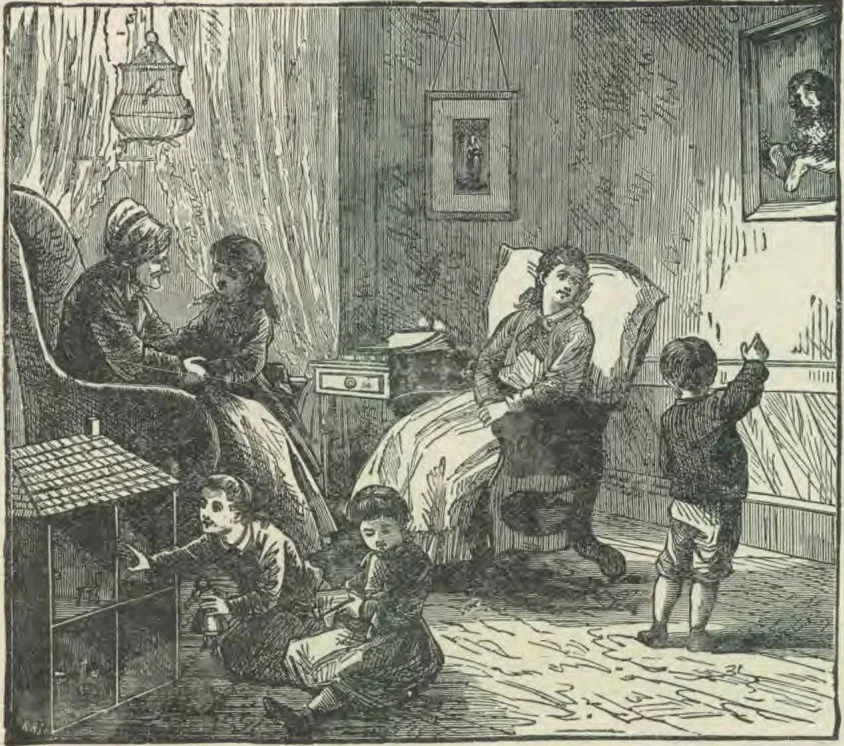
“I like to play over here,” said Lottie Brown to her little friend Carrie one day; “you always have good times at your house.”
“Don’t you always have good times at your house?” asked Carrie, looking at her friend in surprise.
“No, we don’t,” said Lottie, putting her doll on the sofa in the doll-house; “that is, not always.”
“I wonder what makes the difference,” said Carrie.
Lottie had often wondered about that herself. If we should take a peep through the doors when the little people did not know we were looking, do you suppose we could find out?
If you had looked through the door at the breakfast room in Lottie Brown’s house this morning, this is what you would have seen. A little girl with her shoes unbuttoned, her apron-strings untied, and her hair uncombed. She had a great scowl on her forehead, and a whine in her voice, and she didn’t see why she couldn’t have hot cakes and honey instead of that “horrid” brown bread and milk. Anyhow, mamma never would let her have anything good. There were rosy-cheeked peaches, to be sure, but she didn’t want peaches that morning, she wanted cucumbers.
Half an hour later you would have heard this same little girl say to her brother Tom, as he lay stretched out in the hammock, reading a story book, “Tom, get out of that hammock; I want to swing with my doll.”
And Tom replied very gruffly, “I’ve just as good a right here as you have; and I won’t get out till I please.”
Then Lottie grew angry, and said boys were just “too hateful for anything,” and that “Tom never would do anything she wanted him to.”
By and by, if you had looked through the vines that shaded the wide veranda, you would have seen Lottie bouncing a fine rubber ball; and pretty soon you would have heard Tom say, “That’s my ball; give it here. Girls are always meddling.”
In the breakfast room at Carrie’s house, three sunny faces appeared at the table, and three little people ate their bread and milk contentedly, and thought it very good fare.
About an hour later you might have heard a little voice on the play-ground cry, “O Georgie! I want to roll that hoop!” and another voice reply, “Well, so do I.” “You’ve rolled it twice,” said the first voice. “Well,” said the second, “we’ll take turns. You can roll it down to the gate and back, and then I will.”
By and by a voice called from the house—it was mamma’s voice—“Georgie, I want a pail of water.” Georgie was making a sand house just then, molding it over his bare brown foot, and he didn’t want to spoil it. He had his mouth opened to say, “I don’t want to;” but he happened to remember how mamma left her things to help him—just that morning she had left the bread to help him hunt his hat when Anna was going off without him;—so he changed his cross words to a pleasant, “All right; I’m coming.”
If you had stayed there all day, you would have seen clouds gather sometimes on the young faces, and you would have expected a storm; but somehow the sunshine always came from somewhere, and drove the clouds away before any rain had a chance to fall.
Now I wonder if you can tell why they had “good times” over at Carrie’s house, and didn’t have them at Lottie’s? Wasn’t it because each one tried to please others instead of himself?
I remember what a white-haired old man once said to us children when we went to him to settle a dispute. With a twinkle in his kindly blue eyes, he said, “My dears, you must always keep two bears in the house, and then you will never have any quarrels.” We looked at him in open-eyed astonishment, while visions of brown and white bears such as we had seen dancing in the streets rose before our eyes. “Their names are Bear and Forbear,” he added, “and no house can be happy without them.” W. E. L.
Letter Budget.
Here is a letter from Caledonia Co., Vt., written by Lottie C. Dodge. It says: “I love to read the Budget so well I thought I would write a letter too, and tell you about my Sabbath-school. We have fourteen members. I go nearly every Sabbath, and am nearly through Book No. 1. I have learned the names of the books of both the Old and the New Testaments, the number of chapters in each, the ten commandments, and many other useful things, all in less than a year. I am seven years old. My father died, leaving seven of us to be cared for by others. I have found a good papa and mamma to live with, and have been here most a year. They are teaching me to be a good girl. The rest of my friends do not keep the Sabbath. I am trying to be good, and to learn to be useful. I have finished the second reader, and have a third for the fall term. I also study spelling and arithmetic. My school and Sabbath-school are both near, and I love to go to both. I send my love to all, and hope we may all meet in God’s kingdom.”
Maud K. H. Baker, of Tioga Co., Pa., writes: “I see so many little girls are writing to the Budget, I thought I would write too. I love to read the YOUTH’S INSTRUCTOR. I am a little girl eleven years old. I have kept the Sabbath some time, although my papa and mamma do not keep it. I really believe my mamma thinks the seventh day is the Sabbath of the Lord. We have quite a large Sabbath-school, and I have missed only one Sabbath since it was organized. We expect Eld. K. C. Russell will preach to us again as soon as the tent season is over. I have two little brothers, Freddie, six years old, and Josie, four years old. They like to go to Sabbath-school. I will tell you about my pets the next time I write. I don’t like the expression, ‘Meet you all in the new earth’ so well as, ‘Meet you all in heaven;’ for wouldn’t any place be heaven where Jesus is? I would like to correspond with some of the little girls about my age.”
Charlie Stover sends a letter from Custer Co., Colo. He writes: “I am fourteen years old. I go to Sabbath-school, and like to go. I take the INSTRUCTOR, and like to read it. I have three brothers and two sisters, all older than I am. I want to live right, so I can stand on the sea of glass, and have a harp in my hand. I want to meet the INSTRUCTOR family in the new earth.”
Emma Green, of Wautaga Co., N. C., writes as follows to the Budget: “I am thirteen years old and attend Sabbath-school regularly. I have a little sister who goes with mamma and me. My only brother died in 1887. We all keep the Sabbath but pa, and I want you all to pray that he may too. I am secretary of the Sabbath-school. I send love to the INSTRUCTOR family, and hope to meet them all in heaven.”
Lula Lowry sends a letter from Napa Co., Cal. She writes: “I have read so many nice letters in the Budget from little girls that I am glad I can acknowledge that I keep the Sabbath. I want to keep all the commandments of God, grow better each day that I live, and be saved when Jesus comes. I am twelve years old. I intend to earn money to give to the Lord by raising chickens.”
Etta McReynolds, of Wilson Co., Kansas, says: “I am twelve years old. I have three brothers, but no sisters. We attend two Sabbath-schools every Sabbath. We go seven miles in the forenoon to Sabbath-school, and two miles in the afternoon. I study in Book No. 5. Pa is a minister, and is away from home nearly all the time. My uncle and aunt live in one part of our home, and grandma lives with us. We have a patch of missionary melons, and some of them are almost ripe. I was baptized a year ago last fall, and am trying to be a good girl, so that I can meet you in the new earth.”
“ONLY FIVE MINUTES.”
“Tom, you’ve been stopping on the way,” said a poor widow to her son, as he gave her the article he had been sent for. “Why don’t you come straight home when you know that my time is so precious?”
“I did so, mother, until I got to Mr. Gaskill’s, and then I stayed to have a look through the window for only five minutes,” replied Tom.
“Only five minutes,” repeated his mother, “means a great deal when you come to reckon them all up.”
Tom Price looked at his mother as if he had not understood her.
“Just reach down your slate,” she added, “and then you’ll see what I mean.”
Tom had his slate on his knee in a twinkling. “What am I to put down, mother?”
“Well, begin with five, and tell me how many minutes you waste in a day.”
Tom wrote the figures, and scratched his head, and looked into the fire.
“Do you think thirty would be too many?” asked his mother.
Tom did not think so.
“Very well,” continued Mrs. Price, “there are three hundred and sixty-five days in a year; and half an hour for each day gives you a total of one hundred and eighty-two and a half hours, or upward of fifteen days of twelve hours each lost in twelve months.”
Tom put his pencil between his lips, and stared at the sum before him.
“Suppose you put down two hours for each day, instead of thirty minutes,” said his mother. “That will show a loss of more than sixty days in the year.”
“So it does, mother,” said Tom, reluctantly.
“But when I send you for anything I want, and you stay loitering in the street, my time has to be reckoned up as well as yours, hasn’t it?”
Of course Tom could not deny that.
“Then try and remember,” she said, “what a serious loss even five minutes is to me. You know, my boy, how very hard I have to work to pay rent, buy bread, and keep you at school; so you should try to help, rather than hinder, your poor mother.”
“I’ll run all the way the next time I go,” said Tom.
“No, no; I don’t want you to do that. I only want you to bear in mind that our lives are made up of those same minutes, and that we cannot afford to throw them away just as we please.”
Like a sensible little fellow, Tom Price took his mother’s lesson to heart; and it was a long, long time before he was again heard to use the words, “Only five minutes.”
Let our readers remember the value of precious time, so as to improve it to the best advantage. And let them remember that to help in this, as in every other duty, we need God’s grace; and this we shall receive if we ask in the name of Christ. He only can “so teach us to number our days that we may apply our hearts unto wisdom.”—Young Reaper.
SEPTEMBER
SEPTEMBER'S a jolly good fellow,
His great horn of plenty he'll fill,
And pour on the earth all its treasures,
With generous, hearty good-will.
Pears, apples, and plums, mellow peaches,
And grapes of both purple and white,
Fall round us in brilliant showers,
That fill every heart with delight.
No wonder we welcome September;
We wish that he longer would stay,
And not hurry off on his journey,
But linger for many a day.