The Youth’s Instructor, Vol. 34, No. 47.

A HYMN OF THE SEA

The Youth’s Instructor

Nov 24, 1886

S. D. A. Publishing Association · Battle Creek, Mich. · Nov 24, 1886

A HYMN OF THE SEA.

The sea is mighty, but a mightier sways His restless billows. Thou whose hands have scooped His boundless gulfs and built his shore, thy breath, That moved in the beginning o'er his face, Moves o'er it evermore. The obedient waves To its strong motion roll, and rise and fall. Still from that realm of rain thy cloud goes up, As at the first, to water the great earth, And keep her valleys green. A hundred realms Watch its broad shadow warping on the wind, And in the dropping shower, with gladness hear Thy promise of the harvest. I look forth Over the boundless blue, where joyously The bright crests of innumerable waves Glance to the sun at once, as when the hands Of a great multitude are upward flung In acclamation. I behold the ships Gliding from cape to cape, from isle to isle, Or stemming toward far lands, or hastening home From the Old World. It is thy friendly breeze That bears them, with the riches of the land, And treasure of dear lives, till, in the port, The shouting seaman climbs and furls the sail.
These restless surges eat away the shores Of earth's old continents; the fertile plain Welters in shallows, headlands crumble down, And the tide drifts the sea-sand in the streets Of the drowned city. Thou, meanwhile, afar In the green chambers of the middle sea, Where broadest spread the waters and the line Sinks deepest, while no eye beholds thy work; Creator! thou dost teach the coral-worm To lay his mighty reefs. From age to age, He builds beneath the waters, till, at last, His bulwarks overtop the brine, and check The long wave rolling from the southern pole To break upon Japan. Thou bidd'st the fires, That smoulder under ocean, heave on high The new-made mountains, and uplift their peaks, A place of refuge for the storm-driven bird. The birds and wafting billows plant the rifts With herb and tree; sweet fountains gush; sweet airs Ripple the living lakes that, fringed with flowers, Are gathered in the hollows. Thou dost look On thy creation and pronounce it good. Its valleys, glorious in their summer green, Praise thee in silent beauty, and its woods, Swept by the murmuring winds of ocean, join The murmuring shore in a perpetual hymn. —William Cullen Bryant.

NEW YORK HARBOR.

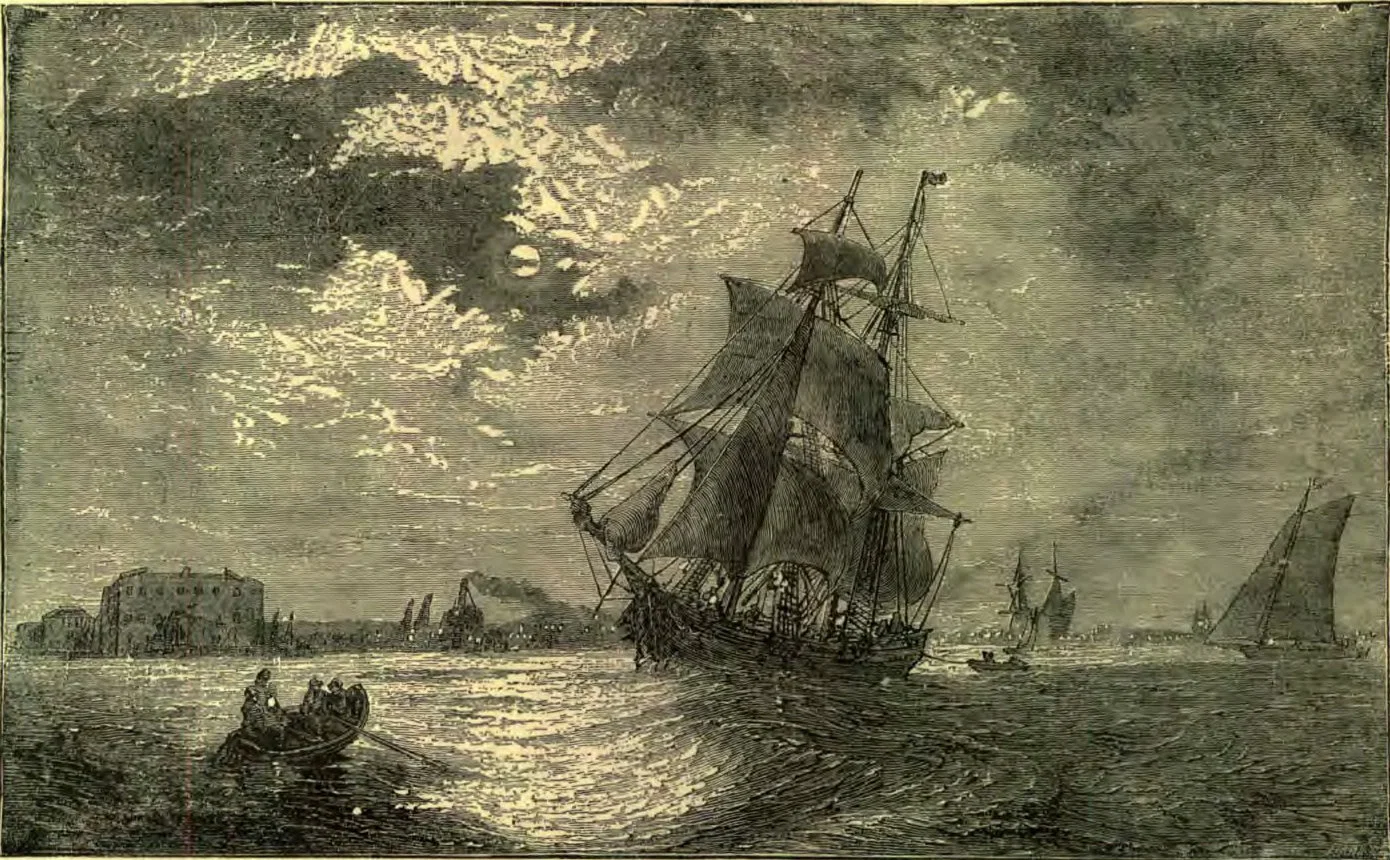
NEW YORK harbor is one of the finest and most commodious in the world. The bar, at Sandy Hook, is eighteen miles from the city, and has two channels capable of admitting ships of the heaviest draft into the lower bay. This bay is from nine to twelve miles wide, and affords a safe anchorage. It is connected with the upper, or New York Bay by the Narrows, which is the channel between Staten Island and Long Island, and has well-manned and well-stocked forts on either side, to protect us from the invasions of foreign foes.
New York Bay is of an irregular oval shape, about eight miles by five, extending eastward into Newark Bay and northward into the Hudson River. It is really the port of three cities,—Jersey City, New York, and Brooklyn. The Hudson and East Rivers, which, like two great arteries throbbing with life, separate the cities, afford, with their long line of wharves on either side, accommodations for fleets of vessels. And the forests of masts, with different flags flying at their tops, show that they are utilized by the shipping of all nations.
The scenery at the entrance of the harbor is picturesque and striking. On one side is the low, sandy coast of Long Island; in contrast, on the other side are the hills, rising higher and higher till they fade away into the blue distance, while in the foreground the islands, clothed with verdure, seem like emeralds in silver setting.
The harbor itself presents an ever-shifting panorama. Here are the ships of the Indies, bringing the products of the tropics; the stout-ribbed whalers from the Arctic seas; iron-clad frigates, representing the navies of the world; the grand ocean steamers; the graceful yachts of the millionaires, alongside the humble crafts of the oystermen and clam-diggers of Long Island Sound. The ferry boats glide in and out of their slips, their decks black with human freight, while the schooners and tugs cross and recross their track; whistles shriek, and signals are given, making a scene of confusion and bustle not unlike busy Broadway. The wonder is that there are so few collisions. The tide rises to about five feet, and that, in its swift and ceaseless ebb and flow, adds its share to the variety. Everything seems to be in a hurry here, even Nature herself.
At the docks the ponderous merchantmen are loading and discharging their cargoes. Accompanied by a friend, I visited some of the docks this morning to find something to interest the readers of the INSTRUCTOR. We saw one Portuguese ship unloading salt. It was a kind of rock salt used here in packing fish and in freezing ice-cream. When once begun, the unloading proceeds rapidly. The salt was hoisted by means of horse power to the deck, where it was weighed, and then pounded down through a wooden spout into the carts waiting on the wharf, and then drawn away to the warehouses near by.
When a ship approaches the coast, she signals for a pilot, and usually has not long to wait; for the pilot boats are constantly cruising in the offing. The pilot brings the ship over the bar and into the lower bay, where a tug boat takes her in charge, and tows her up through the Narrows to the city, so that in a few hours after taking on the pilot, the ship is safe at her moorings at the wharf, where her owner or agent meets her, and the preparations for discharging her cargo immediately begin.
There is a duty, or Government tax, on all foreign goods, so that at each warehouse a revenue officer is stationed, to see that all U. S. claims are paid before the goods are delivered to the consignee. And a sharp lookout is kept on each vessel from the time she reaches Sandy Hook till the claims are satisfied.
A lot of raw sugar from Cuba had just been unloaded on one dock. An inspector was grading it, and another officer was weighing the hogshead, while farther out on the wharf the ’longshoremen were shoveling it into the barrel. It had yet to go through the refining process here; nevertheless it did look rather queer to see one laborer up in the hogshead with his boots on, packing the sugar down with his feet. Afterwards the hogsheads were drawn to the immense storehouse near, and by means of an engine and tackle were hoisted to the fourth floor.
Brooklyn has most of the storehouses of the three cities, and it well repays the visitor to go there. One gets a better idea of the vastness and variety of our commerce. The floors are marred by contact with the freight from all parts of the habitable globe. Spices and fragrant oils, tropical fruit and beverages, dye stuffs and drugs, perfume the air, till one feels as if in a foreign clime, and the old hymn,—
“What though the spicy breezes Blow soft o'er Ceylon's isle,”
comes involuntarily to the mind.
But if ships arrive laden with comforts and luxuries for us, they also depart, carrying to other ports the products of our own well-favored land. One was loading with grain. They have what struck me as an odd contrivance for transferring grain from the cars to the vessels. It is in reality a tall, narrow house, built upon a flat boat; and it looks ready to topple over every minute. It is furnished with buckets fastened to an endless belt, which pour the grain over the ships' sides through an iron tube to the lower hold, where men stand ready with bags to catch it as it comes through. Each bag, when filled, is sewed up and tucked snugly away in as small a space as possible, for ballast.
The great ocean steamers do not require much more ballast than their vast coal bunkers afford. The large steamship, City of Rome, burns 265 tons daily; and the Umbria has seventy-two furnaces, which daily burn 340 tons of coal. One hundred and four men are employed to run the furnaces of the Umbria. If the coal and passengers' baggage are still insufficient ballast, other cargo is taken on.
All night the harbor is brilliant. Each ferry house has its cluster of lights. These, mingling with the thousand twinkling ones of the city and the shipping, together with the flashing string of electric lights from the Brooklyn bridge, overarching all on the one side, and Liberty's beacon sending out its powerful rays on the other, forms a picture which is indeed like a dream of fairyland. L. E. ORTON.

Making Chances Instead of Waiting for Luck

WHILE ten men watch for chances, one man makes chances; while ten men wait for something to turn up, one turns up something. So while ten fail, one succeeds, and is a man of luck, the favorite of fortune. There is no luck like pluck, and fortune most favors those who are most indifferent to fortune.

CORA'S LOSS AND GAIN.

CORA MAYNARD was on her way to church, in her pretty new outfit. She felt very well satisfied with herself, perhaps a good deal too much so. As she passed some plain-looking houses, she could see through the open windows people passing to and fro, and Cora's bright face put on a severe look: “Aren't they wicked, mamma,” she said, “to be staying at home instead of going to church? God will be angry with them.”
“O, I don't know, little daughter,” answered the mother softly; “we must confess our own sins to-day, and let our neighbors' faults alone.”
But Cora, secure in her self-righteousness, hardly heard the gentle reproof.
After the hour of worship was over, as mother and daughter were walking home together, Cora exclaimed: “O mother, I had such a bright thought in church! I happened to look across the aisle at Betty Cane, and saw that she had her old brown dress turned, and made up with a striped under-skirt, and it looked ever so nice. Wouldn't that be a good way to do my blue, mother?”
But there was no response to Cora's enthusiastic proposal; a look, half amused, half distressed, passed over the mother's calm face, and after a silence which made the little girl look up in surprise, she said gravely:—
“Daughter, when our Lord came to his earthly temple in Jerusalem, he was very angry to find it made a place of bargain and sale and merchandise. He stood beside you to-day; was he pleased, do you think, to find you planning how to make over your dress? Was it not, in his pure sight, just the same as if you were at work on it with needle and thread?”
Cora's face fell; tears of mortification, and I trust of repentance, gathered in her eyes. They were now passing the houses whose dwellers she had so severely condemned for not going to church. “It was not the people who stayed away from the temple against whom his anger was turned,” continued the mother, remembering the morning's criticism, “but those who went up to his courts, and took with them their worldly cares and business.”
And the rest of the walk home was in silence. Afterward Cora confessed that she often made plans in church, and asked her mother what she must do to prevent her mind from wandering to such subjects.
“I can give you a certain cure,” was the reply, “if you are brave enough to adopt it: resolve never to carry out any plan for your own advancement which you make in church! Nothing will teach you such carefulness of thought as losing the advantage of these unlawful plans.”
After a hard struggle, Cora resolved to take this advice. She lost the blue and striped suit, and many another little device, at first; but having set self-interest to watch the door of her mind with conscience, she soon learned quickly to challenge and refuse entrance to forbidden subjects, and the result, through long years of Sabbaths, has been a sweet and blessed one. You can tell by the bright, sweet face, no longer a little girl's face now, that for her, indeed, “the Lord is in his holy temple.”—E. P. Allan.

HOW PHOTOGRAPHS ARE MADE.

WHAT child does not like to see its own face in a picture? Indeed, quite large children are often pleased with the same thing. It may not be wrong to have your picture taken occasionally, but a large amount of money is often foolishly thrown away in this manner. But let us find out how our pictures are now taken.
Photography means to write by light. This way of taking pictures was unknown until the present century. It is one of the most wonderful things that has ever been invented. Let us go into a gallery and see how it is done. After arranging your toilet to suit you, you are seated by the artist in a light room. A few feet in front of you is an instrument something larger than a child's high chair, with a dark cloth thrown over it. This is called the camera. If you look carefully, you will see a tube about three inches in diameter, with a glass in each end; on the end opposite you is a small pane of glass, called the focus-glass. This the artist arranges until he sees your image exactly on that focus. Then he goes into a dark room, where he has another small piece of glass, about the size of an ordinary hymn-book. This is prepared with a chemical coating that looks like paste or the white of an egg spread on glass. This is called a dry plate. He brings this out, closely covered up to keep it from the light. The focus-glass in the camera is now removed, and this glass is put exactly where the focus-glass was placed; it must not vary in the least from it, and the glass must be kept in the dark all the time. Now, having arranged this glass, and being sure that you are seated just right, and that the expression of your face is right, he removes a little cap from the end of the tube towards you, and in a flash, your image is formed by the light on the glass.
How long does it take to thus get your image? Only a second. Suppose you have a mirror before you, covered up with a cloth; if some person suddenly removes that cloth, how long does it take for you to see your face in the mirror? It is there instantly. Just as quick as your image is formed in taking your photograph, the artist immediately covers the glass up, and carries it back into the dark again. It must carefully be kept from the light, or else it would be spoiled. In this dark room he has certain chemicals by which he further develops the picture on the glass. Then he washes it, and dries it.
After this, he places it in a certain frame he has, and with a pencil, he touches up the image, so as to bring out every thing distinctly. This image on the glass is called the negative. From this, all the pictures are made. The largest share of the work is done in preparing this negative. If it is good, there is little difficulty in getting a good picture afterward. This negative can be used almost indefinitely. It can be kept for years and will be just as good. After the negative is made, the artist has a prepared piece of paper on which to take a real picture. This is albumen paper, and comes in sheets like a newspaper. Before it is used, the artist has to prepare it still further with a silver preparation. Then he cuts it up with shears into whatever size he wishes. This prepared paper is now laid over the negative, and is pressed closely and smoothly down upon it, in a frame. Then it is set in the sun from one to three minutes. The light, passing through the negative, changes the paper, and so forms the picture on it. How it does that, it would be hard to tell, but we know that it is so. After this, the paper is taken out, and goes through what is called the toning process, in a certain liquid prepared with gold. Then, with another mixture, it is washed, and this fixes the picture. After this, it is again washed for several hours in water. Now it is brought out and pasted on a card of the proper size. After it is dry, it is burnished, or polished, in a very beautiful machine called a burnisher. It looks and works just like a clothes-wringer.
Great improvements are taking place in this art every year. They have now invented a process by which a man can carry in his vest, or in his hat, a little camera, no larger than a button. While talking with a man, you can pull a little string attached to it, and instantly have his photograph, while he does not know a word about it. Isn't that wonderful? They have another one, by which they can take the picture of a bird, while flying, of a horse while running, or of anything in motion.
It does not require a large capital to carry on an ordinary business in this art. From five hundred to fifteen hundred dollars does very well. But for some people it is not healthful. It requires a special gift, an artistic taste, to succeed first rate in the business.
D. M. CANRIGHT.

THE COURSE TAKEN BY MAORIS WHEN WRONGED.

WHENEVER the Maoris think that they are treated with abuse, or that some one has trampled upon their rights, they hold a general council. They have their ideas of right and wrong, and not infrequently they consider themselves abused when they are called upon to pay a tax to the government. Many things, common among Europeans, but which they do not fully understand, they consider an infringement upon their rights. When a council is called, the news soon spreads, and sometimes they will come for hundreds of miles to attend it. As they come together, they first sit down and cross their hands in front of them, under their legs. Thus they will sit for hours, and even days, and during this time they manifest no undue excitement. After a time one of their number rises to make a speech. A path is made for him through their midst, in which he walks as he pours forth his bitterness toward those who they think have injured them. When a man is standing, they think that his anger rises, and just the opposite when he is sitting, consequently they are always calm when seated. The speaker talks only when he walks from the place whence he started, and he returns to it in silent meditation. Thus he continues to walk back and forth, his anger rising higher and higher each time he walks out, but cooling as he comes back to the starting point. When he has finished, another rises to speak, going through the same performance. Sometimes these councils hold for days, and sometimes for weeks, after which the people return to their homes, and this is usually the end of the trouble.
If a white man should chance to pass by during the council, they will invite him to take a seat in the most honorable position, and listen. Nothing will be said to him personally if he does not interfere with their harangue, but should he disturb them in the least, there would be trouble, resulting perhaps in war. He may sit, however, and listen to their speeches as long as he pleases, and they will treat him kindly and with respect. If all are sitting, they will converse with him; but should he interfere with their proceedings they would all rise, and then trouble might at once be expected, even though there should be but little reason for it. These customs, like many others which formerly prevailed, are becoming greatly modified at the present time. S. N. HASKELL.

SHORT STEPS, AND STEPS UP.

You saw him a year ago. When you met him to-day you wondered at the growth of your old schoolmate, not physically alone, but mentally and spiritually also.
A secret in your ear:—
Your old school-fellow took a short step every day, and it was always a step up. Each day he acquired more than he lost, learning some new thing in history, or travels, or arithmetic, or grammar, or geography. It was not a long stride he took, but a short step. He also put his foot on some temptation each day and made that a step by which to rise higher. For one year lay one stone step a foot higher daily, and tell us how high and grand a stairway you can build in the twelve months! All accomplished through that rule, a step each day, and always a step up. Who will try it and keep at it, ever stepping up?

NEVER FRET

I HAVE a rule to give you about fretting and grumbling—a very short rule, which it is worth your while to remember if you want to cultivate contentment: Never fret about what you cannot help, because it will not do any good. Never fret about what you can help, because if you can help it, do so.
When you are tempted to grumble about anything, ask yourself, “Can I help this?” and if you cannot, do not fret; but if you can help it, do so, and see how much better you will feel.

PARABLES OF CHRIST.

LESSON 11.—THE LABORERS IN THE VINEYARD.

1. How did our Lord introduce the parable of the laborers? Matt. 20:1.
2. How much did the householder agree to pay the laborers that began early in the morning? Verse 2.
3. At what time did he hire other laborers? Verse 3.
4. What agreement did he make with them? Vr. 4.
5. When, and with what understanding, did he hire still others? Verse 5.
6. What did he find, when he went out at the eleventh hour? Verse 6.
7. What did he say to them? Same verse.
8. What excuse did the men make for being idle? Verse 7.
9. What did the master then say to them? Same verse.
10. What order was given at evening? Verse 8.
11. How much was paid to those that were hired at the eleventh hour? Verse 9.
12. What did the others expect, when they saw how generous the master was with their fellow-laborers? Verse 10.
13. How were they disappointed? Same verse.
14. What complaint did they make? Verses 11, 12.
15. How did the master justify himself to one of these complainers? Verse 13.
16. What did he tell the laborer to do? Verse 14.
17. What questions did he ask the dissatisfied man? Verse 15.
18. When Jesus had finished the parable, what principle did he lay down? Verse 16.
19. What seems to have called out the parable of the laborers?—It was probably the conversation with the rich young man who could not give up his worldly possessions for the sake of being saved.
20. What question did this young man ask the Saviour? Matt. 19:16.
21. What did Jesus tell him he must do? Verse 17.
22. What inquiry did the young man then make? Verse 18.
23. Which of the ten commandments did our Lord then mention? Verses 18, 19.
24. What reply did the young man then make? Verse 20.
25. What did Jesus tell him was still necessary for him to do in order to have treasure in heaven? Verse 21.
26. How did the young man receive this instruction? Verse 22.
27. What remark did Jesus then make? Verse 23.
28. What anxiety did Peter manifest? Verse 27.
29. What assurance did the Saviour give him? Verses 28, 29.
30. How did he then illustrate the saying, “Many that are first shall be last, and the last shall be first”? Chapter 20:1-16.
31. What makes labor valuable in the sight of God?—Not the time and strength it requires, but the love and faith that actuate it.

NOTE.

“The householder thus made the first last, and the last first, because the first had been working for hire, while the others had simply trusted his promise. He who works in my kingdom for the sake of a reward hereafter, may do his work well, but he honors me less than others who trust in me, without thinking of future gain. The spirit in which you labor for me gives your service its value. He who is called late in life, and serves me unselfishly, will stand higher at the great day than he who has served me longer, but with a less noble motive. Many are called to join my kingdom and work in it, but few show themselves by their spirit and zeal especially worthy of honor. If the first find themselves last, it will depend on themselves, for though no one can claim reward as his due in the kingdom of God, yet I give it, of favor, to those first who serve me most purely. He, I repeat, who works most devotedly, without thought of reward, will be first, though, perhaps, last to be called: he will be chosen to honor, while others less zealous and loving, though earlier called, will remain undistinguished.”
—Paraphrase, by Dr. Cunningham Geikie.

Facing Class Responsibilities Through Prayer at Peniel

If you dread the responsibilities that meet you in your class, as Jacob dreaded the meeting with Esau, tarry along at the Peniel of prayer and look into God’s face, and your heart shall grow strong for your work.

Boyhood of Horace Greeley.

To be able to maintain self-control under irritating circumstances is indicative of a strong mind; and it is noticeable that those persons who distinguish themselves in the more noble enterprises, in which they have to battle for the right, usually possess that virtue, which is a hint for the young to learn to rule the spirit. In the person of Horace Greeley, the famous journalist, author, and humanitarian, is a worthy example, which is well set forth in the following clipping from an exchange:—
“Horace Greeley was born of poor, but respectable parents, and at a very early age showed a remarkable fondness for books. Before he was six years old, he had read the Bible and “Pilgrim’s Progress” through, and as the years went by, he continued to read every book he could buy or borrow.
“From his earliest childhood he had purposed learning the trade of a printer, and at fourteen his long-cherished desire was fulfilled.
“Noticing in a newspaper that an apprentice was wanted at a printing office eleven miles distant, he started on foot to try to secure the situation. In spite of his laggard appearance and squeaky voice, he was hired on trial, and at once went to work. The first day he was permitted to work unmolested, but the second morning dawned with the boys bent on compelling him to talk. They called him the tow-headed Yankee, and asked him if he had not pulled his trousers a season too soon; but Horace kept on with his work, determined to pay no attention to their saucy remarks.
“On the third day an apprentice took a sponge that had been saturated with inky water, and with a remark about dyeing the new boy’s hair, rubbed it over his head.
“The men in the office quit their work to witness the fight, which they supposed inevitable; but Horace never turned from his work, nor did he leave his type-setting until he had finished the article upon which he was engaged. He then went out without uttering a word, and spent an hour in washing the ink from his hair. When thoroughly cleansed, he returned to his desk and took up his work, as though nothing unusual had occurred.
“The boys were baffled, and afterwards treated him more kindly. Indeed, they considered him more of a hero than if he had retaliated as they had expected.
“During all his successful life thereafter, this magnificent power of self-control under exasperating circumstances, proved to be his strong point of character.
“Another trait, that boys of to-day would do well to imitate, was his fixed determination to keep out of debt. He was often annoyed by foolish remarks concerning his poor clothes, but his answer always was, ‘I guess I’d better wear my old clothes than run in debt for new ones.’
“No doubt his bravery in standing up for the right in his youth, made him strong for the battles against wrong and oppression, that he so nobly fought in later years.”

CURIOSITIES OF EASTER ISLAND.

In a late number of the Christian Weekly is an illustrated article showing some of the curious statues found on Easter Island, the farthest east of the South Pacific Islands. The island and strange statues are thus described:—
“The native name of Easter Island is Rapa-Nui, and it has at present a population of about 200. Before 1862, when the Peruvians were guilty of atrociously kidnapping a large number of the people, it was three times that number.
“The fame of this island, which is described in Cook’s ‘Voyages,’ rests upon the gigantic statues which are to be found upon it. Some of them are placed in groups upon what our author calls ‘well-built maraes.’ Others are single, fixed in the earth. They are cut out of solid gray stone. Some of them wear stone pare, or crowns, of a red color. An Easter Islander assured Mr. Gill that these statues had not been worshiped within the memory of any persons now living. Small wooden representations of the human form frequently to be met with were, however, worshiped until a recent date. The author describes one of these wooden idols as being 22 inches by 5½, well carved, the pupils of the eyes of black obsidian, which is abundant on Easter Island, the iris of fishbone, and the hair of a decidedly Egyptian style.
“The native tradition of the origin of the stone statues, which is quite romantic, is as follows:—
“Long ago there lived on Rapa-Nui a famous artisan named Tukoio. He was also a magician. His sole delight was to carve in stone. His tools were merely sharp stone adzes like those now in existence, only larger and stronger. When any of these statues were completed, Tukoio would order them to travel to the sites where they now are. They at once obeyed, but on their way some of them, having had the misfortune to stumble and fall, were never able to rise again. The office assigned to these gods was to guard the island against the intrusion of strangers and the violence of the ocean. To this day they are known collectively as ‘the Stones of Tukoio’ (Moai na Tukoio). Each statue has a separate name. The magician who made them was deified after his death on account of his wondrous skill and might.”

DESTRUCTION OF SONG BIRDS.

It is hardly possible to imagine what a gloomy place this earth would be should all the song birds suddenly be stricken out of it. Without their enlivening strains the fields and woods would be robbed of more than half their charms. Nevertheless, it is true, so says Mr. Oliver Davis, the naturalist and author, that their destruction by small boys is really becoming very alarming. He states the case thus:—
“I have noticed with apprehension, all during the past summer, that the song birds are becoming more scarce every day. A few weeks ago I walked along the bank of the Olentangy, and was far out before the song birds appeared. I was then thoroughly disgusted with the sight of scores of boys along the river bank, shooting every specimen of the feathery tribe that came within range of their guns.
“Parties of three to six were scattered about, shooting robins, catbirds, Maryland yellow throats, jay-birds, warblers, and sparrows. The bank of the river along the paths was strewn with numbers of these birds, which had been destroyed for no object whatever except to gratify the morbid curiosity of a lot of boys.
“The birds are disappearing from our parks and suburbs, and soon none will be left but the bothersome English sparrow. The law imposes a severe penalty, allowing such birds to be killed only for scientific purposes, and it is hoped some steps will be taken for its enforcement.
“The main thing which is contributing so much to the destruction of our song birds is the rapidly increasing use of small rifles. Every neighborhood has several of these, and on Saturday and Sunday the boys amuse themselves in the woods shooting birds.
“Many of them by constant use become expert shots, and play great havoc among our small birds. I hope something will be done soon to prevent this wholesale slaughter of our songsters before it goes much farther.”
If any of the INSTRUCTOR boys wantonly take part in this cruel work, we hope their reverence for God’s great temple will cause them to refrain from defacing it, or of robbing it of any of its charms.

AN AMUSING CLOCK.

For the last few hundred years Genius has taxed her wits to the utmost in trying to invent something curious and wonderful in the line of clocks. That she has succeeded admirably in her attempts, the readers of the INSTRUCTOR have proof in descriptions of her inventions given now and then through their paper. But among all the curious time-pieces, perhaps none more amusing was ever made than one by a man named Droz, about a hundred years ago. An exchange has said of it:—
“When it was completed, the proud inventor carried it to the palace of the King of Spain. His majesty was pleased to examine the clock, which, when set up ready for exhibition, was found to consist of a dial beside which sat a negro, a shepherd with a basket of apples by his side, and a dog. When the hour struck, the negro drew his bow and played six tunes on a violin, after which the dog, endowed with a taste for music, rose and caressed him.
“‘Should it please your majesty to touch one of the apples in the shepherd’s basket?’ suggested the clock-maker. The King put out his hand to take an apple. Determined to protect his master’s property, the dog flew at the royal hand, biting and barking until a ‘really truly’ dog in the room took up the strain and began to bark too. The king laughed heartily, and so I think we would have done too, had we been there to see.”

PUNCTUATION

WHEN punctuation was first invented, or rather, when it was first adopted, no absolute date can be given: but it is certain that printing had been for several years in existence before any regular system of punctuating came into use. A straight stroke passed obliquely through the line indicated a pause, and a full point closed a paragraph. A colon was occasionally introduced, and the “Lactantius,” printed at Subiaco in 1465 (the first book printed in Italy), has a full point, colon, and note of interrogation. Improvements by one printer were not, however, directly followed by others, and it was not until about the year 1470 that we approached to our present-day mode of punctuation. The first book printed in France—the “Liber Epistolarum” of Gasparinus Barzizius, produced by three Germans, Crantz, Gering, and Freiburger—contains the full point, semicolon, comma, parenthesis, note of interrogation, and note of exclamation. In it the semicolon appears to have more force than the full point, for, while it is often reversed indiscriminately, with the full point in the middle or at the end of a sentence, it is alone used at the end of a chapter, or of a heading to a chapter, and then turned as we use it now. The colon in this book is absent.—Golden Days.

The Tartarian Lamb Fern of China

A FERN grows in China which bears such a resemblance to a lamb, that the English call it the Tartarian lamb fern. It is covered with a thick, soft, vegetable wool, of a yellow color. The main stem lies flat, a short distance above the ground, while the hanging stems touching the earth look like little legs supporting it. Covered with this vegetable wool, the likeness to a lamb is quite curious.

THE TOUCAN.

“Oh,” you will say at once when you look at the picture, “what a great bill this bird has!” It looks as if he had borrowed some other bird’s bill, “doesn’t it?” and you wonder if his head does not ache with carrying it around.
But really his bill is very light, so that it gives him no trouble. It is made of a horny substance, but little thicker than the paper your INSTRUCTOR is printed on. To keep it in shape and give it strength, the inside is filled with a vast number of honeycomb-shaped cells. This great bill is gaily colored, to match the feathers on the bird. But after he has been dead awhile, these colors all fade out, so you would never imagine how gay he had been.
If you think any sweet music comes from this bird’s great mouth, you are very much mistaken. He makes a wretched noise, that sounds as if he were trying to talk.
These birds love to sit in great flocks on the branches of the trees, leaving one of their number on guard. Then they all clatter their beaks together, and shout hoarsely. On account of this, the people where they live call them preacher-birds. Sometimes the whole of them set up such a yelling all at once that they can be heard for a mile around. When the bird they have posted on guard sees any danger, he gives a queer cry that sounds like “tucano;” and so the birds are called the toucans.
If you look at the picture, you will see that the foot of the toucan is different from that of many other birds. It has two toes in front and two behind. It is this kind of foot that helps the wood-pecker to run so swiftly up an old tree, and not fall off. The toucan is a great climber. He is not a good flier, but he can hop swiftly and gracefully from branch to branch among the trees.
But the toucan looks the oddest when he goes to sleep. He packs himself up nicely, putting his great bill over on his back to support it. Then he turns his tail square up over his bill, just as he would if it were fastened on with a hinge. Now his gay bill is completely hidden, and he looks like a great ball of loose feathers thrown up on a branch.
But I have not told you where the toucan lives. He is an American bird, and has his home in the hot country of the tropics. W. E. L.
Continue reading: A POOR LITTLE THIEF