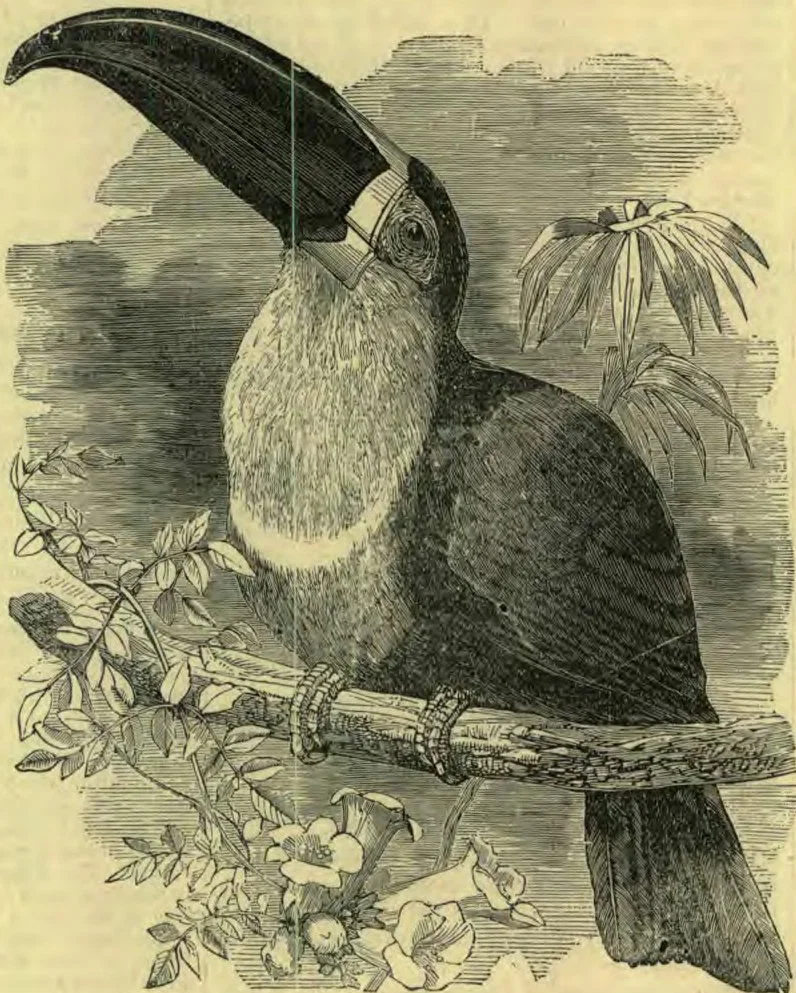
She doesn't look like one, does she? What do you think she has stolen? O, worse than that,—from whom do you think she has stolen? I'll tell you all about it. At Susie's father's house—her name is Susie—they have days with twenty-four hours, all divided off, each with its duties. About eight hours they have for sleeping; in fact, Susie has nearly eleven for that work. Then two for study, and three for dressing and eating; that leaves her eight hours for play! Only out of that time, father has planned that every morning she shall give about fifteen minutes to God. Only fifteen minutes! Shouldn't you think she might spare them? Well, this morning, during that fifteen minutes, what do you think she did? In the first place she found in her pocket a nice, long string, and while her father was reading these words: “Thou shalt love the Lord thy God with all thy heart, and with all thy soul, and with all thy mind,” Susie was wondering whether, if she had a shuttle, she could make tatting as fast as Mary Barton could. So she tried it with a piece of cord, tying it into knot after knot, getting her fingers caught, and finally hurt a little, so that her grown-up sister had to untie them. Not a single word did she hear of all that her father read from the Bible. Then they sang a hymn, sweet words about—
“Amazing love! how can it be
That thou, my Lord, shouldst die for me?”
Something in the tune, Susie could not herself have told what, reminded her of the song the children sang at play:—
“Look to the East, and look to the West,
And look to the one that you love best.”
So she hummed it very softly to herself all the while that the family were singing their hymn of thanks to Jesus for his great love. Then they knelt to pray, Susie put her little body down, too, and looked as though she was praying; but the rhymes she had been saying over had reminded her of what fun they had at recess the day before, and whom she had chosen as the one she liked best; and she planned what they would play to-day, and how she would manage it, and how she wouldn't have Annie Wilcox in the play at all, because she did not like her; and how she would tell all the other little girls not to play with Annie. And before she was half through with her planning, she found that the prayer was over and the family were rising from their knees. Not a word of prayer had she heard, not a sentence had she prayed. Now if she is not a little thief, what name shall we call her? And if she has not stolen from the great God time that rightly belonged to him, how shall we explain what she has done?—The Pansy.
Letter Budget.
We know our boys and girls are interested every time in reading the letters that come to the Budget all the way from New Zealand. A brother and two sisters in one family have just written, and as you hear from these dear friends, and know how they have learned to love the truth within a few months, we suspect your love for the missionary work will grow stronger and stronger. We give one first from,—
Elizabeth Hare, who writes: “We receive the Instructor once a month, and it is with great pleasure I read them. I always read the nice letters in the Letter Budget, so I thought I would write one too. I am fifteen years old, and live with my parents, brothers, and sisters in the far north of New Zealand, at a place called Whangaroa. We have such a beautiful farm, and every thing we want, and I thank my heavenly Father for all his goodness to us. We go down to Sabbath-school every Sabbath if it is fine. We live three miles from the place where it is held. There are a great many people in this place who do not keep the Sabbath, but we must pray for them, and I feel sure God will answer our prayers. Father gave Wilmot, Susie, and I a piece of ground to set vegetables in to sell for the mission cause. I have two sisters and four brothers staying at home now, and they all keep the Sabbath. I was baptized the last time Eld. Haskell was here. We are all trying to keep God’s commandments, so we may be saved when Jesus comes to make up his jewels. I send my love to all the Instructor family.”
Frederick Wilmot Hare writes: “I have been reading the Instructor with its nice letters more than six months, so I thought I would write one too. We live in a very pretty place, called Kukupare re, which is a Maori name meaning, in English, as the pigeon flies. I have a little dog which I call Tiny, she is so small. I have a calf and a cat as well. I have such nice rides on my calf. Father has given us children some ground to do missionary work on. We are going to sell the produce and give the money to the mission cause. I send my love to all, and hope to meet you in the new earth.”
Susanna Wesley Hare writes: “I am a little girl eight years old. I go to Sabbath-school every Sabbath and study in Book No. 1. I like the Instructor, with its nice letters. We have a little lamb called Dolly. It follows me wherever I go. It eats grass now. We have a little dog, which has three pups. I am trying to be a good girl and help mamma all I can. I send my love to all the Instructor family. I am so sleepy now I must say good night.”
Iva Farber writes from Columbia Co., Wisconsin. She says: “We have taken the Instructor eight years, and I am always glad when it comes. I am twelve years old, and have a brother and sister, both older than myself. We have Sabbath-school at our home. I study Book No. 5. We live in the village. I had a missionary garden this summer that earned fifty cents, which I will now send to use in the missionary work. I take the Signs, Review, and Good Health to some of the neighbors to read. I went to camp-meeting this year at Madison. We have some chickens so tame they will jump into my lap and eat. I guess I will have a missionary hen this winter. I send my love to all.”
Your money was received, Iva, and receipted in the Review under Australian Mission. We wish you success with your missionary hen.
Harry Rhodes, of St. Louis Co., Minn., writes: “I live at the head of Lake Superior. There are lots of Indians here, and their ways and habits are very funny. I have two brothers and one sister, and we all keep the Sabbath. I go to school, and like my teacher.”
And you are just the one, Harry, to tell us something about the Indian ways and habits.
Bessie B. Nicola sends a very prettily printed letter for the Budget from Ringgold Co., Iowa. She writes: “I have never seen a letter from our place, so I thought I would write one to you. I am a little girl seven years old. I have no brothers or sisters, but I have a big doll. Her name is Jessie. My mamma is not well, so I help her all I can. I wipe the dishes, sweep the floor, and do lots of work. I go to school, and walk one mile and a half. We have a nice little Sabbath-school. Papa is superintendent, and Aunt Nettie is my teacher. I have lessons in Book No. 1. I have learned all the commandments. I went to camp-meeting last June, at Des Moines, and heard Eld. Carright talk to the children. Please tell him to write some more to the little folks. This is my first letter, and I hope it will be printed. Papa and mamma took the Instructor when they were little; now it comes in my name. I love my little paper, and let my school-mates read it. I love Jesus, and pray every night.”
This bright, industrious little Bessie must be a great comfort to her parents. We suspect she is a little learner when any good thing is told her, and that she always tries to shun evil. It is by doing so that one forms a good character; and we believe there are a great many in the Instructor family who are trying to build one in this way.
For Our Little Ones.
“ALWAYS SUNSHINE SOMEWHERE.”
I SAW a little patch of blue
Behind the great dark cloud,
Just where it seemed to break in two;
It made me laugh aloud
To watch it brighten, for I knew
The good old sun was up there too,
And soon he would be peeping through.
I had not seen his merry smile
For days and days—a dreadful while!
But when I pouted, grandma said,
Just patting softly on my head:
“Wait—wait, and soon it will be clear,
There's always sunshine somewhere, dear.”