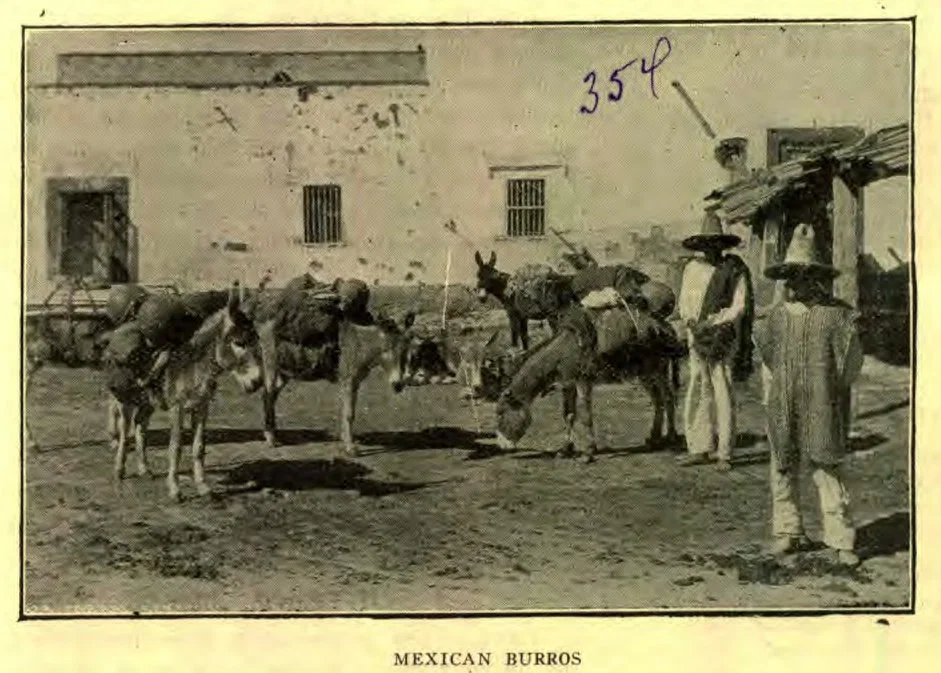
Don and Teddy had but recently moved, with their papa and mama, big sister Ruth and little Anna, to a town in Colorado. Everything was wonderful and strange here, from the cactus that grew on the mesas, to the mighty, snow-capped mountains. But what the boys loved and admired more than anything else was the funny, little, patient, long-eared burro, belonging to Jose Martinez, their little Mexican neighbor. Indeed, when Sabbath came, the boys seemed unable to talk of anything else; so mama said.
“I know some lovely burro stories that have come down to us in history from long ago.”
“Do tell us some of them, mama,” said Don and Teddy. Ruth laid down the book she was reading, and Anna climbed on mama’s lap to hear the story.
“First, I will tell you of some burros, or asses, as they were called in that land, that were lost. Their owner sent his son, a tall, handsome young man, and a servant, to search for them. They sought for three days, and then, as they found no trace of them, the son said to the servant, ‘Come, and let us return; lest my father leave caring for the asses, and take thought for us.’”
But the servant persuaded him to go into the city near them, and ask a prophet who lived there, if he could tell them where to look for the lost animals. The prophet assured them that the asses were found, then kept them as guests of honor at a feast he had prepared; and in the morning as he sent them away, he anointed the young man to be king over the country.”
“That young man was Saul,” said Don.
“His father’s name was Kish,” added Teddy.
“And Samuel was the prophet,” said Ruth.
“Tell another, mama, please,” begged little Anna.
“Perhaps papa now will tell you one.”
“Well,” said papa, after a moment’s thought, “I do not know how many asses Kish had, but the man of whom I speak had five hundred, beside five hundred yoke of oxen, seven thousand sheep, and three thousand camels; so he was a very rich man. Not only was he rich, but he was a very good man, ‘perfect and upright,’ the history says. And because he was blessed of the Lord, Satan was full of jealousy, and sought to destroy him.
“So one day, when the oxen were plowing, and the asses feeding in a field near by, a band of robbers drove them off, and killed all the servants but one, who carried the news to his master. Quickly following him came others telling of the loss of the man’s sheep and camels, and, last of all, of the death of his seven sons and three daughters. Then he himself was stricken with disease, so that he was for a long time in great misery.
“All this trouble was brought on this good man by Satan, to tempt him; but through it all he was faithful to God. And in the end God blessed and prospered him twice as much as before; for he had fourteen thousand sheep, six thousand camels, a thousand yoke of oxen, and a thousand asses. The Lord also gave him a second time seven sons and three daughters.
“That was Job, and the Sabeans took his asses and oxen,” said Ruth.
“Yes, and fire killed his sheep,” said Don.
“And the Chaldeans took his camels,” said Teddy.
“And the wind that killed his sons and daughters,” said mama, “must have been what we call in these days a cyclone.”
“There was a prophet,” said Ruth, “who had owned and ridden upon an ass for a long time; but one day, as he was going on a journey with her, she saw an angel before her, and turned out of the way. This angered her master so that he struck her. A little farther on, in a narrow place between two walls, she saw again the same angel, and in trying to pass, she crushed her master’s foot against the wall; and he struck her again. A little farther on, in a place so narrow that she could not turn out at all, she saw the angel once more, and fell to the ground under her master, who became very angry and struck her with his staff.
“Then the ass did what no dumb beast ever did before or since,—she spoke, reproving her master for his treatment of her.
“Immediately afterward, he, too, saw in the way the angel with a drawn sword in his hand. Then the man was very much afraid, and fell upon his face on the ground. The angel rebuked him for the way in which he had treated his faithful beast, telling him that if she had not turned out of the way, he would surely have been slain. He also said, ‘Thy way is perverse before me.’ Then the prophet offered to turn back; but the angel permitted him to go on, but not to do at the end of his journey as he had purposed.”
“Balaam was the prophet’s name,” said mama.
“And he was going to curse Israel,” said papa; “but his curse was turned into a blessing instead. I should like to tell one more story of this humble creature,—a story that should give it forever a place of honor in our minds. Two men came into a village, and untied an ass they found there. Some standing by said, ‘What do ye?’ and they answered, ‘The Lord hath need of him,’ and led him away.
“Then they placed their garments on him, and their Master rode upon him into the city, while many spread their garments or branches of trees in the way. And those that went before and those that followed after united their voices in the glad cry, ‘Hosanna; Blessed is he that cometh in the name of the Lord: Blessed be the kingdom of our father David, that cometh in the name of the Lord: Hosanna in the highest.’”
Mrs. ELIZABETH ROSSER.
A New Governor
By Letta Sterling Lewis
DEAR mother at the fireplace
Sat “toasting” her tired feet—
They had carried her many a mile that day
On jaunts regretless, sweet.
Still working (darning hosiery)
Though the day ’d been measured off;
For ne’er had she time to cease from work,
Nor her care-full cap to doff.
The children, playing about the room,
Came suddenly to a pause,
And Master Ire with his selfish tongue
Began to plead his cause.
Then each in turn to mother dear
His injured innocence (?) took.
The tales of woe she listened to
Might fill a little book.
Without a word she harkened through,
Nor a smile, nor her mind exposed
Till the least unto the greatest “man”
His argument had closed.
Upon expostulating as
Only a mother can,
She surprised them all by a little talk
On a very wise new plan.
“A new governor is needed sore
In this house, I do declare,
One who’ll keep peace, yes, order too,
And see that games are fair.
“But you must each determine, dears,
Whom this governor shall be,
If you would be Republicans
Precisely to a T.”
She dwelt upon the subject new
In a gentle, winning way,
Until, in Self-defense, no child
Had aught that he could say.
But when her speech its climax reached,
Each now repenting soul
Cast in his vote at the booth of prayer
For Governor Self-Control.
LETTA STERLING LEWIS.
Little Girls Rather Than Pistol-Toting Boys
“But we'd rather all be little girls,
And let them call us babies,
Than all the boys with pistol toys,
For they don't grow to ladies.”
Bible Stories Read From Scripture Itself
You will now find it very interesting, I am sure, to read these stories from the Bible itself. The first is found in 1 Samuel 9, the second in Job, the third in Numbers 22, and the last and most beautiful of all in Matthew 21.
Flourishing Rice Fields
So fast is the area devoted to rice culture in Texas and Louisiana increasing, and with such good results, that it is expected the domestic crop this year will for the first time be equal to the consumption. Enormous areas of swamp-lands along the Gulf coast, sold by the States for twenty-five cents an acre, are diked and drained and turned into flourishing fields. Two hundred and fifty thousand acres were planted in rice in Texas last year. Rice exchanges and rice mills are springing up all through southwestern Louisiana, and are creating an unusual prosperity. The Department of Agriculture is helping in many ways to advance the industry. One of the greatest troubles has been that the area one man could harvest was but a small part of that which he could sow and irrigate. Rice of a given kind tended to ripen at the same time, and the farmer found himself unable to gather the crops which he had raised. The department imported last year forty-one varieties of seed, which were planted in Louisiana, and from which thirty thousand bushels are now ready for distribution. By selecting varieties it has been made possible to plant all at the same time, and to stretch the harvest over nearly two months. The normal period from planting to harvest had been one hundred and three days. Some of the new varieties require a month, some fifty days longer than that. The annual crop is fast approaching two hundred thousand tons.—Youth’s Companion.
The Praise Meeting of the Flowers
THE flowers of many climates,
That bloom all seasons through,
Met in a stately garden
Bright with the morning dew.
For praise and loving worship,
The Lord they came to meet.
Her box of precious ointment
The Rose broke at his feet.
The Passion flower his symbols
Wore fondly on her breast,
She spoke of self-denial
As what might please him best.
The Morning Glories, fragile
Like infants soon to go,
Had dainty, toy-like trumpets,
And praised the Master so.
“His word is like to honey,”
The Clover testified,
“And all who trust thy promise”
Shall in thy love abide.
The Lilies said, “O trust him,
We neither toil nor spin,
And yet his home of beauty,
See how we enter in!”
The King-cup and her kindred
Said, “Let us all be glad;
Of his redundant sunshine,
Behold how we are clad.”
“And let us follow Jesus,”
The Star-of-Bethlehem said.
And all the band of flowers
Bent down with rev'rent head.
The glad Sunflower answered,
And little Daisies bright,
And all the cousin Asters,
“We follow toward the Light.”
“We praise him for the mountains,”
The Alpine Roses cried:
“We bless him for the valleys,”
The Violets replied.
“We praise him,” said the Air plant,
“For breath we never lack:”
“And for the rocks we praise him,”
The Lichens answered back.
“We praise him for the waters,”
The gray Sea-mosses sighed;
And all his baptized Lilies
“Amen! Amen!” replied.
“And for the green, cool woodlands,
We praise and thanks return,”
Said Kalmas and Azalias,
And graceful, Feathery Fern;
“And for the wealth of garden
And all the gard'ner thinks,”
Said Rose and Camelias
And all the sweet-breathed Pinks.
“Hosannah in the highest,”
The Baby Bluets sang;
And little, trembling Harebells
With softest music rang.
“The winter hath been bitter,
But sunshine follows storm;
Thanks for his loving-kindness,
The earth's great heart is warm,”
So said the pilgrim May Flower
That cometh after snow,
The humblest and the sweetest
Of all the flowers that blow.
“Thank God for every weather,
The sunshine and the wet,”
Spoke out the cheerful Pansies
And darling Mignonette.
And then the sun descended,
The heavens were all aglow.
The little Morning Glories
Had faded long ago.
And now the bright Day Lilies
Their love watch ceased to keep;
“He giveth,” said the Poppies,
“To his beloved, sleep.”
The gray of evening deepened,
The soft wind stirred the corn,
Then sudden in the garden
Another flower was born.
It was the Evening Primrose
Her sisters followed fast;
With perfumed lips they whispered,
“Thank God for night at last.”
—Selected.
A Self-Tamed Muskrat
By H. G. Piper
THAT so shy an animal as a muskrat should of his own choice become tame seems strange. Yet this happened at the home of a neighbor of mine, whose boys liked pets.
The family lived on the banks of a stream where the water, free from ice, flowed swiftly until it emptied into the pond near by. Along the shores of the pond the muskrats each season built their huts. In winter they frequently swam about in the open stream, and the boys threw apples into the water for them.
At length one rat ventured to climb up the steep bank and prowl about the house. Not being molested in his visits, one night he crawled under the floor and gnawed through into the kitchen. After that he was the pet of the family.
He took food from the boys’ hands, and allowed them to stroke his fur. He did not object to being taken into their laps. He preferred, however, to lie behind the stove; there he would stay for hours. The hole he gnawed was boarded up, and he was taught to come and go through the door. When he wished to come in, he scratched at the door. At night he sometimes proved troublesome. If no one answered his call, he crawled under the house, and began gnawing a new hole.
A queer pet he proved. He was not nearly so quick on land as in water. When he walked across the floor, his long, scaly tail dragged noisily after him. His favorite food was apples. While eating, he “scooched” on his haunches, and held the food in his paws. When he had eaten enough, he pushed the rest into a dark corner.
In the spring he went away. What became of him they never knew.—Rev. H. G. Piper.
Story of Our Flag
By Anna K. Dunlap
A LONG time ago, when our country was fighting to be free, the people thought they would like a flag different from any they had ever seen,—a flag to wave over their homes and schoolhouses, over their ships when they sailed away to other countries, and one to lead their soldiers to battle.
So they told George Washington to have the right kind of flag made. He and a friend, Mr. Morris, talked about a flag, and wondered just what kind of flag it should be. They wanted a beautiful one, and one that would please the people.
At last, after they had talked it over, George Washington drew a picture with his pencil of a flag with stars and stripes, and took the drawing to Mrs. Betsey Ross, a good milliner who lived in Philadelphia. Washington told her to make the stripes red and white, and the stars white on a blue sky, and he told her to make the stars with six points.
“O, no!” said Mrs. Ross, “I think they should have only five points.” And Mr. Washington wanted to know why she wanted the five points. Mrs. Ross said: “When we look up into the beautiful blue sky at night, the stars seem to have only five points. They look just like this.” And she took a square piece of paper, folded it, and with her scissors made the five-pointed star.
So Mr. Washington and his friend gave up to Mrs. Ross, and told her to make the stars with five points. Then she got some bunting, red, white, and blue, and in her own little shop she cut out and made our first flag with the stars and stripes.—Anna K. Dunlap.
Stephen Girard and the Clerk Who Would Not Work Sunday
Stephen Girard, the infidel millionaire of Philadelphia, one Saturday bade his clerks come the following day and unload a vessel which had just arrived. One of the clerks, who had strong convictions and the power to act upon them, refused to comply with the demand.
“Well, sir, said Mr. Girard, “if you can not do as I wish, we can separate.”
“I know that, sir,” said the hero. “I also know that I have a widowed mother to care for, but I can not work on Sunday.”
“Very well, sir,” said the proprietor; “go to the cashier’s desk, and he will settle with you.”
For three weeks the young man tramped the streets of Philadelphia, looking for work. One day a bank president asked Mr. Girard to name a suitable person for cashier for a new bank about to be started. After reflection, Mr. Girard named this young man.
“But I thought you discharged him?”
“I did,” was the answer, “because he would not work on Sunday, and the man who will lose his situation from principle is the man to whom you can entrust your money.”—Youth’s Friend.
Missionary Gardens Progress Report Requested
THE editor is getting anxious to hear how the missionary gardens are prospering. Will not the little gardeners send some word?
MEMORY VERSE: “And I heard another voice from heaven, saying, Come out of her, my people, that ye be not partakers of her sins, and that ye receive not of her plagues.” Rev. 18:4.
Questions
1. What is the burden of the second angel’s message? Rev. 14:8.
2. To what is the name “Babylon” applied? Rev. 17:3-5.
3. What does a woman represent in prophecy? Rev. 14:4, 5; note 2.
4. What indicates that many churches are included in the fall of Babylon? Rev. 17:5.
5. How is the condition of the fallen church described? Rev. 17:2.
6. Of what great sin has she been guilty? Verse 3. In what similar terms is the church corrupted by worldly alliances, described by James? James 4:4.
7. Then what has brought about this fallen condition? Note 3.
8. How unrighteous has the church become? Rev. 18:5.
9. What judgment is pronounced upon her? Verses 6, 8; Rev. 16:19.
10. Does the fallen church see her condition? Rev. 18:7.
11. What evidence have we that this is a description of the church in the last days? Verse 8; Rev. 14:8-11; note 4.
12. What does Paul say of the condition of the church in the last days? 2 Tim. 3:1-5.
13. What shows that some of God’s people are still in this church? What are they called to do? Rev. 18:4; note 5.
14. What message follows the one announcing the fall of Babylon?
15. What is the simple faith of those who respond to the call to come out of Babylon? Rev. 12:17; 14:12.
16. After the destruction of Babylon, where is the true church next seen? Rev. 19:1-3.
Notes
1. “Revelation 18 points to the time when, as a result of rejecting the threefold warning of Rev. 14:6-12, the church will have fully reached the condition foretold by the second angel, and the people of God, still in Babylon, will be called upon to separate from her communion. This message is the last that will ever be given to the world; and it will accomplish its work. When those that believe not the truth, but have pleasure in unrighteousness, shall be left to receive strong delusion, and to believe a lie, then the light of truth will shine upon all whose hearts are open to receive it, and all the children of the Lord that remain in Babylon, will heed God’s call.”
2. A woman in prophecy symbolizes a church. The true church is represented by a virgin, or a pure woman, while the apostate church is represented by a fallen woman. In this case the woman is the mother of daughters—churches.
3. The illicit connection between the church and worldly power is here clearly illustrated by the woman, a symbol of the church, seated upon a beast, a symbol of earthly government. The Church of Rome with its gigantic organization stands as chief representative of this iniquitous system, and is here called Babylon.
4. From the very fact that the message going with that one which announces the fall of Babylon, is to prepare a people for the coming of the Lord, we know that this church exists just before his coming. Then, too, God’s people are called out, so that they will not be partakers of her punishment which is about to fall.
5. Some of the true people of the Lord are scattered throughout Babylon. In all the churches there are those who sigh and cry because of the abominations which are cherished in their midst. On these the Lord has his eye; they are dear to him. And as the storm of indignation against sin gathers and is about to break, a voice from heaven, a mighty message, calls them to “come out of her.” “Servants of God; endowed with power from on high, with their faces lighted up, and shining with holy consecration, went forth to proclaim the message from heaven. Souls that were scattered all through the religious bodies answered to the call, and the precious were hurried out of the doomed churches, as Lot was hurried out of Sodom before the destruction.”—“Early Writings,” page 139.
MEMORY VERSE: “Wherefore let him that thinketh he standeth take heed lest he fall.” I Cor. 10:12.
Jehoram, the son of Jehoshaphat, was the next king of Judah. He killed all his brothers, married the daughter of the wicked king Ahab, and led Judah into idolatry. Because of his sins the Lord allowed the enemies of Israel to come against Jerusalem. They slew all the king’s sons, save one; and the king himself died of a dreadful disease. Jehoram reigned eight years, and, we are told, “departed without being desired.” What a sad thing to be said about one who might have been loved by the people, and honored by the Lord!
Ahaziah, the youngest son of Jehoram, now reigned for one year. His mother, Athaliah, was a very wicked woman. While the king lived, she counseled him to do wickedly; and when he was dead, she slew all the seed royal of the house of Judah, and made herself queen. But the king’s sister saved one of his sons, a baby only a year old, and hid him in the house of the Lord.
This baby’s name was Joash, and he was cared for by the good priest Jehoida for six years. At the end of that time the people took the kingdom from Athaliah, and made Joash king. He was only seven years old when he began to reign, and he reigned for forty years in Jerusalem. As long as Jehoida lived to counsel and direct him, Joash reigned well. He asked the people to bring gifts to repair the temple, which Athaliah’s sons had broken up; and when this work was finished, they used the rest of the gifts to make vessels for the temple service, in place of those that had been carried away to be used in the service of Baalim.
After Jehoida died, Joash listened to the princes of Judah, and served idols. Then the Lord sent Zechariah, the son of Jehoida, to Joash with a message from him; but the king was angry, and had the prophet put to death, forgetting the kindness of Jehoida, who had cared for him, and made him king.
Amaziah was the next king, and he reigned twenty-nine years. At first he served the Lord, but afterward he worshiped idols. When he died, the people made Uzziah, his son, king in his place.
Uzziah was only sixteen years old when he began to reign, and he reigned for fifty-two years in Jerusalem. “And he sought God in the days of Zechariah, who had understanding in the visions of God: and as long as he sought the Lord, God made him to prosper. . . . And his name spread far abroad; for he was marvelously helped, till he was strong.”
“But when he was strong, his heart was lifted up to his destruction; for he transgressed against the Lord his God, and went into the temple of the Lord to burn incense upon the altar of incense.” The priests reproved the king, and told him to go out of the sanctuary; but he was very angry, and would not listen to them. Then the Lord smote the king with leprosy, in token of his displeasure. All the rest of his life he had to dwell in a house by himself: “for he was cut off from the house of the Lord.”
Jotham, the son of Uzziah, was the next king. He built many cities in the mountains of Judah, and in the forests he built castles and towers. He subdued the Ammonites, also, and put them under tribute. “So Jotham became mighty, because he prepared his ways before the Lord his God.” “And Jotham slept with his fathers, and they buried him in the city of David: and Ahaz his son reigned in his stead.”
Questions
1. Who was the next king of Judah? What wicked thing did Jehoram do? How was he punished? What is said about his death?
2. How long did Ahaziah reign? Who was his chief counselor? Describe her character.
3. When Ahaziah died, what was done by Athaliah? Who only was saved? How old was Joash at this time? Where was he kept? Who cared for him?
4. What did the people do when Joash was seven years old? For how many years did he reign in Jerusalem? What good work was done under his direction?
5. How long did Joash reign well? After Jehoida died, who were his counselors? What did the king then serve? Who was sent to him with a message of reproof from the Lord? How did Joash receive the message?
6. Name the next king, and tell how many years he reigned. What kind of king was he? Whom did the people make king when this Amaziah died? How old was Uzziah when he came to the throne?
7. How long did Uzziah prosper? How was he helped? 2 Chron. 26:5, 15.
8. When Uzziah was strong, what did he do? Who reproved him? How did this make the king feel? How did the Lord show that he was displeased at what Uzziah had done? Where did Uzziah dwell all the rest of his life?
9. What warning has the Lord given to those who think that they are in no danger of doing wrong? Memory Verse. What must each one do who would not fall into sin?—“Watch unto prayer.” 1 Peter 4:7.
10. Who was king after Uzziah? What did he build? What nation did he subdue? Why did he prosper? At his death, who was king?
Near at Hand
“If haply they might feel after him . . . though he is not very far from each one of us.”
Acts 17:27.
This is a wondrously true picture of human souls in this world. They are like blind men, groping in the darkness, trying to find some hand to lead them, some path to take them home. Without God in this world, we are like—
“An infant crying in the night,
An infant crying for the light,
And with no language but a cry.”
Without the gospel we can not find God. At the same time he is not far from any one of us. There is a story of a returning prodigal seeking his father’s house and unable to find it, wandering wearily along the highway, and at last, in his faintness falling down on the threshold of a cottage,—his own father’s house. Inside sat the father and mother for whose love he was hungering; yet he knew it not. So near to every one of us in our need and craving is our Heavenly Father.—Selected.
A Boy's Letter on Memorizing Matthew Twenty-Four
MOUND CITY, KAN., July 15, 1904.
DEAR EDITOR: I am a boy nine years old. I take the YOUTH'S INSTRUCTOR, and like to read it very much. I think it is the best paper I ever read. I went to church-school in Keene, Texas, two winters. We are now living on our farm in Kansas. We have no Sabbath-school near us.
I am learning the twenty-fourth chapter of Matthew. I can repeat seventeen verses now. I began it the first day of July.
As this is my first letter to the INSTRUCTOR, I hope it will be printed. W. IVAN MONTANYE.
P. S.—Enclosed find seventy-five cents to renew my subscription to the YOUTH'S INSTRUCTOR. W. I. M.
The editor likes this letter, and the postscript too. The postscript is sometimes called “the forgetful man's paragraph;” but if postscripts were all as valuable as this one of yours, Ivan, I believe the editor would want every letter to have one or two postscripts.
You have chosen a long chapter to memorize, but it is a good one. I wish a score of boys would join you in the interesting task. When a little girl, living in Texas, I learned that chapter, and I have never regretted the effort. Perhaps the fourteenth chapter of John will claim your attention later on, Ivan.