The Youth’s Instructor, Vol. LII, No. 32

The General Post Office Department

The Youth’s Instructor

Aug 9, 1904

Review and Herald Publishing Assn. · Washington, D. C. · Aug 9, 1904

The General Post Office Department
WE who receive from week to week letters filled with kindly greetings from friends, seldom, if ever, think of the handsome but expensive mail service of our country that makes the enjoyment of such luxuries possible. There is no country that provides for as perfect a mail service as does our own.
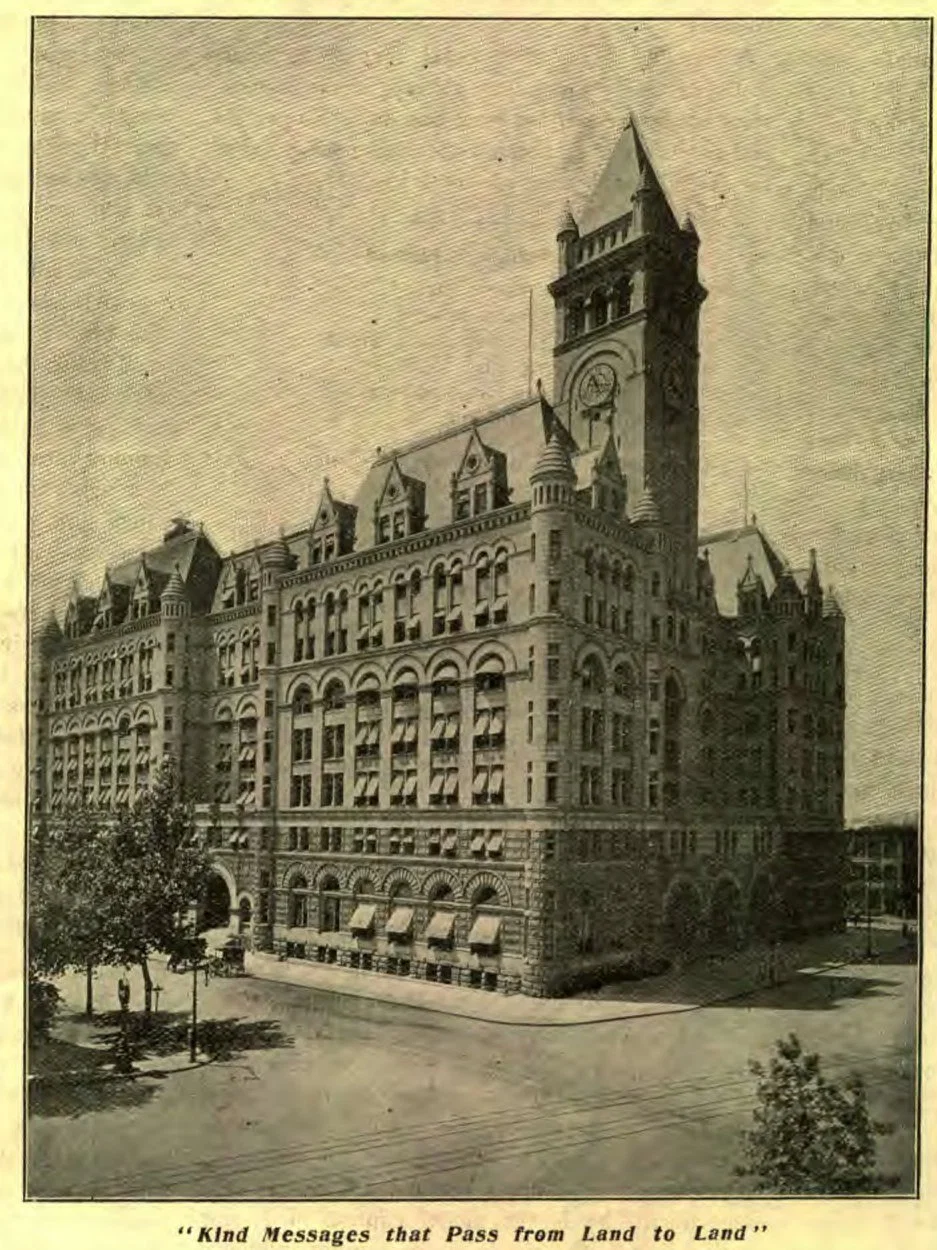
Kind Messages that Pass from Land to Land
The General Post-office work began in a postal system organized in the American Colonies in 1692 by patent to Thomas Neale. On the expiration of this patent in 1710, England introduced her postal system, and in 1753 Benjamin Franklin was appointed deputy postmaster-general for the colonies. The royal system was overthrown by the Revolution, but the Continental Congress established a new service, and put in charge the former postmaster-general, Mr. Franklin. The rapid, continuous growth of the mail service has been phenomenal. In the interval from 1800 to 1903, the receipts of the Postal Department grew from $280,804 to $134,224,443, and in number of post-offices from 903 to over 76,000. The task of supplying this large number of offices with the requisite quantity of stamps alone is not insignificant. The Bureau of Engraving does this work, manufacturing the stamps as well as all the paper money made by the government. Until recent times the stamps were printed by private contractors. Not until 1847 did the government adopt the use of stamps; but during 1902 more than five billion were sold, and nearly ten million dollars' worth of stamp-books. The total cost of the service for the year ending June 30, 1902, was $138,784,487, just about the pension appropriation for that year. The expenditures exceeded the receipts by more than four and one-half million dollars; but such deficits are not to be viewed with apprehension. It is the policy, whenever the postal receipts exceed or come near the expenditures, to extend postal facilities and cheapen the cost of the service to the public. One very practical result of this policy is seen in the dropping of the postage for a letter from twenty-five cents to two cents in less than sixty years. During 1902 the department handled nearly nine billion pieces of mail-matter. Seven hundred seventy millions of these were postal cards from frugal correspondents. The value of the money orders was more than seven hundred fifty millions of dollars; this feature alone is a marked source of revenue to the department. One can hardly appreciate the extensive demands made upon the government by its admirable mail service. The little item of providing wrapping-twine for the work was estimated to have cost during the past year $135,000. Entering upon the fortieth year of its operation, the city delivery service presents a record of remarkable expansion. It is the feature of the service with which the public is most familiar, and has aptly been described as the “fingers of the Department.” Were the city mail carriers to colonize, they would form a settlement of over twenty thousand, and the rural carriers a city of twelve thousand.
The rural free delivery is now regarded as a necessity, a luxury; though it is an enormous burden on the finances of the nation, and every year more is required to maintain it. It does much, however, toward maintaining itself, and it is an admitted mutual benefit to the rural communities and the nation both socially and educationally.

Post Office Building

The present General Post-office is a new building, having been completed in 1899 at a total cost of $3,325,200. Its lofty square clock tower makes it one of the most conspicuous of the government buildings. Its plan for securing well-lighted offices is admirable, the center being a court roofed by a skylight 180 x 99 feet. An interior skylight covers the court at the height of the first story, forming an immense room for the accommodation of the city post-office. The nine floors above the main floor are devoted to the business of the postmaster-general and his department, and contain nothing of special interest to the public, save the Dead Letter Office.
The department of the Dead Letter Office, founded in 1825, was at first quite insignificant, but has grown into an establishment giving employment to an average force of one hundred thirty-four persons. The huge piles of mail-bags along the corridors, holding the unclaimed mail of one month only, and the scores of busy persons looking over the packages, papers, and letters that have found their way to this “last resort,” must certainly determine the visitor to be careful in the future to properly address his friends, and make a full, clear superscription on every letter. The fact that in one year nearly 50,000 letters and 41,000 parcels were received at the office without any address whatever shows clearly that there is need of many abiding by a resolve of future carefulness.

Interesting Figures

During the fiscal year ending June 30, 1903, 10,153,000 pieces of mail-matter were received at the Dead Letter Office, or about 33,000 pieces for every working day in the year. Through the generosity of the government nearly four millions of these found their way back to the sender; but the “leftovers” were sufficient to provide Uncle Sam with interesting reading-matter and curios in abundance. Of the ten-million pieces received, 977,286 were of foreign origin, and were returned unopened to the countries from which they were sent. The United States had the compliment returned by receiving 688,000 pieces that had failed to reach those for whom they were intended. From ten to fifteen persons are constantly employed in opening letters and parcels. Of course they in time become expert, and often some of the most rapid counters exceed the daily average of two thousand or three thousand pieces.

A Paying Business

During the last year $48,634.04 in actual money was found, or nearly $160 for each working day. About $33,800 of this amount reached the owners, the rest was turned over to the Treasury. The face value of the commercial papers found was $1,493,563.65.
One unregistered letter was found containing three one hundred-dollar bills, and one letter had three one-dollar bills sent by a son to his mother, saying that this was all he had; but as soon as he could get more, he would send it to her. Fortunately the money was returned to the young man, but the delay doubtless caused the mother anxiety. If all the disappointments these millions of unfortunate letters have caused were rolled into one, would it not make a big heartache?
Unregistered parcels received numbered about 250,000, of which nearly one half were in time delivered. Over 80,000 photographs were received, and nearly 250,000 stamps came in letters. The number of registered packages was 62,986. Articles of value that can not be identified are recorded, and laid aside for six months; at the end of this time they are sold at auction. The annual sales occur in December. The amount realized from the December sale of 1902 was $3,535.85, 22,382 parcels having been disposed of. At a special sale held in February, 1903, 104,854 parcels were sold for $5,244.15. These two sales made the year’s auction receipts nearly nine thousand dollars.
From the large quantity of printed matter received, including papers, pictures, fancy cards, thousands of pieces are selected annually and given to the benevolent institutions of the District of Columbia; the rest are destroyed.

The Museum

The museum of the Dead Letter Office reveals an endless variety of things that have found their way into the mails. Some of these are now on exhibit at the World’s Fair in St. Louis. “All sorts of small animals, stuffed, dried, in alcohol, and otherwise preserved, are here; a human skull and many bones; surgical instruments and death-dealing implements. Books have been gathered by thousands, dolls and toys enough to furnish half a dozen kindergartens might be taken from here, and, in short, it would be hard to find a path of industry or a region of pleasure or profit of which some reminder might not be found among this queer conglomeration of lost property.”

Foreign Service

The little mail-bag is the star passenger on the great Atlantic steamers. Everywhere it is given the right of way. The flight of the foreign mails now is marvelous, and does much toward lessening the separation that the great sea makes. Our country regards the postal service as a mere matter of business, and so sends its mails by the fastest lines, irrespective of the flag the vessel floats. England is more conservative, patronizing only those carrying the British flag. As only two English mail lines sail a week, there are only two American mails, while from this country there are five sent out. Mr. Roger Waite, in speaking of the foreign service, says:—
“Look in at the foreign branch of the New York office about nine o’clock some Saturday morning. Things are on the run about that time. Two thousand sacks have already gone down to the boat. Now they are handling, on the jump, the supplementary mails. The fingers of the clerks fairly fly. The sacks are not hung up on racks as they were last night and yesterday; men stand on the alert holding them open, and the instant the last letter is in, snap goes the cord, and the bag is thrown into the last mail wagon to make the trip. Down West Street it goes, and just before nine-thirty, the sailing time of the American liner, it dashes up on the pier. At the vessel’s side a string of men seize the bags as they are dumped from the van, and run them up the gang-plank. Everybody and everything else is aboard and waiting.”
“Even during the voyage Uncle Sam keeps at it, racing against time, always. On several of the big liners to-day is the ocean post-office, where from port to port, mail clerks are hard at work sorting letters. In this way hours of time are saved; for instead of the entire mail going to the London office and being rehandled there, it is properly bagged at sea, and on landing is sent direct to its destination.
“On the Liverpool route, when Fastnet Light peers above the horizon, the mail-bags are hoisted from the hold and piled high on the deck, ready to be moved at an instant’s notice. Off Queenstown out comes the tender. The liner stops her engines, the tender is made fast alongside, and down the run-ways slide the sacks. In a short time the liner proceeds, and in sixteen to twenty hours you are landed at Liverpool, but the letters are ahead of you. By dropping them off at Queenstown, they went up through Ireland on the fast mail-train, across the Dublin ferry, and up to London, while you were asleep that last night of the voyage in St. George’s Channel.
“On the Southampton route, the American liners cut down the mail time considerably between New York and London by touching at the first possible English port, Plymouth. Off the sacks are rushed here, and as the train can always beat the steamer, the mail is in London long before the ship reaches its final port, Southampton.”
Expensive as is the postal service, a panic would certainly follow any attempt of the government to suppress it for even one day. So perfect and extensive is it, that no adequate reason exists for friends neglecting absent friends.

The Harpy Eagle

One of the treasures, and I think the greatest pet, in the National Zoo in Washington, D. C., is the beautiful harpy eagle. So far as I know, this is the only one in a zoological collection, and I doubt if a finer specimen could be found in his native jungles in Central and South America.
For good behavior generally, and dignity of deportment, he is the model captive bird; nor is this merely the result of the taming influence of long captivity, for he has always been so, and you can see in his face that he could not well be otherwise. I know of no other beast or bird that can look at one with a more keen, intelligent, and searching expression; and he has never been known to make the wild, futile dashes against the bars of his prison characteristic of other eagles.
I must mention right here that, for reasons interesting only to scientists, he is really not accepted as a true eagle, as he possesses some of the attributes of the buzzard family; but to all appearance he is royal clean through, and when he draws himself up and raises his crown-like crest, he looks it completely.
Visitors sometimes make many strange mistakes when reading the signs attached to the cages. The polar bear is read and accepted as “parlor bear,” and the harpy eagle as frequently is called the “happy eagle;” and I fancy that he is as happy as a bird can be. The interest he displays in everything about him is wonderful. Once I was painting a life-sized portrait of him, and when it was nearly completed I chanced to place it against the opposite wall in such a position that he could see it; this was purely accidental on my part, for I had never seen an animal notice in any way a drawing or painting. He noticed it at once, and fixed on it such a look of intelligent wonder and inquiry that I was filled with amazement. He thrust his head forward, then tilted it to one side, then to the other, exactly in the manner of people in looking at a picture; finally he jumped down from his perch and hopped over to the front of the cage to get a nearer look.
He was known to the Aztecs by the name of “winged wolf,” and it is said that they used him for hunting purposes, as the falcon is used in Europe; and I can well believe it, for his beauty, intelligence, and high courage eminently fit him to be the servant and companion of man. He does not hesitate to attack game three times his size and weight; peccaries, monkeys, young deer, badgers, almost anything that moves in his native jungles, is his legitimate prey. His strength must be very great. No other bird possesses such powerful legs and feet. In my drawing I purposely selected a position rarely taken by him, in which they are fully exposed.
In size he equals any of our eagles. The wings are long and powerful; the tail is long and rather square; the head looks large on account of the crest and ruff which surround the face; the beak is very heavy and hooked, of a bluish color tipped with black; the eyes are deep-set and of a dark hazel color, the pupil, which is rather small, being black. The head, face, and upper part of neck are a rich gray. About the lower part of the neck and running into the breast-feathers is a broad collar of grayish black, which is the color of the back wings and upper surface of the tail. Many of the wing-feathers are edged with a thin line of white, giving a beautiful scale-armor effect. The breast-feathers are snowy white, one feather laid over another in a soft, fluffy manner. The upper parts of the legs are covered with soft, gray feathers, marked with thin semicircles of black; the legs and feet are lemon yellow; and the huge, horn-like claws are black, the under surface of the tail is almost white, broken by broad bars of black.
In a free state his cry is said to be loud and harsh, but in captivity I have never heard him make any sound— J. M. Gleeson, in St. Nicholas.

The Spider’s Thread

“Just let me spin a single thread,” The spider to the rosebush said, “Under this leaf, quite out of sight, I’ll spin it so delicate and light No one will ever know, and no one will see Excepting only you and me.”
So beneath the leaf its thread it spun, But it did not stop with only one, It spun another — two — three — four, And so on, steadily, more and more Till the rose felt the web, and cried, “Dear me! You’d better stop or people will see!”
But the spider smiled in satisfied mood, For it had hatched a swarming brood, And over the rosebush they crawled and spun Till all its beauty and strength were gone, Till the buds and leaves were choked and dead, And over it all the gray webs spread.
Just one small spider — just one small sin, Ah, that is the way that troubles begin! — Mary Whiting Adams.

A New Ocean Leviathan

WHAT is to-day the largest vessel in the world entered New York harbor last week, it being the new White Star liner “Baltic.” She measures 725 feet in length, and has a beam of 75 feet. When fully loaded she displaces 40,000 tons of water. Her engines are of 26,000 horsepower, and consume about 250 tons of coal a day. Standing on the main deck, four decks are under foot, while four more rise overhead. One of the most striking features of the big vessel is the great dining-saloon, a vast apartment extending the full width of the ship, and having a seating capacity of three hundred seventy-five persons. The saloon is lofty, airy, and artistically decorated. The smoking-room and library are also finely fitted up. The staterooms are extremely tasteful in design, and have every comfort and convenience. In these days of excitement about the life-saving equipment of steam vessels, it is interesting to note that the “Baltic” carries fourteen life-boats, with a capacity of 766 persons; four boats, with a capacity for 182; eight collapsible boats, with a capacity for 424. In addition, there are 3,100 life-belts and 48 buoys.—Week’s Progress.

The Three Crosses

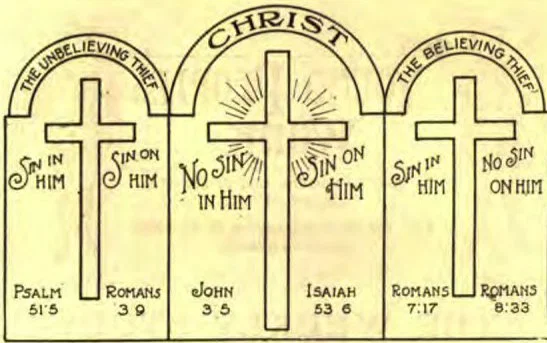
WHEN Jesus was crucified, we are told that two other men were crucified with him. “There they crucified him, and the malefactors, one on the right hand, and the other on the left” (Luke 23:33)—three crosses in a row, and three different characters on them. On the center cross was the sinless Jesus. Peter, speaking of him, said, “Who did no sin.” 1 Peter 2:22. Paul declares, “He knew no sin” (2 Cor. 5:21), and John affirms, “In him is no sin.” 1 John 3:5. But sin was upon him, as Isaiah said, “Hath laid on him the iniquity of us all.” What a shame that Jesus should bear your and my sins, and yet what a blessed thing; for without that Sinless Bearer there would be no way to approach God.
It is said that many years ago when the Swiss were fighting against the Austrians, they saw that the enemy had arranged themselves in a solid phalanx. To break it seemed out of the question, but Arnold von Winkelried rushed out in front of his regiment, and shouted: “Make way for liberty!” The weapons of the enemy were plunged into his heart, but while they were slaying him, a gap was made in the ranks, and the Swiss dashed to victory. Christ saw that all sin and sinners were arrayed against him, and he knew that if any of the human family were saved, he would have to die. So he marched to Calvary, and while the weapons of infernal hate struck him, he opened a way for the redemption of the world.
The cross on the left may be called the unbeliever’s. Upon it a thief hung. Differing from Jesus, he, like us, had sin in him; for all are “shapen in iniquity, and born in sin.” Ps. 51:5. But like Christ he had sin on him—not the sin of others, but his own, for Paul tells us that all are “under sin.” Rom. 3:9. This thief was very impolite. He insulted Jesus even in his dying moments. The scripture says that he railed on Christ, saying, “If thou be Christ, save thyself and us.” One would think a dying man would be more considerate; yet more than one have died like him, with blasphemy upon their lips. Thousands have died unbelieving, and the Word tells us of the awfulness of such. “He that believeth not shall be damned.” Mark 16:16.
The cross on the right may be called the believer’s. Upon it another thief hung. Like the other, he had sin in him. He could say, as did Paul, Sin dwelleth in me (Rom. 7:17), but unlike him and Jesus there was no sin on him. There had been such, for he confessed that his punishment was the due reward of his deeds (Luke 23:41), but sin had been removed, he had become one of God’s elect, and “who shall lay anything to the charge of God’s elect? It is God that justifieth.” Rom. 8:33. This thief believed Jesus was Christ. He did not sanction the way his companion spoke to Jesus; for we read he “rebuked him, saying, Dost not thou fear God, seeing thou art in the same condemnation? And we indeed justly; . . . but this man hath done nothing amiss.” This thief did not question Christ’s divinity with an “if,” as the other did; but he said, “Lord, remember me when thou comest into thy kingdom.” What a beautiful petition! What a simple faith in Jesus! And what a blessed assurance from Jesus! “Verily I say unto thee to-day, shalt thou be with me in paradise.”
What lessons we find here! Jesus on the center cross dying for sin, the thief on the left cross dying in sin, the thief on the right cross dying of sin. Dear readers, if you “believe on the Lord Jesus Christ,” as this last thief, the promise is that you, too, “shalt be saved” (Acts 16:31); for—
“The dying thief rejoiced to see That fountain in his day; And there may I, though vile as he, Wash all my sins away.”
WILLIAM P. PEARCE.

What Relation Should Young People Who Love Jesus Sustain to the World and Its Ways?

NEVER before in the history of man was this question more pertinent than it is to-day. Never before did it require a more definite answer. Living, as we do, in the closing hours of time, it is vitally important that we know on which side we are standing, and also that we may take that stand so firmly and truly that the whole world, if need be, may know where we stand. Our daily life, our conversation, and our dealings with our fellow men are the criteria by which men judge us; and if we claim to be subjects of the heavenly kingdom, will they not judge that kingdom by the same criteria? And, this being so, is it not very essential that our lives should be such as to make us true representatives of that kingdom? Do we treat our fellow men exactly as we would have them treat us at all times? Is our conversation such that those to whom we speak may know that we expect to give an account of all that we say? Do we attend places where Jesus is not welcome, and where we could not invite him if he were here? Is our deportment such that our associates may know that we are serving a higher master than self? If we can not rightly answer these questions, we need to examine our hearts to know what is wrong.
Some day, God will bring everything into judgment. Is it not better to settle these things now, and let them “go beforehand” unto judgment? Probation is nearly over; the time to do things is almost past, and if we are not living now just as God would have us live, when shall we begin? If we are still following the ways and fashions of the world, when shall we begin following God’s ways and walking in his paths? Why not now? To-morrow may be too late.
There are some among us who have not yet decided in which way they will walk. God has a message for them to-day. “Stand ye in the ways, and see, and ask for the old paths, where is the good way, and walk therein, and ye shall find rest to your souls.” Jer. 6:16. In Jeremiah’s time the people had made paths of their own. They had gone out of the “old paths,” the “good way,” and had set up ways and paths of their own; that God never intended them to have. They had a new style. And, of course, since man is changeable, the style was changeable; but no matter how often it changed, it was still something new, and not the old way. Is Satan less active now than he was then? Are not the same conditions prevalent in our day? And one of the easiest ways he has now of getting persons’ minds off of God is by getting them to follow his new styles instead of God’s ways. Must we as young people be caught in this dreadful snare of the enemy? Must we be led along in the same paths that Satan sets for the feet of his servants? Why not remember the direction in which these paths lead, and then by the Lord’s help get out of them?
Christ said, “If ye were of the world, the world would love its own; but because ye are not of the world, . . . the world hateth you.” John 15:19. We belong, as adopted sons of God, to a different country from this. Hence we should not feel hurt if people think we are “peculiar,” and wish to avoid our association. Jesus says again, “My kingdom is not of this world.” Then should we not feel to rejoice that we can make a change in our lives, thereby proving that we are citizens of the heavenly kingdom? My brother, my sister, if you have not made this change in your life, or if you have not made it as marked as it should be, then I ask you in all candor and earnestness, when will you make it? This is a solemn question, and one upon which hinges your eternal life or eternal death. At a time not far hence, all decisions will be irrevocably made. Why not make yours for the right now? The line of separation between God’s people and the world is being drawn to-day. Do you positively know on which side you are standing? If you do not, if you are not quite sure, you must, in the interest of your own soul, look into your heart to find why you are not anchored firmly on the side of right.
We must begin to do definite things and do them now. Do not put this decision off; for it may be too late when your mind is led to this question again. Examine closely your motives, and if they are wrong, make the decision for eternity at once. Do not let little things keep you from having Christ in your heart. If that ring on your finger, or that new dress, or that new hat is going to come between you and your choice for God, would you not better let the personal adornment go? If that party or that excursion picnic is going to prevent you from making a decision for eternal life, you can not afford to go. If that new book or magazine, full of foolish stories, is going to cause you to make a decision for the world, better drop the book now. If you can not serve God and read those foolish stories, why not let the bad reading go? If that habit of jesting and silly talking is standing between you and your duty to God, better stop the foolish talk. It requires an effort to break away from all these things, but eternity is worth everything, and the promise says, “My grace is sufficient for thee.” If each young person would thus clear everything out of his heart that is not right before God, and then let the blessed Master come in, would we not all by this means be united in one great army, with but a single purpose, and that the salvation of souls?
We believe that Christ has nearly finished his work. When this is entirely completed, and he has “risen up,” there will be no more opportunity to get rid of these things. If you have held to that bad reading, you can keep it then. If you have continued that foolish talking until then, you can keep right on. If you have clung to that little bit of jewelry, you can keep it. There will be no time then to make changes. Why not make them now? Why not clean up all these things, and make thorough work of it? You have such a short time in which to make your decision that you can not afford to wait until some time when it will be easier than it is now; for that time will never come. You can not afford to wait even until next Sabbath at meeting, for it may be too late then. The time is now. God is asking to-day for a full and complete surrender of every heart. He wants to prepare us all to meet his Son when he comes; and Jesus is coming very soon—much sooner than we really think. If we but realized the nearness of this great event, there would be a change in our lives. Shall we not make the choice to-day, and, letting everything else go, cling to the simple ways of Christ, thus uniting in the decision that we will be clean before God and our fellow men, that we will let these things go that have been holding us, and take a definite stand for the right? May God help each in making his decision.
WESLEY D. BEARD.

A Plant Cistern

THE following is not only interesting information as to the air-plant referred to, but is a good illustration of the fact that those who keep their eyes open often see many things to their advantage. The item is credited to “an exchange:”—.
A surveying party in Florida, were resting at noon in a forest, when one of the men exclaimed: “I would give fifty cents a swallow for all the water I could drink!”
He expressed the sentiment of the others. All were very thirsty, and there was not a spring or stream anywhere in the vicinity.
While the men were thus talking, the surveyor saw a crow put his bill into a cluster of broad, long leaves growing on the side of a tall cypress. The leaves were those of a peculiar air-plant. They were green, and bulged out at the bottom, forming an inverted bell. The smaller end was held to the tree by roots grappling the bark. Feeding on the air and water that it catches and holds, the air-plant becomes a sort of cistern. The surveyor sprang to his feet with a laugh. “Boys,” he said, “that old crow is wiser than every one of us. He knows that there are a hundred thousand water-tanks in this forest.”
“Where?” they cried.
The surveyor cut an air-plant in two, and drained nearly a pint of cold water from it. The men did not suffer for water after that, for every tree in the forest had at least one air-plant, and almost every air-plant contained a drink of water. — Wellspring.

Heart Enlisted for Life-Service Under Emmanuel's Banner

“WHEN I heard it, my heart enlisted.” This is what Lafayette said in speaking of our Revolution. Would that every one who hears the truth for this time would say as did Lafayette: “When I heard it, my heart enlisted”—enlisted for life-service under the banner of Prince Emmanuel.

The Impulse of Service

PAUL, like his Master, “went about doing good.” He never stopped to rest. When his work was done in one place, he was instantly off to another. When one door was closed, he sought another that was open. No opposition checked him. No persecution daunted him. He is thus a model for all Christ’s followers.
But we must get his motive before we can have his career. There is no use in our trying to imitate his zeal unless we can first get his spirit. Here are two locomotive engines. They are precisely alike, but one of them rolls over the rails at fifty miles an hour, drawing its immense train, while the other stands quiet and motionless in the roundhouse. The difference is that the one has a heart of fire, which gives it power, while the heart of the other is cold. It was a heart of fire that made Paul the great missionary he was. There are plenty of people of the other kind in the churches, wanting only the fire to make them mighty workers for Christ. — J. R. Miller.

The Face of Christ

IF I could gather every look of love That ever any human creature wore, And all the looks that joy is mother of, All looks of grief that mortals ever bore, And mingle all with God-begotten grace, Methinks that I should see the Saviour’s face. —Clara Elizabeth Ward, in Sunday School Times.

Gleanings from General Reports

NINE Young People’s Societies of the Southern California Conference report for the quarter ending March 31, 1904. The total membership is 265. The total contributions are $16.59. The following summary of the reports of Young People’s Societies of Pennsylvania is interesting. The items are compiled from report blanks; hence their brevity:—
PITTSBURG.—Twenty-six members. Meetings are held every Sunday evening. Donations, $4.13, of which forty-five cents was paid as express charges to send fruit to Haskell Home. The lessons on “Great Controversy” have been studied. The members are much interested, and are actively engaged in selling papers.
WEST PHILADELPHIA.—Seventeen members, two were added during the quarter. Meetings are held each Sabbath at 4 P. M. The donations amounted to $4.50, of which $3.70 has been expended for Family Bible Teacher and tracts. The lessons in the INSTRUCTOR have been used in the meetings. The Signs of the Times and the Life Boat have been sold, and tracts have been distributed.
KINGSTON.—Sixteen members. Meetings are held once each week. The members of the Society are working, and the meetings are interesting. Signs are being sold, Bible readings given, literature distributed, and the jail is visited in behalf of the souls of those confined there.
NORTH PHILADELPHIA.—Fifteen members, nine have been added during the quarter. Weekly meetings are held, and the studies have been on the lives of Reformers and work in foreign fields. Signs have been sold, but the exact number is not known. Each member is interested in the work.
WILLIAMSPORT.—Twelve members. The subjects for study have been those outlined in the INSTRUCTOR. The members have been visiting in the hospitals and the homes for the friendless, caring for the sick, and distributing literature.
WRIGHTS.—Twelve members, two were added during the quarter. This Society meets once a month. Donations amounted to $1.20. Plans for missionary work have been considered at the meetings. Tracts and papers have been sold, and papers have been given away. All are interested in distributing the papers. Children five years old give their experience in the meetings.
NORTH WARREN.—Though there are only seven members, all take an active part in the meetings. The older church-members are much interested in the life of William Miller and his work. Meetings are held every two weeks. The studies outlined in the YOUTH’S INSTRUCTOR have been used.
CONNEAUTVILLE.—Six members, one was added during the quarter. The interest is good. Books and papers are sold, and tracts distributed. The lessons in the INSTRUCTOR have been studied.
EMMA S. NEWCOMER.

THE WEEKLY STUDY

Redeemed for Service

(Concluded)
SCRIPTURE STUDY: Matt. 25: 13-30.
CHAPTER STUDY: “Christ’s Object Lessons,” chapter on the “Talents,” from the topic, Mental Faculties.
SUGGESTIVE SCRIPTURES:—

Notes

Would it not be interesting and profitable for the leader to select, one week at least before the time of study, ten or twelve persons, each to occupy not more than five minutes, to present the salient points of each division of the Chapter Study?
Be sure to select and impress upon the hearers the main points suggested in each division of the study. For example:—
Mental Faculties.
God’s ideal for his children.
God’s command to his children.
The Christian’s vantage-ground.
Duty of youth relative to an education.
Self-discipline imperative.
Precious scriptures may be found dealing with the various points in the lesson. Only a few are suggested in the outline. The book “Education” will be helpful in the study of this subject. One thought on speech or language, is found on page 235 of this book: “The chief requisite of language is that it be pure and kind and true,—the outward expression of an inward grace.”

Young People's Work of California

Quarter Ending March 31, 1904
TWELVE Societies have reported this quarter, and three new ones have been organized since March 31. The donations during the quarter have amounted to $75.19. This has been expended in the purchase of papers for distribution, helping to print a Japanese tract, assisting in the education of a young Chinese in Berrien Springs, purchasing supplies for correspondence work, etc. One Society has also sent to India this quarter fifty dollars which had been raised the preceding quarter.
Most of the Societies are studying the lessons in the YOUTH'S INSTRUCTOR, and others are studying the lives of missionaries. They are engaged in home missionary work, such as visiting the sick, filling reading-racks, selling and giving away the Life Boat, Save the Boys, and the Signs, besides carrying on correspondence in connection with the mailing of papers.
MRS. CARRIE R. KING, Secretary.

Boys and Flowers

MEN interested in reforming boys have long known that flowers exert a wonderfully refining influence. There is a farm-school in New York on which the boys are taught how to cultivate the land, and how to care for animals and plants. One boy seemed incorrigible. He would not work in the fields, and he would torment the animals. The superintendent was about to ask that he be taken away, when he happened to see the youth looking at some flowers with a different expression than had appeared on his face before.
The superintendent decided to give him another chance, and sent him out to work among the plants. Pretty soon the boy asked if he might have a flower-bed of his own. It was given to him, and in a few weeks the wilful, destructive young lad was tamed, and captive to a chain of fragrant blossoms. The prison board in charge of the Western Penitentiary of Pennsylvania also seems to believe in the refining effect of flowers; for it has recently accepted the offer of a wealthy Pittsburg man to build a conservatory at the penitentiary for the use of the prisoners.—Selected.

Overlooking Everyday Blessings Beneath Our Feet

“In stretching out his hands to catch the stars, man forgets ofttimes the flowers at his feet, so varied and so fragrant.”
Continue reading: The Children’s Hour