The Youth’s Instructor, Vol. 47, No. 29.

THE NEW ZEALAND MAORIS
Earlier text: THE NEW ZEALAND MAORIS

Chapter VI

From Sinai to Olivet

Chapter VI.

Shirley had written three letters besides the torn one,—one to her mother; another to Aunt Nell, which, for some reason known only to herself, she sent back by a farm-hand instead of leaving; and one that she mailed on the train: this last came through the regular delivery the next day to Seth Adams. It read:—
Dear Seth: I was very angry with you for following me yesterday; but now that I think it over, I do not blame you; in fact, I think I should have thought it strange if I had not seen or heard anything of you when I left as I did; for I saw you at the well as I got out of the window, and knew that you saw me, and would know more about it than I wished you did. So that is all right, seeing you stopped when you did. If you had come on after that, or should after this, I don't know what might happen. But you will not want anything more to do with a girl who quarrels with her father, and runs away from home; you will think she would keep it up,—and she would. Yes; it is quite certain that the same things would keep her running on till the end of time.
It won't be safe, I guess, for you to think about her any more. But if you should have any bearing in your mind toward that idea, you are requested at once to consider it all over between us. It is my advice, as a friend, that you take this view of the case.
I believe they have a post-office in Chicago. If so, and anything happens to your advantage, I will drop you a line. Until I do, farewell. Yours just the same as ever on my part, Shirley Goss.
The letter to Aunt Nell was the coldest note, but she could bear it now, since she had found the repudiated bits. These she had preserved with paste and paper, so she almost smiled as she read:—
Dear Aunt Nell: You are awfully good, and I appreciate it. Am sorry I can't be good, too; but I can't, so it is best to put myself out of the way.
One thing I want you to know; there must be no more following. That I will not stand. If you send Will to look me up, I will go so far that I shall never get back. I am not afraid that anybody else will try it; but what you said made me think you might, so I thought a “word to the wise,” you know. With love, Shirley.
P. S.—Kiss the children for Cousin Shirley. I didn't dare try that before I left, for fear they would waken.
Shirley Goss's escapade was the topic of talk and jest that night at the little village of Waterman, two miles away.
Burley Ben, or Ben Burley, as his name stood on the poll-tax list; who carried the heavy end of the harvesting for Sam Jordan's crew, was a gossip,—a great, good-natured one, to be sure, but he did delight in news-telling, and this was too good to keep. So as soon as the teams were put out for the night, he hastened to Billy McCarty's saloon to tell the story.
He was a recognized story-teller; no points escaped him, nor did they grow less in his hands, and he made the most of those that struck him as especially good in this affair.
He was, in his way, an admirer of Shirley, and detested Benjamin Goss as heartily as his good humor would permit; so the loungers in McCarty's saloon that evening were given a savory morsel to carry away with them.
There were two of the McCarty boys, Billy and Martin. Their father lived on a farm not far from Mr. Goss's, and the two boys had gone to school winters with Shirley, Billy being four, and Martin three, years older than she. They were clever, witty, and as good as the ordinary underdeveloped young fellows found in common country life,—better than many who had better homes. Their father was a drinking man, and as a consequence had mortgaged his farm, lost it, and had been reduced to becoming a tenant where he had been owner; and as the natural sequence to the influences that had been about them all their lives, the boys, when they were ready to “begin for themselves,” began by taking out a license, and opening a saloon in the village.
Both these young men were admirers of Shirley Goss, and she had been very friendly to them until the opening of the saloon; then she instinctively drew away. In the language of the neighborhood, she “turned a cold shoulder” even to Martin, whom she had liked very much. In this she was, of course, approved by both father and mother; for they were not in a hurry to have her marry the best man in the world.
This, which had happened two years before the opening of our story, furnished the occasion for the first actual unpleasantness between Shirley and any of her old playfellows. The McCarty boys had resented her attitude toward them and their business; and as that business grew, and they began to “prosper,” its iniquitous influences became more and more manifest in the loss to them of everything that makes manhood.
That evening as Burley Ben was telling the story of Shirley's flight, and the scene at the supper-table when Seth Adams announced his determination to find her, in defiance of her father, Martin McCarty, while he laughed with the others, was laying a plan of his own. He would find Shirley, if so be that she realized the promise of her nature, and “stood out” until she needed, and would be glad of, a friend.
He understood the girl pretty well, he was sure. He had learned enough of the ways of the world to see the great city in the foreground of the picture, with Shirley beginning life for herself in it, as so many others had done, ending, perhaps, as thousands before her had ended.
He saw for himself an opportunity either to win her, which was his preferred course, or, failing in that, to revenge himself on her for the slights of the past. Not one of the many services rendered by Shirley's father in former days, nor yet the memory of the early regard that Martin knew Shirley had once had for him, counted anything against the scheme with which his brain was busy from that time on. He had to go to the city next morning, on business for the saloon, but would confide in his brother, and get him to watch affairs until his return. He knew perfectly well that Shirley would never look approvingly on him again, unless she changed greatly; but he could trust to life in a great city to work a change in a lonely, proud, defenseless girl, who had left a quarrel with a father like Ben Goss behind her.
He did not forget that he had Seth Adams to consider; but Seth Adams was a laborer, earning a living for himself and his mother at the hardest,—a thorough countryman,—while he knew the city, and could count on plenty of help in every enterprise by which the interests of the saloon and kindred institutions should profit; so Seth Adams might as well be counted out from the first. There was the possibility that Shirley might fall in with people who would surround her like a wall of defense from all his devices, but that would be the merest chance. “Good folks” were not any too quick to build about a young stranger without friends or resources. He would do the fair thing by Shirley if she would by him; but if she chose still to be unfriendly, look out.
If “Burley Ben” had known what was going on in Martin McCarty's brain while he was amusing the crowd, he would have relapsed into a silence from which nothing could have moved him. Had he known all, he would doubtless have joined forces with Seth Adams. He would have been capable of extreme measures with the McCarty's to prevent any annoyance to Shirley Goss; but he did not know: and if he had known the letter of the text of Martin's cogitations, he would have been incapable of comprehending its spirit.
So the influences out of which consequences are evolved began to crystallize about events that might make Shirley Goss a prey.
Mrs. S. M. I. Henry.
(To be continued.)

The Reward of Duty Performed

“THE reward of one duty performed is the power to fulfil another.”

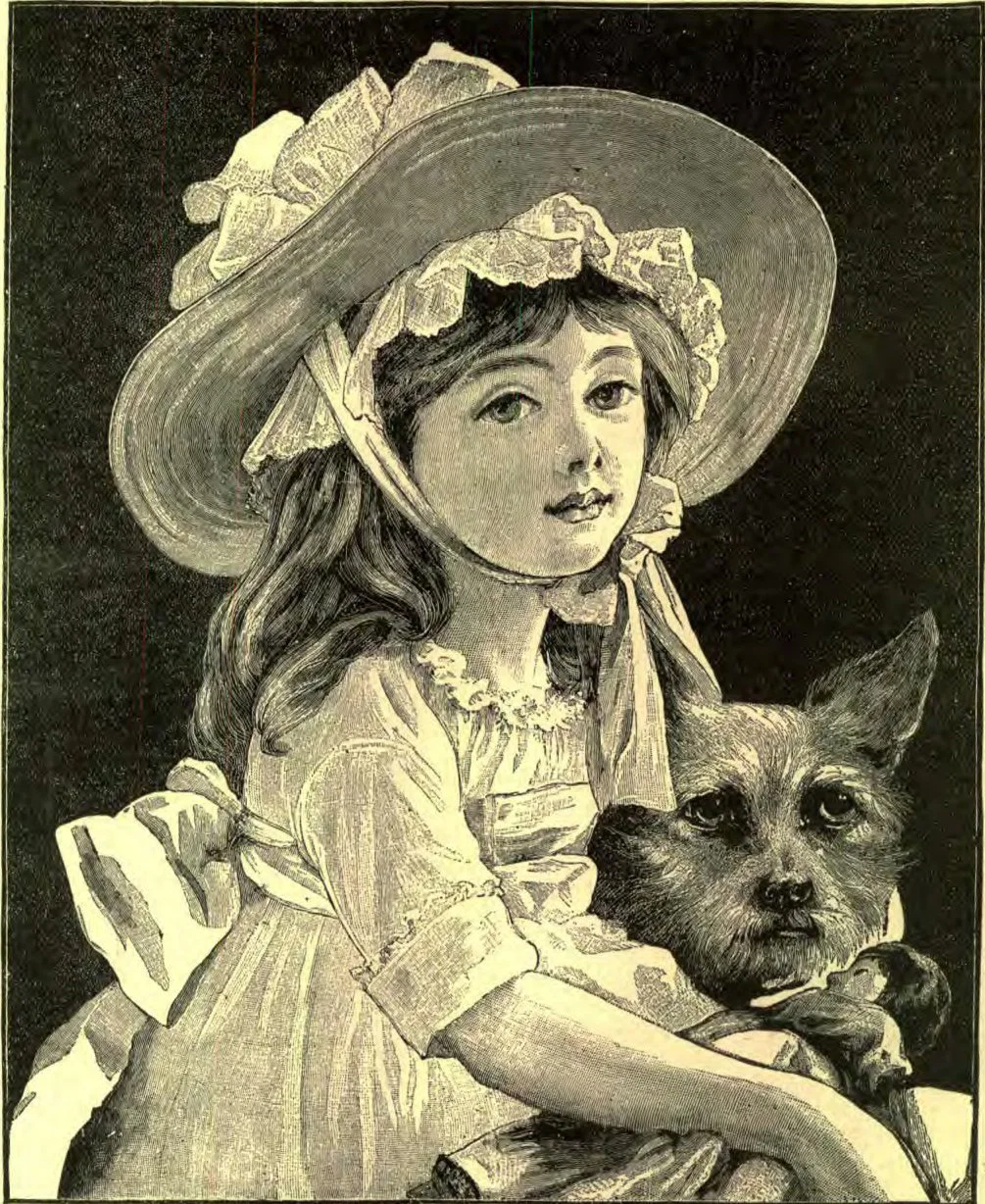
GOING TO GRANDMA'S.

Now, Fido, dear doggie, we're going away, To visit dear grandma this beautiful day; She tells lovely stories, and is always so good, I'd visit her most every day if I could.
And, then, out to grandma's the milk is so sweet, And there are ripe berries and cherries to eat; She lives in the country; and Fido, ’t is true, I sometimes get sick of the city, don't you?
For I love the wild daisies and sweet-smelling hay, And to run in the wide-spreading meadows and play; I can take off my slippers and wade in the brook, And nobody calls me to study a book.
OFF TO GRANDMA'S.
OFF TO GRANDMA'S.
But if you go, Fido, be sure to be good; Don't bark and be noisy, but do as you should; And when grandma's head aches, and she's really ill, We must be very gentle, and try to be still.
Oh, such a sweet grandma, with such a dear home, I know she'll be glad when she sees we have come! Hush, Fido, I'll whisper a word in your ear: There's no one like grandma, so good and so dear.
MRS. L. D. AVERY-STUTTLE.

WHAT FREDDIE SAW.

FREDDIE was out in the orchard, sitting under a tree. Mama looked again, ten minutes later, and he was still there. Fifteen minutes later, mama looked again, and there he sat.
Perhaps he was ill. Maybe he had hurt himself. But then he would cry. Could he be asleep, sitting up straight like that? Anyhow, mama must find out why he stayed there so long; so down she went to the orchard, and came up softly behind the little fellow.
He was looking steadily at a small bush in front of him. Following his eyes, mama saw a large, handsome butterfly drying its wings upon its own empty shell. It stayed an instant longer, and then lifted its lovely wings, and flew away.
The charm was broken.
Freddie sprang to his feet, and, seeing his mother, exclaimed, “O mama! did you see it, too?”
“I saw a butterfly fly away from that bush,” answered mama. “What did you see, Freddie?”
“Why, mama, I saw two bugs come out of bags, and turn into butterflies!”
“Did you, my dear? Tell me all about it, little man.”
“Well, I sat down here, ’cause I was hot running, and I saw those bags there stirring. I was going to pull them off, when, what do you think, mama? those bags just opened their own selves, and two funny bugs crawled out. Those bugs crawled on top of the bags, and sat still. Pretty soon they swelled up, and, mamà, it’s true now,—I did see some wings grow on those bugs. They kept swelling and swelling, and the wings kept growing bigger, and I didn’t dare stir. First one butterfly flew off, and then the other. True, mama! I didn’t ‘make believe’ one single bit.”
“I know you didn’t, Freddie, only the wings were there all the time; they were folded up tight, like the leaves in a rosebud, and you saw them unfold,” said mama. “Don’t forget it, dear; for you have seen a wonderful sight.—
Selected.

OUR SEWING CIRCLE.

This week we will make another quilt block, using the running-stitch. Make two blocks with the backstitch and two with the running-stitch, trying to make each better than the one made before. Then join the four blocks, by sewing the dark squares to the light ones. Be careful to choose colors that look well together, as this will affect the appearance of the whole.
Do not hurry, especially in the preparation of the work. No matter how little is done, do that little thoroughly. When using the running-stitch, be careful not to pucker the work. Smooth out the seam every few stitches, and do not draw the thread too tight. Never bite off the thread. This not only soils the work, but is likely to injure the teeth. Draw the thread over the little finger, never under it. Never use a knot unless it can be completely hidden.
NELLIE V. DICE.

A PRETTY EXPERIMENT.

A PRETTY experiment is that by which the growth of an oak plant can be watched from its earliest stage. Cut a circular piece of card to fit the top of a hyacinth glass, so as to rest upon the edges and exclude the air. Pierce a hole through the center of the card, and pass through it a strong thread having a small piece of wood tied to one end, which, resting transversely on the card, prevents its being drawn through. To the other end of the thread attach an acorn, and having filled the glass half full of water, suspend the acorn at a short distance from the surface.
The glass must be kept in a warm room. In a few days the steam that has generated in the glass will hang from the acorn in a large drop. Soon the acorn will burst, and the root will protrude, and thrust itself into the water; in a few more days a stem will shoot out at the other end, and, rising upward, will press against the card, in which a hole must be made to allow it to pass through. From this stem small leaves will soon sprout; and in the course of a few weeks the experimenter will be rewarded by having a sturdy little oak plant several inches in height.—Selected.

CONDITIONS OF WATER.

II.

We have traced the crystal cycle of water, beginning with the beautiful drops from the rain-cloud, which, after drenching the ground, hasten on to the great sea, thence to be transferred to the clouds, ready again to descend to supply the thirsty earth.
We will now notice some other interesting phenomena connected with water. We have seen that heat is the agent producing the various changes in the conditions of water. Heat causes the particles of water to expand till, becoming lighter than air, they rise as vapor, visible or invisible. Any wet surface exposed to warm air, soon loses its moisture, and becomes dry. Thus clothes are placed upon a line, that the warm air may evaporate all moisture.
When the sun sets, the surface of the ground begins to cool, and soon its temperature is below that of the surrounding atmosphere, especially where there is vegetation. Then the vapor held in the air, coming in contact with the vegetation, condenses, and is deposited as dew upon leaf and blossom, insensibly at first, but increasing as the night advances, and the heat diminishes. Thus the world is bathed in pearly drops to greet the morning sunbeams.
In the cooler seasons the night air may be reduced to the freezing-point, and then the vapor is congealed, and is deposited in the form of frost, which often freezes the juice in the plant, thus destroying its life. The difference between dew and frost is caused by the difference in the temperature of the atmosphere. These conditions are the result of God's thought. “He giveth snow like wool: he scattereth the hoar frost like ashes.”
Snow is vapor that is congealed in the clouds, forming crystals of snow instead of being condensed to drops of rain. As the result of conflicting winds of different temperatures, hail, or frozen rain, is formed. In the winter the temperature of water diminishes till it becomes solid ice,—the very opposite extreme to rare vapor. These extremes exist perpetually in different quarters of the globe. In polar regions there are perpetual ice and snow, but in tropical climates the incessant heat does not permit the condensation in the clouds necessary to produce rain; hence the long rainless seasons.
MRS. S. M. SPICER.

A DREAM.

I DREAMED about birds that were making “collections” Of various toys in all sorts of directions. The balls, tops, and marbles were gathered up lightly, And treasures unnumbered were carried off nightly. ’T was all for bird-science,—no mortal could doubt it,— Yet somehow the boys were all grumbling about it!
—Selected.

Notes & Comments

The Chinese have two of the fastest war-ships in the world’s navies,—a torpedo boat with a speed of thirty-five and one-half knots an hour, and a 4,400-ton cruiser with a record of from twenty-two to over twenty-four knots an hour, according to the draft used.
A Deep Lake.—The deepest lake in the world, as far as known, is Lake Baikal, in Siberia. While nine thousand square miles in area, or nearly as large as Lake Erie, it is from four thousand to four thousand five hundred feet deep, so that it contains nearly as much water as Lake Superior. Its surface is thirteen hundred and fifty feet above sea-level, and its bottom nearly twenty-nine hundred feet below it.
The World’s Sugar.—According to Success, the human race consumes annually between fourteen and sixteen billion pounds of sugar. In 1895 England used eighty-six pounds per capita; the United States, sixty-four pounds; Denmark and Switzerland, forty-five pounds each; France, Germany, and Holland, thirty pounds; and Greece, Italy, and Turkey, seven pounds for each individual. Every year sees an increase in the use of this article of diet. Used in moderation, sugar is valuable as a heat- and fat-producer; but its excessive use clogs the liver and causes serious digestive derangements.
Politics in School.—During the last year a novel experiment was tried by the children of a public school in Milwaukee. They were encouraged to enter upon a course of self-instruction in the principles of municipal government. The offices were all filled, and for a while all went smoothly enough. But before long the officers and citizens of this “Learning-by-Doing” town imitated too thoroughly the methods of their elders. The study of politics absorbed all the juvenile interest, bitter partisan feeling was developed, and one boy who longed for office insured his “unanimous” election by a judicious distribution of pencils, chewing gum, and candy! The parents of the children took sides, and the hard feeling that resulted was entirely out of proportion to its cause. However, it was sufficient to put a summary stop to the “experiment.” If there is no better way for children to become familiar with the usages of municipal government, than by having their consciences seared with the spirit of fraud, deceit, and bribery that too largely prevails, it would be better that they remain in ignorance of them.
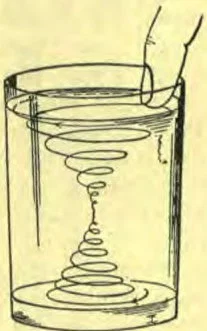
A Waterspout in a Tumbler.—The following experiment showing how a waterspout is formed at sea is thus translated in Popular Science News: “On the bottom of a tall tumbler, or, better, of a cylindrical glass jar, is spread a layer of some colored syrup, such as red currant. The glass is then carefully filled with water, so as not to disturb the layer. If a finger-tip or the bowl of a teaspoon is dipped into the water and rotated slowly for ten seconds, the syrup will be seen to swell and raise itself in the shape of a cone, whose apex is prolonged upward into a slender, flexible column, until it coalesces with the downward-pointing apex of another cone formed at the surface of the water by a rotary movement. Both cones will revolve spirally in the same direction (see figure), and will shift their positions together. If, instead of syrup, small pieces of sugar are strewn on the bottom of the glass and allowed to melt, the remaining particles will be sucked up by the mimic waterspout as far as the thinnest portion of the connecting column, and thrown forcibly outside the vortex. The lower cone will revolve a great deal faster than the upper one, and it is also much smaller. Beside this principal waterspout, others still more diminutive will be produced, whose lower cones are almost invisible, the points of the upper cones rapidly descending to meet the former at less than an inch above the bottom layer. This represents accurately what takes place when two aerial currents come together from opposite directions in the upper strata of the atmosphere, and impart a rotary motion to the latter. Smaller cones may also be set whirling on the surface below, where the air is denser, and they will move much more rapidly than the upper cones. This explains the tremendous velocity of the wind under these conditions.”
WATERSPOUT IN A GLASS OF WATER.

PRACTICAL LESSONS OF FELLOWSHIP

THE SABBATH-SCHOOL LESSON.—NO. 5.

(July 29, 1899.)

PRACTICAL LESSONS OF FELLOWSHIP.

Memory Verses.—Luke 9:46-48.
TIME: A. D. 30. PLACE: Near Mount of Transfiguration, Capernaum. PERSONS: Jesus, disciples, man and lunatic son, multitude, scribes.

QUESTIONS.

1. As Jesus and the three disciples descended from the mount, who came, and with what request? Matt. 17:14, 15. What had he already done? V. 16. What effect did the failure of the disciples have upon the father and the people? Mark 9:22, 14; note 1. What did Jesus say to the father and what was the response? V. 23, 24. With what words did Jesus then cast out the evil spirit? V. 25. In what condition was the boy left? V. 26. What further did Jesus do to heal him? V. 27. What did Jesus say to his disciples about this case? V. 30; note 2.
2. On the way to Capernaum, what did Jesus teach his disciples? Vs. 30, 31. How fully was his instruction received? Luke 9:44, 45. What caused his teaching to be misunderstood by them? Mark 9:33, 34; note 3.
3. Upon reaching Capernaum, who came to Peter, and with what question? Matt. 17:24. What was Peter’s answer? V. 25. Was his answer correct? V. 25, 26. What did Jesus tell him to do? Why? V. 27; note 4.
4. What general lesson did Jesus now seek to impress upon the minds of his disciples? Mark 9:35. What question did this call out from them? Matt. 18:1. How did Jesus reply? Vs. 2-5. In what respects are we to become like little children?
5. Being convicted by these great truths, what previous action of his own did John now call in question? Mark 9:38. What was Jesus’ response? Vs. 39-42. What did he then say to show God’s regard for the “little ones”? Matt. 18:10-14. Who are the “little ones”?
6. When one has been wronged by a brother in the church, what steps did Jesus say he should take? Vs. 15-17. What object should he have in view? V. 15 (last part); Gal. 6:1; note 5. How does God regard the action, when taken in this way? V. 18. What blessing did Jesus then pronounce upon unity among the brethren? Vs. 19, 20. What questions did Peter ask as a result of his instruction? V. 21. What reply did he receive from Jesus? V. 22. To set before the disciples the true spirit of forgiveness, what parable did Christ then give? Vs. 23, 24. What application did he make? V. 25.

NOTES.

1. Though Jesus had given his disciples power over evil spirits, they ignominiously failed in this case. Satan had triumphed over them. The results were that the people, who had reason to expect great things of them as followers of Christ, were led to doubt; and the enemies of the Saviour—the scribes—were given opportunity to cavil. The father, who, it appears, came in faith, was so bitterly disappointed by their failure that his faith in Christ was greatly weakened. Hence his word, “If thou canst do anything.” It were well that the disciples of Christ to-day take this lesson home, lest, like those earlier ones, we shall, by our interest in worldly schemes, lose the power of God from our lives, and, by our failures, cause souls to lose the way.
2. Prayer and fasting, of themselves, are nothing; they are only means through which God puts into the human heart a knowledge of its own weakness and of God’s great strength. Men need to pray and fast, not that they may perform great works for God, but rather that they may gain a knowledge of heaven’s purity and power. Only those who pray much can be used of God to do anything, either small or great.
3. While Jesus was teaching them concerning his approaching humiliation and death, the minds of the disciples were almost wholly occupied with thoughts of self,—how each might secure the highest place. Selfishness blinds the eyes and hardens the heart, and thus it was that they could not discern the meaning of his words. Though Jesus spoke of death, they saw only a scene of temporal glory, in which they should occupy a prominent place. How strange! and yet no more so than now, when men fail to understand truth. Read 1 Cor. 2:14.
4. The “tribute” brought to view in Matt. 17:24 was a tax levied on all Jews for the support of the temple. But Jesus did not acknowledge that he was under any obligation to pay this temple tax. Peter had not stated his Master’s views. As the Son of God, the son of the Owner of the temple, Jesus was free. “But while he saw good to meet the demand, he denied the claim upon which it was based.”
5. The Christian has no rights of any kind for which to contend. Therefore, if his brother has done him a wrong that calls for action, he takes action, not because he himself has claims which must be satisfied, but rather because he pities the one who is in the wrong, and desires to save him from it. To save the brother and keep the church pure, is the only true and unselfish object of church discipline.

DANIEL IN THE LIONS' DEN

THE INTERNATIONAL LESSON.—NO. 5.
(July 30, 1899.)

DANIEL IN THE LIONS' DEN.

Lesson Scripture.—Dan. 6: 10-23.
Golden Text.—Ps. 121: 5.

QUESTIONS.

Who was the first ruler of the Medo-Persian kingdom? What position did Daniel hold? Who were jealous of him? What plot was laid to destroy Daniel? When and where? What effect did the decree have upon Daniel? What is said of his devotions? What effect did the report of his disobedience have upon the king? What did he seek to do? What peculiarity characterized Medo-Persian law? Why? When was Daniel cast into the den? What precaution was taken to prevent his deliverance? How did the king spend the night? What did he do in the morning? How had God vindicated his servant? What was the fate of the plotters? What decree was issued by the king concerning “the God of Daniel”?

NOTES.

1. The incident of the lesson is supposed to have happened about 537 B. C. Babylon fell into the hands of the Medes and Persians, B. C. 538.
2. When Darius the Median, and Cyrus the Persian, his general, came to inquire into the affairs of Babylon with respect to establishing order and reorganizing the realm, they found Daniel in his royal robe and the insignia of the highest office. And when they asked him about the affairs of the kingdom, its revenues, etc., they found him to be so thoroughly informed, and so able, that they took him into their council, and gave him the chief place in the reorganization of the kingdom. . . . When the other presidents and princes saw that Daniel was preferred before themselves, they were dissatisfied. And when they saw that he was likely to be yet further promoted, they determined to break him down utterly.—“The Great Empires of Prophecy,” pages 50, 51.
3. When the king of Persia has condemned any one to death, no one dares speak for him, or make any intercession for him. The command must be executed, for the law can not be countermanded, and the laws can not contradict themselves.—Montesquieu.
4. This custom [of unalterable decree] grew out of the opinions that prevailed in the East in regard to the monarch. His will was absolute, and it was a part of the system that then prevailed to exalt the monarch, and to leave the impression on the mind of the people that he was more than a man,—that he was infallible, and could not err.—“Spirit of the Laws.”
5. Daniel knew perfectly that no law of the Medes and Persians, nor of any other earthly power, could ever of right have anything to say or do with any man's service to God. He went on just as he did aforetime, because, practically and in principle, all things were just as aforetime: so far as concerned the conduct of the man who feared God, any law on that subject was no more than no law at all on that subject.—“The Great Empires of Prophecy,” page 52.
6. Thus, according to this scheme of the conspirators, and so far as all human power is concerned, Daniel was finally disposed of, and was out of the way. Just here, however, there entered an element that the conspirators had not taken account of in their calculations. In Media and Persia a new power had been brought to the dominion of all nations. This was done by the leading of the Lord as really as in the case of Nebuchadnezzar; for, said the angel, “In the first year of Darius the Mede, I stood to confirm and to strengthen him.” It was done also for the same purpose as was that—that the knowledge of God might be proclaimed to all the nations in such a way that they must at least listen to it, because of its being a royal decree.—Id., page 53.
7. The sequel showed that God was able to deliver because innocency was found in Daniel, and before the king he had done no hurt. “Innocence before God is found in the man who disregards any law touching his service to God. It is a divine testimony that the man who disregards such laws, in so doing does ‘no hurt’ to the king, to the state, or to the government.”—Id., page 54.

To Reach BATTLE CREEK

FROM
CHICAGO, BUFFALO, DETROIT, OR TOLEDO,
Purchase Tickets Reading over the MICHIGAN CENTRAL
“The Niagara Falls Route.”
A First-class Line for First-class Travel between Chicago and New York and Boston. Elegantly equipped through trains pass Battle Creek in each direction daily.
R. N. R. WHEELER, O. W. RUGGLES,
Ticket Agent, Battle Creek. Gen'l P. and T. Agt., Chicago, Ill.

SAVING THE SEED.

“GOOD seeds bring a glad harvest.”
It is a law of nature that like produces like. This principle was recognized by Paul when he wrote, “Whatsoever a man soweth, that shall he also reap.” How essential, then, that we select seed with care. There is another principle,—the first is always the best. If we wish to have seed that will produce good crops another year, we must select only the best specimens to save seed from. If peas are saved for seed after they have been gathered two or three times, the seed will be inferior; for, to a certain extent, the strength of the vine has been exhausted. The same principle applies to the seed of all other vegetables.
With lettuce, cabbage, and other vegetables that grow above the soil, there will be little difficulty in selecting the best; but with radishes, beets, etc., it is not so easy to make a selection. It is a good plan to save more of these than will be needed, and when they have matured, you can judge which are the best by pulling them up. When saving seed from radishes, cabbage, etc., those who are the most particular reject all but the seed grown on the leading stem.
Seed should be allowed to ripen thoroughly. Tomatoes should be placed in the sun for a few days; squashes, cucumbers, and pumpkins will require a week or more after they are pulled from the vines for the seeds to mature sufficiently. Melon seeds may be taken when the melon is fit to eat.
When saving sweet-corn for seed, select only the largest ears; after they have ripened, brush off the small grains, and hang the ears up to dry, or shell the grains off and store them away.
Before putting seed away, be sure to label each kind. This will save time and worry in the spring. There is but little apparent difference between one variety of radish and another; the same is true of peas, corn, and a number of other garden vegetables.
The following list shows how long the seeds of the more common vegetables will keep. Of course this estimate is based upon the supposition that the seeds are not allowed to freeze, and are kept in a dry place:—
Asparagus, 5 years. Beans, 6 " Beet, 6 " Cabbage, 5 " Carrot, 4 " Cauliflower, 5 " Celery, 8 " Corn, 2 " Cucumber, 10 " Lettuce, 5 years. Melon, 5 " Onion, 1 " Parsnip, 1 " Peas, 3 " Salsify, 2 " Squash, 45 " Tomato, 4 " Turnip, 5 "
In putting away seed, use tin or glass cans, as these will insure safety against rats and mice.
ARTHUR F. HUGHES.
Continue reading: SKETCHES OF EARLY ENGLISH HISTORY