The text-books say that “zoology is that part of natural history which tells us how animals are formed, how they are classed, what they do, and all about their homes.”
Under this heading Windon found that the animal kingdom includes five subkingdoms,—Vertebrata, Articulata, Mollusca, Radiata, and Protozoa. He kept saying it over and over, until he knew it by heart.
He loved animals, and was learning all he could about them. He caught some hedgehogs, and tried to tame them. He had fox-squirrels gayly spinning in a wheel. He searched the ponds and streams, and came home with tiny red bugs, water-spiders, and beetles. Crabs and turtles interested him, and all wild birds.
But what were the Vertebrata?—“Animals that have brains and spinal cords, like men, horses, snakes, and fishes,” said his book.
It was very curious, Windon thought, if he were an animal. He could hardly believe it at first; but he became reconciled when his teacher told him that man is much higher in the scale of being than a cat, or a dog, or a horse.
He had seen wasps, with their heads and bodies joined together with a thread-like something, not thicker than a pin, and had noticed that bees and ants and crabs are jointed in much the same way. These he found were Articulates, and belonged in the division Articulata. “Articulate” means “having the body and members jointed.”
Snails, he supposed, were hard, and also oysters; but his book said they are soft, mushy animals, and are, therefore, to be classed with the Mollusca, or mollusks. The hard part, the shells, are only their houses.
Windon had never been to the ocean; but there were starfishes in his uncle’s collection of curiosities, and these, he was told, were Radiates, also that the pretty coral and the jellyfish belong to the same class, because their organs, inner and outer, are arranged like the petals of a flower, radiating from the center, their mouths being in or near the center.
Windon had used a sponge in cleaning his slate, and had seen his uncle wet sponges, and put them under his arms when he had a fever; but though he knew the curious things came from the sea, he had forgotten that they are animals.
Yet here they were classed with the Protozoa,—“animals with no proper mouths,” yet taking nutrition, trembling when touched, and smelling like scorched wool when burned.
He liked it all, and prized the book that told him about “four feet, wings, and fins,” more than any other in his library.
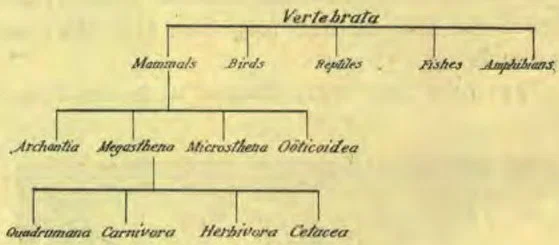
It was not long until he could tell that the Vertebrata are divided into five classes,—Mammals, Birds, Reptiles, Amphibians, and Fishes,—and that Mammals are subdivided into four subdivisions,—Archontia, referring to man alone; Megasthenia, the larger and more powerful mammals; Microsthenia, the smaller mammals; and Oöticoidea, mammals that carry their young in a pouch, or bag, like the opossum and the kangaroo.294
Then he learned the orders of the Megasthenes, or larger mammals; that they are the Quadrumana, or four-handed, like the monkeys; the Carnivora, or flesh-eating, like the wolf and the lion; and the Herbivora, or herb-eating, like the ox and the horse; and the Cetacea, ocean mammals, having fins instead of feet, like the whale.
Windon then made a diagram of his lesson, much as you do of a sentence when studying grammar.
It looked something like this:—
This helped him to remember.
AUNTIE WINCE.
THE BRAVEST BOY
By Frank Walcott Hutt
COULD you place them in a row,
Both the large and small,
Who's the bravest boy you know,
Bravest of them all?
Who's the boy of any size
That should have a hero's prize?
He's the boy that meets his foes
Nobly, one by one,
Halting not, until he knows
Every duty's done;
Every duty, did I say?
Yes; for that's a hero's way.
Where the tiny little throng,
Wide-awake and spry,—
He is brave enough and strong
Not to pass them by.
Conquering the bigger ones,
Little foes be never shuns.
FRANK WALCOTT HUTT.
COWS AND HORSES
How many children can tell the difference between cows and horses? Here are a few of the points of difference, taken from a long list. Compare the numbers; and after you have gone through these, think of as many more as you have noticed, and watch for others. Observe the difference in the tongue, the shape of head and ears, the manner of defending themselves, position in sleep, etc. Compare other animals in the same way. You will find this a very interesting study, which will help you use your eyes, and think about what you see:—
COWS
Have two toes.
Horned.
Have no mane.
Long hair in a tuft at end of tail.
Pawing with forefeet denotes anger.
Seize food with the tongue.
Lips slightly movable.
Have no upper front teeth.
Lie down fore part first.
Rise on hind part first.
Short mouth. No space between front and back teeth.
Four stomachs.
Chew the cud.
HORSES
Have one toe.
Without horns.
Have flowing mane.
Tail covered with long hair.
Pawing with forefeet denotes hunger.
Gather food with the lips.
Lips very movable.
Have upper and lower front teeth.
Lie down hind part first.
Rise on fore legs first.
Mouth long. Space between front and back teeth.
One stomach.
Do not chew the cud.—Selected.
NOTES AND COMMENTS
By A. J. Bourdeau
Rapid Mail Delivery. — The use of pneumatic tubes for the transmission of mail matter is quite common, and productive of great speed in delivery. By this method, letters mailed in Paris, France, are delivered in Berlin, Germany, within an hour and a half, and sometimes within thirty-five minutes.
New Use for Photography. — Public officials in Minnesota are using photography for the detection of oleomargarine. When photographed, butter shows a dull, translucent light; while oleomargarine shows bright and dark spots, caused by fat crystals. The test is said to be very simple, and to convince a jury every time.
French Automobiles in Central Africa. — A French automobile company has shipped forty-two motor-cars to central Africa, to be used in the regular transportation of goods between Busaloba and Bumoka. Heretofore it has required nearly a month to convey merchandise along this trade-route, but the new motor-wagons have accomplished the journey in three or four days. Each wagon weighs about four tons, and has from nine to ten horse-power at its disposal as motive force.
A Cloud of Words. — Whatever the reason, the lawyer generally uses four or five times as many words to express a given thought as are used by the average man. The Kansas City Journal gives the following as an illustration: “If I were to give you an orange,” said Judge Foote, of Topeka, “I would simply say, ‘I give you this orange;’ but should the transaction be intrusted to a lawyer to put in writing, he would adopt this form: ‘I hereby give, grant, and convey to you all my interest, right, title, and advantage of and in said orange, together with its rind, skin, juice, pulp, and pits; and all rights and advantages therein, with full power to bite, suck, or otherwise eat the same, or give away, with or without the rind, skin, juice, pulp, or pits; anything hereinbefore, or in any other deed or deeds, instruments of any nature or kind whatsoever to the contrary in anywise notwithstanding.’”
One Instance of Pig Usefulness. — A Boston paper reports that “the Australian coasting steamer ‘Kameruka,’ while going from Eden to Sydney, traveling at full speed, struck a reef at Moruya Head. There being no rockets on the ship, the captain tied a life-line to some pigs, which formed part of the cargo, and had the animals put overboard. The pigs swam to the shore, taking the lines with them, and, by establishing communication, rescued every soul on board.” We had always thought it an impossible thing for pigs to swim, and that any attempt on their part to do so invariably resulted in the cutting of their throats with their forefeet. However, we may have been mistaken.
What Small Spiders Can Do. — It seems that small spiders are playing havoc with the telegraph wires in the Argentine Republic. The long cobwebs that settle on the wires, when wet with dew or rain, become conductors of electricity. As it is impossible to send messages without a strong current of electricity, the effect of such leakages of the current is practically to stop the operation of some of the lines. In view of this, “the government has determined to connect Buenos Ayres and Rosario by an underground cable one hundred and fifty miles long.” It is a fact that even the wet leaves of trees, in contact with the wires, or wet poles, are often the means of causing much of the current to escape. It is, therefore, quite dangerous for linemen to repair the wires when obliged to support themselves on a wet pole. On the other hand, a295man may, with impunity, hang from a live trolley-wire, provided he does not touch the ground, nor any conductor of electricity connected with the ground or with another wire.
A Princess a Bookbinder. — It has leaked out that Princess Victoria of Wales is a skillful and artistic bookbinder. “At a bookbinders’ exhibition held in London recently, one of the prizes was awarded to a Miss Matthews, who turned out to be the princess.”
Rather Costly Elevating. — The Washington Monument elevator will hereafter be operated by electricity. According to the Electrical World and Engineer, “it costs the government at present about twenty thousand dollars a year to take the public up the five hundred feet to the top, and down again. The sundry civil appropriation bill, approved June 6, included twenty thousand dollars for one dynamo and connections, and installation of a new system, and six thousand five hundred dollars for an addition to the boiler-house.”
A. J. BOURDEAU.
BABIES IN ALASKA
An Alaskan baby has less chance of living to manhood or womanhood than have the babies of other countries. The Alaskans are bold, warlike, and healthy; are great hunters, trappers, and fishers. But the ignorant mothers do not know how to take care of their little babies, and so they die by the score.
How do they treat the babies?—To begin with, they rub their little bodies with grease, pack dry grass tightly around them, and then roll them up in a skin or a blanket. In this tight bundle the baby stays, with his limbs held close to his body, unable to do anything—poor little thing!—but cry from discomfort. If he cries too loud or too long, his mother puts his head under water to teach him to keep still.
Once a day the blanket is unrolled, and fresh grass is packed around the little fellow. After the first year, if the child lives through it, the wrappings are taken off, and the baby is allowed to crawl about, and is fed liberally on whatever the grown-up members of the family have for dinner—seal fat, dried meat, and dried fruit. With such bad food, and such a cold and bad climate, very many of the children die before they are five years old.
When a baby dies, its body is put in a “burial basket.” This is often prettily embroidered, and dyed in bright colors; for the Alaskan mother loves her baby dearly, and makes its tiny coffin as beautiful as she knows how. The burial basket is put into a little canoe, which the mother pushes out into the stream, and the stream bears it out to the sea, where the gods are supposed to receive it. And that is the end of the poor Alaskan baby.—Selected.
TO A LITTLE MAID
How should little maidens grow,
When they're ten or over?
In the sunshine and the air,
Wholesome, simple, fresh, and fair,
As the bonny daisies blow,
And the happy clover.
How should little lassies speak,
When they're ten or over?
As the birds do, and the bees,
Singing through the flowers and trees,
Till each mortal fain would seek
The merry-hearted rover
How about her eyes and ears,
At this stage of growing?
Like the clear, unclouded skies,
Not too eager nor too wise,
So that all she sees and hears
May be worth the knowing.
And the little maiden's heart?
Ah! for that we're praying,
That it strong and pure may grow;
God, who loveth children so,
Keep her from all guile apart,
Through life's mazes straying.
1. How does Paul here address the Galatians? What question does he ask? What had resulted from their being bewitched? How had Christ been presented before them? V. 1; note 1.
2. What question does Paul next ask? V. 2. How is the Spirit of God received? Acts 2:38; note 2.
3. What question shows how foolish the Galatians had been? Gal. 3:3. How complete does Jesus make the work of our salvation? Heb. 12:2. What is the result of living after the flesh? How may we escape death? Rom. 8:13; note 3.
4. What experience had the Galatians had after accepting the gospel? Gal. 3:4. How do Christians often have to suffer? Matt. 5:10, 11. In what other way do they suffer? 1 Peter 4:1, 2; note 4.
5. What had the ministers of the gospel ministered to the Galatians? What wonders had been worked among them? What question does Paul ask as to how this work had been done? Gal. 3:5. What is the evident answer to this question? Note 5.
6. Who is mentioned as an example of faith? What did he do? Then what did the Lord do? V. 6.
7. Who are children of Abraham? V. 7. In what sense are they his children? Note 6.
NOTES
1. Paul had preached the gospel to the Galatians with so much of the power of God that they had beheld Christ crucified as truly and vividly as if they had stood beside the cross on Calvary. One translation of this verse reads: “O foolish Galatians! who has bewitched you? You, before whose eyes was held up the picture of Jesus Christ upon the cross.” And it is also our privilege to behold Jesus crucified for us. Jesus said, “Blessed are they that have not seen, and yet have believed.” John 20:29.
2. Paul’s question carries the answer with it. They knew he had not preached that the Spirit was received by the works of the law. Only those whose faith led to repentance and baptism had received the Spirit.
3. Jesus is “the author [“beginner,” margin] and finisher of our faith.” The Galatian believers had begun their experience in the Spirit, which was received by faith. Paul sought to show them how foolish it was for them to depart from this plan, and seek salvation by the works of the flesh. If salvation were to be had at all by works, why not start out that way? And if not, why not follow the Lord’s plan to the end?
4. The Galatians had evidently had a good Christian experience; for suffering for Christ and with Christ brings the greatest blessings. A blessing is pronounced upon those who are persecuted for their faith, and the death of the old man of sin is likened to crucifixion,—a very painful death. But having thus suffered in the flesh, we have the blessing of life and righteousness in Christ.
5. The only answer to this question is that the Spirit was given, and the miracles were wrought, not by man’s own works, but by faith in Christ, with whom God has freely given us all things. See Rom. 8:32.
6. All who believe as Abraham believed are called his children, because they have the same blessings he had, as if by inheritance. See Gal. 3:29. The Galatians were trying to become the children of Abraham by being circumcised; but Paul showed them that they could become Abraham’s children only by faith, such as Abraham had.
SUGGESTIONS FOR STUDY
We have studied and reviewed the first and second chapters. But do not now leave these behind. Take them along with you in your study of the third chapter, and so on to the end of the epistle. Then as you follow this plan of adding to your knowledge of God’s word, he will multiply his blessings to you.
SEPTEMBER STUDY OF THE FIELD
PART V: REVIEW
(September 23-29)
NOTE.—Again we have a review of the notes that have appeared in the INSTRUCTOR during the last quarter. At first, aim to answer as many questions as you can from memory. After that look up all the answers in the INSTRUCTOR, if you have access to the file. Where possible, let two or three study together. If nothing more is accomplished, let this review be an incentive to a closer study during the coming quarter.
1. What can you say of the desire for education in China? Of the respect for the printed page?
2. Tell something of the religion of this people. What traces are still visible to show that at one time they had a vague idea of the true God?
3. Describe briefly the mode of worship that binds the Chinese so strongly to their ancestors. How does this affect the living?
4. What is the condition of the poor of Mexico? How can you partly account for this degradation?
5. Mention some encouraging results of missionary effort in Mexico, also some of the needs of this field.
6. Describe some of the geographical peculiarities of Greece. The national character.
7. What condition in the worship of the Greeks gave Paul an opportunity to tell them of the true God?
8. Describe briefly the Greek Church. How does it celebrate Easter?
9. How did the message first reach Russia? Relate the experience of Elder Conrad upon his first visit to Russia.
10. In what way was the message carried to Argentine?
11. What selection from the Spirit of prophecy has been given showing that the youth have a responsibility in the closing work?
Discovering Good on Every Side
By Robert Browning
WITH a quickened eyesight, go on discovering much good on the worse side, remembering that the same process should proportionably magnify and demonstrate to you the much more good on the better side.—Robert Browning.
To Reach BATTLE CREEK
FROM
CHICAGO, BUFFALO, DETROIT, OR TOLEDO,
Purchase Tickets Reading over the MICHIGAN CENTRAL
“The Niagara Falls Route.”
A First-class Line for First-class Travel between Chicago and New York and Boston. Elegantly equipped through trains pass Battle Creek in each direction daily.
R. N. R. WHEELER,
Ticket Agent, Battle Creek.
O. W. RUGGLES,
Gen’l P. and T. Agt., Chicago, Ill.
TAKE THE Canadian Pacific Railway
for . . . CHATHAM, OTTAWA, MONTREAL, LONDON, GALT, QUEBEC, WOODSTOCK, TORONTO, BOSTON, PORTLAND, and
All points in New England, the Maritime Provinces, Great Britain, and the Continent.
Illustrated literature, time-tables, and full particulars, upon application to—
J. FRANCIS LEE, GEN. AGENT.,
Passenger Dep’t 228 SOUTH CLARK ST., CHICAGO.
Branch Offices: 770 Ottawa St., Grand Rapids, Mich., Room D, Chamber of Commerce, Cincinnati, Ohio, 515 Chestnut St., St. Louis, Mo.
Cincinnati Northern Railroad Co.
TIME TABLE NO. 3.
IN EFFECT SEPT. 24, 1899.
Trains Pass Battle Creek, as follows:
WEST-BOUND.
No. 21, Mail and Express — 6.58 P. M.
No. 23, Accommodation — 2.07 P. M.
No. 27, Local Freight — 8.25 A. M.
EAST-BOUND.
No. 22, Mail and Express — 8.25 A. M.
No. 24, Accommodation — 1.45 P. M.
No. 28, Local Freight — 5.30 P. M.
Direct connections are made at Toledo with all roads diverging. Close connections for Detroit and Cincinnati.
J. L. READE, Ticket Agt., Battle Creek.
B. R. SMITH, City Pass. Agt., 6 West Main St.
E. W. Meddaugh and Henry B. Joy, Receivers,
CHICAGO & GRAND TRUNK R'Y.
By A. S. Parker
Trains arrive and leave Battle Creek.
WEST-BOUND FROM BATTLE CREEK.
No. 9, Mail and Express, to Chicago, 12.15 P. M.
No. 1, Chicago Express, to Chicago, 9.00 A. M.
No. 3, Lehigh Valley Express, to Chicago, 3.40 P. M.
No. 5, Pacific Express, to Chicago, with sleeper, 1.10 A. M.
No. 75, Mixed, to South Bend, 8.20 A. M.
Nos. 9 and 75, daily, except Sunday.
Nos. 1, 3, and 5, daily.
EAST-BOUND FROM BATTLE CREEK.
No. 8, Mail and Express, to Pt. Huron, East, and Detroit, 3.45 P. M.
No. 4, Lehigh Express, to Port Huron, and East, 8.27 P. M.
No. 6, Atlantic Express, to Port Huron, East, and Detroit, 9.25 A. M.
No. 2, Leh. Exp., to Saginaw, Bay City, Pt. Huron, and East, 6.50 A. M.
No. 74, Mixed, to Durand (starts at Nichols), 7.10 A. M.
Nos. 8 and 74, daily, except Sunday.
Nos. 4, 6, and 2, daily.
A. S. PARKER, Ticket Agent, Battle Creek.
THE PLEASANT SIDE
“How I hate cloudy days!” the girl said, complainingly.
“But look at the sunset!” replied her friend, with a smile as bright as the brilliant glow of color in the west.
“These sand-burs are the plague of my life,” complained the girl a moment later, as she stooped to remove a dozen of the prickly nuisances from her skirt, her sense of offense growing stronger each moment. “Seems to me folks might take some pride in the way the street looks in front of their houses.”
“Look, Helen, at the lovely ferns in this yard! Don’t they fairly take you into the very heart of the woods?” was the cheery observation that greeted this petulant outburst.
“Don’t you dislike the smell of a grocery?” said the girl, lifting her nose as they passed the little corner store that was one of her peculiar thorns.
“I wasn’t thinking of the smell, but of how convenient this place must be for your mother on busy days,” replied the friend; “and see!” she added, “the untidy back yard you have worried over so much has been raked and smoothed till it is as clean as a floor.”
“You always will find something pleasant to look at, won’t you!” exclaimed the girl, forgetting the offending odor in admiration of her friend’s happy faculty of constantly looking at the bright side, persistently making the best of things.
And isn’t it the better way? Try it, and see.
AS WE GO ALONG
“So at last Caroline will find life something besides just a place to work in,” said one not long ago, in concluding an account of good fortune that had come to a friend; and for a moment we echoed the manifest thought that it would be a very pleasant thing for others to find life something besides “a place to work in.”
But another moment brought the “second thought” that is so often the better thought. The person under discussion has had an exceptionally busy, and in many ways an unusually happy, life. Her work has been congenial; she has traveled widely, and has made many friends. If she had lived altogether to herself, as she might easily have done, she would have forever missed much of the loyal support and kindly sympathy that have lightened her hardest tasks, and brought something better than rest to her weariest hours. And now that the necessity for work is removed, it is pleasant to know that she has no thought of giving it up.
We are sometimes pointed to the ceaseless activities of nature as an incentive to labor, and reminded that the moment this activity ceases, death and decay begin. But it is not necessary that we go outside our own experience to prove the truth of this statement. We all enjoy an hour’s playtime the better for the consciousness that we have done our work, and done it well. The knowledge that a hard lesson is thoroughly learned gives a zest to an hour’s reading that would be entirely lacking if the thought of the unsolved problems crept in between the lines.
But there is a still better way. He who is truly wise does not wait for the leisure hour for enjoyment. He finds it as he goes along, in the very work itself. There is no task so humble, so trivial, so disagreeable, that needs to be done at all, but can be so heartily and cheerfully and faithfully accomplished as to bring, in the doing, its own reward of satisfaction and a certain enjoyment. Dishwashing, for instance, that prosaic work that must be done three times a day in nearly every home, may, if one shuts her eyes to the grease and the soap and the black, and thinks instead of the shining result, be a pleasure instead of what it is too often felt to be—the most disagreeable part of the day’s duties. There is no lack of other examples: making beds, cleaning lamps, sweeping and tidying a room, splitting wood, bringing water, weeding the garden,—anything that will in anywise make for the comfort and well-being of others,—may be done in such a way as to bring a sense of enjoyment and happiness to the door.
Pity for those who dawdle through their tasks, slighting them when they can, and always wishing they were finished!—pity for them, not because they have something to do, but because they have never learned that—
“Life can’t be made worth living to a shirk;
You can’t have even fun, unless you work.”