The Youth’s Instructor, Vol. 48, No. 37.

A TRIP TO PARIS

The Youth’s Instructor

Sep 20, 1900

Review and Herald Publishing Company · Battle Creek, Mich. · Sep 20, 1900

A TRIP TO PARIS

II
On leaving the train, our two travelers walked a considerable distance, mainly because there seemed nothing else to do. They did not know what to look for first, nor yet where to find it. Their walk led them to a tram-car, or street-car, station. Here, on paying a fare of thirty centimes (six cents) for inside seats, or fifteen centimes for outside seats, on the top of the car, a large brass check, with a number on it, was given to each prospective passenger. These checks were numbered in order, and the one purchasing first received the lowest number. When the car came, persons were admitted only on the presentation of the checks; and those holding the lowest numbers were admitted first. When all the seats were filled, no more were admitted till the next car came. By this ingenious system, which would work a revolution in the selfish, jostling, standing crowds of a Chicago street car, all were insured seats, and none could crowd in ahead of his turn.
The car taken runs on a slightly elevated street around the north side of the city. The visitors, seated on top of the car, facing the south, enjoyed a most delightful change from their tedious all-night ride and early morning walk. Having no objective point in view, they rode as far as the car would take them. By this means a good idea of the lay of the city was obtained. When nearing the end of the line, and while listening to the talk of their fellow passengers, a few words were sufficiently understood to convey to them the information that they were passing a Russian, or Greek, church. Its attractive exterior caused them both to decide upon a visit to it at the first opportunity. The next day this was accomplished; and in nothing during their whole visit were they more thoroughly repaid than in the investment of the small fee required to admit visitors to this church. Words would have to be combined very skillfully to convey any accurate idea of the grandeur of the place. Nothing in either Protestant or Catholic churches visited before or since will bear comparison with it.
The car stopped just before the Arc de Triomphe, the great pile that commemorates Napoleon’s triumphant campaigns. The top of the monument was reached by climbing two hundred stone steps in a winding stairway. From this position an excellent bird’s-eye view of the whole city was obtained. There were many visitors passing and repassing on the broad top; and among them our friends, fortunately for them, heard words in their own tongue from a lady and gentleman who were also visitors in the city, but who had mastered the language of the people. Being familiar with the place, this lady and gentleman kindly explained some confusing things about the points of the compass, pointed out several objects of interest, and told the best time to visit them,—information which was much appreciated.
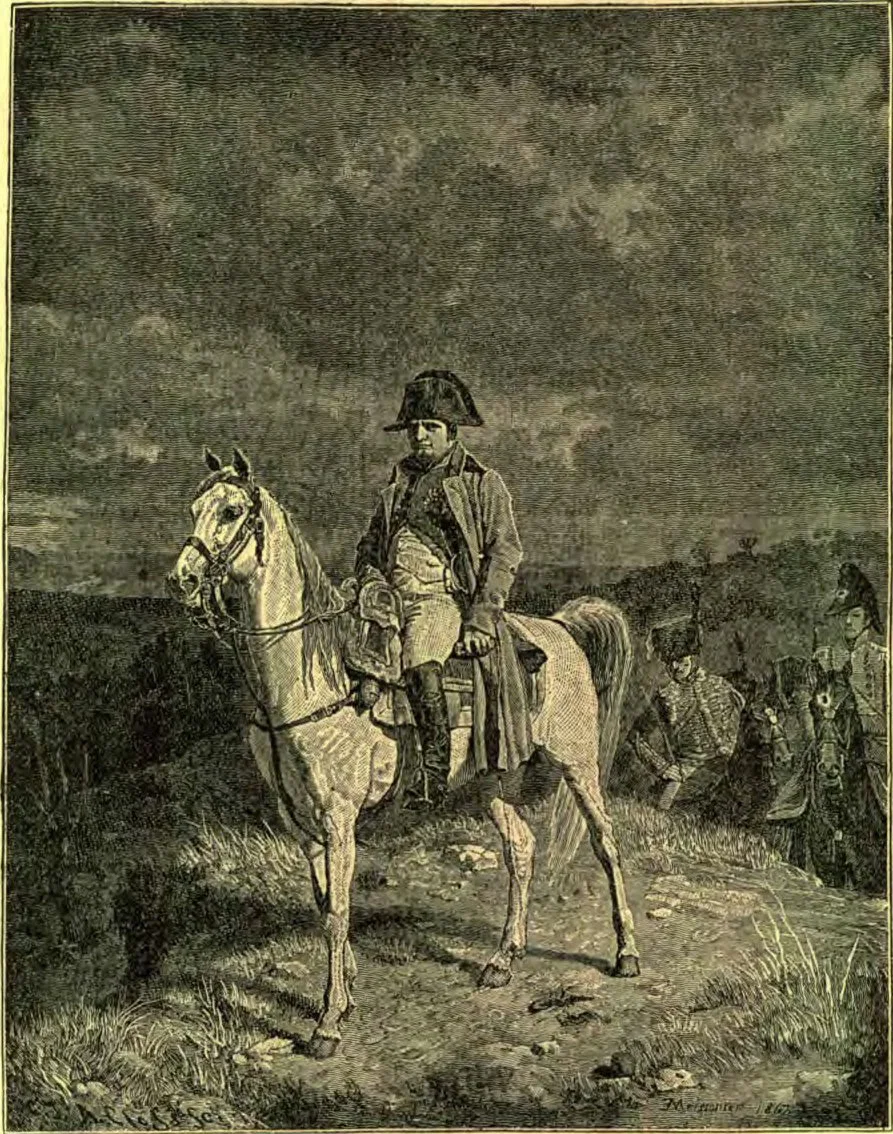
NAPOLEON ON HORSEBACK
The next place visited was the exposition site of 1889. Several of the buildings had been torn down, but some were still standing.
Beyond these is the Eiffel Tower, previously mentioned as the first prominent object seen on entering the city. Under one corner of its massive frame our tourists seated themselves to rest and study a map of the city and its surroundings. While busily discussing this map, a gentleman approached unobserved. He, too, was a stranger in the city, being a delegate from Toronto, Canada, to a Sunday-school convention in England. While there, he made the usual visit to Paris, and was attracted to the seat by hearing the familiar sound of his own tongue. This bond of union proved to be mutual, and the three were together till he left for home, two days later. The Canadian said he had found a pleasant English hotel, and invited his new friends to stay there. The landlady had a large sign over the door, reading, “English Hotel;” but on being asked what part of England she came from, she confessed she had never seen England. She was born in India, which of course is under British control.
The English hotel, however, was some distance from the tower, where this meeting took place. Soon after this incident some one suggested something to eat, as it was already noon. A restaurant was near at hand; and a guide, who had been secured for an after-dinner’s visit to the Hotel des Invalides, proposed the place for dinner, and volunteered to act as interpreter at the meal. After considerable delay, dinner was announced,—but what a dinner! Probably it would have tasted well enough to one who was used to it, but to the Americans it was nauseating. Our friends did not learn just what was set before them, but one dish was found to be fried string-beans, over which a bountiful supply of strong oil had been poured.
After dinner, when the bill was asked for, the greatest surprise was manifested. Two attendants sat down at a table, with paper, pens, and ink, and for fifteen or twenty minutes wrote vigorously. At last a sheet was perfected. The guide, who undoubtedly was to receive a percentage, interpreted its contents. Each item of the meal was mentioned, and a price stated for it in the right-hand column. After a list that seemed far to exceed what had been served, came an item for “service.” This was for the time of the waiters in preparing the meal, and making out the bill! Next followed an item for “tablecloth,” and lastly one for “napkins.” By the time the last item was read, the guests began to wonder if a charge would be made for chairs, knives, forks, etc., and for the air breathed.
The bill was exorbitant, and protests were freely made, the claim being entered that the charges were much higher than for similar service in London. The guide said he would see what could be done about it; and after a long conference with the proprietors, he returned, saying that no reduction could be made. Said he, “You see, gentlemen, Paris is not London. London is a commercial city, but Paris is a city of pleasures, and people expect to pay for them.” The bill was paid, and thus another lesson was learned.
The visit to the Hotel des Invalides was one never to be forgotten. The front portion of the building is square, surmounted by an immense gilded dome, underneath which is a basin of similar proportions. This excavation, the dome, and indeed this whole section of the building, are finished with dazzling splendor. In the center of the basin-like, inverted dome, which is several feet below the floor where visitors are allowed, is the last resting-place of Napoleon, the national hero of France. Born in a soldier’s camp; educated in a military school; and as a young man trained to endure hardship without a protest, and carnage without a conscience, he attained among men a position that many regard as the highest ideal of life. But what was really gained?—He died an exile on an isolated island, without even the common comforts of a peasant’s home. Looking at his career from the standpoint of this life only, his voyage on life’s ocean was a terrible shipwreck; but regarding the possibilities of a life beyond for such as he, nothing hopeful can be said.
A large portion of the building in which this tomb is situated is set apart as a home for the old soldiers of the republic, many of whom have been maimed for life, and were seen hobbling about on a wooden stump, or walking with an empty coat-sleeve. An interesting museum of old armor and other relics of different periods of the national life of France is also connected with the place. Beautiful gardens extending to the river, and filled with flowers alongside the well-kept gravel walks, form a fine promenade for the old veterans.
As the tourists left this place, they walked a short distance to a large building guarded by soldiers. They did not know what the place was; but being there to see all there was to see, they started up the walk toward the front doors. A soldier motioned them to stop, but they were persistent. An attempt was made to pass him, but two other soldiers near at hand presented bayonets at close quarters, so that no progress could be made. At this juncture a higher officer, who had been watching at a little distance, came up, and tried his best to make the tourists understand something, but they only indicated a desire to enter the building. After some parleying the officer indicated by signs that if the small satchel carried by the elder visitor was surrendered, they could proceed. This was at once agreed to, the men even offering umbrellas, jackknives, etc. The satchel was taken, and with a good-natured smile the other articles were refused.
A young soldier was assigned the duty of escorting the men through the building. At the door he again plied them with questions, but to no avail. He could not make them understand French. After passing through a hall, they were shown into a large auditorium, with seats arranged in a partial circle, those in the rear being elevated considerably higher than those in front. As they stood facing these seats, which nearly surrounded them, the guide tried to tell what the room was, but none of the party could understand at first. Finally he pointed to a large chair on the platform behind them, and said, “Président.” Then it dawned upon the mind of the younger visitor that they were in the Chamber of Deputies, which in France corresponds to the House of Commons in England, or the House of Representatives in Washington. On his speaking the words, “Chamber of Deputies,” the French soldier exclaimed, enthusiastically, “Oui, oui,” meaning, “Yes, yes.”
Much pleased that he had been able to convey this information, the guide made another effort to interest his visitors. Pointing to a section where several seats were torn out, and carpenter’s scaffolds were placed, he tried for some time to tell about it, but was unsuccessful in making himself understood. His audience tried their best to understand, but could not. At that another Frenchman in civilian dress, who had fallen in with the party, proposed to try an explanation. He put his hands together, as if expressing the shape of something round; then, motioning with his arms, as if throwing something toward the demolished seats, he exclaimed, with much force, “Whiz! Bang!” The effort was well planned, and entirely successful. The younger visitor said the word, “Anarchist,” and he said, “Oui, oui, anarchist,” pronouncing the word with the soft sound of ch. The word “dynamite” was also mutually understood.
The repairs going on were to restore the damage done by the bomb thrown but a short time before by Vaillant, as previously mentioned. This lesson had taught the French guards to be suspicious of strangers, and no one could blame them. By keeping the satchel outside, they were guarding against another bomb being carried into the building.
After seeing this room, the visitors were taken into adjoining rooms, where, although it was Sunday, several men were at their desks. They all regarded the visitors with great suspicion, and would not remove their eyes from them while in their presence. The young soldier was put to his wit’s end to understand the things spoken to him; but he thoroughly understood, before they left, that his guests were from America, the name of the country, and also the words, “Etats-Unis” (United States) being spoken by him. A mention of Lafayette also brought a pleased look to his face, showing that he was aware of the assistance rendered this country by one of his nation.
H. E. SIMKIN.
(Concluded next week.)

Position of the Planets for October 1, 1900

ASTRONOMICAL STUDY — NO. XIII

Position of the Planets for October 1, 1900
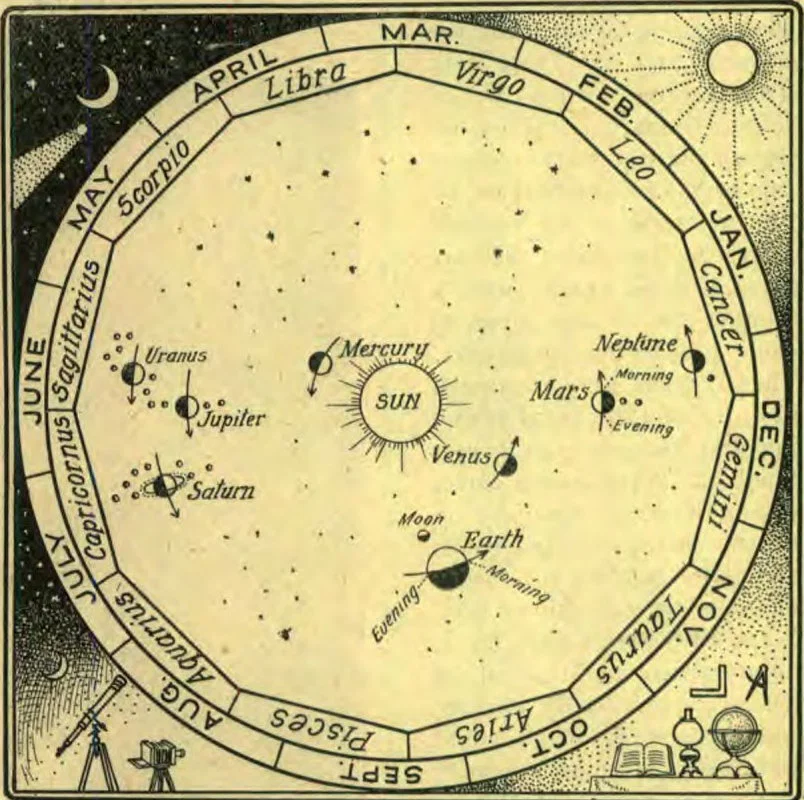
In the INSTRUCTOR bearing date of August 23, we presented a diagram of the solar system, showing the relative positions of the sun, earth, moon, and planets as they would be September 1, 1900. This week we are pleased to call the attention of our readers to the same subject, showing the position of the planets as they will be October 1, 1900. We are glad to learn that so many of the INSTRUCTOR family are making a real study of these subjects, and feel that they are being benefited thereby. We can scarcely see how any one can study the majestic workings of our Heavenly Father without having his soul drawn out to the Author and Giver of all our many blessings.
Now let us study, together, this present diagram, carefully comparing it with the one that appeared in the issue of August 23.
First let us notice the planet Neptune—the one farthest from our sun, and the one requiring a longer time than any of the others to make its yearly revolution around the sun. So far as the diagrams are concerned, we can not see that Neptune has made any progress during the whole month of September. Why do you suppose this is? Think a moment, and see if you can not tell.
We will tell you: although it has been moving swiftly on in its course at the rate of about twelve thousand four hundred miles each hour, it is so very far away from the sun that it requires one hundred and sixty-six years of our time to make one year of its time; this will explain why it has apparently made no progress during one month of our time.
So far as appears on the diagrams, the planets Uranus and Saturn have made but little onward progress, owing to their great distance from the sun.
Next we come to Jupiter, which we see has made some visible progress, as we find it has gained somewhat on Saturn, and left Uranus somewhat in the rear. By the way, how many are watching the real planet Jupiter in its movements among the other stars of the evening heavens? We know of several who are, with us, enjoying this study, and we wish all would. You remember that for a long time this planet appeared to be moving westward among the stars, then for some time it seemed to stand exactly still; but that ever since the middle of August, it has been moving again on toward the east. How carefully did we watch for the first visible shifting of its position toward the east! You remember we told you in an article about this planet some time ago that it would do this very thing, and we know many were pleased to see how faithfully it obeys the Father's commands. May we as faithfully walk in the pathway he has marked out for us.
The next planet that claims our attention in our journey toward the sun is Mars, which, as you will readily see, has made considerable progress, having gained quite perceptibly on Neptune. Now how many can tell, by looking at the diagram, whether Neptune is a morning or an evening star to the inhabitants of Mars? Notice carefully, and see who can tell. Yes; it is a morning star, and has been for some time. How can we tell? Notice again, and see from which place on Mars could you see Neptune the better,—at the point marked “Evening,” or at that marked “Morning.” From the “morning” side, of course. Now another question: By the middle of November, Mars will have so far passed Neptune as to leave it considerably in the rear: will Neptune then be a morning or an evening star to the people living on Mars, supposing that planet to be inhabited?
Our own earth has, of course, moved onward one twelfth of the circle during the last month, and the moon will be in nearly the same position. Venus has been speeding on so as to get considerably ahead of us; while Mercury, which was a morning star last month,—that is, it could be seen from the “morning” side of our earth,—has so sped its rapid flight that we see it peeping around on the “evening” side of the sun, and so it becomes an evening star. Although we speak of Mercury as being an evening star from September 13 to November 29, we shall be privileged to see it but a very few evenings during that time. You who wish to make the acquaintance of this planet may have the privilege of doing so, provided the weather is pleasant, on the evenings of October 28–30. You will see it hanging low in the southwestern sky immediately after sunset. Watch it, and see how rapidly it moves onward in its journey.
One word further as to how to apply the diagram to the heavens themselves. In the evening, stand facing the south, with the top of the diagram to your right. This will bring the sun to the west of you, and you will see Jupiter and Saturn low in the southwestern sky, just as illustrated in the diagram.
You are to imagine yourself as being on that part of the earth marked “Evening,” rolling away from the light of the sinking sun into the dark shadow of the earth. In the morning, stand facing the south; but with the top of the diagram to your left, which will bring the rising sun to your left, or the east; then imagine yourself upon that part of the earth that is just rolling out of its shadow into the light of day, and you will see Venus and Mars as morning stars, as illustrated in the diagram.
Fix these things in your mind, apply what you learn to the heavens themselves, and you will have within yourselves an understanding of the movement of these worlds in their courses that will be a source of wisdom, instruction, and satisfaction that can not be obtained from a superficial piling up of cold facts and figures. May the Lord bless our Instructor family as, together, we study the beauties of his heavens, which continually declare his goodness and glory.
DR. O. C. GODSMARK.

The True Law of Life: Consecration

THE true law of every life, the only law of life, is consecration. Consecration is going out in the world where God Almighty is, and using every power to his glory. It is simply dedicating one's life, its whole flow, to his service.—J. F. W. Ware.

THE TRIALS OF AN APPLE-TREE

In Thoreau’s writings there is an interesting account of some wild apple-trees that he found in an obscure pasture in Massachusetts. This little growth springs up perchance between the rocks. For a year it is unnoticed by the browsing kine. But the next year, when it has become stouter, and risen above the level of the rocks, the cattle find it, and eat off its tender leaves and twigs. Thus it is cut down annually, but it does not despair. It puts out two short twigs for every one cut off, and spreads out low along the ground, growing stouter and more scrubby, until it becomes, not a tree but a compact little bush, in form like a pyramid. The cows regularly clip it all round each year, as a hedge with shears, until it gets a height of three or four feet and a base six feet in diameter. Thoreau says many of this size are old trees. He counted the annual rings on one which was but a foot high, and found it to be twelve years old, sound and thrifty.
The cows continue to browse on these little trees, and keep them down, and compel them to spread out at the trunk, until they are so broad that they make their own fence. Then, some interior shoot, which the cattle can not reach, darts upward with joy, for it has not forgotten its high calling, and in time bears its own peculiar fruit. From this shoot other twigs branch out higher up, and the tree spreads out at the top as it had before at the base, so that now it no longer resembles a pyramid, but an hour-glass. These upper branches, however, seem to grow the more lustily now, the tree’s long-pent-up energies having been released; and the lower growth, having served its temporary purpose, dies in the shade, and in time disappears. Then the forgiving tree allows the now harmless cows to come in and stand beneath its generous shade, and rub against its trunk, which has grown in spite of them, and even allows them to taste a part of its fruit.
Do these trees make you think of some persons you have known, or of some experiences that you yourself have passed through, when it seemed as if the trials came thick and fast? What a struggle with hardship you had! You were determined to get an education. Poverty, sickness, losses, and trials came in steady succession, like the cows nipping the tender twigs of the apple-tree. Or, you decided to carry out some noble project, and met opposition. Perhaps it was your purpose to be a Christian, and severe temptations were encountered.
Now adversity comes to us all, to young and old,—trial in some form or other. But amid all these things can we not feel sure that God cares for us? And as those trees finally rose above adversity, and bore fruit, so may we, gathering root and strength of character, and rising above every difficulty.
Were the apple-tree disposed to reason and complain after the fashion of some people, how easily it might become envious, if it saw in a neighboring orchard another apple-tree growing in good soil and not in a rocky pasture, becoming in twelve years more than twelve feet tall, itself but twelve inches high and appleless, while its favored neighbor is bearing luscious fruit, and not obliged to endure the trimming of the cows. But this stubby tree does not act as persons do who quarrel with Providence, and who envy acquaintances more highly favored than themselves. It wastes no strength in fault-finding, but uses all its energies to get greater strength, to take deeper root, and to reach greater height. In our cutting-down times of life we do well to strive to strengthen our inner life, and deepen our root in God, assured that if we abide in him, in due time we shall grow upward, and bear fruit in spite of our hard knocks,—fruit perhaps for the benefit of those about us who at times have caused us trouble.—Young People’s Weekly.

Editor's Note on Dr. Godsmark's Illness

EDITOR'S NOTE.—Just as this paper goes to press, we learn that Dr. Godsmark is very ill with brain fever, so that beyond one article already sent in, we can promise nothing further in these studies for some time. We are sure our readers everywhere will unite in the petition that if it is God's will, the life of this useful laborer may be spared.

L. A. REED

27—Vervain

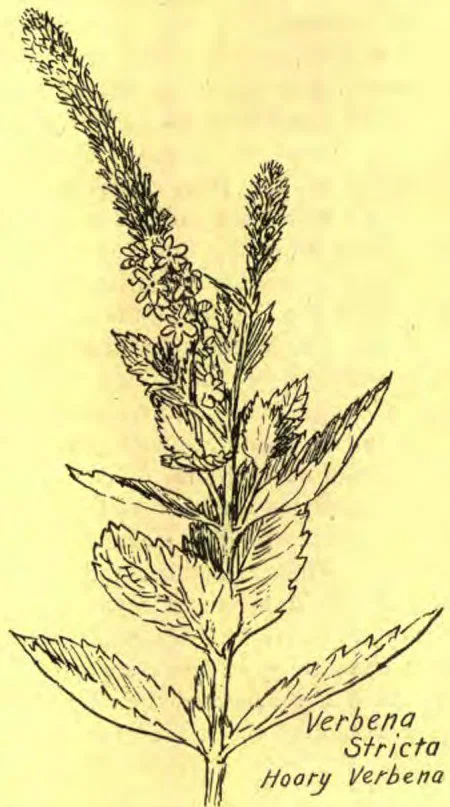
The Vervain is a relative of our showy garden Verbenas. In the garden Verbenas, the flower-spikes are flat-topped; this makes them much more striking in appearance than the wild species presented here.
I give drawings of a single plant and flower-spike. The flowers are of a bluish color, and somewhat showy. Often among these downy Verbenas will be found a plant very much, if not entirely, like them, with white instead of bluish flowers. It is merely a variety of the blue.
In Illinois there are two other wild Verbenas, taller, but with very much smaller flowers. One has blue flowers, and is called the Blue Vervain (Vervain hastata); the other has white flowers, and is called the Nettle-leaf Vervain (Vervain urticaefolia). These Vervains are enough alike to be recognized by any person who is acquainted with any one of the four I have described.

L. A. REED

RECOMPENSE

Just to hear the robin sing In the gladness of the spring, It were worth all care and sadness, Winter's storms in all their madness, Just to hear the robin sing.
Just to hear the robin sing, With closed eyelids listening, Were, indeed, reward enough For the winter harsh and rough. Ope your eyes, and lo, the spring!
— Selected.

A SIN-PARDONING SAVIOUR

II
CHRIST'S lessons reveal a high and holy purpose; but this purpose the blinded, bigoted Pharisees could not discern. Neither could they turn him from his appointed work. He announced in Nazareth: “The Spirit of the Lord is upon me, because he hath anointed me to preach the gospel to the poor; he hath sent me to heal the broken-hearted, to preach deliverance to the captives, and recovering of sight to the blind, to set at liberty them that are bruised, to preach the acceptable year of the Lord.”
In spite of the opposition of the Jewish leaders, Christ went about doing good, healing the sick, and comforting the afflicted. He raised the ruler’s daughter to life; “and the fame hereof went abroad into all that land. And when Jesus departed thence, two blind men followed him, crying, and saying, Thou Son of David, have mercy on us. And when he was come into the house, the blind men came to him: and Jesus saith unto them, Believe ye that I am able to do this? They said unto him, Yea, Lord. Then touched he their eyes, saying, According to your faith be it unto you. And their eyes were opened; and Jesus straitly charged them, saying, See that no man know it. But they, when they were departed, spread abroad his fame in all that country.”
“As they went out, behold, they brought to him a dumb man possessed with a devil. And when the devil was cast out, the dumb spake: and the multitudes marveled, saying, It was never so seen in Israel.”
The scribes and Pharisees had asked Christ to show them a sign. Christ had refused, saying that no sign should be given them. He wrought miracles that sent conviction to the hearts of the unprejudiced. As the people beheld these miracles, they expressed their wonder and amazement at the great power of God. The scribes and Pharisees saw that the people were convicted, and with lowering countenances they came to Christ and said: “Show us a sign; work a miracle for us.” They did not make this request because they wished for evidence. They had rejected the greatest evidence that God could give, saying of Christ, “He casteth out devils through the prince of the devils.” This was the sin against the Holy Ghost, which hath forgiveness neither in this world nor in the world which is to come.
To-day Christ is inviting us, “Come unto me, . . . and I will give you rest.” He waits to raise to newness of life those who are dead in trespasses and sins. But he uses no compulsion. He employs no external force. We are left free to act as we choose. If we turn from disloyalty, and place ourselves under the banner of Christ, it is because that of our own free will we choose to do this.
The expulsion of sin is the act of the soul itself. In its great need the soul cries out for a power out of and above itself; and through the operation of the Holy Spirit the nobler powers of the mind are imbued with strength to break away from the bondage of sin.
When man surrenders to Christ, the mind is brought under the control of the law, but it is the royal law, which proclaims liberty to every captive. Only by becoming one with Christ can men be made free. Subjection to the will of Christ means restoration to perfect manhood. Sin can triumph only by enfeebling the mind and destroying the liberty of the soul.
Do you realize your sinfulness? Do you despise sin? Then remember that the righteousness of Christ is yours if you will grasp it. Can you not see what a strong foundation is placed beneath your feet when you accept Christ? God has accepted the offering of his Son as a complete atonement for the sins of the world.
MRS. E. G. WHITE.

THE DIVINE CHARACTER

THE divine character is the character of Christ. Human nature has fallen,—become sinful,—and so in order to be able to develop divine character,—a real, abiding character,—we must first become partakers of the divine nature. This is the experience of being made one with Christ, of having our lives hid with Christ in God,—of dying to self and sin, and being raised again to walk in newness of life and purpose.
Jesus of Nazareth is an example of the divine character dwelling in human flesh; and just as God dwelt in Christ, and just as Christ was ever controlled by the divine mind, so the humblest Christian to-day has placed within his reach the power of developing a character after the divine similitude.
By simple faith in Christ, by receiving Christ into the life, and recognizing him as the heart’s rightful king and sovereign, and thus becoming partakers of the divine nature, the foundation for a spiritual character is laid, to be developed according as we yield ourselves to the divine mind,—ever permitting the mind that was in Christ Jesus to be also in us.
Christ should be, he longs to be, all in all to us. In this work of securing the divine nature, and developing the divine character, man has his work to perform, his part to act,—he is to co-operate with God. Man must continue to reckon himself dead unto sin and alive unto God. The part we have to act is constantly to maintain an attitude of self-surrender, and faithfully walk in the light as he is in the light; “for if there be first a willing mind, it is accepted according to that a man hath, and not according to that he hath not.” 2 Cor. 8:12.
W. S. SADLER.

THE GOOD SHEPHERD

Oh green were the pastures, the waters were still, And safe was the sheepfold that stood by the hill, So quiet, so restful, so sheltered from ill,— From the fierce heat of summer, and winter winds chill!
Oh wilful the lambkin that wandered away From the fold of the shepherd at close of the day, In the wilds of the mountain unguarded to stray, To the beasts of the forest, defenseless, a prey.
Oh dark were the clouds that swept over the sky, And wild were the winds that went hurrying by, Compelling the lambkin before them to fly; But they bore to the Shepherd its pitiful cry.
Oh kind was the Shepherd who followed its track, Over ways that were rough, under skies that were black; For though witless the lambkin, he mourned for its lack, And he left all the others, to carry it back.
Oh set was the mountain with many a thorn, And the feet of the shepherd were wounded and torn; But the lamb in the desert was found ere the morn And back to the fold was triumphantly borne. ELIZABETH ROSSER.

All Our Prayers and Hopes and Labors

“ALL our prayers and hopes and labors Must be vain without Thy care.”

CAN CHRONIC BACKSLIDING BE CURED?

Have you sometimes thought that it was easy enough for God to cure other people of a disposition to backslide, but that your case was hopeless and incurable? Has Satan sought to impress upon you that God was willing to do more for others than for you; or, in other words, that he had special favorites? If so, plant yourself squarely on the word, “God is no respecter of persons.” Bear in mind that it is God who heals both body and soul. It requires the same divine power to heal “chronic backsliding” that it does to heal a chronic nervous disease. In either case it is a miracle, yet in both cases the human agent has some part to act in order to have the miracle performed. When the chronic patient begins to sow for health instead of disease, then God immediately begins to heal him, although he may not be conscious of it for a long time afterward.
If a person was submerged fifty feet under the water, and was gradually being pulled out, he would feel no more comfortable when within one foot of the top than when he was far below.
When God heals a man physically, his unpleasant feelings are often the last to disappear. So when God heals a chronic backslider, he may do the work instantaneously, or he may do it by a more gradual process. The one who is healed by the gradual process may not recognize that the healing is divine, and thus he will perhaps have the same experience that the children of Ephraim had, of whom it is said, “They knew not that I healed them.” Hosea 11:3. We are admonished not to be weary in well doing, for in due season we shall reap if we faint not.
The thing for the chronic backslider to do is daily to sow the seeds of right-doing, although he may not see them take root and grow. God has said, “Whatsoever a man soweth, that shall he also reap.” He has also promised, “He that goeth forth and weepeth, bearing precious seed, shall doubtless [without doubt] come again, with rejoicing, bringing his sheaves with him.” These promises of God are just as sure as the law of gravitation. We may learn what seed to sow for Christian growth, and God’s word is pledged that it shall produce the harvest.
Perhaps you have tried to gain a solid, substantial Christian experience without sowing for it, or by sowing sparingly. God has said, “He which soweth sparingly shall reap also sparingly;” and it is just as true that he who sows nothing will reap nothing.
DAVID PAULSON, M. D.
Continue reading: ZOOLOGY