In cold climates at the approach of autumn the leaves fall, and from this fact we call autumn the “fall” of the year. In warmer countries the leaves of the trees do not all fall thus at once. Some trees, because they ever have some leaves, are called “evergreen;” but even these trees lose in time their old leaves, but not until they have gotten other new ones. As the new ones grow, the lower, older ones wither up and decay; this phenomenon of the fall of the leaves is quite gradual, and takes place all through the year.
But in our own climate it is quite different. Trees and shrubs and many smaller plants shed the whole of their foliage in a few days at certain yearly, recurring periods, and then remain for a considerable time with bare branches, apparently quite lifeless.
“Before the leaves fall, many of them, you know, become very beautifully colored. The variety of colors that you see in different trees is very pleasing to the eye. The maple leaf is colored bright red, the oak a deep red, the walnut yellow, and other trees have their leaves variously colored.
“Some leaves change their color earlier than others, and some at first are only partly changed. So you see the green mingled beautifully with the bright red, yellow, and other colors. I have often admired a single tree standing by itself when it is partly changed. The maple is particularly beautiful. The top generally changes first. You often see the top bright red, and then the red is mixed with the green here and there in other parts of the tree. A little way off it looks as if the top were a cluster of red flowers. And the other parts of the tree look as if the flowers were coming out among the green leaves.
“When the sun shines bright, the different colors of the leaves make the woods look at a little distance as if they were all covered with blossoms. It is a very splendid sight that you see when you look off from a high hill, over the woods on the hills and valleys. It looks as if monstrous bouquets of flowers had been stuck down thick together in the ground.
“Such a sight is especially splendid when the sun is nearly down. Then the light and shade vary the scene. Here, you see the top of a tall tree standing bright in the sun, while the other trees around are in the shade; there, you see a whole cluster of tall trees lighted up on one side. Here, is a shaded spot; and there, close by, is a very bright spot, the sun shining upon it through some break in a hill. The colors in the lighted spots look the brighter for the shaded spots near by.
“So, too, it is very beautiful when, with the sun overhead, broken clouds are passing quickly in the sky. The swift shadows of the clouds give constant changes to the scene. One shadow seems to be chasing another over a bed of flowers.
“When the leaves put on these bright colors, it is the beginning of their death. It is something like the ripening of fruit, which has hung so long on the tree green. In a few days they ripen, grow rich in color, and then fall and decay, and become a part of the earth. Some one has said that flowers are God’s smiles. So we may say that God smiles upon us in the dying leaf, when he makes it so much like a flower.”—Hooker, pages 96–98.
We do not know how these colors are made, but they please us. God, had he so chosen, could have made the leaves black, or gray, or some other dull, unpleasing hue. But he has given the falling leaves the colors of the sky when the day is passing. All this beauty is to please us, and make us glad and happy. I know that when I do anything to please another, and make him glad and happy, I do it because of my kind feelings for him; and when God does thus to please us and make us happy, I am assured that he has so done because of his great kindness toward us. Truly in the beauty of the world he smiles upon his children, and all this gorgeous glory is but a token of his uncounted love. L. A. REED.
Louisiana: Camp-Meeting Travels and Observations
By Sophia B. Brunson
Louisiana
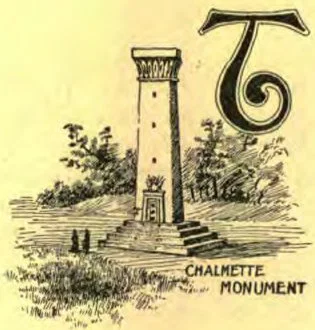
CHALMETTE MONUMENT
THE Seventh-day Adventist camp-meeting for Louisiana was held this year at Welsh. As we spent several days at this place, and in traveling through the State, we will endeavor to tell you some of the interesting things we saw on our journey.
Louisiana is nearly as large as England, a third larger than Scotland, and has almost as much area as New York, far surpassing the latter in land that can be brought into service. It has over forty-five thousand square miles of territory, exclusive of its fresh-water lakes, land-locked bays, and of Lake Pontchartrain,—areas teeming with the richest treasure of fishes on the globe. It is one of the most thinly populated States in the Union. “One may travel half a day along some of the public roads, and never once meet his fellow, and may ride many miles along the highway, and never see a habitation. The bark of the wolf and the cry of the panther can be heard within sound of the locomotive whistle. Bears are yet plentiful in the dense cane-brakes of the swamps.”
The swamps through which our train passed were very beautiful. Tall magnolia trees, with their rich, broad, green leaves, gleamed conspicuously among the cypress, gum, oak, and various other trees, nearly all of which were hung with the long, gray Spanish moss. This was festooned from the branches, forming a beautiful and graceful drapery. Palms and water-lilies grew thickly from the black soil. In many places the water-hyacinth, whose lovely blue bells are borne upon spikes, completely covered large bodies of water. This plant grows so luxuriantly in Louisiana that it is a source of great annoyance to navigators, as it intrudes itself into almost all the lakes and streams, and grows with such rapidity that it soon spreads over their entire surface.
So you see, dear children, that even a little flower, which seems such a modest and insignificant little thing, can do a great deal of harm, and cause much trouble, by being in the wrong place. This flower simply floats with the current, and sails along as the water flows; and when it drifts into a sheltered spot, it remains there, and begins to send out shoots in every direction, until there is soon quite a colony of water-hyacinths. We do not have to drift with the current, as does the water-hyacinth; for God has given us reason, and the power of locomotion, to enable us to choose our pathway in life for ourselves. Let us ask him for wisdom to guide us aright, so that we may be directed into those paths where we can most glorify him, and not “drift with the current,” as do the water-hyacinths, and so block up the way of others.
Going from Welsh to New Orleans, we rode all day through rich plantations of sugar-cane, rice, cotton, and corn. The white planters frequently live in the cities, and leave their farms to be cultivated by negroes, going back and forth to superintend them. Watermelons and cantelopes were growing in great abundance, and large watermelons could be bought for five cents and upward. As our train passed, the little negroes swarmed out at the cabin doors, with round black eyes, as wide open as if they had never seen a train of cars before. Even the grown folks never get tired of running to see the great iron horse puff by.
Arriving at New Orleans, we went aboard the large Southern Pacific ferry-boat, and crossed the great Mississippi River, spending the night at the Seventh-day Adventist mission. The next morning we went out to see some of the sights in the quaint old city. Walking along the streets, our attention was attracted by the old Creole and French houses. These are situated upon the narrow streets, without yards in front, and by their architecture remind one of those to be found in the old Spanish and French cities. Probably one of the most interesting sights in the city is the old French market. It partakes of the nature of an international bazaar, Frenchmen, Spaniards, Italians, negroes, Indians, Chinese, Americans, and others being represented. The produce is displayed in stalls, or booths; and each one tells the merit of the special articles that he has for sale. Here one sees fruits and vegetables of every description and variety, many of which are never seen in a Northern market.
Fat negro women were observed stalking along through the city with huge baskets of fruits and vegetables upon their heads, which they sold from house to house. It really seems possible for the African race to carry almost anything upon their heads that they can get upon them. I have often seen a washerwoman stoop down for a neighbor to help lift a wash-tub half-full of water upon her head, and rise up and walk off with it, also carrying a large bucket full of water in each hand.
One of the most interesting and curious sights to a stranger visiting New Orleans is the cemeteries. Interments are made almost wholly above ground. The day that we visited the cemetery was clear and bright; and the sunshine beating down upon the white marble mausoleums caused them to glitter until it was almost painful to gaze upon them.
Some of these vaults are very beautiful. Lovely statues of saints and angels surmount many of them. As we looked at the hundreds of little white marble houses standing in rows in these cemeteries, we thought, Indeed, these are veritable cities of the dead; and how silent the occupants of these dwellings! how small is the space they occupy! Ah, death is the great leveler. The proudest monarch that ever sat546upon a throne does not complain that he is compelled to sleep beside the meanest beggar. Among the magnificent monuments in Metairie cemetery are those to the Confederate generals, Albert Sidney Johnston and Stonewall Jackson, and the tombs to the Army of Northern Virginia and the Army of Tennessee.
The first monument ever raised in America in honor of a woman is in New Orleans. It commemorates the charities of Margaret Haughery, who, reared in poverty, accumulated a fortune in the milk and bakery business, and devoted a large part of her income to helping the poor. At her death the asylums and charitable institutions of the city received generous gifts.
A visit to New Orleans is incomplete without a visit to the cathedrals. The Church of the Jesuits is very grand and beautiful inside. Near the door stands a statue of St. Peter; and as the faithful Catholics pass the image, they kneel and kiss the toe, hoping thus to gain favor with heaven.
Are you not glad, dear children, that we know that we can come directly to Christ, and that he hears us without the intervention of Mary and the saints? We know from the Bible that these good saints to whom the Roman Catholic prays are sleeping in the dust, and that no amount of prayers addressed to them could possibly be heard. But thanks be to God, we know that when the trumpet shall sound, the dead who sleep in Christ shall be raised, and reign with him in glory forever.
SOPHIA B. BRUNSON.
GENERAL QUESTIONS ON THE BIBLE
By G. W. Amadon
WHAT is the name of the Book that God has given as a guide to heaven?
Why is it called the Bible?—Our word “Bible” is from the Greek word biblia, and means “little books.”
How many little books are there in the Bible? How many in the Old Testament? How many in the New?
Why is the Bible called the Scriptures?—It is so called from the Latin word scriptura, which, in the plural form, means “scriptures,” or “writings.”
Into what two general divisions is the Bible divided?
What is the meaning of the word “testament”?
What is the meaning of the word “covenant,” as applied to the Bible?
Who are the two parties concerned in this covenant?
Has the Lord ever made a covenant with any other party besides man? See Gen. 9: 9, 10. Here we learn that after the flood the Lord entered into an everlasting covenant with Noah and his descendants, and with “every living creature” that came out of the ark. This included all domestic animals, the beasts of the field, and the fowls of the air.
What is the sign of this covenant that God made between man and the animal world? See vs. 12-16.
In what way did God give the Bible to the human race? See 2 Peter 1:21.
Was it all given at one time?547
How long a time did God take to give his word to man?—About 1550 years.
How many different persons have shared in its authorship?—Probably more than fifty.
What were the occupations of the persons through whom God revealed his word?
In what language was the Bible first written?—The Old Testament principally in Hebrew, and the New Testament wholly in Greek. Certain parts of Daniel and Ezra are in the Chaldaic language.
Do any of the original documents in which the Bible was penned still exist?—No, not one.
Then how have the Holy Scriptures been handed down to us?—Through translation into other languages.
Are translations inspired?—No; but there are the best reasons for believing that God, who inspired the word, would have a jealous care that it be rightly translated for the good of his people.
Did any translations of the Old Testament exist in the Saviour’s time?—Yes, there were translations in Greek and Syriac, as well as the Hebrew original.
Would the millions of the Jews who then existed know whether these translations agreed with the Hebrew?—Most assuredly they would.
How early did the translation of the New Testament Scriptures begin?—Probably at a very early date.
What does history say about this?—It is claimed that before the apostles had all died, or soon afterward, the New Testament was translated into the Syriac and Latin languages.
What interesting fact has an important bearing on the early translation of the New Testament Scriptures?—The apostles and early church had the gift of tongues, and so would readily know whether or not the translations were correct. G. W. AMADON.
Time: A. D. 31. Place: In the temple at Jerusalem. Persons: Jesus, disciples, Greeks, poor widow.
QUESTIONS
1. As Jesus sat in one of the temple courts, to what was his attention drawn? Mark 12:41; note 1. Among others, who came to make an offering? How much did she give? V. 42; note 2. What did Jesus say concerning her gift? V. 43. In what sense was her offering greatest of all? V. 44; note 3.
2. With the Jewish people, who had come to the Passover feast? John 12:20; note 4. To whom did these come, and with what request? V. 21. In what indirect way was their desire made known to Jesus? V. 22.
3. As Jesus beheld these earnest worshipers, with what words did he express his deep emotions? V. 23. Through what figure did he then show why he should die for the world? V. 24; note 5. Realizing that he must soon give up his life, what truth, often given, did he express? V. 25. In carrying out this truth, how fully would his servants follow his example? With what result? V. 26.
4. With what words did he then picture his feelings concerning his fate? Vs. 27, 28; note 6. What message of comfort was immediately received from heaven? V. 28. What did the people say when they heard the voice? V. 29. What was the real object of the message from the Father? V. 30.
5. Speaking once more of his death, what did Jesus say would be the result? Vs. 32, 33. What would be the effect of his death upon Satan's work? V. 31.
6. What questions were now asked him by the people? V. 34. Instead of answering these questions, what did Jesus urge upon them? Vs. 35, 36. What did Jesus then do? V. 36.
NOTES
1. From the account given in “The Desire of Ages,” pages 614–616, one would conclude that the offering of the widow was made while Jesus was denouncing the sins of the Pharisees. The treasure-chests of the temple were situated in the “Court of the Women, which was the general place of public worship at the time of the sacrifices.” This being the case, the Saviour may have here uttered his rebuke of Matthew 23, being interrupted by the coming of the widow. How natural that the widow's offering should suggest to Jesus the words of Matt. 23:14.
2. The “mite” was the smallest Greek copper coin. Its value was about one fifth of one cent. The “farthing” mentioned was the smallest Roman brass coin, having the value, according to the record, of two mites, or about two fifths of one cent.
3. When Jesus said of the widow, She “hath cast in more than they all,” his words were true, not only of the motive, but of the results, of her gift. . . . The influence of that little gift has been like a stream, small in its beginning, but widening and deepening as it flowed down through the ages. . . . Her example of self-sacrifice has acted and reacted upon thousands of hearts in every land and in every age. It has appealed to both the rich and the poor, and their offerings have swelled the value of her gift. God's blessing upon the widow's mite has made it the source of great results.—“The Desire of Ages,” page 616.
4. These Greeks were worshipers of the true God, and having heard of Christ's triumphal entry into Jerusalem, they were desirous of learning more about him and of him. They were not permitted to enter farther into the temple than the Court of the Gentiles, which was next to the Court of the Women, in which Jesus was. They were obliged, therefore, to make request to “see Jesus,” and sent word by Philip.
5. “Except a corn of wheat fall into the ground and die, it abideth alone: but if it die, it bringeth forth much fruit.” For it must be that I die, that my work may bear its due fruits, just as the grain must fall into the ground and perish, that it may bring forth the harvest. . . . My life remains limited and bound up in myself, as the life is in the seed, till I die. It can not, till then, pass beyond me to others, and multiply. But when I die, I shall be like the corn, which, in its death, imparts its life to what springs from it.—Geikie. And what is true of Christ is true of all his followers. Only he who dies to self can be a blessing to the world. So long as self lives, he abides alone; but with the crucifixion of self, there comes the resurrection to a new life of righteousness and fruit-bearing in the Lord. The way to life is through death by the cross; if we die, we shall bring forth fruit, even souls, for the kingdom of God.
6. John 12:27 is not properly punctuated in the Authorized Version. Instead of the colon found after the expression, “Father, save me from this hour,” there should be placed an interrogation point. See Revised Version, margin. The verse will then read, “Now is my soul troubled; and what shall I say? Father, save me from this hour?” That is, shall I ask the Father to save me from this hour? Then he adds the words of submission, “But for this cause came I unto this hour. Father, glorify thy name.” I will not draw back, Father; let thy will be done.
IN A QUEEN'S PALACE
By A. D. Wellman
You would not think it a palace; still, it is the home of a queen. Her country is only a few miles square, and she does not rule many people; so she can not afford a fine house.
This palace has walls made of strips of bamboo, woven much like a basket. Of course, the wind blows through them; but that does not matter much, as the weather is always warm on this little island in the Pacific Ocean.
The roof of this queer house is made of palm-leaves, and it keeps the rain out well. The eaves reach far out over the sides, so that rain will not beat through the walls. The floor is made of poles, with dry grass spread over them. Most of the houses on this island have no floors except the earth; but the palace must needs have one, for it stands over the edge of the sea.
There is only one room in this palace, and that has no windows and scarcely any furniture. But the queen has several silk and plush dresses. She usually goes barefoot, though, as do all her people.
I was once invited by the queen to attend a feast at her house. The food was spread on the ground, and there were no napkins nor table-cloths, and but few dishes. Leaves served as dishes, and fingers as forks. These people even dip up soup in their hands, and pour it into their mouths. They think it polite to make a great noise in sipping their food.
If you should see the things placed before me to eat at this feast, you would not know the names of most of them, nor would you care for more than one taste of some kinds.
There were many bananas for the feast, some baked, some boiled, and others uncooked. There were also many oranges. The people of this island never offer an orange to a person without first peeling it, and cutting a hole in one end of it. They would no more place unpeeled oranges before a guest than your mother would put on a dinner-table food wrapped in paper as it came from the grocery.
The queen of whom I have told you is not too vain nor too lazy to do common work, although she has many servants. Her brother, too, does much of the cooking for the family. He is more sensible in that respect than are some American boys I have seen, who were ashamed to do what they called girls' work.
Another good thing about this queen is that she does not smoke tobacco, as most of her people do. They learned that bad habit from white men, and you perhaps know that white men learned it from the American Indians.
— Mrs. A. D. Wellman.
BUMBLEBEES
The bumblebee appears to enjoy the coldest climates, for it is the only bee native to Alaska. Scientists, when in Alaska, have failed to find bees of any other genera. This recalls a picturesque incident attending Colonel Fremont’s ascent of the great peak bearing his name in the Rocky Mountains. He thought he had left everything pertaining to the lower world far beneath him, when suddenly a bumblebee buzzed through the chilly air, and settled on his knee. Peary saw a bumblebee at the northern end of Greenland, and bumblebees are also common in Siberia.— Well-Spring.
WHY TUMBLERS ARE SO CALLED
How many times a day do we use words without stopping to think what they mean!
Every day at luncheon and at dinner we drink out of a tumbler. But I, for one, never thought why the large glass that holds our milk or water was so called until once upon a time I happened to have luncheon at All Souls’ College, Oxford, where the curiosity of all the strangers present was excited by a set of the most attractive little round bowls of ancient silver, about the size of a large orange. These, we were told, are “tumblers,” and we were speedily shown how they came by their name.
When one of these little bowls was empty, it was placed upon the table, mouth downward. Instantly, so perfect was its balance, it flew back into its proper position, as if asking to be filled again. No matter how it was treated,—trundled along the floor, balanced carefully on its side,—up it rolled again, and settled itself, with a few gentle shakings and swayings, into its place.
“Tumblers” were first made of silver, as are these at All Souls’ College; but when glass became common, the round glasses that stood on a flat base superseded the exquisitely balanced silver spheres, and stole their name so successfully that you have to go to All Souls’ and a few other old houses to see the real thing.
So do words, with the wonderful life that is in them, change, and grow, and get fresh meanings, full of interest and teaching and delight to those who think about them.—Selected.
An African Woman's Bible Laid on a Stump
An African woman came into possession, by some means, of an English Bible. She and her people had heard a little of the great gospel; they knew something of what the book was; and the woman was filled with delight in its ownership. But, alas! it was written in a strange tongue, and those who could interpret it were far away. Still, something must be done with so rare a treasure. After consultation, a day was set. Notice was given, and at the appointed hour the Bible was laid on the stump of a tree in an open space. Then the natives began to assemble, took their places in a circle about the spot, and after waiting for a time in reverent silence, quietly dispersed. Can it be doubted that the Father, who seeketh those to worship him who shall worship him in spirit and in truth, was there in their midst, and accepted gladly the poor, maimed service, which was all they had to offer him?—Gospel in All Lands.
Self-Pronouncing S. S. Teachers' Reference Bible.
CONTAINS the celebrated Teachers' Helps, comprising nearly 400 pages. Also a complete series of fifteen new maps.
Description. — Imperial Seal Binding, Tuck Edges, known as “Divinity Circuit,” Rounded Corners, Full Red under Gilt Edges.
We offer this Bible, post-paid, for only _SIX NEW YEARLY SUBSCRIPTIONS_ at 75 cents; or _TWELVE NEW SIX MONTHS' SUBSCRIPTIONS_ at 40 cents.
We will also send it, post-paid, with the INSTRUCTOR one year for $2.25. For 20 cents extra we will stamp your name in gold upon the cover.
A TINY REPUBLIC
If you will look at a map of Europe, you will see, snugly tucked in among the Pyrenees Mountains, which separate France and Spain, a little spot marked Andorra. This is the name given to the smallest republic in the world. It contains only one hundred and seventy-five square miles, and has an estimated population of six thousand. Because of services given him by its people where he was marching against the Moors, Charlemagne declared it a free state, and such it has continued. It is governed by a sovereign council of twenty-four members, chosen by the people. The council elects one of its members, who holds the office for life, to exercise the chief executive power.
Railroad Signals
“Stop” is indicated by one pull of the bell-cord; by downward motions of the hands, with extended arms; by a red flag raised at a station; and by a lantern swung at right angles across the track: “back up,” by three pulls of the bell-cord; by three whistles; by beckoning motions of one hand; and by a lantern swung in a circle: “danger,” by continued whistles; by a red flag waved up the track; and by a red flag standing by the roadside: “go ahead” is signaled by two pulls of the bell-cord; “down brakes,” by one whistle; “off brakes,” by two whistles; and “cattle alarm,” by rapid, short whistles. A red flag carried on a locomotive signifies “an engine following.” A lantern at night raised and lowered vertically is a signal to “start.”
TAKE THE Canadian Pacific Railway
for . . . CHATHAM, OTTAWA, MONTREAL, LONDON, GALT, QUEBEC, WOODSTOCK, TORONTO, BOSTON, PORTLAND, and
All points in New England, the Maritime Provinces, Great Britain, and the Continent.
Illustrated literature, time-tables, and full particulars, upon application to—
J. FRANCIS LEE, GEN. AGENT,
Passenger Dep’t. 228 SOUTH CLARK ST., CHICAGO
Branch Offices: 76 Ottawa St., Grand Rapids, Mich. Room D, Chamber of Commerce, Cincinnati, Ohio. 315 Chestnut St., St. Louis, Mo.
Cincinnati Northern Railroad Co.
TIME TABLE NO. 3.
IN EFFECT SEPT. 24, 1889.
Trains Pass Battle Creek, as follows:
WEST-BOUND.
No. 21, Mail and Express — 6 58 P. M.
No. 23, Accommodation — 2 07 P. M.
No. 27, Local Freight — 8 25 A. M.
EAST-BOUND.
No. 22, Mail and Express — 8 25 A. M.
No. 24, Accommodation — 1 45 P. M.
No. 28, Local Freight — 5 30 P. M.
Direct connections are made at Toledo with all roads diverging. Close connections for Detroit and Cincinnati.
J. L. READE,
Ticket Agt., Battle Creek.
E. R. SMITH, City Pass. Agt., 6 West Main St.
GRAND TRUNK RAILWAY SYSTEM.
Time-Card in Effect October 9, 1899.
C. & G. T. DIVISION.
WEST-BOUND FROM BATTLE CREEK.
No. 9, Mail and Express, to Chicago — 12.15 P. M.
No. 1, Chicago Express, to Chicago — 9.00 A. M.
No. 3, Lehigh Valley Express, to Chicago — 3.40 P. M.
No. 5, Pacific Express, to Chicago, with sleeper — 1.10 A. M.
No. 75, Mixed, to South Bend — 8.20 A. M.
Nos. 9 and 75, daily, except Sunday.
Nos. 1, 3, and 5, daily.
EAST-BOUND FROM BATTLE CREEK.
No. 8, Mail and Express, to Pt. Huron, East, and Detroit — 3.45 P. M.
No. 4, Lehigh Express, to Port Huron, and East — 8.27 P. M.
No. 6, Atlantic Express, to Port Huron, East, and Detroit — 2.25 A. M.
No. 2, Lehigh Ex. to Saginaw, Bay City, Pt. Huron, and East — 6.50 A. M.
No. 74, Mixed, to Durand, (starts at Nichols) — 7.35 A. M.
Nos. 8 and 74, daily, except Sunday.
Nos. 4, 6, and 2, daily.
A. S. PARKER, Agent, Battle Creek.
GEO. T. BELL, 1st A. G. & T. Agent, Chicago, Ill.
An Aged Parrot
The Princess of Wales has among her pets a parrot that is known to be nearly two hundred years old. More than a hundred years ago he was owned by George III. The bird is said to be lively in spite of his great age.
To Reach BATTLE CREEK
FROM
CHICAGO, BUFFALO, DETROIT, OR TOLEDO,
Purchase Tickets
Reading over the MICHIGAN CENTRAL
“The Niagara Falls Route.”
A First-class Line for First-class Travel between Chicago and New York and Boston. Elegantly equipped through trains pass Battle Creek in each direction daily.
R. N. R. WHEELER,
Ticket Agent, Battle Creek.
O. W. RUGGLES,
Gen'l P. and T. Agt., Chicago, Ill.
GARLAND STOVES AND RANGES
The World's Best
Sold by First Class Stove Merchants Everywhere.
DEFINITE PLANS
Now that a definite time—the first week in December—has been appointed for beginning the Missionary Reading Circle, all should be ready to begin at that time. Order at once the literature necessary to make your circle interesting and profitable. If possible, see that your neighbors and friends who expect to take part with you in the study are supplied with the necessary helps.
The Berean Library and the Missionary Magazine, whose numbers will serve as the basis of study, will be sent one year to any address in the United States, Canada, or Mexico for one dollar. Single numbers of the Library, twenty-five cents. The Review and Herald ($1.50 a year) will contain the Outline Lessons on the Library and on the field; and the YOUTH’S INSTRUCTOR will have Supplementary Notes and much helpful matter not found elsewhere. All should have these helps.