Review and Herald Publishing Company · Battle Creek, Mich. · Nov 16, 1899
THE AVONDALE SCHOOL FOR CHRISTIAN WORKERS
By G. C. Tenney
THIS is the name given to the school established in Australia by the Seventh-day Adventists. The name of the adjacent post-office is Cooranbong; but to the estate on which the school is situated, the more euphonious name of Avondale has been attached. This school has now been in operation for five years,—if, indeed, the first year or two could be called operation. Operation it certainly was; but some parts of it would hardly be called school in some literary communities. The equipments were few and rude, the facilities of the barest necessities, the buildings rudimentary, and in process of evolution.
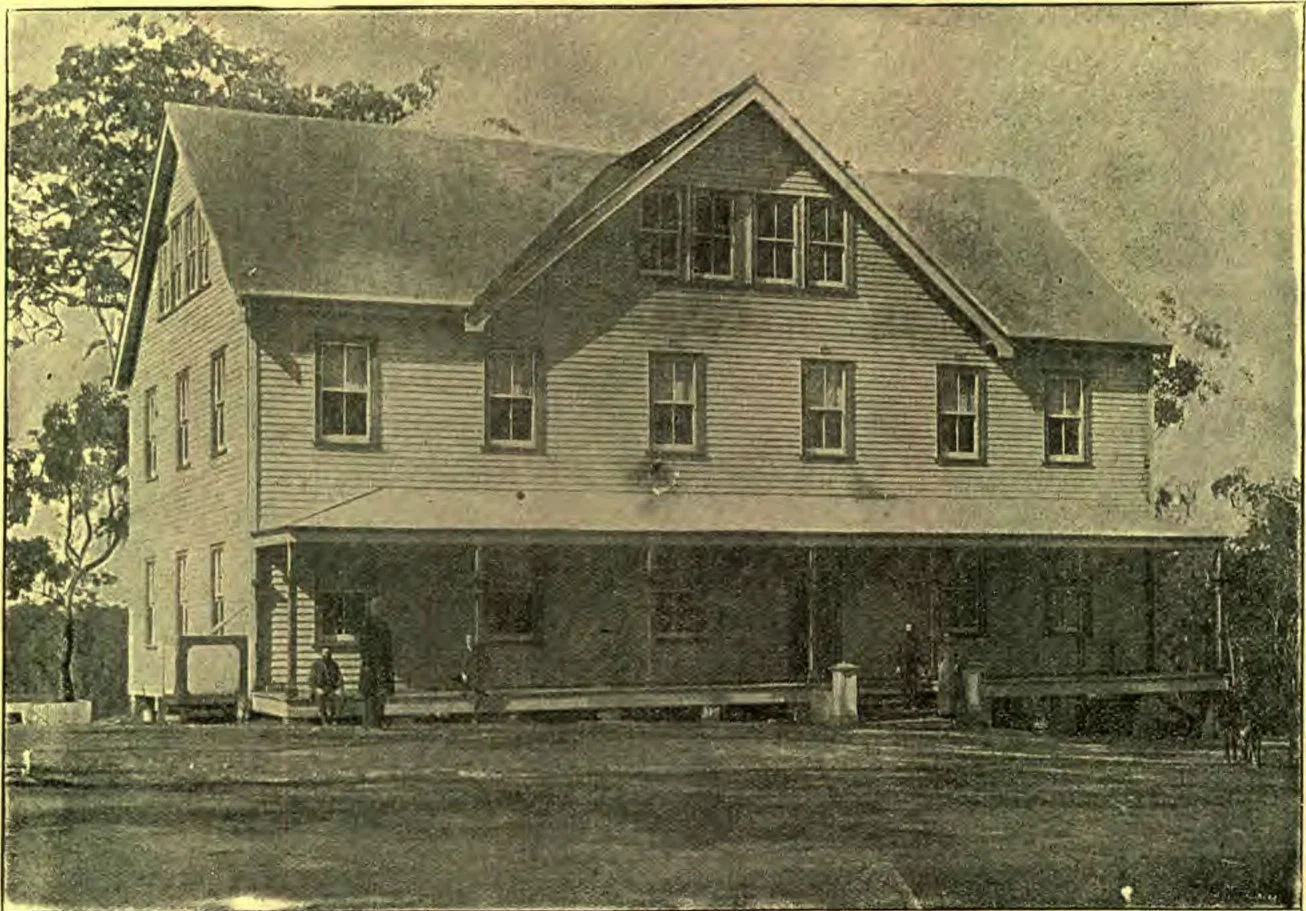
THE BOYS' HALL, AVONDALE.
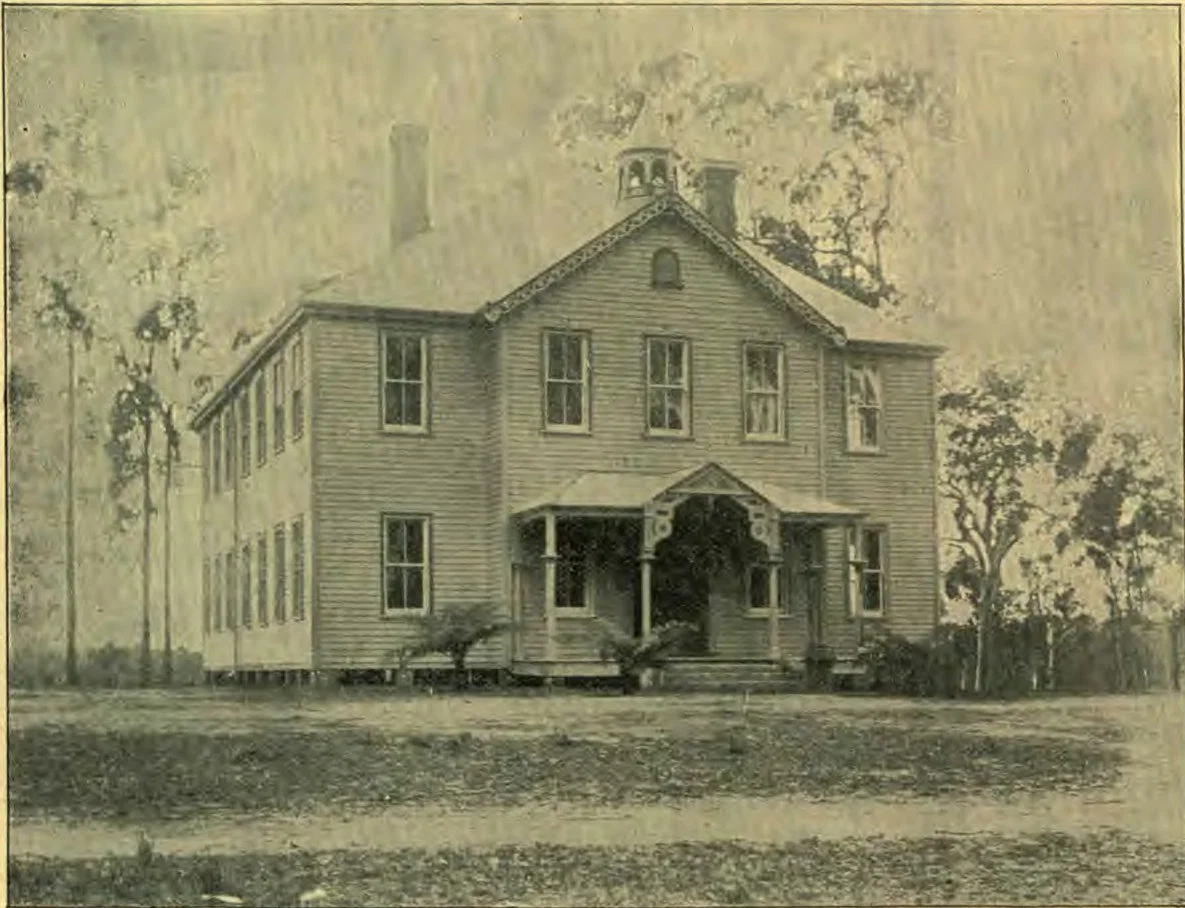
COLLEGE HALL, AVONDALE.
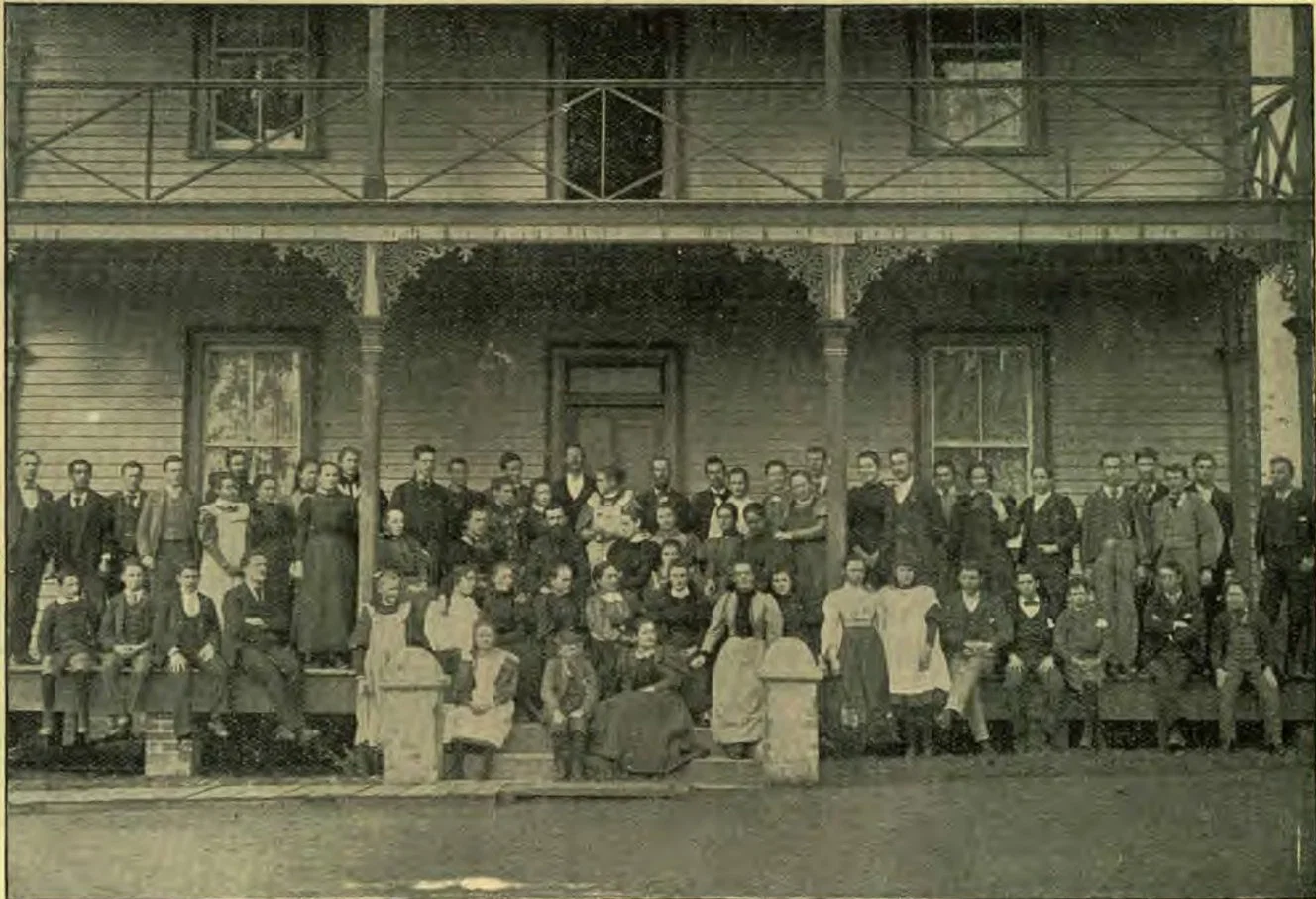
HOME STUDENTS AND TEACHERS OF 1898, AVONDALE.
And we are bound to say, though without malice or reflection, that many of the students who rallied to the school were of a character that is in this country sometimes denominated a “rum lot.” They had for the most part good purposes; but those purposes included having their own ways, and those ways were as diverse as the colors of Joseph’s coat. Some were pleasant, some were otherwise. But God, who spoke light out of darkness, spoke to the hearts of those students; and in the year 1897 every member of the school professed the religion of Christ, and tried to live it out.
In 1897 the school family numbered fifty; and in 1898, seventy; and in 1899, one hundred and twelve. Besides these, there were a number of outside students in attendance. This year the enrolment has reached one hundred and fifty. So far, the attendance has kept fully up to the capacity of the buildings.
The faculty of the school consists of twelve members. The work required in the management of the school in its formative stage is large, including, as does the work of the teacher, a practical application of all principles taught, in field and shop labor as well as elsewhere. Besides the work for the present, preparation must now be made for a larger work in the future.
The fundamental thought in the administration of the school, in discipline and instruction, is that the Bible, as the word of God, thoroughly furnishes unto every good work. All knowledge and truth emanate from God, and the revelation of God is his word; hence that word is the primary fountain of wisdom and truth. In planning for this work, the admonition of the Holy Spirit, that this school should not pattern after any other school in existence, has been continually before the mind of its promoters. On the other hand, the heavenly caution, “See that thou make all things according to the pattern shown to thee in the mount,” has been continually studied.
In the working out of these divine patterns, much remains to be done; but as the work goes on step by step, the way seems to be clearing up, and the blessing of God certainly rests upon the efforts thus far put forth.
July 6, 1899, the Australian Union Conference of Seventh-day Adventists convened at Avondale, and was entertained by the school. Access to and from trains was by boats manned by the students. The students were called on to give up their rooms for the accommodation of delegates, and to labor in the various offices of hospitable service. The meeting continued three weeks, and the number of guests was just about equal to that of the students. The willingness and cheerfulness manifested by the students under these deprivations were a comforting assurance to the visitors of their hearty welcome. But we are bound to say that the sacrifice was not altogether on one side; for in accepting a place in the school family, the delegates incurred the duty of following out the daily program. It was decided to make the Conference a part of the school work, and the school work a part of the delegates’ business. This was true, at least, to the extent of arising punctually at five o’clock; of having “lights out” at 8:45, provided the meeting closed early enough; of being punctilious in deportment at table; and in lifting up axes upon the thick trees for two hours and a half in the afternoon.
Both parties endeavored to carry out the contract, though it is confessed that the students were most faithful in their performance. But the experiment was unique, to say the least. Before the vigorous stroke of the ministers, workers, and students, many a tall denizen of the forest came crashing to the ground, dug up by the roots and torn from its place by the “forest devil” (an implement, by the way).
Throughout the meeting the subject of education was thoroughly studied, and many precious principles were set forth. At hand was the practical demonstration of the intimate union that exists between a useful education and the useful industries and arts. “Labor is worship.” It was truly stated that when we open the Bible, we find God at work. And it was said by Jesus, “My Father worketh hitherto, and I work.” Should we not follow his example? G. C. TENNEY.
PEACE
Not for thy crying,
Not for thy loud beseeching,
Will peace draw near;
Rest, with palms folded;
Rest, with thine eyelids fallen—
Lo! peace is here.
— Christian Advocate.
Be Content With Your Measure of Usefulness
“If you are only a spring, do not exhaust yourself trying to be a fountain.”
A BLOODLESS GUN
An ornithologist, who is also a true bird lover, has devised a gun with which he is said to have done some fine work.
He walked into a New Orleans hotel not long ago, and created something of a sensation by the package he carried. It had the general appearance of a gun-case, except that it was extremely short and thick. While he was registering and chatting with the clerk, two or three guests got into an animated discussion as to the contents of the queer-looking parcel. At last one of them introduced himself, and ventured to ask what the case contained. The stranger smiled.
“The case contains a gun,” he said; and he proceeded to confirm his words by exhibiting the peculiar weapon. The stock was like that of an ordinary shotgun; but the barrel was fully four inches in diameter, and covered with leather. At the breach there was a square box furnished with several small levers.
“I am an amateur ornithologist,” he said, “and this is a gun-camera, used in studying wing-movements. I level it on a flying bird, just as I might a real firearm, and pull the trigger. Instead of exploding a shell, it springs a shutter, and I have my subject transfixed on the film. I can take twelve shots, and the instrument reloads very much like any camera. The form is simply for convenience in focusing, and it has enabled me to get really remarkable pictures. For instance, I have photographed such fast flyers as snipe in every conceivable position, from head on to point blank retreat, a thing that could not be done with an ordinary camera.”
This strange gun is of French make, but it has done some remarkable execution in American territory.
UNATTRACTIVE GIRLS
“Oh, I wish I were pretty and attractive! I can't bear to be so plain. I never please people as Elsie and Anna and the other girls do.”
Perhaps if I tell you what I said to her, as her head lay in my lap, it may help you, if you are not among the beautiful and attractive ones of earth:—
“Suppose, dear, we face this disagreeable truth: you are neither pretty nor accomplished, nor even ‘attractive.’ You wince a little; yet consider a moment. You are not without friends; you have a good mind, good sight; you can walk with ease, and can accomplish any ordinary household duty. Now there is a constant demand for just the kind of women that you may (if you choose) become. Children take to you, and you to them. You can minister to the sick, visit the poor, and help the needy quite as acceptably as if your face were beautiful. You can easily attract the sorrowing, the sick, or the old.”
A lovely woman of forty said to me, the other day: “If girls only knew the rest of accepting the inevitable, they would give up trying to be attractive, and determine to be helpful instead. Some girls ripen late, and an unattractive girl may be a lovely woman at thirty. It is the fruit that ripens latest that is the sweetest. I used to fret about my plain face at eighteen; but when I set to work to make every one about me just a wee bit more comfortable or happy because of me, I had no time to think of my looks.”
I suddenly remembered how, on first meeting this friend, years ago, I pitied her for her exceeding plainness. But her face soon became beautiful to me. She numbers her friends by the score; while to her sister, whose face is like my friend’s with that subtle difference which changes utter plainness into prettiness, what a hindrance that prettiness has proved! She is simply a pretty, petted woman. No one turns to her for sympathy or help or counsel.
We know that God says, “Favor is deceitful, and beauty is vain,” yet we do not believe him, if we long for favor and beauty. If some plain, “ordinary” girl who reads this talk will aim to be a “woman that feareth the Lord,” she will find life full of interest; and his word promises her “praise.”
— Congregationalist.
A NARROW ESCAPE.
By H. E. Simkin
A FEW days ago a young kitten crawled into a horizontal cold-air shaft until it reached the upright part, where it fell to a level with the bottom of the connected heating furnace. It could not crawl up the iron sides of the big shaft, so it mewed piteously till help came. Its rescuers opened the front air-chamber door of the furnace, when the kitten at once crawled around the fire-chamber, and jumped out, grateful enough for its release. There being but little fire at the time, it was not injured; but it will probably never be found in that place again, as one such experience is enough. The incident reminds us of boys who occasionally find themselves unexpectedly in pool-rooms, saloons, or other questionable resorts. They see at once that such a place is no place for them; and if they, like the kitten, do the best they can to get out, and from the experience learn to avoid such places in the future, they, too, may escape serious harm; but if attracted to repeat the visit, destruction will surely follow sooner or later.
H. E. SIMKIN.
God's Place in the Soul
“If God’s place in the soul is empty, nothing else can ever fill it.”
THOSE MILLIONS OVER THERE
By G. F. Woodbury
They wait, those millions over there;
Our hope in Christ they do not share;
They wait for us to come.
The time of waiting seems so long
To those who wait without a song
To bless their cheerless home.
They weep, those millions over there;
Our joy in Christ they do not share;
They weep in nameless grief.
Shall we not wipe their tears away?
Shall we not turn their night to day?
Shall we not bring relief?
They die, those millions over there;
Our life in Christ they do not share;
They die in sin and shame,
While Christ has died to save them all,
And yearns to save whoe'er may call
On his sweet, blessed name.
Then help those millions over there
The bread of heaven, sweet, to share;
God's sweetest message give,—
That life's sad end is not the grave,
That Jesus died our souls to save,
He died that we might live.
— G. F. Woodbury.
HOW BOY WAS CURED
HERE is a true story of a dear little Chinese boy. It isn’t a very long story, either, but I thought you would like to hear it.
Boy lived with his father in a little town, and one day he grew very ill. Now in China when one is sick, and a Chinese doctor comes to make him well, he sometimes does very cruel things to him. The Chinese think that when one is ill, some evil spirit is in him, and must be driven out. So when Mr. Mulberry—for that was the name of Boy’s father—sent for a Chinese doctor, he came, examined Boy carefully, and said: “Yes, he is sick. He has rheumatism. You must heat some needles red-hot, and run them into the place where the pain is. That will cure him.”
But though Boy cried hard enough at the needles, he did not get any better; and one day a friend who came to see him said to Mr. Mulberry: “Why don’t you take Boy to the missionaries at Lahore? They can cure every disease.”
“No, no,” said another friend, “don’t take him to the missionaries. They make the lenses of their opera-glasses out of children’s eyes.”
This information frightened Mr. Mulberry so that for a while he did not dare take Boy there; but after a few days he heard so much that was good of the missionaries that he decided to start with him.
There was no railroad to Lahore, and Mr. Mulberry could not afford to hire a carriage; so he put Boy into a wheelbarrow, and wheeled him a hundred and fifty miles.
At last the sick child and his father, very weary, reached the missionaries’ house, but there Mr. Mulberry’s courage gave out. He remembered all the dreadful stories he had heard; and, almost discouraged, he sat down beside the wheelbarrow, and wondered what to do next.
As he sat there, the doorkeeper of the missionaries came out of the house, on an errand. As soon as Mr. Mulberry saw him, he recognized him as an old friend and neighbor. Oh, how delighted Mr. Mulberry was! A moment before he had been sad and lonely, and here was help.
“Well, old brother,” said the doorkeeper, “where do you come from, with your sick child in a wheelbarrow?”
Then Mr. Mulberry told the doorkeeper the whole story, and said: “Now, tell me, confidentially, do you think it would be safe for me to take my little son inside?”
And the doorkeeper replied: “Yes, indeed; the missionaries are good and kind, and they will heal your son.”
Then Mr. Mulberry gathered the almost fainting child in his arms, and carried him in. The missionaries received him gladly, and kept him a week, and at the end of that time Boy was well.
But another beautiful thing happened. As the missionaries nursed the sick child, they told his father about the Great Physician, and he learned to know and love him; so when Mr. Mulberry went home, he was also a Christian. There is no more earnest man in all that country than the father who carried his sick son a hundred and fifty miles on a wheelbarrow for help.—Selected.
EXPERIENCES IN KANSU
By Uncle Pilquist
I
FOUR years ago God led me through special experiences in China. I was appointed to a new field of labor in the far-away province of Kansu. If you look on the map, you will see, in the northwestern corner of the Celestial Empire, the province of Kansu. On the north side of that province is a small strip of land, which goes up into the Gobi Desert of Mongolia, like a peninsula of the sea. On the extreme northern end of that peninsula is a city called Ning-hsia-fu. I am going to tell you what God led me through there.
Although Ning-hsia was a new field for me, it was not new as far as mission work was concerned. Before I went there, an English missionary had labored in that place; but at the time of my visit he had gone home to England; and while he was there, he died, and was gathered to his ancestors.
When my wife and I first came to the place, discouragement of all kinds was in store for us. I will not attempt to tell you all; but one thing that made us exceedingly sorry was that the few members of the church there were scattered abroad in all directions, so much so that they did not meet for worship. I felt sorely grieved to see how the enemy was working to spoil the vineyard of our dear Master.
After looking around for a few days, and consulting with God and my wife, I called a church meeting, in the hope of leading those wandering sheep back to the fold of the Good Shepherd. But this was not an easy matter. The first meeting was attended by only two of the nine who belonged to the church. I asked those two where the other seven were. The cool answer was, “Do not know.” It was hard to keep back the tears. But the love of God upheld me, and the words spoken by Sister White, many years ago, were brought to mind: “Let your smiling face show forth the love of Jesus, even when your heart is heavy laden with sorrow and care for those who do not love God.” This helped me to look bright and cheerful when the clouds were darkest. So I sang a Chinese hymn, and poured out my heart in supplication and prayer to the Good Shepherd, who had more interest in this poor, scattered flock than I could possibly have. I also read to them a portion from the Bible. But no response was awakened in their hearts. Neither of them would help me pray. Everything seemed to indicate that the Spirit of God had left their hearts.
This was in July, and for about three months it seemed as if our efforts were an utter failure. Satan tried to discourage us many times. He whispered in my ear that the best thing for us to do was to leave Ning-hsia, and go to another place, a few miles from there. He said that in that other place, beyond the river, we would have success. But we put our trust in the Lord, and bravely said, “If God be for us, who can be against us?” From the very beginning we made up our minds to resist the devil with the word of God; and strength was given to us in a wonderful way, so we could accomplish that which was put into our hands.
From an early hour in the morning until noon, I was out on the street, selling books, and preaching to the people, as they wandered to and fro. In that way all the country folk were reached with the glad tidings of salvation. After dinner I looked after the most necessary work at the station until four o’clock, when the street chapel was opened. There I preached until somewhat after six o’clock.
The street chapel was a large storeroom on the busiest thoroughfare in the city. A good attendance was always to be had, and God gave me power to proclaim the truth without fear. It was sometimes amusing to see how the farmers, when coming from their work in the field, entered the chapel. Some came to see me, while others came to hear what I had to say; and of course all kinds of remarks were made. One, after listening for a while, bravely shouted, with all his might,—“lang-kuei-tsi, why did you bring opium to our pure kingdom, to destroy so many people?” When I told him that I did not do that, but that the men in the land over which Queen Victoria reigns brought about the opium trade with China, they quickly said: “Then go home, and ask the lao po po [old lady] to hinder her people from doing such a bad thing as to poison so much people in our country.”
When the working people came into the chapel, they always brought their tools with them. One would have a plow on his back (the Chinese plow is not so heavy as that used in this country); another, a harrow on his shoulder; some had hoes, others spades, etc. They dared not leave these implements outside, because of their belief in the proverb, “When you see a company of ten, there are eleven thieves to be found close together.” The Chinese understand that proverb very well.
Cows, horses, mules, and stupid donkeys were also brought into the house where the words of life and truth were spoken. Fancy what an exhibition there was! When the farmers came from their work outside the city, they thought they did not have time to go home with their animals, and then come back to hear the precious word of God; so they brought what they had, and came right in. I have preached many sermons to cows and dull-headed donkeys. They did not disturb me any. After working hard all day, the poor animals were very tired, and so gladly lay down on the mud floor to have a nap. The farmers sat down beside them, and after listening to the gospel for a while, they also would fall asleep.
What an audience! I wish I could give you a good picture of it as I have often seen it. While some were sleeping, others listened with interest to what was said. One time a man came into the chapel with a chicken under his arm, and sat down directly in front of the pulpit, and began to talk. As no attention was paid to him, he finally fell asleep. Beside him a beggar was standing, his attention fixed on the plump chick. As soon as the man was fast asleep, the beggar snatched the chick, and ran away as fast as he could go. Then the man woke up, and began to scold me severely for not telling the beggar not to steal. A few days later, our cook told me that the man who lost the chick had himself stolen it from one of his neighbors! UNCLE PILQUIST.
CHINA AS A MISSION FIELD
By Judson Smith
NOTWITHSTANDING all drawbacks, China is to-day one of the most hopeful mission fields in all the world. The old faiths are decaying, the minds of all classes are open, and external barriers are being removed in the most providential way. Notwithstanding the enormous difficulties that attend the work, in spite of the many and formidable obstacles which must be overcome, even though progress is slow, and only a beginning has yet been made, God’s hour for the evangelization of this populous and ancient stronghold of paganism is here; and the summons to our zeal and devotion is as clear and inspiring as the angelic song that fell on the shepherds’ ears at the advent of our Lord: “I bring you good tidings of great joy, which shall be to all people.”—Dr. Judson Smith.
Feet Shod With Love
“ALL paths are easy to feet shod with love.”
A BOY'S THOUGHT
By Hope Onslow
"As He was in the world, are we,"
Was written on a card
That led a mother and her boys
To talk about the Lord,
And think of Jesus' earthly life,
And dwell upon his love,
From child to youth, from youth to man,
And of his work above.
One day the eldest lad came in
With features all aglow.
"O mama! I have had a thought
You'll surely want to know!"—
His eyes grew very dark and deep,
As if in some amaze,—
"One day my Lord was old as I,
And lived as many days.
"And one day Jesus measured up
In height the same as I."
He took his tape-line from its place,
And measured just how high.
Then grew an earnest, solemn peace
O'er all his youthful grace,
It seemed we caught a look divine
Upon his boyish face.
And day by day the pleasant thought
Took hold upon his heart.
It seemed the Saviour was a boy,
Nor walked from him apart:
Companion of his youthful days,
He learned the heavenly plan,
And grew in stature and in grace,
Beloved of God and man.
We thought, How graceful is the lad,
How upright and how pure,
How eager for the true and high,
For good that shall endure!
And guessed how, day by day, he took
Anew the measuring line,
And squared his shoulders and his soul
To meet the height divine.
To-day within the sacred desk
He stands as Jesus stood,
And breaks the bread of life divine
To give the hungry food.
His face aglow with heavenly light,
He spreads the Saviour's fame,
And still he says, "My Lord and I
Of days have lived the same."
Still, morn by morn, the thought sweeps in,
With solemn, holy joy:
"My Lord and I still measure up
As when I was a boy.
As he was in the world, am I;
He keeps me by his grace,
And lets his love-light fill my eyes,
And smile upon my face.
"His love still pleads with men, through me;
My arms are reached as his.
Through dark Gethsemane to the cross
We'll walk, and will not miss.
Through Joseph's tomb to God's high throne,
My Lord and I will go:
As he was in the world, so I
Shall all his pathways know.
"And day of days will come at last,
When I shall find my place,
When that sweet presence by my side
Will meet me face to face,
O, heart to heart we long have been;
And on through endless ways,
I still shall measure by my Lord,
And live as many days!"
This story is told of a minister in the M. E. Church, who has not lived beyond the years when he can say, "One day my Lord was old as I." Dear boys, let the inspiration of this thought also have a molding influence on your life; and may the same noble comradeship with Jesus make you kings and priests unto him who has loved you, and has washed you from your sins in his own blood.
HOPE ONSLOW.
ANCIENT BOOKMAKING
By C. B. Morrill
The Codex
The forerunner of the modern book was the bundle of waxen tablets,—the diptych, triptych, etc., consisting of two, three, or more tablets hinged together with threads, after the manner of a school slate. The book of tablets was often used for recording wills and other documents. The triptych, or book of three leaves, was frequently used for this purpose. A few specimens have come down to us. The first and last pages are usually of plain wood, not prepared to receive writing. The inner pages are hollowed out, and covered with a thin layer of wax, the edges of the wood being raised a little above the surface of the wax, and answering to the frame of the slate. The document was written on the second and third pages of the triptych; a string was then passed through a pair of holes bored for the purpose in the middle of the tablets, and tied at the center of the fourth page. Seals were set upon the string, and the names of the witnesses were added above the seals. Upon the lower half of the fourth and the fifth page the sealed writing was repeated. Thus the instrument itself was secure from all tampering hands; while the seals, the names of the witnesses, and a true copy of the document, were in plain view. Such a book of tablets was sometimes called a codex. The word “codex” or “caudex,” originally meant the stem, or woody part, of a tree, just as our word “book” once meant a beech block. The bundle of tablets, being really a book of wooden slabs, was very properly called a codex.
The name is now more often applied to that kind of vellum or paper book which resembles the book of tablets in form. The codex, or book of leaves, was invented by the lawyers. In the old days of the Roman Republic the laws were engraved on bronze and posted in the Forum; but under the empire, when the laws of Rome were the laws of the whole world, they were usually written in books consisting of sheets of vellum bound together.
The form of the codex, which was probably borrowed from the tablet-book of the same name, was far more convenient for reference than the scroll, or volume; was more economical of material and space, since both sides of the leaf were written on; and there was practically no limit to the quantity of manuscript which could be bound up as a single book. For all three reasons it was a far more suitable form for ponderous law-books than that in which most literary works were then issued. The early use of the codex form for compilations of the law has left its trace on language in the words “code” and “codify.”
The new kind of book was favored not only by law but by religion. The daily consultation of the Sacred Scriptures by the early Christians as the guide of faith and practise led to the adoption of the codex form for the Bible. The missionary zeal of the church centered the attention of all classes on the Scriptures; every church and monastery had its Bible; and all devout Christians of the upper classes owned copies of a part or the whole of the Sacred Writings. In this way the codex came to be characteristic of the Christian, as the volume was of the pagan, literature. The fact that the Church Fathers adopted the newer style of book-making for their writings sharpened the distinction. In Bible criticism, indeed, the word “codex” means nothing more than an early manuscript copy of the Scriptures.
It is almost certain that the first vellum books were not bound in covers. The art of binding was naturally of later development. The earliest books were not bound at all; somewhat later they were preserved between oak boards; and if the history of the book did not end with the cover, neither did it begin with the contents. Like a ledger, the book was made, then written in; the first process in its making was gathering the sections, or quires.
The sheets of vellum composing the book were folded once; such a folded sheet was called a “diploma.” It was customary to lay four sheets together before folding, and in such a manner that hair-side faced hair-side, and flesh-side, flesh-side, thus giving the pages that faced each other a uniform appearance. The four sheets, thus folded, were called a “quarternio,” or “quire.” Each quire was numbered as it went into the book, and marked, or signed, at the bottom of the first or last page. It is from this custom that the name “signature” is often given to the sections that make up a book.
Before the quires were folded, a row of holes was pricked with a compass down the outer margins of the sheet. Lines were then ruled with a bodkin across the sheet, and usually up and down where the margins of the text were to be. These lines were ruled heavily enough to show in relief on the other side of the sheet; often, indeed, a whole quire was ruled at once. In the most carefully made books the lines were ruled lightly with a sharpened piece of lead, and the holes pricked by the compass were placed close to the edge of the material, so as to be cut off when the edges were trimmed.
The text was written very carefully in the best copies. The evenness of the lines, the uniformity of the letters in shape and size, and the beauty and compactness of the writing, are sometimes little short of marvelous. There are few divisions; paragraphs are usually indicated by a mark between the lines, and even the beginnings of chapters are distinguished only by a somewhat ornamental initial.
Few books of any consequence were written in black ink alone. The running titles at the tops of pages were in red or red-and-blue uncials or capitals; the rubrics or side-titles, and the chapter numbers, were also in colored ink. Books of considerable importance were generally illuminated; that is, the margins were decorated with brilliantly colored figures, and the initial letters of the chapters were beautifully ornamented.
One of these books is before me as I write,—a copy of the Vulgate, or Latin Bible, written in the twelfth century. The vellum leaves are as thin and fine as the choicest book paper of our day, and are as clear and firm as when they came from the fingers of the copyist. This copyist must have been a wonderful man. He has left his personality on those pages,—something that a roaring engine of iron and lead can not do. He was a monk, no doubt. I can see him in fancy, seated in the scriptorium of his abbey, tracing these marvelous characters, no larger than the types of a daily newspaper; every one perfect, every one a work of art, and eight lines of them to the inch! No type ever put on a press is worthy to be compared with this matchless black letter.
Nor can any triumph of latter-day lithography vie with the rich coloring of the illuminations. Eight centuries have not dimmed the pigment that these forgotten artists wrought into the robes of madonnas and the wings of cherubs—vermilion, ultramarine, emerald-green, and gold. Their beauty has almost caused the destruction of the volume; for as I turn the pages, I find many a rectangular gash where an initial has been cut out by some irreverent hand.
C. B. MORRILL.
A BEAUTIFUL BOOK
In the Congressional Library at Washington there is a Bible of great beauty. It was transcribed by a monk in the sixteenth century, and in all its thousand parchment pages there is said to be not a scratch, nor blot, nor the slightest irregularity of line, space, or formation of the letters. Even the microscope fails to reveal a flaw in the work. The lettering is in German text, with illuminated initials at the beginning of each chapter. The book is preserved under a glass case.
ROCKING-CHAIR TRAVELS
By Annie Willis McCullough
You sit down, snug and quiet,
A book upon your knee,—
A wonder-book, that tells about
The lands across the sea,—
And then a strange thing happens:
You do not leave your chair,
But as you read about those lands,
It seems that you are there.
You see the queerest people,
They talk a language new;
The buildings are not those you know,
The streets are strange to you.
But you are never frightened,
'T is pleasant to be there;
For you can always quickly come
Back to your rocking-chair.
It does you good to journey
In such an easy way,
To learn about the big, big world,
And how it looks to-day.
This way a child should travel,
The road is very fair;
'T is safe and best for little ones
To go by rocking-chair.