The Youth’s Instructor, Vol. 43, No. 20.

A VISIT TO MOUNT ABOO

The Youth’s Instructor

May 16, 1895

S. D. A. Publishing Association · Battle Creek, Mich. · May 16, 1895

A VISIT TO MOUNT ABOO.
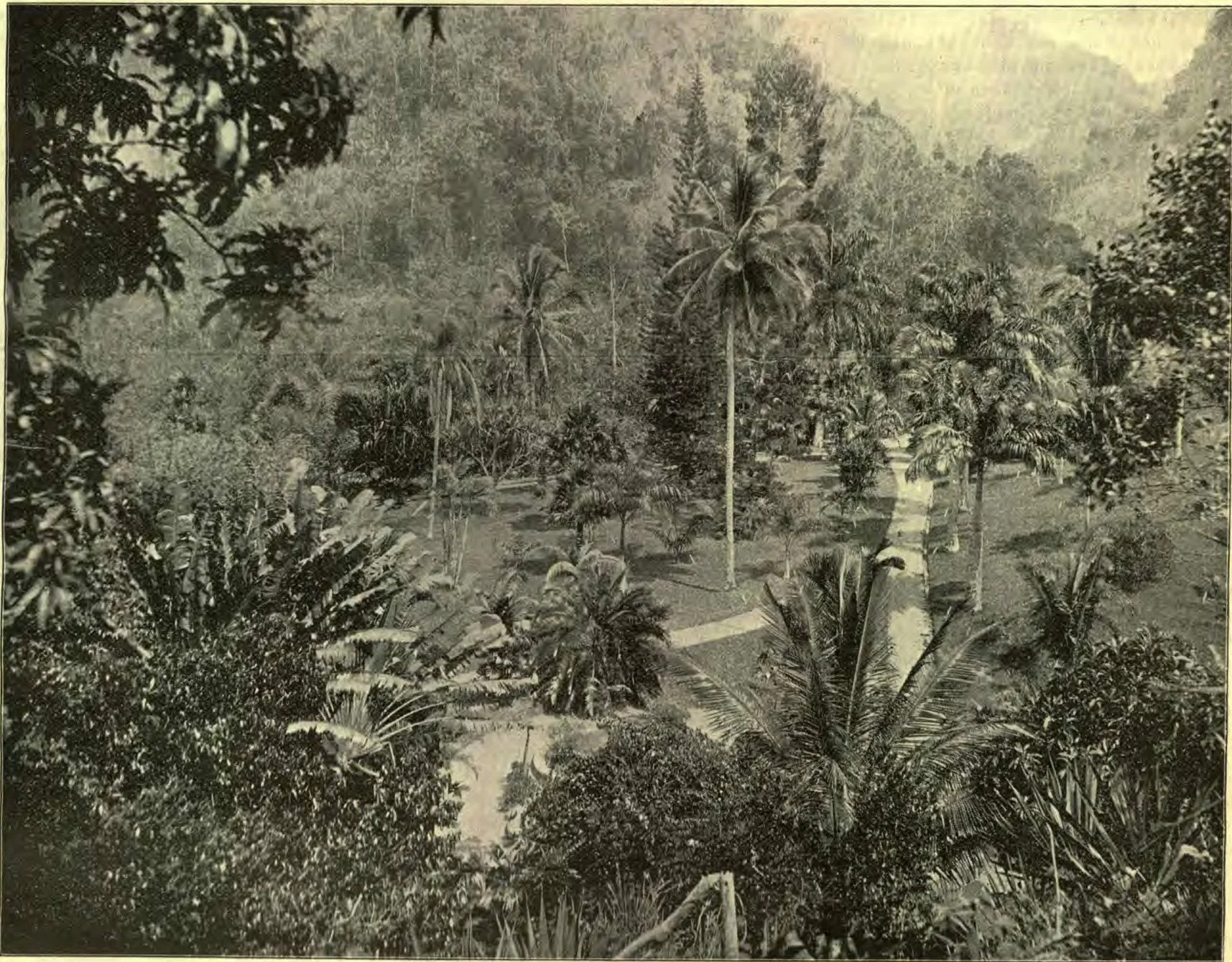
A GARDEN IN INDIA.
A GARDEN IN INDIA.
On the fourth of January I took the train at Ahmedabad for this celebrated mountain, about four hundred and twenty-five miles north of Bombay. The first part of the journey was through a deserted-looking country with a scanty vegetation,—the home of the camel. Through this section large numbers of camels were roaming about, very much the same as the cattle do on the plains of America. In India they are used as burden-bearers; and long trains of them may be seen every day on their way to or from a city. Each one has a hook in its nose, and is tied by a cord about ten feet long to the tail of the one in front of it. The leader is either ridden or led by an Indian. The crane also finds a very good home in this section. Large numbers of these were seen soaring high in the air, while others were feeding upon the scanty vegetation. As we neared the end of the journey, which was over a winding pass and through a mountain jungle, we passed a number of beautiful wild deer and some elephants with a little baby elephant.
Aboo Station, sixteen miles from Mount Aboo, is situated in a valley. The surrounding mountains, covered with dense forests and jungles, are very picturesque and beautiful. The highest one, “Saint’s Pinnacle,” is five thousand six hundred and fifty-three feet high.
Near the station are two immense rocks called the “Nun” and the “Toad,” from their curious resemblance in outline to a veiled woman and to an immense toad. Near by is a beautiful little lake.
Mount Aboo is much visited by tourists from all parts of the world. In company with several tourists from Madras, I made the ascent. We went on little Indian ponies, by a good road. It is a very celebrated place of pilgrimage, especially for the Jains. About half way up the mountain is a group of four temples arranged in the form of a cross. Two of these are classed with the most beautiful temples in the world. Colonel Todd, in speaking of one of them, said: “Beyond controversy this is the most superb of all the temples in India, and there is not an edifice besides the Taj-Mahal that can approach it.”
According to tradition, the founder, Bunul Sah, a Jain merchant, purchased the site from the ruler of Sirohi by covering as much ground as was necessary for the temple with silver coin, and paying it as the price. The temple was fourteen years in building, and is said to have cost eighteen million pounds. It is a three-storied temple with porticoes on each of its four sides, supported by marble columns. There are sixteen on each quarter between the lines of entrance.
This temple, with its four approaches, ample domes, and shady colonnades, built of pure white marble, and carved with all the delicacy and richness of ornament that India at the time of its erection (A. D. 1031) could devise, is dedicated to Rishabhanath, the first of the twenty-four deified men whom the Jains worship. Inside the shrine, which is the only inclosed part of the temple, is a quadruple image of this deity, facing the cardinal points.
At different periods of the year thousands of pilgrims assemble at this place to worship this senseless image, many coming from far-distant places. Some who are more foolish than the rest crawl or roll the whole or a part of the distance, while others measure it with their bodies by a repeated falling and rising movement. I have seen them traveling in these ways in some of the cities during the Monsoon season, when the filth and mire of the streets was something terrible. Much of the worship connected with this temple is disgusting, and the worst evils result. O, how bitter are the results of sin, and how blighting are the effects of idol-worship upon its devotees!
A very extensive view is obtained from the top of Mount Aboo. It enjoys a healthful, invigorating climate during the hot season. For a number of years there has been a sanitarium here for European soldiers.
WILLIAM LENKER.

4.— THE “LASSO-THROWERS,” OR HYDROZOANS.

If among the many forms of life we wished to choose the most graceful and brilliant creatures, whose histories are more like fairy stories than sober reality, we could scarcely do better than to select those which we are now going to study under the name of the “lasso-throwers.” Strange as the name may seem, I hope to show that it is not too fanciful to be accurate.
SEA ANEMONE.
SEA ANEMONE.
Every one knows that the long cord called the “lasso,” used by the Western cow-boy and the South American hunter, is the peculiar weapon which they use to capture animals. From the earliest childhood the young Gaucho learns to play with the lasso, and almost before he can walk amuses himself by skilfully throwing the lasso-loop around the necks of young birds and other small animals round about his father’s hut, and drawing them to his feet. When he is large enough to ride, we see him galloping over the plain, swinging the cord round his head, and letting it fly at the wild horses and wild cattle; and when he becomes a man, often he captures a jaguar or a puma.
Now among animals, as we have already seen, any weapon which they are to use must be such as grows upon their own body, and we should little suspect that an animal could be provided with a lasso ready grown within its flesh; yet this is true. In the type of life standing in rank just above the sponge, we find a weapon of this kind as simple and as deadly as the lasso of the South American hunter, and far more wonderful in its action.
In almost every pool, clinging to a floating stick or to a stone at the bottom, will be found little greenish animals in great numbers, about a quarter of an inch long. Examine one of these, and you will find it looks like a tube with a circlet of fibers at the end, which are waving in the water. This creature is the common fresh-water hydra, and is, in fact, nothing more than a tube fringed at one end with these lassos, and with a sucker at the other end to hold on to the object where it lives. The most remarkable thing is the power which it has of overcoming animals stronger and more active than itself.
Thrusting out its flexible, jelly-like cords, perhaps it touches a water-flea, a water-worm, or even a newly-born fish passing by in the water. Instantly it twists its lasso round its prey. The victim does not struggle, but is at once drawn into this hollow tube, for him a fatal sack.
Now, why does the young fish succumb so quickly? Let us examine the cord, and we will see where the secret of all the hydra’s strength lies. Instead of having a loop at the end of the cord, as does the lasso which the cow-boy throws over the horns of the cattle, the weapon of the hydra, when examined under a microscope, is seen to be crowded with hundreds of clear, transparent cells, each so small that two hundred laid in a row would not be an inch long.
Each of these lasso-cells contains a formidable weapon. Within the cell, lying bathed in a poisonous fluid, is coiled a delicate thread, barbed at the base.
The moment these cells touch an animal, they burst, and these little barbed threads fling themselves out full length. So the victim is pierced by a number of darts, and the poisonous fluid pours into the wounds, paralyzes him at once, and he becomes an easy prey for the hydra. But the hydra does not waste his lasso-cells; for although a cell once used cannot be used again, he grows a new one for each one he exhausts.
The animal develops from a true egg. The creature dies in the early winter, leaving an egg which remains until spring, when it is hatched, producing a new creature to take the place of the parent.
This is the simplest lasso-thrower; the class as a whole is called Coelenterata, and includes a great variety of beautiful creatures. It is divided into two divisions,—Hydrozoa, or water animals, and Actinozoa, or ray-like animals, such as the anemone. But it is sufficient for us to know that, with few exceptions, these all seize their prey by means of a lasso. In another article we will learn something about how they spend their lives.
T. J. ALLEN.

HOW PARIS CLEANS HER STREETS.

THE streets of Paris are by common consent the cleanest in the world, a distinction not maintained without large expense—which is borne by a sense of pride—and unremitting toil on the part of an army of three thousand sweepers.
From 4 to 6:15 in the morning, the sidewalks are swept and watered, sand is strewed on the pavements so as to make them safe for horses and carriages, and all public places requiring such precautions are flushed and disinfected. From 6:30 to 8:30 are removed all household refuse and the sweepings from gutters and flags. From 8:30 to 11 all animal refuse is removed from the streets, the gutters are flushed, and the thoroughfares are watered by hose or water-carts. The time from 11 A. M. to 1 P. M. is given up to the meals of the men, to sweeping by machinery, to the laying of the dust, etc.; and under pressure of necessity the labors may be extended until 9 P. M.
But it is in the season of heavy snowfalls that the efficacy of the Paris system becomes most conspicuous. The snow is first swept up by machinery, and then carted to the Seine and dumped overboard; or, in the remoter districts, it is thawed by salt, and got rid of by the main sewers. Altogether, the French system is in such marked contrast with anything attempted in our American municipalities—saving Colonel Waring's move against the snow in New York last winter, which nearly drove the taxpayers of that city frantic—as to suggest that our street-cleaning authorities might profitably follow the Paris fashion, at least with some modifications.—Philadelphia Record.

FATIGUE OF METALS.

In a new work on engineering, Professor Warren discusses the “fatigue” of metals—a striking term used to describe their loss of power of resistance after having been subjected to strain. Car axles grow thus “fatigued,” and finally break, from the effect of jolts and strains so small that no single one of them seems to have any effect at all.—Selected.

Lake Superior: The Greatest Lake in the World

The greatest lake in the world is Lake Superior, four hundred and thirty miles long and one thousand feet in depth.

The Greatest Coal-Oil Region in Pennsylvania

The greatest coal-oil region in the world is in Pennsylvania.

ONE AT A TIME.

One little grain in the sandy bars, One little flower in the field of flowers, One little star in a heaven of stars, One little hour in a year of hours— What if it makes? or what if it mars?
But the bar is built of the little grains, And the little flowers make the meadows gay, And the little stars light the heavenly plains, And the little hours of each little day Give to us all that life contains.
— Ernest Whitney.

THE WAR IN CUBA.

The war in Cuba still continues with varying fortune to the combatants. One victory has been gained by the Spanish troops, and it was reported that General Maceo, the famous Cuban leader, was killed; but later reports make it certain that he escaped, and that he is now in the mountains with a small band of men. Another Cuban leader, General Gomez, who fought the Spanish troops from 1868-78, is now in Cuba, having gone there from San Domingo. Much is expected of him. A late report states that two hundred Spanish soldiers have been overpowered and killed by the revolutionists.
The Spanish commander-in-chief, General Campos, is now in Cuba, and is directing the movement of the troops for the suppression of the rebellion. He is an able general, and much is expected of him. He finds that the Spanish army in Cuba is poorly supplied with doctors and nurses, and has telegraphed the government at Madrid for these necessary helps in war. The insurgents hope that the coming of the summer will bring the yellow fever among the Spanish troops, and that they will be destroyed by this disease.
Spain has apologized and promised reparation for firing upon the American ship “Alliance,” but her ships have fired upon several British vessels, and some British subjects are reported to have been killed.
Nothing like regular warfare is attempted by the revolutionary party, but this does not make it certain that they will not in the end gain the victory. At the present time the “Pearl of the Antilles,” as Cuba is called, presents a sad spectacle. The Spanish troops hold all the large towns, and those in rebellion hold the mountain fastnesses. There are many thousands of persons of whom it is not known which side they are on. Many plantations are not being cultivated, and business is nearly suspended. This is the picture: Tyranny leads to insurrection, rebellion, and war; this causes death, destruction of property, stagnation of honest trade, and an innumerable host of evils. Out of this chaos there may be evolved a better condition of things, and perhaps not.

GREAT BRITAIN AND NICARAGUA.

DURING the latter part of April the contention between Great Britain and Nicaragua reached an acute stage, and for a time it seemed as though a war between the power that rules the seas and much of the land, and the pigmy Central American republic, would certainly result. The demand of Great Britain for seventy-five thousand dollars as an indemnity for the forcible expulsion of a British subject from Nicaragua, was not acceded to, and both parties prepared for the bloody arbitrament of the sword. Great Britain sent over a strong fleet of war ships under Admiral Stephenson, and Nicaragua mustered her forces to repel an invasion of her shores.
In this country the affair was watched with intense interest. Some thought the United States should interfere, and there is no doubt that the Nicaragua minister at Washington, and the people of his country generally, looked to this country for protection. But the president and his cabinet, relying upon the promise of Great Britain that no attempt would be made to seize and hold any of the territory of Nicaragua, refrained from any active interference in the matter. The British government authorized the landing of sailors and marines if the indemnity should not be paid at a certain day,—April 26,—and as neither money nor promises were forthcoming, the following night a force was landed at Corinto, and took possession of the town. It was the declared intention of Great Britain to take possession of the customs department, and collect duties on foreign imports sufficient to pay the seventy-five thousand dollars indemnity. This determined action had the desired effect upon Nicaragua; and after further negotiations, in which some of the other Central American states took part, it was agreed that if the British fleet would leave, Nicaragua would pay the sum demanded, within fifteen days of the British evacuation. So the contention seems to be settled without war, which should be a cause of satisfaction to every lover of peace. It is estimated that Nicaragua, by her extra expenses for troops, the loss of the usual customs, and the general disturbance, has lost one million dollars.

DEAD AND LIVING SAINTS.

THE Catholic Church, with its great reverence for dead people who are supposed to have been saints, almost equals the veneration of the Chinese for their ancestors; but it has not been very successful in manufacturing saints out of American material, and what few American Catholic saints there are, have not that imputed holiness which is inseparably connected with people who lived so long ago that their weaknesses and failings have all been forgotten, and only a hazy tradition of their good deeds has been remembered. This being so, the Catholic Church in this country makes frequent requisitions upon the cemeteries of Europe for dead saints to supply the deficiency in the American saint market.
The latest addition to the dead saints of the United States arrived about two weeks ago. He was known as Saint Peregrinus, and he lived in the ninth century, and died at Rome. He was afterward removed to Neustadt-on-the-Main, where he is supposed to have rested quietly ever since.
It is quite likely that dead saints are no novelty in Germany, and so cannot be used to stimulate the superstition of the people or draw money from them; and so the Catholic bishop of Neustadt has given up the body of this saint, with attested certificates of its genuineness, and it will hereafter rest in the Church of Saint Anselm, in New York City. This is the second Catholic church in that city which has a dead saint within its walls, and its members feel highly elated. Other churches will not be outdone, and so we may expect quite an increase of the business of bringing dead saints here. Talk about the “heathen Chinee” who send the bodies of their dead back to China! Here is a heathenism fully as great, and otherwise intelligent Americans participate in it. Dead saints, forsooth! What the world wants are living saints. A dead saint may fan a spark of credulity into a blaze of superstition; but a living saint will kindle a fire of faith that will lead to a better life. An intelligent Christianity would suggest that the dead saints—if saints they were—be allowed to sleep undisturbed until the resurrection, but that living saints should exert all their powers to rescue the perishing, and teach the principles of the gospel.

ARMENIA

LATE reports from Armenia are of an alarming character. In spite of the vigilance of the Turkish government, large quantities of arms and ammunition are being shipped into Armenia, and in many cases Turkish officials, who are easily bought, are conniving at this work. Money for this purpose is freely furnished by Armenians in England and the United States, and their friends. The Armenians have no hope to defeat the Turkish armies and gain their own independence; but they believe that if Armenia shall rebel, the Turkish troops will commit such atrocities that the European powers, already much stirred over Armenian affairs, will interfere, and that Armenian liberty, guaranteed by the great powers, will be the result. It is said that the uprising will take place in this month.
Meanwhile all the civilized world is waiting to hear the report of the commission which was sent out last fall to investigate the reported Armenian massacre. If the report of the commissioners shall establish the truthfulness of the accounts which have been given to the press, whether the Armenians rebel or not, the Ottoman empire will have to make such changes in the government of Armenia as will protect them in the future from the wild Kurds, and from the equally barbarous Turkish regular troops.

Monument Effort to Honor Francis Scott Key

For many years the body of Francis Scott Key, author of the “Star Spangled Banner,” has lain in a humble graveyard in his native State, at Frederick City, Maryland. Now an effort is being made to erect a monument to his memory which shall suitably reflect the estimation in which he is held by the American people. The governor of Maryland has addressed letters to the governors of all the States of the American Union, asking them to take such action in the matter as will help to secure the necessary funds for the erection of a proper monument. The sum of two thousand dollars has already been raised by the people of Frederick City.

Supreme Court Income Tax Decision and Civil War Refunds

ONE of the most serious difficulties arising from the late decision in regard to the “income tax,” has been brought out by a statement presented to the Supreme Court of the United States by Mr. Olney, attorney-general of the United States. Mr. Olney declares that during the years of the civil war many millions of dollars were raised by taxes on incomes derived from profits on land and rentals, which the present court pronounces unconstitutional. If this shall hold, all that money was raised contrary to law, and the government may be compelled to pay it all back. That is the most serious side to this vexed question which has yet been presented.

Minnesota Supreme Court Upholds Telephone Company Pole Rights

A LEGAL decision of much importance has lately been rendered by the supreme court of Minnesota. A farmer denied the right of a telephone company to place their poles in front of his house, and the case was taken to the courts. The lower court held that as the telephone is a public service, the company had a legal right to erect their poles without compensating the owner of the land. An appeal was taken to the supreme court of the State, which, April 30, sustained the former decision.

Black Flags Oppose Cession of Formosa to Japan

THE “Black Flags,” a kind of irregular force of Chinese soldiers on the island of Formosa, are much opposed to the cession of the island to Japan, and they are terrorizing the sea-coast towns. M. E. K.

COMMITTING SCRIPTURE.

In the age in which we are living the Bible is found in most all households. Publications containing portions of the Scriptures are scattered everywhere. Sabbath-school lessons are so nicely arranged that there is not the necessity of depending upon the memory for scriptural answers, as in former days. The Bible is read frequently by a great many, and there are scores in our churches who can turn readily from book to book and from chapter to chapter for the required text. But how few there are who can repeat the text without the book in hand! What would be the result if the written word were taken from them?
We have a rich promise to those who have the word of truth stored away for future use: “If ye abide in me, and my word abide in you, ye shall ask what ye will, and it shall be done unto you.” It is a great thing to be granted the privilege of asking what we will, with the assurance that it may be granted to us. But what is the condition?—If “my words abide in you.” We know of no other way for Christ’s words to abide in us than that we know them so as to use them. This was Christ’s stronghold when tempted by Satan. He could say, “It is written,” and give the exact words that were written.
There is a great neglect in learning the Scriptures so as to be able to repeat them. While we do not favor an exhibition of mental powers in repeating many verses or chapters, we do think there might be a great improvement in this line. Why should not young men and women be able to repeat the promises of God in time of temptations? This is the only way temptations can be met. If whole books of the Bible were learned so that every verse could be referred to as readily without the book as with it, what a power for spiritual strength it would be! When the time comes that we are deprived of the written word, we will be able to reproduce it from the great tablet,—the memory,—on which God has written it.
The following anecdote, which we read but a short time ago, illustrates the importance of committing the Scriptures to memory. A Catholic priest in Ireland one day met a lad returning from a Protestant school, with a Bible in his hand. The following conversation took place:—
“Do you go to that place?” asked the priest, pointing to the Protestant school.
“Yes, your reverence,” replied the boy.
“I thought so,” said the priest, “by the book you have in your hand. It is a bad book; give it to me.”
“That book is God’s word,” said the boy, “and it teaches us the way to love God, to be good, and to get to heaven.”
“Come home with me,” said the priest. The boy did so, and on entering his study, the priest took the poor boy’s Bible, and threw it on the fire.
“You shall never read that book again,” said the priest; “it is a bad book; and, mind, I shall not suffer you to go to that school again.”
The Bible was soon in flames, and the poor lad at first looked very sad; but as the priest grew more and more angry, and told him there was an end of it all now, the boy began to smile.
“Why do you laugh?” asked the priest.
“I can’t help it,” said the boy.
“I insist upon your telling me why you laugh,” said the priest.
“I can’t help laughing,” replied the boy; “for I was thinking your reverence couldn’t burn the ten chapters I’ve got by heart.”
This is what we all need. Like David, we should be able to say: “Thy word have I hid in mine heart, that I might not sin against thee.” Little by little we can do this. We may be so limited for time that we can commit but one short verse each day; yet in the course of a year this will equal several long chapters. But the best of all is, the word thus learned cannot be burned. J. H. D.

GOD'S APPOINTMENT.

It is true that when the probation of the race is ended, the righteous retribution of God will fall upon those who have persistently refused to accept the offers of mercy which he has so graciously and for so long a time offered them; but let no one think this to be God's act; it is not. It will be the act of those, who, by their own conduct, choose to receive this instead of the blessings which God offers to them; for if God tells men plainly the results of pursuing a certain course,—the good they will receive by following one, the evil they will receive by pursuing the other,—giving them the enlightenment of his Holy Spirit that they may discern the right way, and by that same Spirit, the power to walk in that way, and then they choose the path of evil with its fatal termination,—what can it be but their own act if they pursue the evil course, and receive in themselves the terrible results of sin? So the Lord once said to his people after having fully set before them the two ways they were at liberty to pursue: “See, I have set before thee this day life and good, and death and evil.” “I call heaven and earth to record this day against you, that I have set before you life and death, blessing and cursing: therefore choose life, that both thou and thy seed may live.” Deut. 30:15, 19. Thus God says to every one, “Make your own choice;” so if we choose the evil, we cannot say that God's desire was that we might choose the downward path, that he might inflict upon us punishment.
The apostle Paul illustrates this truth very forcibly in 1 Thessalonians 5. After describing the coming of the day of the Lord and the “sudden destruction” that will then come upon the ungodly, he says: “But let us, who are of the day, be sober, putting on the breastplate of faith and love; and for a helmet, the hope of salvation. For God hath not appointed us to wrath, but to obtain salvation by our Lord Jesus Christ, who died for us, that, whether we wake or sleep, we should live together with him.” Verses 8-10. No; God hath not appointed us to wrath. Let us thank him that this is so. What is God's appointment for us?—“Salvation by our Lord Jesus Christ” is his appointment. To accomplish this glorious salvation for us, to make this appointment possible, Jesus “died for us.” God purposed our salvation, even giving us his dear Son that it may be accomplished. If any one will not receive it, he simply frustrates the grace of God, as far as he personally is concerned, and by his evil choice gains what the Lord desires he shall not receive, and loses the blessings God wants to give him. God wants to save us, but he will not do it against our will. So the greatest of all blessings for this life and for the life to come may be obtained by us by a submission of our wills to God, because he wills the best thing possible for every one of us. He wills our salvation. May we recognize in that will our highest good, and place our wills in harmony with the will of God.

Labor and Rest.

PROBABLY no words that Jesus ever uttered have given more comfort to the children of God than those recorded in Matt. 11:28-30. Yet it is likely that all who read them do not take in their full meaning, and perhaps no one ever got all their meaning; for there is an infiniteness in the word of God, as there is in God himself. Neither he nor his word can be exhausted. We would, at this time, emphasize one thought,—that of rest in labor. Generally speaking, in regard to the affairs of this world, rest is supposed to be the absence, or cessation, of labor. Such is not the rest to which Jesus invites his followers. Who ever rested so perfectly in God as did Jesus? and who was so active as he who said, “My meat is to do the will of him that sent me, and to finish his work,” and who, as that work was closing, declared with supreme joy, “I have glorified thee on the earth: I have finished the work which thou gavest me to do”? The yoke, then, is a symbol of labor; but in Christian experience labor and rest go together, and it becomes not only a symbol of work but of rest.
There is rest in labor for Jesus, because it brings to the soul the blessing of God, and there is nothing so restful as the presence of God’s spirit. Said the Lord to Moses: “My presence shall go with thee, and I will give thee rest.” The burden may be heavy, but God, who gives us our work, dividing to each according as he will, will see that we are sustained in our work; and we have the promise: “As thy days, so shall thy strength be.”
A gentleman once met a little boy who was carrying a heavy load. Surprised at the sight, he questioned him in reference to his great burden. Frankly the child made reply, “Father told me to carry it.” To the obedient child this was enough. Would that we could all view the burdens given us by our heavenly Father in that way. Then, indeed, would labor for him be restful and sweet.

QUOTING THE SCRIPTURES CORRECTLY.

THE importance of learning the word of God so that we are perfectly familiar with it, as suggested in the first article upon this page, cannot be overestimated. There is one more point in reference to this subject that we wish to emphasize: it is that the Scriptures be remembered and quoted with absolute correctness. If we learn a text of Scripture, we may just as well, while we are about it, learn it right as to learn it wrong. If we do learn it wrong,—if we insert a word that is not there, or leave out one that is there,—we shall be liable to read it wrong even when the words are right before us. How often we have heard Heb. 1:14 quoted in this way: “Are they not all ministering spirits, sent forth to minister to them who shall be heirs of salvation?” and again: “Seek ye first the kingdom of God, and its righteousness; and all these things shall be added unto you!” Matt. 6:33. Learn the Scriptures, but learn them right; and especially learn them right before you write anything in which you quote them. M. E. K.
Continue reading: LESSON 9.—THE LITTLE HORN AND THE JUDGMENT. DANIEL 7