LESSON 9.—THE LITTLE HORN AND THE JUDGMENT. DANIEL 7.
By M. E. K.
(June 1, 1895.)
Time: B. C. 540. Scene: 1. The papacy rises and does his work against God, against his people, and against his law. 2. But the judgment sits, and he is destroyed in the burning flame. 3. Christ receives his kingdom and dominion. 4. All the nations of the saved serve him forever.
SYMBOLS.
1. The little horn.—Papal Rome, or the papacy.
2. Three horns.—Heruli, Vandals, and Ostrogoths.
3. “Plucked up.”—Overthrown. (See Senior Lesson, Note 1.)
4. “A mouth.”—A means—the opportunity and power. God permitted him to have the opportunity to speak great words against the Most High,—to pass cruel edicts against his people, and think to change his law. (See Senior Notes.) The Lord gives each individual the opportunity to choose for himself what course he will pursue, but he tells us to remember that for all these things he will bring us into judgment. Eccl. 11:9; Dan. 7:26, 10, 11; 2 Cor. 5:10.
5. “Ancient of days” (verses 9, 22).—The Father.
6. “Son of man” (verse 13).—The Saviour.
7. “Clouds of heaven” (verse 13).—The angels.
8. “A time” (verse 25).—One prophetic year,—three hundred and sixty prophetic days, or three hundred and sixty literal years.
“Times.”—Twice “a time,” or two prophetic years,—seven hundred and twenty prophetic days, or seven hundred and twenty years.
“The dividing of time,” or “half a time.”—One half of a prophetic year,—one hundred and eighty prophetic days, or one hundred and eighty years.
“Time, times, and a half” (Dan. 12:7).—Three and one-half prophetic years,—twelve hundred and sixty prophetic days, or twelve hundred and sixty years.
“Forty and two months” (Rev. 13:5).—Forty-two divided by twelve gives three and one-half prophetic years,—twelve hundred and sixty prophetic days, or twelve hundred and sixty literal years. Counting thirty days to a month, forty-two months make twelve hundred and sixty prophetic days, or twelve hundred and sixty literal years. (See also Rev. 12:14, 6.)
ANALYSIS.—In Dan. 7:3-14 we are taken chronologically from the days of Babylon to the close of probation. Then in verses 15-27 we find an explanatory chart carrying us back over the same ground. Hence the verses and events may be arranged as follows:—
VISION.
EXPLANATION.
Verses 3-7:
Verses 17, 23, 24, first part.
Verse 8, first clause:
Verse 24, last clause.
Verse 8, last clause:
Verse 25, first clause.
Verse 21:
Verse 25, second clause.
Verse 9:
Verse 22 (until the Ancient of days came).
Verse 10:
Verse 26.
Verse 14:
Verse 18.
Verse 22, last clause:
Verse 27.
IMPORTANT LESSONS.—1. Verses 8, 25, and 26 have been wonderfully fulfilled as written on the pages of history. Each additional fulfilment should strengthen our faith and confidence. 2. Daniel’s deep anxiety concerning the fourth beast and the little horn, doubtless because of their relation to the people of God, is a lesson to us to take a deep interest in the history and work of the papacy. The prophecy applies with particular force to this generation. Rev. 14:9-12. 3. The judgment work is now going on. The little horn is not the only one to be judged. I have a case pending there. 4. Daniel kept the matter in his heart. Dan. 7:28. It was his thoughts daily. What are our thoughts daily? Please read Ps. 19:14; 119:11.
What solemn event is brought to view in close connection with this? Verse 26.
Describe the judgment as seen by the prophet. Verses 9, 10.
What voice did he hear after the judgment session began? Verse 11.
What scene in heaven again attracted the prophet’s attention? Verse 13. (See note.)
What was given him? Verse 14.
Who shared with him in this kingdom? Verse 27.
How did these solemn scenes affect Daniel? Verse 28.
What did he do? Verse 28.
NOTE.
“Came to the Ancient of days” (verses 13, 14).—This is the closing scene in Christ’s priestly work. The Father is on the throne above the law that has been transgressed. The Son, escorted by the angels, is now brought into the most holy place to do his last pleading for man. He is there now. Soon my life record, and the life record of all, will be decided. Then our Saviour will receive the kingdom and dominion. O happy day for my Lord! The Father will say: My son, you have been a faithful son; you have well earned your kingdom; you have pleaded earnestly for your subjects; and you have a right to them and your throne. Therefore, in view of your loyal, self-denying, self-sacrificing life, in the presence of all these happy angels who have ministered with you and for you, I now present to you my beautiful city, the New Jerusalem, to be your bride and joy forevermore. My dearly beloved son, behold your future throne of glory; and now, upon this head that has borne the thorns, I place the royal diadem, and crown you King of kings and Lord of lords, and proclaim the kingdom and dominion over all nations to be yours forevermore. Amen. It is done. Rev. 16:17. Then the angelic choir will chant with rapture: “The kingdoms of this world are become the kingdoms of our Lord, and of his Christ; and he shall reign forever and ever.” Rev. 11:15. Then “the Lord himself shall descend from heaven with a shout”—a glad, happy shout—and do you wonder? He hastens for his loved ones—the purchase of his blood. O who does not desire to be ready to meet him?
ADDITIONAL NOTES.
It often happens that when those to whom God has imparted an understanding of the meaning of these prophetic symbols that were shown to Daniel, endeavor to explain them to others, they are told, even by ministers of the gospel, that the Lord does not want us to be inquiring for the meaning of these things. But Daniel wanted to know, and drawing near to one that stood by, he “asked him the truth of all this.” He was not rebuffed, but a full explanation was given to him, and it was written in the Scriptures for the benefit of future ages.
Three distinct and separate events are brought to view in verse twenty-second,—(1) the coming of the Ancient of days; (2) judgment given to the saints; and (3) the possession of the kingdom by the saints. The coming of the Ancient of days is the opening of the judgment. This began in 1844, when the twenty-three hundred years ended. That judgment dooms the papacy, and at the second advent of Christ it is cast into the lake of fire. Then judgment is given to the saints, who live and reign with Christ a thousand years. The judgment work is nearing its close; the papacy, though apparently prospering and succeeding, is nearing its end; and soon the time will come when the saints will possess the kingdom.
The place of the inheritance of the saints is clearly marked in this prophecy. It is to be “under the whole heaven.” That is specific enough. It will be under the same heaven that Babylon, Medo-Persia, Greece, and Rome were under. These kingdoms were universal in a limited sense. The kingdom of God will be universal under the whole heaven in an absolute sense.
A historian, speaking of the early settlement of America, has said that “God sifted three nations to find the seed to sow in America.” But for the inhabitants of the new earth, the kingdom of God “under the whole heaven,” God has sifted the world. Every generation has been tested, and some souls have been found who will help to compose the “great multitude, which no man could number,” for they are gathered from “all nations, and kindreds, and people, and tongues.”
Protestants are generally agreed that the little horn of this chapter is a symbol of Rome. Its blasphemous words against God and its persecution of the people of God, prove this. There is another point that deserves notice. It thinks to change “times and laws.” This cannot refer to the laws of a preceding, or of any earthly, power. As all powers do that, as far as possible, it would be nothing remarkable, and something else must be meant. The work of the papacy is against God; it speaks great words against the Most High, and wears out the saints of the Most High. Then it must be that the laws against which it strikes are the laws of the Most High. The laws of God are emphatically contained in the ten precepts of the decalogue. A glance at this law as it is in the Scriptures, and as it is in the Catholic catechisms and as taught by that church, will leave no doubt in this matter. The second commandment is entirely removed, the fourth is abolished to make way for the papal holiday, Sunday, and the tenth is divided. Surely the papacy has in more than one way arrayed itself in war against God!
All in that kingdom will be the servants of Christ; for we read: “All dominions shall serve and obey him.” But the service of those who become the subjects of Christ in his future reign of glory, begins here on this earth in its present condition. Here they first learn of him and of his claims to their love, worship, and obedience; and it is here in this mixed state of good and evil that they prove their loyalty to him. And he has left us this promise: “And every one that hath forsaken houses, or brethren, or sisters, or father, or mother, or wife, or children, or lands, for my name’s sake, shall receive a hundredfold, and shall inherit everlasting life.” M. E. K.
MOSES
By Emma L. Kellogg
Where the days are hot and sultry, far away in Egypt's land, Dwelt the captive Hebrew nation by the Nile so broad and grand. Years before they went from Canaan, when the famine pressed them sore; For the corn was there in plenty—for their need a goodly store.
They had gained the king's good favor through one Joseph, known of old, Whom his brethren, being envious, to the Ishmaelites had sold; And they dwelt in peace and plenty, for the king had given command They should tend their flocks in Goshen,—the best pastures in the land.
There they tarried till the kingdom was o'erthrown, and they became Bondmen in the land of Egypt,—bondmen both in deed and name,— There to serve the king with rigor from the morning till the night; For thus to lay on heavy burdens seemed to be his chief delight.
Then the Pharaoh sent a message through all portions of the land, Urging people to be ready to obey his stern command: All the daughters of the Hebrews should be kept in bondage vile; But the sons, while little babies, should be thrown into the Nile.
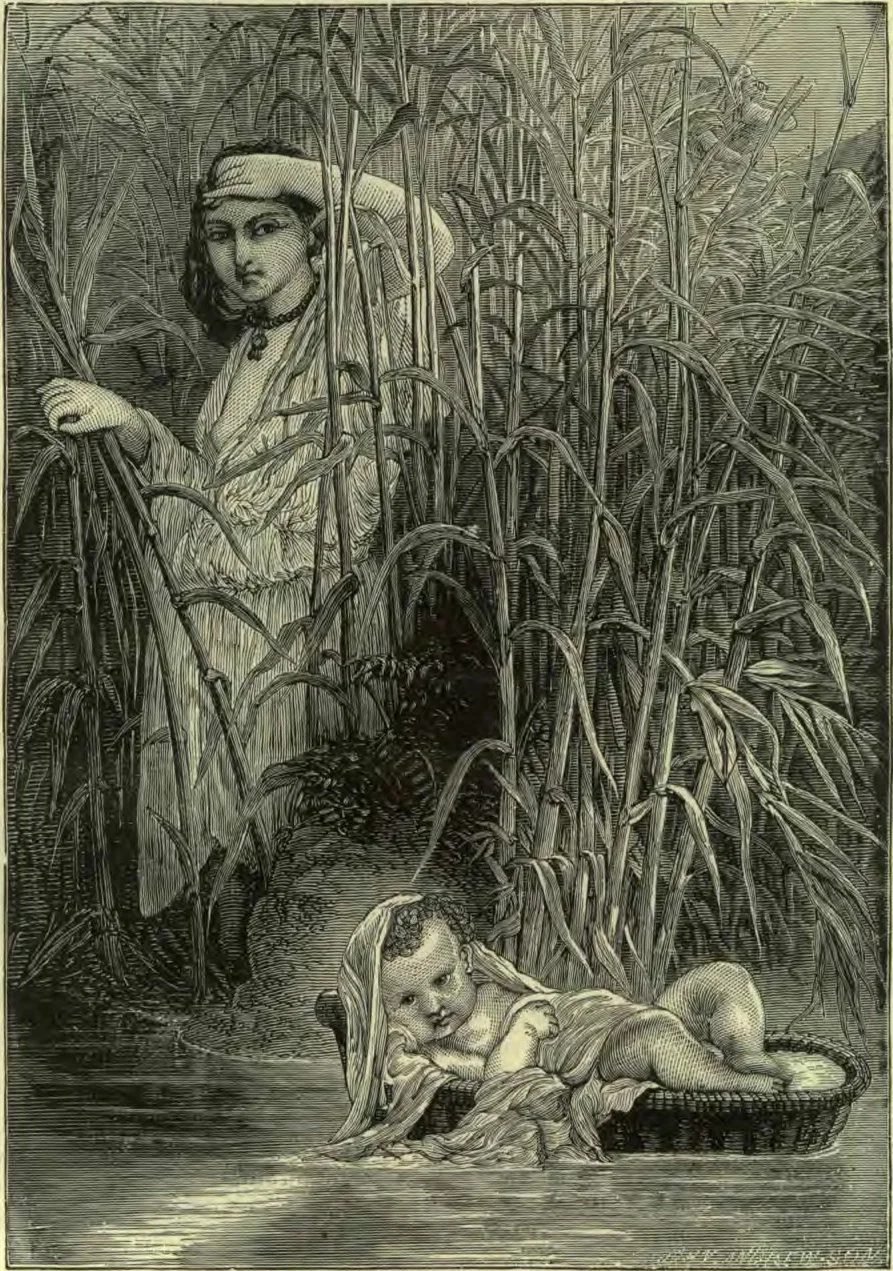
So one mother, broken-hearted, hid her son three months or more; Then she took an ark of rushes, and with pitch she daubed it o'er, Laid her sleeping babe within it, and though from the act she shrank, Placed it in the treacherous water close beside the river's bank.
Then she left his little sister to keep ward and watch that day, For she knew that Pharaoh's daughter would be sure to come that way; And with heavy heart she waited for some tidings of her child, All unmindful of its danger, sleeping on the waters wild.
Down beside the Nile's dark waters, where the reeds grew tall and rank, Came the princess and her maidens, walking by its winding bank,— Came to lave in its cool waters,—free from care to sport and play, Where the reeds along the margin sheltered from the sun's bright ray.
Then the merry-hearted princess, laughing gaily on her way, Looked abroad upon the waters on that pleasant summer day, And the outlook gave her pleasure. She, of Pharaoh's line so grand, Spied a tiny ark there resting 'mong the reeds not far from land. And then summoning her maid, she said: “Go bring it here straightway;” And the messenger returning, soon the ark before her lay. Carefully she raised the covering; a sweet Hebrew babe was there, With its cheeks bedewed with teardrops,—it had lost a mother's care. Then she sweetly smiled upon it, pressed it closely to her breast; And her heart was filled with pity as she thus the babe caressed. “I will make you prince of Egypt; you shall be my son and heir;” These were the words the sister heard as she stood listening there. And then running to the princess, said, in accents low and clear, “Shall I bring a Hebrew woman now to nurse this baby dear?” “Go at once,” the princess answered. “I have drawn him from the deep; So his name shall be called Moses. As my own this child I'll keep.”
Then they called the babe's own mother, who in prayer to God meanwhile Asked that he would shield her darling from the dangers of the Nile; And she clasped her own loved son unto her aching heart once more, And she thanked the God of Jacob as she ne'er had done before.
And the mother took her darling to her home not far away; And this Moses grew in stature and great beauty day by day; And he gained vast stores of knowledge from wise men on every hand; And he led the captive Hebrews out into the promised land.
EMMA L. KELLOGG.
MY WASPS.
By Helen A. Steinhauer
It was “way down in Dixie.” I had a twenty by twenty room, with four great windows in it,—two east and two south. I kept the blinds on the south side closed, as it made the room too much like a lantern to have them all thrown open.
Pretty soon some wasps came along, prospecting; and liking the lay of the land, they built them a nest between the sash and the closed blind. As a matter of course, I asked to have it removed; but the lady of the house was in poor health, and could not look after her servants, and as they were not anxious to do the work, it was not done; and I did not insist upon it for fear of bothering her.
And now, you know how it happened; they not merely built just outside my window, but they raised a large and flourishing family, who made themselves at home in my room. I did not fancy it, but made up my mind that since we must live together, it would be pleasanter for all concerned that we should be friends.
At first they only flew through the room, in at one side and out at the other—“across lots,” as it were. I sat at my desk writing one afternoon, when suddenly a big wasp flew angrily round my head. Looking at the window, I at once saw what was the matter; the slats of the Venetian blinds had been tightly shut; so when he wanted to get out, he found his right of way closed, and it made him angry. So I got up and let him out without delay.
He must have told the others; for after that whenever they were shut in, they would fly round my head with a gentle humming noise till I got up and turned the slats so that they could get out. I also let them in whenever they called me with this pleasant humming sound, which was very different from the noise made the first time, when the wasp got so angry.
Very soon they seemed to know and trust me as their friend, crawling over my hands, as if they liked to be with me; and I really enjoyed having them near me. When my meals were brought to my room, they always shared the sweets on my tray, like so many invited guests. At the end of the summer we were on the friendliest of terms, and I could say that they had never once tried to sting me!
My young readers must remember, however, that if I had one single time been cross or cruel to them, or even failed to wait on them, there would have been serious trouble. For this reason they would better be a little cautious how they set about petting wasps. It is always safe to let them alone, and not to run or strike, but to be quiet and very gentle if one is forced to be where they are.
Their sense of smell is said to be very acute, and it is a fact that the neater people are about their persons the less likely they are to be stung by wasps, and the same is true of honeybees.
HELEN A. STEINHAUER.
Moses Refuses to Be Called Pharaoh's Grandson
“By faith Moses . . . refused to be called the son of Pharaoh’s daughter.”
NUGGETS FROM THE GOLDEN WEST.
By Kittie Wagner
IN FIVE PARTS.—PART I.
FLOWERS.
“Wondrous truths, and manifold as wondrous,
God hath written in those stars above;
But not less in the bright flowerets under us
Stands the revelation of his love.”
“Bright and glorious is that revelation,
Written all over this great world of ours;
Making evident our own creation,
In these stars of earth, these golden flowers.”
“Everywhere about us are they glowing,
Some like stars, to tell us spring is born;
Others, their blue eyes with tears o’erflowing,
Stand like Ruth amid the golden corn.”
“And with child-like, credulous affection
We behold their tender buds expand;
Emblems of our own great resurrection,
Emblems of the bright and better land.”
Let us together observe the marks on the dial-plate of the heavens. Our attention is first directed upon that great central orb of the planetary scheme, the dispenser of all light and heat. Should it for a single day fail to shine, it would be with us as if God had created us but to perish. We look again, and there in all her beauty and splendor rides the “Queen of the Night.” In the west, “Hesperus, that leads the starry host, rides brightest;” while in the south shines brightly a small but sparkling light which we all know to be mighty Jupiter—the prince of planets. These are but a few of the many millions of visible stars, to say nothing of the countless hosts that are even beyond the giant eye of the astronomer’s telescope.
Although we can become acquainted with the position of the fixed stars, and trace the paths of the planets as they move in perfect order among them, we can become far more intimately acquainted with the flowers.
How we delight in observing the heavenly bodies; for we, like the poet, realize that they reveal the mighty truths and wondrous love of the Father! But does he not also say that God’s love is revealed no less in the stars of earth,—the little flowers at our feet? Can it be that in the daisies, the lilies, the violets, which grow so profusely about us, is written that same love, that wondrous love, that is revealed in the “forget-me-nots of the angels”? Some one has said, “Every rose is an autograph from the hand of God on this world about us.” He has inscribed his thoughts in these marvelous hieroglyphics which sense and science have these thousands of years been seeking to understand.
As we, by studying the productions of an author, find there his character portrayed, so, by studying the works of the Author of all, we may see in them his majesty, love, and power revealed; and as these attributes are seen in the flowers, shall we not contemplate their beauty whenever an opportunity is offered for so doing?
Many, many years ago this earth in its beauty came pure and spotless from the hand of its Maker. Planted in it eastward, in Eden, was that beautiful garden which was the dwelling-place of man, and which would have continued to be such, had he not by disobedience forfeited his right to it. God could not trust such a lovely garden to the care of those who had proven unworthy of their sacred charge; and in order to preserve Eden in its original beauty, he removed it from earth, and gave its care and training into the hands of angels.
Although the never-fading flowers were removed from earth, the Creator’s tender pity for fallen man caused him to clothe the earth with those bright gems “in which, perchance, we see what Eden was, what paradise may be.” This gift has been appreciated not only by the children who in their delight wander through the fields, ruthlessly filling their tiny hands with “these stars of earth,” but also by the great and wise; and their appreciation for flowers is shown by their many words of praise, just a few of which I have gleaned: “Lovely flowers are the smiles of God’s goodness;” “flowers are God’s thoughts of beauty taking form to gladden mortal gaze;” “flowers are nature’s jewels, with whose wealth she decks her summer beauty;” “your voiceless lips, O flowers, are living creatures,—each cup a pulpit, and each leaf a book.”
How natural for us to love flowers; for when language fails to express our most delicate, heart-felt sympathy, we then resort to flowers! Who can express the sentiments of his inmost feelings in words as he can in presenting a bouquet of fresh, fragrant flowers? A gift of flowers soothes the pain of one languishing on a bed of sickness, that no medicine could alleviate. How could we better show our sympathies to those bereft of the nearest and dearest on earth, than by twining about the lowly resting-place of their beloved those emblems whose perpetual and renewed beauty directs their minds to the morning when the dead shall awake to immortal bloom?
How beautifully Job, when speaking of the shortness of life and the certainty of death, expresses himself by simply using the flower as a symbol: “He cometh forth like a flower, and is cut down.” As the flower springs forth in all its beauty and innocence, and blooms but to fade, so man comes forth but to die.
Then as we wander among the flowers, admire their beauty, learn their language, and enjoy their fragrance, we are led to exclaim, “O, what a desolate place would this world be without flowers! It would be a face without a smile, a feast without a welcome. Are not God’s flowers the stars of earth? and are not our flowers the stars of heaven?”
Jesus dwelt amid scenes of true and perpetual beauty; yet when he came to this earth, he could see in the flowers a reflection of the same beauty; for he said, “Consider the lilies of the field, how they grow; they toil not, neither do they spin: and yet I say unto you, That even Solomon in all his glory was not arrayed like one of these.”
KITTIE WAGNER.
SYSTEMS OF HANDLING THE MAILS IN LARGE CITIES.
By E. G. Burdick
3.—MAILING DIVISION (CONTINUED).
In my last article you will remember my closing with facing and separating letters and papers when brought into the main office. Now I will tell you about canceling and post-marking them. During the last two years all large offices have been supplied with from one to four stamping machines. Before this all mail was canceled by hand. All small offices do so now. This machine is manufactured by Hay and Dolphin, of New York City, and is furnished by the International Postal Supply Company. This company does not sell the machines, but rents them by the year to the post-office department, at a given price. They are run by electricity, and will cancel and post-mark thirty thousand letters an hour, when at full speed. The name of the post-office, with the date and time of mailing, is the post mark, and the short lines of various shapes, or the long straight or crooked line, across the stamps, is the cancellation. All stamps are supposed to be canceled, but some pass through without being so.
When a letter reaches its destination uncanceled, and has a “return card” on the envelope, it is sent out with a slip attached, asking the return of the envelope by the carrier. Then it is returned to the place of mailing as a “check” on that office, to call the attention of its officials to it, so they will be more careful. All letters too large to pass through the machine are canceled with a hand stamp, which covers only about one half the space of the machines. Letters bearing long straight or crooked lines are canceled by machine, all others by hand. A clerk who locks and unlocks all mail pouches also cancels the stamps on all other mail matter, such as single papers (as those sent out by our missionary societies), and merchandise. These cancellations do not have the date and time in the post-mark. All kinds of mail except letters must be fully prepaid with postage before sending out. All United States senators and representatives, and all branches of the government, can send their mail free; but such mail must be franked,—that is, have the name and position, or office, on the corner of the letter,—usually on the upper right-hand or left-hand corner. In my next I will tell you how all periodicals and papers brought in by publishers and news-dealers are handled. E. G. BURDICK.
A POST-OFFICE IN 600 B. C.
THE invention of the post-office, says Harper's Young People, is ascribed to Cyrus, king of Persia, who lived about 600 B. C.
Cyrus required all of his governors of provinces to write to him exact accounts of everything that occurred in their several districts and armies.
The Persian empire was of vast extent, and some means had to be provided to render that correspondence sure and expeditious. Cyrus therefore caused post-offices to be built and messengers appointed in every province. He found how far a good horse, with an experienced rider, could travel in a day without being hurt, and then had stables built in proportion, at equal distances from each other. At each of these places he also appointed postmasters, whose duty it was to receive the letters from the couriers as they arrived, and give them to others, and to give them fresh horses in exchange for those that had performed their part of the journey. Thus the post went continually, night and day, rain or snow, heat or cold; and Cyrus received speedy news of all occurrences, and sent back whatever orders he considered necessary. Darius, the last king of the ancient Persians, was superintendent of the postal service before he came to the throne.
EXPOSITION IN MEXICO.
A GREAT International Exposition of Industries and Fine Arts, authorized by the federal government of Mexico, by concession dated Jan. 9, 1895, will be inaugurated in the City of Mexico on the second of April, 1896, and will remain open for a period of at least six months. This will be Mexico’s first exposition.
It is to include all kinds of industrial, scientific, commercial, and artistic productions, and to embrace, in fact, the whole range of human activity.—Scientific American.
A HEAP OF DUST.
By Carra Barnes
ALONG the village road he came,
An old man, stooped and gray;
But he stopped before a heap of sand
That in his pathway lay.
The sunlight came through the wind-blown leaves
With alternate shine and shade,
And painted the mound, and danced in the print
That a boyish foot had made.
Tears rushed into the old man's eyes,
And he could not go on just then;
That mound and the print of the boyish foot
Brought his childhood back again.
He seated himself by a moss-grown stone,
And the long years slipped away,
And again he was a careless boy—
A boy in the dust at play.
He scooped it into his ragged hat,
In its gold he buried his feet,
Yet paused to list through the dewy air
To the lark's song, pure and sweet.
Once more he let down the pasture bars
And drove the cattle through,
Or stood in the shade of the maple trees,
To watch where the robins flew.
Again he was down by the hurrying brook,
And he heard the mellow tones
Of its waters, whispering “hush, hush,”
As they lapped against the stones.
Again the dusk of a summer day
Was lit in its waters sweet,
And he leaned his boyish face to see,
’Mong the bubbles about his feet.
And then, away through the twilight air,
As clear as of yore, doth come,
A voice—the voice of his mother,
Calling the children home.
Lower the old gray head had sunk
Till it lay against the stone;
And the wan, white smile of eternal peace
On his withered features shone.
And forgot were the toil and loneliness!
The long, long day was done;
Slowly his lips formed the answering call,
“Yes, mother, we're coming home.”
— Carra Barnes.
A MISTAKEN BOY.
A young lad of this city lately took it into his head that he would not stay at home any longer; he would see the great world. So he got on to a freight-train, and rode from this city to Port Huron. When he arrived there, fearing that he would be detected and punished for riding without paying, he jumped off the cars while they were moving, fell on the track, and the wheels passed over his arms. He was taken to a doctor, and both arms were amputated, the one at the elbow, the other at the wrist. About that time he wanted to see his father and mother much more than he desired to see the great world. Now he is a poor, helpless boy, and if he lives, he will be a burden to some one all the days of his life. It may be nice to see the world, but home is the best place for a boy, until he can go away under proper care and instruction.
POISONOUS LITERATURE.
It almost seems strange to think that there are human beings who for money will print and sell vile literature, corrupting the young. Some persons engaged in this nefarious business were lately arraigned before Judge Grosscup, of Chicago. They were sentenced to imprisonment for more or less time, one for several years. Before he pronounced sentence, the judge expressed his feelings toward the men engaged in this business in the following energetic manner, which no one can say was too severe:—
“You are vipers, and your crime is second only to murder. You men have been proved guilty of sending through the mails books and pictures of the most debasing character. I would rather that a rattlesnake came into my house and crawled into my child’s couch than that your vile literature were carried to him. We rarely hear of any one disseminating the germs of some infectious disease. That would be an awful crime, but your offense is worse. I do not intend that any person shall ever hold up my court as countenancing your business. Your business strikes down the teachings and the years of labor that parents have given to the training of their children.”
HOLD MY HAND.
The father of a little girl was once in great trouble, and could obtain no rest. One night his little daughter was sleeping in her crib beside his bed, when she suddenly called out amid the darkness, “Father, father!”
“What is it, my darling?” he asked.
“O father, it is so dark! take Nellie’s hand.”
He reached out and took her little hand firmly in his own. At once she was quiet and comforted. She felt that a loving father was near her, and in a few moments she was sound asleep again. That father felt that his little child had taught him a valuable lesson. “O my Father in heaven, my Saviour and my God,” he cried, “it is very dark in my soul! Take my hand.”
So he turned to Jesus, and trusted in him, and he had a sweet feeling of peace come over him.
“This is all that I need,” he said. “Jesus, my Saviour, keeps hold of my hand.”—Selected.
HIGHER PRICES.
SEVERAL very important articles of consumption have lately received quite an advance in price. Among them are oil, beef, wheat, and rye. The prices now fixed upon some of these commodities are such as to lead to the belief that the rise in price is not natural,—caused by a scarcity of the articles which have advanced in price,—but that a “corner” has been secured on these products, and that they are selling at an artificial price, to secure great gain for somebody. Wheat is reported to be higher in this country than it is in Liverpool, England, and rye is forced up to a higher price than wheat by fifty per cent. Beef is higher at the packing-houses of the great Chicago packers, but the farmer and cattle-raiser gets no more for his stock than before. Such queer movements of the market will lead the majority of people to believe that certain men and companies, already excessively wealthy, are bleeding both the producers and the consumers for their own benefit. It is an old saying that a “corporation has no soul.” It might be truthfully added that many of them seem to have neither soul nor heart,—nothing but insatiable greed.
CHINESE AND BIBLICAL CHRONOLOGY.
SKEPTICS have alleged against the Bible chronology the age of the Chinese annals. At length Professor De Lacouperie has found the key to these extravagances, and discovered in them new proofs of the veracity of Holy Writ. The Chinese themselves were unable to make sense of their oldest books, but this eminent Frenchman has deciphered them, showing that their characters are derived from the Babylonian. In the Chinese list of mythical sovereigns he discovers a reproduction of the first Babylonian dynasty mentioned by Berosus, and in the records which accompany it, some of the facts and legends in Babylonian history. In a paper read before the Royal Asiatic Society, Professor De Lacouperie seems to set these wonderful identifications beyond doubt. As Elamite sovereigns also are named, everything goes to show that all mankind diverged, after the deluge, from the reason assigned by the Pentateuch.—Selected.