Pacific Press Publishing Company · New York · Jan 13, 1898
A Papal Authority on Christmas.
THE following from the Catholic Standard and Times, of January 8, ought to be interesting reading for all Protestants:—
“M. C., on behalf of a Protestant friend, asked: ‘What proof have we that Christ was born December 25?’”
“St. Chrysostom, in a Christmas sermon, December 25, 386, says: ‘The Romans who have celebrated this day as the anniversary of our Lord’s nativity have transmitted it to us (the Greeks) from ancient tradition.’ Ancient authorities are not agreed on the date; the church has, however, the right to appoint any day for the special commemoration of a mystery or great religious event. The acceptance of the Roman date by all Christians shows not only the supremacy of that church, but also the fact that tradition must be relied on in many cases. The name of the festival itself is Catholic in the extreme, made up, as it is, of the words of Christ and Mass.”
Probably there are few, if any Protestants so ignorant and superstitious as to believe that Jesus Christ was born on December 25; and even if that were the correct date for the event, no logical reason could be drawn from the fact for celebrating the day in the manner which is followed throughout Christendom. This, as may be18easily shown, is based upon ideas distinctly pagan. The whole institution, as it now stands, is a monument of tradition. And in following tradition, the religious world is following Rome. Of this there can be no question.
The “reasons” which this papal authority gives for the celebration of December 25, are as good as any that can be given; indeed, they are the only ones that can be found for it. But what Protestant is willing to accept them as a basis for his own practice? It is pleasant to give and receive gifts; but why should this not be done according to Scripture rather than according to tradition? It is high time that every person who takes the name of Protestant should cut loose from tradition, and cease from any practice which declares the supremacy of Rome.
“OVERCOME evil with good.”
THE devil can be respectable, but he cannot be pious.
Love Opposes Sin, Not the Sinner
It is love alone which opposes sin, but not the sinner.
No Right Way to Do Wrong
THERE is no right way of doing a thing which is wrong in itself.
Reforms Won by the Ballot Are Short-Lived
REFORMATIONS which are wrought by the ballot are phenomenally short-lived.
Human Nature and Human Law
HUMAN nature can change human law; but no human law can change human nature.
Political Righteousness Without Faith
THERE can be “political righteousness” when there can be righteousness without faith.
Preservation of Individual Rights in Human Legislation
The preservation of individual rights is the sole object of all proper human legislation.
Natural Instincts and the Temptation to Oppress
A PERSON needs only to carry out his natural instincts to become an oppressor of his fellow men.
Preachers Divided on Religion and Politics
How can it be expected that the preachers will be united on politics, when they are so hopelessly divided on religion?
All Wrong and All Error Are on One Side
ALL wrong and all error are on one and the same side; and will be found so at the end, whether they appear so now or not.
Vox Populi and the Changing Mind of God
If it be true that “the voice of the people is the voice of God,” there is no escape from the conclusion that the Lord frequently changes his mind.
Conscience and the Limits of Human Dictatorship
MAN often aspires to be what God has always refused to be—a dictator. If God had designed that man should be ruled by a dictator, he would not have provided him with a conscience.
Setting Others Straight.
By Editor
WE have been criticised for speaking against the work of the “Societies for Setting Others Straight;” the ground of the criticism being that the SENTINEL is seeking to do this very thing itself.
Our critics are mistaken. One man cannot set another man straight, nor can any set of men do this. This the SENTINEL knows and is trying to get the people to see.
An individual can be set straight only by the Word and Spirit of God.
And what the SENTINEL aims to do is to persuade those who think they can and ought to set other people straight, to leave this work in the hands of the agencies God has established for that purpose; and to warn the people of the results which will follow if this is not done.
This is why the SENTINEL opposes religious legislation, and any effort to unite church and state.
If it were not for the continuous efforts made by religious societies all through the country to set other people straight by legislation, the SENTINEL would have nothing to say.
Righteousness By Law.
The Jews sought righteousness by the works of the law—so the epistle to the Romans tells us—and they failed to obtain righteousness. And the fact that they sought righteousness in this way is the reason, we are told, why they failed. Rom. 9:30–32.
Yet there was nothing the matter with the law. It was the law which God gave them, and was just as good a law as God himself could make. It cannot be claimed that any legislature of men can enact a better one.
If, then, the Jews, who were scrupulous observers of God’s law in outward conduct, and had great zeal for it, could not through it become righteous, how can it possibly be that righteousness can come through a human law which is imposed upon people against their wills?
Is righteousness to come by the law, or can it come by faith only? It really seems as though the situation warrants the asking, in all seriousness, for an answer from the churches to the question.
If the churches still believe that righteousness can come only through faith, why are they uniting their forces in a great movement to control the politics and shape the legislation of the country?
The Law of Christ.
“THE National Christian Citizenship League,” we are officially told, “aims to do two things. One is to unite all who believe the will of God should be done on earth in practical opposition to the enemies of his will. The other is to teach the people that society, business, industry, and all government must be obedient to the law of Christ.”
From a Christian standpoint, there are two objections to these two things at which the Christian Citizenship League aims. One is that Christianity does not oppose men, even the enemies of God’s will; it opposes only sin. The other is that the law of Christ is not a law of force.
“Bear ye one another’s burdens,” wrote the Apostle Paul to the Galatians, “and so fulfil the law of Christ.” But what is it that leads us to bear one another’s burdens? Is it force or love?
To say that “society, business, industry, and all government must be obedient to the law of Christ,” is to say that all these must be actuated by the principle of love. But in such a case, force is powerless. Love does not come in that way.
To use force in fulfilling the law of Christ, would at once rob that law of all its divinity.
Keep the Church and State Forever Separate
“KEEP the church and the state forever separate.”— U. S. Grant.
Which is the Worse?
It is admitted on every hand that a union of church and state in this country would be a very bad thing.
That is, it would be very bad if the state should become joined with one of the churches or denominations professing the Christian religion.
But the surprising thing in connection with this is, that while the people are against this thing, as constituting a union of church and state, they are quite generally in favor of a union of the state with religion, as represented by the churches in general.
If it is wrong for the state to unite with one church alone, is it right for the state to unite with all the churches?
If even marriage between church and state is wrong, what must be said of church and state polygamy?
Dangerous Models.
By A. T. J.
THE Endeavor Herald remarks:—
“The old Puritans would have made good members of our citizenship committees. They had the courage of their convictions, and advanced to the attack of anything which they regarded as evil with a confidence of victory that is inspiring.”
Thus the Endeavorers adopt the Puritans as their model and their ways as their example in the matter of citizenship. And then they think themselves very much outraged when we say that their Endeavor citizenship movement means the union of church and state with its essential accompaniments—religious despotism and persecution!
There is nothing truer nor more palpable in history than that the principles of government and citizenship of the “old Puritans” were essentially theocratical, and their practices therein essentially despotic and persecuting. With them and in their government no man could be a citizen of the commonwealth except he be a member of the Puritan Church. Members of other churches were persecuted to death. All this is notorious. And it is equally notorious that as to government and citizenship these are the only principles that received any recognition from them. And yet the Christian Endeavorers who now propose to remodel citizenship and reform the nation, adopt these same theocratic, despotic, and persecuting Puritans as their model, and publish to the American people that “the old Puritans would have made good members of our citizenship committees;” and declare that the way in which these old Puritans did these things “is inspiring”!
Any governmental or citizenship movement of which the old Puritans would be a good part, is surely only to be dreaded by everybody who has any respect for either Christianity or humanity. And any inspiration that can be derived from either their principles or their practices can be nothing short of an inspiration to oppression and persecution, to death and destruction.
It has been well remarked that “if we are to be profited by the past, it is essential that we should study our history honestly and impartially. We cannot be true to ourselves if we begin by being false with our predecessors. If we credit them with motives they did not feel and could not have understood; if we claim for them things which they never accomplished; if we defend their indefensible acts; if we seek to prove them in the right when they were in the wrong in their behaviour toward others,—it will follow that we will deal likewise in our own case, and prove dishonest and tricky as a nation and in our personal transactions.” “We regret to read of the banishment of Quakers and the expulsion of ‘papists’ from soil procured for the settlers by one of the best papists and best men that ever lived. But the American patriot’s cheek never kindles with shame till the story of the New England Puritans is told. Theirs alone is the dishonor of the torture, the mutilation, and the scaffold.”
No man will ever be better, nor ever do better, than his chosen model. So long as “the old Puritans” shall be the chosen models of the Christian Endeavorers in government and citizenship, it is certain that every movement that they make in matters of government and citizenship will be a positive menace to free government and American citizenship, and is to be dreaded and opposed as such. And as just now the Christian Endeavorers are the leading and controlling influence among the National Reform elements of the country, so long as they hold “the old Puritans” as their models, they need to be carefully watched by the whole American people, in the interests of true Christian and civil liberty. A. T. J.
The Individual vs. the Masses.
By Mrs. S. M. I. Henry
BY MRS. S. M. I. HENRY.
Whenever we lose sight of the divine ideal, we begin to drop below the level of success, especially in handling the Word of God and dealing with souls. Satan is always anxious to make us think that we can improve on the old methods which Christ employed, or that the times have so changed that the old ways must be changed to suit them. He is very anxious that the “good things” which are ground out in the study of the average preacher should get before the people; he believes in a gospel that will draw and a crowd that can be drawn this way and that. He has so far succeeded in popularizing the gospel that it has come to be a serious problem how we can get rid of the crowd, to which the truth can never mean anything, and find the individual who is starving for it.
We hear a great deal about “reaching the masses.” “The masses” is as illusive as a swamp full of will-o’-the-wisps. It may seem to be just within reach, but “when you put your hand on it, it isn’t there.” What belongs to “the masses” belongs to no man.
To send the gospel to the masses is like shoveling sand into the sea. Before any man can become a true witness for the truth or a soul winner, he must get the idea of the masses out of his head, the word out of his vocabulary, the hunger for the crowd out of his heart, and come to recognize the individual in all his aloneness. Truth is a turnstile that has a way of its own of dealing with the crowd. It may pack up against it by the thousands, but must come through one by one.
Christ came to save a lost world by saving the lost individual. The multitude followed him and hung upon his words, but were reduced to individuals by the glance of his eye and the touch that healed. It was always one by one that he reproved, comforted, and pardoned. No man is ever truly saved until he recognizes himself, in his relation to God, as entirely separate from every other individual, and that Christ died for him alone; that he is the man who made necessary all the expensive work of redemption. He will never be “firm in the truth” until he learns to stand alone with God and be strong and20glad in his companionship and satisfied with his approval, until in fact Christ is to him “all and in all.” To have the witness of the Spirit that his ways are pleasing to God must be to him the end of desire, his crowning joy, before he is ready to meet the Lord, either at resurrection or by translation. It is very necessary that this should be thoroughly understood by any who are called to promulgate any great principle. The broader the principle the more necessary that it should be firmly planted and rooted in the individual mind and heart. I heard a minister say once, “I did not preach the sermon I intended this morning because it was too important to throw away on the small congregation.” He had utterly lost sight of the ideal congregation in this popular craze for the crowd.
We need, in these last days, for the promulgation of the momentous principles which have been committed to us as a people, to cultivate the mother instinct which never can see more than one at a time, and that one for the time being, as long as her eye is on him, to her, like his Lord, “the chiefest among ten thousand, the one altogether lovely.”
Just as long as a man thinks of himself as a part of a crowd he is useless, if not dangerous; for he will never be able to pass through any crisis where manhood and integrity are needed. A series of evangelistic temperance services had brought a throng of men out of the saloons into the church; they came almost in a body; it was a wonderful thing to witness. All went well for months, but on the Fourth of July one of the number in a little town where he had found work was tempted to drink, and fell. The word was carried quickly to the rest of “the crowd” who were “celebrating” in a decorous manner, suited to the day and the new life they were living. It struck them, as a ball might strike a row of bricks standing on end. Before night a large proportion of them were lying around drunk in the old haunts. They had gone down one after the other, until, at last, one who had learned what it was to be a man in his own right and to stand alone with God, refused to go down; and stood as a kind of break-water to a remnant who were yet sober, and so gave them time to rally their senses; and also gave them a testimony that salvation personally applied meant something.
To come into the church for the purpose of getting help is, sooner or later, to become disappointed, discouraged, and to apostatize in heart if not in outward appearance. There is no help in the church, excepting for the man who comes into it as the arm has come into the shoulder, by natural growth, and for service to the whole body. Then nothing can hinder him from being helped. As he exercises the gifts that are in him for the edification of the body of Christ and for the rescue of the lost, he must thrive, and grow up into spiritual manhood.
As time passes on rapid wing the need grows that we should each find the soul that we must win,—that we should seek out the lonely and desolate ones, who are, here and there, waiting for the truth with which we have been so richly laden, to the end that we may dispense it as liberally as we have received.
Which Shall We Believe?
THE Christian Citizen, for December, in speaking of the prospective time “when the initiative and referendum are applied to municipal and State politics,” says:—
“Then the voice of the people, which is the voice of God, will be heard.”
So said the old pagans of ancient Rome, and to them, as far as it can be traced, the statement owes its origin. Upon their authority it rests. But the Bible says that the voice of God is heard through “holy men of old,” who “spake as they were moved by the Holy Ghost.”
Which shall we believe, the pagans of ancient Rome, or the Bible?
The True Reformer.
A TRAVELER is one who travels, and not one who stays at home and writes books of travel. A worker is one who works, and not one who enjoys seeing other men work. So a writer is one who himself writes, and a reformer is one who reforms himself, and not, as seems to be the popular idea, one who sets himself the task of reforming everybody else after his ideas. It is true that the work of a real reformer does not end with himself, since everybody, however humble, has an influence, and so his example, coupled with precept, invites others to reform. But no man has any claim to the title of reformer who simply devises schemes for others to carry out. “Come!” is the watchword of true reform. “The Spirit and the Bride say, Come. And let him that heareth say, Come.”—Sel.
Theories Versus the Realities of the World
SOME would-be reformers might save themselves and others a good deal of trouble, if they would remember that theories based upon an ideal state of things will not always fit the world in which we live.
Scientific Discovery and the Persistence of Religious Superstition
An increasing light of scientific discovery does little, if anything, to dispel the darkness of religious superstition. The amazing prevalence of such superstition in the world to-day is sufficient evidence upon this point.
Subscriber Praises the American Sentinel
MR. W. J. DESMOND, of Ronceverte, W. Va., writes: “I inclose subscription price of the SENTINEL. I would rather be deprived of some of the comforts of life than to do without my dear little friend, the AMERICAN SENTINEL.”
Is State Interference in Religion Upheld by God?
By J. O. C.
The question of civil jurisdiction in moral matters is becoming one of deep and widespread interest in religious circles. Arguments as to its fitness, both for and against, are advanced with much earnestness and warmth by those in high positions, but without permanently deciding the question. In fact, every point in the controversy appears to assume various phases, under the treatment of partisan logic, and is fast becoming a factor in political strife. Already many view the matter as a party principle, rather than a question of fundamental truth.
With such, reason is brushed aside, and truth is forbidden a part; expediency outweighs every other consideration. Professing alliance with God, they do not ask whether his attitude toward such problems in general, favors their cause or not. A goal is to be reached; and if it is not attained in one way, another must be devised by which it can be.
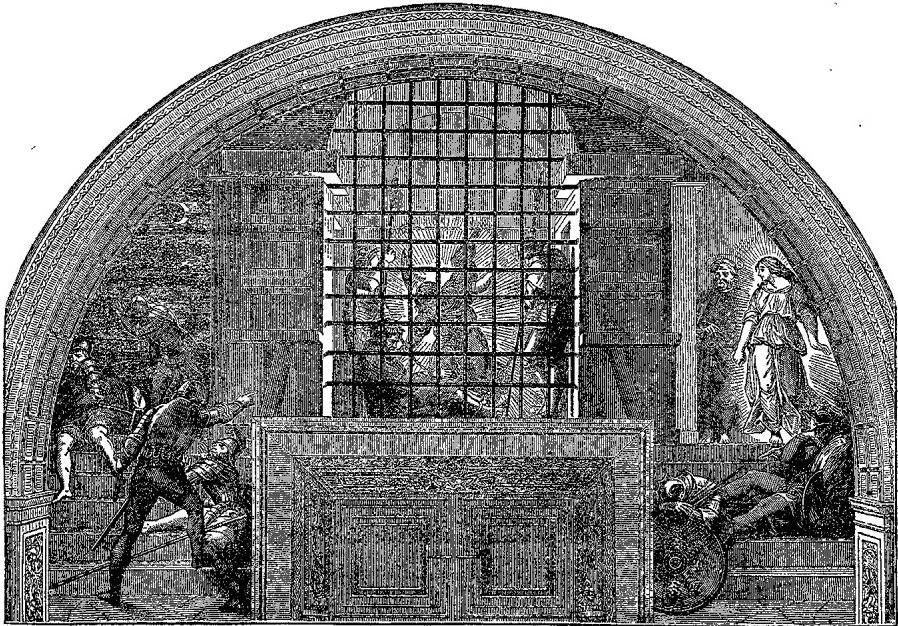
PETER DELIVERED FROM PRISON.
But, strange to say, all those who favor coercion in religious matters by application of civil law, profess to be working in the interest of God's cause. But does God uphold such work in the interest of religion? He has done infinitely much to bring men to walk in his ways, even to giving his only begotten Son in their behalf, but has he ever given his sanction to compulsory measures in holding men to the path of right? The only absolutely reliable history of the early church will give the facts in this line, and we may rest assured that as he viewed the case then, he will regard it now, since “with him is no variableness, neither shadow of turning.”
We need not trouble to search the records of the Old Testament, where the special interpositions of God in behalf of his people are so plainly set forth; that may be considered as going too far back. But let us note one case in the Christian church where the civil law was being applied in behalf of religion, and see which side of the controversy God supported.
About twelve years after the death of Christ, the king of Judea took a hand in the religious controversy of the day, and by virtue of his civil authority put to death James, a prominent disciple of Christ. Seeing that this act was approved by the Jews, whose political support he greatly desired, he proceeded to please them further by having Peter, another prominent worker in the infant church, apprehended and put in prison, intending to deliver him over to the will of his religious enemies, immediately after Easter. Acts 12:1-4.
The record of this case reveals that human nature has changed little, if any, in some respects, since that early day. It has ever been demonstrated that men can be induced to go to great lengths, even to doing unreasonable things, through the enthusiasm which it is possible to excite in some large gathering. What they had not courage to do under ordinary circumstances, they will do under the stress of excitement, especially where religious fervor is wrought up to a very high pitch. It was this way when Christ was to be sacrificed to the demands of the Jewish priesthood. The occasion of a pass-over gathering was waited for, when crowds of ignorant, yet enthusiastic pilgrims would be assembled from all parts of the country, and a general excitement could be aroused in favor of taking his life. It required no less an occasion to inspire the nerve to carry out a design so treacherous and diabolical as the sacrifice of the sinless Christ. The priests were reminded of this, too, by the Saviour at the moment of his arrest. Said he, “When I was daily with you in the temple, ye stretched forth no hands against me; but this is your hour, and the power of darkness.” Luke 22:53.
This was a point well understood by Herod, and one which he intended to make count in his arrangement for the immolation of Peter. The apostle was, therefore, held in prison, not to await a legal decision in his case, for his fate had been decreed from the moment he was placed under arrest. But Peter was kept there simply in anticipation of the time when the king could not only be reasonably sure that the multitude would sustain his murderous intent, but that by destroying so prominent an enemy to the prevailing religion, in so public a manner, he also might gain a wider political influence among those whose religion he had so signally upheld. The plot was, indeed, a deep-laid one, but was destined not to mature, because of an interference which had not entered Herod's calculations.
Peter, lying in the inner prison, chained to a soldier on either side, and with a strong guard at the door of22the prison, was supposed to be safely in the grasp of the civil power. Indeed, on the last night of his confinement, no doubt was entertained of the apostle suffering on the morrow at the hands of an excited populace. Everything was ready for the autodafe, and there was great expectation on the part of those who were preparing to witness it. But on the very eve of the anticipated tragedy, an arm was outstretched to stay and frustrate the plans of the civil power. In answer to the united prayers of the church for deliverance, God sent an angel from heaven to strike off the prisoner's chains, and lead him forth to liberty.
It surely cannot be said that, on that occasion, God took the side of Peter, and against the civil decree because the form of religion which was sought to be upheld by coercion was not heaven-born. No, indeed; for the Jews received their forms of worship directly from God. And although the measure about to be executed was highly pleasing to the chosen people of heaven, yet God opposed it with the might of an angel of light. It may be suggested, however, that God's attitude on that occasion was solely because his people had forsaken his ways. Exactly so. Had they retained the spirit by which they were called to be God's people, they would not have been found uniting with the civil power to destroy a fellow man, simply because his religious convictions did not coincide with their own; and the same is true to-day of any people who claim, as did the Jews, to be specially favored of heaven. The very fact of their uniting with the civil power to restrain others in the matter of conscience, is the best of evidence that they, too, like their prototypes of old, have wandered from the ways of Him who said, “If any man hear my words, and believe not, I judge him not; for I came not to judge the world, but to save the world.” John 12:47.
How much more Christlike it would be, if all professed Christians would unite to save sinners, a work which God upholds, rather than to call upon the courts of the land to condemn them, a work which Christ affirms he did not come to do or sanction. It has been the work of Satan from the first to find fault with and condemn others on religious lines. Should God uphold the civil power in doing the same, he would thus sustain Satan in his work, and so divide his kingdom against itself, which would bring about its speedy dissolution. We may, therefore, rest assured that God is not in any move looking toward the church sustaining the civil power in making statutes to regulate forms of religion. J. O. C.
Twelve Subscriptions Sent by J. N. Devereaux
MR. J. N. DEVEREAUX, of Parker, S. D., a warm and appreciated friend of the SENTINEL, sends us twelve subscriptions to the paper, with this note appended: “I am sorry the list is not a larger one, but it is the best I could do. When I was in the army during the late war, I sometimes would catch a sentinel asleep on guard, but I must say I have never caught the AMERICAN SENTINEL napping. It always gives the alarm in season, but the sad feature of the situation is that the majority will sleep on heedless of the warning till it is too late to do them any good.”