It is said that the natives of the Society Islands improved in every way for the first few years after embracing Christianity, but as time passed by, formality took the place of true, Christian devotion.
About fifty years ago, the French took possession of two of the largest islands, doing away with their religious laws. Every one was left free to do and believe as he pleased, so long as the civil laws were not violated.
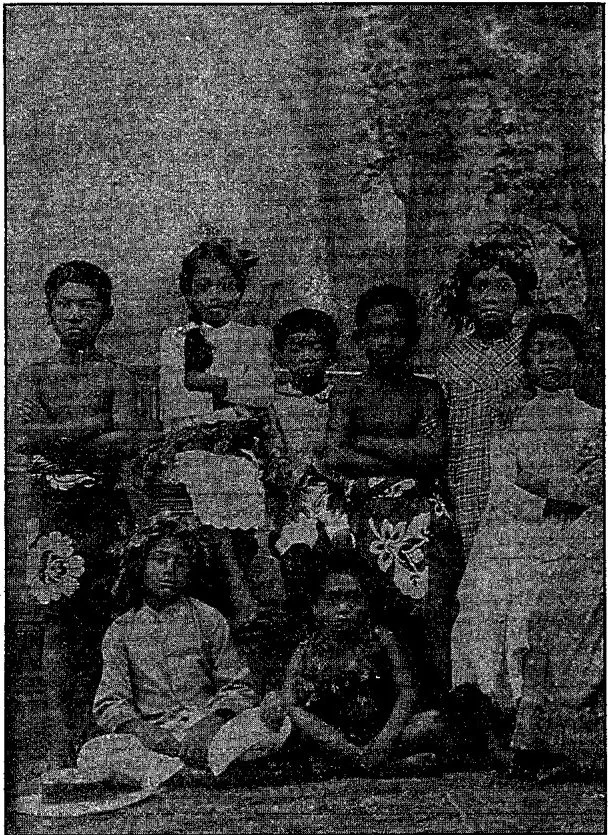
GROUP OF NATIVE CHILDREN.
One might fish, trade, buy or sell, stay at home, or attend church upon Sunday. It soon became apparent that many had refrained from work and had attended church on Sunday more from fear of the laws of the land than that God would be displeased with them. As soon as the law was repealed, church members, and nearly everybody, would not only cook, but do their marketing upon that day.
In Tahiti, Sunday is the great market day, when it is customary for all who live near enough to go to the market in the morning, some to sell and others to buy. It is the day of all days when the people spend their time in festivities. Many go to church in the morning, and then spend the afternoon and evening in drinking and making23merry, going through with all sorts of old, heathenish performances.
Raiatea, one of the largest islands of the group, has stood out against the French government until only a few months ago. The people of this island have looked upon themselves as better than their brethren who were under the French laws, because they had laws against work of any kind upon Sunday. I remember of seeing a stranger on the island, who was not a believer, but wished to attend one of the religious meetings in the adjoining district. He arose Sunday morning, and traveled to the place of worship, reaching it a little before meeting time. As he was preparing to take a bath in the river before going into the church, an officer informed him that it was against the law to bathe at that time; that he might wash his face and hands, but that he could not take a full bath until after four o’clock that evening. He also stated that this law was made to keep people from doing anything that would detain them from church.
It is customary in these islands to have a watch meeting at the church New Year’s eve, to bid adieu to the old year and welcome the new one in. I attended such a meeting on the island of Raiata three years ago. There everything was church and state fully united, and they looked forward to the time when the Lord would cast the French into the sea, or destroy them in as marked a manner as he did the enemies of the Israelites. The time was occupied by exhortations, prayer and singing. Each district represented had its own choir, and only one choir was to sing at a time. About nine o’clock their pastor appointed a certain choir to sing a hymn. There was a misunderstanding, and two of the choirs began singing different hymns at the same time. They were requested to stop, but could not be induced to do so, as each wished to be the one to sing. So they continued singing for nearly thirty minutes. By this time nearly the whole congregation of about one thousand were on their feet, and they were preparing to have a pitched battle in the church to settle the difficulty. Through the efforts of their queen and others, peace was at last restored, but it took until about 11 o’clock for them to get settled down so that they could go on with their meeting.
On Sunday, a meeting of another denomination was held on board a ship in the harbor, and the queen and some of her friends were invited to attend. She accepted the invitation, but, upon returning to land, found officers waiting to impose a fine against her for attending a meeting which was not conducted by their own church.
Can the government, by passing religious laws, make better citizens and Christians? It certainly has failed in these islands, as is acknowledged by all who are acquainted with what was the Raiatean government. It is apparent that all these religious laws only tended to give the people a very poor idea of what true Christianity is. It was all form and no practice. The result is that the people poorly realize that they are responsible before God for the way they live, for they considered it their chief duty to do as the rulers directed them in religious matters. As the French took possession of the islands, religious laws were abolished. When they were no longer restrained by the law, but few attended church, and fishing and all kinds of work were done by them on Sunday. A native church member portrayed the matter to me, telling how that now they have no religion, as many of the people are busy with other things Sunday, and do not attend church. I asked why it was so. She replied that there is no law now for bidding them to work on Sunday, and that they had not kept it since the law was repealed. I then asked her if she thought that they would refrain from labor if they had another Sunday law. She thought that would be all that was needed to get the people to keeping the day properly again.
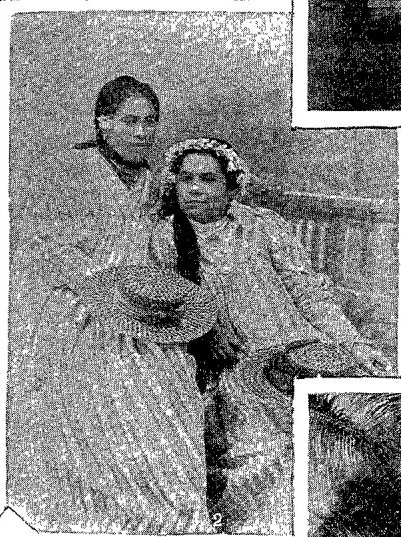
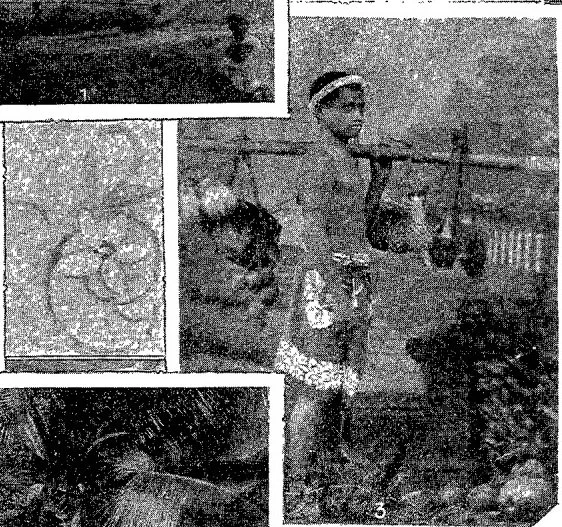
VIEWS ILLUSTRATING SCENES IN THE SOCIETY ISLANDS.
But, who would they obey, God or the government, if they were to keep Sunday simply because the government would fine them for working upon that day? If men will not obey a plain command of God, but rest upon24a certain day because the government commands them to do so, can God look upon that as obedience to his law? No; it is simply obeying the law of the land: for when men obey because the state commands, they do it not in respect for God, but for fear of temporal punishment. The tendency of all such laws is to make professed Christians, who have a form of godliness, but deny the power thereof.
What God wants is men who are true to him, even though all the world may be against them. Where are the Daniels of to-day, who will serve God in the face of a frowning world? Where are the Pauls, who will give their lives to living and preaching the gospel, and give up the idea of making Christians by passing religious laws in the governments of the world? Christ says, “Whatsoever ye would that men should do to you, do ye even so to them.” But we are not doing to others as we would have them do to us, when we try to compel them to do what we wish them to do. Such attempts have always resulted in evil, and always will.
The author of Christianity says, “Whosoever will, let him take the water of life freely.”
Significance of the Proposed Religious Amendment to the Constitution.
By C. H. Keslake
BY C. H. KESLAKE.
The Constitution of the United States is in perfect accord with the Protestant idea of church and state contended for in the Reformation. One reason, why such separation was provided for was because it was then recognized that it was “impossible for the magistrate to adjudge the right of preference among the various sects that profess the Christian faith without erecting a claim to infallibility which would lead us back to the church of Rome.”
With but few exceptions, the people comprising this nation are either Catholics or Protestants—the large majority being Protestants.
Every well-instructed Catholic knows how and when Protestantism originated. He knows that in the sixteenth century there were those, who, loyal to the Word of God, in the strength and power of Jesus Christ, dared to stand up and protest against the Romish doctrine of the union of church and state.
But it is a question as to how many of those who call themselves Protestants know how and when Protestantism originated. For certain it is that at this present time there are millions of professed Protestants who are stultifying themselves and denying the principle from which they derive their name.
That they are not conscious of this is evident, for there are many already who have come to a true understanding of the work in which they were engaged, and have renounced it.
Now, if a person does not know what Protestantism really is, how can he possibly know what Romanism is?
That being so, when such a thing happens, and it has happened, that Roman Catholics and Protestants work together for the same object, one may depend upon it that the Romanist will decidedly have the best of it, for he is not working in the dark. He knows exactly what his principles are, and he knows, too, that Romanism and true Protestantism cannot possibly agree any more than it is possible for light and darkness to mingle together. The one is the inveterate foe of the other.
Consequently, when a professed Protestant unites thus with the Catholic, the latter knows full well that the former has ceased, in reality, to be a Protestant, if indeed he ever was one more than in name.
When it is remembered, as stated above, that the one reason why the union of church and state is forbidden in the Constitution, is because it is impossible for the magistrate to adjudge the right of preference among the various sects that profess the Christian faith without erecting a claim to infallibility which would lead us back to the Church of Rome; and when it is remembered, too, that Protestantism is a protest against the Catholic principle of union of church and state, the question may well be asked, Can a person be a Protestant and indorse any effort that might be made to have the Constitution changed with reference to this matter of church and state? Decidedly not. He may be a Methodist, Presbyterian, Baptist, or anything else, but he would not be a Protestant.
Now there are in this country millions of Protestants (so-called) who are laboring hard to have the Constitution changed, and to have the Christian religion incorporated into the fundamental law of the land.
Year after year, Congress has been besieged and petitioned to legislate in behalf of religion, notwithstanding that Congress is expressly forbidden, by the Constitution, to have anything to do with religion—for or against. For in the very nature of things it could not legislate in favor of one religion without legislating against some other.
Will those Protestants who are thus engaged in this work stop and consider what they are doing before they get so far along that they cannot retrace their steps? Will they take the Word of God and ponder its pages upon this particular question? for God has spoken plainly regarding it, and pointed out the inevitable result of such a movement as that they have undertaken.
The Trouble with Schemes for Social Reformation
The only trouble with the numerous wise schemes for the reformation of society that are being everywhere heralded, is that they will not “work.”
Free Thinker Imprisoned for Contempt of Christianity
Dr. Bruno Wille, a “free thinker,” of Berlin, was recently sentenced to a week’s imprisonment at Gratz, Austria, for “publicly holding up to contempt the Christian religion.” It is safe to say that the act of imprisoning a person on such a charge does more to hold the Christian religion up to contempt than anything that was done by Dr. Wille.
NEWS NOTES AND COMMENT
By Editor
THE difference between civilization and Christianity, which seems not to be very clear in many minds, has been illustrated in a melancholy way out in Kansas, by the recent action of four Pawnee chiefs, or as perhaps it might be better to say, by the actions of their wives. Just what the conduct of the latter was in every case, we are not informed; but it was such as to bring their husbands into the United States Court with a petition for divorce. What an unwonted incident is this to be chronicled in the history of the red man!
ONE of the strongest cases, we are told, was that made out by Pipe Chief, who averred that his conjugal partner wanted to spend all his money on fine dresses, and refused to associate with squaws who were not in her set. The untutored mind of the chief probably did not understand the high precedent which Mrs. Pipe Chief had for her conduct in this respect. He did not comprehend the fact that in this she was only imitating the conduct of ladies in the highest circles of civilized society. Perhaps it would have made no difference to him if he had. At any rate, the fact remains that from his point of view, such conduct was more intolerable than anything which belonged to the ways and customs of savagery. And who can say that his point of view may not be nearer the truth than the highly artificial standpoint from which is derived the unwritten social law of the “best society”?
IT may not be that “society” would be willing to admit it, but it is a fact susceptible of proof that this most “sacred” and carefully followed part of the code of “high society,” stands or falls with the case of Mrs. Pipe Chief, of the Kansas plains. For if it be right for the ladies who move in the circles of civilized society to spend money regardlessly for fine dresses and refuse to associate with people not in their set, as everybody knows that they do, who can take exception to a similar course on the part of those with whom their own civilization comes in contact? Is not a good example worthy of imitation? If it be proper to have a social “four hundred” in New York City, why is it not proper to have a social four hundred, or forty, as the case may be, in Pawnee society on the Western plains? It really seems as though civilized “society” were bound to come to the rescue of Mrs. Pipe Chief, and vindicate the propriety of her conduct in this matter.
THE divorce court, it is almost needless to remark, is a necessary adjunct of civilization. The nearer we approach the dividing line between civilization and savagery, the less do we see of this institution. In making use of it for the purpose of annulling the matrimonial relation, the Pawnee chiefs have taken a step which distinctly favors of transition from the ways of barbarism to those of civilization; and in developing a passion for fine dresses, and “cutting” squaws not in her set, Mrs. Pipe Chief shows a still further advance toward civilization’s “higher” ideals. But what have fine dresses, social “sets,” and divorce courts to do with Christianity?
CONTACT with civilization in many instances marks the red man’s decadence. But contact with Christianity can never be otherwise than elevating and ennobling.
Is there a pious way of doing things that are wicked? We might conclude that there is, from many things that are said nowadays by some who occupy the position of religious teachers of the people.
FOR instance, the pastor of a church in Oakland, Cal., is quoted as having addressed the following to the managers of the race tracks at the neighboring town of Emeryville: “I request you to consider and inform me of your opinion as to the possibility of having a Christian day at the races. This, of course, would preclude drinking and gambling.” It would seem that this pastor is bent on supplying the floating phrase, “pious horse race,” with a definite basis of fact.
IT may be that this California pastor has been wrongly quoted; but the words are so well in accord with the religious spirit of the times that there is little reason to doubt the correctness of the report. There is a “pious” way of conducting fairs, lotteries, “donkey” sociables, etc., in the basements of the churches, and why, on the same principle, should there not be a pious way of conducting a horse race? There are worse things than horse racing, which it is commonly believed can be done in a Christian way; for instance, the taking of human life in the heat of battle. Certainly it is worse to kill a man convicted of no crime than it is to race horses. And if Christian people can do the one, and remain Christians while they are doing it, there can be no reason why they cannot, as Christians, engage in the other.
THE only thing really surprising about the pastor’s request is that he should think it necessary to exclude drinking and gambling. No one questions, of course, that drinking and gambling are wrong, as ordinarily indulged26in. But if they are done not in a worldly manner, but in a pious, religious way, can any one object to them then? Why have a “Christian day” at the race track, and not also a “Christian day” at the bar and gaming table? In the fairs and lotteries which are now so frequently held inside church doors, we have an illustration of how gambling can be done in a “Christian” way; and if a bar were set up inside the church edifice, where everything would be very respectable, and people of good church standing might come and drink in a quiet and moderate way, would this not also be compatible with Christianity? If a thing can be made very respectable, is there anything to hinder its becoming pious?
IN all ages of the world, men have sought to shield the workings of their carnal propensities behind the idea that such acts were all right and even laudable when done in the name and under the cloak of religion. It was considered proper to hate people, and even to kill them, if it be done from a “pious” motive. If a person had committed an offense against religion, he was given a religious trial, conducted by prelates of the church, and then, if convicted, it was deemed quite proper even to burn him at the stake, care being taken to keep up the religious appearance to the last by holding a crucifix before the condemned and filling his ears with religious exhortations. It was even thought quite proper to execute “heretics” without the formality of a trial, when the church or the pope approved such work as being a “pious” undertaking. And since it is true that men have often found a way to “sanctify” the passion of hatred, even as manifested in the taking of human life, it is only natural that they should find ways to “sanctify” other carnal passions whose outworkings are less serious in their results.
BUT the truth which is invoked by every manifestation of this baneful delusion, is that such passions of the natural heart as prompt men to indulge in horse racing and gambling, or any other form of worldliness, are never so dangerous, never so wicked, never so detestable, as when clothed with the forms of piety.
A Catholic Bishop on Church and State.
New York Independent, December 23.
BISHOP SPALDING, of Peoria, is one of the ablest and best equipped bishops in the American Catholic Church. We therefore listen with especial interest to what he has to say of the effect in the Catholic countries of Europe of having the church supported by the state. Speaking of the religious and moral lapse of the Italians who come to this country, he says:— “They have been led by unfortunate circumstances into indifference and even antagonism to the church. In the first place, the means and opportunities of public worship have been provided for them without their being called on to bear their share in the expense. And, since what costs us nothing we care little for, they have become callous, and have relaxed somewhat their hold upon the vital faith which is nourished by generous deeds and unselfish devotion.”
This is sound American doctrine; and we cannot understand why Catholics and Anglicans who find the absolute divorce of church and state so admirable in this country should so deprecate religious independence in England or Italy.
Religious Liberty in the Argentine Republic.
By L. Brooking
BY L. BROOKING.
The following is an article from El Faro, a periodical in the Argentine Republic, under date of Nov. 1, 1897:—
“LIBERTY OF CONSCIENCE.
“The national Constitution will shortly be submitted to a constituent convention with the object to effect in it certain urgent reforms. Among these reforms figures that of liberty of conscience, which until now has been prevented by the second article that says, ‘The Federal Government sustains the Roman Catholic apostolic religion.’ There is being signed with much enthusiasm a petition asking for the suppression of the said article. This petition says very judiciously, ‘The separation of church and state is to-day a constitutional precept of the most civilized new countries. The United States of America, a model religious country, owes to it a great part of its strength, its freedom, and active ideas; and Brazil has adopted it conjointly with (the formation of) the Republic. The separation of church and state is a guarantee that we owe even among ourselves to liberty of conscience, and a highly needful measure in this country to which flow men from all schools and of all religions. If they are to be fertile for our intellectual and moral development, it will not be by the privileges which some of them enjoy, but by the necessity which all see to strengthen themselves with the practice of good and truth. The abolition of the calculated cost of worship is a wage of liberty for the actual official church, and a sign of respect to the right that the Catholics have of paying the cost of the religion in which they alone believe.’”
Noble words these because they are true; and had that been the principle since their independence, how much purer and nobler would the lives of many of our brethren in those countries have been, as they would have had a purer standard than that of the state-supported clergy. I say “brethren” because “God hath made of one blood all nations,” and they can accept the word that brings comfort to us; “God so loved the world that he gave his only begotten Son that whosoever believeth in him should not perish but have everlasting life.”
The Church and the World.
By M. E. Kellogg
BY M. E. KELLOGG.
An English Congregational minister, Dr. Barry, has lately expressed the belief that “the church must be separated from the world while it seeks to save it.”
The sentiment expressed in these words is so self-evidently true, that no further words of commendation or approval can add anything to it. The doctor further elucidates his idea by comparing the present condition of things to a drowning man and a would-be rescuer. He says: “The danger is that the drowning man will clutch the rescuer and both will sink. It must not be so with the church. The church must clutch the world firmly and lift it up, but not be dragged down by it.”
This, of course, is but to say that the church in its efforts to reform the world must not allow the world to deform the church.
Another thing ought to be no less apparent. If the church remains separate from the world, it cannot have any union with the state, whether that union be avowed or is only a tacit agreement. The state represents the world; it is the world in an organized capacity. Hence a union of the church with the state is the strongest kind of a union of the church with the world.
But the church has no mission to the state, or to the world as a whole, only as it has a mission to every person in the world. The mission of the church is to individuals.
“If any man hear my voice, and open the door, I will come in to him, and will sup with him and he with me.” “Whosoever will, let him come.” The church, by the power given her of God, is equal to this task of saving individuals. The apostles saved no world—no nation as a whole—but they were remarkably successful in saving men.
A few hundred years passed, and the church conceived the idea of saving men by wholesale, by nations. The church seized the world, at least the Roman world, and tried to save it by uniting itself to the Roman state. There was a mighty pull, but the church gave way, and was dragged down to the level of the Roman world, and her fair robes were indelibly smirched. The same plan has been tried over and over again in different countries at different times, always attended with the same lamentable results.
The reason why God saves men individually and not by nations is very apparent. The salvation of men depends upon their individual wills, and each person must exercise his own will. Hence, in the offer of salvation, God appeals to individuals.
There is in the gospel power to save those who believe and submit their wills to God. Had God commissioned his church to seize the world and save it as a whole, then no doubt he would have clothed it with power for the accomplishment of the task. But he did not. The church has an abundance of power for the work God gives it to do to save individuals. Paul understood both the power and the scope of the gospel, and he said, “I am made all things to all men, that I might by all means save some.” 1 Cor. 9:22. Another apostle “declared how God at the first did visit the Gentiles to gather out of them a people for his name.” Acts 15:14.
As long as the church keeps at her God-commissioned work of saving individuals, she will find herself clothed with power for her task; but if she tries to save the world as a whole, she will be shorn of her power and will be drawn down to the level of the world. The world as a whole is going down, sinking amid the sinful pleasures that “drown men in destruction and perdition,” and just as sure as the church takes a firm hold of the world so that the two cannot be separated, the church will sink with the world,—the would-be rescuer will also be drawn into the depths.
Religious Liberty in Chile.
In July, 1897, the Roman Catholic bishop of Iquique, Chile, published and caused to be posted on the doors of the Catholic church in that city, a circular, of which, says the Converted Catholic, the following is a translation:—
“TO CATHOLICS:
“Those married persons whose marriages have not been performed by the church, until this is done:—
“1st—Cannot receive the sacraments;
“2nd—Nor be god-parents;
“3rd—Nor be witnesses in marriage ceremonies;
“4th—Nor be inscribed as members in the religious societies, nor receive the scapulars;
“5th—Nor have charge of any duty in the church;
“6th—Nor can funeral honors be celebrated for them;
“7th—Their names shall be erased from every society and religious association;
“8th—In the baptismal records, their children shall be counted illegitimate;
“9th—They are public sinners;
“10th—Their names shall be recorded in an especial book for the preceding end.”
And this same church poses in America as the champion of civil and religious liberty; and what is stranger still, a great many Protestants seem actually to believe that it is the truth.
Subscriptions Sent by Mr. N. O'Moore
Mr. N. O’Moore, of Highland Park, Ill., writes: “Inclosed find $10, for which send the SENTINEL one year to each of the accompanying names, and credit my subscription five years in advance.”
Subscriber Praises the American Sentinel
MR. ETHAN LANPHEAR, of Plainfield, N. J., in renewing his subscription to the SENTINEL, says: “Among all the papers that come to my table, there is none that speaks as much truth in so few words as does the AMERICAN SENTINEL. May it continue to live until the end comes and righteousness triumphs.”