LET us take a look at the five-syllabled word. Its root is the old Roman or Latin word, punctum, derived from which we have in our language about forty different words.
The term signified a point, and stood, as the case might be, for a point in time, in labor, in duty, in argument, in ceremony, in diplomacy, in a journey, and for other things too numerous to mention.
In our tongue, however, most of its derivatives have reference to doing things promptly, or to doing them nicely. In this latter sense, especially, we use the word punctillio and some others.
The first syllable has a dangerous look, and suggests a sharp-pointed instrument, as a spear, lance, javelin, or stiletto, and also the manner in which they are used. The first thing one does in using any of these implements, is to take aim at a certain spot, place, or object. The next step is to throw the weapon and hit the spot, place, or object.
In some degrees this illustrates how persons do who strive to be punctual. They appoint a day, hour, or point of time when they will do a certain thing. Before the time arrives they take aim at it—that is, they arrange to do the deed. And when the time arrives, they do it, and thus puncture the time.
Every effort at punctuality involves two steps—taking aim, and doing. The first step may be taken without the second, but never the second without the first; for one must aim to do a thing punctually before he can so do it.
In our day society is so organized that a vast proportion of the work we do is done in union with some other person, and very often in union with several, or with many other persons. And so in our day there is to be done—by every one who has a mind to labor at all—so great an amount of work that the time we take in our doing has become a momentous, yes, a tremendous consideration.
No individual who is engaged in any right work has half the time he wants. Before the most diligent of workers little mountains of labor pile up daily, and it has come to pass that on all sides come to our ears the fervent, heartfelt cries: "O, that I had more time!" "Would5that the working hours were twice as many."
These two important facts, then—that of laborers being united with others in so much of their work, and that of the immense amount of work to be done, should impel all persons who make proper engagements, to meet them punctually, on time, at the moment.
But there is a still more serious view of this matter, which justly claims our attention.
In a very solemn sense, every man's time is his own. That is to say, the Creator has given to every man his lifetime for two ends,—to work out his own salvation, and to do whatever work beside his Creator requires of him.
Not a moment of one man's time is the rightful possession of any other man. For this reason, then, the taking from any man unnecessarily, any part of his time, however small, is theft of a most serious sort. It is plundering from him that which neither the robber nor his victim can replace.
Purloin a man's money, and all around him are Klondykes, of one kind or another, in which he may dig for more. Steal a man's breakfast, and on every hand lies food. But a man's time is measured off, and not all the worlds in the universe can extend it one moment.
What then?—Simply this. The man who, under any circumstances, consumes—carelessly, unnecessarily, unprofitably—ten, twenty, thirty minutes of another man's time, commits both a crime and a sin.
There is no denying that this sort of unintentional thieving goes on everywhere daily to an enormous extent. It is practised in two ways especially—by failing to keep engagements promptly, and by dropping in upon other people solely to discuss the affairs of usually mutual friends and acquaintances, affairs with which, often, the droppers-in really have nothing to do, and can not, by talking, make either better or worse.
It is noticeable that this variety of robbery is practised most liberally by three classes of persons: Those who have not sufficient pressing work of their own to do, those who lack resources within themselves, and those who fail to realize that, possibly, they may have to account for their own and a part of their neighbor's time.
But if it be wrong to rob one person of a small amount of time, what shall we say of him who takes a few moments on every single occasion from twenty, fifty, or a hundred persons, by failing to be punctual? And what shall we say if this culpable course be his habit?
Suppose a Sabbath-school teacher keeps his class of ten waiting two minutes some morning. What has he done?—Only this: He has taken from his pupils, as a class, twenty minutes, which he can never restore. Suppose he should decide to teach two minutes past the time, to make it up. Does he thus make it up? We are sorry for him. So doing, he steals just forty minutes of their time.
And what shall we say of the leader of a meeting, behind time because he suffers some one to detain him needlessly? of a business man, tardy in a midday engagement, because it has slipped his mind that his fellow-citizen regulates his watch by the time ball, which drops on its tall staff just at twelve o'clock? and of the great multitude of people, always behind time because their sense of right is not so keen as it should be?
But you will ask, "What is one to do when prevented unexpectedly or unavoidably from being punctual?—Usually, when the unexpected happens, one may excuse himself and meet his duty, and the instances are rare, we think, in which one is really unavoidably detained from keeping an engagement punctually. A genuine, resolute, downright effort to be on time will bring one to the spot, almost surely, just at, if not a little before, the moment.
One grand result of the habit of being punctual is its effect upon one's own character. Such a person becomes distinguished for reliability, and would rather forego any pleasure than fail.
Not long ago, in this southern city, a woman, active in missionary work, made an engagement to meet a young lady at the public library, at a certain hour. Promptly at the time she drove up to the building, and asked a friend in the carriage to notify the young woman that she was waiting.
"But suppose she is not here," suggested the friend.
"I should as soon think of finding the public library not here. That young woman always keeps her appointments," was the answer. It is needless to say that the young woman was there.
But there is a second and far more momentous result arising from a habit of punctuality or of unpunctuality, and that is its effect upon heredity. A habit of punctuality becomes an element in character. It influences immensely one's thinking, feeling, and doing.
Parents transmit traits of character to their children as they do features, form, intellect, a taste for music, or a fondness for art, a bias toward religion, or a tendency to crime. An inclination to steal may be sent down from generation to generation. So may a disposition to utter falsehoods. Indeed, being punctual is one way of being truthful, one way of being honest.
This consideration alone should lead parents to be extremely conscientious in cultivating the habit of punctuality in themselves.
Finally, a third reason for being punctual is one which appeals to the Christian particularly, and that is the example God sets us in reference to the principle. The Scriptures are full of events illustrating God's unswerving promptness in fulfilling his word. With the "fulness of time" comes always his moment for doing.
Our Lord entered upon his ministry proclaiming, "The time is fulfilled." His birth, his baptism, his death, resurrection, and ascension, all, occurred exactly at the time appointed before the foundation of the world. We can not imagine one of these events to have taken place a moment after it was due.
But God has other agency than his Word for proclaiming the pleasure he takes in punctuality. He has set the stars to telling that story.
Look at the vast system of worlds which speeds around our sun for a center. Can you imagine one of them returning to its starting-point an hour behind its appointed time? ten minutes behind that time? ten seconds? Can you imagine one of them as falling to gossiping on its way, with some brother planet, and forgetting to reach home on the instant?
How little does it matter whether one of the brilliant orbs of our system accomplishes its journey around the sun in 365 days, as does our Earth; or in 29 1/2 years, the time in which Saturn makes its revolution; or in 165 years, Neptune's period for completing its circuit, since all come to the point in which God, in the beginning, sent them forth—at the instant.
To meditate upon these stupendous facts is to be overwhelmed with a sense of the value God attaches to punctuality.
If then, the practise—as illustrated by the stars which gem the sky—affords him delight, must not God greatly desire it in the sons and daughters whom he purposes to make kings and priests—helpers—unto himself and Christ?
EMMA H. ADAMS.
TWO WAYS—BUT ONE RIGHT.
By E. L. Krumreig
It is noteworthy that the apostle Paul, who most strenuously upholds justification by faith in Jesus, always connects it with holy living, and frequently shows that it is the firm belief of the truth.
In his epistle to Titus, after speaking of "Jesus Christ our Saviour," and being justified by his grace, and made heirs according to the hope of eternal life, he directs that the doctrine of salvation by free grace alone should be affirmed constantly in order that believers might maintain good works. Titus 3:4-8. And there can never be good works accomplished but on the principle of being justified by the faith of Christ, and not by the works of (man) "law." Gal. 2:16.
We are now living in a most important era of our world's history. How melancholy the condition of things, and how ominous of evil the attitude of earth's nations! The great warlike powers confront each other, the blood of their embattled hosts ready to be shed in torrents, and yet amid all the turmoil how persevering and successful is man in carrying forward his gigantic schemes!
We can not help being stimulated in our exertions for the cause of Christ by observing the unceasing earthly activity manifested on every side; but were this our only incentive to action, our zeal would be spurious; for all efforts and activity in promoting the Gospel which are the offsprings of mere imitation, and which originate only in the presence of activity displayed by the world, are based not on personal faith in Christ, and living communion with God, but upon nothing higher and nothing better than a desire to make a fair show in the flesh.
But we have good reasons to believe that a mighty angel with the last warning message is now passing over the earth (Rev. 14:6), to seal those who keep the commandments of God and the faith of Jesus. And the true church of the living God, though scattered throughout the whole earth, is feeling its influence, and the result of his gracious presence and quickening power is appearing in greatly increased religious liberty and zeal for the spreading of Gospel truths. And for this we are especially thankful to Him who has given us wisdom to understand these things, which are spoken to us by His servant John.
But let us ever bear in mind that the grand prerequisite to thorough usefulness is that we ourselves should be strengthened with might by the Spirit in the inner man; and not with aid of governmental laws; that Christ may dwell in our hearts by faith; that ye being rooted and grounded in love, may be able to comprehend with all saints what is the breadth, and length, and depth, and height; and to know the love of Christ which passeth knowledge, that ye might be filled with all the fulness of God (Eph. 3:16-19), not with the fulness of politics. If we would be filled with the grace of God, and refreshed in our hearts, it is essential, at such a time as the present, that we should constantly recall and deeply ponder the great fundamental truths of the Word of God, upon which both religious and civil liberties rest, and out of which truths grew the Declaration of Independence, and our Constitution.6
In thus looking unto Jesus (Heb. 12:2), we are changed, strengthened, and refreshed, and the shortest road to bring this land of ours and its inhabitants to a spiritual life is by the cross of Calvary, and not by Sunday laws.
Our salvation is not because we do well, or force men to do well, which always fails, but because "He in whom we trust hath done all things well." But those who would rule conscience, or make laws to bind others' consciences, look at themselves too much, and at the infinite price paid for them too little. For condemnation man may look at himself, but for comfort and strength and good Christian citizenship in truth, at our Saviour. The graces of the Spirit are good things for others to judge us by, but it is Christ himself received, believed in, rested upon, loved, and followed, that will speak peace to ourselves. It is through him alone that we can bring others to do right, act right, and observe the Sabbath, and not by the enforcement of any law can we make man believe on our Lord and Saviour Jesus Christ, or observe Sunday or any other day or constitution contrary to God's Word.
E. L. KRUMREIG.
South Lancaster, Mass.
TRUE PERSONAL LIBERTY.
By J. Edwin Collins
THE clamor for more stringent Sunday legislation, which has become almost universal throughout this government, brings forcibly to our minds the fact that, tho flaunting the magic word 'freedom' in the teeth of other people, we, as a nation, have but crude conceptions of that intensely comprehensive word. Many are in comparative ignorance of the exceeding broadness and far-reaching qualities of the underlying principles of this inspiring term.
The words of that wonderful instrument—the Declaration of Independence—'That all men are created equal; that they are endowed by their Creator with certain unalienable rights and privileges, among which are life, liberty, and the pursuit of happiness,' are but the echo of that broader proclamation of personal liberty granted to the human race by Him who 'hath made of one blood all nations of men' (Acts 17:26), when He said, 'I have set before thee this day life and good, and death and evil,' 'Choose you this day,' and, 'Rejoice, O young man, in thy youth; and let thy heart cheer thee in the days of thy youth, and walk in the ways of thine heart, and in the sight of thine eyes; but know thou, that for all these things God will bring thee into judgment.' Deut. 30:15; Josh. 24:15; Eccl. 11:9.
Thus did God promulgate the doctrine of true moral freedom, reserving only the right to vindicate the righteousness of the eternal law of his kingdom, by bringing into judgment every work, whether good or evil. This he has reserved to himself alone: 'Vengeance is mine; I will repay, saith the Lord.' Rom. 12:19.
The freedom of choice granted in the foregoing inspired language is not limited to people as nations, municipalities, nor associations, as such, but is guaranteed to the individual. It is, in fact, full personal liberty,—liberty to choose good or evil, life or death, to love God or to rebel against him, to be a man of the purest motives, of the highest and holiest ambitions, of the noblest purposes, or to become the most degraded of beings, to descend below the level of the brute, with a groveling mind that can grasp naught but the vilest contents of the cess-pools of corruption and wickedness. These are the fundamental principles of true personal liberty.
A man may sink into iniquity as far as a corrupt mind may lead him, and, so long as the effect of his evil course is confined to his individual life, no man, corporation, nor government can legitimately abridge that liberty; but the moment his acts infringe on the equal rights of another, by restricting that liberty which was given to all men without respect of persons, so soon the principle of perfect freedom is violated, and it becomes necessary to arrange some means to protect men in their divinely-appointed rights.
Here we discover the origin of true civil law, and its proper exercise. This principle of protection is, to a greater or less extent, incorporated in the civic laws of earthly governments.
By these man should be fully protected in his rights to 'life, liberty, and the pursuit of happiness,' in whatever manner or direction most agreeable to him. One man may choose the pleasures of the world, and utterly disregard the teaching of the Bible. No man or government has a right to compel him even to seem to respect that which his soul abhors. Compulsory law could at the best only make of him a hypocrite.
Another man finds happiness in the hope of eternal life, in a life consecrated to the service of God, in contemplating his wonderful love to a fallen race as revealed in the great scheme of redemption. While deeply investigating this marvelous exhibition of the Lord's infinite love, he may see the finger of divinity pointing, and hear a still small voice saying, 'This is the way, walk ye in it.' Isa. 30:21. This may be 'the old path,' which has been well-nigh lost beneath the rubbish of human tradition, but which is now to be restored. Jer. 6:16; Isa. 58:12. He may thus be led in paths he has not before known. See Isa. 42:16. There may be comparatively few who have as yet been thus influenced, but even tho their religious practises may be different from the rest of the religious world, so different as to draw the attention of the world to their peculiarities, yet God has given them the unqualified privilege of following the dictates of their consciences, provided always that such practises do not infringe on the same rights of others.
Therefore, when an honest investigator is convinced that God has enjoined the observance of one day as the Sabbath, and that day is the seventh, no man, nor number of men, can compel him to receive another day without abridging his rights, and thus violating the eternal principle that 'all men are created equal.'
J. EDWIN COLLINS.
Noblesville, Ind.
THE TWO GOVERNMENTS AND THE LAW OF GOD.
(Continued.)
Third Proposition.—The Ten Commandments, spoken by God upon Mount Sinai, written upon two tables of stone with the finger of God, and delivered to the children of Israel, is the law of the universal government of God. In other words, the law delivered to Israel was only a duplicate of the one which is the foundation of God's throne.
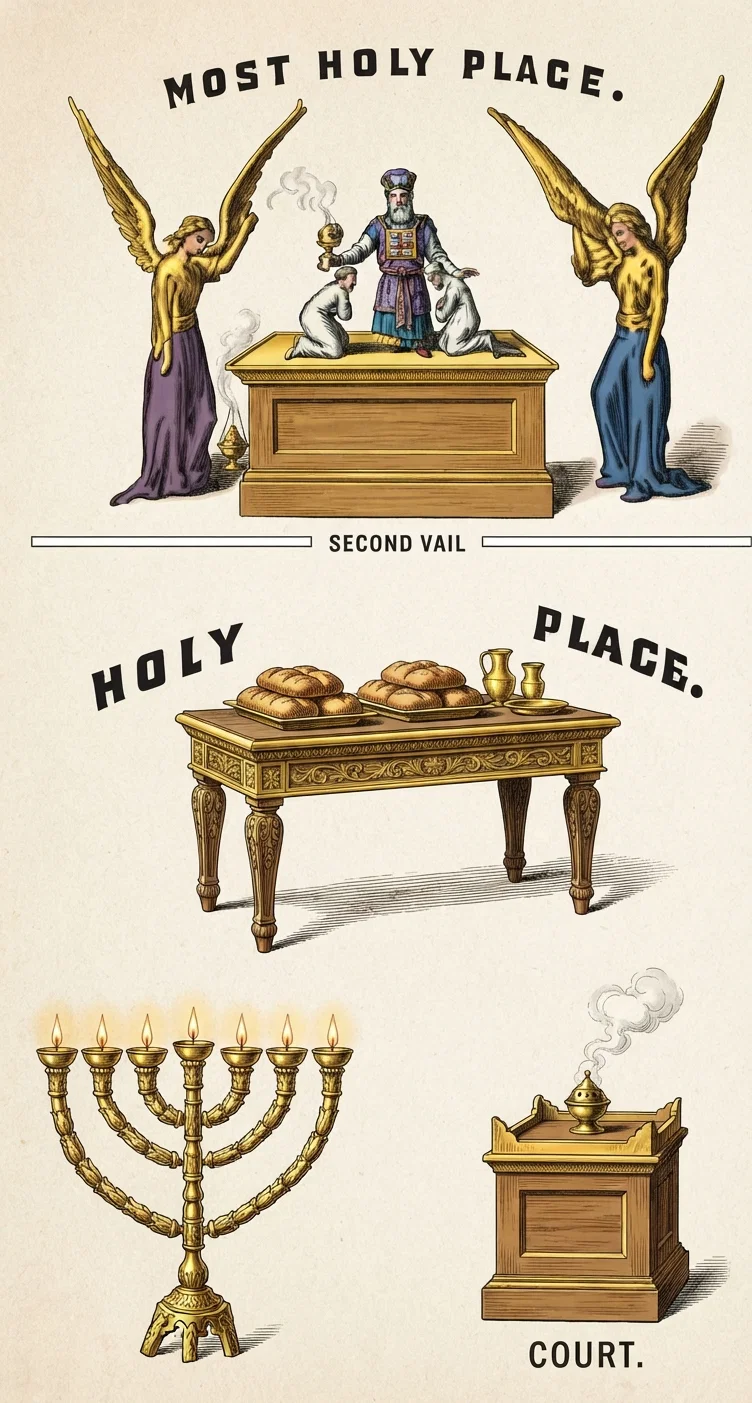
This is a very important proposition, and, if true, should forever settle the question as to which day is the Sabbath in this dispensation. To substantiate the above proposition, we call attention to the sanctuary built by the children of Israel, and the one in which Christ now ministers. The sanctuary built by the children of Israel was "patterned" after one in heaven. Ex. 25:8, 9; Acts 7:44. "We have such an high priest, who is set on the right hand of the throne of the majesty in the heavens; a minister of the sanctuary, and of the true tabernacle, which the Lord pitched, and not man." Heb. 8:1, 2. "It was therefore necessary that the patterns of things in the heavens [the earthly sanctuary] should be purified with these; but the heavenly things themselves [sanctuary above] with better sacrifices than these." Heb. 9:23. In this text, the sanctuary of the old dispensation is called a pattern of things in heaven. We now wish to show that both sanctuaries had two apartments: "And thou shalt hang up the vail under the taches, that thou mayest bring in thither within the vail the ark of the testimony; and the vail shall divide unto you between the holy place and the most holy." Ex. 26:33.
These holy places were "figures" of the holy places in heaven. "For Christ is not entered into the holy places made with hands [made by the children of Israel], which are the figures of the true [pitched by God, Heb. 8:2]; but into heaven itself, now to appear in the presence of God for us." Heb. 9:24.
A vail hung between the two apartments of the earthly sanctuary, and we also read of a vail connected with the sanctuary of heaven. "Which hope we have as an anchor of the soul, both sure and steadfast, and which entereth into that within the vail; whither the forerunner is for us entered, even Jesus, made an high priest for ever after the order of Melchizedek." Heb. 6:19, 20.
Not only was the sanctuary patterned after the one in which Christ ministers, but the instruments, or articles of furniture, used in the sanctuary, were "patterned" after those of the sanctuary of heaven. Ex. 25:9, 40. If this be true, and we find certain articles in the sanctuary built by Israel, we shall find corresponding articles in the sanctuary pitched by God. In the earthly sanctuary they had a candlestick of pure gold, with seven lamps. Ex. 25:31-40. In the heavenly temple there are seven lamps of fire burning before the throne. Rev. 4:1-5. A description of the altar of incense is given in Ex. 30:1-8. That there is an altar of incense in the heavenly sanctuary, see Rev. 8:1-5. In the first apartment of the sanctuary were the candlestick and the table of showbread and the altar of incense.
In the most holy place of the sanctuary was the ark and that which pertained to it, to which7we now call attention. "And thou shalt make an ark of shittim wood," "and thou shalt make a mercy-seat of pure gold," "and thou shalt put the mercy-seat above upon the ark." "And thou shalt make two cherubims of gold," "and make one cherub on the one end, and the other cherub on the other end; even of the mercy-seat shall ye make the cherubims on the two ends thereof." "And there I will meet with thee, and I will commune with thee from above the mercy-seat, from between the two cherubims which are upon the ark of the testimony, of all things which I will give thee in commandments unto the children of Israel." "And in the ark thou shalt put the testimony that I shall give thee." Ex. 25:10-22. "And he gave unto Moses, when he had made an end of communing with him upon Mount Sinai, two tables of testimony, tables of stone, written with the finger of God." Ex. 31:18. "And I turned myself and came down from the mount, and put the tables in the ark which I had made; and there they be, as the Lord commanded me." Deut. 10:5.
We have mentioned above the "ark," "mercy-seat," "cherubim," the Ruler of Israel "between the cherubim," and the "testimony," or the Ten Commandments. We shall find the same in the sanctuary of heaven, where Christ ministers.
Whatever we find in the sanctuary of heaven belongs to the universal government of God. If we can find an ark in heaven, and upon the ark cherubim, and between the cherubim, God as ruler, and in the ark the testimony, or Ten Commandments, then the "testimony" must be the law of the universal government. "And the temple [sanctuary] was opened in heaven, and there was seen in his temple the ark of his testament." Rev. 11:19. "The Lord reigneth; let the people tremble; he sitteth between the cherubims; let the earth be moved." Ps. 99:1. "O Lord of hosts, God of Israel, that dwellest between the cherubims, thou art the God, even thou alone, of all the kingdoms of the earth; thou hast made heaven and earth." Isa. 37:16.
In the above texts we have the "ark," "his testament," or his testimony, "the cherubim," and God the ruler, and all in heaven, belonging to the universal government. We can therefore come to no other conclusion than that the Ten Commandments given at Sinai were only a duplicate of the testimony in the ark of heaven, and of that which is the habitation of his throne. Ps. 89:14.
When we accept of Christ we become citizens of the universal government of God, we belong to the household of God. Our citizenship is in heaven. We are fellow-citizens with the saints. We belong to the "family" of God, of which some members are in heaven, and some upon earth. Eph. 3:15. Shall we obey the laws of the government to which we belong? If we do, and we have accepted of Christ, we will keep the law, which is the foundation of God's government, and the habitation of the throne upon which Christ sits as priest. This law embraces a Sabbath command, which says, "The seventh day is the Sabbath of the Lord thy God."
The Ruler of Israel communed with Israel, and gave commandment unto them, from between the cherubim, upon the mercy-seat, beneath which was the law of God. It would seem from this statement that the Ten Commandments was the constitution of that government. Any law or commandment given to Israel that conflicts with the Ten Commandments, would be unconstitutional. The constitution of God's universal government is the Ten Commandments. Satan's studied purpose has been to get some command in the church that conflicts with the law of God. The Sunday institution has for its authority the commandments of men, and, as it conflicts with God's law, or the constitution of his government, it is unconstitutional.
Those who framed the Constitution of the United States were not perfect in wisdom and knowledge, and so in the development of the government, amendments had to be made. God, being all-wise and having all knowledge, knew what would develop in his government, and will never need to make any amendments, to meet the demands of his government. The Ten Commandments are so perfect that God will never need to alter them, or add to them, tho some of his subjects should rebel against him. If God should alter his constitution because of sin, then God compromises with sin.
CHRIST'S HUMANITY.
THE humanity of Christ appeals to every heart. "God manifest in the flesh;" such a God is not so far away from our human comprehension as that infinite Father upon whose face we may not look, and who manifested his presence at Sinai in clouds and fire, in mighty thunderings and the earthquake.
But Christ comes to the world as "our Elder Brother," "tempted in all points like as we are, yet without sin," understanding our infirmities and remembering "that we are but dust." He had not only words of tenderness for human sorrows, but he had tears for human woes. "Jesus wept!" Do we fear his lack of sympathy when we read that? Can not we go to him with all our burdens and cares when we remember those tears at the grave of Lazarus?
Yet why should he weep beside that tomb where his friend lay still in death, when his omniscient eye could see him coming forth at his command, and, laying aside the garments of the grave, rejoicing in new life and the glorious strength of his young manhood? Could those four days of silent slumber in the tomb so move him when he stood there with the words trembling upon his lips that should call him back to earth and the enjoyment of its love and friendships, its activities and its hopes? It could not have been this, but it was rather the burden of the world's sorrow that moved him, for he saw the countless graves that yawned for the race, and he remembered that death must come to all because all have sinned. It was his grief for human sinfulness and his tender pity for us that upon us must fall the awful consequences which sin brings. O, the infinite tenderness of such a heart! It was because of the awful havoc that sin had wrought in the world that he welcomed the cross and Calvary that men might live, and that his redeemed ones might come forth at last from the grave, as Lazarus came at his bidding, and share with him the life everlasting.
The divine and the human nature of Christ draws human hearts to him. He is one with the Father and he is one with us. From everlasting to everlasting he is God. He is the Creator of this world. "In the beginning was the Word, and the Word was with God, and the Word was God; . . . and without him was not anything made that was made." Thus we may look upon Christ our Redeemer as Christ our Creator. He is our Maker and he loves us. What more do we need to make us trust him? We love our children; can we doubt that Christ's love is less for his children whom he has made?
"God is love." What more do we want? Is there anything so tender as love; so full of readiness to help; so glad in the gladness of others; so full of beneficence; so ready to bless? How can we turn from such love as Christ offers, from the blessings which he is ready to impart, and go on in the ways of sin, at enmity with God?
It is sin that separates us from God and makes us unwilling to come to the cross. The human heart is hard and rebellious, yet Christ waits, and his language to us ever is, "Come unto me, all ye that are weary and heavy-laden, and I will give you rest." And such rest! Upon his own shoulders he places the burdens of all earth's cares. In the place of anxious fears and trembling hopes he gives us peace. For every temptation that assails us he gives us strength to overcome. In every sorrow he enables us to say, "I know in whom I have trusted," and he will never betray me. I will not loose my hold upon his hand. He leadeth me into green pastures and beside the still waters. The Lord is my Shepherd, and I shall not want.
And he never forsakes those who trust him thus. If we ever walk in darkness it is because we are blindfolded by doubt. But even this he forgives us, for "he knows our infirmities." He was tempted as we are tempted, and he does not forget what those temptations mean; and he is patient and forgiving toward us.
Could men stand in a tenderer relationship to God than they stand through Christ? We need not be afraid; it matters not how great our sins, how many the temptations that beset us, how many the obstacles that lie in our path, if Christ is ours, we may overcome all things. It is the voice of our Redeemer that says to us:—
"The way is long, My child, but it shall be
Not one step longer than is best for thee;
And thou shalt know at last when thou shalt stand
Safe at the goal, how I did take thy hand,
And quick and straight
Lead to heaven's gate,
My child.
"The path is rough, My child, but, O, how sweet,
Will be the rest for weary pilgrims meet,
When thou shalt reach the borders of that land8To which I lead thee, as I take thy hand;
And safe and blest
With Me shalt rest,
My child!
"The throng is great, My child, but at thy side
Thy Father walks, then be not terrified,
For I am with thee, will thy foes command
To let thee freely pass, will take thy hand,
And through the throng
Lead safe along,
My child.
"The cross is heavy, child, yet there was One
Who bore a heavier for thee; My Son,
My Well-beloved. For Him bear thine, and stand
With Him at last; and from thy Father's hand,
Thy cross laid down,
Receive a crown,
My child."
—Lay Sermons, Los Angeles Times.
Law and Gospel.
By W. L. Iles
By faith we see the eternal throne,
And there behold our Lord;
O, may He for our sins atone,
According to His Word!
He rules upon the mercy-seat,
Between the cherubim.
The story of His love, complete,
Has drawn from sin to Him.
Thy holy law within the ark
Thy children have transgressed.
The Saviour came to earth, so dark,
To man by sin oppressed;
His blood He shed upon the tree,
Because His law we broke;
He took our place, and set us free,
Who every precept spoke.
Our Saviour kept the holy law,
And thus prepared a dress,
It is without a single flaw,
It is God's righteousness.
That perfect robe is "unto all"
Who on the Son believe.
The sons of Adam, since the fall,
Are truly blessed, indeed!
The Son of God doth dwell within
The freely opened heart;
His power is great, it saves from sin
He says, "I'll ne'er depart,
I'll dwell within, to will and do;
I also dwell above.
I'll write My law on hearts so true;
Thou art My child of love."
W. L. ILES.
PROHIBITION IN MAINE
The New York Christian Advocate comments on an article in Zion's Herald in a manner that lays the responsibility for the wane of prohibition sentiment in Maine at the door of church-members, especially Methodists. The Herald's correspondent represents himself as a Methodist minister in a town of 1,700 inhabitants, having five places of worship.
"He had not been there very long before he saw signs of drunkenness, and no apparent shame or attempt9to conceal it. . . . He sought the co-operation of other churches, and announced a temperance Sunday. Common talk of the street declared that there were from seven to twenty places where liquor was sold. At last he succeeded in arranging a union service, but when it came to the service, not a soul except himself would say a word. . . . No attempt is made to enforce the prohibition law, and the amazing thing to him is that most of the leading men are church patrons, some of them Sunday-school workers, and all of them supporters of the church."
To this the Advocate, itself a leading Methodist organ, adds this testimony:—
"Methodism, which has ever been regarded as the chief foe of the liquor traffic, is paralyzed in a large part of that State. The Maine Wesleyan Seminary, at Kent's Hill, is the only institution under the patronage of Methodism, so far as we know, that ever disgraced the church by electing a brewer a trustee. This was equivalent to a declaration to the people of Maine that a majority of that corporation did not regard the manufacture and sale of beer as an immorality, or that, if they did, the probable pecuniary aid they expected condoned it, in their opinion."
Law and the Prophets
By Editor
No. 656. Law and the Prophets.
PLEASE explain Luke 16:16. Some say that there were to be no more prophets after John, also that this statement does away with the moral law. Please answer in your valuable "SIGNS OF THE TIMES," and oblige, Yours in Christ. W. J. T.
(1) It does not mean that there were no more prophets after John, for the apostles, some of the apostles at least, if not all, were prophets. See Acts 2:17, 18; 19:6; 21:9, 10; 1 Cor. 14:29-32. (2) It does not mean that the law of God was then done away. In fact, nearly all those who make this claim contend also that the law was abolished at the cross, over two years later. It was after this that our Lord said, "If thou wilt enter into life, keep the commandments." Matt. 19:17. Who would charge Christ with teaching obedience to an abolished law? He tells us in the very connection of Luke 16:16, in fact, the next verse, "It is easier for heaven and earth to pass, than one tittle of the law to fail." We have found that it does not mean that prophets were no more or the law abolished; what does it mean?—It means, "The law and the prophets [were preached] until John; since that time the kingdom of God is preached, and every man presseth into it." Before John came, the teachers of God taught the law and the prophets,—the Scriptures,—but did not see all that they meant; but when John came, he preached the fulfilment of many of these prophecies in the advent of the Messiah. The Royal One of David's line was born, the present truth for that time was proclaimed (Matt. 3:2, 3), Satan was working as never before, and only the earnest and persevering would enter the kingdom.
PLEASE explain Heb. 10:20, last clause. I want to know if the vail before the most holy place was a figure of Christ's body. Does Matt. 27:50, 51 teach this?
Heb. 10:19, 20 reads as follows: "Having therefore, brethren, boldness ["liberty," margin] to enter into the holiest [literally, "holy places"] by the blood of Jesus, by a new and living way, which he hath consecrated for us, through the vail, that is to say, his flesh." In the earthly sanctuary the presence and glory of God were especially manifest. He who passed through the vail, entered into the presence of God in the holy place, passing through the second vail, he entered the holy of holies, in the presence of the glorious Shekinah upon the mercy-seat. So he who enters God's presence spiritually must do so "through the offering of the body of Jesus Christ." Verse 10. The priest anciently, and the people in the priest, entered the holies through the vail, but we enter through Christ Jesus, our Advocate. Matt. 27:50, 51 teaches that the typical system then ended, for then took place in fact what before had been done only in type,—the offering up of the body of Jesus Christ once for all. In these respects the vail was a figure of Christ. But it is not wise to press any earthly figure of the heavenly in every particular.