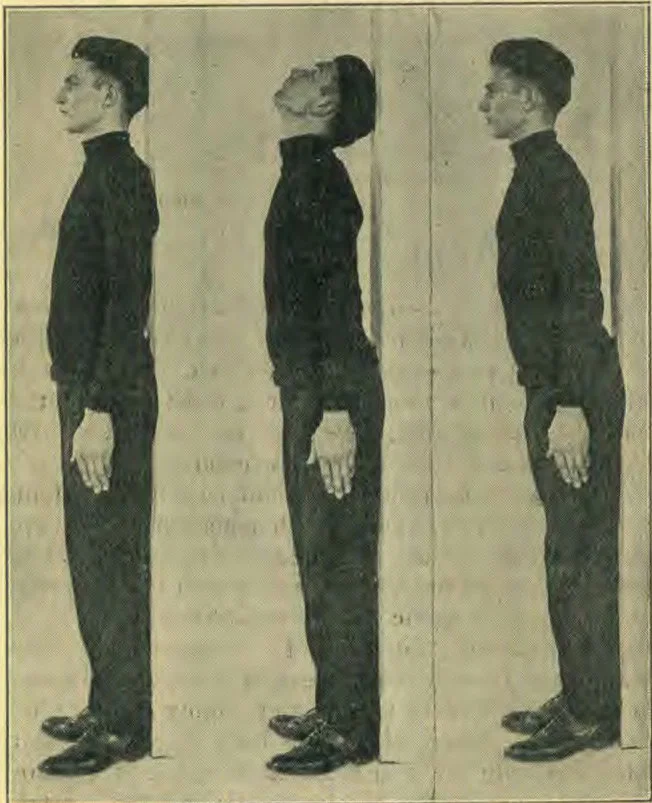
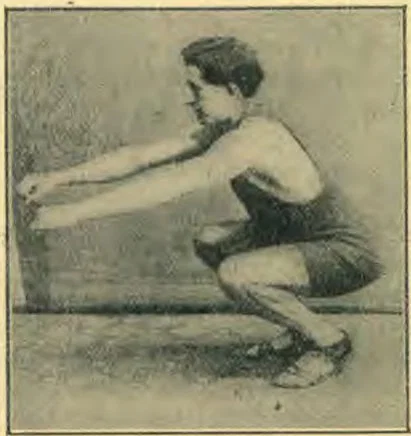
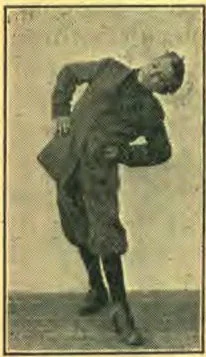
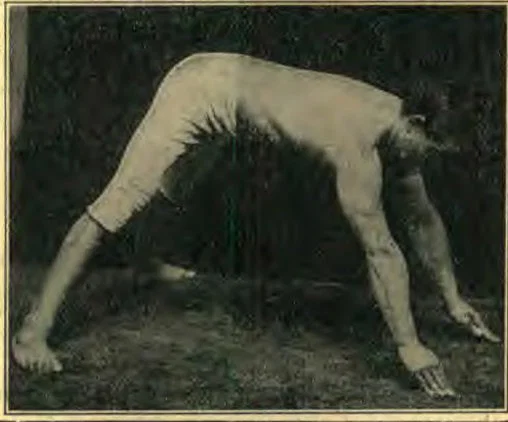
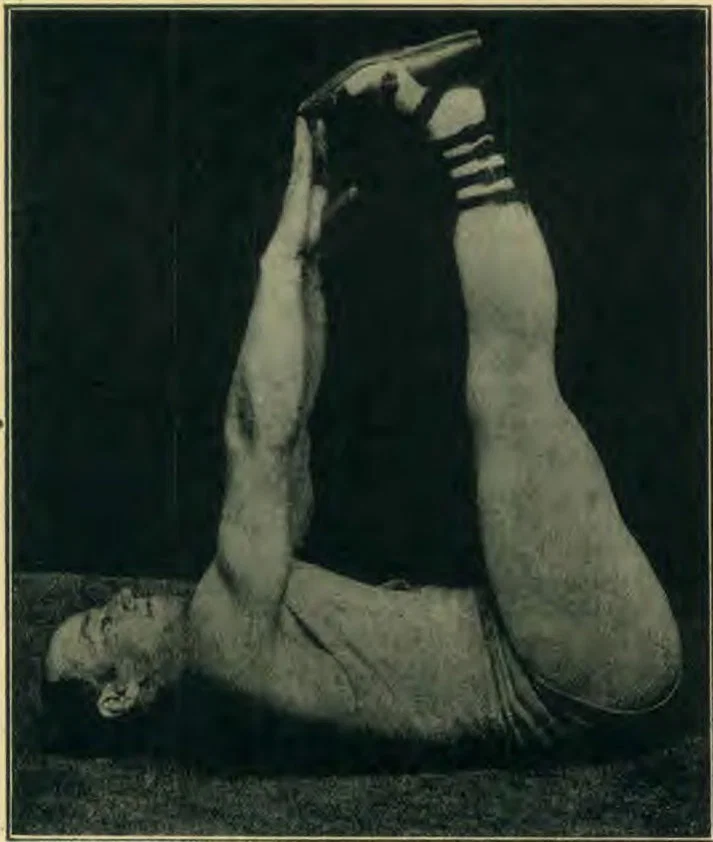
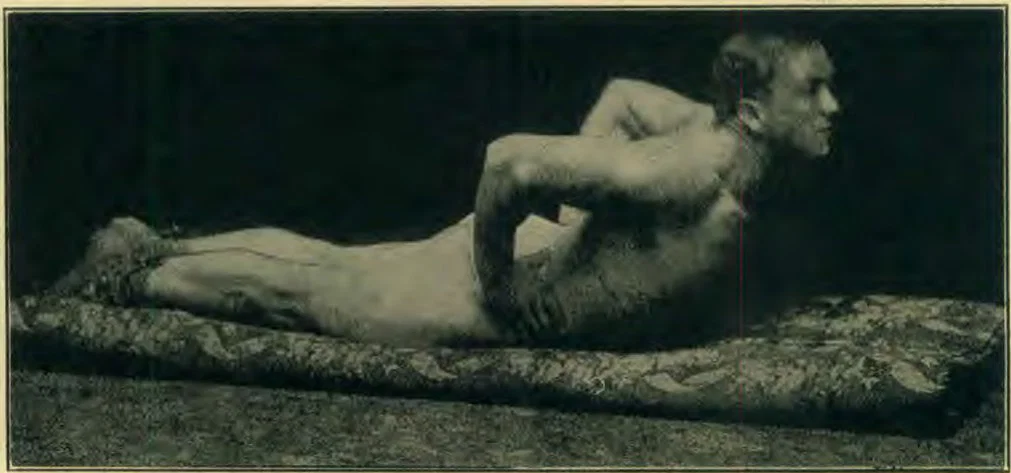
One of the first things about which teachers and parents should be concerned is the posture of the children, how they carry the body when sitting and walking, because their physical and mental health are both dependent upon the proper carriage of the body.
An article by Mr. Cleveland Moffett which appeared in McClure’s Magazine emphasizes the close relation of physical training to mental and physical efficiency.
The following lengthy extract from his article contains helpful suggestions:
“A little girl who had heard her father talking about the war, said recently to her mother:
“‘Mother, it says in the geography that Russia is the largest country in Europe.’
“‘Yes, dear.’
“‘And Russia has the largest population?’
“‘Yes, dear, it has.’
“‘But father says Russia doesn’t amount to much in the war. Why is that, mother, if Russia is so big and has so many people? Why can’t they do anything they want to?’
“The mother hesitated, being a little puzzled herself.
“‘Why—er—I suppose it’s because the Russian people haven’t—er—they haven’t had the right kind of teaching, the right kind of training.’
“Well spoken! The most learned man could not have answered better. That is what the anguished world needs today, not only in Russia, but in all lands—the right kind of teaching, the right kind of training! There lies the sole hope of tortured humanity, the only relief from all-encompassing miseries and injustices. And now that Russia has become a democracy, the light will dawn for her.
“We Americans pride ourselves on many excellences in our educational system—our public schools, private schools, colleges. And yet— . . .
“How about our system of physical training? What kind of citizens shall we have without proper physical training? What kind of fathers shall we have? What kind of mothers?
Compulsory Physical Examination
“I talked about this recently to Dean Briggs of Harvard University, and found him inclined to favor the idea that physical training should be made compulsory in American colleges, at least for freshmen. And, as showing a trend in this direction, he pointed out that Harvard, for the last year, has adopted a plan of compulsory physical examination for all new students, a thing that would at one time have been regarded as a gross violation of personal liberty.
“The first physical examination of Harvard’s freshman class (completed March, 1917) leads to some startling conclusions: four fifths of the new class, numbering 746 students, are found to have defective posture; that is, they slouch forward, or are narrow-chested, or have protruding abdomens or bad feet. In other words, they are more or less physically unfit.
“This is a matter of great importance, for defective posture indicates constricted lung space, impaired breathing power, a crowding together or displacement of vital organs; in short, a tendency to disease which is borne out by a higher percentage record of illness among bad-posture boys than among those who stand and carry themselves properly.
“There is no reason to doubt that the same condition exists among students at Yale, Princeton, Columbia—in fact, in all our colleges and high schools and among all American boys and young men. As a nation we are untrained physically. Take a million American men of military age from all classes, let them be examined according to standards of the United States army; one half of them will be rejected as unfit for military service.
“This is the opinion of physical trainers, athletic instructors, army officers. It must be the opinion of any intelligent citizen who keeps his eyes open. Look at the men and boys you pass on the street and judge for yourself. How many of them are physically fit? How many are overfed, underexercised, short-winded, weaklings, dyspeptics, alcoholics, incapable of endurance? How many carry themselves well—head up, shoulders square, stomach in, chest out? Not half of them, certainly; which is not saying that they could not benefit by training, but simply that they need training.
“‘The United States has become effeminized,’ said Rear Admiral Bradley A. Fiske recently. ‘George Washington would not know us, and General Grant would be shocked to see the difference in manner and carriage between the young men of today and the young men that marched behind him only fifty years ago.’
“I must add that, if our men and boys are thus physically defective, it is evident that our girls and women must suffer even more from inferiorities. Look at them—in the shops, on the streets, anywhere! Note how many girls of high-school age are round-shouldered! Is there any reason, except ignorance and9neglect, why American girls should be round-shouldered?
“Watch our women waddling or mincing along, handicapped by restricting garments, by absurd shoes! Handicapped by unwholesome fat! Think how differently God meant them to walk. Picture the Indian maidens, the Syrian women, straight as arrows, lithe and slender, striding over mountains and plains, nature’s princesses, with water jars poised on their heads! How can American mothers expect to have fine children unless they take better care of themselves?
“Oh, if some apostle could rise up and teach American women that beauty depends upon health, not upon anything that is bought in a bottle! And inspire them to pursue the health ways of bodily exercise and food abstemiousness as assiduously as they powder their noses and rub cheap lotions into their faces!
Training Acorns to be Oaks
“Let us now consider the education of American boys. What is wrong with this education? How can we better train our precious acorns to be oaks?
“In the first place, we can make sure that our children have proper physical training. Every father, for example, should teach his children at an early age to do simple setting-up and breathing exercises, say for five minutes every morning before dressing. Here are three such exercises that will help wonderfully in lung development:
“1. Stand erect, arms at sides. Inhale slowly but hard, mouth shut, raising the arms and stretching them sideways until backs of hands touch over head. Return slowly, exhaling through the mouth. Do this six times.
“2. Stand erect, arms reaching forward. Raise arms overhead and stretch, inhaling through nostrils. Return slowly, exhaling through mouth. Do this six times.
“3. Lie flat on floor, heels and toes together, knees together, chest arched, abdomen in, chin in. Place arms overhead with back of head on floor. Inhale and exhale repeatedly, raising chest and abdomen alternately. Do this ten times.
“Also every father should see to it before his children are ten years old that bad conditions, due to tonsils, adenoids, mouth breathing, obstructed nasal passages, eye defects, ear defects, teeth defects, have been properly attended to by private experts or in public hospitals. These things have a direct bearing upon the child’s general health and efficiency.”
Mr. Stevenson, of the Allen-Stevenson School, New York City, said that he regarded “physical training as the foundation on which everything else rests. If a boy is doing badly in his studies, if he is irritable, careless, disobedient, our first idea is not to preach to him or punish him, but to find out if anything is wrong with his bodily condition. We send for Anton Muller, our physical director, and take up the case with him. For weeks this boy is studied from a standpoint of physical health, sometimes with the cooperation of a doctor, and nine times out of ten the cause of the classroom trouble is located and remedied in the gymnasium.”
“As indicating the fine result obtained at this school through Mr. Muller’s care and cooperation with the teachers, I may mention that a recent physical examination of one hundred Allen-Stevenson boys, discovered only two who showed bad posture!
“It was a joy to me to watch these young fellows, bare to the waist, go through their table work and boxing bouts, then stand for inspection—straight backs, even shoulders, magnificent chest development, skin alive and glowing. And I saw the same fine results of this work continued at the ‘Boyville’ summer camp.
“‘When I get through with my boys,’ said Mr. Muller with pride, ‘they are broader, heavier, bigger in all proportions—you ought to see some of them when they start!’
“Another point in the new educational wisdom is that physical training must be universal; our schools and colleges should be concerned not with the making of a few star athletes (usually unbalanced persons), but with the making of a large number of all-round men. I would not send a boy to a preparatory school or a college where excessive importance is attached to the results of athletic competitions with rival institutions in football, baseball, rowing, and track events. In such schools and colleges the inevitable tendency is to overtrain a few dozen students who
‘make’ the teams (and often suffer for it in later years), and to neglect the training of several hundred other students who are not considered important by the trainers since they have not the making of star athletes.
Which School to Choose
“I would send a boy to a school or college where the reasonable physical training of every student is considered as important as that of every other student, and where such reasonable physical training is obligatory for all students, with no exceptions!
“In addition to general athletic games in which all students must take part it is important that individual physical needs and defects of certain boys be studied and exercises supplied to meet such individual needs.
“At the Asheville School I talked with the gymnasium trainer, Jasper Richardson, who takes in hand round-shouldered boys, and requires them to go through certain back-straightening, lung-developing movements until they have attained correct posture. Or he takes flat-footed boys, and gives them helpful foot exercises—rising on the toes, walking on the outside edge of the feet while toeing in, ankle-turning and stretching exercises which develop weakened foot muscles. Or he takes boys with well-developed legs but thin arms, and builds up their arms symmetrically with dumb-bells, wands, and rowing machines.
“‘One thing that I am keen about,’ said Mr. Richardson, ‘is to see that the boys do exercises to strengthen the abdominal muscles,—trunk twisting, sideways bending, up-and-down abdominal exercises. This is an important part of physical training, since it has to do with digestive and intestinal hygiene, and it is often neglected.’
“There are encouraging signs that the importance of universal physical training is coming to be understood also10in some American girls’ schools and girls’ colleges.
One of the best girls’ schools in New York City has in its new building given up an entire floor to an open-air, covered gymnasium for use in all weathers, my only criticism being that some of the exercises here are optional instead of compulsory with the pupils.
“And Vassar College has so far awakened to the need of better physical training for its young women that quite recently Anton Muller was called upon to make suggestions looking toward the introduction of his posture-building system.
“It is certain that if thousands of bad-posture girls only knew how easy it would have been a few years ago (when they were twelve or fourteen) for them to have developed straight backs, even shoulders, full busts, and how much better they would feel and look, they would be indignant at parents and teachers who allowed them to fall into sagging, stooping ways.”
Our schools should not be behind in anything that makes for the betterment of pupils mentally, morally, or physically. In the church-school grades much attention should be given to the correct posture and carriage of the body. Simple corrective and developing exercises should form a part of the regular work. The INSTRUCTOR of July 24 gave some exercises that will greatly help boys in attaining physical health and efficiency. It requires effort and time to carry out a regular schedule of body-developing exercises; but it is worth all the time and effort it demands.
Our Boston Juniors
By Matilda Erickson
OUR Boston Juniors have made a most unique Standard of Attainment scrapbook. It had not occurred to me that such a book could be so interesting as is the one our Juniors in Boston have made.
The first part of this beautiful book is made up of brief sketches of the life of Christ, “the first Missionary Volunteer;” an appropriate picture accompanying each sketch. Then follow short stories on Bible doctrines; and it is remarkable how the Juniors have managed to find suitable pictures to illustrate different Bible truths.
The denominational history part of the book is just as interesting. It consists of short articles on the pioneers. These articles, as well as those on the life of Christ and on Bible doctrines, are written by the Juniors. With each biographical sketch is a picture of the pioneer, and in a few instances the skilful pen of the Junior has drawn the pioneer’s home. There are also studies in this part of the book showing how each line of our denominational work has developed, and explaining the present plan of organization. On the closing pages are the names and pictures of the Juniors who have made this most interesting Standard of Attainment scrapbook.
Those of us who have seen this book appreciate it very much. I wish every Junior society could see it; but I wish even more that every Junior would try to make a Standard of Attainment scrapbook for himself. The Boston Juniors have set us a good example, for aside from the one made by the entire society, each member made one of his own. Who will be the next Junior to make a Standard of Attainment scrapbook?
MATILDA ERICKSON.
Franz von Papen Indicted in New York Bomb Plots
It is revealed that Franz von Papen, formerly German military attaché, is among the seventeen men indicted by the New York Grand Jury for complicity in bomb plots.
President Wilson announced an agreement between the War Industries Board and the steel manufacturers by which the price of steel in all forms is reduced almost one half.
The depth bomb is one means of combating the submarine. It is timed so that it explodes when it gets to a certain depth, because of pressure. If it strikes within a few hundred feet of the submarine, it creates such a commotion that the submarine will be crushed.
Surgery is every day accomplishing feats heretofore thought impossible. Dr. W. J. Hurley, head surgeon of St. Bernard’s in Chicago, performed an operation in which he transplanted a rib, making a chin for a ten-year-old boy. The teeth were also put in. His chin had been shot away by a shotgun.
LETTA STERLING LEWIS
By Letta Sterling Lewis
Fulfilled
At break of day, bold chanticleer,
Who loved to make a show,
Sought out his owner’s highest peak
From which to loudly crow.
“The neighbors all about the place
Who hear my stirring notes
Will vow, ‘There ne’er was such a bird.’”
Thus to himself he gloats.
“‘There ne’er was such a bird,
There ne’er was such a bird;’
The neighbors all around will say,
‘There ne’er was such a bird.’”
“My plumage, too, is very rare,
My topknot shows good breed.
Loud notes, fine coats, sure, make fine birds,
Say nothing of the feed.
My tones so very loud and shrill
Will surely reach all ears:
‘O matchless, early bird!’ they’ll say,
And appraise me with the peers.
“‘There ne’er was such a bird,
There ne’er was such a bird;’
The neighbors all around will say,
‘There ne’er was such a bird.’”
“Close every window, crevice, door,”
From every house was heard.
“That offensive rooster’ll drive me wild;
There ne’er was such a bird.
His gaudy coat bespeaks his worth.
To make his coarseness heard,
He’ll split his throat some day, I ween;
There ne’er was such a bird.”
“There ne’er was such a bird,
There ne’er was such a bird;”
The neighbors all around did say,
“There ne’er was such a bird!”
LETTA STERLING LEWIS
GENEVA E. HART
By Geneva E. Hart
Dorothy
GENEVA E. HART
OUR dark-eyed, happy-hearted baby was running everywhere a baby should go, and sometimes where she should not, as they all do. One sad day she was taken ill, a sickness which soon developed into infantile paralysis. This was not so severe a case as some, and she began to walk again a little in three months, but was quite lame, and fell so easily that she did not much care to be with other children.
One day while I was reading the INSTRUCTOR, Dorothy came and wanted to see. The paper was open at the Children’s Page, containing at the top a small picture of Jesus holding a little child and surrounded by others. I said that that was Jesus who loved little children; that he had gone up to heaven, but was coming again to take all the good people to live with him. She understood it, and said “Jesus,” although it was among the very first words she spoke. Her eyes would sparkle as she said it, and she would put up her little hands and tell it the best she could by saying, “Jesus — sky — me — papa — mamma — back.” She never tired of looking at it, and would pass by every other picture with only a glance at a bird or kitty, till she found it, to show to any one who came, and tell the person all about it in her baby way. Very often she would come, several times a day sometimes, to “find Jesus,” and I would look for pictures of him until I wished every paper had Jesus in it. One might tell by the little finger marks nearly every paper that has a picture of Jesus. Later she would say, “Gamma, sing Jesus,” when I would sing “Jesus Loves Me,” and others. She said to a little friend who was singing another song, “Let’s sing Jesus.”
How we ask God that the tiny seed planted in the heart of this little child may grow and bear much fruit in the kingdom by leading others to “find Jesus.” While one sows another must water, and God will give the increase. Let us not forget to sow the seed in the springtime of life, before the evil days come.
How Edith Harvey Spent Her Vacation
By Mildred Shaw
EDITH had entered a near-by college in the fall, and was enthusiastic over her new experiences in college life. On returning home for her first vacation, she said one morning as she entered her father's study, her blue eyes sparkling, her young body vibrating with joyousness of life: “Father, I want to go canvassing next summer!”
“Canvassing!” ejaculated her father, as he smiled incredulously at his young daughter.
“Yes, sir, canvassing.” Then she related a few of the wonderful experiences some of the students had had while selling books during the preceding summer, several of the boys having earned two and three scholarships.
Edith's plan to go canvassing was treated lightly by some members of the family. If she did go she would be back in two weeks was the verdict of her youthful brother.
“Probably I shall be able to retire from business when you return from your canvassing,” jested her father.
Edith smiled, but said little. Instead of becoming discouraged as the days passed, her determination to go increased. A certain amount of opposition helps one. You know “kites rise against and not with the wind.”
In a letter home after the vacation she said: “I really believe canvassing will give me just the experience I need, and it is real missionary work too.”12
In reply her father wrote: “You know, Edith, all are not canvassers. Some can make a success of one thing and some of another. Each has his own work to do; and besides, canvassing is too hard work for a girl. We want you home this summer.”
However, the months flew by, and the first of June found Edith and her school friend, Ruth, on the train headed for their canvassing field, as Edith's parents had consented to her making an attempt to carry out her desires.
When the girls finally reached their destination, their hearts began to sink within them. The thoughts of home and her father's words rushed into Edith's mind, but she said determinedly: “I must do it. I can't be a quitter!”
As she started out, she lifted her heart to her heavenly Father in prayer, and felt much strengthened. In the early part of the summer she canvassed among a good class of farmers who were hospitable and kind, and best of all, seemed interested in her book. With prayer and hard work, Edith found that she could sell books, and was happy in the discovery.
Several weeks passed, and she entered a less friendly neighborhood, where it seemed impossible to take orders. One morning, after trudging the dusty roads all the forenoon with no success, she sat down by the roadside to rest. It was dinner time, and she was hungry and tired, but no one seemed to care whether she had dinner or not. Her thoughts ran back to the folks at home. How far away they seemed! They were sitting down to a good dinner. How she should like to be there! “Oh, how can I ever stand it?” and tears of self-pity flowed uninvited. Then, suddenly realizing what she was doing, she hastily brushed away the tears, saying: “Why Edith Harvey, what are you doing? Aren't you ashamed of yourself?” Pulling out her road map she studied the roads awhile; then breathing a silent prayer to her Father in heaven, she started on her way.
She had gone only a short distance when she was stopped by the driver of a horse and buggy, whom she recognized as a man she had canvassed the day before, but who had not seemed interested enough to order a book.
“How do you do?” he said. “I thought perhaps I should see you on this road. I want my brother,” pointing to the man sitting beside him, “to see that book of yours.”
Edith took out her prospectus and gave them a canvass. As she finished, Mr. A's brother said: “I will take one in the cloth binding.” How thankful Edith felt for such a direct answer to prayer. “How can I ever become discouraged again,” she thought, “with such help at my command?”
One Monday, after tramping all day, she received only one order. However, she felt sure she would do better the next day. After working hard all day Tuesday she received two orders, and when Wednesday night came with only three more orders, she was downcast and blue. Knowing this would never do, she said to herself: “Edith, you must do better than this.” As she knelt that night by her bedside she sent up an earnest petition that on the morrow the Lord would give her twenty dollars' worth of orders.
The next morning when she awoke it was raining,—dubious weather for a canvasser. Edith anxiously looked for the rain to cease while eating her breakfast and drying the breakfast dishes, but instead of abating, it came down harder than ever, until there was a steady downpour. “Well,” she thought, “I must start out or I shall have no chance of taking twenty dollars' worth of orders today. God can't give me orders if I don't do my part.” When the rain slackened somewhat, as it did before and after each outburst, Edith started out. As she entered the storm she called back to the elderly couple standing on the porch, “Every cloud has a silver lining; that is what I am looking for.”
At the first farm the people owned an old edition of the book she was selling, but at the second place she secured an order. At each of the next eight or ten places she took an order. All nature seemed to be rejoicing at her success, for by noon the rain had stopped; the clouds had rolled away, and the sun was shining in all its splendor, while the birds almost burst their throats with song. With thankful heart Edith laid her weary head to rest that night, for the Lord had more than doubled the sales which she asked for.
The rest of the summer was hot and dry. The farmers worried, fretted, and prayed for rain, but no rain came. Almost every one prophesied a loss of crops. Edith thought her troubles had just begun, for the time for her delivery was swiftly approaching, and she feared the farmers would not take their books. She prayed and tried not to worry. She knew that things are promised to those who ask in faith; but it was hard just to leave it all trustingly in God's hands.
Finally, on the day of delivery, Edith started out with fearful heart. She stopped at the first house and could scarcely believe her eyes when the three dollars were laid in her hand. She was much encouraged by this to go on to the next place. And so it was, with few exceptions, until her delivery was successfully completed.
“How can I ever thank God enough?” thought Edith, as she was rapidly being carried eastward toward home and friends. How glad they all were to see her when she finally arrived. And after listening to a recital of her summer's experience none felt to laugh at her canvassing idea.
Years have passed since, but Edith never forgot her first summer's experience in canvassing. When difficulties have arisen and when tempted to doubt that God answers prayer, her faith has been wonderfully strengthened by the remembrance of that summer's experience.
MILDRED SHAW
What Our Blessing Cost Heaven
By M. E.
(Texts for December 9-15)
“This man's father,” said the driver, pointing to a large farmhouse, near the road, “left each of his sons four hundred acres of land.” To help my mind grasp the meaning of such gifts, I immediately began to convert those broad acres of fine Iowa land into silver and gold; then I asked myself: Do these men realize what it cost their father to leave them such gifts? Do they see how in the struggle of pioneer13days their parents toiled and saved and suffered? Are they accepting these gifts of love and sacrifice thoughtlessly and without gratitude? It is a pity if they are, for ingratitude is so unjust, and sadder still, it eats away the finer elements of character.
But what about the gifts you and I are getting from God? Every day of our lives he has watched over us, protected us, meted out to us life's necessities, and given us many other things to make us happy. His promises cover every need of life. We do not mean to be unappreciative, but do we not often pillow our heads on some of God's promises while forgetting entirely at what infinite cost heaven purchased them for us?
God's promises are not mere phrases — empty platitudes. There is deposited in the inexhaustible treasuries of heaven just what his promises to you and me offer. The psalmist says: “Thou openest thy hand, and satisfiest the desire of every living thing.” No man's check is good for an amount larger than his bank account; then think how very great must be the reservation that makes the promise passed on to us by the psalmist as good today as it was then. And think what it must have cost heaven to make such provision for our returning wants.
Love, only love, and only the love of God would pay the infinite price of the promises God has given us. Men have weighed the earth, and measured the distance to stars, but no one has even attempted to put God's love in the balances. John 3:16 is perhaps the best approximate measure we have of this matchless love which is —
“The balm of life, the cure of woe,
The measure and pledge of love,
The sinner's refuge here below,
The angel's theme above.”
That love counted not the cost too great; it laid its dearest treasure upon the altar to save us. It gave all. Imagine the Father saying: “Son, will you leave this beautiful home, and go down there to that dark, dark little speck in the universe? The people living on it have sinned and cut themselves off from eternal life. Will you go and purchase their redemption with your own blood? Many will hate you; you will be misunderstood and ridiculed. You will suffer more than tongue can tell; you will sweat drops of blood as you struggle alone with that awful load of sin; and finally you will be crucified. I know that only a few will let us save them. But I am willing to let you go. Will you?” That's how God loved us then; and that's how he has loved us ever since. Stretch your imagination, young friend, and try to comprehend the Father who in his love for us did not withhold his own Son,
“But gave him for the world undone,
And freely with the blessed One
Gave all.”
And Christ favored the plan. He chose to give up all that he might come to save us. How hard it must have been for him to leave home! How lonely was the path he trod in this sin-cursed world! Never can we know how much he suffered for us; but we do know that he did not falter nor fail. He loved us too much to give up. So he suffered and died that he might bring from the chamber of death our hope of eternal life; that he might purchase for us — for you and for me — all the promises that make life worth living to-day. My dear young friend, do you realize what it cost heaven to give you the hope of eternal life and to shower upon you the blessings that make you comfortable and happy? How much do you appreciate it?
M. E.
The Cross Versus Social Service as the Road
“It is an entirely good Christian thing to give the down-and-outer a bath, a bed, and a job—it is an entirely Christian thing to establish and maintain schools and universities; but the road into the kingdom of God is not by the bathtub, the university, the gymnasium, or social service, but by the blood-red road of the cross of Christ.”