The Youth’s Instructor, Vol. 65, No. 49.

Miscellaneous News Items from Around the World

The Youth’s Instructor

Dec 4, 1917

Review and Herald Publishing Assn. · Takoma Park Station, Washington, D. C. · Dec 4, 1917

Miscellaneous News Items from Around the World

The French conduct an ambulance service for wounded horses.
Telegraphic transmission of photographs has been introduced on the Berlin-Bagdad line.
Goat’s milk is being used for cheese making on a larger scale than ever before in this country.
A New Jersey manufacturer is making an acceptable salad oil from the alligator pear, or avocado.
England is to make bullets out of hairpins. There seems to be no end to the usefulness of that little article.
Chicago carries the honors in the baseball world. This year she won the world’s championship against New York.
Uncle Sam is to have a new army. One thousand war dogs are being gathered from noted kennels in California and in the Hudson Bay regions to be sent to the battle field in Europe.
The Humboldt River, which flows through central Nevada, is declared to be the most crooked river in the world. It crosses the Southern Pacific track twenty-eight times, necessitating as many bridges.
Cork fabric is a recent French production. It is waterproof, a nonconductor of heat, and unbreakable. Thin slices of cork are glued to cloth; or, if a stronger garment is desired, the cork sheets are placed between two layers of cloth.
The German ship “Vaterland” is now ready for service, and “Kaiser Wilhelm II” and “Cecilie” will be ready soon. These ships were taken over by the United States on its entry into the war. They will doubtless be used as transports to carry troops to Europe.
One of the greatest engineering feats in the history of mankind was successfully completed Sept. 20, 1917, when the large center span of the Quebec bridge was safely swung into place. The great structure is 3,229 feet long and contains 180,000,000 pounds of steel. The total cost was $20,000,000, and it required eleven years to complete the task.
A large department store in New York City opens its working day with a “sing.” A visitor who happens in punctually at eight o’clock hears a chorus of several hundred melodious voices mingling in agreeable songs, accompanied by an organ, in a large rotunda in the center of the store. The singing lasts five minutes or more, ending with “The Star-Spangled Banner.” The employees seem to enjoy most heartily this unconventional introduction to the day’s work.
Two very young gorillas have been captured in the African jungle, by Prof. R. L. Garner, of Philadelphia. He intends to educate them, with the purpose of seeing how much can be made of these man-like apes. Dinah is three years old, thirty-two inches high, and weighs forty pounds. She already knows her name. Professor Garner writes: “She is one of the jolliest things you ever saw. I let her out of her cage occasionally and we have some real romps. The other gorilla, Tom, is younger, but is a timid, savage little beggar and hasn’t much sense.” Professor Garner has spent several years in the African forests studying their ways and language—for he insists that they have a language.
To save the lives of the pythons of the Lincoln Park “zoo,” in Chicago, a “food gun” has been invented. The jaws of the serpents are to be forced open and food shot down their throats. Pythons are expected to eat once a month, but two of the most valuable of these great snakes went on a hunger strike several months ago, and have refused to eat anything since. It was decided, therefore, to resort to “forcible feeding.” Pythons in captivity quite commonly refuse to eat, and seem to commit suicide by starving themselves.
Dr. Gulick has prepared an elaborate plan for a skyscraper playground for Seward Park, which is to be twenty stories in height, the lower five or six stories to be devoted to business purposes, the succeeding stories to be used for swimming pools, basket ball, tennis courts, kindergartens, general games, and the like, while the top floors are to be used for a library and training school for playground workers, and the roof for an open playground.
Three meteors fell in Wisconsin July 4, at 6:20 P. M., within a radius of 57 miles. They were attended by smoke trails and explosions which shook the windows. Two of the meteorites were recovered, and weighed 80 and 200 pounds, respectively. While the other one was not recovered, it was said to be very much brighter than the sun.
Stoves are carried in one’s pocket in Japan. A small tin brazier, which resembles a cigar case, contains the fuel in the form of a roll, like sausage. Each roll will burn for three hours. They are much used by travelers, school children, and sick people. The fuel is made of hemp stalks, mulberry, and the catalpa plants, these being pulverized and mixed with vegetable oil.
Few if any counties in the country can equal the achievement of Larue County in Kentucky. Its draft quota for the National Army was 132 men. Each of the 132 responded, was examined, passed, claimed no exemption, and entered service. Larue (then Hardin) County is the birthplace of Abraham Lincoln.
The government secret service agents found a huge hoard of sugar in a Buffalo warehouse. The bags and barrels were labeled “top-crust flour” and had flour sprinkled on them to complete the deception. It is estimated there were 150 carloads.
The Italians have invented a triplane which is planned to carry a crew of three, 2,750 pounds of bombs, three guns, and a fuel supply to last six hours. It has three 700-horsepower motors, and has a speed of 80 miles an hour.
The United States transport “Antilles” was sunk on its journey home from France. Seventy men were drowned.

I Volunteer

I VOLUNTEER for Jesus; The sweetness of his name Subdues this sin-scarred heart of mine, And sets it all aflame.
At Jesus’ feet I cast me; The richness of his love Assures me that he’ll make all new— My life, like that above.
Not worthy? No; but he is! And he takes things of naught To bring to nothing things that are, And so my all I’ve brought.
My all of nothingness to him Who made, and can make o’er, From nothing, things that mighty are. Things strong in his great power.
So take the gift, dear Saviour, I have naught else to bring; And now, if thou wilt fit me, I’ll serve thee well, my King.
Wherever thou wouldst have me, Here, or beyond the sea, Wherever, and in any work, Only, O Lord, with thee.
Thy presence is the glory, The Word of truth the cheer That buoys me up. Thy flowing love Makes service, O, so dear.
— Welcome Visitor.

Consecration — with a New Meaning

C. S. LONGACRE
CONSECRATION with a new meaning is needed now. We are facing the most momentous struggle of all the ages. The long-expected crisis is upon us. Every day is trembling with destinies. A new hour has struck. New opportunities have arisen. Great responsibilities confront us. The curtain has been lifted, and we are facing a different world, with an unfinished task before us. All this calls for a new experience—a consecration with a new meaning.
We have prayed that God would hold the winds from desolating all the earth. He has heard the prayers of his people, and confined the raging conflict to the iron ring which encircles the borders of the central powers of Europe, though ninety per cent of the inhabitants of the world are drawn into this mighty holocaust. But how much longer can we expect God to hold the winds from their utter loosening? We cannot consistently ask God to continue to hold the winds of strife much longer. Our prayers are a mockery unless we consecrate ourselves anew to God for the speedy finishing of his work. We must put a new meaning into our prayers and our consecrations.
God expects more of us after he has held the winds in answer to our prayers than he ever did before, and he has a perfect right to expect more of us, because of the peculiar situation and the exigency of the times. Such a time as this calls for a surrender of ourselves, our talents, our plans, our lives, and our treasure. It calls for a new covenant of sacrifice to God. It means a mobilization of all our forces of mind and body, as well as all our possessions, for service in the army of the Lord, to win the last and crowning battle for the Lord God Almighty. The time has come to sever every earthly tie; to give up our fondest hopes of worldly prospects; to part with our dearest friends on earth; to sacrifice every cherished comfort; and to lay everything on the altar of consecration and seal it, if need be, with a martyr’s precious lifeblood. This is what the warring nations demand of every able-bodied man they are calling into the service of a carnal warfare, and millions have already paid the price of their lives for the honor of their countries. Why should God expect less of us in the greatest enterprise which he ever intrusted to mortals? The sacrifice which the world is making to win the perishing laurels of war. should arouse us to a still deeper consecration to win for our crowns stars which will never lose their luster. A passion to save the lost should be the controlling power in our lives.
God expects and requires more of those who are candidates for translation than he did of those who died in Christ in past generations. This fact attaches a new meaning to our consecration. Those who are saved from passing through the portals of the tomb will have to stand without fault before the throne of God with a perfected Christian character.
“The seal of God will never be placed upon the forehead of an impure man or woman. It will never be placed upon the forehead of the ambitious, world-loving man or woman. It will never be placed upon the forehead of men or women of false tongues or deceitful hearts.” “Not one of us will ever receive the seal of God while our characters have one spot or stain upon them.” But thank God for the assurance of hope. “No one need say his case is hopeless, that he cannot live the life of a Christian. Ample provision is made by the death of Christ for every soul. Jesus is our ever-present help in time of need.”—“Testimonies for the Church,” Vol. V, pp. 214-216.
“Those who consecrate body, soul, and spirit to God, will constantly receive a new endowment of physical, mental, and spiritual power. The inexhaustible supplies of heaven are at their command. . . . Through coöperation with Christ, they are made complete in him, and in their human weakness they are enabled to do the deeds of Omnipotence. . . . The time demands greater efficiency and deeper consecration. I cry to God, Raise up and send forth messengers filled with a sense of their responsibility, men in whose hearts self-idolatry, which lies at the foundation of all sin, has been crucified; who are willing to consecrate themselves without reserve to God’s service; whose souls are alive to the sacredness of the work and the responsibility of their calling; who are determined not to bring to God a maimed sacrifice, which cost them neither effort nor prayer.”—“Gospel Workers,” pp. 112-114.
Our joy in the world to come will be commensurate with the sacrifice and consecration we have made in this world for the cause of Christ. The greatest struggle that we have in this life is the surrender of our plans to the will of God. No surrender is complete until our most cherished plans are all laid on the altar of sacrifice to be given up or carried out as God may choose. No greater glory can come to a youth than to consecrate himself and his plans to God.
A consecration is now needed which makes no mental reservations, and burns all bridges behind it. The time has come to provide new bottles for the new wine, and new garments for the new man. The reforming and patching up processes of the old life must be exchanged for a new life altogether. A motive of love must take the place of a sense of duty, or our religion will be worthless in the sight of Heaven. An undying passion for lost souls must be substituted in the place of the love of money, worldly honor, and sensual pleasure. A desire to reach the highest ideals in the Christian life instead of the lowest acceptable standards must be the new meaning of an up-to-date consecration. We need a consecration which will not only lead to a spiritual revival in our souls, but to a transmutation of our highest ideals into a transformed life, which will measure with the fulness of the life of Christ. Our only hope of heaven is to have Christ formed within, the hope of glory. Fulness of power comes with whole-hearted consecration. God is still waiting for an opportunity to demonstrate what he can accomplish through a human life that is entirely surrendered to the divine will. It is possible for you to be that one.

Getting and Giving the Best

Could we step forward to the last of the last days, and lay this life over into the great democratic past, where all things stand upon their true merit, then we should be able to choose to use our days more wisely. But this we cannot do; yet ours is a better lot. We may let God choose for us.
And it pays to enter often into the chamber of prayer to talk with God about the best things in life; for Satan with his reversed field glass has given us a wrong perspective, and it is only when we withdraw from the world's hustle, and from our own selfish desires, and stand quietly face to face with God, that we get a true view of life.
Closely associated with what we count the best things in life is that impelling power of ambition which is constantly drawing us up or down toward our ideal. Nearly all are fiercely resolved to succeed, and are panting to reach some goal,—of wealth, of honor, of pleasure, of knowledge, or of ease. And how sad it is to see thousands of young people rushing headlong into these quicksands of life, when the selfsame powers might be utilized in raising them to life's highest possibilities!
Young friend, what does life mean to you? Are you living just to have a good time? or are you trying to get and to give the best? Remember things are not always what they seem. Sometimes appearances are so deceiving that we really cannot trust our own judgment. We need a wiser and stronger hand than our own to guide us in life in order to be safe. If our eyes are fastened upon the tinsel of the world, and we are grasping at shadows; if nothing in life seems more important than greenbacks or pleasure or fine clothes, let us pray God to anoint our eyes, that we may see how life transcends all these.
We need God in everything every day. We need him all the time. Only God knows what is best for you and me; and only when we have him in our lives, can we give our best to the world. Then will you not try to get better acquainted with him? Will you not meet him every morning in the chamber of secret prayer? Will you not make the Morning Watch a Medo-Persian plan of your life, that God may choose for you the best and teach you how to give the best to others? MATILDA ERICKSON.

Accuracy or Intellectual Honesty

SOME one has said that “accuracy is intellectual honesty” and that “honesty is the best policy.” The truth of these statements will not be questioned; but the application may not be altogether clear.
There are two prominent forms of intellectual dishonesty,—overstatement and understatement, the former being perhaps the more common. It is called exaggeration. People addicted to this form of intellectual dishonesty are invariably making statements that stretch beyond the mark of honesty, as did the little fellow who watched the street parade, and who on returning from it remarked, “O papa, I saw a dozen elephants,” when there were only three or four.
The young woman in describing her new hat would lead you to believe she paid about three times as much for it as she really did. In this age a false pretense of wealth is undoubtedly the most flagrant form of intellectual dishonesty.
Thousands of instances of such forms of dishonesty are occurring every day. No wonder the child scarcely knows that such statements are dishonest, when he hears so many of his seniors constantly exaggerating. If he is an inquisitive child, he is often met with such remarks as, “Run away, Willie, you have asked me that question a thousand times already.” Probably he had asked it once or twice before, but did not receive a satisfactory answer according to his way of thinking. The answer was too superficial, and not explicit enough in the details. Children are usually curious to know all the whys and wherefores; and many of the little details, which to us seem a waste of time to mention, are of great concern to them. His fund of knowledge is limited, and the details help to enlarge it.
Understatement of the truth is a falling short of the mark of honesty.
One morning John’s father told him to saw a pile of wood before his return. John’s brother, James, also had a pile to saw, but James was not very industrious, and sawed only about one half of his pile, while John finished his completely. John was very eager to tell his father that James had not finished his work, so he said, “Papa, James has sawed only a few sticks of his pile.” This is still exaggeration, but it lies on the opposite side of the mark of honesty. It is that form of exaggeration which falls short of being honest, while the other form steps beyond the mark of honesty.
Accuracy of statement in minor details is, therefore, of great importance in the development of honesty in the character. Honesty is reckoned at par value always. Its price never fluctuates, and no brokerage should be added or subtracted. Our statements should never be made above par nor below par, but always at par—a Yea, Yea, and a Nay, Nay, as saith the Lord. Let us therefore speak in mathematical precision. Our brokerage fees will be charged according to the trouble we make others by our overstatements and understatements.
Poor Richard Junior’s philosophy states that Diogenes needed a lantern to find an honest man in his day, but that in these days he could see the whitewash a mile off. An insincerity of heart coupled with the prevailing habit of exaggeration makes a Pharisaical character, which Christ denounced as a whited sepulcher, being filled with dead men’s bones, or rank dishonesty. The Pharisees made many false pretensions and lived an exaggerated form of godliness without the power thereof. They used plenty of whitewash to hide the insincerity of heart and purpose within.
Mary M. Crawford.

Important Announcement

A YEAR ago we announced that because of increased cost of paper it was necessary to increase the subscription rate of the INSTRUCTOR. Our readers were loyal. They knew from experience that the increase was justified. Instead of the new price decreasing our list, the list now contains nearly one thousand more names than it did on Jan. 1, 1917.
At the time we made the advance in our subscription rate, it was with the hope that before another year had passed the prices of materials might have become more nearly normal. Then, too, a year ago the only advance which we attempted to cover by the increase in price was partially to make up for the increased price of paper. Not only has paper advanced to about twice its former price, but all other items entering into the cost of production, have increased from fifty to one hundred per cent.
During the year 1917 we were favored in having some paper on hand at the beginning of the year which had been bought at the old figures. We shall have none of this cheap paper to use in 1918. The cost of mailing the INSTRUCTOR will be increased in 1918 when the section of the new tax bill relative to second-class postage rates goes into effect.
It was evident before the year was half over that the INSTRUCTOR rates were too low. In fact, on most of our papers, which were sent out at club rates, we were receiving considerably less than factory cost, to say nothing of the promotion expense, and of the salaries of the mailing employees.
No final action was taken, however, until the situation was presented to the members of the General and North American Division Conference Committees at the Fall Council. They voted to approve a raise in subscription rates as recommended by the publishers.
We announce, therefore, that beginning Jan. 1, 1918, the subscription rates to the YOUTH'S INSTRUCTOR will be increased, and on and after that date the rates will be:
Single subscription, one year . . . . . . . . $1.75 Single subscription, six months . . . . . . . . 1.00 Clubs of five or more to one address: One year, each . . . . . . . . . . . . . . . . $1.25 Six months, each . . . . . . . . . . . . . . . . .75 Three months, each . . . . . . . . . . . . . . . .40
These rates will, we know, fall heaviest upon our Sabbath schools where clubs of the INSTRUCTOR are purchased for the pupils, but we believe you will agree that it is better for all to help share the burden, than for your publishing house to lose several thousand dollars each year in publishing our young people's paper.
Opportunity is given to renew a subscription, whether single or club, between now and Jan. 1, 1918, at present rates. If your letter is postmarked not later than Dec. 31, 1917, subscription or renewals will be accepted at present rates, but if postmarked Jan. 1, 1918, or later, the new rates will apply. Those who wish to secure present rates for another year are at liberty to do so, by subscribing or renewing before January 1 next, no matter when the present subscription may expire. Orders may be sent to your conference tract society office.

Missionary Volunteer Experiences in Christian Help Work
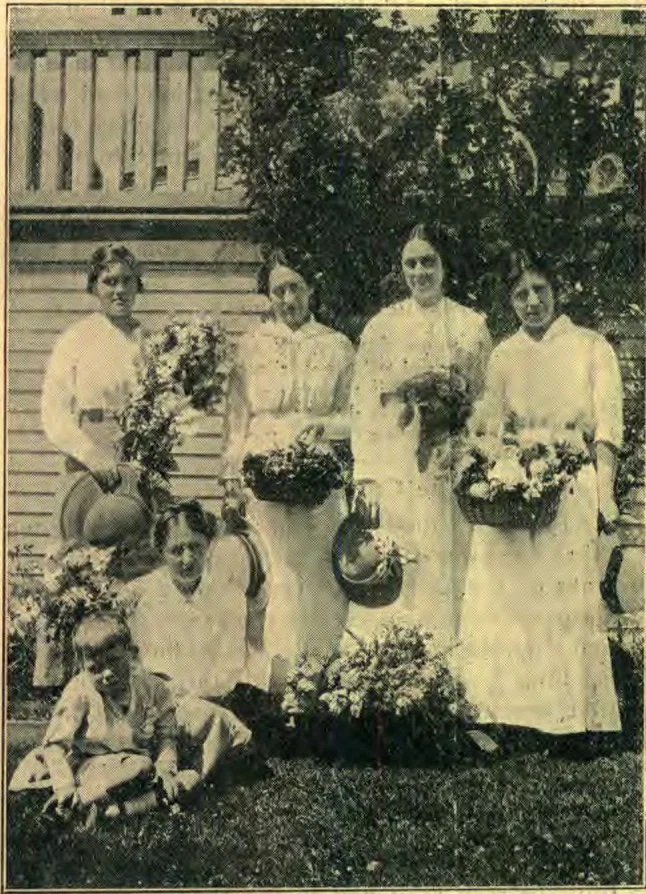
The work of saving souls does not depend alone on the ordained minister. God has given to him his work, but he has also placed a solemn responsibility upon the individual members of his church. To the youth of our denomination he has given a special work. There are many precious, honest-hearted persons, either sick or blind, or otherwise physically unable to leave the institutions which they must call home the rest of their lives, who may never receive a knowledge of the gospel of Christ unless it is carried to them.
A CHRISTIAN HELP BAND, BRITISH COLUMBIA
The following account of work done by the Christian Help Band of a British Columbia Missionary Volunteer Society, sent us by Mrs. R. A. Vass, shows the importance of doing good wherever we can, and the possibilities there are in Christian Help work:
“Some of the young people from the River Road church have gone each week to visit the incurable patients at the Ebourne Hospital near the Fraser River. They also give to each one a copy of a truth-laden paper. Bright smiles and words of cheer gladden the hearts of men who have been confined to bed or wheel chair for many years. One dear old man has been in this condition for ten years. Others, for four, five, six, seven, or eight years.
“The men look forward eagerly to these visits, and are very much disappointed if anything prevents them. One night we gave them a concert, and if you could have seen their faces and heard their words of thanks and blessing, it would have brought tears to your eyes.
“One afternoon Sister Smead took four of them in her automobile to a Bible study given at the Little River Road church. It took a long time to get them into the church, and a much longer time to get them out again. One poor man sat on the top step and just let himself down step by step, as we used to do when children. It was very pitiful, but they greatly enjoyed the study, which was on the signs of the times. Later a garden party was given on a pretty lawn, one of the friends carrying the men there and back in her car. The men were like a lot of boys on their first excursion. Their poor old paralyzed bodies did not prevent their hearts from throbbing with joy.
“Raspberries and cream, cake, lemonade, sandwiches, buttermilk, etc., had been prepared, and were much enjoyed. One old man said to me, ‘It is a long time since I went to a picnic;’ some of the men had not been away from the hospital all the years they had lived there. They sat on the lawn in comfortable chairs, and listened to the beautiful hymns that were sung. One poor old palsied man insisted that we take him along, much to our consternation; and when he was placed in the automobile, he laughed like a child. It seemed best not to attempt to take him from the car, so one of the sisters sat by him and fed him; he ate heartily, and enjoyed the outing immensely.
“When evening came, and the last group had been safely returned to the hospital, our happy hearts soothed our tired bodies by singing:
“One more day's work for Jesus, One less of life for me; But heaven is nearer, And Christ is dearer, Than yesterday to me.”

The Cross of Christ

NEARLY two thousand years ago the city throng that went out of one of the most important Eastern cities of the Old World viewed on a near-by hill the form of three crosses, on the center one an individual who, the inscription said, called himself “King of the Jews.” From that day to this, for nineteen hundred years, the cross has been prominent in the world's life, and men have had to consider whether they would make Jesus first in their hearts.
Six thousand years ago serious rebellion broke out among the angels of heaven, which was carried to the newly created world, causing havoc and ruin to the souls of men as it had to the angelic host. The One with the Father looked down Time’s stream, and saw in the cross the power to save ruined man and the power to draw doubting angels, who for lack of knowledge sympathized in the rebellion, back to their allegiance to God. And he said, “I, if I be lifted up, . . . will draw all men unto me.” The cross has proved itself to have an unlimited power for drawing souls from the evils that beset them, to the life that is in God. It is stronger by far than the strongest of magnets, for even their enormous, inherent mechanical power is not sufficient to raise some of the wrecked vessels lying many fathoms deep on the ocean’s bottom. Those who are acquainted with the sea are of the opinion that the “Titanic” is beyond the reach of salvage apparatus. However, a certain engineer believes that by means of a device that he has invented the ocean liner can be raised. He declares that the sunken vessel will come up when his “pontoons” are placed on the surface and his “magnets” welded to her sides.
This is an untried theory, but the power of the precious blood of Jesus Christ to raise every wrecked life from sin’s deepest sea is a tried and proved fact. “I, if I be lifted up,” said Jesus, “will draw all men unto me.” By the unlimited drawing power of the mighty magnet of his grace he is able to lift every sinner from the depths of sin and the sloughs of despondency, and to plant his feet on solid ground.
Into all lands the message of the cross has found its way and lifted from the dregs, honest-hearted men and women. A few nights ago some of our missionaries were walking down one of China’s inland cities, passing and being passed by throngs, when out of the darkness a musical voice rang out, “Ping-an si-mu,” Peace to you, lady (the Chinese Christian’s greeting), and they turned aside to catch a better glimpse of one who had been lifted from heathenism and whose clear voice, in the midst of China’s darkness, was praising the sacrifice of the cross. This is only one of the hundreds of Chinese who are daily witnessing for Christ and who are of the same material that the 20,000 were, who in the northern province of Chili in the days of the Boxer uprising, rather than deny its power by spitting on the forms of some crosses in the sand, suffered death by one hundred cuts.
It is the cross that brings to one’s mind noble, uplifting thoughts, that causes one to think of Jesus, of the value of a life and of “What will a man give in exchange for his soul?” It brings sweetness into life and dispenses grace and comfort wherever its power is felt. May the great God teach you its mighty power, help you to exemplify it in your lives, and to tell others of the source of its power.
What is the source of its power? Ah, it is Jesus Christ, the Son of God, the Saviour of mankind. Infidels of the past have criticized the idea of salvation through Christ, but have offered nothing to take its place. So, well may we, with the good and blest of all the ages past, “nail our hopes to the cross.” Christianity is the only religion with a cross in it, and the only one with salvation. Let us be proud of it, and boldly proclaim its meaning to all men. Let us never forget that he was wounded for our transgressions and bruised for our iniquities. Where was he wounded? Where was he bruised? I quote: “In Palestine. Yes, but let us come nearer. On Calvary. Yes, but nearer still. On his head, on his back, in his side, in his feet and hands. The thorny crown pierced his brow, the cruel scourge lacerated his back, the spear found its way to his heart, and the spikes pierced his hands and feet, the head for wisdom, the heart for love, the back for burdens, the feet for duty, and the hands for blessed service. As all of his person was wounded and bruised for us, let us consecrate all of self to him.” M. G. CONGER.

Words of Comfort

LET us remember that Jesus knows us individually, and is touched with the feeling of our infirmities. He knows the wants of each of his creatures, and reads the hidden, unspoken grief of every heart. If one of the little ones for whom he died is injured, he sees it, and calls the offender to account. Jesus is the Good Shepherd. He cares for his feeble, sickly, wandering sheep. He knows them all by name. The distress of every sheep and every lamb of his flock touches his heart of sympathizing love, and the cry for aid reaches his ear."—“Testimonies for the Church.”

Tangled Arithmetic

If one boy, playing, Makes one bit of noise, How many bits, think you, are made By two little boys?
Where is the answer? Not in any rule That your teacher made you learn When you went to school.
Those rules are easy; All they'd have you do Would simply be to set down one Multiplied by two.
But two boys, playing,— Thus the sum is done,— Make ten to twenty times the noise That is made by one. —Emma S. Francis.

Minnie Wimble's Great-Aunt

“If it had merely come to my ears as gossip,” said Mrs. Odlin, with dignity, “I should have paid no attention. I have always thought well of Minnie Wimble. But I cannot reject the testimony of my own eyes.”
“Of course not, Lucretia,” assented Mrs. Bessey, somewhat tartly, “but there's such a thing as seeing straight and understanding crooked.”
“That has scarcely a friendly sound, Susan,” rejoined Mrs. Odlin, stiffening. “All I can say is, I possess a fair intelligence and excellent eyesight, and Minnie Wimble's land adjoins mine, and I see what I see. If I had a great-aunt eighty-five years old visiting me, I hope I should fulfil my duty to the aged as I understand it. I don't say that Minnie Wimble doesn't understand hers differently, but—well! to see that poor, frail, silver-haired, tiny, old lady with a limp actually doing Minnie's washing and spreading it out to dry! I was observing orioles through my opera glass and she came directly in line, so I saw the whole thing.”
“Oh!” said Mrs. Bessey.
Mrs. Odlin flushed, and rose to leave. “If you persistently misinterpret my remarks, Susan, I'm sorry,” she observed, “but I think I'd better go. I have a call to make on Mrs. Teeby and a few of the neighbors.”
“And I rather think that I have a call to make on Minnie Wimble,” murmured Mrs. Bessey, looking after her departing guest with a peculiar expression. “It'll probably be a pleasure, and I'm quite sure it's a duty.”
It was the brisk, little, old great-aunt herself who limped to open the door. Mrs. Wimble was out, but Mrs. Bessey accepted a cordial invitation to come in, and the old lady was soon chatting delightedly of the pleasures of her visit.
“All my great-nieces are good to me,” she said proudly, “but Minnie's the most understanding. The others, bless them! want to keep me wrapped in cotton wool so's I won't break, but Minnie lets me help her do things. You wouldn't believe, now, the good time we've been having together with Grandmother Landon's laces. They needed looking over, and Minnie had put it off till I came, because she remembered I was dainty-fingered handling such things, and she'd a notion there was one or two might be put in shape to use, now fichus and capes have come in again. Grandmother Landon's wrought collars were famous, and there's a shaped net shoulder scarf with scallops and a basket-of-grapes pattern—well, you'll see it soon, for Minnie's going to wear it guest night at the club; but you be sure, deary, to ask her to let you look at the work close to. It's wonderful!”
“The scarf was yellow as could be when we took it out of the trunk, and a stitch gone here and there and dreadfully tender; Minnie said she was afraid to touch it. She let me wash it and bleach it all myself, and, deary, it's come out beautiful! Minnie's as pleased as can be, and so am I. And somehow, just looking over the old trunk together got us telling stories and remembering things, and talking family talk, so's it most seemed like going back to when Sister Maria was with me, and we used to talk by the hour, sewing together for the children. Well, well! Maria's been dead thirty years now, and I'm a very old woman, and Minnie's still a young one; but she's understanding, my dear; she's understanding!”
“Yes,” said Mrs. Bessey, softly, “she is.” Soon she said good-by with a friendly smile on her lips, but something rather like the light of battle in her eyes. “I really must go,” she explained. “You see, I have other calls to make—on Mrs. Teeby and a few of the neighbors.”
To herself she murmured as she reached the gate, “Lucretia Odlin's trail needs following up, and for once it's going to be followed, and followed quick.”—Selected.

Household Suggestions

WHEN the soles of new shoes are dipped several times in very hot mutton tallow, they will wear nearly twice as long.
Do you want to save wear on your stockings? Then glue a scrap of velvet very smoothly on the inside of each shoe heel.
If new enamel pans are placed in a pan of water and the water allowed to come to a boil, then set aside to cool, they will last much longer without burning, cracking, or chipping.
When lemons are so dry that they are of little use, place them in the oven until they are heated through. You will be surprised at the amount of juice they will then give.—Selected.
Continue reading: Physical Training Compulsory