Your ShelfYour Projects

Review and Herald, Vol. 88, No. 21.

Bible Charity
Earlier text: Bible Charity

The Safeguard of Shame

THERE are those who look upon sin as a light and little thing, and who insist that society shall take little notice of the faults and sins of those who have gone astray. They condone dishonesty, they pass over wrong-doing, they make light of vice, and they complain bitterly of those who are not ready to overlook the sins of those around them.
Of course there is much hypocrisy in the world, much condemning sins to which persons are not inclined, and tolerating others which are more agreeable and consequently more respectable. But there is a difference between right and wrong, and society must protect itself against the incoming tide of evil. All persons, and especially the young, need to know that sin is an awful thing; that criminal acts carry with them direful consequences; that men or women who have gone down, or have suffered themselves to be dragged down into the depths of sin, can not instantly and easily regain the position, the confidence, and the character which they have lost.
God, who searches hearts, may forgive the sincere, while he condemns and abhors the hypocritical. But society is not always able to discern between the two, and must feel its way carefully, not allowing any to perish for lack of sympathy, and yet not allowing the innocent to be again imposed upon by the artful and designing. Hence society builds her walls, and an enlightened public sentiment utters its warnings, against sin. Those who refuse to heed such warnings will find, when it is too late, that they were meant in kindness, and that the neglect of them constitutes a fault and a sin which carries its terrible curse through this life, and often into the life which is to come.— H. L. Hastings.

Happy Mothers, Happy Children

THE happiest children are those who have happy mothers. The young life which grows up in the shadow of a discontented, repining, and gloomy mother is like a plant unwatered by kindly dews. It is apt to be dwarfed and stunted. Even when things are crooked, and temptations to be harsh come, let the mother, for her child's sake, try to be happy. She can show happiness, even if she does not feel it; and the joy and pleasure she causes in her children will reflect in her own soul.—Herald of Light.

Natural Remedies for Sleeplessness

M. ELLSWORTH OLSEN
INSOMNIA is a symptom rather than a disease, indicating a condition of the body in which the nervous system is in a state of uncommon excitability. The balance has been interfered with, the natural course of nature broken up, and the sufferer is wide-awake and active just when he ought to be relaxed, tired, and sleepy; and weary and dispirited when he should be ready for work.
The first thing to do is to bring the life into harmony with the laws of nature. Have regular habits of eating, working, and recreation. Let the hardest mental work (for we have to deal mostly with those who work with their brains) come in the forenoon; in the afternoon do work that calls for less nerve force, and absolutely eschew severe brain work in the evening. This may not be possible for every one, but careful planning will enable the rule to be carried out to a large extent in most cases. By rising reasonably early in the morning, a great deal of work can be turned off before dinner.
Take regular exercise out-of-doors. Do enough walking or hoeing in the garden or other brisk but unexciting exercise to make you feel really tired by night. This exercise should preferably come in the afternoon; it may even be taken in the evening. While taking exercise, keep the mind free and easy. Don’t let it travel over the world, and busy itself with troubles of all kinds.
The disposition to carry things on the mind and brood over them, to feel vexed and harassed because things do not go as they ought—all this must be put away. The man or woman who is determined to overcome insomnia must cultivate self-control. He can work as much as he likes, but he must not work all the time; and this is what people virtually do who carry their burdens on the mind all day, and then to bed with them at night.

Proper Diet

The diet should be confined to the simplest and most easily digested foods. Slow digestion, constipation, and all disorders of a similar nature must be attended to promptly if the system is to be brought into a condition where it can have sound sleep at night. Tobacco, alcoholic drinks, and even tea, coffee, and flesh-meats must be given up to secure really good results. The poor sleeper is in a condition of poisoning; and before the balance can be restored, the poisons must be eliminated, and a further supply of such nerve excitants provided against.
Never eat anything after six or seven o’clock, and let the last meal of the day be light, say fruit with a little bread. Many sleep best by taking only two meals.

Hydropathic Treatments

Now for some hydropathic remedies. We will suppose that the patient has adopted the simple, natural habits mentioned, and has absolutely stopped worrying, or at least has come as near to doing so as he can. Still the blessing of sound, refreshing sleep is denied. What shall then be done?
When you find yourself in a wakeful mood at night, usually the head is rather warm, and the feet are cold. Put your feet in a pail of water as hot as can be borne; if you have a sufficiently large receptacle, let the legs also be partly immersed. Meanwhile apply a cold cloth to the head. After ten or fifteen minutes, sponge off the body quickly, and pouring a little cold water over the feet, rub them vigorously with a dry towel. You have drawn away the blood from the head, and have restored vigorous circulation in the extremities; now slip into bed, and compose yourself for sleep.
Sometimes the whole body feels heated, and all the nerves excited. A good remedy in such cases is to take a neutral full bath at 92° to 96° F., or just a little below blood heat. The pressure of the water has a calming effect upon the nerves, and the neutral temperature is soothing. Lie in this bath half an hour or an hour, if you like; then very quietly wipe the body, and go to bed.
Another excellent remedy is the wet-sheet pack. Wring a sheet out of cold water, and lay it across the bed, placing underneath it three or four blankets. Lie down, and bring the sheet up over you, using one flap to cover the chest and left arm, and pulling the other over the right arm. Have some one assist in pulling up the blankets. Remain in the pack for an hour or more. You will feel a little cold at first, but very soon, if you have the proper amount of covering, a delicious warmth will succeed the chilly feeling. If you are entirely comfortable, you may remain in the pack all night.
The wet girdle is also a fine sleep producer. Wring a towel out of cold water, and wrap rather tightly about the lower half of the trunk. Follow with a bit of rubber cloth and a piece of flannel. When the weather is warm, flannel is not needed. This application helps to restore the circulation, and to calm the nerve-centers.
A simpler treatment than any suggested thus far is the air-bath. Disrobe, and let the cold air come in direct contact with the whole surface of the body. Benjamin Franklin found this the best way of inducing sleep.
One general precaution is of great importance: Avoid too much bedding. Light blankets are the best covering. Feather beds and feather pillows are heating. A mattress of moss or hair is far better, though the ideal bed ought to have about the same thickness underneath as above. This enables both sides of the body to keep of even temperature, and greatly contributes to one’s comfort. A rather stiff wire mattress with two or three blankets as overlay, could satisfy this condition, but would hardly allow of more than one person occupying the bed. In general, poor sleepers ought to sleep alone.
Finally, don’t worry because you can’t sleep as much as you would like. Take it with perfect good nature. When the proper time comes, go to bed, and dispose yourself comfortably for sleep. Let your mind be a blank, or if that is absolutely impossible, let it rest easily and lightly on some pleasant, unimportant incident. Never do any serious thinking in bed. Never lay your plans there. It’s a bad habit, and fatal to the best sleep.
Train yourself patiently, good-naturedly, but firmly, and you will in time learn to sleep.
Takoma Park, D. C.

A Calendar for Workers

Sunday

No man is born into the world, whose work is not born with him.—Lowell.

Monday

There is a noble dignity in all honest labor. By it no man is degraded, but dignified, enriched, purified.

Tuesday

You must be sure of two things—you must love your work, and not be always looking over the edge of it, wanting your play to begin; you must not be ashamed of your work, and wanting to be doing something else.—George Eliot.

Wednesday

When you have found your place, you will feel yourself growing in your work, and your life broadening and deepening. Your work will be a perpetual tonic to you. There will be no drudgery in it. You will go to your task with delight, and leave it with regret. Life will be a glory, not a grind.

Thursday

The spiritually unemployed are busy with the frittering business of the moment only, when they might be engaged in work of eternal value. Such lives are inevitably without the noble rewards of the higher labor. The love, joy, peace, and the like which are the fruits of the Spirit are not for them. They know not— “The joy of the working / For the God of things as they are.” / —Sunday School Times.

Friday

It is said of George Müller, that marvelous man of faith and prayer, who has cared for so many orphans, and “prayed down” millions of money, that every phase of his work was always settled by three questions: (1) Does God want this done? (2) Does he want it done now? (3) Does he want it done by us? He then waited upon God, day and night; and if these questions were answered affirmatively, the result was sure.

Saturday

We are going to be through this life before very long. The longest life is short when it is over; any time is short when it is done. The gates of time will swing to behind you before long. They will swing to behind some of us soon, but behind all of us before long. And then the important thing will not be what appointments we had, or what rank, or anything of that sort,—not what men thought of us, but what God thought of us, and whether we were built into his kingdom. And if, at the end of it all, we emerge from life's work and discipline, crowned souls, at home anywhere in God's universe, life will be a success.—Prof. B. P. Bowne.

Evangelism and Native Self-Support

JOEL C. ROGERS
Wrestling with the situation in Central Africa forces upon one some serious questions as to financial methods among the heathen. No other problem has given me more serious study in the actual affairs of mission work, nor more real embarrassment, than that of wisely administering the money received from abroad. First, we well know that nine tenths or more of it comes from sacrifice and toil. In my efforts to help the natives receiving its benefits, I have occasionally used the expression, “The people who send this money to help you, work hard for it; in fact, they work harder and more hours in the day than you ever do.” This is one key to the problem. The money comes from toil and sacrifice of which the native is blissfully ignorant; it is no small task to convince him of this fact. All the foreigners that he has seen, work but little with their hands—the only kind of work the native understands. We may not digress here to ask whether or not the foreigners, including missionaries, would be better for more hand-work mixed with head-work; as a rule, the latter have sufficient of both—indeed, of all sorts of work.
I shall modestly set down some ideas gained from my own experience and observation:—
1. We should seize upon every chance of obtaining means of support on the field of evangelistic or missionary effort.
2. The natural resources of each field should suggest the best ways of obtaining means of support.
3. The principles of gospel self-support are the same for every country and place; but no one rule nor method can be made for all countries.
4. The Scriptures furnish the very best guide in principles, and in methods of their application.
5. The Scriptures have not been sufficiently studied nor followed in the matter of missionary activity.
6. Leaders as well as others in gospel evangelistic work will derive great benefit from a thorough study of this problem.
Some suggestions, made with equal modesty, follow. These are both from experience and from limited study:—
1. The soil may be safely looked to as one of the first means of gospel support. No argument is required here. Teach the inhabitants of the mission field to turn attention more and more to mother earth, whence, after all, come the things which supply most of our human necessities. The parables of Christ form a good basis for this instruction.
2. Handicraft, with its limitless scope and possibilities, may well be given a prominent place. Skilled artisans in some handicraft are to be found in every conceivable place. I am surprised, and the surprise never abates, at the skill developed by the native African in matwork, basketwork, building, iron-work, wood-work, and weaving. Any reader or traveler knows that I have not mentioned a tithe of the works of native handicraft. Encourage this skill, and direct it in the line of God's plan of self-support.
3. Live stock in its varied uses and products must have a place in the scheme. This line is capable of great extension and development. Within four years I have seen our little herd of native cattle increase from seventeen, not producing a drop of milk on my first acquaintance, to one hundred fifty, bringing a monthly income of one hundred dollars; and this appears to be only a beginning of what may be done. I must state that the increase was not entirely natural; some cattle were purchased. The income on the investment, however, is almost a parallel to the parable of the good seed.
4. Unpaid work of our people among whom we live as evangelists. I believe this may be greatly increased. Last year one of the leading mission societies in Central Africa erected a good training institution of burned brick without any money from abroad. The cost would be not less than from three to five hundred pounds in any European country. I saw the making of the brick by students—all hand-work—and native teachers under the oversight of their missionaries. The missionaries gave some money, with head-work and hand-work. The natives did the rest. This example is worthy of imitation everywhere.
5. Offerings from natives will come in due course, and the principle of giving should be taught from the first.
I have given the merest outline, which may be enlarged indefinitely. Let us all enlarge.
Nyasaland, British Central Africa.

Her First Pair of Shoes

A WOMAN came into a store very timidly. She was evidently unaccustomed to trading.
“What can I do for you?” inquired the merchant.
“I want a pair of shoes for a little girl.”
“What number?”
“She is twelve years old.”
“But what number does she wear?”
“I do not know.”
“But what number did you buy when you bought the last pair for her?”
“She never had a pair in her life. You see, sir, her father used to drink when we had saloons; but now they are closed, he doesn’t drink any more, and this morning he said to me: ‘Mother, I want you to go to town to-day, and get Clara a pair of shoes, for she never had a pair in her life.’ I thought, sir, if I told you how old she is, you would know just what size to give me.”—Little Christian.

The Call to Prayer

“BEHOLD, I stand at the door and knock.” That is the Christian’s call to prayer. That is the pathos of prayer—God’s yearning so often repulsed. That is the power of prayer,—it is based, not on our weak human desires, but on the desires of an infinite God. Shipwrecked soul, storm-beaten and despairing, arms are around you as you sink. His harbor is at hand; his palace is warm; his feast is bright. Yea, his arms are around you as you sink—why do you beat them back? Lean upon them; just lean upon them, and that will be prayer.—Wells.

The Uneducated Will

A GREAT many highly educated persons have entirely uneducated wills. The result is that their education does not end in the hoped-for success, but rather in a flat failure in life. A trained will is the alphabet of a successful education; for character must underlie intellect if true power is to be gained and held.—Young People.

The New Brazilian Union Conference

L. R. CONRADI
Brazil, with its population of twenty-two millions, is the youngest of the Seventh-day Adventist union conferences. However, it is the largest in extent; for one could easily place the United States of America in Brazil, and still have ample room for such an empire as Germany. Brazil is properly called the United States of Brazil. That it deserves this title is seen not only from its size, but also from the fact that it has twenty states, a federal territory, and a federal district. Up to the present time, only a limited part of that territory, extending along the coast from Uruguay to Pernambuco, has been occupied by us. The vast inland territory has never been touched.
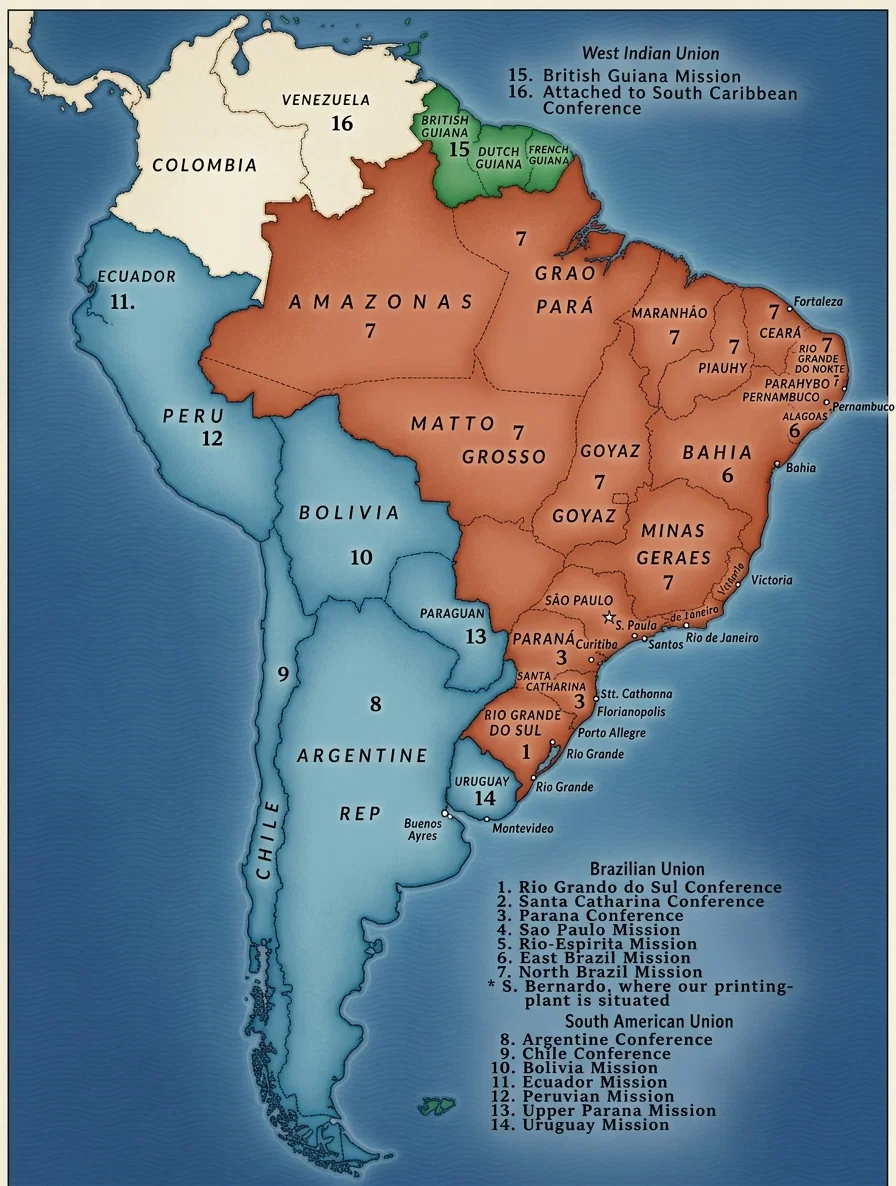
Brazil is now divided into seven unequal parts,—three conferences and four mission fields,—as shown on the accompanying map. The three conferences cover the three southern states,—Rio Grande do Sul, Santa Catharina, and Parana. One mission field takes in Sao Paulo; the other, Rio de Janeiro and Espiritu Santo; besides these, there are the Eastern and Northern Brazil missions. The three states, which form the three conferences, have, all told, a population of only a little more than two million, with a membership of 1,150; while the great mission fields, with a population of twenty millions, have about three hundred fifty members. By far the greatest number of the members are German settlers, who have formed large colonies in the more healthful southern states. As our workers become more proficient in the Portuguese, which is the native language, the Portuguese-speaking Sabbath-keepers increase in numbers.
West Indian Union
15. British Guiana Mission
16. Attached to South Caribbean
Conference

Brazilian Union
1. Rio Grande do Sul Conference
2. Santa Catharina Conference
3. Parana Conference
4. Sao Paulo Mission
5. Rio-Espirito Mission
6. East Brazil Mission
7. North Brazil Mission
* S. Bernardo, where our printing-
plant is situated

South American Union
8. Argentine Conference
9. Chile Conference
10. Bolivia Mission
11. Ecuador Mission
12. Peruvian Mission
13. Upper Parana Mission
14. Uruguay Mission
West Indian Union
  1. British Guiana Mission
  2. Attached to South Caribbean
Conference Brazilian Union
  1. Rio Grande do Sul Conference
  2. Santa Catharina Conference
  3. Parana Conference
  4. Sao Paulo Mission
  5. Rio-Espirito Mission
  6. East Brazil Mission
  7. North Brazil Mission
  8. S. Bernardo, where our printing-
plant is situated South American Union
  1. Argentine Conference
  2. Chile Conference
  3. Bolivia Mission
  4. Ecuador Mission
  5. Peruvian Mission
  6. Upper Parana Mission
  7. Uruguay Mission
All this immense field has at present no school, no medical work, and only a small publishing plant at Sao Bernardo, near Sao Paulo, a growing city of three hundred thousand. Our general meeting was appointed at Porto Alegre, in connection with the Rio Grande do Sul Conference, December 8-17. The workers’ meeting was to precede. Porto Alegre is a city of one hundred thousand, and one would expect good connections from there to any part of the republic; this, however, is not the case. Elder J. W. Westphal and I spent three days in traveling four hundred fifty miles from the Argentine border through the state of Rio Grande do Sul to Porto Alegre. The railroad belongs to a private company, and is narrow-gage. Though the state is comparatively well settled, one could see very few towns along the way, and only now and then some poor houses. When we reached Porto Alegre, Brother Westphal thought he had done very well to get through so quickly. Elder F. W. Spies, with all the rest of the workers from the north, was to be in Porto Alegre about the same time, on the steamer. But on account of the mutiny at Rio de Janeiro, the steamer was delayed several days. They were eight days on the way, and we were very happy when they arrived, on the eighth.
The camp was pitched on the outskirts of the city, and twenty-five tents were put up. The electric tramway led to the entrance of the camp. There were about two hundred persons in attendance; and when we organized the union conference, December 9, all the fields were represented by twenty delegates. The Sabbath was a good day, and quite a number professed Christ for the first time. The Lord blessed his people in uniting them not only as a union conference, but also with him. We had our regular committees appointed, and by Monday were able to select the officers, Elder Spies being unanimously chosen as president. Everything went off in perfect harmony; there was also some outside interest.
Elder W. Ehlers lives in Porto Alegre, and has quite a large dwelling, and in connection with it a good-sized assembly-room. As we began to consider this field, it was apparent to all present that it was most needy. As Elder C. F. Knott’s health was poor, we found that we had only four available men for the seven fields and the union, where there should have been at least eight.
The canvassing work also received some attention, but the population being so scattered, and the distances being so great, it presented many difficulties. On the other hand, we have only a very limited stock of Portuguese literature. Special attention will have to be given to develop such literature, as well as to strengthen the canvassing work; but we are sure that if the same active field work is done here as Brother M. Trummer is doing in Argentina, things will begin to move here also.
As my steamer was not to leave until the twenty-fourth, and the meeting was to close on the seventeenth, I thought I had time to stay till the close, and still reach Rio, which is not more than one thousand miles north. But in this I was disappointed. Fortunately, however, I caught a Brazilian-Lloyd steamer on the fourteenth, reached Rio Grande do Sul the evening of the fifteenth, changed to another steamer, and next morning we had the good fortune safely to cross the sand-bars. On Sabbath we lay at Santa Catharina, a pleasant island town of about forty thousand. Here I visited Sister Knott, who lives alone in that large town. The Sabbath-keepers are scattered throughout the state on the mainland.
On the twenty-first I embarked at Santos, the greatest export town for coffee in the world, and a very busy place. From here I found an excellent railway, operated by an English company. Though we had to make some fairly steep ascents to reach St. Bernardo, yet one could see that neither money nor skill had been spared to make a good road. Arriving at St. Bernardo, a town of five thousand population, I secured a carriage, and drove a mile out into the country, where our printing-office is located. Our brethren had purchased a small farm, in a hilly country, partly timbered; and here, in a good-sized building, they carry on their printing, folding, typesetting, bookkeeping, and shipping. They have invested twenty-five conto di reis (a conto varies from $350 to $500), one third of which is paid-up capital. Brother A. Pages looks after the business, and at the same time acts as union conference treasurer. He has a small dwelling-house on the place, while the other employees live near by. The location has been well chosen, as St. Bernardo is only about twenty miles from Sao Paulo, and has good railway connections, and a good road to the building. The plant is sufficiently large, and could do much more work; but there is a lack of men in the field. A monthly Portuguese paper of excellent quality is published, but altogether too small an edition. Only about one thousand copies a month are printed, and not nearly that number are circulated. Several small German papers are also published.
The following afternoon I spent in the city of Sao Paulo, which presents an excellent field for labor. This prosperous state, where we now have only a little over one hundred members, with its three and one-half millions of people, ought to have several strong workers. I believe that with some earnest work, we could soon have a conference there. From here, a night’s run on the train brought me to Rio de Janeiro. As the brethren expected me by steamer, no one was there to meet me; but I found my way to the steamship company, then to the post-office, and to the police,—to secure the permit to leave, as the city was still under martial law.
When I looked for the car to take me out into the suburbs, where Brother Spies lives, I found none answering the description given me; so I waited half an hour on one corner, then went over to the next. After I had stayed there a few minutes, a gentleman came up and looked at me closely. As he looked somewhat like an Adventist, I asked him in English whether he was looking for any one. To my surprise he answered, in French, “I am looking for a Mr. Conradi.” Brother Wilfart, our French Bible worker, who also speaks Portuguese well, had been searching for me at the steamer, and not finding me, was just ready to go away. Thus God’s providence brought to me the right man at the right time. As I rode out with him on the tram-car, I made up my mind that I would have had quite a difficult time to find the house without him. We afterward returned, and called upon the elder of the Rio church, a German tailor, and enjoyed his hospitality.
As we walked through the streets of that great city, and viewed its beautiful avenues and elaborate houses,—even palaces,—I said to myself: “What a work might be done if we had a few experienced city workers here!” But there is only one Bible worker besides Elder Spies, who has the care of that great union conference. There is a church of about twenty-five members, partly in Rio and partly on the other side of the bay. In Rio they meet at Brother Spies’s house, out in the suburbs. As it was Sabbath evening, we had a Bible study; there were only a few of us, but even then some of the children ran by and called us heretics, and tried to disturb the meeting.
Though Rio has the beautiful Monroe palace of peace, yet it is not all peace. As I viewed the barracks of the marines, recently laid in ruins, because the marines had opened fire on the city during the mutiny, and viewed some buildings in town which had been struck by the bullets, it surely looked like war, and even civil war. Toward noon, the German steamer “König Wilhelm II” steamed up the bay, and the same afternoon we pulled out, homeward bound.
On the twenty-sixth our steamer stopped in the beautiful bay of Bahia. This city of two hundred fifty thousand inhabitants lies in a semicircle about the bay. Many colored people live here, and Brother John Lipke has his headquarters here. It was very hot while we passed the equator. On the sixth of January, we reached Lisbon, where I found some mail, having waited two weeks without news from home. Elder C. E. Rentfro and some of the Portuguese workers met me there, and took me up to their new quarters in the central part of the city, where they showed me their recently rented meeting-hall. One of our French-Swiss workers has come to Elder Rentfro’s assistance, and is making good progress in the Portuguese, which is closely related to his mother tongue.
Later we touched at Vigo, Southampton, and Boulogne, and by the eleventh I was in Hamburg again, after an absence of three months. While the trip had been short, yet I had visited all the institutions of South America, had attended five general meetings at different places, assisted in the organization of the Brazilian Union Conference, attended two local conferences, and had also met all the leading workers of South America, except those of Peru and Ecuador. The South American field is one of promise, and it should have more help and our special prayers.
Hamburg.

Parana (Brazil) Conference

F. W. SPIES
The second annual session of the Parana Conference was held at Ponta Grossa, March 29 to April 2, 1911. The attendance was not very large, only about fifty being present; but this was almost one third of all the members of the conference. The conference being held at a place where we had but few people within reach, the attendance was, all things considered, a fair one.
Spiritually, the conference was big with blessing to all who attended; precious victories were gained, new consecrations made, and the general tenor of the testimonies given indicated that many had obtained a deeper insight into this work, and that all would go forth with renewed courage to fight the good fight of faith. A few who had grown tired of walking in this way were reclaimed. Taken all in all, the conference was certainly a good one.
The Parana Conference had been unfortunate in not having a president in the field during the last nine months, he having been engaged in editorial work. And even now, Elder J. G. Kroeker, who is also superintendent of the Sao Paulo Mission, was elected president, with the plan that he spend one half of his time in each field. We hope we may soon have additional men to take up the work in these needy conferences. At the present time the Santa Catharina Conference is likewise without a president.
Resolutions relating to the circulation of our literature, and the need of greater faithfulness in giving to the Lord his own in tithes and offerings, were fully discussed and heartily adopted. A resolution giving to the union conference the weekly offerings, and also several others aiming at unifying the work in the entire union conference, were discussed and adopted.
After five days of blessed meeting, during which unity prevailed in all transactions, the conference closed. Elder Kroeker holding credentials from the union, only missionary licenses were given at this meeting—to Theodor Newmann and George Wishral.
May the Lord richly bless all members of the Parana Conference during the ensuing year.

The School of Christ

THE student enters the school of Christ for three supreme things: To hear what Jesus says, or to master his teachings; to see what Jesus does, or to become familiar with his program; to learn what Jesus is, or to become acquainted with his personality. The student is then sent forth with a threefold task: To proclaim and interpret the Master's teaching to the world; to continue and fulfil the Master's purpose in the world; to reveal the Master's character to the world.—Selected.

The Gospel Is God’s Power

“The gospel . . . is the power of God unto salvation to every one that believeth.”

The Christian Mariner

Editorial

THE poems of hope and trust and of conflict and victory which the REVIEW pages have presented during these years of pilgrimage, have been no small contribution to the cause of the advent movement. This gift of song was not to be lacking in the believing host; for it was written, “The redeemed of the Lord shall return, and come with singing unto Zion.”
IN the REVIEW of March 5, 1867, we ran across the first poem contributed to our pages by Brother L. D. Santee, whose pen is still giving us lines that vibrate with the joy of journeyings of the advent people nearly over. Here is that first contribution:—

The Christian Mariner

Behold the dauntless mariner upon the sea of life! He battles with the elements amid the angry strife. When foes with hate surround him, and envy’s surges roar, Hope, like the faithful compass, points him to Canaan’s shore.
He’s out upon the ocean waste, the waves run mountain high, But his Leader’s gone before him and beckons to the sky. His eye with holy radiance glows, his bosom has no fears, As o’er the pathless ocean wide his way to heaven he steers.
He’ll enter soon the better land, he hails the dawning light; His hope is anchored in the veil, where hope is lost in sight. Farewell to storm and tempest now, farewell to woe and sin, The haven now he can descry, and soon he’ll enter in.
THE “blessed hope” never grows old. Those who started out in the early days, it is true, expected that the voyage would have ended ere this; and so it might have been, had the work been done. Yet, after all, the way has not been long, and the hope grows ever brighter as the signs that we are nearing the haven multiply on every side. Every beacon and landmark has appeared according to the chartered route of the advent people. Well may we sing for joy.

Christian Courtesy

THE church of God needs to keep before it continually its family relationship. We should be one in Christ, and must because one in Christ, one with one another. “For both he that sanctifieth and they who are sanctified are all of one: for which cause he is not ashamed to call them brethren, saying, I will declare thy name unto my brethren, in the midst of the church will I sing praise unto thee.”
It is only as this divine relationship is recognized, and the spirit which creates it is allowed to control in each individual heart, that there can be preserved in the church of God the bonds of peace and love. Each member of the church possesses an individuality of his own, a temperament peculiar to himself, characteristics which differentiate him from all his fellows. These are due to heredity, to environment, to education. Naturally these varying characteristics found in different members of the church are bound to clash unless they are subordinated to the one controlling Spirit, and unless there is maintained in each heart love for one another, and kindly consideration and courtesy for each and every member of the church.
The apostle Peter recognizes this both in the family and in church relationship: “Finally, be ye all of one mind, having compassion one of another, love as brethren, be pitiful, be courteous: not rendering evil for evil, or railing for railing: but contrariwise blessing; knowing that ye are thereunto called, that ye should inherit a blessing.” The church of God presents a sad picture to the world when it engages in strife and controversy. By such conduct it gives the lie to its holy profession, and denies the great truth of unity by which Christ says, “The world may know that thou hast sent me, and hast loved them as thou hast loved me.”
In worldly associations we see the spirit of good fellowship and kindly courtesy manifested from selfish considerations. We see men oftentimes contending over principles, arrayed on opposite sides of some great issue, members of opposing parties, and yet personally a warm fellowship oftentimes exists. If those engaged in the earthly conflict can manifest toward one another this spirit of fellowship and kindly courtesy from motives of policy or self-interest, how much more should the followers of Christ, whose purposes and work should be actuated from above.
In the history of the church and of the world we have now entered upon strenuous times. Sometimes even in the church of God we may be associated with unreasonable men and women. Our views may be opposed by our brethren. Others may employ methods and follow plans widely different from our own. This will require a constant exercise of kindness and courtesy. If we must differ from others as a matter of principle, let us be sure that the spirit of the Master, the spirit of truth, inspires the dissent on our part. The difference which engenders strife and discord and uncharitableness and harsh criticism of others is quite likely not to be a contention for vital truth.
In doing the work of Christ, we must speak first his words, and secondly we must speak his words in his spirit. The failure to do either will repel men rather than win them. It will embitter and never sweeten the hearts of our associates. Sometimes it is necessary for the disciple of the Lord to stand stiffly for truth, even as Paul of old contended for the faith delivered to the saints. In this there may be necessary plainness of speech, but let the plainness of speech be connected with humility of soul.
Sharp drives at an opponent never win him for the Lord. It is by the meekness and gentleness of Christ that the hearts of men are won to the gospel. Let us manifest toward all men kindly Christian courtesy. Whatever the occasion, whoever our opponent, however much in our estimation the cause of truth may be maligned, or our personal character attacked, let us be sure, in standing for the truth, that we do it in Christ’s way and not our own. All through his earthly ministry he dealt with unreasonable men. His pathway was beset by designing spies, who sought continually to entrap him in his words, that they might find occasion against him. All this oftentimes called for plainness of speech. Sometimes, as in the case of the Pharisees and of the cities which rejected his marvelous work, words of denunciation were uttered, yet these were never spoken in anger. While condemning the sin, his heart went out in yearning and pitying tenderness for the sinner; he withstood the evil principle, but sought to draw to himself the men who upheld it.
We need to-day, in the message we are carrying to the world, and in our church relationship, to distinguish between men and principles, between the sin and the sinner who holds it. Christ is our pattern; he is the divine example for every pupil in the school of Christ. Let us see that in our own relationship to all men we correctly represent his character in the words we utter, the sentiments we express, and the spirit which inspires the utterance. Let us preach the word plainly, faithfully, uncompromisingly; but let us preach it in the spirit of the One whose gospel it is, the spirit of our divine Master.
F. M. W.
Continue reading: The Key-Note of the Gospel