INTERESTING things are taking place in the country of Luther. Between 1872 and 1880, a movement, similar to that now going on in France, was being carried through with an iron hand by the "iron chancellor," Bismarck. In order to stem the inroads of Romanism, a series of laws called the "May Laws" was passed by the Reichstag. Most of the Catholic orders, if not all, were expelled from the country, and the free expansion of Catholicism was checked by many legal difficulties.
In the heat of the debates in the Reichstag, Bismarck used to say that he was not "going to Canossa," making allusion to King Henry IV., of the days of Hildebrand. Not long after that, however, Bismarck did go to Canossa. He made terms with the Papacy, and caused the "May Laws" to be partially abrogated. The reason of this backward movement was that the "Center," or Catholic, party in the Reichstag was fiercely opposed to the government's military plans, and could only be brought to terms by order of the pope. Bismarck secured this result at the price mentioned.
The "Center" thus learned to appreciate its power, and has been making use of it ever since, by offering its help to the government when in difficulty, and receiving pay for each service rendered, in the form of favors for the Catholic Church.
Herr von Bülow, the present prime minister, has thought it proper to follow the example of his famous predecessor, and makes the "Center" his first and last resort when he has a scheme to carry through, making, in return, almost any concession to the Catholic party. This policy has been enthusiastically adopted by the emperor, who has repeatedly gone to Rome to visit the pope, and whose last visit was, as many remember, a very pompous affair.
The Emperor No Longer Master.
But it now happens that the "Center's" influence has grown to such proportions that neither Herr von Bülow nor William II. is master of the situation any more. Not only have the religious orders re-entered Germany, but, some months ago, after a long struggle, the "Center" succeeded in obtaining the repeal of a famous paragraph in the "May Laws," which forbade the entrance of the Jesuits into Germany. And now the "fathers" are again making Germany their field of operations.
In some of the public schools, the ceremonies of the Catholic Church have been made compulsory. A Catholic theological school has been opened at Strasburg, and generously endowed by the government, a thing which is not done for Protestant seminaries and theological schools. A Protestant minister was imprisoned for preaching against purgatory, while a Catholic bishop was allowed to curse a cemetery in which a Protestant had been buried. Any slanderous libel may be preached or printed against the lives of the Reformers, while books, tracts, and papers touching on the character of the "beast," or of "Babylon," are apt to be taken up and their circulation restricted, or even forbidden.
A Law Against Religious Liberty.
In 1900, the "Center" presented to the Reichstag a bill called, "A National Law Concerning the Freedom of Religious Practise;" also entitled, "Toleration Bill." The first part of the bill was adopted, while the second part, meeting with too great opposition, was withdrawn by the "Center" party itself, and kept for better days.
Think of it! the Catholic party, in the year of grace 1900 favoring the country of Luther with a law on religious liberty! Is not this a strange sign of the times? But let us look at this wonderful law:
Article I., of Part First, reads as follows: "Every citizen, living within the limits of the kingdom, shall be entirely free to profess his religion, to join any [[FIGURE]] religious body, and to perform his home or public religious duties."
Attention is called to the fact that, while Prussia, Saxony, Bavaria, Baden, and Württemberg grant "perfect freedom of conscience and belief," or "freedom of thought and conscience," and that since 1849 this new "Toleration Bill" knows only "freedom of religious profession" (bekenntnis). Why?—Because the Church of Rome denies "freedom of thought and conscience," and is satisfied with outward profession, since worshiping in spirit implies freedom of thought.
Article II. says, among other things, "After completing its 12th year, a child shall be free to choose his religious profession."
This is rather an early age for a child to be allowed to be snatched away from parental teaching and influence in religious matters. In France, in 1681, a law was passed which granted children seven years of age the right to pass over to the Catholic faith, while the reverse was forbidden even to grown people.
The Reformation Ruled Out.
That is the law with which the German nation is scourged since 1900. And now here is Part Second of the same, for the re-introduction of which the time seems to have come, since it is again before the Reichstag:
Article IX. "Religious bodies which are recognized by one of the states of the confederacy, shall enjoy, within the limits of the kingdom, the free and public performance (ausübung) of their cult."
Part First of this remarkable law completely ignores freedom of conscience. Part Second grants "freedom" in the "performance" of "cult," and that only to "recognized religious bodies!" Wonderful, is it not? Under such a law, Luther and the Reformation would never have had a chance. This all seems like a dream, and one wonders whether Protestantism is dead in Germany.
A section of the same article grants "recognized bodies" the right of erecting churches, provided with belfrys and bells, without first obtaining any license from the state or city council.
Article X. claims the right for the above bodies of communicating with their religious chiefs without hindrance. By-laws and regulations of said bodies shall be binding, without any special authorization from state authorities.
Article XI. claims for the above bodies the untrammeled right of employing foreign agents for performing spiritual duties.
Article XII. grants "recognized bodies" full freedom of performing baptism, religious marriage, and burial.
Article XIII. claims liberty of carrying on "missions" (or special revival services).
Article XIV. claims full liberty for orders, societies, and clubs belonging to "recognized bodies" to organize and carry on their work.
Limitation of Religious Liberty.
Thus it is seen that the simplest liberties are claimed only for such "bodies" as are "recognized" by the state. Wide-awake German Protestants see in the provisions of this law a door open for introducing Catholic processions on the streets—which are already a fact in the Rhenish provinces—an unlimited number of monks and nuns, and no end of Catholic churches, schools, and monasteries. In a word, they see in this law the entering wedge of papal supremacy in Germany. Hence, they endeavor to fight its passage with all their might.
It must be granted that these Catholic laws on liberty have a twofold aim: (1) Conquering complete liberty of action for the hierarchy in Germany; (2) closing the door to all new religious bodies which might come up to call out of sleep the old Lutheran churches, now petrified by rationalism, higher criticism, and worldliness.
Full liberty for Roman Catholicism is not what Germany need fear most. Her greatest danger lies in scientific unbelief in the Word of God—unbelief7in which German theologians have been the leaders in the Protestant world for a hundred years. This nefarious teaching has sown a crop of spiritual death, from which Rome is now ready to reap a harvest.
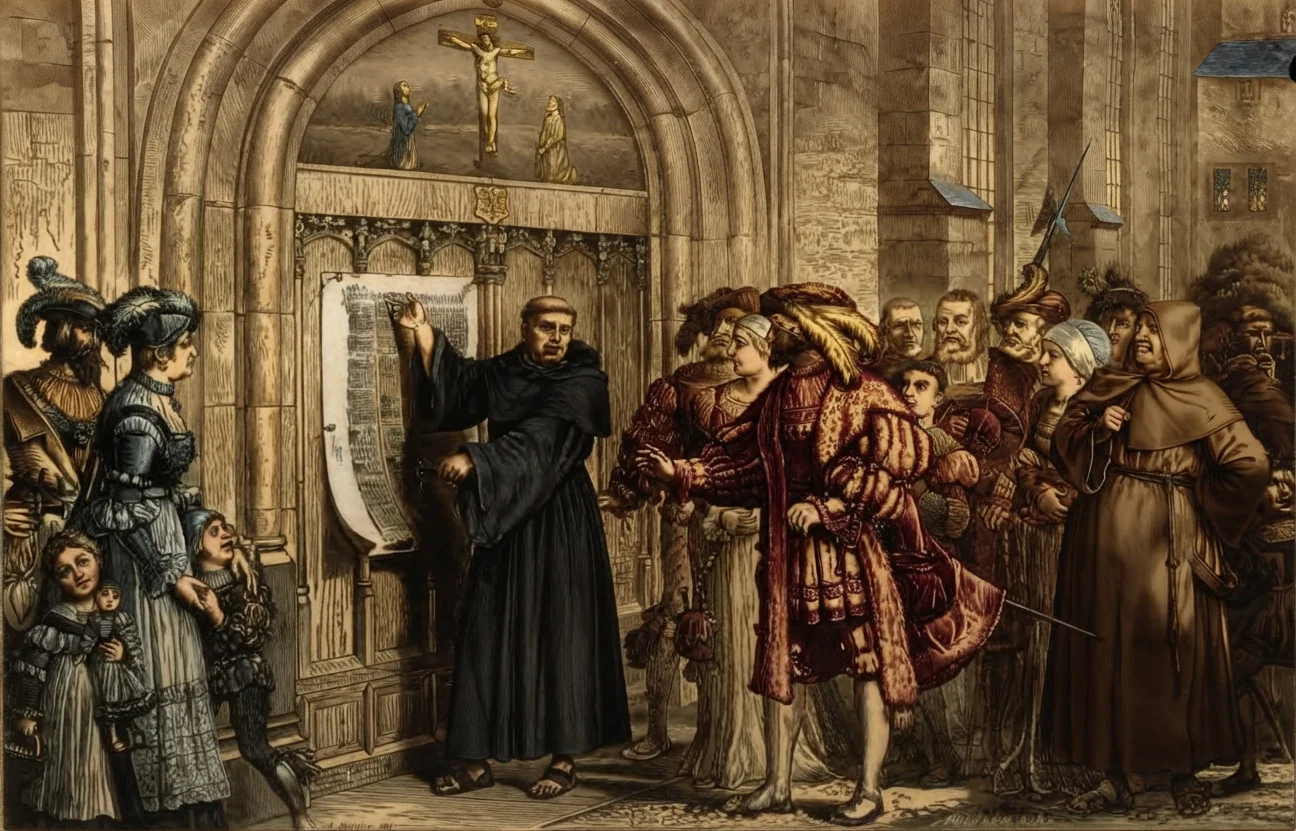
Luther Nailing Up His Famous Theses on the Door of Wittenberg Chapel.
Sunday Enforcement and Moral Decadence.
By Editor
From a preamble to certain resolutions adopted at a recent conference of the Northwest Sabbath Association, we take this expression:
It is inconceivable that our Republic could have grown to its present proportions and commanding position among the nations of the earth without the sabbath. The day has entered into every part of our national fabric, given integrity to the morals of our people," etc.
The reference to the "Sabbath" here signifies the first day of the week, the usurper sabbath. Then we may logically infer that the deteriorating morals in this country are due to the growing efforts to enforce upon the people the observance of this institution that has so affected the "national fabric" and the "morals" of the people. It was just so in other times; the faithful observance of the Lord's Sabbath, "according to the commandment," was a guaranty of temporal and spiritual prosperity (Isa. 56:1-7; 58:13, 14). But when Israel departed from the Sabbath, and went into idolatry—which means that they observed the solar holiday (Sunday) of the heathen, they became "worse than the heathen." Such was the influence on their "morals" and "national fabric." It is fair to reason, therefore, that the corruptions permeating every phase of our national life—political, financial, social, industrial, and religious—is because men have rejected the Sabbath of the Lord, and are more and more determined to honor the man-made substitute. More and more, men are putting on a cloak of religion to cover all kinds of treachery (2 Tim. 3:1-7), and this cloak is mainly manifest in some kind of Sunday recognition, principally in some kind of Sunday law.
THE WAR IN THE EAST.
THERE have been only minor engagements between the great armies operating in Northern Manchuria during the past week. The Russian rear-guard has been resisting the advance of the Japanese; but the latter seem not to have been pressing the pursuit with great vigor. Railroad bridges, and others as well, have been destroyed by the Russians for the purpose of impeding the progress of the Japanese. It is reported that the latter are engaged in extensive flanking movements on both sides of the Russian line of retreat. The Russian rear-guard has fortified a position about seventy-miles north of Tie Pass. The Russians are also strengthening the defenses of Kirin and Harbin; but, with the great losses which they have suffered in men and provisions and munitions of war, it is not thought they will be able to make a successful resistance to the Japanese advance even at the latter-named places.
There is much talk in Europe of peace propositions; but there is yet nothing to indicate that the czar has determined to abandon the war and sue for peace. The immense indemnity which Japan will demand is the principal obstacle to peace negotiations at the present time. With that indemnity, Japan could build a mighty navy that would make her mistress of oriental waters; but with the sum she would have to pay, Russia could rehabilitate her own navy.
The Russian War Office has given out figures which show that more than 700,000 men have been sent to the front by the Russian Government; but she is compelled to admit that more than 400,000 of these are now lost to her through deaths, sickness, wounds, and capture by the Japanese. The railroad is at the present time handling all the freight and soldiers it can carry, and therefore Russia's purpose to send to the front another 400,000 men looks like an impossible undertaking. The talk of another mobilization is causing very strong opposition to be manifest on the part of the Russian people, and disorders are increasing.
AS MIGHT BE EXPECTED.
By G.
THE National Reform organ, published at Pittsburg, tells us that "a corrupt oligarchy is ruling Pennsylvania." Then it gives some details of the manner in which the "corrupt oligarchy," through a few leading spirits in both houses of the Legislature, manage to control the people's representatives, and thus control the state.
Now Pennsylvania has had on the statute books, for more than a hundred years, a Sunday law than which none in the union is more stringent. Pennsylvania is also the home of the National Reform Association, one of whose special aims has been Sunday-law enforcement. Here we have a striking illustration of the fact that stringent Sunday laws and their persistent enforcement do not beget honesty in state government.
It also illustrates that Sunday closing does not beget temperance sentiment; for the organ above quoted cites the assurance of the "oligarchy" that controls the state, that "no local option bill will be allowed to pass at this session." And this assurance was so sure, that a fund of $800,000, raised by the liquor interest to defeat a local option measure, was deemed unnecessary for that purpose, and was transferred to another political fund. The people's representatives didn't need to be bought on the score of defeating local option.
Nor is such a condition strange in a state where the professed Christian people extensively encourage a system of political "reform" by means of enforced religious dogma. Altho this principle is upheld by professed Protestants, it is the leading polity of Rome, and never can succeed in bringing about either moral or political reform. Both Romanists and professed Protestants have demonstrated this problem over and over in many countries. It is high time that a professedly progressive people should have the lesson well learned. The condition complained of by our National Reform contemporary is not at all surprising; the surprise is, that such medieval methods of "reform" should still be pursued under the guise of Christianity at this late date.
G.
"INFIDEL AS INGERSOLL WAS."
By Editor
Verdict of a Secular Paper.
WE are surprised that any one is surprised at the recent utterance of Dr. Abbott: "My God is a good and ever-present force." The New York Sun comments thus: "That is, he has become a pantheist. If any newspaper is surprised by this confession it must be ignorant of the outgivings of Dr. Abbott, and of the School of Theology to which he belongs, for a long time past, or be incapable of drawing an obvious logical conclusion. The new theology has given up the dogmatic premises of the old theology, and, according to past religious standards, it is wholly heretical. Measured by those tests, it is as infidel as was Ingersoll himself, the difference being rather in form of statement than in substance of thought. Ought such a man to be occupying the pulpit of a Christian church founded on belief in a 'Great First Cause' and on belief in the fact of the Incarnation and in something more than 'mere energy,' even if it be 'intelligent energy'?" And yet, Dr. Abbott is a constant preacher at Wellesley and other so-called Christian colleges! Many ministers still follow him. We wonder what the president of Brown University now thinks of his "patron and leader!"
Well, there always have been freaks, fools, and men of erratic wobblings, and they will not grow less toward the end of this wicked age. God lives, and His Word is true from its first sentence to its closing Amen.—Watchword and Truth.
LITERARY NOTICES.
By Editor
"The Encyclopedia of Missions. Descriptive, Historical, Biographical, Statistical." Second edition. Edited under the auspices of the Bureau of Missions by Rev. Henry Otis Dwight, LL.D., Rev. H. Allen Tupper, Jr., D.D., and Rev. Edwin Munsell Bliss, D.D. 870 pages; cloth, $6.00, net; carriage, 50 cents. Funk & Wagnalls Co., New York and London.
The voluminous contents include: (1) The most recent advance in the missionary occupation of the world; (2) the development of older fields; (3) the development of missionary methods; (4) biographical notes; (5) an exhaustive list of missionaries of all nations who have translated the Bible into heathen languages; (6) a complete directory of missionary societies, with post-office addresses; (7) tables of interesting and valuable statistics, etc. The work is especially useful to students of missionary enterprise, to ministers, editors, and teachers, in fact, to all who are interested in the spread of the Gospel. It is a splendid supplement to secular encyclopedias, which give so little of the religious movements of a country, movements which in so many instances are of preeminent importance. This work should be in every up-to-date library. It is inspiring in giving the barest facts of what the soldiers of the cross have done. The list of scripture translations, in some cases marking the very beginning of a systematic language among tribes, is a valuable addition.
"Self-Healing through Suggestion." By Henry Harrison Brown, San Francisco, Cal. Paper cover, 61 pages, price, 25 cents.
Like all exponents of a heathen philosophy, this book opens with a declaration that contradicts the Word of God, and would nullify the Gospel work. "Health," the author says, "is the normal physical condition." That would be true if there were no sin and none of the fruits of sin in the world to-day; but as these things do exist, and in ever-increasing quantity, the statement is not true. There is not in the world to-day a perfectly healthy specimen of the human race. The blight and canker of sin are visible in every land. The author of this book holds the human mind responsible for all the disease of the race. So he would cure all diseases by teaching the diseased person to declare he has no disease about him. He would go still farther and have the person declare that he has within himself all power; that he has within himself the very source of life; that he is all God is—in short, that man is God. It is the repetition of the tempter's lie in Eden—"Ye shall be as gods." "Get thee behind me, Satan."
(Continued on page 13).
Immigration, Plague, and Santo Domingo
A great increase in immigration is reported from the port of New York. In three days, March 20, 21, and 22, 16,000 immigrants landed at Ellis Island. It is feared that the capacity of this immigrant station will not be large enough to accommodate the large numbers of aliens that are booked to arrive in the coming weeks. All vessels arriving are crowded with this class of passengers, and extra vessels are being put into the service for accommodating these passengers. Over 7,000 Russian Hebrews have reached New York since the first of March; but the greater number are from Italy, Austria, and Hungary.
Mr. Broderick, Secretary of State for India, replying to a question in the House of Commons on March 23, stated that the number of persons who have died in India of the bubonic plague since January 1, of this year, amounts to 318,178. Notwithstanding the terrible ravages of this disease during this short time, very little has been said concerning it. A commission has been appointed to inquire into the causes for the fresh outbreak of this epidemic, and the commission will start for its field of operations immediately.
Foreign nations whose subjects have business dealings with the people of Santo Domingo, are pressing the government of Santo Domingo for an immediate settlement of claims. This comes as a result of the refusal of the Senate to approve the treaty prepared with the State Department, by virtue of which the United States was to assume what would have been practically a protectorate over Santo Domingo.
Germany has served imperative notice upon the Turkish Government that it must make no more purchases of arms and ammunitions from France. Both France and Turkey resent this interference which was accompanied by threats on the part of Germany; and the French ambassador continues the negotiations to secure the order.
The great basin known as the Salton Sink, in the southern part of California, is being turned once more into a great lake, through seepages from subterranean sources, and bids fair to rival the Great Salt Lake. Immense quantities of salt have been taken from this dry salt lake every year for many years past.
As an answer to England's operations in Tibet, Russia is said to be sending a strong force to the vicinity of the northern Indian border. Fifty-six military trains have arrived at Tashkent within two months. There is reported to be much military activity in this locality.
The government investigation into the operations of the great beef trust at Chicago, is now under way. Scores of persons have volunteered to give testimony in the case—so many, in fact, that the investigators will be able to hear only a portion of the testimony.
As a reply to Russia's action in concentrating troops in the vicinity of the Indian frontier, England is putting the Indian police on such a footing that they will be able to control the situation and release the Indian troops for service in India's defense.
The threat of Venezuela to cut the French cable has not been carried out, as President Castro had been warned that serious consequences would follow such an act.
Nebraska has passed a law designed to prohibit the practise of Christian Science doctors.
EVOLUTION AND GEOLOGY
By George McCready Price
XVIII. EXTINCT SPECIES.
(Continued.)
ZITTEL gives us a peep behind the scenes which helps us somewhat to understand the matter of extinct species. He pictures the uncritical work of the earlier writers on Paleophytology, or the science of fossil plants, how—
many of the fossil genera and species had been based on insufficient grounds of distinction, and how often miserably-preserved fossil remains, whose identification was impossible, had been used for the erection of new genera or made the basis of some wonderful new hypothesis. Many of the special papers on fossil plants had been contributed by authors with insufficient botanical training, and were in consequence an untrustworthy foundation for an inductive reasoning regarding the past periods of vegetation and their climatic conditions.—History of Geology, p. 373.
A Vital Deficiency.
But August Schink, late Professor of Botany in Leipzig (1868-91), by more critical methods, "practically initiated a reform in paleophytology;" and Zittel declares that "now, the author of a paper on any department of paleophytology is expected to have a sound knowledge of systematic botany."—Id. p. 375.
And he adds: "It can not be said that paleozoology [the science of fossil animals] has yet arrived at this desirable standpoint."
But he justifies this charge of want of confidence by saying that—
Comparatively few individuals have such a thorough grasp of zoological and geological knowledge as to enable them to treat paleontological researches worthily, and there has accumulated a dead weight of stratigraphical-paleontological literature wherein the fossil remains of animals are named and pigeonholed solely as an additional ticket of the age of a rock-deposit, with a wilful disregard of the much more difficult problem of their relationships in the long chain of existence.
The terminology which has been introduced in the innumerable monographs of special fossil faunas in the majority of cases makes only the slenderest pretext of any connection with recent systematic zoology; if there is a difficulty, then stratigraphical arguments are made the basis of a solution. Zoological students are, as a rule, too actively engaged and keenly interested in building up new observations to attempt to spell through the arbitrary paleontological conclusions arrived at by many stratigraphers, or to revive their laborers from a zoological point of view.—Id. pp. 375-76. Italics supplied.
This scathing impeachment of the trustworthiness of the current specific and generic distinctions established for the fossil animals, has no doubt a special reference to the case of the lower forms of life. For if, in spite of the masterly, and withal careful, work of Cuvier, Owen, Wallace, Huxley, and Ray Lankester, there are still grounds for such grave doubts of the values of specific distinctions in the case of the mammals, whose general structure and life-history* are so well known and their almost countless examples of variation so well studied out, what must it be in the case of the lower vertebrates, and especially of the invertebrates, whose general life-history is in so many instances only dimly understood, and the limits of their variations absolutely unknown? Remembering this, what is our amazement when we read in this same volume by Professor Zittel that the modern tendency is toward the erection of the closest possible distinctions between genera and species, until recent paleontological literature is fairly inundated with new names; and all this with—
The Purpose, Unblushingly Avowed,
of enhancing the value of such distinctions as a means of determining the relative ages of strata and to bring the autogenetic and phylogenetic development of the various forms into more apparent agreement. I do not exaggerate in the least. Zittel is here speaking about Brachiopods:
Whereas Davidson in his systematic treatment allowed for a considerable extent of variability in his definitions of genera and species, the new direction of research guided by Hall, Clarke, Beecher in North America, and by Waager and Bittner in Europe, tries to restrict generic and specific definitions within the narrowest possible limits, in order to enhance the value of fossil Brachiopods for the characterization of stratigraphical horizons. A systematic review of all known Brachiopods forms an introductory chapter in the comprehensive monograph of Paleozoic types which has been published by Hall and Clarke. The number of genera has been greatly increased, and in many cases species have been elevated to the rank of genera. A new classification was proposed in 1889 by Beecher, in which it has been the author's aim to bring the autogenetic and phylogenetic development of the group into more apparent correspondence, and to apply the differences in the beak region more often for systematic distinctions.—"History of Geology and Paleontology," p. 400.
Deductions Unscientific and Illogical.
I hope my readers will have the perseverance to "spell through" this rather technical quotation, solely for the purpose of seeing the scientific (?) character of the reasoning involved. For it is surely a case of first assuming your premises, and then proving them by means of your conclusion. The method employed seems about like this: First, assume the succession of life from the low to the high as a whole; then, in any particular group, as in this one of Brachiopods, decide the momentous question as to which came first and which later in "geological time" by comparing them as to size, shape, etc., with the live modern individual in its development from the egg to maturity; and lastly take the results of this arrangement in supposed chronological succession to prove just how the modern forms have evolved.
On pages 403 and 405 of Zittel's "History" will be found similar statements about the Mollusca; and tho Zittel himself plainly does not approve of these methods, there is no doubt that the practise referred to in his quotation is quite general throughout modern paleontological literature. But I can only look upon the whole thing as a most fearful example of intelligent men being hypnotized by their theory into blind obedience to its suggestions and necessities.
A Candid Admission.
Not long ago I had occasion to write to a well-known geologist about a Lower Cambrian mollusk which appears strikingly like a modern species. I give below an extract from his reply which bears directly upon this point. I withhold the name, for it was given in a half-confidential manner, but I may say that the author's work on the Paleozoic fossils is recognized on both sides of the Atlantic.
Some geologists make it a point to give a new name to all forms found in the Paleozoic rocks, i. e., a name different from those of modern species. I was taken to task by a noted Paleontologist for finding a pupa [a kind of land-snail] in Devonian beds; but I could not find any point in which it differed from the modern genus (? species). Yet if I could have had more perfect specimens I might have found differences.
Such disclosures speak volumes for those able to understand, and lead one to receive with a smile the familiar assertion that all the species of the Paleozoic and other "older" rocks are extinct. And we can now form a truer estimate of the high scientific accuracy of Lyell's ingenious division of the Tertiary beds according to their contained percentages of living or extinct Mollusks. But O, "Tell it not in Gath!"9
Discoveries That Disprove Geological Hypotheses.
Going back now to our main subject in this series of articles on Geology which was a denial of the reality of a life-succession and of the "ages" of the common text-books, we must bear in mind that the present classification of the fossils was outlined in all its general details when little or nothing was known of the contents of the depths of the ocean, or even of the land forms of Africa, Australia, and other foreign countries. On pp. 128-137 of his "History," Zittel shows how, up to 1820, little or nothing of a scientific character was known of any of the classes of living animals save mammals. I need not go into this subject at length, but it may suffice to say that during the last half century or more a steady progress of discovery has resulted in showing case after case where families and genera long boldly said to have been extinct since "Paleozoic time" are found in thriving abundance and in little-altered condition in unsuspected places all over the world. Nor need I here dwell on the obvious absurdity of these inhabitants of the modern seas and the modern land, skipping all the uncounted millions of years from "Paleozoic times" down to the "recent," for, tho found in profuse abundance in these "older" rocks, not a trace of many of them is to be found in all the "subsequent" deposits. About this, too, I may have something more to say sometime. I wish only to reiterate here that the traditional arrangement of the fossils in single file, and the association of a time value with their "successive appearances" when thus arranged, was invented when little or nothing was known of the rocks outside of England and Germany, and in complete ignorance of some of the most important facts concerning the fossil and the living forms, just as Zittel says that the theories of the igneous origin of the crystalline rocks "had been laid without the assistance of chemistry" and the knowledge of the microscopic structure of these rocks.—"History of Geology," pp. 327, 341. All of which reminds us of the old tale of the three little green peas in the little green pod, who, noticing that their little world was all green, and they themselves green also, shrewdly concluded that the whole universe must be green likewise.
Some Fundamental Facts.
To sum the matter up in a few short sentences, I may say that the popular doctrine that life has occurred on our globe in a certain order of development originated in ignorance or a disregard of the following fundamental facts, the first four of which I ask pardon for repeating from previous articles so that my readers may have them here together:
1. The "broad fact" as stated by Zittel that any kind of rocks whatever, i. e., containing any kinds of fossils, may rest on the Archean, or may themselves be metamorphosed and crystalline.
2. That any kind of beds may rest in such perfect conformability on any other so-called "older" beds over vast stretches of country that "were it not for fossil evidence one would naturally suppose that a single formation was being dealt with," while "the vast interval of time" intervening is "unrepresented either by deposition or erosion."
3. That in very many cases and over many square miles of country these conditions are exactly reversed, and such very "ancient" rocks as Cambrian limestones occur on top of the comparatively "young" Cretaceous, while the line between them "acts exactly like the line of contact of two nearly horizontal formations," and in a natural section cut out by a river, the two "appear to succeed one another conformably."
4. That many of the rivers of the world in working across the country completely ignore the varying ages of the rocks in the different parts of their channels, and act precisely as if they began sawing at them all at the same time.
5. That very, very many, perhaps a large proportion of the forms of the so-called "older" rocks, long regarded as extinct, are alive and thriving to-day in our modern world.
6. Hence, since no one kind of fossil can possibly be proved to be intrinsically older than any other kind, it follows that no one kind of fossil life can be proved to be older than man himself. Therefore man himself must have been an unwilling spectator of cosmic changes of climate and of the position of the land and the water which could only have occurred to him as an awful watery catastrophe—the scientific complement of the Biblical Deluge.
However, when I charge this life-succession idea with being an unscientific fancy unworthy of a moment's consideration by reasoning beings, I do not at all mean that the present orderly arrangement of the fossils should be disarranged or set aside. We can, I think, work with and speak of these fossil forms without being in any way biased by the traditional age-values so long associated with them. Let the arrangement in customary order stand by all means. It is a well-nigh perfect taxonomic or classification series of that ancient world which has long vanished from the sight of man, and which lives now only in scattered traditional memories and in the Inspired Record of what man once enjoyed of nature's glory and beauty. Let it stand by all means, for it will be indispensable in the reconstruction of the science of Geology on a truly scientific, because inductive, basis, by which reconstruction we may hope to reproduce a more or less faithful picture of that marvelous world which man once beheld, but whose ruins now lie buried thousands of feet deep beneath our feet.
(Concluded next week.)
THE GIFT OF SPEECH.
By Ellen G. White
BY MRS. E. G. WHITE.
SPEECH is one of the great gifts of God. It is the means by which the thoughts of the heart are communicated. It is with the tongue that we offer prayer and praise to God. With the tongue we convince and persuade. With the tongue we comfort and bless, soothing the bruised, wounded soul. With the tongue we may make known the wonders of the grace of God. With the tongue also we may utter perverse things, speaking words that sting like an adder.
The tongue is a little member, but the words it frames have great power. The Lord declares, “The tongue can no man tame.” It has set nation against nation, and has caused war and bloodshed. Words have kindled fires that have been hard to quench. They have also brought joy and gladness to many hearts. And when words are spoken because God says, “Speak unto them My words,” they often cause sorrow unto repentance.
Of the unsanctified tongue the apostle James writes: “The tongue is a fire, a world of iniquity; so is the tongue among our members, that it defileth the whole body, and setteth on fire the course of nature; and it is set on fire of hell.” Satan puts into the mind thoughts which the Christian should never utter. The scornful retort, the bitter passionate utterance, the cruel, suspicious charge, are from him. How many words are spoken that do only harm to those who utter them and to those who hear. Hard words beat upon the heart, awakening to life its worst passions. Those who do evil with their tongues, who sow discord by selfish, jealous words, grieve the Holy Spirit; for they are working at cross-purposes with God.
The apostle, seeing the inclination to abuse the gift of speech, gives direction concerning its use. “Let no corrupt communication proceed out of your mouth,” he says, “but that which is good to the use of edifying.” The word “corrupt” means here any word that would make an impression detrimental to holy principles and undefiled religion, any communication that would eclipse the view of Christ, and blot from the mind true sympathy and love. It includes impure hints, which unless instantly resisted, lead to great sin. Upon every one is laid the duty of barring the way against corrupt communications.
It is God’s purpose that the glory of Christ shall appear in His children. In all His teaching, Christ presented pure, unadulterated principles. He did no sin, neither was guile found in His mouth. Constantly there flowed from His lips holy, ennobling truths. He spoke as never man spoke, with a pathos that touched the heart. He was filled with holy wrath as He saw the Jewish leaders teaching for doctrines the commandments of men, and He spoke to them with the authority of true greatness. With terrible power He denounced all artful intrigue, all dishonest practises. He cleansed the temple from its pollution, as He desires to cleanse our hearts from everything bearing any resemblance of fraud. The truth never languished on His lips. With fearlessness He exposed the hypocrisy of priest and ruler, Pharisee and Sadducee.
Guard well the talent of speech; for it is a mighty power for evil as well as for good. You can not be too careful of what you say; for the words you utter show what power is controlling the heart. If Christ rules there, your words will reveal the beauty, purity, and fragrance of a character moulded and fashioned by His will. But if you are under the guidance of the enemy of all good, your words will echo his sentiments.
The great responsibility bound up in the use of the gift of speech is plainly made known by the Word of God. “By thy words thou shalt be justified, and by thy words thou shalt be condemned,” Christ declared. And the psalmist asks, “Lord, who shall abide in Thy tabernacle? who shall dwell in Thy holy hill?—He that walketh uprightly, and worketh righteousness, and speaketh the truth in his heart. He that backbiteth not with his tongue, nor doeth evil to his neighbor, nor taketh up a reproach against his neighbor. In whose eyes a vile person is contemned; but he honoreth them that fear the Lord. He that sweareth to his own hurt, and changeth not. He that putteth not out his money to usury, nor taketh a reward against the innocent. He that doeth these things shall never be moved.”
“Keep thy tongue from evil, and thy lips from speaking guile.” The wild beast of the forest may be tamed, “but the tongue can no man tame.” Only through Christ can we gain the victory over the desire to speak hasty, unchristlike words. When in His strength we refuse to give utterance to Satan’s suggestions, the plant of bitterness in our hearts withers and dies. The Holy Spirit can make the tongue a savor of life unto life.