V. God’s Word Twice Written in Prophecy and Fulfilment.—No. 1
The great part of the Scriptures of truth are prophetic in the broad meaning of the term. The term “prophecy” itself is defined as a prediction made under divine influence and direction; discourses delivered under divine inspiration or direction; something uttered by a teacher as the representative of God and for God. Sometimes it refers to a book of prophecies, as the prophecy of Ezekiel. We are using the term, however, in this article, as “a prediction made under divine influence and direction,”—future events foretold by the Spirit of God. Perhaps in no other way does God’s word witness to His divinity and its own inspiration as through prophecy. The prophetic portion of God’s word gives in advance the history of the world, of nations, of peoples, of cities, of individuals. It is God telling beforehand just what will be. When the time comes for its fulfilment, God in His overruling providence writes it again in nations, in events, in men; that all who know His prophecy may read again His word, may shun the dangers, and may find in Him salvation.
In the 2d chapter of Daniel, the God of heaven is set over against the gods that were worshiped by the Babylonians, with the characteristic that He is the revealing God. “He revealeth the deep and secret things: He knoweth what is in the darkness, and the light dwelleth with Him.” Verse 22. Again: “He that revealeth secrets hath made known to thee what shall come to pass.” Verse 29. By the prophet Amos it is declared, “Surely the Lord Jehovah will do nothing, except He reveal His secret unto His servants the prophets.” Amos 3:7. And by one of the mighty apostles we are told that “we have the word of prophecy made more sure; whereunto ye do well that ye take heed, as unto a lamp shining in a dark place, until the day dawn, and the day-star arise in your hearts.”
As this series of articles will deal in the future with some of the great prophecies of the Word, we will touch upon a few incidents which will not fall within the general purview of those articles, as strong and material evidence that the word of God is true. The first of these which we will take is—
The Jews
The story goes that when the skeptical Frederick the Great of Germany asked his court preacher, in a sneering kind of way, what particular evidence he had that the Bible was true, the answer of the preacher was both laconic and conclusive,—“Sire, the Jews.”
The Jews, or Hebrews, are the people that God chose through whom to reveal His great truth to the world, a nation which in a great deal of its history was apostate. Very many of the scriptures which have been preserved to us so carefully and faithfully, and particularly through them, were prophecies which condemned them, bore witness against their conduct, and pointed out an unenviable doom. The fact that, notwithstanding all this, they preserved them so carefully, was evidence of this, at least,—that they believed them to be of higher source than humanity. One of the great prophecies concerning their career is found in the 26th chapter of Leviticus, another in the 28th chapter of Deuteronomy. They are told in these chapters that if they would walk in God’s statutes, and keep His commandments, be submissive and obedient to Him in every way, willing to be led by Him and taught by Him, He would make them the head, and not the tail. They would lie down in peace, and none should make them afraid. Five should chase a hundred, and a hundred should chase ten thousand, and they would be fruitful and multiply. How true this was in the days of David and Solomon, and in a measure with one or two later kings!
They were told also that if they departed from God and would not hearken to Him, but rejected His statutes and His ordinances, He would appoint over them terror, consumption, and fever. They would be scattered among the nations; the sword would be drawn out after them; their land should be a desolation and their cities should be a waste; a faintness and a fear would possess them; the sound of a driven leaf should chase them; their wives and their children should be taken from before their eyes; they would be led captive by a nation whom they did not know; they would become a proverb and a byword among all the peoples whither Jehovah should permit them to be carried away,—nay, more, that in some of the sieges of the enemies against their cities, they would be reduced to that condition where the mother would eat her offspring, and they would be scattered among all the peoples from one end of the earth to the other. In Numbers, the 23d chapter and 9th verse, we are told that it is a people that “shall dwell alone, and shall not be reckoned among the nations.”
We need not detail in particular the fulfilment of this regarding that marvelous nation. We need only to say that it has all been literally fulfilled. The land has been laid waste and desolate, the cities have been brought to destruction, the people have been carried captive to the ends of the earth among all the various nations. Go where one will, and the Jew has been there before him. Nor has he been there as one among the peoples of the land,358mingling with them as have other peoples; but wherever he is, he is alone. It is rarely that he mixes himself among the other peoples of the world. He is a Jew still. They have become a “byword and a reproach.” It is a common thing to hear men use the word “Jew” as a term expressive of contempt. It is “cheating like a Jew,” and “lying like a Jew.” In the siege which the Romans waged against Jerusalem before the city fell, the Jews endured untold hardships and miseries. Their own historian records how they ate human flesh, and the flesh of their offspring, in the straitness of the siege. Bitterly, fearfully, overwhelmingly, has every word that God has said concerning that people and the calamities which were to come upon them been fulfilled in their history. The Jew is himself a witness that God’s word is true, written first by Jewish prophets and scribes, written secondly through the perversion of God’s law in the history of that people.
The Prophecy Concerning Babylon
One of the mightiest nations of ancient times was Babylon. Others have been as great in warfare; but none of the great ancient nations had more to do in the molding of the history and fashions and customs of the world than did Babylon. She made all the earth drunk with the wine of her fornication. Placed in an important position in world influence through the providence of God, she abused that position, and the prophecy of God’s word was that she should come down from her high estate, and be brought low. Neither is the prediction general in its scope; it is particular in its specifications. Among the multitude of prophecies concerning that empire and city, we note the following written 150 years before Babylon reached the height of her glory under Nebuchadnezzar: “And Babylon, the glory of kingdoms, the beauty of the Chaldeans’ pride, shall be as when God overthrew Sodom and Gomorrah. It shall never be inhabited, neither shall it be dwelt in from generation to generation: neither shall the Arabian pitch tent there; neither shall shepherds make their flocks to lie down there. But wild beasts of the desert shall lie there; and their houses shall be full of doleful creatures; and ostriches shall dwell there, and wild goats shall dance there. And wolves shall cry in their castles, and jackals in the pleasant palaces: and her time is near to come, and her days shall not be prolonged.” Isa. 13:19-22.
Surely unless one was confident of the source of his information he would wait long before he would presumptuously offer such a prophecy as that concerning a power that had not yet reached the height of its glory. But over this the prophet of God had no question. He tells us not only the doom of Babylon, but also the nation which will be used for that purpose, the Medes. Babylon should come to utter ruin. Like Sodom and Gomorrah, it should not for a time be found. How true has been the prediction concerning this mighty city! Its decay began gradually. For a time its empty streets were the haunt of wolves, and the cry of jackals was heard in the pleasant palaces. Superstitious Arabs could not be hired, travelers tell us, to encamp upon the ground. Some parts of the great city were overflowed with stagnant water, others were sufficiently dry for the dens and burrows of the wild beasts of the desert.
In 538 Babylon fell before the conquering armies of Cyrus king of Persia. From that time its decay was rapid, until finally the sun-dried brick and other buildings had utterly crumbled, and the desert sands had swept over the ruined city until its very place was disputed. Only in recent years has the great mound where the city stood been opened, and the Scripture of truth has been confirmed. As was shown in a recent number, in a photograph of those uncovered ruins, the very names of the streets have been learned, and among them is one named after the prophet Daniel, who was for a time prime minister of the great empire. And now it is remarkable only for its ruins. “It shall never be inhabited,” the prophecy declares; and it stands there, a mighty tho mute witness for the truth of the prophecy of God given 700 years before Christ.
Let us learn the lesson. As every prophecy concerning that primal Babylon has been fulfilled to the letter, so will every prophecy regarding modern mystical Babylon be fulfilled. As God’s providence has overruled in the writing of the doom of first Babylon, so will it be in Babylon the great. The twice-written Word is our assurance. And God’s message to the inquirers in the days of this Babylon is the same as it was to the inquirers of old: “What then shall one answer the messengers of the nation? That Jehovah hath founded Zion [not Babylon], and in her shall the afflicted of His people take refuge.” Isa. 14:32.
[This topic will be continued in our next.]
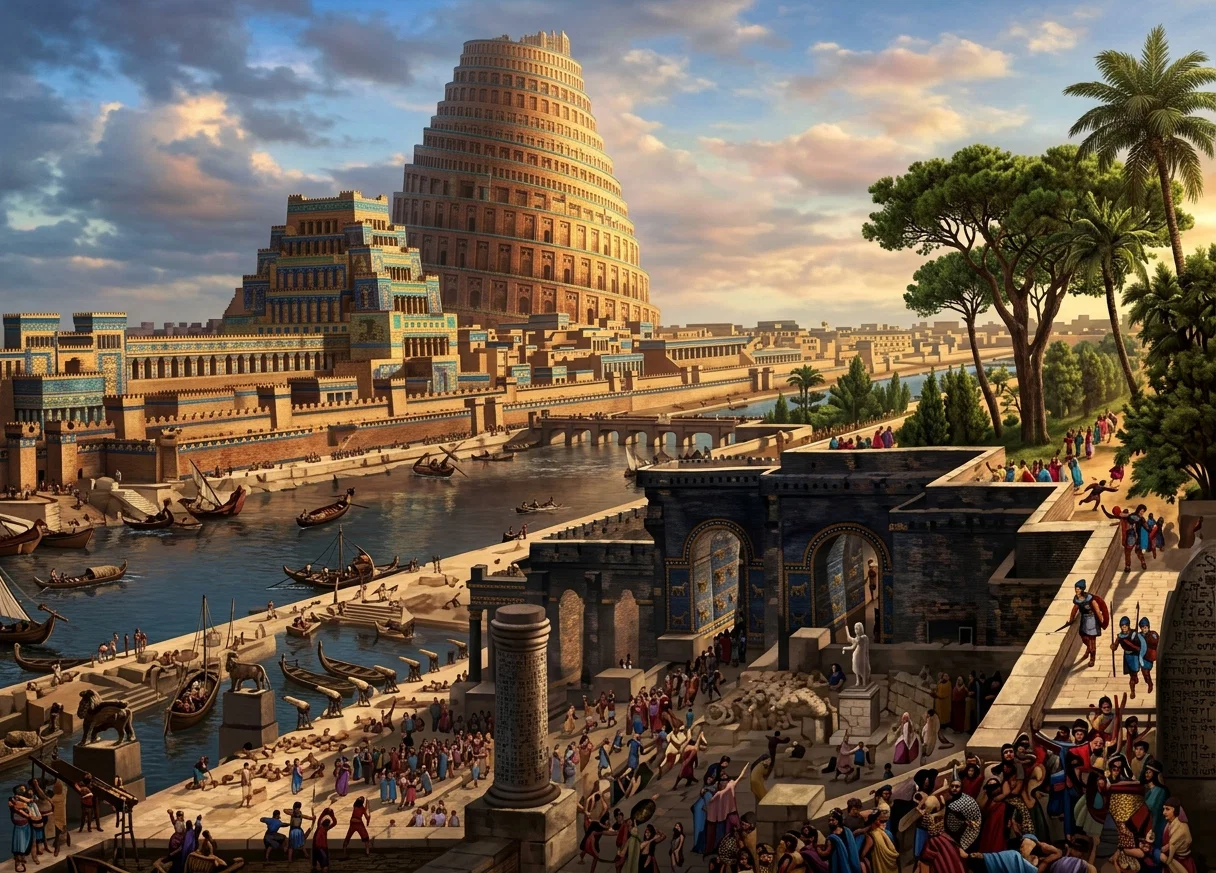
BABYLON AT THE HEIGHT OF ITS GLORY
“And Babylon, the glory of kingdoms, the beauty of the Chaldees’ excellency, shall be as when God overthrew Sodom and Gomorrah.”
The Evening Star
By Augusta Wolcott Heald
By Augusta Wolcott Heald
The planet Venus, beloved by every one as the “star of the evening,” has seemed especially beautiful to us this season. We first began to observe her in the latter part of September, tho in some altitudes she was visible much earlier.
We made various excursions to an adjacent hill at the twilight hour, for a first glimpse of the beautiful orb. When, at last, our search was rewarded, she appeared as a small, brilliant gem just above the sunset point, and very soon disappeared in the golden glow.
Each evening, she rose a little further east of the sun, and soon we could view her from the dooryard, and from the south and west windows. She continued this eastward motion, increasing, apparently, in size and brilliancy, and rising higher and higher in7the heavens, till she reached an angle of about forty-six degrees.
She then commenced her retrograde motion, turning again toward the west, and approaching the sun.
Venus has been a most beautiful object all through the winter and spring months. In April, as she advanced nearer and nearer to her conjunction, she gradually assumed the crescent form; for she, like the moon, passes through different phases. It is very interesting to watch her through the telescope as the crescent grows finer and finer.
The retrograde motion of Venus is accomplished in a much shorter time than the direct motion. While she was yet quite high in the heavens, a week of cloudy skies concealed her from view. When the nights were again clear, she was no longer visible to us—her beautiful light is absorbed in the splendor of the setting sun. When a week or more has passed, she will appear before dawn in the eastern sky, and will be our “morning star.”
Venus accompanies the earth as morning and evening star, alternately, for a period of two hundred ninety days each time. Her year is equal to seven and one half of our months. Her day is about twenty-five minutes shorter than ours. When nearest to earth, her distance is about twenty-six millions of miles. Her greatest distance is about one hundred sixty-four millions of miles. Being much nearer to the sun, she is supposed to receive twice as much light and heat as does the earth.
What is the wondrous power that adjusts the lovely evening star in its orbit, and upholds the countless myriads of glowing worlds, controlling and guiding their motions through the unlimited realms of space? Some call it gravitation—“and others call it GOD.”
“By His Spirit the heavens are garnished. . . . Lo, these are but the outskirts of His ways: and how small a whisper do we hear of Him!” Job 26:13, 14.
We shall learn more and more of the marvelous works of God, our Creator and Redeemer, when—
“Face to face in all His glory,
We shall see Him by and by.”
Windham, New Hampshire.
Dreams of the Unseen
By Clara Edna Rosencrans
By Clara Edna Rosencrans
I dream of the beauty of Jesus’ face
In its purity, calm, and love.
Like a land-locked harbor resting still
All earthly strife above.
Like the sun in his strength, like the ocean at rest,
Must that glorious vision be;
Yet nothing earthly can e’er convey
Its glory and beauty to me.
For faces are beautiful, fair, and good
As they glow with the Spirit’s light;
And looking into the soul’s calm depths,
We may see with the Spirit’s sight.
So something there is in the face of Christ
That is deeper than mortal ken.
And beauty of face and form are His
Unknown to the sons of men.
Sometimes in fancy I try to think
What the home of Jesus must be—
That beautiful mansion in which He dwells
By the side of the crystal sea.
But tho on the beauties of earth I gaze,
With its sunlit vistas fair,
I know that no loveliness of earth
Can with that home compare.
There are lakes, and rivers, and calm, still depths
In the forests’ billowy green; There are lakes, and rivers, and calm, still depths
In never-dimming sheen.
Yet all we know of the beauties of earth
But pale and fade and die
Beside the glory manifest
In the home of the Christ on high.
I try to think of the presence-room
Where my Lord is ministering now,
Of the faces of angels and seraphim
Who rapt before Him bow.
I try to think of the King supreme,
And of the Son who does His will;
But their glory and radiant majesty
Are hidden from me still.
For nothing of earth’s poor royalty
Can with that scene compare,
For wondrous glory no eye has seen
Surrounds the Saviour there.
On that scene the eyes of unfallen worlds
With wonder rapt are bent,
But naught of our poor humanity
Can fathom its deep intent.
For love so matchless, so wonderful,
Can never be known or penned,
As righteous God and repentant man
Their work together blend.
How deep, how anxious, how full of hope
Should our trembling interest be,
Knowing what sorrow or endless joy
Are bound in that last decree:
And watching, and prayer, and earnest lives
Should mark our walk below;
For signs fulfil, the time is near—
Tho the day, O, who can know?
But this we know,—that the day draws on,
And the hour is waxing late.
Dare we risk the doom? Must we fail at last,
And be left outside the gate?
The Home of God’s People
1. For what purpose did God create the earth?
“For thus saith the Lord that created the heavens; God Himself that formed the earth and made it; He hath established it, He created it not in vain, He formed it to be inhabited: I am the Lord; and there is none else.” Isa. 45:18.
2. Since God formed the earth to be inhabited, what is His purpose concerning the people that are to be its permanent dwellers?
“Blessed are the meek: for they shall inherit the earth.” Matt. 5:5.
“The meek shall inherit the earth; and shall delight themselves in the abundance of peace.” Ps. 37:11.
3. What dominion was given to man when he was first created?
“And God said, Let Us make man in Our image, after Our likeness: and let them have dominion over the fish of sea, and over the fowl of the air, and over the cattle, and over all the earth, and over every creeping thing that creepeth upon the earth.” Gen. 1:26.
4. What comment does the psalmist make upon the dominion that was given to man?
“What is man, that Thou art mindful of him? and the son of man, that Thou visitest him? For Thou hast made him a little lower than the angels, and hast crowned him with glory and honor. Thou madest him to have dominion over the works of Thy hands; Thou hast put all things under his feet: all sheep and oxen, yea, and the beasts of the field; the fowl of the air, and the fish of the sea, and whatsoever passeth through the paths of the seas. O Lord our Lord, how excellent is Thy name in all the earth!” Ps. 8:4-9.
5. What comment does the apostle make on these verses from the 8th Psalm?
“Thou hast put all things in subjection under his feet. For in that He put all in subjection under him, He left nothing that is not put under him. But now we see not yet all things put under him. But we see Jesus, who was made a little lower than the angels for the suffering of death, crowned with glory and honor; that He by the grace of God should taste death for every man.” Heb. 2:8, 9.
NOTE.—The verses that precede the ones just quoted from the second chapter of Hebrews are a still further quotation from the 8th Psalm, all of which shows that we have an inspired comment in Hebrews on the statement made by the psalmist. In this inspired comment our attention is called to the fact that we see that while man had the dominion over all things upon the earth in the beginning, yet “we see not yet all things put under him.” In other words, he lost this dominion, and now we “see Jesus,” through whom this dominion is to be restored.
6. What direct promise concerning the dominion is made through Christ by one of the ancient prophets?
“And thou, O tower of the flock, the stronghold of the daughter of Zion, unto thee shall it come, even the first dominion; the kingdom shall come to the daughter of Jerusalem.” Micah 4:8.
7. In what words does the apostle Peter speak of the promise concerning the new earth?
“Nevertheless we, according to His promise, look for new heavens and a new earth, wherein dwelleth righteousness [or, as some have translated it, “wherein the righteous dwell”].” 2 Peter 3:13.
8. What is one of the promises to which Peter evidently refers in the foregoing quotation?
“For, behold, I create new heavens and a new earth: and the former shall not be remembered, nor come into mind.” Isa. 65:17.
9. What view did the apostle John have of the new earth when this promised dominion through Christ is restored?
“And I saw a new heaven and a new earth: for the first heaven and the first earth were passed away; and there was no more sea. And I John saw the holy city, New Jerusalem, coming down from God out of heaven, prepared as a bride adorned for her husband. And I heard a great voice out of heaven saying, Behold, the tabernacle of God is with men, and He will dwell with them, and they shall be His people, and God Himself shall be with them, and be their God. And God shall wipe away all tears from their eyes; and there shall be no more death, neither sorrow, nor crying, neither shall there be any more pain: for the former things are passed away. And He that sat upon the throne said, Behold, I make all things new. And He said unto me, Write: for these words are true and faithful.” Rev. 21:1-5.
Life’s Common Things
The things of every day are all so sweet—
The morning meadows wet with dew;
The dance of daisies in the noon, the blue
Of far-off hills where twilight shadows lie,
The night with all its tender mystery of sound
And silence and God’s starry sky!
The things of every day are all so sweet!
The common things of life are all so dear—
The waking, in the warm half-gloom,
To find again the old familiar room,
The scents and sights and sounds that never
tire,
The homely work, the plans, the lilt of baby’s
laugh,
The crackle of the open fire;
The waiting, then the footsteps coming near,
The opening door, the handclasp and the kiss,
The common things of life are all so dear.
—Selected.
The Seventh-Day Adventist General Conference
THE thirty-eighth session of the General Conference of Seventh-day Adventists is now convened in Washington, D. C. They met on May 15, and the meetings will continue until June 8. A large delegation is in attendance from every quarter of the world, some seventy different nations being represented. The reports from the officers of the conference, as well as from those in charge of the various subdivisions or union conferences throughout the world, show a very prosperous condition. During the four years since our last General Conference met, there has been the greatest growth in the history of the people. The treasurer’s report showed an increase in tithes and offerings for the year 1912 over those of 1908 of more than $500,000. This was a gain of more than fifty per cent. In addition to this increase in tithes, the increase in offerings to foreign missions amounted practically to one hundred per cent; or, in other words, we gave double the amount to foreign missions in the year 1912 that was given in the year 1908, the year just before the General Conference of 1909.
In like manner, the report from the Educational Department showed a big increase in the number of young men and young women who are attending our schools to fit themselves for work in the various fields. The constant call for recruits in all lands to give the great message of the soon coming of Christ is appealing to our young men and young women, and drawing them in large numbers into the good work.
The reports from the Publishing Department show a tremendous increase in the circulation of our literature. The total amount of literature circulated in the first fifty-eight years of the history of our publishing work, or down till the close of 1902, amounted to $6,647,500. From the beginning of 1903 till the close of 1912 we circulated $11,036,000 worth of publications. In other words, we circulated almost twice as much literature in the last ten years as we circulated in the first fifty-eight years. The value of the publications circulated in the one year of 1912, which was the last and the greatest year of our history, amounted to $1,836,500. The stakes are set for a strong increase in 1913; and certainly with the all-inspiring and important message that we have to give to this world, our future history will be the same as that of the past. It will show phenomenal and vigorous growth.
Delegates and visitors to the Seventh-day Adventist General Conference from the Asiatic Division
Delegates and visitors to the Seventh-day Adventist General Conference from Africa
The Sabbath-school Department, the sanitarium work, and the work of the young people’s societies, all told the same story of progress and earnestness which mark the growth and prosperity that should be expected among a people who have such thrilling tidings to proclaim to the world. As is well known to the subscribers of this paper, two of the great leading doctrines of the Seventh-day Adventists are the soon coming of Christ and the observance of the seventh-day Sabbath. The doctrine of the soon coming of Christ is fortified by a great chorus of prophetic voices that are sounding in the most distinct tones from God’s word. The seventh-day Sabbath is the Sabbath of the fourth commandment. It is the Sabbath of the Bible all the way through, and it is the great memorial of the work of the infinite Creator.
The proper observance of the Sabbath leads the worshiper, as nothing else will, to a realizing sense of the great truth that God created the heavens and the earth. And in view of the fact that the world is soon to be visited by the personal presence of the mighty Creator at His second coming, the observance of the Sabbath, which commemorates His creative power, is filled with importance, and has a charm about it that is absolutely indescribable. It is necessary for an individual to enter into these experiences to know the joys that well up in the soul as the heart is thrilled with the thought of the speedy fulfilment of the promise of standing face to face with the great Creator, clothed in righteousness and immortality. Eternal joy awaits every soul who is preparing for this thrilling and indescribably glorious event.
Taste and See
By T.
THE psalmist calls out to us with great earnestness, we might even say with earnest enthusiasm, “O taste and see that the Lord is good; blessed is the man that trusteth in Him.” Ps. 34: 8.
Many individuals have theories concerning the Lord. Many have systems of religion and of theology, but all of those theories and systems are nothing more than dry shucks unless we have the actualities in our soul of the knowledge that comes through really tasting of the things of God and knowing for ourselves that they are good. You may have found some very delightful fruit, beautiful to the sight and beyond description to the taste. You may seek to describe it. You may tell your friends and acquaintances everything that you can think of concerning it. But after all, they know nothing about it until they actually see and taste it for themselves.
The individual who has not seen this fruit may laugh about it. He may ridicule you for thinking that it is so beautiful and that it tastes so good, and his ridicule may keep him away from the joys of participation. But his mockery does not overthrow your knowledge that has come to you through a definite experience in the tasting. And so it is with the one who has tasted of the realities of the Lord’s great plan of salvation. He knows that the Lord is good; he knows that the Lord saves him; he knows things that he can not describe any more than he can describe the taste of that delicious and delightsome fruit. The only thing he can do is to present the beautiful entreaty of the psalmist, “O taste and see that the Lord is good.”