“Children, obey your parents in the Lord: for this is right.” Verse 1. Note 1.
2. By what command of God is this injunction enforced?
“Honor thy father and mother (which is the first commandment with promise), that it may be well with thee, and thou mayest live long on the earth.” Verses 2, 3. Note 2.
3. What solemn duty is laid upon fathers?
“And, ye fathers, provoke not your children to wrath: but nurture them in the chastening and admonition of the Lord.” Verse 4. Note 3.
4. What duty is laid upon servants?
“Servants, be obedient unto them that according to the flesh are your masters, with fear and trembling, in singleness of your heart, as unto Christ.” Verse 5. Note 4.
5. What should be the spirit of their service?
“Not in the way of eye-service, as men-pleasers; but as servants of Christ, doing the will of God from the heart; with good will doing service, as unto the Lord, and not unto men.” Verses 6, 7. Note 5.
6. From whom may they know that they will receive the reward?
“Knowing that whatsoever good thing each one doeth, the same shall he receive again from the Lord, whether he be bond or free.” Verse 8. Note 6.
7. What duty is laid upon the masters?
“And, ye masters, do the same things unto them, and forbear threatening: knowing that He who is both their Master and yours is in heaven, and there is no respect of persons with Him.” Verse 9. Note 7.
Note and Comment
1. “Children.”—There is a duty laid upon children, and their religion consists largely in that,—“Obey your parents,” especially if the parents are godly people. There may be times when it is the duty of the child to obey God rather than the parents, but this is never true unless the parent demands of the child that which is sinful, immoral. The apostle does not leave it unmodified,—“Children, obey your parents,”—but, “Children, obey your parents in the Lord: for this is right.” It is assumed that the godly parent will teach the child godliness, as the Lord has taught it in His word; and as it is the duty of the parent to teach it, it is the duty of the child to obey.
2. “Honor thy father and mother” is the fifth commandment spoken by the Lord from heaven, setting forth the duty of children. It should be instilled into their minds from the very beginning. If there were more reverence for the father and mother, more strict, prompt obedience taught in the home, there would be a great deal less of disobedience to God. A child that was taught to revere his father and his mother would much more quickly learn to revere and obey God. “Which is the first commandment with promise” is a parenthetical clause thrown in by the apostle regarding the commandment itself. Note that obedience brings life. “In the way of righteousness is life; and in the pathway thereof there is no death.”
3. “Ye fathers.”—The fathers have a duty. They may not treat their children as brutes or animals. The children themselves have rights, and one of those rights is that they should be treated reasonably. They are not to be provoked to wrath. Their naturally wrathful or revengeful disposition is not to be stirred up. The fathers should seek to guide and teach by reason. Children are usually and generally amenable to reason, after the burst of passion is past. They should be taught, nurtured in the chastening and admonition of the Lord, from the time that they are old enough to understand anything,—nay, from before their birth. They may need chastening at times. There is such a thing as sparing the rod when it ought to be used; but it never ought to be used with a spirit of impatience and anger. They should be warned betimes, and admonished as to duty. Sometimes their hearts may rebel against the punishment; but if the punishment be justly administered, with the proper spirit on the part of the parent, it will bring the peaceable fruit of righteousness, and the child will come to see that father or mother did right.
4. “Servants”—literally “bond-servants” (see the margin).—This is set over against masters, or lords. It will be noted, by the careful reader of the New Testament, that neither our Lord nor His apostles sought to change social order or conditions. They were not doing politics in the world; they were not forming parties, they were not Republicans, nor Democrats, nor Progressives, nor Socialists; they were just simply Christians from another kingdom, another empire. They were bringing down the life of God into the world, and endeavoring to spread abroad the mystery of the gospel of Christ, stronger than all the power of Rome or all the civil governments that have existed. And these very servants—or bond-servants—living out the life of the Master even in their slavery, might be the means of winning souls to Christ that they could not have won in any other position in life. Consequently they are enjoined to be obedient to the masters according to the flesh. “With fear and trembling” does not mean that they are to be cringing in their service; but understanding their duty, they should go about it diligently and with earnestness, keeping before them the great fact that duty is the most solemn and sacred thing that a soul can know. They are to feel that they are not serving some human master, they are to look beyond him, recognizing that when they gave themselves to the Lord Jesus they became His servants, and the service is to be wrought as to Christ.
5. “Not in the way of eye-service.”—That is the way that many in the world serve. If the thing looks well, if they can be seen seemingly to do right work, that is about all that is demanded on the part of the servants. If they can slight their work easily, the work is slighted. They do not know that God sees the part that is slighted, sees behind the hedge, sees where little work and wrong work and imperfect work is done, however it may be covered by men. It is not eye-service, as men-pleasers, but doing the will of God from the heart that God wants. A carpenter was asked, one time, why he finished the pickets of a fence that he put up against the hedge. The one that asked the question remarked that “no man will see that; and the man that you are doing it for will never know it.” The only reply was that “God sees it; God will know that those pickets were not finished at all in that place.” The true Christian needs no watchman or overseer. He has one thing that he wishes to do, and that is to serve God.
6. “Knowing.”—His master may ill-treat him. He may pay him insufficient wages. He may even cheat him out of the wages that he agrees to pay. But the servant may know that whatsoever good thing he has done he shall receive again from the Lord, whether he be bond or free. In the judgment to come every wrong will be righted, every deed of iniquity punished.
7. “Ye masters, do the same things.”—If they are Christians, they are to cherish the same spirit. They are to do as Philemon the master of Onesimus was enjoined to do,—receive the slave not as a slave, but as a brother. Philemon 10-16. They are to remember that their own Master, as well as that slave’s Master, is in heaven, and that He is “no respecter of persons.” The masters who did this were friends to their slaves, and the slaves themselves have loved such masters. The recognition of the one great Master and His love softens and sanctifies all true human relationships.
Delegates and visitors to the Seventh-day Adventist General Conference from West Indian and Caribbean Union Conference
Rich in the Life Eternal
The poor of this world who have faith can wait and struggle on. Of Him in whom they believe it is said: “For He will deliver the needy when he crieth, and the poor, that hath no helper. He will have pity on the poor and needy, and the souls of the needy He will save. He will redeem their soul from oppression and violence; and precious will their blood be in His sight.” The kingdom of Christ is eternal. It reaches beyond this poor life to the life eternal. Better to be poor here and rich there than have all things here and be found naked in the judgment.
The California Legislature and a Sunday Law
By J. F. Blunt
By J. F. Blunt
From the “Illustrated London News”
California still preserves her integrity as a commonwealth where the civil and religious rights of her citizens are maintained, in harmony with the constitutional guaranties of the state and nation. The legislature has concluded its labors without the enactment of a Sunday closing law, wisely deciding that while men differ in their convictions as to which day they ought to observe, the state well may leave to individual choice the question as to the day for such observance.
Thirty years ago, in California, the free exercise and enjoyment of religious profession and worship, without discrimination or preference, was made possible by the repeal of the then existing Sunday law. Previous to that time, at intervals, citizens had been subjected to severe penalties for engaging in innocent labor and legitimate business on the first day of the week. Ever since then every one has been free to worship God according to the dictates of his own conscience. Meantime, California has prospered as no other state in the Union has prospered, and population has increased phenomenally.
Moral Conditions
Moral conditions have not deteriorated in consequence of the liberty accorded in respect to Sunday observance. On the contrary, California has attained a higher standard of ethics than have states less mindful of the rights of citizens, and civil freedom has not led to moral turpitude. There has been a distinct improvement in society, and higher educational and social ideals have been attained than in most of the states from which this increase of population is derived by immigration.
Nevertheless, while the line of demarcation between church and state has been distinctly observed in recent years in California, mistaken advocates of state-enforced religion have arisen from time to time, demanding the enactment of laws in violation of natural rights, and for the compulsory observance of Sunday as a day of enforced idleness. Scarcely a session of the state legislature has been held without a renewal of the issue, and the session just ended has not been free from such controversy. That legislators swept into office by the extraordinary conditions which have prevailed during the last two years, many of them inexperienced hitherto in public affairs, should so readily have recognized the sectarian character of this demand for Sunday laws, and should refuse to enact such legislation, attests alike their patriotism and their intelligence.
Failed Through the Initiative
Despite the failure of an organized body of sectarians to secure the submission of a Sunday law to a vote of the people, by recourse to the initiative, last year in California, they caused to be introduced in both houses of the legislature the same measure, slightly altered in its terms, and falsely proclaimed as a labor measure. Notwithstanding the enfranchisement of women, only 13,713 signatures had been obtained on the initiative petitions, whereas 31,000 were requisite, and the campaign had convinced the advocates of the proposed law that its enactment could be accomplished only in disguise, inasmuch as less than two per cent of the voters in the state had signed their previous petitions. So they sought to hide their personal connection with the movement by not occupying any time at the public hearing early in the session, pressing forward instead the few members of trade-unions whom they had persuaded, contrary to the avowed policy of the State Federation of Labor, to advocate the measure.
The hypocrisy of this policy was patent to all, but it was ruthlessly exposed at the great hearing in the assembly chamber, where the opposing speakers were accorded an ovation, and the unanswerable arguments in opposition to such legislation were presented. Press comments of an entirely disinterested nature next day were to the effect that not only had the Sunday bill been slain, but a post mortem had been held over the remains. Even the sponsors for the bill in the legislature revealed the fact of their chagrin that their names had been drawn into so bootless a controversy.
Eleven Weekly Rest Bills Introduced
Altogether nine bills were introduced, intended to secure a weekly day of rest; but the substitution of entirely new bills for two of those originally filed, the enacting clause alone being preserved when they were amended, brought the total up to eleven distinct bills, and in only two instances were the bills submitted in the two houses exact duplicates. Of the entire number, only three bills referred distinctly to Sunday, the rest merely providing for more drastic enforcement of the custom of granting one day in seven to those working for wages; one of the amended bills sought to prohibit all persons from working more than six days in seven. Only in the distinct Sunday bills and in the more drastic of the committee substitutes were penalties provided, but in those measures fines of from $10 to $100 and imprisonment for thirty days were provided in all except the bill proposed by the Assembly Committee on Public Morals, which had a monetary penalty of from $25 to $500, and a possible sentence of thirty days’ imprisonment, attached to its provisions.11
None of the more radical measures ever had any real chance of enactment; but some of the less objectionable bills, on account of their assumed bearing on labor interests, were favored in some quarters, until it became fully apparent that all such legislation would constitute an unwarranted interference with personal rights of an inherent nature, and with existing guaranties, would be held unconstitutional if tested before any competent tribunal. As the prospect of the enactment of any Sunday bill into law became more and more discouraging, the friends of such legislation, who all the time had been the persistent advocates of drastic restrictions, while expressly lobbying in the interest of Sunday observance, reached a point where they were willing to make any necessary concession, if only they could secure some recognition of Sunday as a day of compulsory rest in California. They had sought in every possible way to distort the opposition of those who conscientiously observe the true Sabbath, into an endeavor to foster the liquor interests; but at last they themselves had reached such a critical position that they were willing to allow the sale of liquor all day Sunday, if only they could secure the closing of legitimate places of business and the compulsory cessation of honorable labor on that day. Thus shamefully did they abandon the pretense that their measure was devised in the interest of temperance, and their hypocrisy was instantly noted by the clear-headed legislators, who perceived that they had to deal with men of the most unscrupulous character, who were ready to sacrifice a principle to gain a political advantage in the interest of a religious institution. Some were quick to resent the attempt of such advocates to graft upon the statutes of California the spurious sabbath, adopted by an apostate church, tho nowhere established by divine mandate.
Photograph by Underwood & Underwood
Numerous exemptions had been proposed in the beginning, which would have invalidated the law, had there been no constitutional objection to its enactment; and a wave of popular protest arose, as the legislative session lengthened, and numerous memorials, remonstrating against the proposed invasion of individual prerogative, were filed in the legislature. These were printed in the journals of both houses, and came from the Seventh-day Adventists, the Seventh-day Baptists, the Jews, the Pacific Religious Liberty Association, the Western League for the Preservation of Civil Liberty, and numerous other associations of civil and religious character. Literature in abundance was scattered broadcast and distributed among the legislators. The protracted session, including a month’s recess, gave ample opportunity for newspaper comment, and the press abounded in splendid enunciation of the principles of liberty for which our state and national government was established. Meantime, the legislature, crowded with business, was engaged in committee hearings, many of them being held on Sunday; and the absurdity of making a penal offense of acts no whit more culpable than their own, was pressed to the attention of legislators. In fact, the last Sunday of the session was devoted to the frantic attempt of both houses to dispose of the numerous bills awaiting action, in view of the proposed adjournment next day at noon, both senate and assembly being convened for the regular transaction of business.
When it was proposed for the legislature to meet on Sunday, one of the senators who had been active in working for a Sunday law arose and said:
“‘Mr. President, Mr. President, I am horrified, I am shocked, I am grieved, I—I—I don’t know what to say. The very idea is abhorrent. What? the great senate of the great state of California going to meet on the sabbath to pass laws? Why, Mr. President, it is the worst thing I ever heard of in all my life; but if you say you are bound to do it, I guess I will have to be here too, for I have several bills pending that I am deeply interested in. All right, all right, all right, I—I—well, I’ll sit down.’ And then the senators fairly roared.”
Meantime, three of the rest day bills had been withdrawn, only one of the least offensive had been adopted by the assembly, without concurrence of the senate and consequently inoperative, and all the rest had either remained on file, without action, or had died in committee, where several had been sent by unanimous consent, to get rid of them.
So once more the God-given right of men to decide whom they will serve is left to the people of California. That future attempts will be made to secure the exaltation of the Sunday institution in California is probable, both on account of the mistaken zeal of erring men who are committed to the error of Sunday observance, and from the testimony of prophecy, which shows that for a time a seeming triumph of evil will be accomplished in the world, tho happily thereafter to give way to the eternal reign of righteousness. Let us hope that in that day, all who are becoming acquainted with the truth in these times of combat may be found alined on the side of the true Sabbath, and opposed to the heathen substitute for God’s lasting memorial. Meantime, let the friends of truth be ready to oppose most effectively any effort that may be put forth for the enactment of a Sunday law in California by recourse to the initiative. Among the memorials filed in protest against such legislation, at this session of the legislature, was one bearing the signatures of 68,559 male voters of California, the largest number, until that time, appearing on any memorial submitted to the California legislature since the admission of the state to the Union. The love of liberty is strong here, and every campaign only serves to strengthen the conviction that the observance of Sunday at all is wholly without authority of the Scriptures.
Submarines Sink Eleven Battleships
Eleven of the largest battle-ships of the American navy engaged in sham battle, on May 24, off Block Island Sound, in the neighborhood of Newport, Rhode Island. They were to be attacked by five submarines. They were on the lookout for these submerged war-ships. One of the little submarines came to the surface off the bow of the flag-ship Wyoming on purpose that it might be seen, and before the guns of the flag-ship could be trained on the little submarine, a dummy torpedo struck the Wyoming well below the water line. In a similar manner all the eleven war-ships were struck by torpedoes from these submarine vessels. The judges of the trial combat said that all the war-ships were theoretically sunk by the torpedoes from these submerged vessels. Experiments of this kind are causing the quandary as to the advisability of building these immense battle-ships that can be so easily sunk by a little war-ship that sails like a fish, entirely out of sight.
Revolutionary Tendencies Worldwide
Sir Robert Parks, who has been for eighteen years a member of the British Parliament, has recently been giving forth some opinions in regard to conditions in this country. He says that liberty here is a gigantic hoax, and furthermore he predicts a great revolution in this country, in which class will be arrayed against class, and he thinks this revolution will be in the near future. He spent considerable time in this country before making these observations. Now if the gentleman will spend a little time in England, he will find that it has not been so very long since that country had to have a standing army of fifty thousand men to quiet her labor disturbances, and she still has that trouble on her hands; and besides that, the militant suffragettes have arisen with heroic vehemence to fill in the interim between the outbreaks in the labor world. So it would seem that England does not have any particular advantage over the United States in the matter of revolutionary tendencies. And then if we will let our minds run all through the world, we will find that Germany, France, Austria, Japan, and all the rest of the nations of the world are in the same category.
The Papacy’s Interest in the United States
Cardinal O’Connell, of Boston, has recently visited the pope, and he says that in his conversation with him he had a very intimate knowledge of conditions in the United States. He also displayed great interest in the welfare of the American government. We are assured quite frequently that the Papacy has a watchful eye on this country, and that she is doing everything within her power to increase her hold here. These facts should be kept in mind, and should be placed alongside prophecies which unmistakably forecast the restoration of the Papacy in the Old World and the formation of an image to that power in the New.
four choice works
in limp leather—
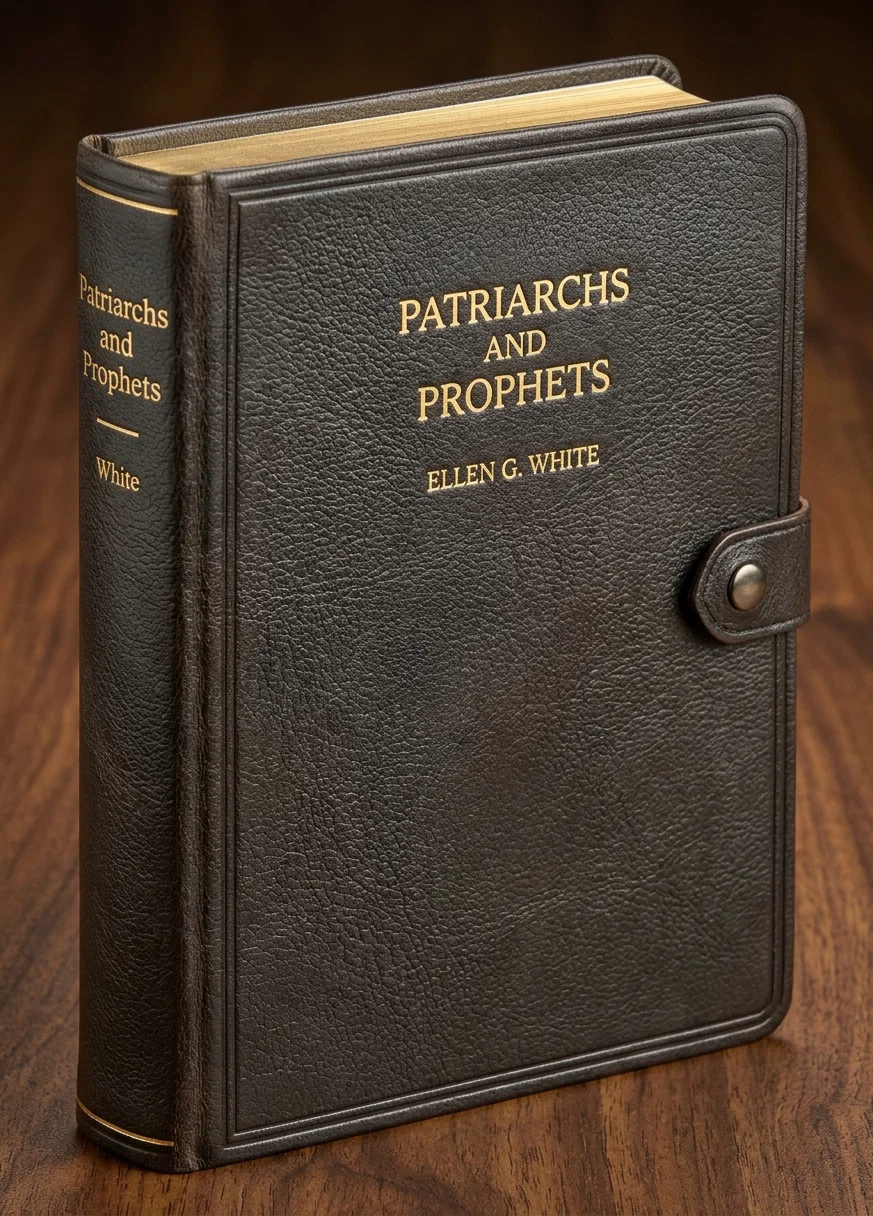
PATRIARCHS AND PROPHETS
In this style “Patriarchs” weighs just 24 ounces. It is 8 1-16 inches long by 5 3-4 inches wide and 1 inch thick. Every family should have this work for constant use in the study of the Old Testament. You will find this light edition easy to carry with you. Price in the limp leather binding, post-paid, $2.00; same size in durable cloth, $1.50.
THE DESIRE OF AGES
This masterpiece on the life of our Saviour, published in several large forms and circulated widely, in the limp leather style weighs 26 ounces, and is 8 3-4 inches long, 5 3-4 inches wide, and 1 inch thick.
Altho it was issued in response to an urgent call from ministers and workers, all classes of people are appreciating this edition of “Desire of Ages.” It is furnished at the same price; namely, in the limp leather binding, $2.00; in durable cloth, $1.50.
THE GREAT CONTROVERSY
This volume presents in a most wonderful and interesting way the great struggle in which we are all engaged. It brings out the principles involved, and makes clear to the reader the path which leads to Him who is able to conquer in every conflict.
“Great Controversy” in limp is 8 1-16 inches long by 5 3-4 inches wide and less than one inch thick. Price in limp leather binding, post-paid, $2.00; cloth, same size, $1.50.
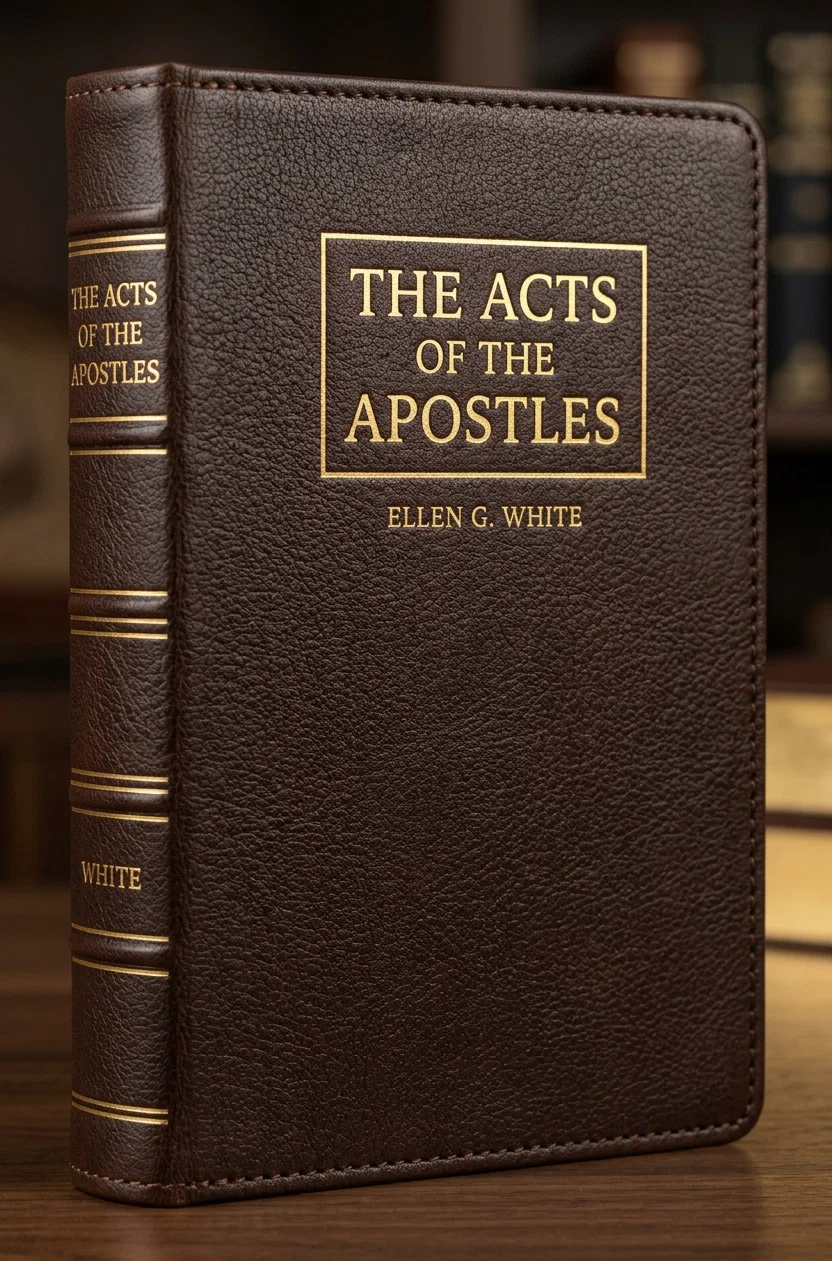
THE ACTS OF THE APOSTLES
In recommending this work, Elder G. A. Irwin felt impressed to write:
“The historic and prophetic features of the book of Acts are so vividly brought out in ‘The Acts of the Apostles’ that in perusing the book one can not help catching the spirit of those faithful men who stood so nobly in defense of the truth in their day. The book in its every detail brings out the parallel between their time and ours so clearly that one’s confidence in the third angel’s message and the foundation upon which it is based is greatly strengthened. “I would say, Purchase this book at your earliest opportunity, and read it carefully. And while the early influence produced by the book is upon you, speak of it to your friends and neighbors, and induce them to buy a copy, and thus increase its circulation, influence, and usefulness.”
“The Acts of the Apostles” in the limp leather style is 8 1-16 inches long by 5 3-4 inches wide and 3-4 of an inch thick. It contains 630 pages. Weight, 20 ounces.
Price in the limp leather, $2.00; red durable cloth, $1.50.
Prices 10% higher in Canada
Order of your tract society or
Pacific Press Publishing Association
Mountain View, California
Kansas City, MoCalgary, Alberta, CanadaPortland, Ore.
Ecumenical Conference on Faith and Morals
By T.
In 1910 the Protestant Episcopal Church appointed a commission to arrange for a conference for the consideration of questions as to “the faith and order of the Christian church, in the hope that such a conference will promote the cause of Christian unity.” This commission invites all Christian churches throughout the world to unite in arranging for and conducting such a conference. The commission is publishing leaflets explaining the scope and methods of the conference, which are sent free to any one who will apply to the secretary, Robert H. Gardiner, Gardiner, Maine. Persons applying for these leaflets are placed on their permanent mailing lists and are to receive all future publications.
This Episcopal commission has already obtained a large list of individuals from various church organizations, such as the Disciples of Christ, Congregationalists, Methodists, and even Roman Catholics, who are banding themselves together to meet for united prayer for the reunion of Christians, and to aid in promoting a conference to study how it can best be brought about. It is said that this world conference may not be held for several years yet, but the world-wide plan is under way to arrange for it as soon as the necessary preliminaries can be got out of the way. We will be interested to learn what relation this proposed world conference of “faith and order” is to sustain to the Federal Council of Churches. And we might say, in passing, that it is very interesting to observe the strong sentiment that is manifested all through the world to establish a union among the Christian churches. This union is not to be effected by coming together as one in Christ according to the Bible plan and according to the prayer of the Master, but it is to be federation; and such world-wide combinations worked along such lines have always produced religious tyranny and disaster. They will do it again.
We are in favor of Christian unity, but this unity must come through the study of God’s word and union with Christ. There is no human makeshift by which it can be brought about through the surrendering of certain so-called non-essentials. When an individual surrenders a principle, no matter of how little consequence, he has laid the foundation for surrender all along the line; and when he has finally subscribed to his accepted platform of essentials upon which all are agreed, he can not be sure that he is right. He has destroyed the finer textures of mind and of conscience by surrendering principles, and in doing this he has been shifted from the great foundation of morality and righteousness. It is well for men to think earnestly and carefully before they take part in any of these modern schemes for federation and so-called unity. The prayer of Christ recorded in the 17th chapter of John seeks for a unity that is not proposed in any of these federal councils or ecumenical organizations for faith and morals.