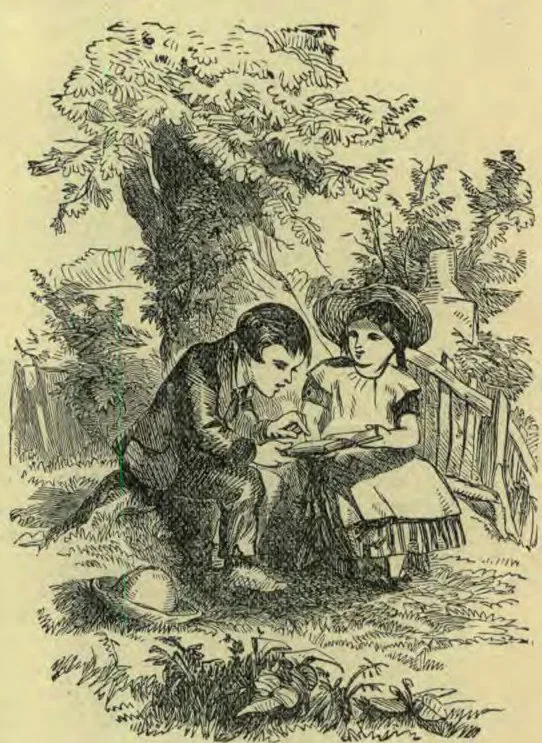
COME, little children, come with me, Where the winds are singing merrily, As they toss the crimson clover; We'll walk on the hills and by the brooks, And I'll show you stories in prettier books Than the ones you are poring over.
Do you think you could learn to sing a song, Though you drummed, and hummed it all day long, Till hands and brains were aching, That would match the clear, untutored notes That drop from the pretty, tender throats Of birds, when the day is breaking!
Did you ever read, on any page, Though written with all the wisdom of age And all the truth of preaching, Any lesson that taught you half so plain Content with your humble work and gain, As the golden bee is teaching?
For see as she floats on her airy wings, How she sings and works, and works and sings, Never stopping nor staying; Showing us clearly what to do To make of duty a pleasure, too, And to make our work but playing.
Do you suppose that a book can tell Maxims of prudence, half so well As the little ant, who is telling To man, as she patiently goes and comes, Bearing her precious grains and crumbs, How want is kept from the dwelling?
Whatever a story can teach to you Of the good a little thing may do, The hidden brook is showing, Whose quiet way is only seen Because of its banks, so fresh and green, And the flowers beside it growing.
If we go where the golden lily grows, Where, clothed in raiment fine, she glows, Like a king in all his glory, And ponder over each precious leaf, We shall find there, written bright and brief, The words of a wondrous story.
We shall learn the beautiful lesson there That our Heavenly Father's loving care Even the lily winneth; For rich in beauty there she stands, Arrayed by His gracious, tender hands, Though she toileth not, nor spinneth.
There isn't a blossom under our feet, But has some teaching short and sweet, That is richly worth the knowing, And the roughest hedge, or the sharpest thorn, Is blessed with power to guard or warm, If we will but heed its showing.
So do not spoil your happy looks By poring always over your books, Written by scholars and sages: For there's many a lesson in brooks or birds Told in plainer and prettier words, Than those in your printed pages.
And yet, I would not have you think, No wisdom comes through pen and ink, And all books are dull and dreary, For not all of life can be pleasant play, Nor every day a holiday; And tasks must be hard and weary.
And that is the very reason why I would have you learn from earth and sky Their lessons of good, and heed them; For there our Father, with loving hand, Writes truths that a child may understand, So plain that a child can read them.
—Phebe Cary.
THE SNOW-PLANT.
FAR away to the north, in the regions of perpetual ice and snow, where the sun never rises and sets but once a year, is to be found a little plant so small that it would take two or three thousand of them to cover your thumbnail. This plant has a long Latin name, which scientific people have given it, and may be translated to you as red snow. It flourishes in the coldest of climates, growing upon the surface of the cold, white arctic snows, sometimes spreading out for miles, and so dense as to be several feet thick.
When Sir John Ross first sailed up Baffin’s Bay, he saw this red snow extending upon the shore to a distance of eight miles, and about twelve feet deep. It must have been a beautiful sight as it grew in the midst of the white drifts. From that day these bluffs went by the name of the “Crimson Cliffs.”
But we are not obliged to go to the north pole to find red snow. It is also found upon the tops of mountains, above the snow-line, where the snows of many winters are piled up upon each other, until they fall below as avalanches, or become glaciers.
Our own country is not behind others in respect to the snow-plant. Some years ago I had some red snow given me, which came all the way from California, that land of wonders.
Now, so tiny is this snow-plant, that a powerful microscope must be used to see one perfectly. This requires it to be magnified several hundred times in diameter, as naturalists say, which makes one of these little plants look about the size of a gold-dollar piece. They are not, however, of the same size. This no doubt seems very strange to you,—to hear one talk about something which the unaided eye cannot see at all as being of different sizes, some larger, and some smaller, and of them none so large as the smallest of mustard-seeds.
A very curious thing about red snow is that a kind of motion is observed in it; but this is only a signal of growth. When growth begins, this motion stops; when growth ends, then locomotion commences, and the plant spreads or extends itself over the snow; and this process goes on until large patches of the snow-plant are formed.— Well-Spring.
Avoid the First Wrong Step
EVERY day some of the boys and girls are taking their first wrong step, and every day some older ones are dropping down to endless ruin because they took the first wrong step, which led to another, till the last step was a plunge into darkness forever. Dear young friends, avoid the first wrong step. Yield not to a single temptation, or you will be less able to resist subsequent ones. If you have already started in the way of disobedience and vice, retrace your steps at once.
George Muller on Reading the Bible
Mr. GEORGE MULLER, of the Orphans' Home, England, says, “In forty-six years I have read my Bible through a hundred times; yet it is always fresh and new when I begin it again.”
Whatsoever You Find to Do
WHATSOEVER you find to do,
Do it, boys, with all your might;
Never be a little true,
Or a little in the right.
Trifles even
Lead to Heaven,
Trifles make the life of man;
So in all things,
Great or small things,
Be as thorough as you can.