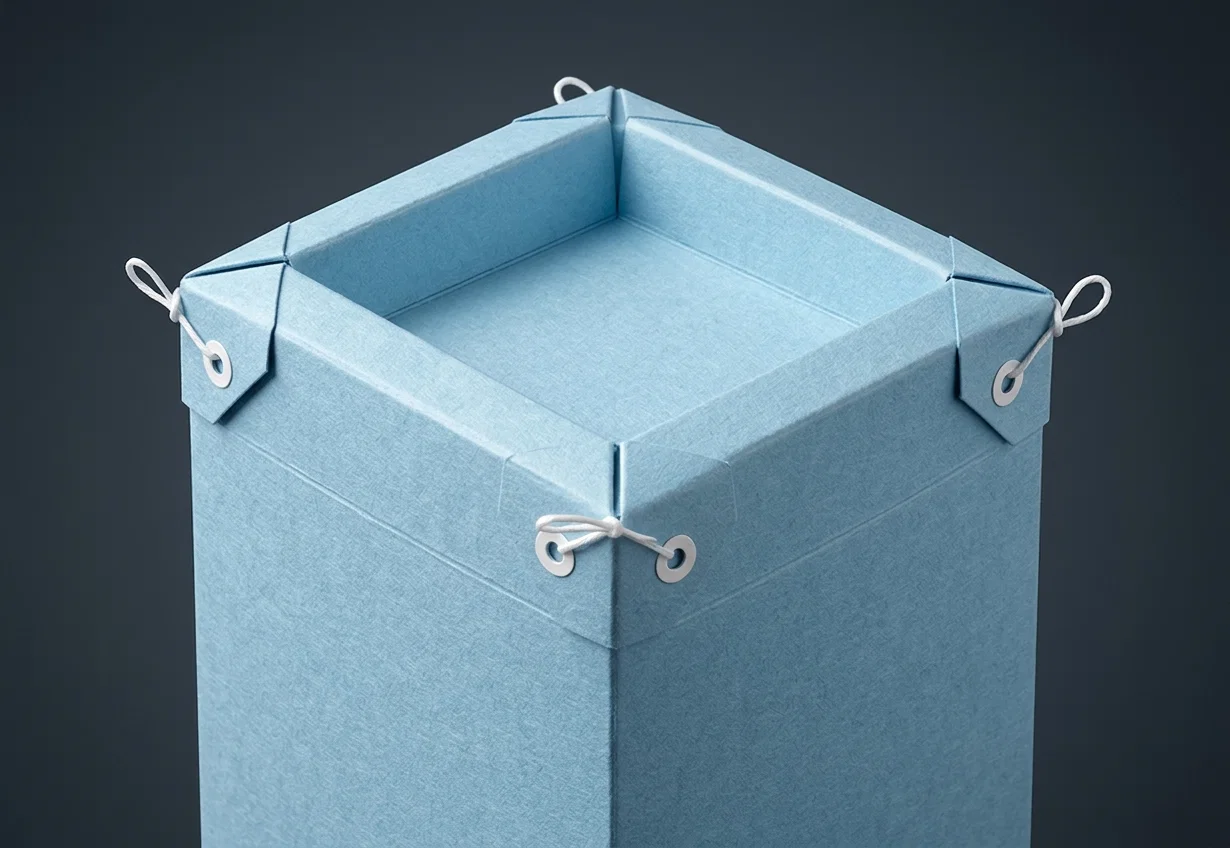
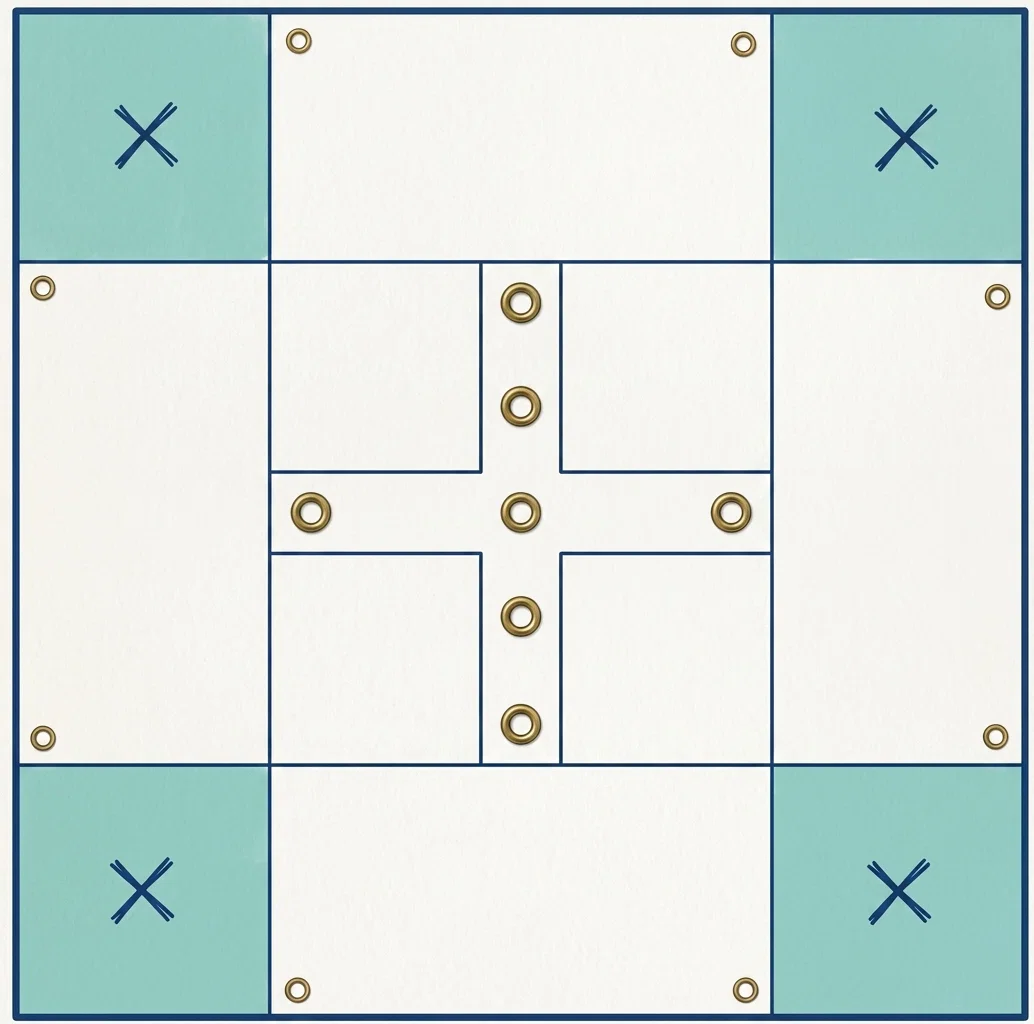
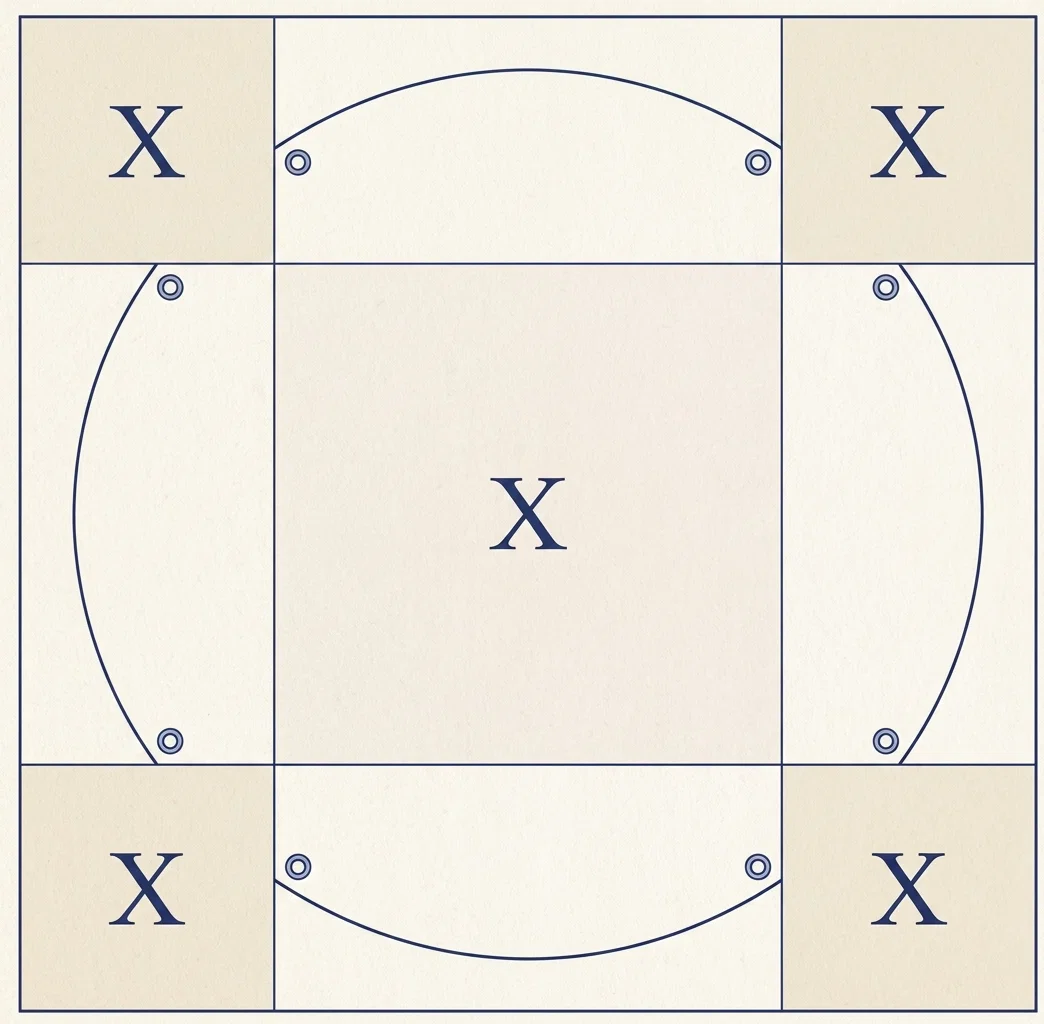
This is a square box. For the drawing, first make a point two inches from each corner on each side of the paper.
MODEL NO. 3
Connect opposite points with straight lines (Fig. 1). Mark the places for tying, as indicated by the small circles, or rings. Cut away the parts marked X.
FIGURE I
In cutting, be careful to stop exactly at the intersection of the lines. Fold the remaining lines. To insure a good fold, teach the children to lay the edge of the ruler along the line that is to be folded, then, holding it firmly in place with the left hand, lift up the free part of the paper with the right, and press it closely against the edge of the ruler. The fold may be made sharper after removing the ruler. Tie so that the corners just meet. This makes a good handkerchief box.
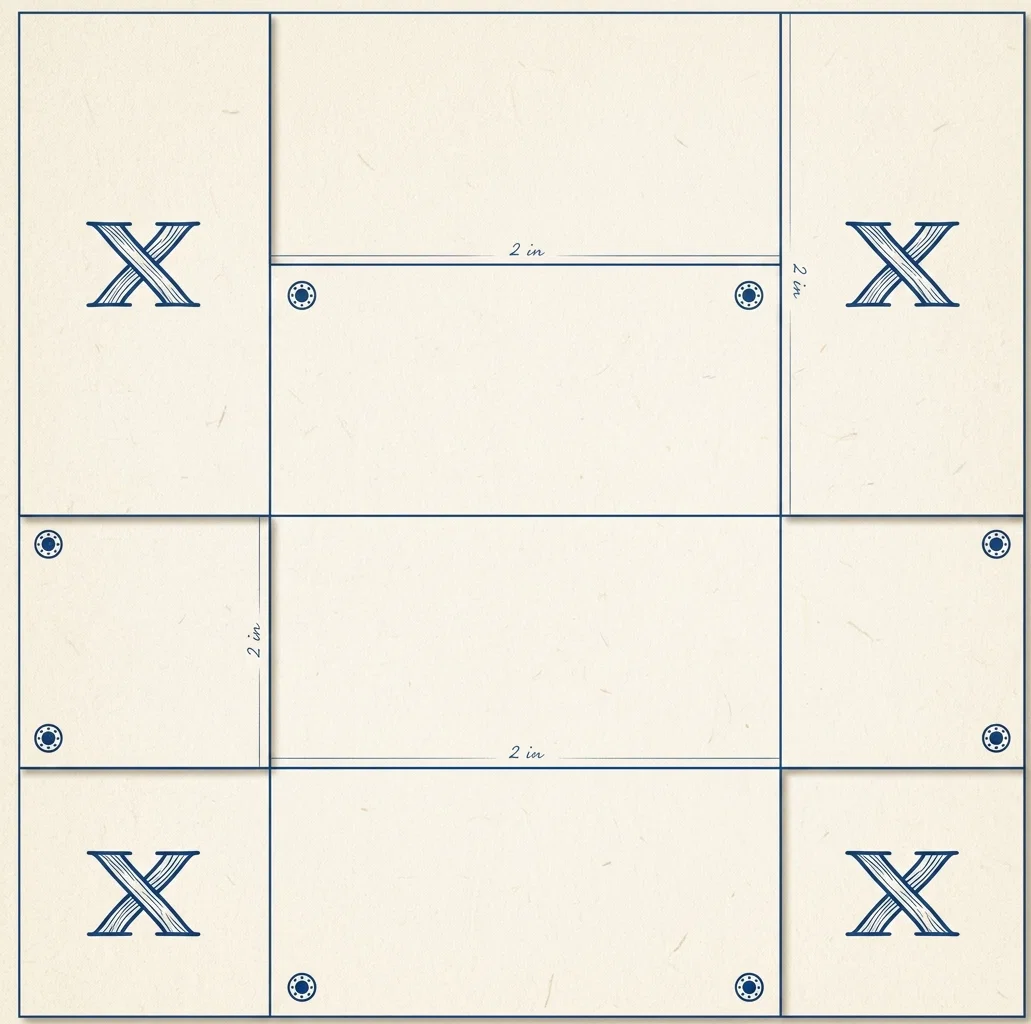
Model No. 4 Is an oblong box with a cover. A two-inch measurement is used in locating all the lines shown in the drawing. (Fig. 2.) Locate and draw the upright lines first.
In each case mark the places for tying, cut away the parts marked X, fold the straight lines, and tie, the same as directed for Model No. 3.
MODEL NO. 4
If you wish to fasten the cover of this box down, attach tie-strings to the center of the front edge of the cover, and to the upper edge of the front of the box.
FIGURE 2
The cord which comes around store packages may be wound into neat little rolls, and kept in the boxes, ready for use when wanted.
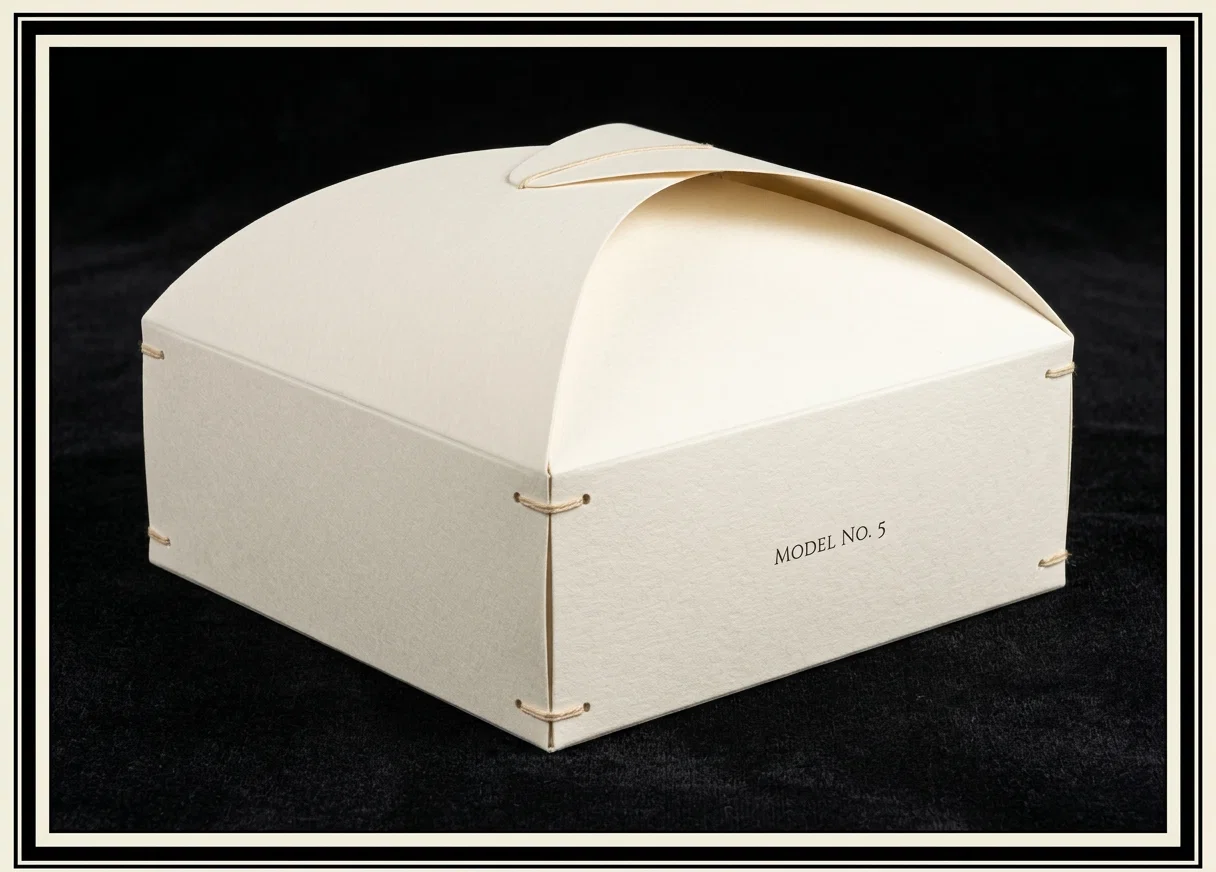
Model No. 5 Is another square box, but instead of a straight, it has a curved top. The straight lines are located the same as for Model No. 3. Then find the center of the paper, by placing the ruler across diagonally, so that it just touches the corners, and draw a very short line as near the center as you can by the eye. Place the ruler across in the opposite direction, just touching the other two corners, and draw another short line. This should cross the first one, and the point of intersection will, of course, be the exact center of the paper. (Fig. 3.)
MODEL NO. 5
With a radius of three and one-half inches,—that is, with the compasses open that distance,—place the point at the center of the paper. It may slightly prick the paper, so as to keep it from slipping out of place while the pencil revolves around it.
FIGURE 3
Hold the compasses lightly, by the very top, and with the thumb and forefinger only. Use very slight pressure, and let them lean slightly in the direction in which they are moving. Beginning on one of the lines, move the pencil point steadily from left to right, across the paper until it touches the corresponding
line on the opposite side. Let this movement be accomplished by rolling the top of the compasses between the thumb and forefinger. Begin and end exactly on the lines. Repeat on the three other sides.
FIG. 4
If you have not compasses, you can make a substitute that will answer the purpose just as well. All that is needed is a strip of thin cardboard, one fourth of an inch wide, and four inches long. A strip cut from one side of a postal-card will do nicely if one side is free from writing. Make a point one fourth of an inch from one end in the center of the cardboard. Mark this O. (Fig. 4.) Measuring from this point, make points one, two, three, and three and one-half inches above, along through the center of the cardboard. Mark them as you see in Figure 4.
Take a common pin, and perforate each point by pushing the pin through to its head. Your pencil should be kept so well sharpened that the point will pass through these perforations. Put the pin into the one marked O, let it slightly prick the paper in the center to prevent it from slipping. Hold the pin upright with the left hand. Put the pencil point through the perforation marked three and one-half inches, and draw the curved24lines as directed above. Of course it is important that the cardboard compasses should be kept flat on the paper. A little practise will enable the children to do as good work with this simple instrument as with an expensive one.
Mark the places for tying. Cut out the corners as marked. Give special directions and cautions for the cutting of the curved lines. It will be much more difficult to secure smooth curved cuts than straight ones, but do not lower the standard. Teach the children to take pride in doing their work well. Remind them to open the shears wide, and make long, steady cuts. It is also better to steady the right arm against the body, and with the left hand swing the paper slowly around to meet the shears.
Teach the children to test the smoothness of a curved edge by passing the finger-tips lightly over it. The irregularities can be felt even better than seen. Also show them how to further test their work by the corners, which should fit together perfectly when folded and tied.
Do these things seem unimportant? They are not unimportant to the children. They are forming habits of accuracy or inaccuracy, of efficiency or inefficiency, of thoroughness or slackness, and consequently are laying the foundation of success or failure, and it rests largely with you to say which it shall be.
Model No. 6
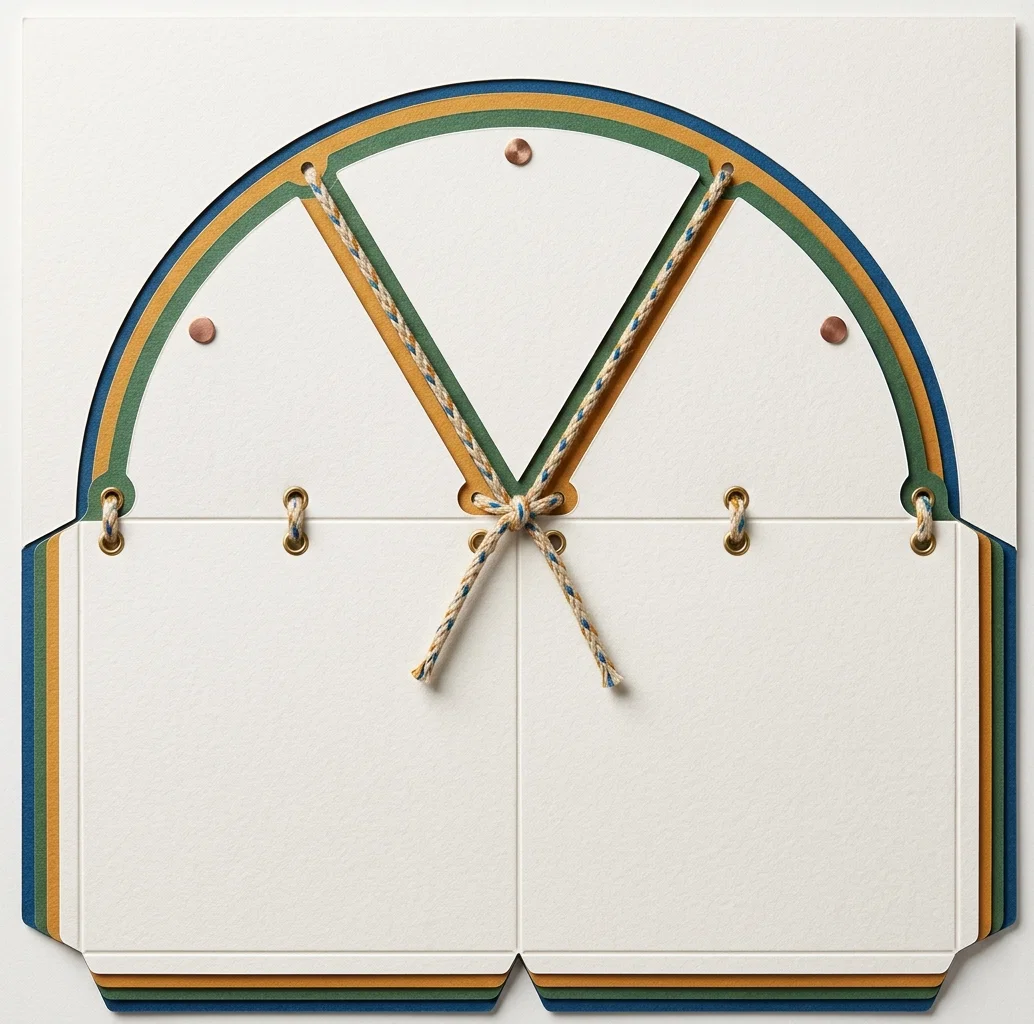
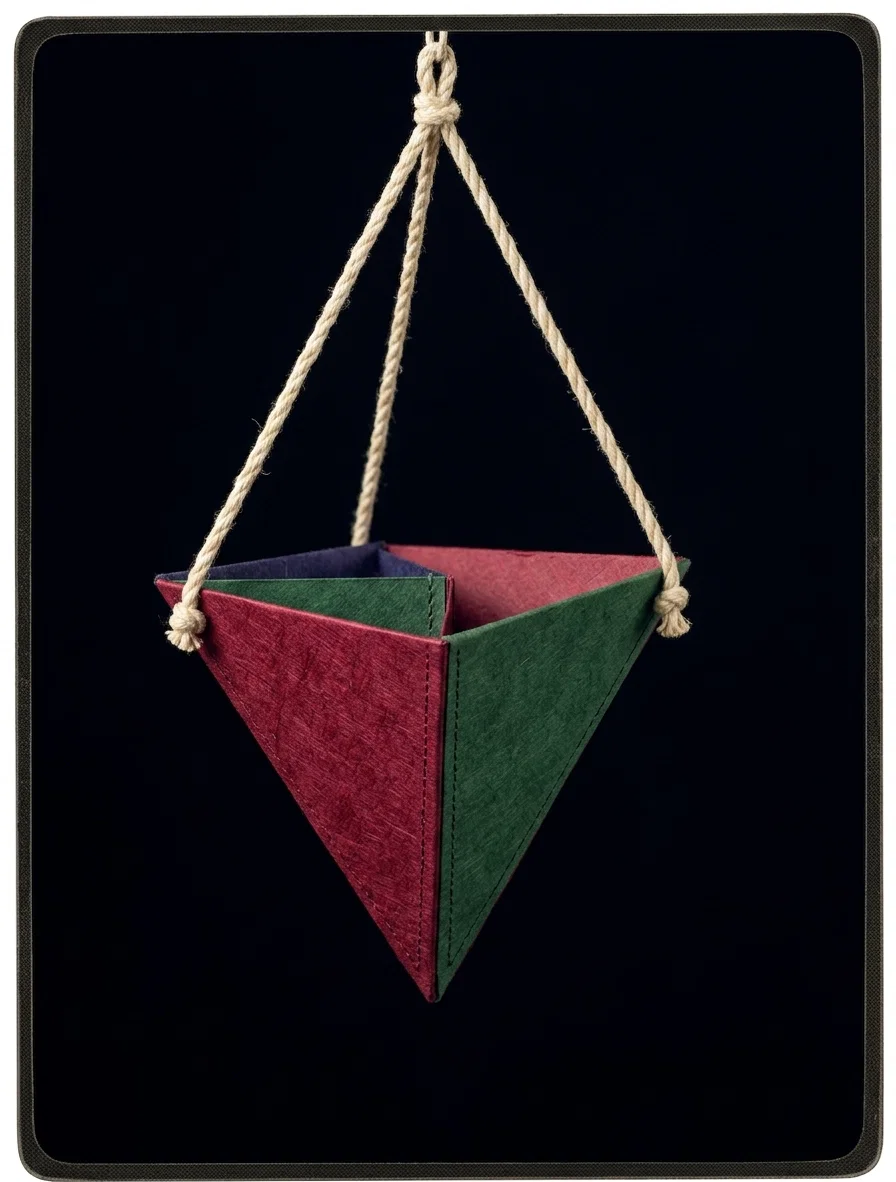
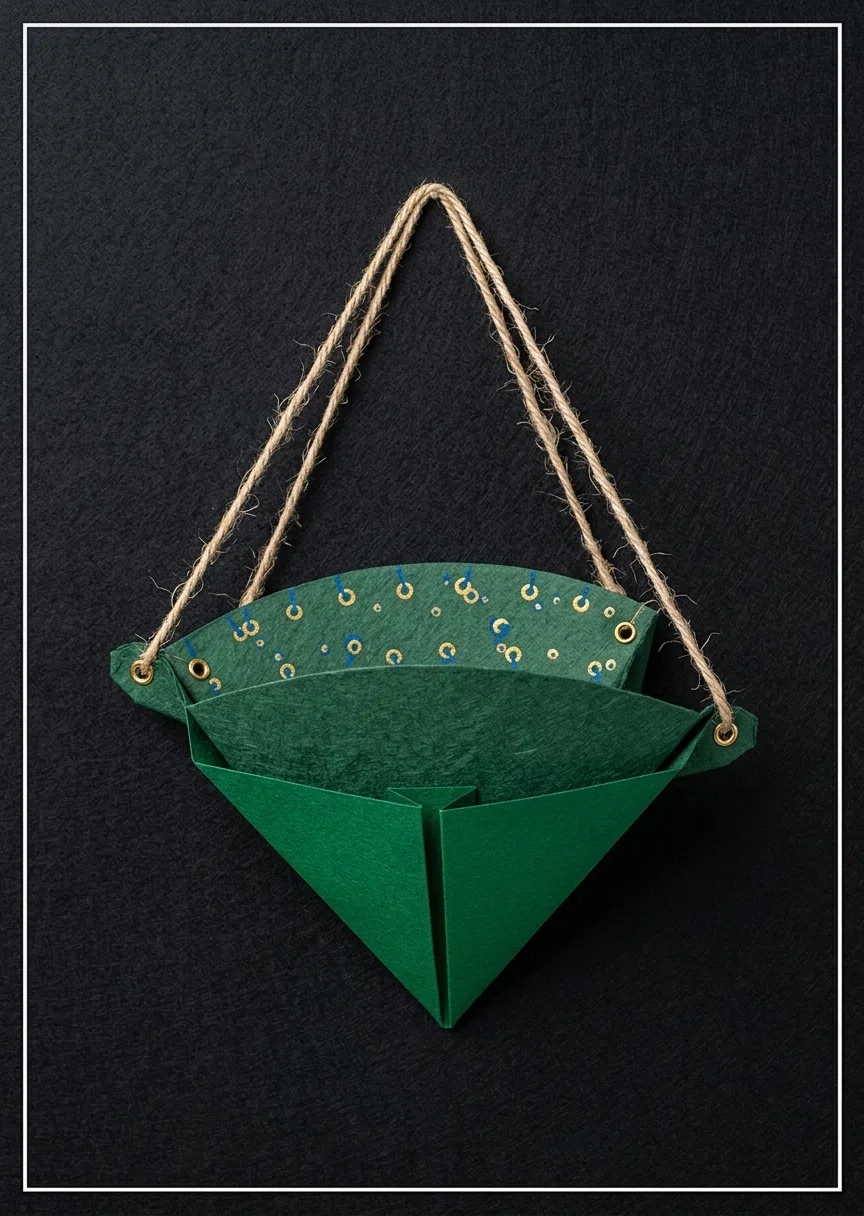
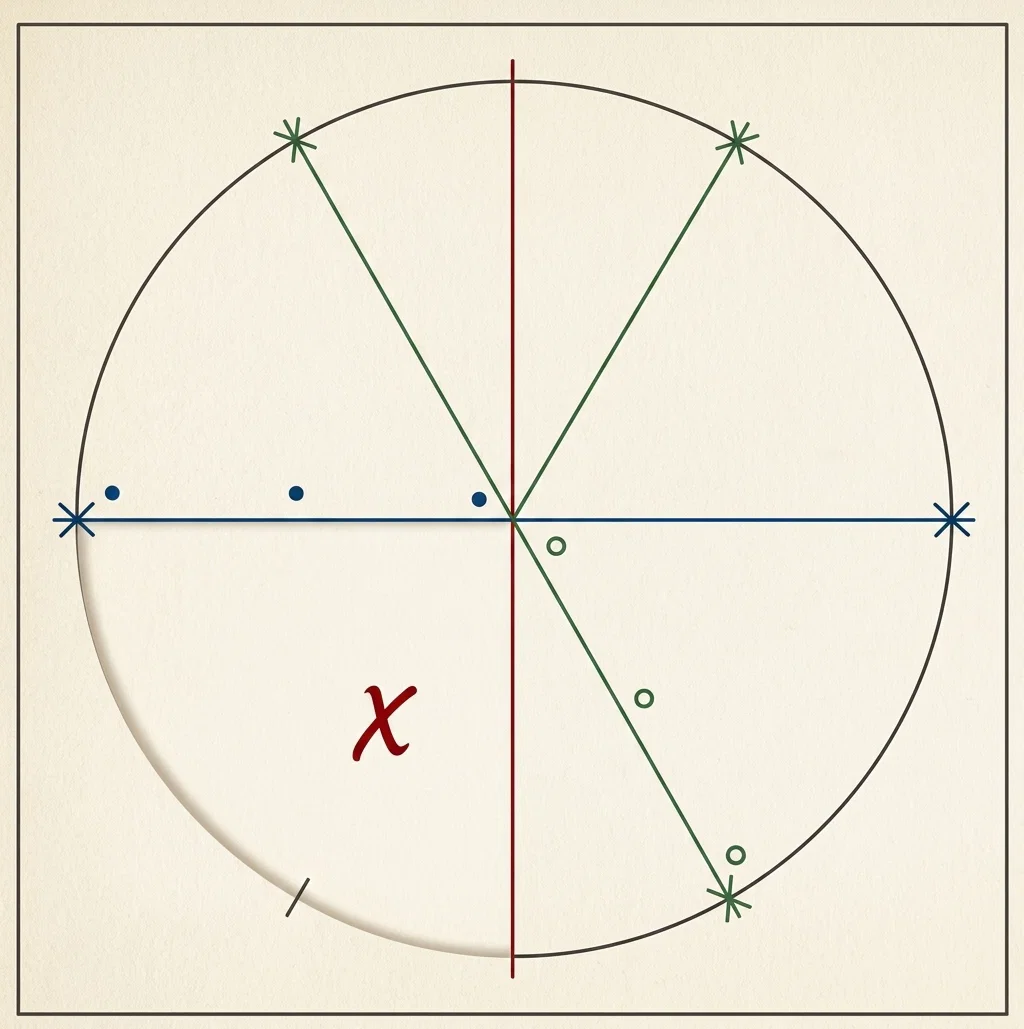
This is a triangular hanging-basket. Make a point in the center of opposite sides of the paper, and connect with a straight line. Mark the center of the line with a point. With this point for a center, and a radius of three and one-half inches, draw half a circle above the line. (Fig. 5.) To divide this into three approximately equal parts, place the point of the compasses at one of the points where the curved line meets the straight one, and mark off the length of the radius on the curved line. Repeat on the opposite side. Make a distinct point where each of these short lines intersects the curved one. Connect these points with the center. Mark the places for tying, and cut out the half-circle. Examine carefully the curved edge to see if well cut. Fold on the lines. Tie and attach handles.
FIGURE 5
MODEL NO. 6
Figure 6 is an exercise in drawing circles. Spend whatever time may be necessary to make the children proficient in this.
FIGURE 6
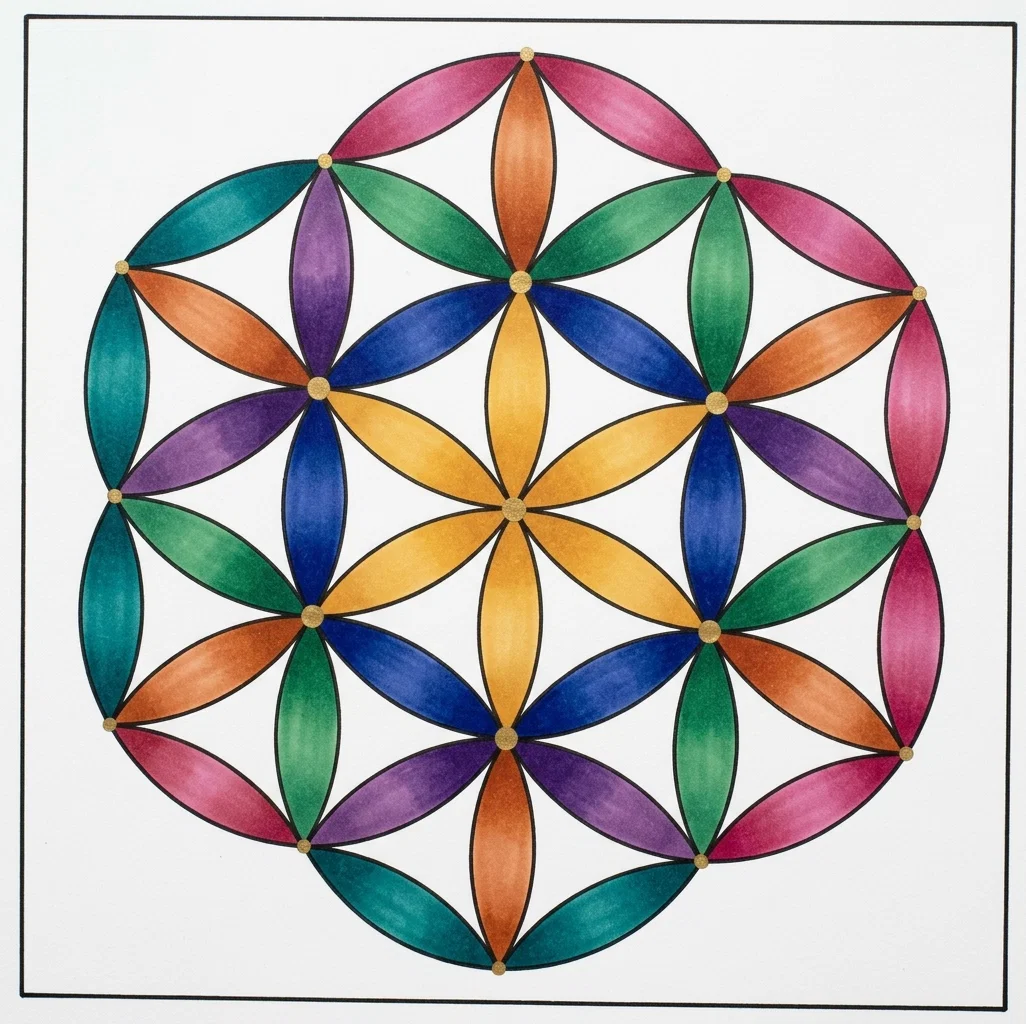
Find the center of the paper, as directed for Model No. 5. With a radius of two inches draw a circle around this center. Place the ruler across the circle, so that the edge just touches the center, and make a point in the circumference at each side just where it is crossed by the ruler. With the same radius that was used in drawing the circle,
the point of the compasses at one of the points just made, and measure off the length of the radius on the circumference at each side of the point. Repeat on the opposite side of the circle. This divides the circle into six approximately equal parts. The children learn very readily to do it, so that after one or two lessons it is only necessary to ask them to divide their circle, and no help need be given.
MODEL NO. 7
Still with the same radius, and using the six points as centers, draw a circle around each. Each of these circles should pass through the center of the first one. The next row is made up of part circles, with the points where the first row of circles cross each other used as centers. This work will just reach across the paper. If desired, the outline may be cut, thus forming a lamp-mat.
Model No. 7 Is a square hanging-basket. The drawing shown in Figure 7 is made with a three and one-half inch radius. Divide the circle as directed above. Draw two and one-half diameters, as shown. Cut out the circle, then cut away the part marked X. Fold, tie, and attach handles.
FIGURE 7
FIGURE 8
Figures 8 and 9 are practise exercises. Figure 8 is made with a one-inch radius only. Figure 9 uses first a two-inch radius, and then a one-inch.
MRS. E. M. LONG.
FIGURE 9
Some Principles Underlying Government and United States History
By Laura Wagner
HISTORY is a record of events. That record shows that a controversy has been going on between unseen forces as well as the forces that are visible. In studying the history of the United States we find this to be true. The unseen forces are Christ and Satan.
The conflict began with Satan in heaven. He was cast out, and with his forces determined to get possession of this world. God created the earth to be inhabited, Adam and Eve had dominion over all things. Satan usurped the kingdom, and thus became prince of this world. Since that time Satan has been working to bring the people of all the world into subjection to him, while Christ has been working to counteract this evil.
God has the ideal form of government, and he desires men to be self-governing and free, but Satan wishes them to be in subjection. Under Satan's evil influence, man wandered further and further from God, until the race was completely in subjection to Satan, and every imagination25of the thoughts of the human heart was “only evil continually.” God saw that something must be done, so an ark was provided for the few who were righteous, and the whole earth was destroyed by a flood.
After the flood the people were told to scatter abroad and replenish the earth. A great portion of the inhabitants of the earth became wicked again; so God chose one man to become the father of a nation through which he could teach the true principles of government. This he did through the person of Abraham. The Israel of God, as these people were called, departed from the true principles given them, until they rejected God, and chose a king, that they might be like other nations. God now endeavored to teach the true principles of government, not through nations, but through individuals, so God's chosen people to-day are found to be of every nation, kindred, tongue, and people, and will be until the close of time.
Beginning at the time when Israel chose a king, we find in studying their history that they as a nation had forsaken God, only a few among them being loyal. The nation grew so rebellious and wicked that they actually stoned the prophets of God. From this time on, the people who were really striving to serve God found it very difficult. God's once-true Israel rejected Christ, and not long after his ascension a persecution began which waxed steadily worse. The Christians were persecuted on every side. Then followed the most terrible era of ecclesiastical crime known in history,—the Dark Ages. During this time the persecution was fearful,—how fearful we know from the Bible, which says, “Except those days should be shortened, there should no flesh be saved.” God saw that something must be done to save his few loyal people. First, he raised up such reformers as Huss, Jerome, Wyclif, and Luther. Then began what history calls the Reformation, which gave light to the poor souls in darkness. Then God prepared an ark for his people, as in the days of Noah, in the shape of the New World; for in 1492 all the world was startled by the discovery of lands across the “Sea of Darkness.”
Here a refuge was prepared for the persecuted. Homes were made in this new world, explorations were conducted by the different nations until by the eighteenth century, the thirteen colonies had been settled by the English; France held territory in Canada and along the Mississippi; and Spain possessed Florida and Mexico. God's hand was in all this, for he permitted the English people instead of the Spanish or French, to settle the greater part of the New World, and in the French and English war which followed the settlement, the English, a freedom-loving people, gained possession of the greater portion of what later became the United States.
The great War of the Revolution made the colonies free and independent States, and at the close of the war, the Constitution of the United States was drawn up, and a new nation was born, destined to rise foremost among the nations of the world.
In 1619 slavery was introduced into the colonies. This awful traffic grew most rapidly in the South, because it was found more profitable there than in the North. A strife between the North and South grew out of slavery and related questions until the Civil War was the result; but the Union was preserved, and the slaves were freed.
Peace once more reigned, and attention was given to improvements, and rapid advancement has since been made in every line of civilization. The nation has grown in wealth until men of great money interests have succeeded in getting a large control of its affairs. Much distress among the laboring classes has been caused. The strife between capital and labor will continue. Again a spirit of religious intolerance is rising in fulfilment of the prophecy of Revelation 13. The saddest part of this country's history is the part now developing, the growth of religious intolerance in the “land of freedom.” But what God says is true, and soon the crisis will be upon the people. It is interesting and helpful to study the history of the United States, seeing through it all the mercy of God, and his tender care in endeavoring to lead the world to see his principles of government. LAURA WAGNER.
Our Star Study for 1907-1908
By Carrie E. Robie
By “our star study” I do not mean the study of astronomy, as might possibly be inferred, but rather the study that magnifies Him who says of himself, “I am the bright and morning star.”
As I planned my school work for the year, I resolved that this study of the Life of lives in the Book of books should indeed be our “star study;” for I wished to place this beautiful life in the best possible setting for the children to behold, study, and love. To the same end, I also resolved that this study should have the bright, new morning hour of each day, when the children are their sweetest and best, and when their minds are in the best possible condition for receiving lasting impressions.
I tried a new plan of procedure, which held the children’s attention the entire year.
On examining the catalogue of G. P. Brown & Co., Beverly, Mass. (other companies have just as good a line of material, however), I found that nearly every story in the life of Christ could be illustrated by one of his miniature pictures. Since we were to correlate our Bible study and other lines with language, thus doing away with the need of buying a text-book either in Bible or language, we decided that we could afford to indulge in rather a liberal supply of these pictures, which cost only one-half cent each in small quantities, with a discount on a larger purchase.
Having laid in a good supply of these little helps, we were ready for work in earnest. Beginning with the birth of Christ, each morning I told the class a story of Christ’s life, as studied in the Bible, supplemented by “Desire of Ages.” After telling the story, all the pictures I could find on the subject were shown to the children, usually by one of the class. Next one of the children was called forward to tell the same story to the class. If this second telling revealed that the teller did not have a good understanding of the story, I either brought out the missing facts by questioning the remainder of the class or called for a volunteer to strengthen the story. Following this, one or more songs appropriate for the day’s lesson were sung. (As the year passed we were surprised to find how many charming songs of Christ’s life are to be found in our various books.)
After this oral work each child wrote the story of the day, which I later corrected and returned. Each story was then rewritten, and returned to me for safe keeping until we had enough papers to make a little booklet.
When enough stories had thus accumulated, each child arranged his own in the right order, pasted his pictures in appropriate places, and fitted a cover to his book, usually of gray or white drawing-paper with one of the most striking pictures pasted on the front. Then, as the last step, he punched holes in the top or left side, and tied the booklet neatly with bright raffia or ribbon.
Each booklet represented much labor on the part of both pupils and teacher. But the pleasure and profit derived amply repaid us.
It took the entire school year thus to complete the study of the life of Jesus. At the end of that time, however, each child had a very attractively illustrated life of Christ in many dainty volumes, all written and bound by his own hands.