Probably nowhere else can the general effectiveness of our public schools be so well gauged as at the government academies at West Point and Annapolis, remarks Col. Charles W. Larned, of the Military Academy, since “their candidates are drawn from every Congressional district of every State and Territory in the Union, and largely from the class of our citizens who send their children to the primary and high schools26supported by the States.”
Applying the results of this year’s entrance examination at West Point as a measure of our public-school efficiency, Colonel Larned reveals a most depressing condition of affairs. Out of 314 who took the examination, 265, or 84 per cent, failed in one or more subjects; 209, or 66 per cent, failed in two or more subjects; while 26, or 8 per cent, failed in everything. The subjects in which candidates are examined are: elementary algebra through quadratics; plane geometry; English grammar; English literature and composition (very elementary); United States history (high-school); general history (high-school); geography (descriptive, common-school). The minimum mark allowed in any subject is 66 out of a possible 100. To quote further from Colonel Larned’s paper, which appears in The North American Review for September:—
“Examining the failures by subjects, it appears that 154 failed in algebra, 44 per cent; 237 in geometry, 67 per cent; 129 in grammar, 37 per cent; 144 in composition and literature, 40 per cent; 73 in geography, 21 per cent; 54 in history, 15 per cent. . . .
“Out of the 314 examined mentally it appears that 295, or 90 per cent, have been educated in public schools, and that the average number of years of attendance in these schools was nine years and eleven months. Separating this into primary and secondary attendance, we find that the average attendance in high schools was three years and three months; and in grammar schools, six years and eight months.
“One hundred three candidates had private schooling wholly or in part; 135 had college education of one year or more; 189 studied the classics. Of the 135 who had gone so far as a college education of one year or more, 82 failed to enter. Eighty-two failed and were rejected on physical examination, and 18 were placed on probation; making a total of 100 physically defective. . . .
“That 314 youths, nearly all trained in our costly public schools, with an average of almost ten years’ attendance (supplemented in the case of one third of their number by private schooling, and in the case of 43 per cent by college training) should show 84 per cent of failure and the various deficiencies analyzed above, is surely a state of affairs that should make the judicious grieve, and our educators sit up and take notice. That about 30 per cent of these lads were physically unfit is, perhaps, the most serious feature of the exhibit.”
The results, says Colonel Larned, indicate a weakness in our methods of instruction which must result in “a vast waste of time on the part of a great portion of the student body;” and he emphasizes his argument by citing a number of “shocking examples” from which we select the two following for quotation:—
“‘F,’ from New Jersey, had been ten years in grammar school and five months at a technological high school. He made in algebra 33; in geometry 15; in grammar 36; in composition and literature 46; in geography 52; in history 52—failing in everything. He was under the impression that the Seine is in northern Russia, the Ebro in western France. He writes ‘orbet,’ ‘gess,’ ‘orther,’ ‘cival,’ ‘barbarious,’ ‘cural’ (for ‘cruel’), etc. He conceives of Rome as embracing ‘all Italy the Holy Land or Jerusalem;’ and of feudalism, as ‘one family making war on another in their castles;’ of the War of the Roses as between Cromwell and the king; of the Reformation as the changing by the people from ‘the evil ways to a more Christian way of living.’ He is severe on the Inquisition, which he reprobates as ‘barbarious methods resorted to in order to try and a person’s religion, these methods were very cural.’ As to the causes of the war for the Union, he judges that ‘slavery was the main aggrization. So Carolina done most of the disputing and finely conceded’—which can not be gainsaid. His grammar is no less original in conception. ‘If—is an infinitive. It gives ground to make the sentence possible, and if removed causes to become inoperative.’ . . .
“‘M,’ a young man from Mississippi, of good family, after eight years of mental effort—five in the grammar school and three in the high school—made a clean sweep of every subject. In a buoyant flight over the fields of general history, he finds Athens and Spärta ‘on the Tigress.’ His memorandum on the Spanish Inquisition is a model of succinct statement: ‘Spanish king tried to make every one join the Catholic Church, but the Spaniards protested against it and was carried as planed by the king.’ In geography, he is without bias or partiality. Cape Cod is assigned to the eastern coast of North America; Look-out to the northeast coast of Brazil; Hancock, to Japan. The Ganges goes to South America; the Ebro, to Austria; the Seine, to England; the Dnieper, to Canada. Hongkong does duty as the capital of Japan—a sinister suggestion; Cuba settles west of the Philippine Islands, with Hawaii just north; while the Kongo River, disgusted with the performances of his Belgian majesty, flees sadly to China.”
Says the writer, in conclusion:— “Thirty per cent of physical deficiency in our youth is a condition of our civilization which may well give concern, more especially in view of the increasing tendency of population to urban centers. What are we going to do about it? Does education have anything to do with it; and, if so, what does an educational system amount to that shows this percentage of deficiency in its output? If education is concerned with mental development alone, it is fair to ask: If 16,596,503 boys and girls, taught in our public schools at a cost of $376,996,472, average no better in intellectual attainments than is evidenced by the foregoing, does the result justify the outlay and the ten or more years’ apprenticeship of youth it demands?”—Literary Digest.
The Missionary Map
The missionary map of the world should be in every schoolroom in this denomination. It can be purchased very cheaply from the treasurer of the General Conference, I. H. Evans, Takoma Park Station, Washington, D. C.
The third angel’s message has been sounding in all the earth for a long time. Time is nearly finished, and yet there are great multitudes of people to hear of the soon coming of the Saviour. There is no feature of our school work that should be more thoroughly impressed upon the minds of the pupils in our schools than that they are to take part in this finishing work of the gospel in all the earth.
This map should be where they can continually see the great dark portions of the world where heathenism reigns supreme. If it is continually before them, they can but be deeply impressed with the great work to be done; and in view of the fact that time is so short, they need to be taught to seek the Lord for power with which to do this work.
Pictures are necessary and valuable for every schoolroom. The walls should be decorated tastefully and instructively; but there is no picture nor any decoration which will mean so much, and teach so worthy and valuable lessons, as will this missionary map of the world. Let our teachers and our school boards recognize the importance of having it in every schoolroom.
Promptness and Regularity
A MORAL trait which should be instilled into youth at an early age is that of promptness and regularity. Regular attendance at school should be set forth as highly necessary in order to secure the benefits of school. The teacher should talk to parents on this subject, and show them that it would be to their own interest to send their children regularly to school. If they are to keep the children at home half the time, that time should be consecutively and not a day now and then. Train pupils to be prompt to come in when the bell rings, prompt to come to the recitation, prompt to answer when called upon to recite. Pupils who are in the habit of straggling in when the bell rings should be reminded of the fact by being detained a few minutes after the others are dismissed. They can see the justice of this punishment, for if they persist in disturbing the order of the school by coming in late, and try to gain a few moments for play at the expense of the rest of the school, they should be compelled to make up this time while those who have been prompt are permitted to play.—Selected.
Man’s Lesson Book
By J. S. Washburn
In the beginning, before sin blighted the earth, when there was such beauty in all creation as we can neither understand nor imagine, nature spoke only of the sweet, the unfathomable, depths of the love of the great Creator.
Well do I remember having placed in my hands, in an English city, an unusually beautiful and fragrant rose, and there came to my mind the thought that down through all the ages of sin God was still sending us his infinitely tender and loving thoughts,—thoughts ineffably sweet, and beautiful beyond words to tell. However, we are constantly reminded by the thorns and poisonous plants and the ferocious instincts and selfishness of disposition, even of the lower animals, that there is another power working in nature. Yet to the mind divinely enlightened, nature is a wondrous book, full of hopeful, instructive lessons. I will quote a few words found on page 26 of the book “Education,” which beautifully expresses this thought:—
“Although the earth was blighted with the curse, nature was still to be man’s lesson book. It could not now represent goodness only; for evil was everywhere present, marring earth and sea and air with its defiling touch. Where once was written only the character of God, the knowledge of good, was now written also the character of Satan, the knowledge of evil. From nature, which now revealed the knowledge of good and evil, man was continually to receive warning as to the results of sin. In drooping flower and falling leaf Adam and his companion witnessed the first signs of decay. Vividly was brought to their minds the stern fact that every living thing must die. Even the air,27upon which their life depended, bore the seeds of death.
“Continually they were reminded also of their lost dominion. Among the lower creatures Adam had stood as king, and so long as he remained loyal to God, all nature acknowledged his rule; but when he transgressed, this dominion was forfeited. The spirit of rebellion, to which he himself had given entrance, extended throughout the animal creation. Thus not only the life of man, but the nature of the beasts, the trees of the forest, the grass of the field, the very air he breathed, all told the sad lesson of the knowledge of evil.
“But man was not abandoned to the results of the evil he had chosen. In the sentence pronounced upon Satan was given an intimation of redemption. ‘I will put enmity between thee and the woman,’ God said, ‘and between thy seed and her seed; it shall bruise thy head, and thou shalt bruise his heel.’ This sentence, spoken in the hearing of our first parents, was to them a promise. Before they heard of the thorn and the thistle, of the toil and the sorrow that must be their portion, or of the dust to which they must return, they listened to the words that could not fail of giving them hope. All that had been lost by yielding to Satan could be regained through Christ.
“This intimation also nature repeats to us. Though marred by sin, it speaks not only of creation but of redemption. Though the earth bears testimony to the curse in the evident signs of decay, it is still rich and beautiful in the tokens of life-giving power. The trees cast off their leaves, only to be robed with fresher verdure; the flowers die, to spring forth in new beauty; and in every manifestation of creative power is held out the assurance that we may be created anew in ‘righteousness and holiness of truth.’ Thus the very objects and operations of nature that bring so vividly to mind our great loss become to us the messengers of hope.
“As far as evil extends, the voice of our Father is heard, bidding his children see in its results the nature of sin, warning them to forsake the evil, and inviting them to receive the good.”
What a wonderful symbol and promise of the resurrection is the season of spring-time! Death has seemed to triumph. Now again new, and wonderful life is springing forth fresh and young. What hope, what power, even the hope and the power of the blessed resurrection, come to us in the spring-time! Let us never become unmindful of the blessed, wondrous lessons which nature still teaches.
J. S. WASHBURN.
The Teacher
The Priceless Lesson
I've learned as days have passed me,
Fretting never lifts the load,
And that worry, much or little,
Never smooths an irksome road;
For you know, that somehow, always,
Doors are opened, ways are made,
When we work and live in patience
Under all the crosses laid.
He who waters meadow-lilies
With dew from out the sky,
He who feeds the fluttering sparrows,
When in need of food they cry,
Never fails to aid his children
In their stress, though great or small;
For his ears are always open
To their faintest, far-off call.
— Evening Star.
“Misery Loves Company”
By Editor
MANY of our teachers often have occasion to feel that they are of all teachers the most unfortunately situated so far as schoolroom conveniences are concerned. The following clipping, however, reveals the fact that we are not alone in our discomforts. This is the only reason we have for giving it an insertion in our columns. We have no sympathy whatever with such unfavorable, and, we believe we may truly say, unpardonable conditions. They are not right, and rarely ever are necessary. It is the duty of our school boards to provide hygienic conditions for our pupils. It is incumbent upon a people holding such good principles of health as do we, to give a demonstration of these principles in providing good-sized, well-lighted, properly ventilated rooms, equipped with seats, comfortably adapted to the size of the pupils, good blackboards, and to keep all buildings so clean and orderly that they are an ornament to our high profession of Christian education. However, if there is any crumb of comfort for our teachers afflicted with improper school-room conditions, here it is:—
“Public-school conditions in Philadelphia are in a bad way, according to the Public Ledger, which states that in one school, to which rich and poor alike send their children, the furnishings are so deficient that many children are obliged to sit on soap-boxes. This at what is declared to be one of ‘the city’s best-known and most-progressive grammar schools.’
“At present the school is crowded with more than five hundred pupils, of whom two thirds are in the grammar grades, and about two hundred fifty in the primary grades, under a corps of eighteen teachers, an average of fifty children to each instructor. Such is the congestion, that even in the higher grammar grades the bigger children sit two by two at single desks. Where the seats, through use and age, have altogether gone, soap-boxes, chairs, and other devices are resorted to. In one class-room with ostensibly thirty-nine desks there are fifty-two pupils. At nine desks there are no seats but soapboxes and chairs. The teachers’ desks are as dilapidated as the rest of the furniture. One teacher is without desk accommodations of any kind, and has to write at the window-sills or blackboard ledges.
“The Public Ledger describes the building itself, inside and outside, as follows: ‘Erected in 1879, the building, which contains eighteen class-rooms and is three stories high, is barely habitable. More than twenty years have elapsed probably since a brushful of paint was put on any of the class-room walls. Overhead the blackened plaster ceilings add to a general dinginess which only the hard work of the janitor and his assistants in the matter of daily cleaning of floors, desks, and walls, and the heart-breaking attempts of the teachers to brighten the rooms, rescue from absolute squalor. Unless the sun shines brightly, the gas has to be kept burning in the class-rooms so that the pupils may do their work. For lack of sash-cords, the window sashes are nailed up. Unpainted for so many years, the woodwork of the window frames is decayed, and through the interstices the snow during last week’s storm drifted in until the inside sills were covered. Splintered and broken floors, slate blackboards only kept from falling on the children by care in constantly driving additional nails to hold the decayed beadings from giving way, and broken desks and seats, which occasionally give way even under the moderate weight of children, are in keeping only with the general decay from top to bottom of the whole structure.’”
Women in India
India a land of strange contradictions! Here excessive humaneness toward animals exists side by side with harshest and most unsympathetic treatment of women. The Indian woman has suffered, beyond her sisters of any other heathen land, the disabilities that later Hinduism has put upon her sex. As early as the fifth century before Christ, Manu, the famous lawgiver, in his code defines the place of woman and her relation to her husband as that of a slave to her lord, a creature to her master. He is to exercise the severest discipline in her treatment and in her standing in this world, and any glimmering hope that she may have of a life to come depends upon her obedient service to lordly man.
The sad history of Indian womanhood, as seen by those brought up in the free air of Christian teachings, has been pathetically summed up in three brief sentences, which, though not wholly true, still contain so much truth as to afford a severe arraignment of Brahmanism. This terse history is, “Unwelcomed at birth, unhonored in life, unwept in death.” No heavier burden lies upon life in India than the inhuman and debasing treatment of womanhood by the religious prescription of the ruling faith. India can make but little advance in any true progress or civilization, except as the wrongs of child marriage, enforced widowhood, and the social suspicion and disrespect and religious discrimination against her, are lifted off the heart and mind of the Indian woman. No blacker cloud darkens any national sky than the cloud of unhonored womanhood which overhangs India.
Among the most futile of the defenses that are offered is, that the Indian woman desires the conditions under which she lives, and most earnestly resists any alteration of social conditions. This has always been the lame apology of the wrong-doer. The slaveholder has always held his slaves for their good, and has always pleaded their belief in his statement of the case; anything to the contrary has always been the mischievous work of meddlesome friends of the slave. So with Indian women, there are not a few Western men who are tempted to believe the Hindu putting of the case. But what if the woman, deprived for centuries of the ordinary rights and privileges of a human being, should be sunk through the generations into passivity and even ignorant welcoming of her servile place. Alas, for the captive bird that never knew freedom!
But let any faintest understanding of the true state of the case, any feeblest knowledge of how other women live, and are trusted and honored reach her, and at once the woman’s heart in India pines for what she immediately recognizes as her natural right. Listen to the prayer of one of these as recorded by her fellow countrywoman, the Pundita Ramabai: “O Lord, hear my prayer. For ages dark ignorance has brooded over our minds and spirits; like a cloud of dust it rises and wraps us round; and we are like prisoners in an old and moldering house, choked and buried in the dust of custom; and we have no strength to get out. Bruised and beaten, we are like the dry husks of the sugar-cane when the sweet juice has been extracted. Criminals confined in jails are happier than we; for they know something of the world. They were not born in prison; but we have not for one day, no, not even in our dreams, seen thy world, and what we have not seen we can not imagine. To us it is nothing but a name; and not having seen thy world we can not know28thee, its Maker. We have been in this jail; we have died here, and are dying. O God of mercies, our prayer to thee is this, that the curse may be removed from the women of India!”—Selected.
A NewIntermediate School
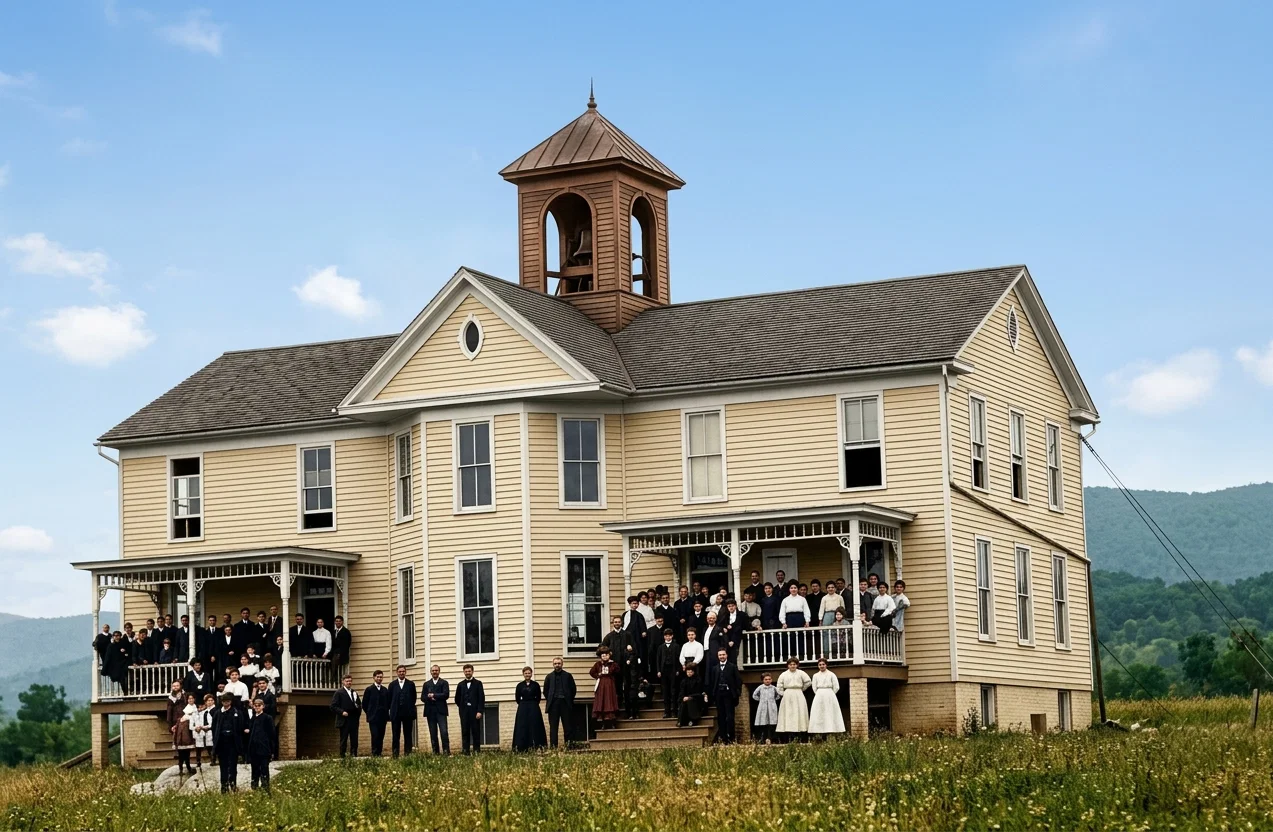
ANNOUNCEMENT has been previously made of the beginning of a school, and the erection of buildings, by the Virginia Conference. It is located at Newmarket, Va., in the historic and beautiful Shenandoah Valley. It had its direct beginning in the wish of Brother Charles D. Zirkle, who died March 27, 1905. Before his death he requested his father to give to the Virginia Conference, for the purpose of establishing a school, a portion of real estate, which would have belonged to him had he lived. After his death his father and mother, respecting the request of their son, deeded to the Virginia Conference a tract of land containing a fraction over forty-two acres, and valued at about three thousand dollars.
Upon this ground the conference has erected a neat school building. The total cost of the building is about five thousand dollars. It was dedicated by appropriate exercises on Sunday, September 13. This building is constructed so as to make two separate homes—one for boys and one for girls. As will be seen from the picture, there are two separate entrances. The schoolrooms and the dining-room are in the center of the building, with separate entrances for boys and girls. This plan makes possible the handling of boys and girls in one building with many advantages.
THE SCHOOL AT NEWMARKET, VA.
The Shenandoah Valley lies between the Allegheny and Blue Ridge mountains. Its fertile soil, its good climate, and its beautiful scenery make it indeed an ideal location for a school. Every view from the building is pleasing.
The school being away from the village, the students can work undisturbed. Prof. R. G. Ryan and his wife are in charge of the school. Mrs. Ryan has been preceptress of South Lancaster Academy for a number of years. They have associated with them instructors who are qualified for excellent work. This school will be of great value to the Virginia Conference.
The Opening of Our Schools
By Editor
[We delayed the Educational number of the REVIEW one week, and sent out letters to the heads of all our intermediate schools and colleges, asking for a report as to the opening of their school. We are certain that the reports which we have so far received will be read with much interest by our people, particularly by those engaged in school work.—F. G.]
Union College
This school opened September 9, one week earlier than usual. The enrolment of three hundred eleven was not quite so large as it was on the corresponding date of school last year, perhaps because school began a week earlier than last year, and also because three new academies are opening in Union College territory. However, every available room for the gentlemen is now filled, and we have begun to locate newcomers in the village. A higher standard of scholarship is noticeable in the new students. Classes in the preparatory grades are smaller than in former years, some being almost entirely eliminated. The good work of our academies and intermediate schools is thus apparent. The religious conditions opened very favorably. Elder Luther Warren is with us again to hold a series of meetings at the beginning of the school year. Special meetings were held Thursday and Friday evenings and Sabbath forenoon. At the close of the meeting Thursday evening, ten persons signified their purpose to lead a Christian life. Pray for the blessing of the Lord to attend this revival effort at College View.
C. C. LEWIS.
South Lancaster Academy
Our school is full to overflowing. We had more at the beginning this year than we did last year. There is particularly a large increase in the number of young men who have entered. Everything started off in fine order. Our new electric plant is installed, and we expect our heating and light, being thus connected, to be much cheaper than it has previously been. Sixteen young people took their stand for the truth at our Friday evening prayer-meeting. This was very encouraging to us.
B. F. MACHLAN.
Cedar Lake Academy
Our school opened Tuesday, September 8, and although this was earlier than ever before, there was a fair attendance the first day. Others are continually arriving. They are a fine class of earnest, wide-awake young people. The students’ rooms in both the boys’ and the girls’ halls have been made pleasant by having the walls nicely tinted. Other improvements are being made about the home, which will tend to make the plant more convenient. We are looking forward to a pleasant year’s work.
W. L. AVERY.
Battle Creek Academy
We began our school this year on the first day of September. At present we have one hundred twenty-five pupils in attendance. In the upper grades we have more students than at any time since the academy was established. We are anticipating a very profitable year’s work.
FLORA H. WILLIAMS.
Southern Training-School
Our school began September 16. The whole tenor of the program was along missionary lines. The students all seemed interested in the theme of the day. The enrolment was gratifying, and the spirit manifested by the students encouraging. Teachers and students alike dedicated themselves to the work of the Lord for service. We are expecting splendid results from this year’s work.
M. B. VAN KIRK.
Adelphian Academy
During the first week of school there were just twice as many enrolled as there were at the same time last year. Thus the Lord has prospered us as far as bringing the students to our school is concerned. Our recent camp-meeting showed that the young people in this part of Michigan are being stirred mightily upon the subject of Christian education, and the necessity of their procuring a29preparation for service in the Lord’s work. Our various industrial departments are being greatly prospered.
R. B. THURBER.
Mount Vernon College
We have about fifty per cent more students than were in attendance at this time last year, and more are coming. They are a splendid class. There appears to be a disposition on their part to co-operate with the management in discipline and class work. Our building has undergone extensive repairs, which makes the work more pleasant than it would have been otherwise. We shall have electric lights in a few days. The piping is being laid for natural gas in the kitchen and for heating the boilers. This will be a great improvement over soft coal, which has been used heretofore. We are of good courage.
S. M. BUTLER.
Beechwood Academy
We opened school September 16, with an attendance of forty-four, which has increased to fifty-one thus far. The students have settled down to hard work, and an excellent spirit prevails among them. For this we are grateful. Our building has received quite extensive repairs. We are looking forward to an excellent year’s work.
CLIFTON L. TAYLOR.
Emmanuel Missionary College
Our school began with fifty-three students on hand, and in two weeks this number was increased to seventy-three. Others are coming in continually. The students are of an excellent class, and seem to have educational ideals that are wholesome. Our college building has been almost completely white-coated or tinted on the inside, and the ladies’ dormitory has been completely overhauled on the inside with tinteresco and white lime. The boys’ dormitory is being white-coated and the lower floors refloored. A steam-heating plant is also to be installed. Our courage is good.
O. J. GRAF.
Strode Industrial Academy
Our school opened under very encouraging circumstances. The enrolment is between eighty and ninety, with others coming. Every seat is taken in the dining-room. A better class of students I never met in any school. Our buildings are nearing completion.
N. W. KAUBLE.
Elk Point Industrial Academy
Our school opened September 16, with an attendance of twenty-six. This number was a little less than the first day last year, owing to the fact that school opened a week earlier. We now have thirty-three, which is as large a number as at the same time last year. We have a larger number of young men than young ladies, which has not been the case before at the opening of school. There is a spirit present to make this the best year of the school. We are of good courage, and the outlook is good for a full school.
J. B. CLYMER.
Oakwood Manual Training-School
Our school opened September 23, with an enrolment of sixty-one, and others will come later. We believe we have very good prospects for a successful year. We are able to introduce higher work than ever before. A better class of students is entering the school. Our nurses’ training class is also doing good work. We are greatly encouraged.
W. J. BLAKE.
Iowa Industrial Academy
Our opening exercises were held September 9. The prospects are fair for a prosperous school year. At the time of our opening our two cottages were filled with students, and now we have a total enrolment of fifty-three. The erection of our new building has now been begun. We all feel encouraged with the class of students that have come to the school this year. They seem desirous of co-operating and lifting with us.
M. M. HARE.
Walla Walla College
College opened for another year’s work September 9. Those who spoke at the opening exercises expressed their faith in a greater work being done by the college than ever before, and that the prospects for the present year were very encouraging. There were ninety-nine students enrolled in the college department, and seventy-five in the normal department, making a total of 164 students, an increase of about fifty pupils over last year. The Lord is moving upon the hearts of the youth everywhere to make haste in the work of preparing to enter the whitened harvest-fields. School has been in progress eight days, and the enrolment to date is two hundred twenty-six, and every day is bringing more. While we thank the Lord for large numbers, we feel more grateful for the larger measure of his Spirit and presence that we believe will characterize the work of the new year.
M. E. CADY.
Fernando Academy
This school opened on September 2, with a good attendance. During the summer the building was refitted, and the class-rooms were readjusted. Everything was in good condition when school began. All seem to be pleased with the changes made. An excellent spirit marked the opening of the school, and this has continued since the school started. The Friday evening social meeting was very refreshing to both teachers and students. The students showed that they had not lost their spirituality during the summer. There are about one hundred twenty-five enrolled, so the chapel is about full. We know that the Lord has been blessing us since school began, and it can be said of our school, “The Lord is here.”
H. G. LUCAS.
Mount Ellis Academy
Our school opened on the morning of September 16. A mature and earnest class of young people are in attendance this year, more so than I have ever known in this school. About forty are now enrolled, and others are planning to come; and almost all who are here are preparing for some part in the Lord’s work. All the buildings have been freshly painted, and many repairs and improvements have been made. Taken all in all, we think that the outlook for the present year will compare very favorably with any preceding year in the history of this school.
W. A. GOSMER.
Cumberland Industrial School
This school opened with a larger enrolment, and a more earnest and spiritual atmosphere, than last year. The Bible and missionary biography studies are given special prominence. Evening classes have been organized for parents and neighbors. Heaven’s benediction has rested upon our labors upon the farm. I feel much encouraged about our work here.
CLIFFORD G. HOWELL.
Lornedale Academy
The academy opened September 23, with an enrolment of fifteen, and we expect several others in a few days. Every one seems of good courage for a successful school year. With the new building completed, dedicated, and practically paid for, we are in a fair way to make the school a success. Unity prevails in the conference, and we look for much from the school during the coming year.
EUGENE LELAND.
Hazel Industrial Academy
We have with us a fine class of students this year. The enrolment is thirty-six. The new building, which is just completed, is a wonderful improvement over the tent school-house of last year. We are trying to be true to the name of the school, Industrial Academy, and we are very thankful for students who are willing to work.
THOS. D. ROWE.
The School
By J. F. OLMSTED.
Union College, South Africa
As we read in the REVIEW the good reports of our schools and their work, we feel encouraged as we note the progress made during the last few years. Truly our young people of to-day have many educational advantages that were almost unknown a few years ago; and many are filling places of trust and responsibility as the result of sound teaching and thorough preparation made while in school.
Our attendance is not large, but shows a gain over last year. We have a good class of students, and the older ones are preparing to enter the work. A good spirit came in during the week of prayer, which has continued up to the present time. Our seasons of prayer and meditation are times when God's Spirit comes especially near; and we look back to these gatherings, realizing that prayer moves heaven, and brings us nearer our eternal home. We trust that several of our young people will soon be in active service, and that we in this part of the world may do our part in hastening the Lord's return.
This country is passing through a most distressing financial crisis. Hundreds have been discharged, others are working on half pay, and all have had their salaries greatly reduced. Great numbers have gone home to England, Australia, and the States. Men of means are searching for new and more promising fields for speculation. Business is paralyzed, and enterprise well-nigh ruined. Our people are, also, more or less affected by this unsettled condition, and our institutions are, from time to time, seriously embarrassed in endeavoring to make income balance expenditure. But the Lord's work must be carried on regardless of financial disasters; and we are persuaded that if we hold on to the mighty arm of Christ, our trials and perplexities will be overcome. The walls of Jericho did fall before God's people, and the chosen of the Lord put their enemies to flight; so if we walk in the light of his presence, victory will be ours in the closing conflict of this world's history.
J. F. OLMSTED.
Notes
By Editor
NOTE was made last month to the effect that Prof. A. W. Spaulding had severed his connection with Bethel Academy, with the intention of taking up school work in the South. These plans have since been changed and Professor Spaulding will continue his work as principal of Bethel Academy.
The special attention of parents and teachers is again called to the “Church-School Manual” recently issued by the Pacific Press Publishing Company. It can be obtained from all our tract societies, and should be in the hands of every one who has to do with the training of children. Most valuable suggestions are made as to courses of study, text-books, methods of teaching, etc., and many questions which perplex teachers and parents in the education of their children are here answered.
Mention has been made in recent REVIEWS of several new text-books in preparation. They are: “A New United States History,” by Prof. F. S. Bunch. This can be obtained of Prof. M. E. Cady, of College Place, Wash. “A New Course in Music,” by Prof. Gerard Gerritsen. This can be obtained from the author at Room 670, 324 Dearborn St., Chicago, Ill. “Lessons on Daniel and the Revelation,” by Prof. H. A. Washburn. This can be obtained by addressing the author at Walla Walla College, College Place, Wash. We would most earnestly urge our teachers to secure these books, and use them this year. They are being brought out at the suggestion of the Department of Education, and are presented for this year’s work in tentative form. It is earnestly desired that the teachers shall co-operate with the authors and with the Department of Education in a critical examination of these manuscripts in actual class work; and that they will freely express their criticisms to the author in order that such changes may be made in the manuscript as will make it a durable and valuable text if the works are adopted by the Department of Education, and brought out in permanent form. Our teachers can not have it too strongly impressed upon them that one of the greatest needs is a good series of text-books.