Your ShelfYour Projects

Review and Herald, Vol. 92, No. 15.

The Instructor Temperance Annual
Earlier text: Willing Service

Among the Outstations of Hu-peh, China
R. F. COTTRELL
On Nov. 27, 1914, at 6:30 A. M., Brother Li Wei Ching, Mrs. Cottrell, and I started by train to visit Ying-shan, our most northern outstation in Hu-peh Province. On leaving Hankow, we first passed through a low, marshy tract, and after that a good agricultural district. By eleven o’clock the mountains near the Ho-nan border were reached, and at a place named Kwang Shui (broad water) we left the railway, and pursued the remaining fifteen miles by sedan chair.
Three of our brethren had walked to the railroad station to meet us, while others came a part of the way to extend their welcome. As it had been quite impossible to rent a suitable chapel in the city of Ying-shan, we found the place of meeting to be at a little market village about three miles in the country. Although there had been no regular evangelist at this place for several months, we were pleased with the way in which the church school and the Sabbath school were conducted, and with the earnest desire to study the message.
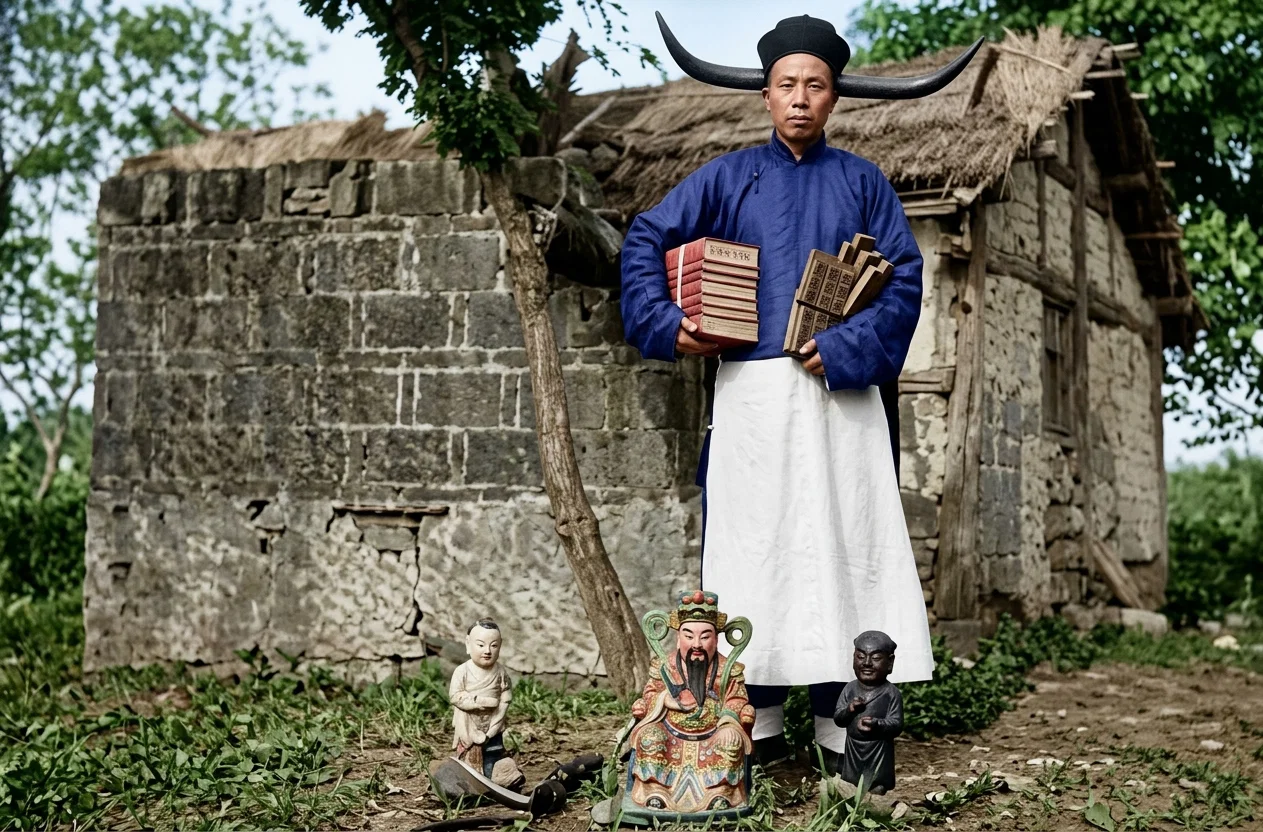
One inquirer requested us to perform Christian marriage for his son. A former Taoist priest, who united with us a year ago, made arrangements to become a colporteur. The accompanying picture shows this brother and one of the idol shrines near his home, where he had in the past so frequently worshiped and officiated. Here we had the pleasure of receiving nine candidates by baptism, and we hope a church may soon be organized. Returning a part of the way to Hankow by the modes of conveyance already mentioned, we next visited Siao Gan, a city of 40,000 inhabitants, where we have had a chapel and church school for over two years. The rented buildings occupied by our mission are large and well constructed, but being in a quiet section of the town, are not suitable for a strong evangelistic campaign. We hope a better location may soon be found.
At this place, three followed their Lord in baptism. One of these was a man eighty-three years of age. As it was a cold winter day, some feared the feeble old man could not endure the ordeal, but he reassured them. Entering the water with a radiant smile, he was baptized without shudder or struggle, and on nearing the shore, gently brushed aside the extended hands, saying, “Please don’t trouble, I am well able to walk without help.”
To the next outstation is seventeen miles, and of this distance we traveled ten miles by rowboat, four miles on foot, and the remaining three by sailboat. Reaching Chiang Giang Pu, we remained but one night, promising the people that we would return in a few days, and make them a longer visit.
A former Taoist priest, and the shrine where he often officiated before learning to love Jesus. The center idol is the village god, and those on the right and left are the gods of rain and wind, respectively.
A half day’s trip by chair brought us to Ying-cheng, where we stayed one night and spoke to a small company of inquirers, and on the following day went to Lodien. The surrounding country has a somewhat rough, wild appearance, and here and there, either on mountain top or encircled by moat, are large inclosures surrounded by high walls, to serve as refuges or fortresses for the people in case of war or bandit raid.
The people, too, seemed quite untouched by civilization; and as no foreign woman had previously visited that section, large crowds followed us everywhere, and could not be kept out of the house even while we ate our meals. A goodly number at this place applied for baptism, and a few candidates were accepted; but after careful consideration it was decided to ask all to wait for a time to study the gospel more fully.
During this visit, we were given the use of the town theater for public meetings, and many thus heard the “good tidings” for the first time. A number of substantial persons are here enrolled as believers, and the outlook for the future is most promising.
Returning to Chiang Giang Pu, where we have a school for boys and girls, we received an enthusiastic welcome. The mission compound was decorated with mottoes, flags, and banners, and at night was illuminated with Chinese lanterns. For a part of one evening, the boys stood in line on one side of the open court, and the girls on the other. One side sang a hymn, and the instant it was finished the opposite row started another, and so on, alternately. As a number of the children had good voices, splendidly trained for interior China, the exhibition was pleasing and commendatory. And as we sat listening, Brother Chen, for fourteen years a raving maniac, but who had been clothed in his right mind in answer to the earnest prayer of our brethren, passed quietly in and out, serving cups of hot water to the assembled guests.
During our visit here, ten were baptized, and three young men were accepted as students for the training school in Shanghai. Although a little early, the annual offering was also taken, which amounted to $56.40 Mexican, a splendid gift, and one that meant real sacrifice to most of the givers.
Returning to our home, we spent the week of prayer with the Hankow and Wu-chang churches. Each of the readings was translated verbally. Our Chinese brethren and sisters gave a loyal response, and covenanted with God that by his help during the next year they would live and work for Christ as never before. The native annual offering in these two churches was $66 Mexican.
The week following, we visited the new outstation in Chichuen, which by steamer and sedan chair is a two days’ trip from Hankow. At this place the brethren and sisters warmly welcomed us. A private school building is freely given, which serves for the present as chapel, and home for the evangelist. The believers are mostly farmers of a substantial class, and on Sabbath afternoon six of their number were buried in baptism. We trust that this is but the first fruits of a large ingathering in this new locality.
During 1914, Mrs. Cottrell and I have traveled 1,300 miles in visiting our Hunan and Hu-peh outstations. In so doing, we have journeyed by steamer, sailboat, rowboat, railway train, sedan chair, wheelbarrow, on horseback, and on foot. In all this journey, we have not once traveled in the rain, nor been delayed because of bad weather. Although there has been frequent rain during our stay at various places, when the time came for us to leave, the clouds lifted. For this kind providence we wish to bear special testimony to the favoring hand of our Heavenly Father. About two hundred believers have presented themselves as candidates for baptism, and it has been my privilege to administer this blessed rite to one hundred and three. The others have been advised to study the gospel message a little longer before taking this step.
Photo by R. F. Cottrell
Brother Chen, demon possessed fourteen years, restored by the power of the third angel's message.
Photo by R. F. Cottrell Brother Chen, demon possessed fourteen years, restored by the power of the third angel's message.
The opportunities for work in Central China are apparently limited only by the lack of workers and the scarcity of funds. Could our young people in America but know the conditions, the volunteer corps for missionary service would be doubled; and could the members of our homeland churches see the needs as they really are, I believe there would be five dollars where now there is one, to proclaim this closing message in the great heathen fields.

The Salvation Army at Fifty

Hardly a country in the world but in one way or another is uniting just now in celebrating the fiftieth anniversary of the founding of the Salvation Army. This organization holds property today valued at $32,000,000, and carries on a charitable work that ranks it among the leading philanthropies of the age.

Malaysia

(Continued)
F. A. DETAMORE
BROTHER YATES accompanied me to lisher Battakland, and we left Padang on Sunday morning, August 23, going by rail to Ft. De Kock, where we remained that night. The next morning we started early on our long journey by carriage overland through the mountains of Sumatra. It took us till Friday to reach Si Pirok, where our native brother is working as best he can. It was a splendid trip for us, and we were compelled to practice our Malay, for we met but one or two during the journey who could speak English. We had a beautiful view of the country, and saw the Malay in his native state, as we climbed mountains and again descended into the valleys, passing village after village of naught but native huts, and stopping nights in government houses kept only by natives, all of whom were Mohammedans.
Feeling that we might never pass that way again, we resolved to do something to leave a testimony of truth behind us, so we took a large package of papers in the Malay language. At first we planned to give these out, but later decided to sell what we could, and give only when we thought best; we began on the train, and succeeded in selling many papers all along the way, and left a goodly number as presents to those who could read. At one place we found a Malay who could speak English; and as the people crowded around, we used him as an interpreter, telling them what we could about Jesus and his soon coming. The interpreter told them that what we said was true, though he himself was Mohammedan.
Only a few years ago this was the land of the head-hunters, and it is claimed that there are still wild tribes back in the hills who have not been conquered. We were not afraid, for we felt the constant presence of our Lord and Master, and we prayed much for the poor people who know him not.
On Friday, August 28, we arrived in Si Pirok, and found Brother Immanuel Siregar well and of good courage. He made request over a year ago for permission of the government to teach the Bible here, but he recently received a negative answer. He is permitted to teach English, however, so he has started a school. We did not know that he had started the school till we arrived, though it was opened last March. Some things were not as they should be, and we found some difficulty in adjusting them, but I am glad to say that after much prayer and several days of counsel, we feel that the Lord has helped us to come to an understanding.
There is a great interest in the truth, and men are coming almost constantly to learn about it. Persons who heard of our coming walked from thirty to fifty miles to see us. One man and his daughter walked about fifty miles. He has been a minister for years, but has given up his position, and has decided to obey the Lord and keep the Sabbath. He has been a teacher in the training school for Battaks, and has a splendid reputation, being well respected by his fellow workers of the past. He is not yet fully established in all points of the truth, but shows a very teachable disposition, and I hope that the time will come when we can baptize him, and that he will help us give the message to the Battak people. This must be done largely by the native worker, but must be supervised by a foreigner.
TOEROETONG, SUMATRA, SEPTEMBER 5. — This letter was begun several days ago, but I had to leave it to go and visit Brother Immanuel Siregar's school, and have not had time to write more since.
This has been the Sabbath, and I have stopped here for the day. It is two days from Si Pirok. The first day I traveled on horseback, and carried my luggage on a pack horse. The roads are too steep, rough, and stony for a carriage. The boats are so far apart that I could travel this way and get to Penang by way of Medan sooner than to wait for a boat; and it is cheaper, too. It will also afford me a better chance to study the people and become acquainted with the field. Brother Yates left me at Si Pirok, and returned by way of Siboga, so I am quite alone. Today, I have called on some in this place who are interested in the truth from visiting with Brother Immanuel, but I could talk so little Bible in Malay that I could not do much. Some have learned that I am here, and have come to see me. I have given out some papers in Malay, and pray that some seed may fall upon fruitful ground. My heart goes out in pity to these poor souls. How quickly they respond to love and tender treatment! Many of them are Christians, but the majority are Mohammedans. They all seem very willing to listen to the truth, and the Mohammedans seem surprised to know that I do not eat babi (pig). As they do not eat it, they are glad to meet a Christian who is in sympathy with them on this point.
Tomorrow morning I shall resume my journey, going as far as Baligi by carriage, and thence by boat across Toba Lake, and again by carriage to Medan, where I plan to take the train to the sea, and from there go by ship to Penang, and on to Kwala Lumpur by train. It has been a very profitable trip, all things considered.
Though hard in many ways, still the view of the country, the sight of the masses of people in their native state, the opportunity to leave a few papers in their language, and the hope to be able to do more at some not-far-distant time for their eternal salvation,—all this has more than overbalanced the lack of food and comforts. I have scarcely tasted water since I left Padang, for fear of disease, but have been able to get green coconuts, and these have been a splendid substitute. I have lived principally upon rice and eggs.
Our crying need is for consecrated men who have tact and wisdom, to patiently teach this people the way of salvation in a simple way. My own heart has been melted as I have seen how they grasp the lessons of divine truth. Two men came to see me at Si Pirok, and when I asked how they were getting on they replied that the way was clear, but that they lacked power to obey. I gave them a Bible study on the principles of obedience, showing that the power is not in man nor in his promises, but in God and the promises of the new covenant; that it is ours to choose to obey when the temptation comes, and it is God's to give what we choose, and that is sure victory. I wish you could have seen their faces light up with joy, and they declared that they would try more intelligently to trust God's power. I beg of you to remember these perishing souls in your prayers.
BROTHER C. L. BUTTERFIELD, of Korea, writes:—
“This has been by far our best year in Korea. There has been a good increase in church membership, Sabbath school attendance, and a gain of over fifty per cent in tithes and offerings over last year.”
“For all this we thank God and take courage. I have just returned from a country trip, during which I found several new believers rejoicing in the truth. So it is in many places; as the printed page is being scattered throughout the length and breadth of the land, many are accepting the truth with joy.”

Pictures and Their Care

L. A. HANSEN
PICTURES give the finishing touch to the furnishings of the house. Their selection and placing require discrimination. They should be appropriate to the room and harmonize with its furnishings.
Do not hang inharmonious pictures together. Do not mix paintings, drawings, etchings, and bric-a-brac. An etching should not be placed beside a strong oil painting, nor where it will be completely overshadowed by the painting. The same may be said of a delicate water color.
Highly glazed pictures or pictures under glass should not be hung opposite a window where the glare of light will be reflected, obscuring the detail of the picture. Pictures should be hung so that the light falling on them will make them show to the best advantage.
A picture has an unconscious influence in its suggestions. It is not merely a decoration. There is a psychological side to the use of pictures. Being kept year after year, they usually find a permanent place in the home. They become a part of lifetime associations. It is worth while to give thought and care to securing only those which are really suitable for particular places. The mere fact that it is a picture does not afford sufficient reason for giving it place on the wall, in the home, and in the family, as it were.
If the entrance to the house is used merely as a hall or passageway, it should have but few pictures, and they of a design that can easily be taken in at a glance, as persons are not expected to linger there long. Architectural subjects are suitable. Simple frames should be used, in harmony with the simple furnishings. If the hall is used for a reception room, it should be furnished accordingly, and the pictures should be in harmony with the background.
Pictures for the dining room should be bright and cheerful. Welcome and good cheer should be depicted in all its furnishings. The wall coverings are important, and should preferably be soft-toned. Pleasant things to look at during the meal hour will be helpful to good digestion.
We used to see an arrangement called “A Memorial,” consisting of the picture of a departed one, with crape costume, dark-bordered handkerchief, etc. Possibly it had a picture of a tombstone. Its effect was like that of a perpetual funeral. If such memorials are still in the home, their place is certainly not where they will often be seen by the family members, or at any time by guests. Such things do not serve as decorations. Their finishing touch is not the right kind. Their psychological effect would better be spared.
Portraits of family members belong in the bedroom, rather than in the living room. Good judgment rather than sentiment should rule in the matter of what portraits are kept hanging on our walls, determined by whether their presence is helpful or otherwise.
Do not think that “anything” will do for the bedroom. The pictures should be restful and conducive to peaceful thoughts. Beautiful landscapes are appropriate. Seeing a nice picture on awakening in the morning is helpful. The bedroom is not the place for such pictures as “The Assassination of President Lincoln,” “The Early Christian Martyrs,” or “The Last Hours of John Bunyan.”
The nursery should have pictures that will start the little folks aright, educating their eyes from the beginning to that which is of the best. What older person does not remember well the pictures of childhood association? Children are attracted by pictures. Growing up with certain ones before their eyes and in the mind, must have some influence on the developing character.
The living room may have a miscellaneous collection of pictures. These should not emphasize too much the personal likes or individual taste of any member of the family, but should be suitable for all the family and for visitors. They should not be all black and white, else the room will be too dead and dull; use some color.
Individual taste of the young men or ladies of the family may be better considered in their own rooms. Here the pictures may reflect school life, or other suitable individual taste.
The frame should be appropriate to the picture, and yet in harmony with the background of the picture and the furnishings of the room. The picture should fit into the room, and not stand out as something separate and distinct. The frame determines this very much.
Oil paintings require gilt frames. Water colors may be framed in gilt or wood. Black and white pictures go in simple frames. Brown etchings and chalk drawings may be put in broad, smooth frames of natural oak. White enamel frames are for bathroom pictures, though some water colors combine well with gold and enamel.
Clean ornamental gilt frames with a soft clothes brush. Rub the ends of the hair over a lump of beeswax, then brush over the ornaments with a rotary motion, working the brush into the bottom of the ornaments. The wax gives a clean, fresh appearance to the frame, and removes dust without spoiling the frame.
Takoma Park, D. C.

The Home Department

Conducted by Mrs. C. C. Lewis, Takoma Park, Washington, D. C.
Assisted by Miss Lora E. Clement
Through the columns of this department, hints will be given on all matters pertaining to the home life. Short articles and letters are solicited from home makers, telling of their everyday experiences,—their joys and sorrows, their failures and successes.

Thy Mother

LEAD thy mother tenderly Down life's steep decline; Once her arm was thy support, Now she leans on thine.
See upon her loving face Those deep lines of care? Think—it was her toil for thee Left that record there.
Ne'er forget her tireless watch Kept by day and night, Taking from her step the grace, From her eyes the light.
Cherish well her faithful heart, Which through weary years Echoed, with its sympathy, All thy smiles and tears.
Thank God for thy mother's love, Guard the precious boon; For the bitter parting hour Cometh all too soon.
When thy graceful tenderness Loses power to save, Earth will hold no dearer spot Than thy mother's grave.
— Kate Hogan.

The Use of Tincture of Iodine in the Home

E. DOLPHUS HAYSMER, M. D.
TINCTURE of iodine is probably the most used drug in the world in “first aid to the injured” work, and is generally employed to paint the skin in order to sterilize it preparatory to operations. Its use has marked an important era in antiseptic surgery. It is, however, remarkable in how few homes this drug is to be found, and its common use is to paint inflammatory parts rather than to kill germs.
Germs cannot live in alcohol, and iodine is one of the greatest antiseptics. When these are combined, as in tincture of iodine, we have a most useful and powerful antiseptic which is easily and safely used.
All cuts and bruises should be thoroughly painted with iodine as soon as possible after the injury, and once a day until well. A dressing may or may not be applied after the painting, depending on the nature and extent of the injury. No matter how small the scratch or abrasion, this treatment should be used. In large wounds it is equally applicable, and should be applied before the physician arrives. Often the smallest injuries when improperly treated result in serious with inflammations, and at times even in blood poisoning. I have known of two cases of fatal blood poisoning occurring in the last three months from small wounds received while shaving.
Tincture of iodine should be kept in every home, and used whenever an injury is received. It is easily applied with a simple applicator made by twisting a small piece of cotton on the end of a toothpick. This can be dipped in the iodine, and the affected part painted.
Iodine will smart in most cases, but its great value in preventing infection will greatly outweigh any objections to its use. The too frequent use may result in blisters; this can be avoided by either using it less frequently or diluting it with an equal part of alcohol. If too much is applied, the excess may be removed by sponging with alcohol. It is well to remember that iodine stains can be removed with ammonia water.
Hastings, Nebr.

Too Much Attention Injurious

MRS. HELEN M. STEWART
The truth of the principle expressed in the heading of this article came home to me with particular force during my experience as nurse. I have often said to busy nurses, “Give people a chance to get well.” One little babe I attended was simply being worn out by constant treatment. Baths, temperature, medicine, and injections followed one another in rapid succession, leaving very little time for rest and sleep.
I try to avoid this evil with my two little boys, aged three and a half and four and a half years. During the hot weather we are up early in the morning. After breakfast and prayers are over and papa has gone to work, I try to devise some errand for them to do. This brings them into contact with their little friends and neighbors, and sometimes I have two hours without interruption for general housework. Then James usually comes in just to make sure I am here.
The long hot afternoons when the little folks must not be exposed to the sun are nearly as difficult to manage as the wet days in winter. We have no delightful barn with hay or corn piles, and other joys. Our trees are not grown enough for shelter yet, and, besides, the insects in the grass are very troublesome. Sometimes I let the children go over to the carpenter shop and play with the gardener’s children, but I cannot watch them there, so I do not like them to be away very long. This afternoon we had one of our summer storms, so we had to stay indoors. It was a great comfort to have the air cooled off. Finally, as an antidote for the fidgets, I suggested the Sabbath blocks, as they had not been in use for a week or two. This kept the boys occupied until nearly supper time.
I have felt lately that I ought to devote some time to teaching the little folks their letters, some little verses, etc. I cannot sing a note, so it is not possible to teach them that way, which I really think appeals to children more quickly than any other method. Some of the sisters think it is absurd to think of teaching them anything definite yet. Please advise me what to do. This afternoon as we watched the clouds racing up from the Rio de la Plata, James said, “Los cielos se van!” (The clouds are moving.) So I explained about the clouds and the wind. The children are not at all afraid of thunder and lightning. “La luz” (the light), James calls it. I have been careful that they should not get the idea that there is anything which they need fear.
South America.

How I Taught My Little Girl to Read

MRS. F. B. YOUNG
My little girl learned to read by the sentence method. I wrote sentences on the blackboard, and had her tell me what I had written, not allowing her to give any part of the sentence until she could give the whole readily. Then we took up the word method, and she learned very readily. When she was perfectly familiar with about eighty words, I let her have the book (“True Education,” No. 1). She is now reading on page 42, and seems to enjoy it very much. She likes to write, and does a great deal of it. Inclosed is a little letter in her own wording and spelling. I knew nothing of it until it was folded and handed to me. We have just moved to this place, and she takes great delight in writing to her city playmates. Please advise in regard to what copy book she should use, or is she too young for one?

Beauty of Character

THERE is always a certain amount of enchantment about a beautiful character. We all know what it is to meet those whose quality and beauty of character we admire and esteem. How it thrills us with the dignity of its gracious mystery, its rare, delicate sympathy, its natural charm! Every one in this transitory life of ours has in his mind the ideal of what he would like to be; and the loftier and nobler the ideal, the more godlike will the character become. Each character, with its beautiful thoughts and beautiful actions, is an exquisite proof, a living, practical witness on earth, of the power and glory of God.
What are the effects of a strong and beautiful character upon those with whom it comes in contact? In the first place, it is the divine inspiration which it continually inspires in the hearts of others toward the love of moral beauty. In the second place, it is the example of such a character, with its tremendous influences for good, which cannot be overestimated. It shines forth with radiant beauty like some bright, serene star, guiding with the glory of its light the footsteps of wanderers, lest peradventure they stumble through the darkness of the world.—“Great Thoughts.”

West Pennsylvania Conference

The year 1914 brought its cheer and blessing to our brethren and sisters in this conference. A deep interest has been taken by our conference workers and churches in the upbuilding of the work in this part of the great harvest field.

Progress Made in 1914

We have great reasons to thank our Heavenly Father for the progress made last year. We can say, “Truly God is good to Israel.” We know that it is not by might, nor by power, but by the Spirit of God that this conference has been able to make a favorable showing. We rejoice that we made up our full quota on the Twenty-cent-a-week Fund, which amounted to $8,216. Elder R. T. Dowsett’s visit in the conference was much appreciated. He and the writer visited twenty-one churches, receiving in cash and pledges about $1,400 for missions.
Our tithe showed an increase of nearly two hundred dollars over the previous year. Six new Sabbath schools were added, with an aggregate membership of sixty-six. Sabbath school offerings to missions amounted to $3,982.28, being $742.23 more than the previous year. Literature sales amounted to $15,000, and, best of all, 116 persons were baptized.

Future Work

We are now more concerned over the future than the past. What will be our record this year? We all realize that as the end of time draws near, our responsibilities to God in soul winning are increased. Thorough organization and plans are needed in order to reach success. Our conference committee held its annual meeting at the conference office February 22 and 23. It was voted that each worker in the conference visit every church in his district, instructing the members how to do missionary work, and at the same time presenting the plan for raising funds to make up the full quota of twenty cents a week per member for missions.
The Atlantic Union Conference asks all who can to pay one dollar a week for missions. Some cannot pay this much, while others can give more. This plan has worked well in that union conference, and it saves making such a heavy call for offerings at the camp meetings.
We know that all appreciate the need of funds for missions, and we trust, when cards are presented for signature and a statement of the amount you will pay this year, that you will consider for a few minutes what God is doing for you, and that you will realize that what you give is given to God. You are dealing with God, and not with men only.
The conference executive committee, in looking over the field for a place in which to hold camp meeting, has voted to hold it at Homestead Park, Pittsburgh, in June. The date of the meeting will be June 17-27.
Our courage is good. We are trusting, with divine guidance, to reach a higher standard than ever before. Our greatest need is the Holy Spirit. If the Spirit is with us, we shall be led every step of the way. F. H. ROBBINS.

A Visit to the Atlantic Union

I RECENTLY enjoyed the privilege of spending a little time in the Atlantic Union, and was much encouraged at the evidence of growth seen in the work.
I spent a day with the Massachusetts Conference Committee. The headquarters of this conference are now located in Tremont Temple, Boston, one of the most central and accessible places in this great center of population. Elder Allen Moon is carrying on an aggressive work, seeking to develop churches in the cities, of which there are many. The great need everywhere is for strong young men of deep piety and consecration who will enter the ministry and become efficient in the winning of souls to Christ.
The Melrose sanitarium is enjoying a splendid patronage. An excellent spirit pervades the entire institution, and it was a great privilege as well as a blessing to mingle with the large family gathered in this institution. While I was here, a plan to increase the mission offerings was placed before the family. The plan is indorsed by the union, and consists in asking those who are financially able, to pledge to foreign missions one or more dollars a week; or if not able to give so much, fifty or twenty-five cents a week. Pledges are taken for any sum above twenty cents a week. This plan we believe to be a most excellent one, in that it places before those who are financially able a goal of more than twenty cents a week. These pledges are paid into the Sabbath school, or through any other regular church channel. I believe this plan will be attended with excellent results. The sanitarium family responded most heartily, and a sum equal to almost fifty dollars a week was pledged by those connected with the institution, or about twenty-five hundred dollars for the entire year.
I spent one Sabbath with the students and church at South Lancaster. The Lord is greatly blessing the South Lancaster Academy. The attendance is the largest this year of any in the history of the institution. A splendid class of Christian students is gathered in this school, from which a strong force of workers should go forth into the field as laborers. We hope many of them will become strong ministers of the word. The academy family also entered heartily into the dollar-a-week plan, and pledged an amount about equal to that of the sanitarium family.
February 23-28 the annual session of the Greater New York Conference was held, the meetings being in the Central Baptist Church in Brooklyn. This church, which has been leased for several years at a reasonable rental, affords a most excellent place to meet. The main auditorium will seat about one thousand persons. On Sabbath this was entirely filled.
Elders R. D. Quinn, K. C. Russell, and G. B. Starr, Dr. D. H. Kress, Profs. B. F. Machlan, C. L. Benson, and W. W. Prescott, Mrs. G. B. Starr, and the writer were present during some portion of the session, and shared with the local workers in the burdens and blessings of the meeting.
The business of the conference was marked with unity and the blessing of the Lord. Elder J. L. McElhany, who has rendered faithful and efficient service as president, having accepted a call to the Pacific Union Conference, Elder J. E. Jayne was unanimously elected president. Elder Jayne is familiar with the needs and perplexities of this great metropolis. He was present at the meeting, and enters upon his work with the confidence and support of all the people and the workers, and hopefully and courageously takes up the responsibilities he is asked to carry.
The reports rendered at the meeting indicated progress during the past year. We believe the present year has in store even greater blessings, and a more abundant ingathering of souls. It is a great work to carry this message to the millions of all nationalities gathered in this conference. Only God can make it possible. Let all remember the work and workers here in their prayers.
G. B. THOMPSON.
Continue reading: The Passing of the Debt From Mount Vernon Academy