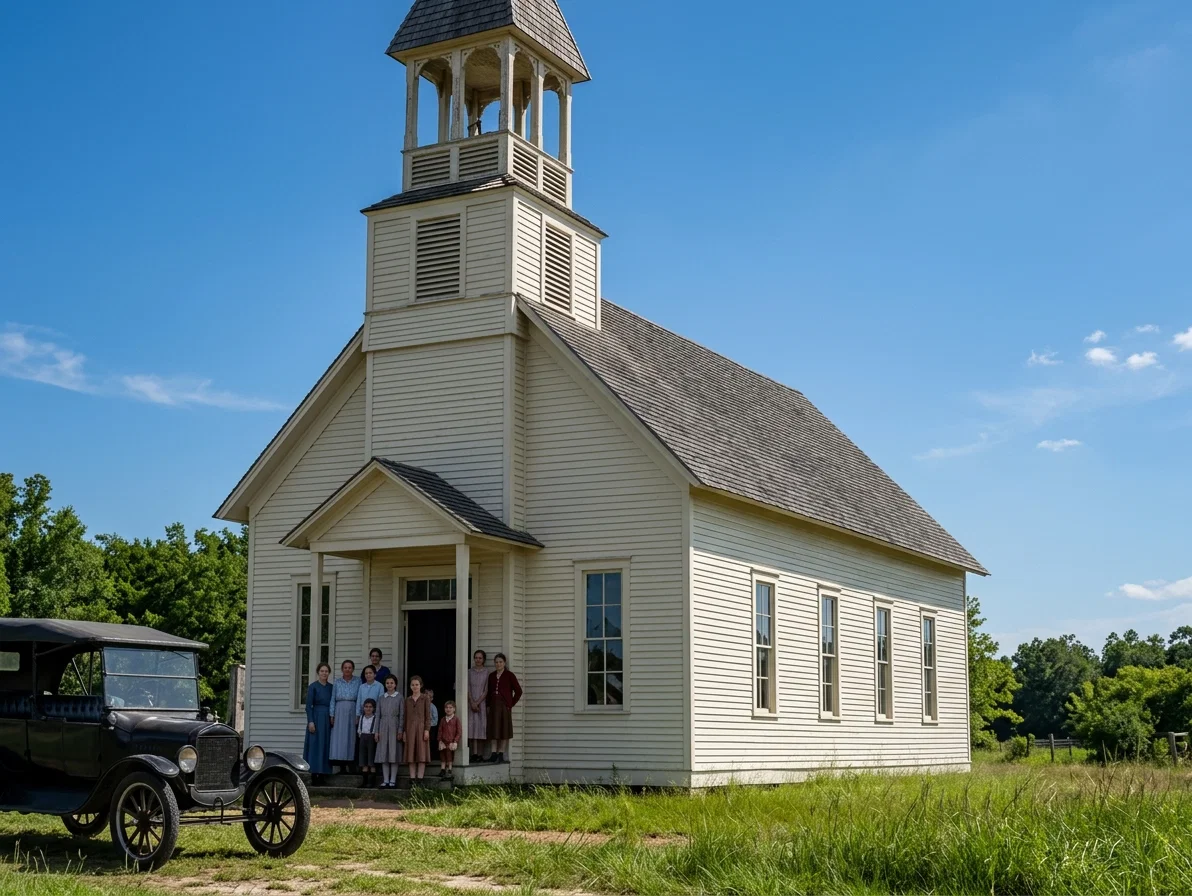
It will be a matter of interest to the readers of the REVIEW to know that this year sees the total indebtedness lifted from Mount Vernon Academy. An institution dedicated to the proclamation that Christ is soon to return is a precious one, and no one who loves the advance of the message can suffer it to be laden with the reproach of debt. It was under the distinct advice of the spirit of prophecy that the institution at Mount Vernon was converted from a sanitarium into an academy. But it was started with a heavy debt, and from that day to this it has labored under a heavy indebtedness. At times the interest to be paid was so heavy that the building suffered sad neglect for the want of repairs.
Until 1908 the academy was managed by the Ohio Conference. That year the Columbia Union Conference was formed, and as Ohio entered the new union, it turned over the academy to union control and union possession. In 1909, when I became connected with the Columbia Union Conference, the debt of the academy was $32,951.21, with the building in need of immediate repairs to the amount of about $5,000.
From the year 1909 there was, each year, an encouraging and growing improvement in the operating gains of the institution. The brethren throughout the union responded liberally to the call for donations, but the great need for repairs during the first few years did not permit these donations to effect great reduction in the debt. The constant appeals, however, throughout the field, began to show results, until the last two years the marked responses have enabled us to pay off the entire indebtedness. For this we offer our heartfelt gratitude to God.
At the academy board meeting held three weeks ago, it was voted to request the faculty to arrange for a jubilee program to be held during the closing exercises at the end of the present school year, celebrating the victory achieved in clearing Mount Vernon Academy of its debt.
At this board meeting the Columbia Union Conference Committee took up the question of the debt upon Washington Missionary College. It was voted to appropriate from the surplus proceeds of the missionary receipts for 1915, fifty per cent to apply on the debt of the Washington Missionary College. We hope this year to make a good showing in affording assistance to this splendid College, and also to clean off the last remaining portion of the old debt on the sanitarium at Philadelphia. When this is done, all the old institutional indebtedness of the Columbia Union will be gone. The record of the union on institutional indebtedness stands as follows:—
Mount Vernon Academy
Pennsylvania Sanitarium
Total
1909
$32,951.21
$
$
1910
30,675.47
82,075.39
112,750.86
1911
30,884.64
45,989.46
76,874.10
1912
28,332.88
17,107.76
45,440.64
1913
26,484.35
9,926.23
36,410.58
1914
18,000.00
9,926.23
27,926.23
1915
NOTHING
9,926.23
9,926.23
When we consider that during the same period, the union has increased her tithe receipts from $70,585.50 in 1908 to $142,798.40 in 1914, and her weekly offerings to foreign missions from $18,679.56 in 1908 to $70,085.25 in 1914, we can readily see that God has been building up his work in this part of his vineyard. There has been a mind to work upon the part of all the laborers in the union. The united effort of all, workers and people, has lifted the burdens.
B. G. WILKINSON.
Minnesota
By G. W. WELLS
EVERY loyal Seventh-day Adventist is deeply interested in the onward progress of the gospel message.
We are grateful for the victories gained in the distant fields. When we read of the courage and faith of our dear missionaries, of how the work is growing under such trying circumstances as those under which many of them have to labor, we wonder sometimes why more is not accomplished in the homeland. The work is all one, and the same Lord is over all. The blessed message must go to all, to every nation, kindred, tongue, and people.
It is in this generation that the gospel work is to be finished. God is calling his people to greater faithfulness and more earnest efforts in service for the lost.
There has been manifest in our conference a very deep interest in the growth of the work in the fields beyond. Some faithful laborers have been sent out to the mission fields from Minnesota. This has kindled an interest that is not easily quenched, and in view of the perilous times and the unmistakable evidence on every side that our Lord will soon come, our dear people seemed to have renewed their interest the past year, and put forth greater efforts than ever to assist in carrying forward the work. Their liberal gifts and hearty response to harmonize with the general plans, gave evidence of their confidence and untiring interest in the finishing of the work in the homeland and abroad.
While our interests have been with the many mission fields, and special efforts have been put forth to assist them, the work in the homeland and in our own conference has not altogether been overlooked.
We are indeed thankful for the degree of success that has attended the faithful efforts of the laborers and believers in Minnesota. In every department there has been some advancement made.
The reports show that about 190 were baptized last year. The tithe was $40,939.42. This was an increase of $3,523 over the previous year. We raised our full quota for missions, and in excess of this we sent in over $1,600. Our total amount was $19,521. This was over $4,000 more than was given in 1913.
The book sales were materially increased, amounting to nearly $20,000, and the sales on magazines neared the $8,000 mark.
In the Sabbath school department there was an encouraging growth, and the offerings were increased $2,000, the total amount being $9,321.
The educational department has been strengthened. A number of new church schools were started, and our academy has been filled to the utmost capacity. Some had to be turned away.
The Missionary Volunteers have shown an interest in their department, the membership has been considerably increased, and a noble class of young men and women have taken the Reading Course and passed the Standard of Attainment examination.
We greatly appreciate the hearty support and cooperation of the workers and constituency, and we recognize that in order to achieve anything for the Master, there must be, on the part of all, a surrender of heart and a willingness to be under the management and leadership of the Holy Spirit.
G. W. WELLS.
Six New Church Buildings
By R. W. PARMELE
The Louisiana Conference has erected an average of two church buildings a year for the past three years. For many years the First Seventh-day Adventist Church of New Orleans (white) met in rented quarters, and it was not until about three years ago that they had the privilege of worshiping in a building of their own. The building they secured had formerly been owned by the Disciple Church, and later by the Christian Science people. It was bought for $4,000. and is a credit to our work in New Orleans. It is located on the corner of Camp and Melpomene Streets, is easily accessible, and in a good locality, except for the noise consequent upon the traffic in the vicinity.
The Second Seventh-day Adventist Church (colored) had likewise occupied rented quarters in a private house since its organization, but last year the effort was begun in earnest to secure a permanent home. A lot, well located in a colored section of the city, near a car line, was secured, and a very creditable stucco building was erected, which provides an excellent meeting auditorium and a church-school room. The white church is free from debt, but there is still $1,000 to be paid on the colored church. The property is worth at least $3,500. Pictures of these buildings have appeared in the REVIEW.
A little over a year ago a church was organized and a church building erected near Arcadia. It was good to be able to organize this church in its own home, completed and free from debt. The dedication of the building followed the organization. This church has since conducted a school at this place.
CHURCH BUILDING AT WELSH, LA.
Ever since its organization our church at Welsh has met in its own building, about one mile in the country. On account of the distance and the frequently muddy roads, it was quite impossible to get the townspeople to attend services in this church. The building had depreciated considerably, and last fall it was sold and converted into a rice storehouse. Shortly afterwards an opportunity presented itself to buy the Congregational church building, in town, which was well located. This organization had so gone down that but few members remained. There seemed to be no prospect of its reviving, and our church secured the building and a lot and a half for only $500—$200 more than had been realized from the country church building. Since that time fully $200 has been expended in furnishings, installing electric lights, etc., and on the twenty-seventh and twenty-eighth of February it will be dedicated to God and his message for this time, free from debt. A picture of this building appears above.
We had a most profitable canvassers' institute in this church, from January 28 to February 6, and night services are still being kept up, with a good interest. At this writing (February 18) it is impossible to tell the results, but we are hoping for some substantial additions.
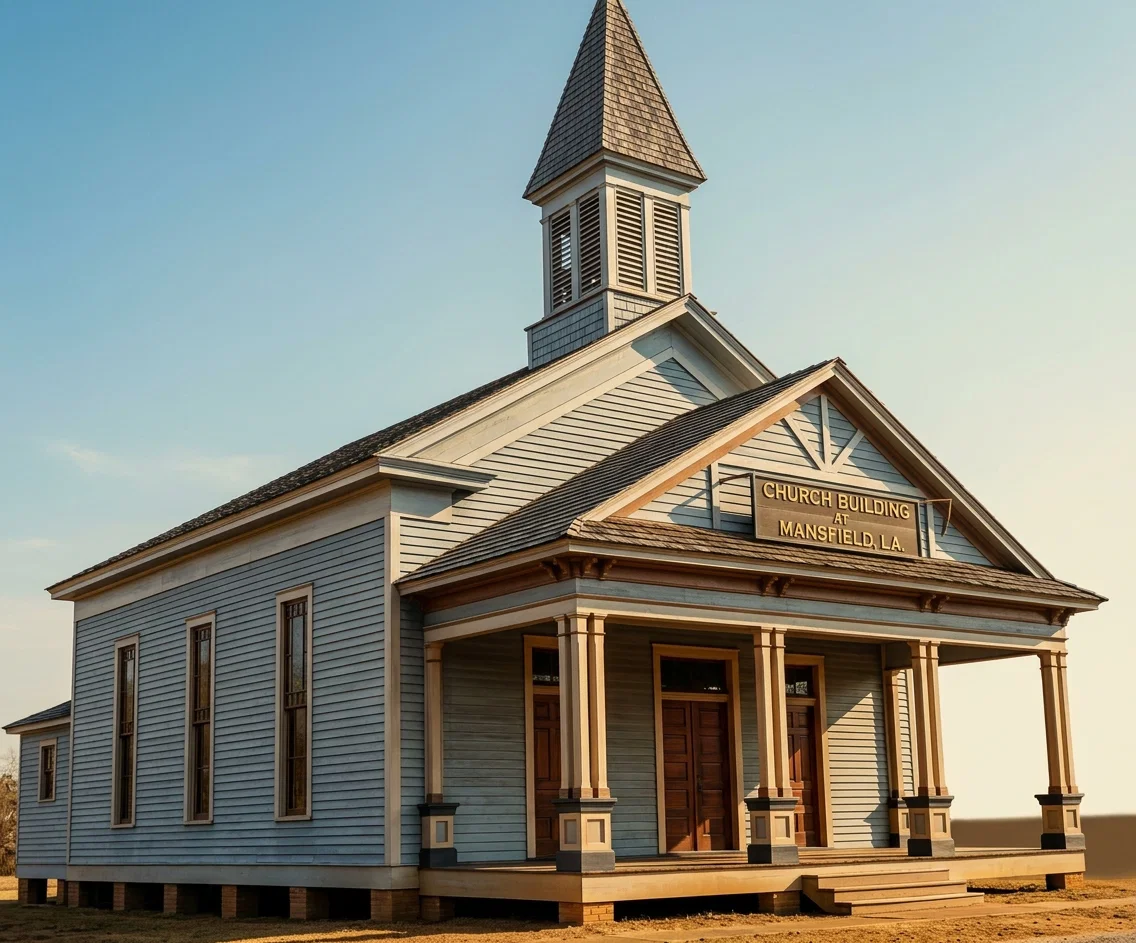
Some years ago we had a church organization and building in Mansfield. This church had been brought into existence by the untiring labor of some of our faithful sisters. Later the building was burned to the ground. Since that time the lot has been vacant, but in the latter part of last year some of these same sisters set out to raise again a memorial17for God on this spot. How well they have succeeded is illustrated by the accompanying picture. This building was formerly a Methodist church building; the membership having outgrown it, sold it to these sisters, who solicited donations from their friends to pay for it and move it onto their lot. It will be observed that the building needs repairs. These dear sisters have gone as far as they can. Though in feeble health themselves, they have worked most earnestly to secure means for this purpose. We plan to hold a tent meeting in Mansfield this summer, in the hope of reviving the work and of completing this building for a permanent church home. We are hoping that God will put it into the hearts of friends of his cause to give these sisters a helping hand in finishing this enterprise. They have everything paid for as far as they have gone, but the building is receiving damage now while it stands as it is. It should have a new roof and a coat of paint, and needs much in interior finishing and furnishing. Mansfield is a growing town, in the oil and gas belt, and the lot is well located, in the center of the city, so the church should be a strong factor in spreading the truth, if properly finished.
The Shreveport church had for about fifteen years met in their church building five miles in the country; but it had become evident that they were not reaching the 30,000 persons of the city, and so it was decided by vote to disband the country organization and reorganize in the city. This organization was accordingly effected last spring. Since that time the work has grown materially, and they are now struggling to secure a permanent church home. Their meetings at present are held in the council chamber of the city hall; but they have bought a lot, which is fully paid for, and are now straining every nerve to provide means with which to erect a suitable meetinghouse. They, too, need our sympathy, prayers, and financial help.
These buildings give stability to our work, which we believe will count for much in the advancement of the Lord's cause in this needy field.
R. W. PARMELE.
Selling “The Great Controversy”
By Walter Harper
I rejoice to report that the Lord has spared my life thus far, and enabled me again to take up the sale of that torchlight of truth “The Great Controversy.” I began work January 26, after a rest of several weeks at the Loma Linda Sanitarium, in California. Time would fail me to tell of all the marked answers to prayer and of the Lord’s loving care, for his mercies are new every morning. I believe it is Heaven’s order that our canvassers combine medical with religious books in their work; and following the instruction of the Testimonies on this point, I am also working with “Practical Guide to Health” and the relief edition of “Ministry of Healing.” However, if I could leave only one book in a home, from all our wealth of denominational literature I should choose “The Great Controversy.” It contains all the message — enough truth to save any soul that will give heed to it. Marvelous possibilities are wrapped up in the circulation of this wonderful book. Some years ago the Lord told us that if “The Great Controversy” had been circulated as Heaven designed, great things would have been accomplished. Let us pray that God may richly bless the colporteurs, for time is short, and now —
“The work that centuries might have done,
Must crowd this hour of setting sun.”
Walter Harper.
CHURCH BUILDING AT MANSFIELD, LA.
Brazil
By F. W. Spies
In the month of November, 1914, it was my privilege to visit the new Sabbath keepers in Minas Geraes. Since the first of the year, Brethren R. M. Carter and H. Simon have been selling our good books in this state. While engaged in this work they found some persons who had already read our literature, and were, as a consequence, somewhat interested. Others became interested as a result of the literature received from the brethren laboring with these different persons as opportunity afforded, which resulted in a number of them beginning to keep the Sabbath.
In the city of Barbacena I found five adults keeping the Sabbath; in Palmyra three families (six persons, not counting children) are keeping the Sabbath; in Juiz de Fora thirteen have begun to obey the fourth commandment; and in Guarany, which I could not visit at this time, there are others. At all the places I visited I held meetings, and these were especially well attended at Juiz de Fora. We hope soon to have a worker in this section.
Returning to Rio de Janeiro Brother Carter accompanied me, in order to assist some colporteurs who had just made a beginning in selling our literature at the nation's capital, and a good report has since been received of the work being done.
Even though the financial crisis is making itself felt more and more, our faithful colporteurs are working away courageously, and with a fair measure of success. We thank God for this, as our message-filled books and papers so many times answer the question in many minds, though perhaps not even formed into words, “What do these things mean?”
As a whole, the reports coming in from the various parts of our union are encouraging. And as we consider how highly we are favored in our field, as compared with many other places where the turmoil of war and revolution causes a condition that greatly hinders if not entirely stops the work, we do feel grateful to our God for the special blessings we enjoy. Our desire is to push the battle to the gates, and thus hasten the day when, the work finished, the Master will come to take his storm-tossed and waiting children to their eternal rest.
F. W. SPIES.
Back at Work in China
By W. C. Hankins
THE time since our arrival has been spent in settling and in getting hold once more of the mission work. The days seem all too short for what we want to do.
We had a pleasant voyage across the Pacific, and down the China coast to Hongkong. The first few days out of Seattle were a little rough, but the “Sado Maru” proved to be a very steady little boat, and there was no great amount of seasickness. After that short spell of rough weather it was very smooth down to Hongkong.
We had a good visit with our workers in Japan, and found them all of good courage and enjoying good health. The buildings for the headquarters, near Tokio, were nearly ready for occupation.
At Shanghai we had the pleasure of viewing the new quarters for the publishing work and the new homes for the workers. I am sure it would do the hearts of our people good if they could see what a change has been wrought in the condition of our work there. The workers have cozy, comfortable homes, which have been put up at a very moderate expense. The publishing house is roomy and convenient, and is so far ahead of the quarters they were occupying when we left China that there is no room for comparison. The orders for literature come in so fast that they have not been able to fill up their shelves with a proper stock of tracts.
The workers in Shanghai gave us a very cordial reception, and did everything to make us feel that we were welcome. We spent two days with them, and all wished that our visit might have been longer.
Arriving in Hongkong, we were met by Elder B. L. Anderson and Brethren Ham and Nagel. We accompanied them to Canton to attend a committee meeting, and there we had a chance to see the new homes for the Canton workers. It certainly rejoices our hearts to know that they are out of those old unhealthful quarters and into clean, sanitary homes where they can get pure, fresh air. Surely this is money well spent, and I only wish that our brethren in the homeland could realize the great difference it makes to the work in that place.
The two workers were stationed at Swatow and Kwang-si. Brother and Sister Bates went to Swatow, while Brother Thomas and wife went with Dr. Law Keem to open up work in the interior of Kwang-si province.
Our voyage up the coast to Amoy was uneventful. We stopped a few hours at Swatow, and saw the new house there,18and also visited with Brother Ang. We found Brother Ang’s daughter carrying on a fine girls’ school with about eighty pupils. The prospects for work in that section are very good.
And now we are at home again. It seems good to be back once more after all this time. We enter upon our work with fresh vim and courage. We are all feeling very well. The children enjoy the beach and the abundance of fresh air, while my wife seems better than she has for years. The message never seemed plainer than it does now, and our hope was never brighter. We rejoice to see the signs of the soon coming of our Saviour. Surely the time is short in which to work, and we want to improve it well. Pray for us that we may be given grace and wisdom sufficient to do the work that is before us.
W. C. HANKINS.
Newspaper Publicity Pays
By H. M. Kelley
A CERTAIN manufacturing company spent $1,500,000 in the year 1913 in advertising a ten-cent article. Their advertisements appear regularly in ten thousand newspapers and magazines. They use other advertising methods, of course, but at least seventy-five per cent of their total expenditures for advertising purposes was paid for space in papers and magazines. It is wholly a matter of dollars and cents with them, and they naturally put their money where it will accomplish most, and they consider newspapers better for advertising purposes by seventy-five per cent than all other methods combined. As a result of their extensive advertising, they created an international demand for their merchandise, and were therefore able to send out during 1913 forty-five thousand carloads of their goods.
When one has something for the public, it is incumbent upon him to create a public demand for it. The best way to reach the public is through the newspaper, the recognized avenue to the public mind. Enterprising business men make free use of this method of advertising, although they have to pay for every inch of space they use. Everybody reads the newspapers, and if a thing is kept before the public it will be noticed by the public. People are bound to read the papers. If they do not, they cannot keep up with the times; and when they are asked if they have read something that has been presented in the papers, they are chagrined if they have not.
The Saviour said, “The children of this world are in their generation wiser than the children of light;” but this ought not to be. If it is policy for the men of the world to use legitimate means to bring themselves and their business before the world, it is expedient that we use the same methods to bring the great message of salvation before the world. The Lord has graciously given us the third angel’s message with all its possibilities for good, and the eternal destiny of countless thousands hangs upon their attitude toward this message. It is apparent therefore that we are duty bound to impress the sacred importance of the message upon the minds of men and women everywhere.
We should improve every opportunity and use the best methods available. The message intrusted to us to give to the world is past due, and the Lord is entreating us to hasten the work. The wise man’s counsel to the sluggard is, no doubt, applicable to some of us: “Go to the ant, thou sluggard; consider her ways, and be wise.” Why should we not be as quick to utilize the columns of the newspapers for the proclamation of the third angel’s message as the children of this world are to advertise their merchandise?
How Do Newspaper Men Regard Us?
As a rule newspaper editors have no prejudice against us. They are in business to publish anything that is of interest to the public, and are usually glad to use important notices of our meetings, and short, pointed articles prepared especially for them. For a number of years the writer has furnished articles on the Sabbath question and other doctrinal points of our faith, and at times has run series of articles in city papers; and with but few exceptions has not had articles rejected. On a number of occasions Catholic editors have given us considerable space and have been friendly toward our work. Under such circumstances we have found it necessary to be cautious not to use unwise and offensive expressions. Indeed, propriety demands this under all circumstances.
We met one editor who was not favorable toward us. I proposed to pay him for a display advertisement of our meetings. He had never run an advertisement of this kind before, and wrote an editorial calling attention to it. Afterwards he was willing to use anything we gave him. It is not always necessary to run display advertisements; in fact, a short article, well written, will be read by more persons than displayed matter, but there are times when it is profitable to use display advertisements.
We were running a series of articles in the daily paper this summer. The articles were creating quite an interest, but the ministers of the city went to the editor and told him they would boycott his paper if he continued to run the articles. The editor himself was very much interested, but the business manager and proprietor refused to use any more of the series. We took the matter good-naturedly, and have since been privileged to furnish articles on different points of our faith. Because an editor refuses to use a certain article which we may think is all right, we need not think he will not publish anything for us. Editors are always glad to get copy that will be of interest to their readers, if it is properly prepared. I know of a man who worked an article over seventeen times before he could get it before the public; but when he finally did succeed, it was a masterpiece, and was read by thousands of persons. It is better to write an article over seventeen times and have it read by thousands of persons than to write it once and have only seventeen persons read it.
Dr. T. De Witt Talmage appreciated the value of newspaper publicity. In one of his sermons he said: “Whoever else may be crowded or kept standing, or kept outside the doors, I charge the trustees and the ushers of this church that they give full elbowroom to all these journalists, since each one is another church five times or ten times or twenty times larger than this august assemblage, and it is by the printing press that the gospel of the Son of God is to be yet preached to all the world. May the blessing of the Lord God come down upon all the editors, and all the reporters, and all the compositors, and all the proof readers, and all the typesetters!”—“Life and Sermons of Talmage,” page 80, part I.
H. M. KELLEY.
Nebraska
By GEORGE J. SELTZER
NEBRASKA CITY.— In June, 1913, I was asked to come to this place and conduct a tent effort. At that time there were five or six members in the little church. We now have thirty-six baptized members, and others are ready to take this step. A new church building has been erected, and for this we are thankful, as well as for the fruit of our labors.
After our last State camp meeting I was called to Seward to follow up the interest there, and the Lord blessed the effort with fifteen converts. Will not you continue to pray for the success of the laborers in this part of the great harvest field?
GEORGE J. SELTZER.
The Kansas Sanitarium
By James C. Atkinson
I RECENTLY spent several weeks at the Kansas Sanitarium, and since that experience feel more certain than ever before that our medical institutions are filling an important place in this closing work.
Under Dr. L. A. Sutter, as medical superintendent; Brother R. C. Carson, as business manager; and Miss Clara D. Larson, as matron and head nurse, the sanitarium is well conducted, and enjoys an excellent patronage. The young people in training are of an excellent class, consecrated, and anxious to benefit spiritually as well as physically those who come to them for help. The Lord has especially blessed in the many difficult and dangerous surgical operations that have been performed, and it is a marvel how soon patients are able to be up and return to their homes, praising the Lord.
I have sometimes thought that our own people fail to appreciate fully the importance of our sanitariums. Frequently they employ worldly physicians, and if the case proves to be a serious one, often pay much more than the price of several weeks' treatment in one of our institutions, in which they may have the daily care of Christian physicians and nurses.
Since my return home I have come in touch with a friend who went to an outside institution in Kansas City for a surgical operation, about the time I went to the sanitarium at Wichita for that purpose. He told me that his expenses were over $400, whereas mine were less than $200. I praise the Lord for the medical missionary work. Let us rally to its support as never before.
JAMES C. ATKINSON.
The Earliest Known Law Code
LAWS believed to have been written about 2,500 years before Christ, and to have remained buried in the sands of Babylonia for more than 4,000 years, are now in the process of being deciphered at Yale University. The tablet containing them is thought, at this point in the work of deciphering it, to be the very earliest law code in existence, antedating even that of Hammurabi. The tablet is written in the Sumerian language, which was the language of southern Babylonia prior to its conquest by the Semites or Akkadians in the time of Hammurabi.
The Ministerial Reading Course for 1915
By W. E. Howell
REGISTRATIONS for the new course for 1915 are still coming in from far and near. We shall be glad to receive them as long as any one feels he can complete the reading by the end of the year. Reports on completed work in the course for 1914 are reaching us at a good rate. By the end of March, our roll of charter members will be much increased.
Take Notice
As we had planned the course for 1915, the book "Medical Science of Today" was to be completed by March 31, and the new "Gospel Workers" begun April 1. It has been found impossible, however, for the publishers to bring out this new book in time to fit into this schedule. We are, therefore, substituting "The Minister as Shepherd" as the second book, to cover April and May, and plan to begin "Gospel Workers" June 1. All orders for this book are being kept on file, and will be filled as soon as the book is off the press. Our reading offer includes only the cloth edition, but any one who wishes the limp leather binding can secure it by sending us fifty cents additional.
Our First Book
Reports on the completion of our first book, "Medical Science of Today," are already beginning to come in. The following all reached us the same day:—
“I have carefully read through twice the first book of the Ministerial Reading Course for 1915, ‘Medical Science of Today.’ It seems to me that you have made a very good selection in this book. I hope you will be as fortunate in the future in making selections among the medical books for us preachers. For one, I am anxious to have some medical books in our Reading Course.
“O. F. FRANK.”
“I have just finished reading ‘Medical Science of Today,’ and have found it to be both interesting and instructive, so much so that I have read some parts of it several times. Of course I had a vague idea of some of the achievements and accomplishments of modern medical and surgical skill, but it is very gratifying to have some plain, reliable, definite information concerning the origin, discovery, importance, and value of the different departments of modern medical science.
W. A. SWEANY.”
“I enjoyed reading the book very much, and received much practical help from it.
L. O. GORDON.”
“I am almost ready for the second book. This reading has been of unmistakable inspiration and value to me.
“P. A. FIELD.”
“I appreciate more and more the educative value of this systematic reading, and will do what I can to encourage others to share the blessing of the course.
W. G. FORSHAW.”
It is understood that this course is open to all classes of gospel workers.
W. E. HOWELL.
News and Miscellany
Notes and clippings from the daily and weekly press
— A presidential mandate has been issued by Pres. Yuan Shi Kai, of China, instructing the minister of education to prepare the way for a uniform system of public schools to be established throughout China. The schools, according to the plan, are to be modern, patterned after Western ideas to a large degree, but not to the extent of discarding the best teachings of China's ancient sages, “to whom the culture of the nation is due.”
— After being in session almost continuously for the two years of its existence, the Sixty-third Congress came to an end on March 4. This also marked the close of half of President Wilson's term of office—the first Democratic administration since Cleveland's last election, in 1892. Among the important measures passed by this Congress were the following:—
Underwood tariff act.
Federal reserve act.
Clayton act to strengthen Sherman antitrust law.
Act to establish a federal trade commission.
Repeal of Panama tolls exemption for American coastwise shipping.
Act to regulate cotton exchanges.
Act providing for a government railroad in Alaska.
Act to admit foreign-owned or foreign-built ships to American registry.
Arbitration treaties with many foreign nations renewed.
Twenty-two peace commission treaties ratified.
Appropriations made total the enormous amount of $1,132,982,839.76.
President Wilson expressed his satisfaction with the work of Congress in a statement in which he said that the longer it is tested the more will “the purpose and quality of its statesmanship” appear.
— The formation of the American Legion, an organization of first reserves for national defense, has been announced in New York City. The project contemplates the establishment of a first reserve of between 250,000 and 300,000 men, including many formerly in the army, the navy, and the militia, who will be ready for instant response to any call in an emergency.
— The president of Haiti—Davilmar Theodore—has abdicated his office of presidency and taken refuge on the Dutch steamer “Frederick Hendrik,” in the harbor at Port au Prince. Local officials have taken charge of the capital and are maintaining order. The United States will send a commission to the republic to put its finances in such a condition as will satisfy foreign creditors and restore order.
— The United States government has granted the use of the steamer “Vulcan” to carry 900 tons of foodstuffs to the starving Jews of Palestine. The distress in Palestine is due to the arrest of those economic activities on which the economic welfare of the people depends. The entire population of the Holy Land has been threatened with starvation this winter. The cargo will go to Jaffa and thence to Jerusalem in care of the United States consul. The food will be distributed under the direction of the consul and representatives of the American Relief Committee.
— Denouncing the drink traffic as doing “more damage to the country than all the German submarines put together,” Chancellor Lloyd-George, in an address delivered at Bangor, Wales, recently, announced that the government was about to take drastic measures to handle the liquor situation. He referred to the fact that Russia had abolished the use of vodka, and France that of absinthe, stating that the Russian minister of finance had said to him that “the output of Russian workmen had increased from thirty to fifty per cent since the sale of vodka had been prohibited.” “While it is not proposed to go to the extreme of either France or Russia,” the chancellor added, “we have great powers to deal with drink, and we mean to use them.”
— On March 1 the United States took one of its most forward steps when the law forbidding illicit sales or distribution of habit-forming drugs became effective throughout all States and Territories. The new federal law is stringent, compelling druggists to inventory and account continuously for all opium and allied drugs in stock or dispensed. Many States have drastic laws against commerce in opium and cocaine drugs, of which there is an estimated 4,000,000 victims in the United States, but the users of the drugs have been enabled to import the drugs from adjacent States. All this law-evading interstate traffic is now forbidden. A druggist now cannot fill prescriptions unless he knows them to be made by physicians formally registered and licensed by the federal authorities, and these prescriptions can be filled only once. Federal inspectors will visit the drug stores, examine the records, and investigate cases where physicians buy unusually large quantities of prohibited drugs. Violators of any provisions of the statute face a $200 fine, or five years in prison, or both.20
— The modern system of waterworks, built by the American engineers, which will supply 12,000,000 gallons of water daily to Panama, Balboa, Ancon, and other canal villages, went into operation recently. The supply comes from a river which at one time was thought fatal even for bathing.
— A nation-wide and ultimately world-wide boycott upon the purchase and use of Japanese products is the announced aim of a new Chinese society organized in San Francisco, March 1. The embargo has been started by Chinese-Americans in an attempt to force Japan to recede from her demands upon the Chinese government.
— Fourteen miles out of Washington and twenty-six from Baltimore, there exists one of the most interesting communities in the United States—a town composed entirely of Negroes. It is an up-to-date place in every way, with water, good streets, and other improvements. Colored people living in that part of the country formed a stock company six years ago, with a capital of $200,000, and purchased this tract of land on the electric car line that connects Washington, Baltimore, and Annapolis. Prosperous colored people are building good homes in the town, where all the work is done by workmen of their own race.
— Although, as the Literary Digest points out, the word jitney is not found in the dictionaries, it is rapidly assuming a definite meaning to dwellers in Western cities. The “jitney bus,” as it is called, is an automobile operated for the accommodation of passengers at the rate of five cents (one jitney) a passenger. It was started in cities along the Pacific Coast several months ago, and immediately became popular. Now the movement is spreading toward the East, threatening to cut deep into street car service monopolies. The Digest gives the following figures as to what is being done in Pacific Coast cities in this direction:—