Official Celebration of the Hundredth Anniversary of the Bible Society in Albert Hall, London.
BY M. ELLSWORTH OLSEN.
Not least significant among the numerous tokens that we are living in the last days is the great work of publishing and distributing the Word of God which has been carried on by the British and Foreign Bible Society during the century just past. The society celebrated its hundredth birthday last Monday, the 7th of March, in the Albert Memorial Hall, in the presence of an audience numbering some ten thousand people.
A choir of 1,500 trained voices rendered several pieces of sacred music, while the vast audience, admitted severally by tickets, filed in, and were seated. The chair was then taken by the Marquis of Northampton, the society's president, supported on the right hand by the Archbishop of Canterbury, and on the left by Dr. Watson, better known by his literary pseudonym, Ian Maclaren. Among others present on the platform were the Bishop of St. Albans, the Dean of Peterborough, Lord Kinnaird, Sir John Kennaway, Colonel Shortland, the Chaplain-General, and other well-known leaders in the religious world.
After the singing of a hymn, in which the entire congregation joined, Rev. R. Lovatt, of the Religious Tract Society, read the parable of the sower, as given in Mark's gospel, and the Bishop of St. Albans offered prayer.
The chairman, in his opening address, expressed the conviction that the work of the society would be finished in the present century, and every person in the world would have the Holy Scriptures in a tongue he could understand. When the society began its work in 1804, the Bible "was current in about forty different languages, understood by two-tenths of mankind. In 1904 it can be read, more or less completely, in 430 languages and dialects, which include all the chief vernaculars, and are understood by seven-tenths of mankind." No less than 370 of these translations made during these one hundred years, have been the work of the Bible Society, which was well described to be not old in the sense of worn-out, but full of youthful vigor, altho full of years. Doors were opening before it on every side, said the speaker, and many countries formerly closed against the Gospel, were now eagerly awaiting the Word of God in their own tongue.
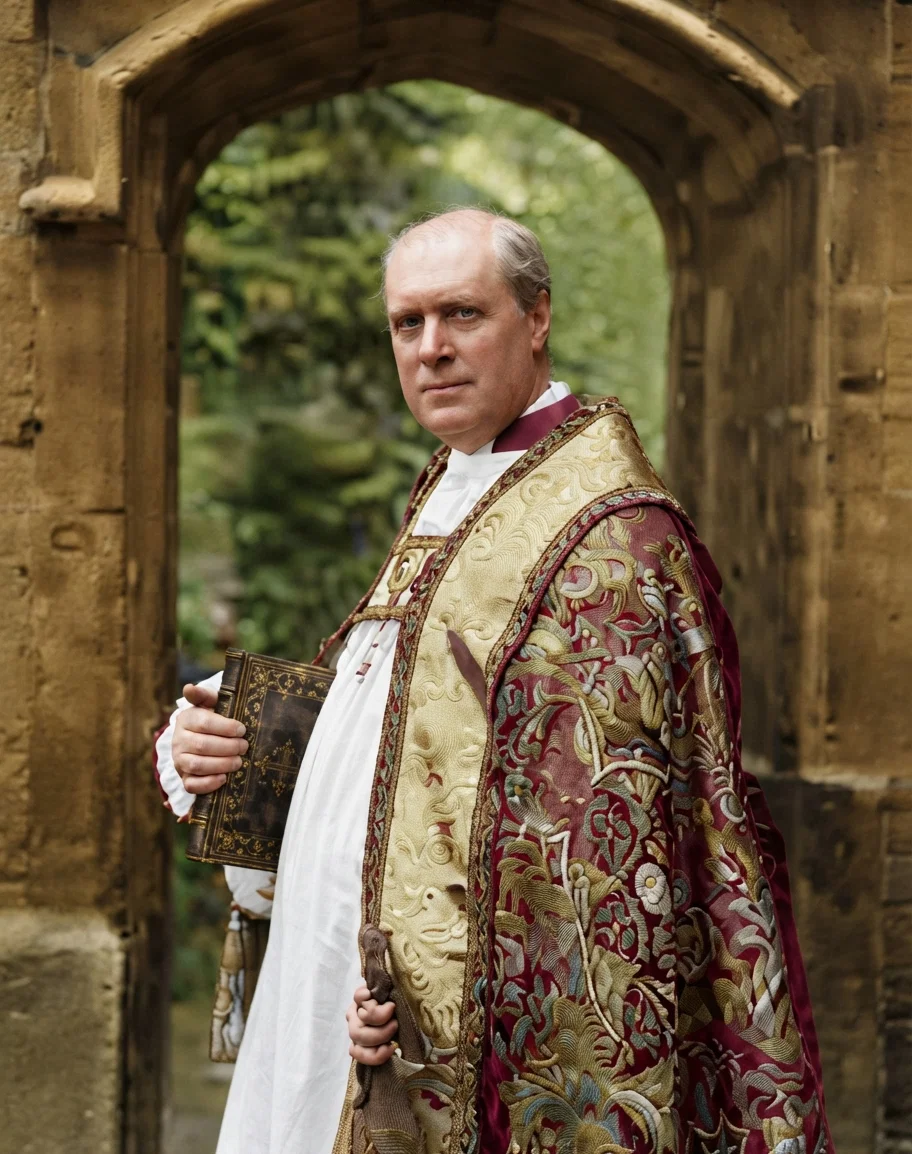
The Marquis of Northampton.
The Archbishop of Canterbury referred to the favorable attitude of the press, which was in marked contrast to that assumed a hundred years ago. It meant much to the nation that, as a result of the society's work, the easiest book to procure—the most accessible of all books to everybody, either at home or in the colonies—should be the Written Record of the Word of God. The translation of the Scriptures into 370 languages and dialects during the past century had meant much more than was realized. In not a few cases there was no written language to hand, and one had to be built up. How many present could name even fifty different tongues? For himself, the speaker admitted that a great many names in the list gave him not the slightest idea of the geographical location of the country where the language was spoken.
Following the archbishop's address, the audience joined in singing the Te Deum, after which Sir George Smith, of Truro, said that "the fourteen millions of pounds ($70,000,000) spent by the society during the hundred years of its existence was the best investment of money that this country had any knowledge of." He dwelt on the internal evidence of the Bible as to its inspiration, quoting the saying of the Chinese mandarin: "This I know, that whoever made that Book, made me." "History tells us," he continued, "that the periods of religious revival throughout the world have synchronized in successive ages with the greater study of the Word of God. From the finding of the forgotten roll in the house of God to the finding of the Latin Bible by Martin Luther, and to the gathering of that little 'Holy Club' around the New Testament in the cloisters of Oxford, over the whole span of those years the discovery or rediscovery of the Word of God has signalized a spiritual awakening in the church. The nations which lead the van of human progress to-day are the nations of the open Bible. The peoples who have learned the union of liberty and order, the peoples of free parliaments and stable institutions, are those whose characters have been formed by, and nourished upon, the Word of God."
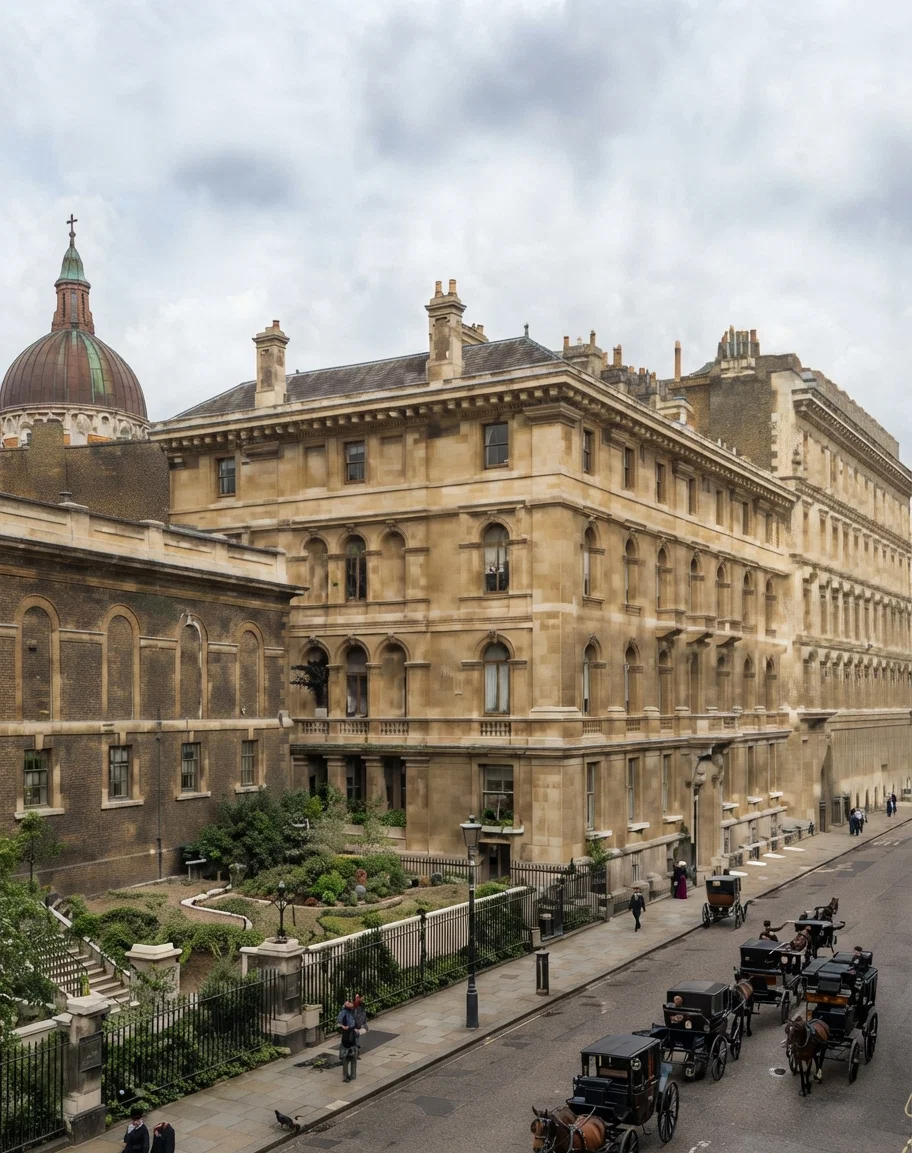
British and Foreign Bible Society's Headquarters in London.
Sir Lewis Dibdin, the Dean of the Arches, said the Bible stands for so much in England. It is the foundation of our laws. When one gets behind judicial decisions, and codes, and acts of parliament, one comes at the bottom to the moral law, of which the Ten Commandments were the first written summary. Equally the Bible is the parent, almost the source, of the best English literature. It is the Book of our childhood days, the best comforter in time of trial. When we are called upon to part with one we love, and turn away from the open grave, is it not the Bible that gives us strength and comfort? Is not the Bible, indeed, bound up with every great crisis in our lives?
It is also bound up in the great crises of the English nation. A hundred years ago was a time of stress in England. It was the eve of the great Napoleonic war. This country was in very imminent, it was thought deadly, peril. There was much want and suffering. It was the beginning of that nineteenth century, which is already beginning to look so far behind us. The great British Empire was in that century to beat off its enemies, expand over many parts of the world, and fill them with her sons and daughters. English trade and commerce were to make a great advance; scientific inventions were to revolutionize the daily life of the English people. All this was coming in 1804, when the Bible Society took its start, and the men who were its founders probably little realized the magnitude of the work they were initiating.
"There is a large class," the speaker continued, "who tell us plainly that the Bible is out of date, and belief in it is a superstition. Is it, then, a mere coincidence that we hear so much at the same time of the decay of morals and of a growing limpness of character. It is worth while to ask, Is the Bible as much studied as it used to be? We have grown used to the privilege of reading the Bible; it has become a common thing, and is not properly appreciated. In the early days the people flocked to the churches to hear the Bible read. We need to cultivate love for the Word of God.
"Whatever people may say, especially idle people, whose useless lives the Bible condemns, it is a fact that can not be denied that the men who made England centuries ago, and the men who in our own time have served her best—the men of grit and power—have been those to whom the Bible was not an exploded myth, but the guide of their lives and the record of a divine revelation."
At the close of the dean's stirring address the audience arose and sang the beautiful and touching hymn, "Tell Me the Old, Old Story." It was heart-thrilling to look out over that vast multitude of men and women, and see their earnest faces, and hear the sweet melody of their united voices. How good it seemed to witness this outward loyalty to the Word of God! One could not help breathing the heartfelt prayer that all the singers might indeed be true and loyal to all God's requirements—that, when, at some time in the near future let us say, they have brought to their knowledge the Gospel in its pristine purity and simplicity, free from man-made traditions, they will joyfully accept it, and join in the company of those who keep the commandments of God and the faith of Jesus.
Dr. Watson gave the closing address, an eloquent tribute to the power and influence of the Holy Scriptures, but one which also showed the speaker's strong bearings toward the "higher criticism." It is significant that his was the only address which showed any sympathy with this well-known movement which has spread so rapidly during the last9decade. The disciples of the "higher criticism" are not the men who are devoting their lives to give the Bible to the world.
The day following this official celebration in Albert Hall a meeting was held in Queen’s Hall, at which many different missionary societies testified through their representatives to the value of the help they had received from the Bible Society. A message of congratulation was also read from President Roosevelt.
Dr. Randall Davidson, Archbishop of Canterbury, Titular Head of the Church of England.
On the preceding Sunday sermons were preached throughout the kingdom and in other parts of the world, in commemoration of the centennial, the Archbishop of Canterbury conducting the service in St. Paul’s, which was attended by the queen and the Prince and Princess of Wales, the king being prevented from attending by a slight indisposition.
London, March 11, 1904.
WHAT A MORMON CONVERT FOUND.
By Frank S. Johnson
THE Ram’s Horn, March 26, 1904, prints the following account of a Mormon convert, in Virginia, and what he found when he reached the Mormon communities in the West:—
My home is in Vicksville, Southampton County, Va. I am thirty-eight years old, and have a family of six children. My sister-in-law died after the death of her husband, and left five children to my care. I had been a Christian more than four years before the Mormon missionaries came to my house, and had found great comfort in the Christian life. I was a member of the Christian Church, sometimes called the Disciples. Nine members of my family were also members of the church. George Whittle and Henry Taggart, Mormon missionaries, came to my house early in December, 1899. They have made their home with me since they came, until this time, in May, 1900. (That is the way they preach the Gospel without purse or scrip.) There were six other missionaries coming often to my house and remaining several days at a time. They told us that we must gather to Israel, flee to the mountains; that this was the commandment of the Lord. They talked like Christians, and I believed what they said, and trusted them. They said when Christ came He would come to the temple, and we ought to be there. They said polygamy had been done away with—that no one was living in polygamy, nor had been for a great many years. They told us we could not live our religion in Virginia, but ought to come to the mountains. They said the Saints here (in Utah) were a pure people—no such wickedness as in the states. They represented Utah as a paradise. They wanted us to go to the temple and be sealed to each other as husband and wife and children.
They wanted me to sell all and come with my family. We all joined the Mormon Church, and believed what the missionaries told us. But I did not want to sell my little home until I had come to see.
They said I could take up as much land as I wanted when I came, so I decided to come, and sold all my farming implements, my mechanical tools, my horse and timber that I had ready to work. I got money enough to come and go back again. They did not want me to take money enough for me to return—said I would like it here. I came on and went to the friends at Preston, Idaho, to which place they had directed me. I called at Mrs. Whittle’s and learned that her daughter, sister of our missionary, was living in polygamy—the second wife of Mr. Pond. I learned also from the Mormons that the sister of Elder Taggart was a polygamous wife.
These facts startled me, as both of the missionaries had declared to us again and again that no one had been in polygamy for a long time; polygamy was a thing of the past. If they had told me the truth I would not have come to Utah, nor would I have sacrificed my property to come.
While visiting among the brethren at Preston I discovered that the Saints would swear, for I heard them. They would ask a blessing at the table, and presently begin to curse. They would pray and swear right along. I had never been used to that, and it hurt me.
President Snow, the "mouthpiece of God, prophet, seer, and revelator," came up to the conference at Preston. I thought, "Now we will hear something good; if he does speak for God, he will surely say something good and helpful." But to my surprise he did not. He talked all the time about tithing. They must "pay up." It was money, money, money, all the time; no Gospel at all; nothing about the love of God; nothing about our Saviour whom I loved. I was sick and disheartened. I could neither sleep nor eat.
The Saints wanted me to come to all their meetings, but I could not. The missionaries had deceived me. Instead of a paradise, I found the Saints swearing, living in polygamy, and the young people were vile beyond description. Instead of the prayer-meeting, they had the dance. Instead of the Gospel of love, they preached money. I went out and laid down in the fields, crying to God for help to get away, back to my home again.
All these facts and conditions I found out from the Saints. I did not go to any of the denominations for information. I heard with my own ears, saw with my own eyes, and sorrowed in my own heart. The Mormon missionaries who profess to preach without purse or scrip cost me, a poor man with a large family, about three hundred dollars. But I am thankful that I did not bring my family. I thank God that He has made it possible for me to go back home. I will warn all my neighbors against the falsehoods and deceptions of the Mormon missionaries. I make these statements to warn people against the Mormon deceivers. It is the worst thing I have ever heard of.
FRANK S. JOHNSON.
THE ATHLETIC CRAZE.
A LEADING San Francisco journal, whose editors are supposed to know, and probably do know, the trend of the reading public’s taste for “news,” gives over one-third of its reading space in one issue to an affair that occupied less than an hour and a half on the previous evening. The “event” was simply a brutal, bloody prize-fight between two young men. That the editors were evidently correct as to the public desire for such news in preference to anything else in that line, we have the fact that the receipts at the door amounted to $33,000, from an audience of about seven thousand people. The paper says of the winner, “He has proved again that Californians are a fighting race,”—which is a doubtful compliment. A terrible sign of the times is reflected in the statements—no doubt correct—that “he will be the idol of many young women,” and “men will point him out and crane their necks as he swings confidently by.” Verily the athletic craze has a terrible hold upon the people of to-day.
Yet, in the face of an abundance of evidence of a like nature, many men posing as “watchmen on the walls of Zion” are assuring us that “the world is growing better;” and the world and the church are being lulled to sleep in carnal security, confidently believing the terrible deception, so prone are they to believe that moral improvement is possible while indulging to the full the pleasures of the world, the lusts of the flesh. Well might the Lord repeat the question, “When the Son of Man cometh, shall He find faith on the earth?” The present outlook would indicate that the faithful in that day will be a very “little flock,” even “as it was in the days of Noah.” See Luke 12:32; 17:26.
There is, however, one lesson the Christian may learn from the worldly athlete, namely, his careful and temperate training for the conflict before him. The apostle Paul, referring to the athletic sports of his time, notes that “every man that striveth for the mastery is temperate in all things. Now they do it to obtain a corruptible crown; but we an incorruptible.” 1 Cor. 9:25. Therefore shall we not all the more make every possible preparation for certain victory? There is an incorruptible crown of glory for every overcomer.
IN THE ORIENT.
THE Japanese fleet continues to bombard Port Arthur at intervals. On March 21 the bombardment lasted several hours, and about two hundred shells fell in the town, killing and wounding a number of persons. The fleet also made another attempt to block the entrance to the harbor, sinking four stone-laden merchant vessels. The Russians resisted the attempt vigorously with their torpedo flotilla, and state that through their defensive operations the entrance to the harbor is still open.
The Japanese continue to advance their forces in Korea toward the Yalu River, where the Russians are concentrating their army. They have brought many soldiers south from Vladivostok, and, since the declaration of war, have transported more than 100,000 men and 6,000 horses across Siberia, with several hundred cannon. The fact that the large number of newspaper correspondents who have been held in Tokio have now been permitted to proceed to the scene of expected hostilities would seem to indicate that the most serious business of the war will soon begin. The Japanese Government has not permitted these correspondents to go to the front while its plans were being laid, lest information concerning the movements of the troops should leak out, and be taken advantage of by the Russians. The Japanese field marshal has expressed the belief that Japan would have to fight Russia at odds of two to one, and yet she was confident of being able to hold her own with the stronger power.
One engagement has already taken place in which both sides claim the victory. There was considerable loss of life on both sides, just how great is not known. The Russian force retired from the position which it occupied, and the Japanese have advanced beyond the scene of the conflict. The coming weeks may be expected to bring news of heavy fighting.
News from Around the World
A terrible tale of murder and cruelty is that connected with the exposure of the "malpractice syndicate," in Philadelphia, to which reference was made some weeks ago. The accusations then made have been confirmed and others have been added to them. The furnace in which both living and dead infants were cremated has been found, and it has been ascertained that infants were sold at auction, were palmed off on families who needed heirs, were put to sleep with dogs, were starved, maltreated, sent the rounds of baby farms for a purchaser, and failing to meet one, were left neglected to die. The bodies were thrown into sewers and left in alleys and churches.
The French Court, to which the case of Colombia against the Panama Canal Company had been referred, has decided against Colombia. Colombia desired an injunction against the transfer of the canal property to the United States, and also asked that costs of suit be assessed against the company. The court denied all the claims, and assessed the costs to the Colombian Government. This is thought to remove all legal obstacles to the transfer of clear title to the United States.
A decisive majority has been given the bill of the French premier for the suppression of teaching by the religious orders. The government has also, during this week, put into effect the law passed in December last, requiring that all religious emblems be removed from court rooms and halls of justice. This move, which has been put into execution during "holy week," is regarded as a retaliatory blow at the pope.
Millions of dollars' worth of property has been destroyed by floods in Michigan, Illinois, Missouri, and other states during the past week.
The members of the Panama Canal Commission have sailed for the isthmus, to begin the preliminary work of canal building.
READING HISTORY AND BIOGRAPHY.
By Mrs. L. D. Avery-Stuttle
BY MRS. L. D. AVERY-STUTTLE.
Good books are guides to lead our wandering feet
In paths of righteousness and pastures sweet;
Other than these true wisdom never knows—
Other than these are never friends—but foes.
It is astonishing how much one can add to his store of useful knowledge by a systematic course of reading history and biography. The old saying that "history repeats itself" is so true that we may learn much of the future history of our own country by the past history of others,—even tho we had not the sure word of prophecy to help us.
Take, for instance, the history of France. In the continual troubles between the very rich and the very poor, between the peasantry and the nobility, between the servant and his master, as chronicled by the historian, we may see, as in a mirror, the certain future of any country where ill-gotten wealth is amassed in the hands of a few multi-millionaires whose least concern is the embarrassment and distress caused by their own avarice and greed.
Do we read with horror the bloody history of the French Revolution? Let us remember that it is only a little more than a century since the dreadful cry, "Down with the aristocrats!" brought terror to the stoutest hearts, and blanched the cheek of the bravest,—and this in cultured France,—the home of art, refinement, and education.
A few moments each day given to the study of ancient history can not but be productive of good results. There is nothing which can better lay the foundation of a sound education than the study of the history of nations. To one unaccustomed to such reading, the pages of history may at first seem dry and uninteresting; but read with the distinctive object of self-improvement and culture,—such reading soon becomes a source of pleasure as well as of great profit.
It is always well, in reading profane or secular history, to compare it with the Book of Inspiration—the sure word of prophecy. We here read of the four great universal kingdoms: Babylon, Medo-Persia, Grecia, and Rome. The exact order in which they are to arise has been accurately foretold, as well as the distinctive characteristics of each. Turning quickly to the pages of ancient history, we find not only a fulfilment of the prophecy, but also an exact agreement in every small particular. The kingdom of Babylon, whose capital city, Babylon, was one of the most wonderful on earth, was succeeded, so says ancient history, by Medo-Persia, or the united kingdoms of Media and Persia; and in exact accord with the prophetic word, this was succeeded by the kingdom of Grecia, whose first king, Alexander,—himself a subject of prophecy,—overthrew the Medes and Persians. After this, says Inspiration, there must arise the iron kingdom of Rome, which will be divided into two parts, and then subdivided into ten. Again the voice of the historian attests the perfect fulfilment of the prediction of the pen of Inspiration.
It is well, of course, to know something of the history of our own country. Since the Lord Himself has taken the pains to point out the characteristics of our nation, among others, it will certainly be time well spent if we inform ourselves concerning our early history. While it is well to understand the prophecy regarding the future of our country, it is also profitable to compare its past history with the Word of Inspiration.
Then, too, it is always well to store the memory with the biography of good men,—mind, I do not say great men. How inspiring to read of the conduct of Luther before the Diet of Worms. Surrounded by the bitterest enemies, who thirsted for his blood, stands this man of God, calm and unmoved.
There sit the lords and ambassadors of Henry the Eighth, of England; Francis the First, of France; the nuncios of the Pontiff from the banks of the Tiber; and last, tho by no means least, young Charles the Fifth, of Germany. His youthful face is pale and expressive of the deepest concern and anxiety. Can he succeed in stamping this heresy from the face of the earth? Ah, the Eternal has not so decreed; He will send every angel from the courts of glory to the help of His servant, rather than that the cause of evil shall triumph. Read the wonderful prayer of Luther just before entering the Episcopal court to appear before the Diet. The historian declares it to be the key to the Reformation: "I will not break off from Thee, either now or through eternity," declares the servant of the Most High. Even like Jacob of old, he has wrestled alone with the angel, and prevailed; and strength is given him to say, in the very face of the faggot and the stake: "I can not and I will not recant; so help me, Thou Eternal God!"
In order to get the most good from the reading of history and biography it is best to read slowly and understandingly. It is a good memory drill to repeat the substance of those chapters which seem most impressive and important. A few facts clearly remembered are of much more value than whole volumes so dimly and imperfectly remembered as to form a sort of "hodge-podge" in the brain.
Then let us read slowly, carefully, intelligently. Let us break ourselves of the brain-destructive habit of "skimming," and let us always remember that there is no history so thrilling and exact, and no biography so wonderful, as that found in the Word of God.
THE DAY OF REST.
By Frances E. Bolton
BY FRANCES E. BOLTON.
As courtiers gather from the field,
Where they have stood with lance and shield,
Or as the pages from the stairs,
Or toilers from a host of cares,
And go to court reception, so
From six days' weary toil we go
Into the day that God hath blest,
As to a court of sacred rest.
As courtiers don some royal dress
Of fair, resplendent loveliness,
As pages find some dainty beauty,
For more refined, exalted duty,
As toilers doff their toil-stained one,
And wear one worthier of the throne,
So we, with happier look and pace,
Find for the Sabbath robe of grace.
O Sabbath day, thou art a court
Where we from week to week resort,
And learn the manners that we seek
To shape our conduct through the week.
We hear the dictates from the throne
The King would speak unto His own,
And all the six days find more blest,
Because of thee, sweet day of rest.
THE MAN WHO KILLED THE HENS.
By H. L. H.
Tom and Fred were neighbors, tho they could hardly be said to be great friends. A man who would have friends must show himself friendly; but, tho Tom was friendly enough, Fred was rather a surly chap. They were, however, sober and industrious; and each prided himself on his well-kept garden, striving to produce the earliest peas and the biggest cabbages, tho when Tom happened to get the advantage Fred was sure to be savage about it.
One spring morning Fred looked out and saw Tom's hens scratching up his peas. He rushed out half dressed, and made an onslaught upon the invaders, killed two hens, and drove the rest away, and, feeling a little mean over his exploit, flung the dead hens over into the field at the back of the gardens, and went into the house. When the hens were found, Fred pretended to know nothing about it. But as Tom suspected that Fred had killed them, and Fred knew he had, it was not strange that coolness sprang up between the families.
Harvest-time came, and Fred Archer fell from the top of a wagon, and broke a leg and some ribs, and was laid up in the house. He did not suffer for bread, for his employer and others looked after that, but his garden went to the dogs, and got weedy and seedy enough.
Tom thought it over, and one day said to his wife: "I can't bear to see it so. It isn't doing as we'd be done by. I'll take a spell at poor Fred's garden myself."
"He doesn't deserve it," said Tom's wife, as she thought of the dead hens.
"The Bible tells us to bear one another's burdens," replied Tom.
"Fred wouldn't have put his little finger to one of ours," said the wife.
"If ye do good only to them that do good to you, what thank have ye?" was Tom's prompt reply.
"I believe you are right, Tom," said his wife, "but there's our garden wants as much work as you can give it."
"Look not every man on his own things, but every man on the things of others," was Tom's rejoinder, and that put an end to the argument.
Fred was sitting in the easy chair one evening; he was rather more cross than usual, as sick folks are when they begin to mend, when in came neighbor Tom with—
"How d'ye do, mate?"
Fred, with an effort, growled out a half-civil answer.
"About your garden, neighbor?" said Tom.
"What about it?" asked Fred.
" 'Tis in a terrible mess."
"Could have told you that," said Fred.
"I want to put it to rights a bit, if you would let me!"
"You!"
"Yes, why not; there's those trees need cutting."
"I know they do."
"A good many things want seeing to," said Tom.
"You need not tell me that," said the crippled man.
"May I do it?" said Tom.
"What for? I can't pay you if you do."
"I don't want you to; may I do it?"
"If you like," answered Fred.
So Tom put his odd time into Fred's garden. A month later Fred was hobbling around with a stick and watching Tom as he was raking over a bed. Everything was neat and tidy; but when he looked over Tom's fence he said:—
"Why, Tom, you are backward with your own work."
"Rather, neighbor, but I'll soon catch up. There, I think that puts on the finishing stroke," he added, as he shouldered his rake to go home.
"But Tom,—stop a bit, Tom,—I've got something to say. I say, Tom, this is very kind of you. I could not have thought of it. And Tom! I say, Tom, I can't bear it," and he drew his brown hand across his face, and brought it away moist. "I can't bear it, Tom; to think how crooked I've always been with you. Those hens of yours, Tom."
"Never mind about them, Fred."
" 'Twas I that killed 'em, Tom."
"Never mind," answered Tom, "they shouldn't have got into your garden."
"Did you know I did it, then?"
"Well, I gave a pretty close guess; but what matters?"
"You've beat me," sobbed Fred; "you've beat me out and out. God bless you for it, Tom!" And he held out his hand to Tom, who grasped it and shook it heartily.
The man who killed the hens was conquered, and Tom Carter had learned how to "overcome evil with good."—H. L. H.
"THE NILLENNIUM."
DILLY communicated the story confidentially to Freddie Burr.
"See here!" she said, pushing the toes of a pair of stout new shoes through the fence.
"Where did you get 'em?" asked Freddie.
"And see here!" continued Dilly, bobbing up for an instant to show the pretty hood that covered her yellow hair, and touching it significantly with her finger.
"Where did you get 'em?" repeated Freddie.
"My pa worked an' bought 'em an' brought 'em home; an' they didn't get into nobody's barrel, either," explained Dilly, with great pride and little regard for grammar, pressing her face close against the fence for a prolonged interview. "You see, Freddie Burr," began Dilly, "the Nillennium has come to our house."
"The what?" said Freddie, in bewilderment.
"The Nillennium. It's a pretty long word," explained Dilly, complacently, "but it means good times. Anyhow, that's what ma called it, and I guess she knows. It was just this way, Freddie Burr: When you told me Mr. Barney had all our good things down to his store in his rum barrels, I just went down there right off and asked for them—me and Toddles."
"You didn't!" exclaimed horrified Freddie.
"Did too!" declared Dilly, with emphatic nod. "Well, he wouldn't give us one of 'em, and he was just as cross as anything. So then my pa got up from behind the stove and walked home with us. He didn't scold a bit, but he just sat down before the fire this way and thinked. At last he put his hand in one pocket, but there wasn't anything there; then he put it in his other pocket and found ten cents, and he went out and bought some meat for supper. When ma got home he talked to her, and they both cried. I don't know what for, 'less it was 'cause we didn't get the things out of the barrels. And ma hugged me most to death that night, and kissed me lots, she did. Well, my pa got some work next day, and brought some money; and now he has found a place where he works every day. He bought all these things, and he says his little boy and girl shall have things like other boys and girls. So now you know what the Nillennium means, Freddie Burr, when anybody asks you; and you can tell them that Dilly Keene 'splained it to you."—Selected.