About Pearline. You can use it everywhere in place of any soap, and gain by it. Pearline contains soap—is improved soap in powdered form, with certain other things added to make it more effective, and quick to act on dirt. Pearline is as harmless as the best soap, and as it saves the rubbing it saves the Worst of the Wear.
THE INDIANS' TEACHER.
John Eliot, who translated the Bible into the language of the Massachusetts tribe, two hundred and fifty years ago, and who was called the "Apostle of the Indians," was found on the day of his death, in his eightieth year, teaching the alphabet to an Indian child at his bedside.
"Why not rest from your labors?" said a friend.
"Because," said the good man, "I have prayed to God to make me useful in my sphere, and He has heard my prayer; for, now that I can no longer preach, He leaves me strength enough to teach this poor child his alphabet."—Selected.
Through cars to—
Portland Los Angeles Salt Lake City
Omaha Denver Kansas City
St. Paul Minneapolis Chicago
St. Louis Louisville Cincinnati
Memphis El Paso San Antonio
Houston New Orleans Montgomery
Atlanta Washington, D. C.
Remember these cars run through to above named cities without a change from Oakland or San Francisco. Our fast limited trains in connection with the above mentioned service. . . .
C. T. FORSYTH
Div. Pass. Agent
12 San Pablo Ave., Oakland, Cal.
PHONE MAIN 543
FORGET.
By Sibyl Smith
[By Sibyl Smith, in Church Advocate.]
Will you try to forget the ugly things
That I have said and done?
Will you try, from your memory's storage-room,
To banish them every one?
When you think of the past, and the part I had
In bringing you grief or shame,
Just put them away,
And gen'rously say,
"Perhaps she wasn't to blame."
Will you try to forget the ugly things?
My heart is so sore and sad,
To think I occasioned you pain and grief,
When I wanted to make you glad.
They sting me! they sting me! those ugly things
That I didn't intend to do.
They're hurting me yet;
O, will you forget
The things that were ugly to you?
Will you try to forget the ugly things?
They keep us so far apart.
You used to commune with me soul to soul,
And talk with me heart to heart,
But, while you remember the ugly things
And treasure them up in store,
A barrier high
As from earth to sky,
Divides us forever more.
And were there nothing but ugly things
In all that I did and said?
Were there any ready, willing feet
On loving errands sped?
Was there any word of kindly cheer,
Or true, unselfish deed?
Was nothing brought—
No kindness wrought—
To meet a pressing need?
Will you try to forget the ugly things?
They are grievous to you as to me.
Remove them as far as the east from the west,
Or bury them deep in the sea.
And did you never an ugly thing
In action or word to me?
And shall I forget,
Or ponder them yet?
Which way do you want it to be?
There's One who has seen all the ugly things
That ever were said or done,
And yet, from His memory's storage-room
He'll banish them every one.
And never again will He bring them up
To sting us with grief or shame.
And O! will you be
As forgiving as He,
And honor His glorious name?
MISSIONS
GLORIFY THY NAME.
CAN a child presume to choose
Where or how to live?
Can a father's love refuse
All the best to give?
More Thou givest every day
Than the best can claim,
Nor withholdest aught that may
Glorify Thy name.
If in mercy Thou wilt spare
Joys that yet are mine;
If on life serene and fair
Brighter rays may shine—
Let my glad heart, while it sings,
Thee, in all, proclaim,
And, whate'er the future brings,
Glorify Thy name.
If Thou callest to the cross,
And its shadow come,
Turning all my gain to loss,
Shrouding heart and home—
Let me think how Thy dear Son
To His glory came,
And in deepest wo pray on,
"Glorify Thy name."
—Selected.
THE NEED OF MISSION WORK FOR ROMAN CATHOLICS.
ROMAN CATHOLICISM poses as the only Christian religion, and many Protestants recognize the Roman Church as a branch of the Christian church. It is clear, however, that, if Protestantism is Christianity, then Romanism is not. To recognize Romanism as Christianity is to admit that idolatry is Christianity. In the United States and in the British possessions, Romanism wears a modified cloak, because of her doctrine that "the end justifies the means." The enlightenment that is reflected upon Catholics in these countries, through the influence of generations of Bible circulation, compels a certain yielding to surrounding circumstances; but, underneath the surface, "Rome never changes." The fundamental errors are the same, whatever the appearances may be. Roman Catholicism is seen in its true light in those countries where Rome has had full religious sway for centuries. That there is crying need for missionary work among Catholics may be seen by noting the work of that system in countries where it finds but little counteracting influence. We append a few
Testimonies from Missionaries in Central America.
All consistent Roman Catholics serve and worship the creature more than the Creator. To them Mary is the sinner's hope, the door of refuge. Their confidence is in rites and ceremonies, images, saints, and men, and not in the only Saviour. If salvation is of faith, then it is not of works; if of works, then not of faith. "Being justified by faith, we have peace with God." "For by grace are ye saved through faith; and that not of yourselves; it is the gift of God; not of works, lest any man should boast." Among all the converts from Rome which I have met, I never have encountered a single one who had any conception of the finished work of Christ while he remained true to the teachings of Rome.—A. E. Bishop.
The devout Roman Catholics in Central America are idolaters, and we are told that no idolater shall inherit the kingdom of heaven. 1 Cor. 6:9, 10; Rev. 21:8. It is a well-known fact that in every community in this country the most religious or devout persons are those who have the greatest number of images in their houses, who most frequently bow down to these images, and who give the most toward the idolatrous processions which are so frequent. Salvation is secured only by faith in Jesus' atoning blood. Paul had lived in "all good conscience," but when the light of heaven shone into his heart, he saw himself as the "chief of sinners." Cornelius was a "devout" man, yet it was necessary for Peter to go to him, and tell him words whereby he should be saved. Acts 10:1, 2; 11:14. The Roman Catholic Church positively denies the sufficiency of the sacrifice of Jesus Christ for salvation, and constantly and persistently puts good works and human merits in place of faith and the merits of Jesus Christ as the means of salvation. I do not remember having ever met a Romanist who, as such, had any conception, whatever, of Christ's perfect work for the sinner.—J. G. Cassel.
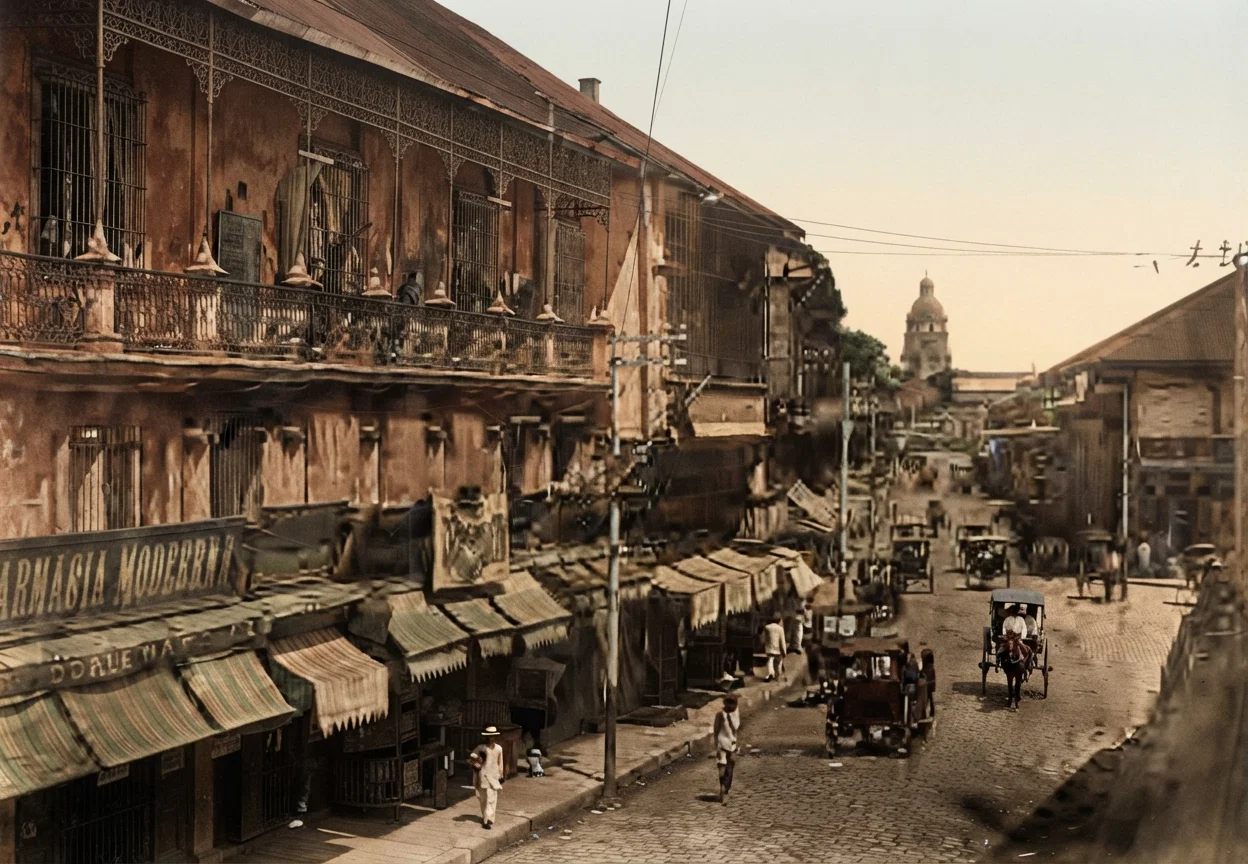
A Street Scene in Manila.
After having worked for six years among Romanists, I have never found one who even pretended to be saved, and as for trusting in the merits of the Son of God, it is always through the hands of Mary. Rome teaches that the priest brings Christ down from above by the mystery of the words, "This is My body." Rom. 10:6.—A. B. DeRoos.
Romanists are not taught the perfection of Christ's work; they are taught that they must supplement the work of Christ by their own meritorious works. The priests come between them and God, and God has said: "There is . . . one Mediator between God and men, the Man Christ Jesus."—R. H. Bender.
Roman Catholics put the creature before the Creator, giving to the Virgin the place of intercessor, which belongs to Christ. Rom. 1:25; 1 Tim. 2:5; Acts 4:12. They rob the sacrifice of Christ of its atoning merits and power to save, and save completely, all who believe. Heb. 9:15, 27, 28; 7:25. A lawyer expressed his belief in the following terms, and it is the faith of every true Roman Catholic: "The sacrifice of Christ atones for our original sin, but the actual sins of our lives need to be purged by good works, obedience to the church, and at last by the fires of purgatory, which are more or less severe and lengthy, according to the circumstances and actions of the person in this life, from which he is ultimately liberated by the intercession of Mary." They deny the possibility of any one asking for, and receiving, the assurance of pardon and eternal salvation in this life, which fact they declare can only be known when one stands in God's presence, when pardon will be given on merit, thus denying John 3:36; Eph. 5:9; Rom. 10:13.—Eva Ridge.
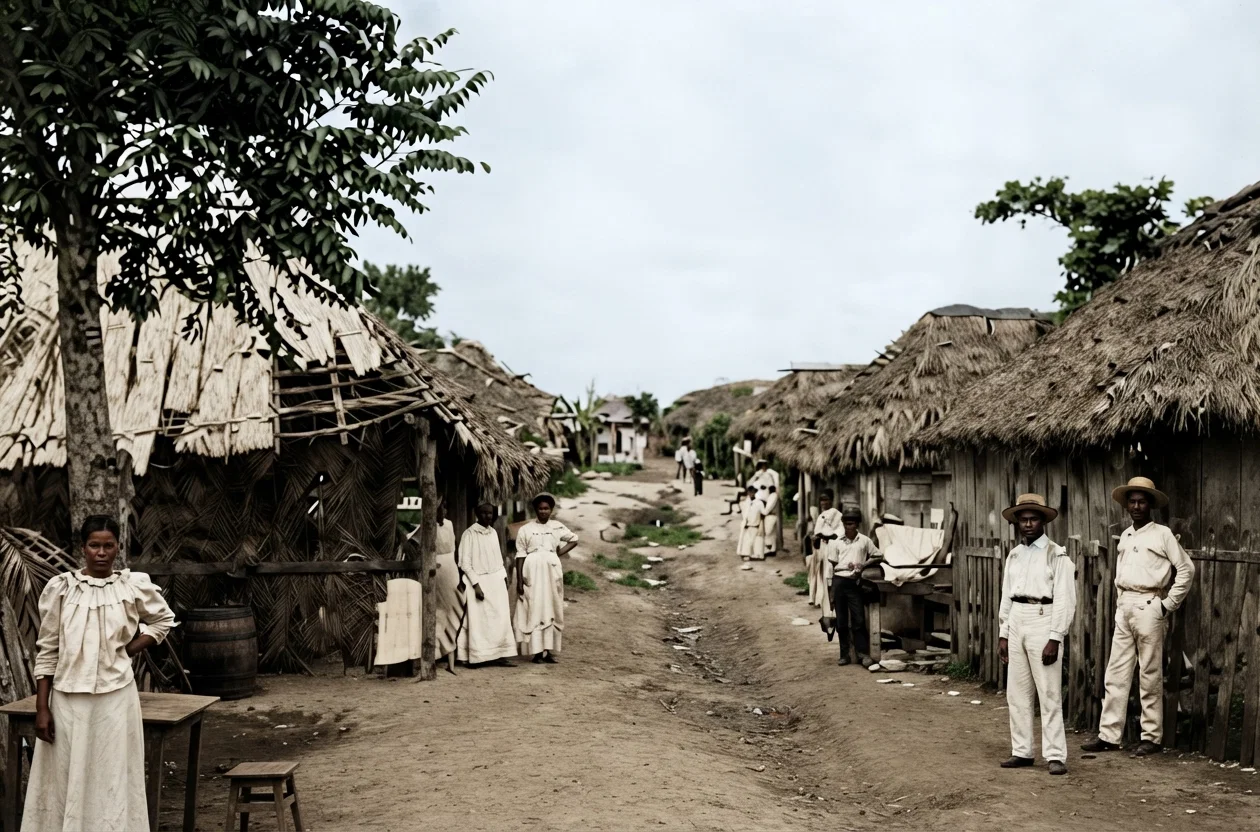
A Street Scene in Porto Rico.
Here in Nicaragua the great mass of people have no clear idea, whatever, of salvation. Those who understand a little more, invariably tell you that by good works, penances, and purgatory they pay the debt of sin, and thus buy salvation, coming in as auxiliaries, images, Mary, masses, baptism, etc. They thus place salvation on their own efforts as the foundation instead of the finished work of Christ. Salvation impossible; the foundation is false. I have never found a Romanist in Central America who had any conception of the perfection of Christ's work for the sinner.—Eta Aviles.
I asked the girl who lives with me, a native convert from Romanism, whether one can be saved in the Church of Rome, and she replied: "It is impossible, because God says that all idolaters shall have their part in the lake of fire; and in 2 Cor. 6:16, 17, that the Spirit of God can not have communion with idols, and God promises His Spirit to those who separate themselves from such things. And to live in the Church of Rome, it does not matter what other qualities one may possess, he is an idolater, and is occupied in everything under the sun but obedience to God's Word."—Callie Ham.
The doctrine held by Roman Catholics of transubstantiation is entirely antichristian, and substitutes the sacrificial work of the priest in the place of Christ's sacrificial work on the cross as the ground of pardon. Every Roman Catholic must believe that baptism is God's way of canceling sin, and that only those baptized will be saved. This destroys entirely the efficacy of Christ's work, and substitutes for it a mere ceremony. Confession to the priest, and believing that he has power to forgive sins, perverts the whole plan of salvation. This every Roman Catholic believes in. During my ten years in Costa Rica, I have not met one Roman Catholic who could give a clear and simple testimony of the plan of salvation,13as given in the Scriptures. I have met many thousands who believe that the saints, and especially Mary, can and will save them. One text describes Romanism as I know it: "They have taken away my Lord, and I know not where they have laid Him." Take away Christ, and what have we left but dry formalities and ceremonies which never did, and never can, take away sin? Christ says: "I am the way, the truth, and the life; no man cometh unto the Father, but by Me." This means, put Mary, good works, or some creature, in the place of Christ, and you can not come unto the Father.—James Hayler, Missionary of the Jamaica Baptist Missionary Society, Cartago, Costa Rica.
Romanism has not the slightest idea of the efficiency of Christ's redemptive work. As well ask heat of the moon as ask this of Rome. Neither priest nor people know or experience it. We have a proof of this in the sickness and death of Pope Leo XIII., invoking the Virgin, asking for the blessings of the priests, seeing shadows and phantoms, and having to be tranquilized by worldly men.—F. G. Penzotti, a converted Romanist, for many years a missionary and agent of the American Bible Society in South and Central America.
We were greatly impressed [in Italy], as never before, with the need of Protestant missions in Roman Catholic countries. Whatever truth the Romish Church conserves is buried under a mass of rubbish, both ecclesiastical and doctrinal. We saw, even in Dublin, on a Roman Catholic church, the blasphemous inscription, "Maria Peccatorum Refugio" (Mary is the refuge of sinners); and on many a church in Italy, the notice that in her name full indulgence for sin might there be procured.—Dr. A. T. Pierson.
THE MEETING AT HEALDSBURG.
By Editor
THERE is nothing like the pure Gospel of Jesus Christ to unify the hearts of people. This thought comes to us as we write a few notes of the Pacific Union Conference meeting at Healdsburg, Cal., March 18 to 25. There were two things which greatly contributed to this spirit of love and unity. The first was the Gospel teaching of Prof. W. W. Prescott, editor of the Review and Herald, and Pastor A. G. Daniells, president of the General Conference; and the second was the effect of the reading and study of Volume 8 of the Testimonies to the Church, filled with most excellent instructions and warnings concerning the perils and work of this time.
Professor Prescott's teaching was based largely on the epistle to the Hebrews, in which is so clearly revealed the Sonship, Creatorship, priesthood, and redemptive, saving power of Jesus Christ, our Lord, as opposed to all man-made devices for saving the soul. It was the everlasting Gospel in the setting for this very time. There was clearly set forth the apostasy and its result in the early centuries and its parallel in these days; and the remedy, the Gospel, was clearly presented. But no mere theory of this Gospel will save; there must be the vitalizing power of the Spirit of God brought into the life by faith. God's last great message never seemed so dear, precious, glorious. The counsel and instruction of these brethren were greatly appreciated.
Delegates were present from the following conferences: California, Southern California, Arizona, Upper Columbia, Western Washington, Western Oregon, British Columbia, Montana, and Utah. British Columbia, Arizona, Utah, Western Washington, and Western Oregon were admitted as new state conferences into the Union Conference. Good reports came from all parts of the field, including the mission fields of Alaska and Hawaii.
There were twelve physicians present, most of them from various sanitariums within the Union Conference—from Portland, Spokane, Seattle, St. Helena—and a goodly number of schoolmen also from Walla Walla, Healdsburg, and Fernando Colleges.
Desirable actions were taken for the enlargement of the work along missionary lines, for better adjustment of financial conditions, and for the unification of all branches of the work.
It was a matter of great regret that Pastor Knox could not feel free to continue his work as president of the Union Conference; he was relieved at his earnest request.
The officers of the Union Conference are as follows: Pastor W. B. White, president; J. J. Ireland, secretary and auditor; Pacific Press, treasurer; missionary secretary, H. H. Hall; educational secretary, Prof. M. E. Cady. Others will be announced later on. Dr. W. R. Simmons was elected president of the Pacific Medical Missionary and Benevolent Association.
Healdsburg church opened its hospitable homes for the delegates, and generously entertained them.
May the blessings of this important meeting greatly multiply in abundant fruitage for God.
OUR WORK AND WORKERS.
THE members of the S. D. A. Church at Gentry, Ark., are at work on a new house of worship.
THE company of believers at Madge, Coleman Co., Texas, has grown from one to nearly forty in less than two years.
AT Stillwater, Okla., five have received baptism. These were convinced of the truth principally through reading, and took their stand after a presentation of the Gospel message by Brother C. Sorenson.
GEO. E. NORWOOD, in Southwestern Union Record, reports the erection of a church building at Fayetteville, Ark., and the addition of four new members as the result of a series of meetings there.
INTERNATIONAL PUBLISHING ASSOCIATION.
By T. G. Johnson
Knowing that many of the readers of the Signs are watching with interest the development of this institution, we shall endeavor from time to time to report the progress of the work.
We moved into our building and began our work about February 1, and have since printed our four papers: Christlicher Hausfreund (German weekly), Der Deutsche Arbeiter (German monthly), Evangeliets Sendebud (Danish-Norwegian weekly), and Sion's Vaktare (Swedish weekly), and a number of new tracts. We have a good stock of our literature, and are ready to fill orders. Our new catalogues will be ready in a few weeks, and we shall be glad to mail them to any one who is interested in the foreign literature.
While the association will do its utmost to get this literature before the people, it will take our united efforts to reach the foreign population with the Lord's message of truth for this time. Our English-speaking brethren and sisters everywhere must continue to realize the responsibility that rests upon them, in seeing that their foreign neighbors and friends are supplied with literature, containing special truth for this time. Orders have been coming in quite freely for tracts and papers, and some for our larger books. Let us continue to broaden our efforts in reaching souls for whom Christ died, before it is forever too late.
Below is a list of some of our latest special tracts and pamphlets, that should be put in the hands of the people of various nationalities at once:—
German Tracts.
We Would See Jesus, $1.00 per 100.
The Thief on the Cross, and the Spirits in Prison, $2.50 per 100.
Have Faith in God, 50 cents per 100.
Without Excuse, 50 cents per 100.
Way to Christ, $1.50 per 100.
What Do These Things Mean? $1.00 per 100.
Can We Know? 50 cents per 100.
Signs of the Times, $1.50 per 100.
Is the End Near? $1.50 per 100.
The Veil Removed, 50 cents per 100.
The Prophetic Word and the Last Warning Message, $3.00 per 100.
Perpetuity of Law of God, $1.50 per 100.
The Fire Test, $1.00 per 100.
Danish Tracts.
We Would See Jesus, $1.00 per 100.
How Was the Sabbath Changed? 50 cents per 100.
The Gospel Remedy for Present-day Isms, $1.50 per 100.
Which Day Do You Keep? 50 cents per 100.
The Law of God, 50 cents per 100.
Perpetuity of the Law of God, $1.00 per 100.
Signs of the Times, $1.00 per 100.
Is the End Near? 50 cents per 100.
Is Man Immortal? 50 cents per 100.
Forbidden Ground, 25 cents per 100.
The Sinner's Fate, 50 cents per 100.
The Coming of the Lord, 25 cents per 100.
Our Answer, $1.00 per 100.
Swedish Tracts.
The Present Truth, $2.00 per 100.
Christ and the Sabbath, $3.00 per 100.
True and False Interpretation, $1.00 per 100.
Canright vs. Canright, 10 cents each.
Alarm of War, $2.00 per 100.
Christ and the Pharisees, $2.00 per 100.
Last-day Tokens, $3.00 per 100.
Marshaling of the Nations, 10 cents each.
Address, International Publishing Association,
College View, Neb. T. G. JOHNSON.
THE ADVANTAGES OF A TRAINING-SCHOOL AT WASHINGTON, D. C.
By W. T. Bland
WHEN it was decided that the headquarters of the denomination were to be located at Washington, D. C., at once the advantages in the establishment of a training-school at the same place were apparent.
Washington is rapidly becoming one of the most prominent cities of the world. Here are gathered from all over the country the men who make the laws of the land. The great government departments, with their thousands of officers and clerks, are located here. Here are also gathered the representatives of the various foreign nations of the world.
It is not a factory or commercial city. The hours for labor are short, and the people have much time for study and thought. This makes it a favorable place for our ministers and Bible workers to present the truth, and for students in the training-school to have an actual experience in the various lines of work they are fitting themselves for.
Here students will have access to the Congressional Library, considered one of the finest of its kind in the world; also the Smithsonian Institute, the National Museum, the patent offices, the Art Gallery, and other places containing collections for study and information.
Industrial Employment.
In the construction of buildings for the offices of the General Conference, the publishing house, the sanitarium, and even in the erection of the school buildings themselves, an opportunity will be furnished from the very start in giving employment and training to the students. The experiences in the establishment of all of our schools in the past will be available, and considered with a view to the avoiding of mistakes and taking advantage of the successes achieved.
When the time arrives to begin vigorously pushing the work of building, it is desired that the actual work of school commence. As far as possible, the work of building, of laying out and beautifying the grounds, will be done by the students. The plan of study and labor will be so combined that the students will be able to meet much, if not all, their expenses. Especially will this be so while the buildings are in progress of construction.
Class of Students Wanted.
Especially during the first year of the school only those should come who are able and willing to work. While the students are pursuing their studies, helping in the construction of the buildings, and in other lines of employment, opportunities will also be found for Bible work, canvassing, and other forms of religious work, as the student may have the ability to undertake.
Young men will be wanted who can be trusted, who can work, and who are willing to consecrate their lives to the Master's service, and to be trained for whatever responsibilities He may have for them.
A number of earnest, devoted young women will also be furnished with employment, for much will be found that they can do that will assist them largely, if not wholly, in defraying their expenses.
No one should come without first having made definite arrangements. Correspondence is invited, and full instruction and information will be given on request. W. T. BLAND. 222 N. Capitol Street, Washington, D. C.
NOTICE OF THE ANNUAL MEETING OF THE STOCKHOLDERS OF THE PACIFIC PRESS PUBLISHING COMPANY.
By Editor
NOTICE is hereby given to all whom it may concern, that the annual meeting of the stockholders of the Pacific Press Publishing Company, a corporation organized and existing under and by virtue of the laws of the state of California, will be held at the office of the company on the southwest corner of Twelfth and Castro Streets, in the city of Oakland, county of Alameda, state of California, on Monday, the twenty-fifth day of April, A. D. 1904, at 9:30 o'clock A. M.
The election of directors for the ensuing year, the advisability of amending, repealing, or adopting new by-laws, of changing the principal place of business of the corporation to the town of Mountain View, in the county of Santa Clara, of selling the property of the corporation, of re-organizing the corporation, and such other business as may be necessary or proper to be transacted, will come before the meeting.
By order of
W. T. KNOX,
President of the Pacific Press Publishing Company.
A. G. MILLER,
Secretary of the Pacific Press Publishing Company.
Special Notice.
In view of the important questions that are to be considered at the next annual meeting of the stockholders of the Pacific Press Publishing Company, it is not only desirable but necessary that there shall be as large an attendance of stockholders as possible. To this end it has been thought best to postpone the meeting and hold it in connection with the California Conference and camp-meeting, which is to convene in Berkeley, the first of June.
But in order to comply with the law, it will be necessary to call the first meeting of the stockholders at the regular time and place prescribed by the by-laws. This meeting, however, will be adjourned (no objection being offered) to meet on the camp-ground at Berkeley, Tuesday, June 7, 1904, at 10 o'clock A. M.
Stockholders who can not be present at this adjourned meeting are requested to have their stock represented by proxy. Blanks and all necessary information will be furnished by the secretary. Address, A. G. Miller, care Pacific Press, Oakland, Cal.
By order of the directors.
A. G. MILLER,
Secretary.
(1) "Now AFTER these things the Lord appointed seventy others, and sent them two and two before His face into every city and place, whither He Himself was about to come. (2) And He said unto them, The harvest indeed is plenteous, but the laborers are few: pray ye therefore the Lord of the harvest, that He send forth laborers into His harvest. (3) Go your ways; behold, I send you forth as lambs in the midst of wolves. (4) Carry no purse, no wallet, no shoes; and salute no man on the way. (5) And into whatsoever house ye shall enter, first say, Peace be to this house. (6) And if a son of peace be there, your peace shall rest upon him: but if not, it shall turn to you again. (7) And in that same house remain, eating and drinking such things as they give: for the laborer is worthy of his hire. Go not from house to house. (8) And into whatsoever city ye enter, and they receive you, eat such things as are set before you: (9) and heal the sick that are therein, and say unto them, The kingdom of God is come nigh unto you. (10) But into whatsoever city ye shall enter, and they receive you not, go out into the streets thereof and say, (11) Even the dust from your city, that cleaveth to our feet, we wipe off against you: nevertheless know this, that the kingdom of God is come nigh. (12) I say unto you, It shall be more tolerable in that day for Sodom, than for that city. (13) Wo unto thee, Chorazin! wo unto thee, Bethsaida! for if the mighty works had been done in Tyre and Sidon, which were done in you, they would have repented long ago, sitting in sackcloth and ashes. (14) But it shall be more tolerable for Tyre and Sidon in the judgment, than for you. (15) And thou, Capernaum, shalt thou be exalted unto heaven? thou shalt be brought down unto Hades. (16) He that heareth you heareth Me; and he that rejecteth you rejecteth Me; and he that rejecteth Me rejecteth Him that sent Me."
Golden Text.—"Pray ye therefore the Lord of the harvest that He send forth laborers into His harvest." Luke 10:2.
SUGGESTIVE QUESTIONS.
(1) How many disciples did the Lord appoint in addition to the twelve? In what manner did He send them out? Where were they to go? Verse 1. Note 1. (2) What did the Master say to His disciples regarding the harvest? What regarding the laborers? What prayer did He instruct them to pray, and to whom? Verse 2. Note 2. (3) What command did He give them? What did Christ tell the seventy concerning the conditions that would surround them? Verse 3. (4) What instruction did He give them concerning provision for their temporal needs? What were they to refrain from doing? Verse 4. Note 3. (5) What were the disciples to do on entering a house? Verse 5. (6) On what conditions would peace rest on that home? What would result in case the "son of peace" were not there? Verse 6. Note 4. (7) Where were they to make their home? What was to be their conduct in that home? What were they to consider the comforts which they received? What course were they to avoid? Verse 7. Note 5. (8) What rule was to govern the disciples wherever they were received? Verse 8. (9) What was to be their work? What was to be their message? Verse 9. (10) When a city refused to receive them, what course would they pursue? Verse 10. (11) What were they to do, and what was to be their message in such a case? Verse 11. (12) What did Jesus declare concerning such a city? Verse 12. (13) Upon what cities did the Lord pronounce wo? What comparison did He make? What would have been the result in those heathen cities? Verse 13. Note 6. (14) How will these cities fare in the final judgment? Verse 14. (15) What did the Saviour say of Capernaum? What was the cause of the judgment which would fall upon that city? Verse 15. (16) Whom would the people be hearing in hearing the message of the disciples? Whom would they be rejecting in rejecting the disciples? In rejecting Him whom would they be rejecting? Verse 16.
NOTES.
1. The time of the sending out of the seventy was toward the close of the earthly ministry of Christ, not more than five or six months before His crucifixion. It was a time for the work to be hastened, hence the extra number of laborers. Two in a company would be thirty-five companies going from place to place in advance of the Saviour of men. This shows the efficiency of Christ as a teacher, that He prepared so many qualified ministers of the Gospel while traveling about ministering to the wants of the people. The commission to the seventy is almost identical with that previously given to the twelve. But there is one difference that is significant. To the twelve He said, "Go not into the way of the Gentiles, and into any city of the Samaritans enter ye not." Matt. 10:5. There is no such direction given to the seventy. There was good reason for it, however, in the first instance. Jesus Himself had not yet given any attention to the Samaritans, and the disciples, like other Jews, were much prejudiced against them, and could not have manifested a Christian spirit toward them. Until they could do so, it would not have been worth while for them to go there. Moreover, they would have met such a strong opposition from Jewish prejudice in general that they would have been unable to overcome.
2. The harvest is plenteous.—Multitudes of people were in a condition to be won to Christ. The field of Palestine was a type of the great world field, which is now ripe and soon to be harvested; and the prayer which Jesus instructed His disciples then to pray is the prayer which every child of God should be praying now. The world is as ripe now for the Gospel message as Palestine was then for the message of the seventy. They bore witness of Him, and then He came to complete their work. Even so will it be now.
3. "No purse, no wallet, no shoes."—The purse was a leather bag for carrying money. The wallet, or scrip, was a sort of haversack for carrying provisions. The shoes referred to were of softer material than the sandals, were generally made use of in the house, and were always of bright colors, and sometimes richly embroidered. "They were to take nothing not absolutely necessary for the journey."
4. "A son of peace."—One inclined to peace; one favoring their work and message. To such a home their coming would bring blessing, as did the ark in the house of Obed-edom. If not, their salutation was to be as if it had not been made, and they would themselves receive again the blessing they had pronounced.
5. "In that same house remain."—It was better so. Otherwise Oriental customs of entertainment would take a large amount of their time, and so hinder the Lord's work. By going from house to house, they might stir up jealousies and unconsciously give wings to neighborhood gossip, which would mar the work.
6. "Wo unto thee."—A statement of literal fact, not a declaration of the Saviour's desire concerning them. The course they had taken was sure to end in wo to them. Having had greater light, their responsibility would be greater than that of the cities of the plain. Wo did overtake these cities, and Capernaum also. Chorazin and Bethsaida are lost, and Capernaum is a heap of ruins.