VI. WHAT THE LAW COULD NOT DO; WHAT CHRIST COULD DO.
IN his great discussion on the law question in the book of Romans the apostle Paul declares that "what the law could not do in that it was weak through the flesh, God sending His own Son in the likeness of sinful flesh, and for sin, condemned sin in the flesh." Rom. 8 : 3. When God gave to man His plan for him in the garden, among other things He said, "Of the tree of the knowledge of good and evil, thou shalt not eat of it; for in the day that thou eatest thereof thou shalt surely die." Gen. 2 : 17. The words which are rendered, "Thou shalt surely die," in the Hebrew are "Moth Ta-mooth," which second word is simply a repetition of the first. In other words, God assured man that as surely as he ate of the forbidden tree the death sentence was passed upon him; and as far as he was concerned he would be separated from God. He would die, he would be alienated from God's life, he would be irretrievably lost, and there would be no hope for him. Death was certain, and man could not help himself.
God's Plan Devised.
So when man did eat of the forbidden tree he realized he was a lost man, and immediately started to hide himself. Gen. 3 : 8. Sin had brought in the separation. Isa. 59 : 2. Man had gone out of the way, and had become alienated from the life of God. Rom. 3 : 12; Eph. 5 : 18. He could not find his way back to God. He had forfeited his right to life, and now the death sentence was lawfully to be imposed upon him. Having disobeyed God, he lost the power and ability in himself to do anything for God that was demanded of him. The law condemned him; it demanded his life, and die he must. If, however, he is to have another opportunity, God must devise a way whereby he can be brought back, which will still demonstrate the justice of God in man's receiving the death sentence, yet manifest the love and kindness of a tender God.
The Lord, therefore, did devise a means whereby his banished creature should be brought back. 2 Sam. 14 : 14. Immediately Jehovah God starts in pursuit of man, and calls him to come back. "Adam," the Lord calls, "Where art thou?" Gen. 3 : 9. And from that hour to this present moment Jehovah has been calling men to come back to Him. He has devised a plan whereby man might find the way back to God, where there need not be any separation or alienation, while at the same time the death sentence has been proclaimed, and the demands and claims of the law are as obligatory as ever.
Adam immediately begins to excuse himself by blaming some one else. God listens. Before He passes the death sentence upon Adam, and through him upon the human race, the Lord utters these sentiments to the serpent: "And I will put enmity between thee and the woman, and between thy seed and her Seed; He shall crush thy head, and thou shalt bruise [or hinder] His steps." Gen. 3 : 15. Hebrew translation. The thought in the Hebrew of the last clause in this verse is that the serpent would seek to bruise or wound or hinder the progress of the Seed of the woman, even as one person would hinder another by holding him by the heels, and not allowing him to go forward. Yet, in spite of this, he would make progress. The word translated "heel" in this verse is the same word that is translated "steps" in Ps. 56 : 6.
Statue of "The Minute Man" at the "Old North Bridge," near Concord, Mass., where the first conflict of the Revolution occurred, April 19, 1775. On the monument is this verse:
Jehovah Jesus, God's Way of Return.
In this promise to man and death-knell to the serpent is contained God's remedy for bringing back His exiled children, and doing for them what the law could not do, while yet he was a just God. This was the first Gospel sermon. This was the first ray of hope. This was truly the Seed which God had planted in Eden's garden through which man might feel that, tho a sinner, tho unable to do God's will in himself, tho having forfeited the gift to life, tho impossible to obey God's law, there was still a hope for him that he could do what the Lord wanted him to do.
This Seed was none other than the Lord Jesus Christ. Gal. 3 : 16. It was right there in Eden that the Lord Jesus declared to Satan that tho he had deceived man, and had led him away from God; tho he had brought wo, misery, and sorrow into the world; tho he had caused man to do on earth what he had done
heaven; and had brought rebellion into existence in this planet; tho he had made null and void Jehovah's law, there was a plan devised whereby man would be able to do God's will, and to be brought back into the favor of God, and to have accomplished in him what God desired originally to have done. Jehovah, with whom he had battled on heaven's plains and who had overcome him, would take the place of man, would come to earth as a man, would live the life of a man, would obey the law of God like a man, would die the death penalty for man, would eventually crush the head of Satan with every righteous man.
Old Testament Revealed Christ.
From that day forward God unfolded to Adam and to all his posterity what he would do for men in the person of His own divine Son; and every promise from that time onward, if man would but appreciate it, was God's unfolding his plan in Jehovah Jesus to reveal to man his help and power to do right by the new divine life in God's Son. This was manifest all through the Old Testament, in every offering which had shed blood, and in nearly all the experiences of the holy men of God.
We are told that Abel offered up a better sacrifice than Cain. Heb. 11 : 4. Wherein was it better?—It had blood, while Cain's did not.
But what was involved in this shed blood?—A testimony that Abel was righteous. But how could Abel be righteous? The Bible tells us, "There is none righteous, no, not one." Rom. 3 : 10. By the offering of this lamb, Abel by faith saw the life, the death, the obedience, the virtue, the efficacy of the Lamb of God which would bear away the sin of the world. He accepted this as his portion; and this divine life of Jehovah Jesus was imputed and imparted to Abel, and thus he became a righteous man.
This was also true of Noah. Of this patriarch we read, "But Noah found grace in the eyes of the Lord. These are the generations of Noah; Noah was a just man and perfect in his generations, and Noah walked with God." "By faith Noah . . . prepared an ark to the saving of his house; by the which he condemned the world, and became heir of the righteousness which is by faith." Gen. 6 : 8, 9; Heb. 11 : 7. But righteousness is found only in Jehovah Jesus: "This is His name whereby He shall be called: Jehovah our Righteousness." "Who of God is made unto us wisdom, and righteousness, and sanctification, and redemption." Jer. 23 : 6; 1 Cor. 1 : 30. Righteousness by faith, however, is contained in the Gospel (Rom. 1 : 16, 17); and this is the Gospel of Christ. Therefore, Noah was enabled to see Jehovah Jesus as his Saviour and Redeemer, living the life acceptable to God, fulfilling all the will of God, dying the death that he should have died to pay the penalty for sin, and living the righteous life which the law demanded. Noah accepted it, and thus became heir of the righteousness which is by faith.
Thus the cloud of witnesses might be multiplied, all of which shows that what the law could not do on account of the condition of man because of sin, Jesus Christ, the divine Son of God, who became the Son of Man, did for all who had faith in Him. He became the ladder uniting earth and heaven. Gen. 28 : 10-22; John 1 : 51. He became the Rock which was smitten. 1 Cor. 10 : 1-4. He became the great Judah, pleading that He might7become the surety in order to bring back the lost brother. Gen. 43 : 8, 9; Heb. 7 : 14. In the fulness of the time He became the helpless Babe, born in a stable and cradled in the manger. Gal. 4 : 4. He became the Mediator, the Middle-man, the God-man, that He might bring God to man, and might take man back to God. 1 Tim. 2 : 5. Bless God, Jesus Christ became the great Link which was lost in the chain that bound heaven and earth together. He is the All-in-all, and all is in Him. He came to do what the law could not do, in order that the world and universe might see what the law was intended to do, and what it will do when redemption shall have been completed and man is restored to a condition of obedience. Rom. 8 : 3, 4; 7 : 10; 3 : 21.
OUR GREAT TREASURE-HOUSE
By Ellen G. White
BY MRS. E. G. WHITE
XI. THE BOOK OF REVELATION.
As we near the close of this world’s history, the prophecies relating to the last days especially demand our study. The last book of the New Testament is full of truth that we need to understand. Satan has blinded the minds of many, so that they have been glad of any excuse for not making the Revelation their study.
The book of Revelation, in connection with the book of Daniel, demands close study. Let every God-fearing teacher consider how most clearly to comprehend and present the Gospel that our Saviour came in person to make known to His servant John,—“The revelation of Jesus Christ, which God gave unto Him, to show unto His servants things which must shortly come to pass.” None should become discouraged in their study of Revelation because of its apparently mystical symbols. “If any of you lack wisdom, let him ask of God, that giveth to all men liberally, and upbraideth not.” “Blessed is he that readeth, and they that hear the words of this prophecy, and keep those things which are written therein; for the time is at hand.” We are to proclaim to the world the great and solemn truths contained in the book of Revelation. Into the very designs and principles of the church of God these truths are to enter. There should be a closer and more diligent study of this book, a more earnest presentation of the truths it contains, truths which concern all who are living in these last days. All who are preparing to meet their Lord should make this book the subject of earnest study and prayer. It is just what its name signifies,—a revelation of the most important events that are to take place in the last days of this earth’s history. John, because of his faithful trust in the word of God, and the testimony of Christ, was banished to the Isle of Patmos. But his banishment did not separate him from Christ. The Lord visited His faithful servant in his banishment, and gave him instruction regarding what was to come upon the world.
Bunker Hill Monument, Breed's Hill, Boston. Corner stone laid June 17, 1825, the fiftieth anniversary of the battle of Bunker Hill. Daniel Webster delivered the address. Lafayette was present. Of Quincy granite, 221 feet high, 30 feet square at the base, 15 feet square at the spring of the apex; 295 steps to the top.
This Instruction is of the Greatest Importance
to us; for we are living in the last days of this earth’s history. Soon we shall enter upon the fulfilment of the events which Christ showed John were to take place. As the messengers of the Lord present these solemn truths, they must realize that they are handling subjects of eternal interest, and they should seek for the baptism of the Holy Spirit, that they may speak, not their own words, but the words given them by God.
The book of Revelation must be opened to the people. Many have been taught that it is a sealed book, but it is sealed to those only who reject truth and light. The truths that it contains must be proclaimed, that people may have an opportunity to prepare for the events which are so soon to take place. The Third Angel’s Message must be presented as the only hope for the salvation of a perishing world.
The perils of the last days are upon us, and in our work we are to warn the people of the danger they are in. Let not the solemn scenes that prophecy has revealed are soon to take place be left untouched. We are God’s messengers, and we have no time to lose. Those who would be co-workers with our Lord Jesus Christ will show a deep interest in the truths found in this book. With pen and voice they will strive to make plain the wonderful things that Christ came from heaven to reveal.
NAZARITES.
By A. Carter
WHAT is a Nazarite?—One separated, or set apart, for the service of God. This being true, how very impressive are the words found in Lev. 20:26, “Ye shall be holy unto Me; for I the Lord am holy, and have separated you from the peoples that ye should be Mine.”
For how long is that condition to continue? —Forever. Was not Christ, as a man on earth, a life-long Nazarite? Does not faith in Him and having His Spirit in us make us true Nazarites? Of course we are not under the old Mosaic law; but being free men in Christ Jesus, and our bodies being temples of the Holy Spirit, all of us ought to refrain from following the foolish fashions of the Gentile world. Of every believer it can be said, “All the days of His separation he is holy unto the Lord.” Num. 6:8.
In the New Testament, also, the thought of complete separation is found. Here the command is, “Come out from among them, and be ye separate.” From whom are we to be separated?—By reading 2 Cor. 6:14 it will be seen that it is unbelievers. Why should we be so urgently commanded to withdraw from intimate association with them?—Because in being yoked with them we become associated with unrighteousness. Yet, notwithstanding the results in prospect, many souls prefer such association, and disregard the call to come out. Surely it behooves us all to beware of the opinions of men who are living in unbelief. Their sentiments can not be a safe guide in either social or religious life. It is sad to note that many professing Christians in these days are so influenced by public opinion (or the ideas of those who are in the New Testament designated “unbelievers”) that they readily conform to the fashions of the world.
John the Baptist was a true Nazarite, and no greater teacher, excepting Christ Himself, ever lived. Self indulgence is inconsistent with the life which the Lord calls us all to live in order to fit us for service as forerunners of His second advent. A. CARTER.
Religious Rights, Not Toleration
What other nations call religious toleration, we call religious rights. They are not exercised in virtue of governmental indulgence, but as rights, of which governments can not deprive any portion of citizens, however small. Despotic power may invade those rights, but justice still confirms them. —United States Senate Report, 1829.
OUR DAY.
By Eliza H. Morton
OUR day,—a day far more than seems
When all the trembling air
Is laden with forgotten dreams
That come and go in fitful gleams,
Like sunshine on the placid streams
That seem so bright and fair.
It is a day among the years,
A time the prophets saw.
’Tis full of doubts and wondering fears,
’Tis full of wo and pain and tears,
’Tis full of scorn and scoffing jeers;
And souls are filled with awe.
For this our day is one of thought,
A trumpet sound is heard,
A message by the humble taught,
Traditions old declared as naught,
And Christians, worldlings—all besought
To search God’s written Word.
Our day is one of dazzling light
From God’s own living throne.
His law the standard true of right
Tho men its claims ignore and slight,
It will the church of God unite
When Jesus claims His own.
And what the key-note of our day
That gives to it a song?
’Tis found in that one word—obey.
No use to talk and work and pray,
And then go on the same old way.
God wants His people strong.
ELIZA H. MORTON.
TEMPORAL POWER OF THE PAPACY
By C. E. Milton
The Papacy the Same.
ANY change that we see in the Papacy is one of form and not of heart. I believe that from what I have already written that we are well persuaded of this fact, and for this reason the scope of the present article will be to round off and substantiate this thought.
I have already shown that the often-repeated maxim that the church never changes is easily susceptible of proof and is founded on fact. Therefore we can not expect the Papacy to change in its foundation principles, but only in its mode of applying them.
The Papacy persecutes, and this not because a Catholic is of different nature than other men; persecution is the logic of the principles he holds. One has but to know something of the inner workings of the Papacy and become somewhat intimately acquainted with the clergy to be thoroughly persuaded of the foregoing statement. For if the church had the power, there would not be a Protestant missionary in the city to-morrow. The truth of this statement can be verified very easily by looking into what the church did up until the very time when it lost its temporal dominion.
Not very long ago I met an American whose father was here in Rome from about 1860 and onward. This gentleman told me that in those days his father met an English clergyman who came to Rome for a tour of sight-seeing. The boat in which this minister had taken passage from New York to London was wrecked, and using this incident as a basis, he wrote a sermon of purely evangelical nature and in which no tinge of doctrinal controversy entered. He took with him to Rome several hundred copies of this sermon, thinking to distribute some of them. The very next day after he arrived, he made a visit to St. Peter's cathedral and incidently gave a copy of his sermon to the cabman. Likewise, while in the church, meeting with a very friendly abbot, he offered him a copy which was readily accepted. He then returned to the hotel where he was stopping. Early the next morning he was awakened by a heavy rap upon his door, and two policemen entered and inquired if he did not have some sermons in his baggage. He replied in the affirmative, and they immediately proceeded to take possession of them. They then told him that he would find his sermons when he arrived at Civita Vecchia, a town some miles distant from Rome, and he was ordered to leave the city that very afternoon; which he was obliged to do.
The Bible Considered the More Dangerous.
Another clergy man was returning from a tour to the Holy Land, about 1860, and stopped at Rome on his return trip. Before starting on his voyage he had provided himself with a revolver, as he had heard that things were not quite safe in Palestine. When he entered Rome the city official, while inspecting his baggage, found the revolver as well as a copy of the Bible. They told him that he might retain the revolver but the Bible they would be compelled to take from him, as he could not be allowed to enter the city with such a weapon.
The gentleman previously mentioned, whose father resided at Rome, told me that one day his father happened to be in a park here when he fell into a conversation with a gentleman who told him a number of things about the papal corruption. A short time afterwards this gentleman's father was saluted by an American archbishop whom he had incidently met in New York. The gentleman who had told him of the papal abuses seeing this, thought that he must have mistaken his man, and hurried up to him pale and trembling, and said that he owed him an apology for speaking so freely of the papal corruption for he had mistaken him for a Scotchman, a Protestant. He begged him to forget what he had told him and not to tell the authorities of their conversation. For, he added, if the papal authorities should find out that he had spoken of their abuses, he would be banished immediately from Rome and his business would be ruined. The other gentleman assured him that he need have no cause for alarm, for he was a strong Protestant and no one would be informed of the matter.
These are a few of the many instances of similar nature that might be given, but perhaps they may suffice to give us an idea of the spirit that actuated the Papacy up to the time that the temporal power was wrested from it. Nor has the Papacy changed in the principles which demand persecution in the short period of the last thirty years.
Some Recent Events
also give us an indication of the feeling of intolerance that exists and is ever waiting for an opportunity of venting itself. But a short time ago the city authorities refused to allow the Protestants the right of putting out posters to advertise their meetings. This privilege has always been conceded to them in the past from the time that Rome was open to evangelical work. In another city of Italy a minister was fined recently two hundred dollars for omitting to put a stamp on the sign advertising his meeting. Ordinarily such omissions are passed over or the fine given them is small, but in this case the punishment meted out showed the spirit that was back of it. These are but straws which show how the wind is blowing. An English Baptist minister who was born in Rome told me that he believed that the day is not far distant when the persecutions will be renewed in Rome.
A friend of mine recently interviewed a leading prelate in relation to the apparent changes that are taking place in the church. The prelate said:
The Papacy is such an institution that it never changes with the change of things and time. It is a mistake to say that the Papacy is losing its energy. It is more correct to say that the obstacles that confront it are greater than those of yesterday, and the past. The masses subtract from its influence by leaving the church because they are dominated by the spirit of rebellion which is the result of modern rationalism. But the times change and men are teachable and the nations are capable of being healed. The Papacy sees the time in which again its authority will be venerated and recognized. It does not hurry matters, but serenely and calmly awaits its time. For in the past other tempests have assailed the Papacy but it ever remained solid and immovable and then seemed stronger afterwards than before. Society progresses and the church follows it and stands near at hand to watch it and save it.
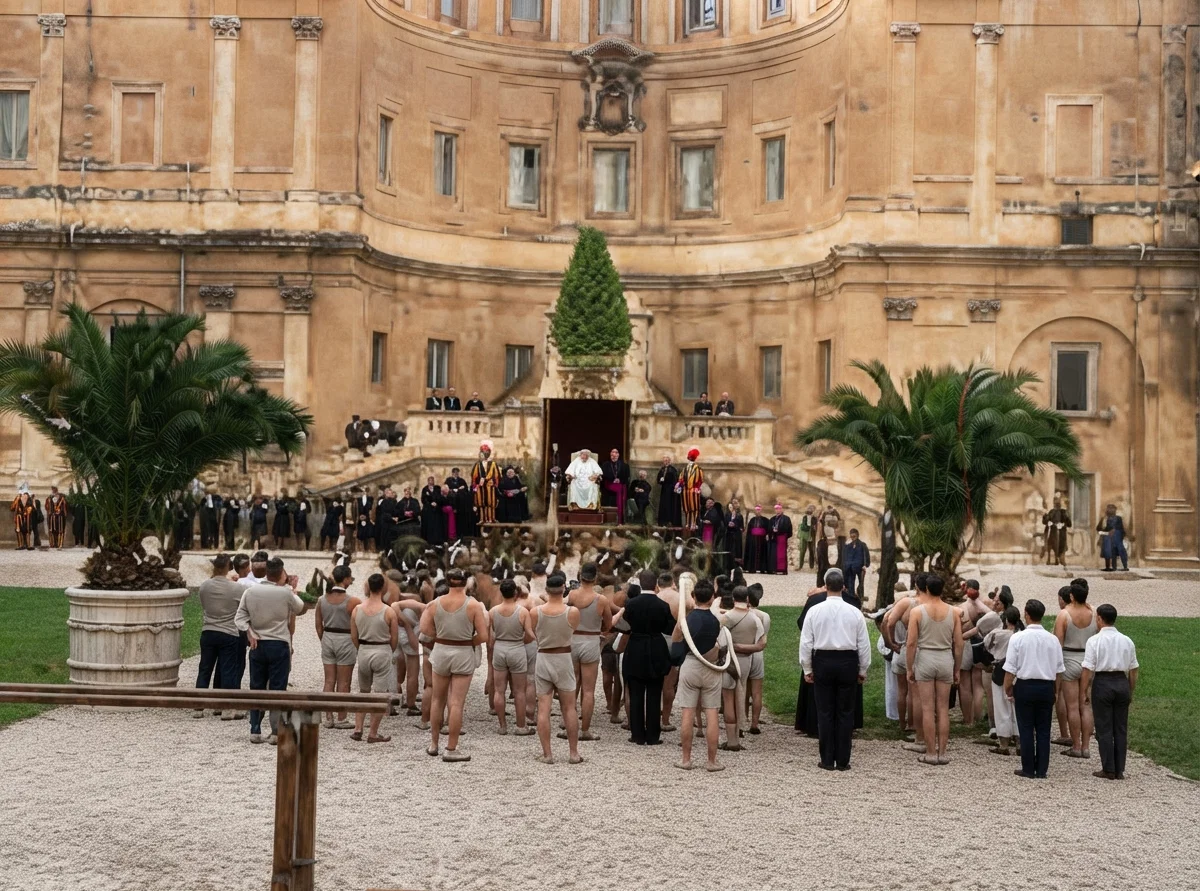
From a Photograph of Sports in the Vatican before the Pope, who is dressed in white in the center of the background.
Sports in the Vatican.
The prelate makes it plain that no real change in the Papacy is contemplated, but only a slight modification in its method in order to keep up with the progress of society. In fact, a short time ago the Catholics of the old school were almost scandalized by the new departure that was taken towards introducing into the Catholic societies a régime of gymnastics and out-door sports.
The pope took the initiative in this matter by inviting the young people's societies to give an athletic performance in his presence at the Vatican. The church had been accustomed in the past to frown upon anything that savored of athletic sports and therefore this new move caused a storm of comment from every side. And now the young priests can9be seen in the public parks playing football. Among other comments that appeared on the subject was a comic poem written by a prominent Italian poet. He was himself a student for the priesthood when a young man, and in his poem contrasts the dreary seminary life of the past with the present, and speaks thus of the innovations being introduced:
But now, my dear children, there is no more the sorrowful time of that ecclesiastical austerity, but the style of the modern seminarists is to come in short breeches to perform gymnastics. And all are now members of the Christian democracy. And soon we shall see the holy muscles* playing at football and in the wolf chase.
These changes have helped to strengthen the church's hold on the young men of the country. As I have said, the church is making some changes in form in order to keep in tune with the present conditions.
This question was put to a leading priest of Rome: "It seems that the Papacy has broken to some extent the iron bands that separated it from the world?" He answered:
It is a great mistake to say that there has been an iron band separating the church from society. The church is ever cautious, prudent, and watchful. It can not put itself in accord with errors, but it loves the erring and follows them near at hand. It watches for the times to ripen, and when they arrive at the point to offer good prospects for society, it blesses and sanctifies the progress and gives it new impulses and tries to make it more Christian. The modern society is easily offended and touchy, and it is necessary to use much indulgence in dealing with it.
It is evident from these statements that the church has the same attitude toward society as in the past, but is ever watching its opportunity to ingratiate itself into its good wishes and make it "more Christian," which means to make it more Catholic. The present policy of the church, therefore, is to try to lay aside to some extent the rod of iron of the past and use more indulgence until the times ripen. Its aims have not in the least changed, but it has modified to some extent its means of attaining them.
The Papacy and the Italian Parliament.
A prelate was asked the question, "Does the Papacy intend to reform the Italian Parliament?" He answered:
And why not? By reforming the Parliament the nation will be reformed. Because, "Regis ab exemplo totus componitur orbis" [to the example of the king the world conforms itself].
Its designs, therefore, upon the government remain the same, and it still sighs for the restoration of its lost power. For while recently the Papacy has accepted from the Italian Government the money for its Italian missions which it has refused since 1870, yet it has not even in this respect been willing to recognize itself as in any way obligated to the government. It accepts this money without in the least relinquishing its claim on Rome or renouncing its intention of again setting up its temporal dominion. For as one Catholic journal says, "Pius X., like Pius IX. and Leo XIII., strictly maintains the rights of the Holy See."
So that from whatever point of view one looks at the present attitude of the Papacy it is evident that it has not in the least changed its aims nor committed itself to a modification of its principles, but it has only varied its means of obtaining its object in conformity with the times.
MUSIC.
By Lina Hall
MUSIC is the language of the soul, the expression of its emotions. Therefore, as all other language, it is a power, a great power, for good or evil.
As there is but one source of good and one of evil, so good music is of God and bad music of the devil. Music must either exalt Him who is the Author of all good, or honor the enemy who has so well succeeded in perverting all of God's blessings.
What makes music good or bad are principally three things: (1) Its Aim; (2) Its Performance; (3) Its Composition.
I. Its Aim.
We must not lose sight of this fact, that the original end of all music was to honor the Creator and thereby be a blessing to His creation.
Ah, who can without strong emotion think of those myriads of angels worshiping around the great white throne, or, again, of the ecstasy of that song of triumph of the redeemed—the Song of Moses and the Lamb! Ought we not to learn to sing to such noble sentiments in anticipation? Therefore, music that does not express true emotions is not honorable to the Lord, such as praise, devotion, love (not passion), sincerity, majesty, sympathy, scenic beauty, childish joy, or even playfulness.
Good music arouses feelings of rectitude, but the result of bad music is fleshly lusts, indolence, worldly love, etc.
II. Performance.
Good music can be spoiled by being performed in a frivolous or faulty manner. Therefore, sacred music should be performed by such as are in harmony therewith. Why does the organ adapt itself so well to sacred music? It is because its keys can not so easily be struck in a frivolous and light manner.
Whence comes this idea that church or praise music must be very fast and light, or it is not praise? The old Hebrew way of singing the Psalms is so solemn and grandly religious, that the hearer is impressed with the grandeur of its thoughts without understanding one word of it.
Little by little we have drifted into the worldly, and our taste is so far perverted that we call for the light rather than for the solemn; the frivolous and worthless, rather than the grand and worthy.
Luther's hymns are known for their slowness and reverential expression. Listen to a congregation of thousands singing the inspiring hymn that gave Luther courage to stand alone against the world: "Ein fester Burg ist unser Gott!" The children are impressed with true sentiments on hearing such tunes.
It is to be very much deplored that hymns are sung so fast that they can hardly be discerned from other light, worldly tunes. Slowness in singing is not dragging behind time. Majestic clearness, majesty, and sweetness in music is an art that the evil one has replaced by his way. The time should be true, but true time must not be confounded with fast and frivolous time. The singing in church should be a rebuke to irreverance and worldliness.
III. Composition.
True composition must agree with the aim of the music; this makes its character.
Much could be written on this phase of the subject. Listen on passing saloons or other amusement places. Here the phonograph emits a tune, with such a confusion of voices, and noises, even whistling, stamping, etc., that its aim can not be mistaken. Or, again, it is a tune sung so as to arouse baser passions or nonsensical hilarity. Its character is confusion, anything but beautiful harmony. Such like pleases—the world. Nay, even some who profess to know better things seem to be charmed by it. O, let us return to the true in our devotion. Let music be a means of giving the sorrowful comfort, the despairing hope, the weak ones strength. In one word let it be as a pure sacrifice laid at the feet of the Father and the Lamb. In these days when every art is cast into the shrine of false gods, let the Lord Jehovah receive from His own the unmixed tribute of this beautiful art—music.
LINA HALL.
A SINGING HEART.
By Frances E. Bolton
"Now thanks be unto God, which always causeth us to triumph in Christ, and maketh manifest the savor of His knowledge by us in every place." 2 Cor. 2: 14. "More gladly therefore will I rather glory in my infirmities, that the power of Christ may rest upon me." 2 Cor. 12: 9.
HOWEVER dark may be the day,
However long the night,
And whether it be bloom of May,
Or chill of winter white,
The soul may have fair atmosphere,
Through Faith's celestial art,
And Nature sings a song of cheer,
With every singing heart.
However sad may be the way,
However lone the hour,
Or whether it be thongs of day,
Or silent prison tower,
To him who triumphs in the truth,
In Love's eternal part,
Ah! he shall revel as in youth,
And have a singing heart.
However death may sore bereave,
Or hate and envy win,
Or malice round her webs enweave,
To bind and kill thee in,
O, yet the hour of triumph's there
To cast aside each dart,
And angels to the voice of prayer
Shall give the singing heart.
Should death itself upon thee fall
For righteousness and love;
It need not come to sore appal,
But open Heaven above;
Like Stephen with an angel's face,
Like Christ who died apart,
Thou'lt know the glory of the grace
That gives the singing heart.
The grave itself that makes thy bed
Shall not have chains to hold;
For Love arises from the dead,
Immortal from the mold.
Celestial from the very sod
Transfigured thou shalt be,
To dwell forevermore with God,
To sing eternally.
FRANCES E. BOLTON.
Stars in the Night
By G. B. F. Hallock
If we never had nights, we could never see the stars. And so if you and I never had any trouble, we could never enjoy promises of sustaining grace. We do not love nights, but we do love the stars. We do not love sorrow and trouble, but we do bless God for sustaining grace. We do not love weakness, but we rejoice in such promises of God as will uphold us when weakness comes.—G. B. F. Hallock.
Self-Conceit
By Charles Kingsley
SELF-CONCEIT is the very daughter of self-will, and of that loud crying out about I, and me, and mine, which is the very bird-call for all devils, and the broad road which leads to death.—C. Kingsley.