Your ShelfYour Projects

Signs of the Times, Vol. 32, No. 26.

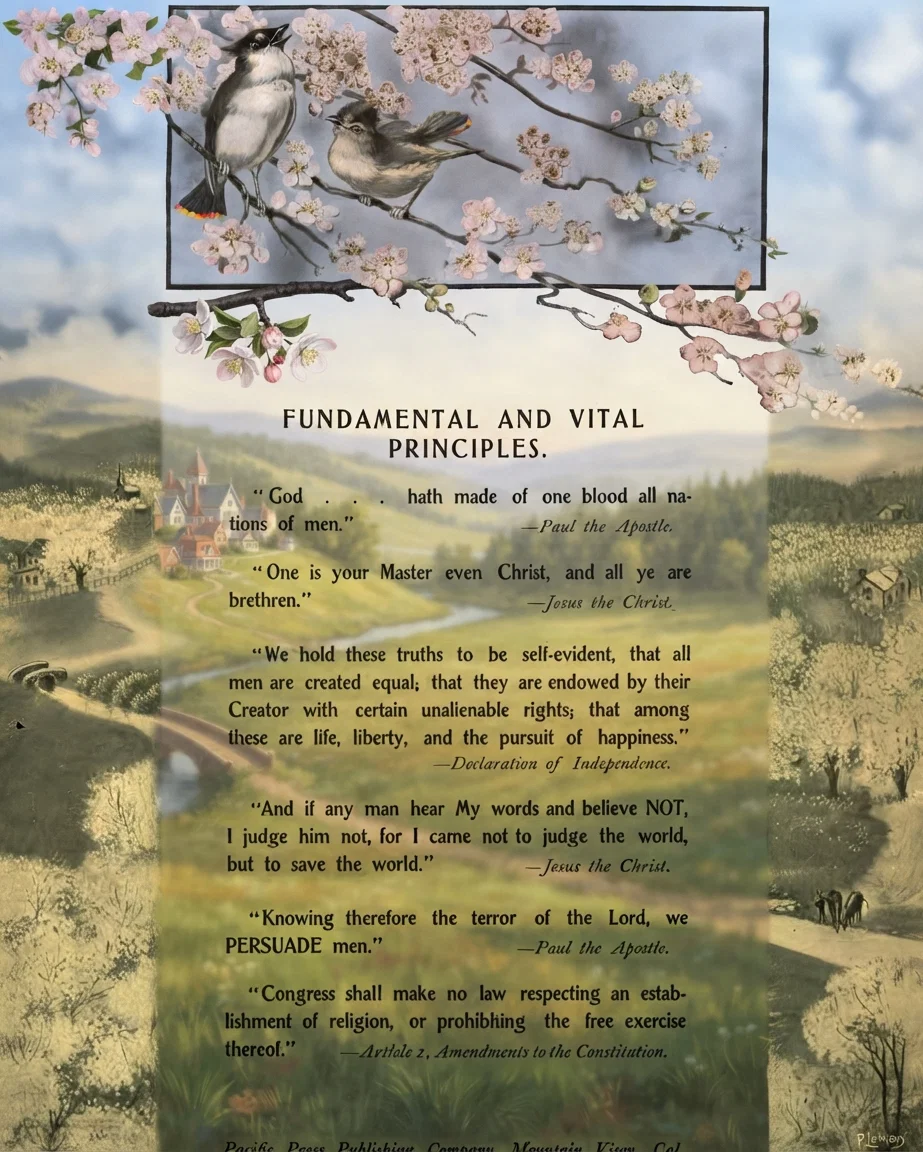
FUNDAMENTAL AND VITAL PRINCIPLES
Earlier text: HOW RODNEY CELEBRATED THE "FOURTH."

A FRENCH STATESMAN ON THE SEPARATION OF CHURCH AND STATE.

YVES GUYOT, former French minister of public works, declares that "to be constructive and progressive a national governor must neither ally itself to, nurture, nor even protect beyond that protection properly offered any other social or industrial body, a religion." In an article telling "Why France Sought Separation of Church and State," which has just appeared in a leading American newspaper, we have the most recent expression on the subject from the side of the champions of church and state separation in France. M. Guyot says:
The trouble between France and Rome, which has lately terminated in the law of separation, began with the Concordat, negotiated by Napoleon and Pius VII. This instrument served to enrol the clergy of France for the sole benefit of the Vatican. It organized and marshalled them without any regard to the wishes of the national government, and practically made them independent of the authority of the archbishops and bishops, who, under the Concordat, were state officials. It withdrew the higher clergy from the criticism and control of the inferior clergy. Finally, it withdrew the whole body of clergy from the criticism and control of faithful Roman Catholics. It elevated them above and beyond all controversy.
The Concordat so organized the Catholic Church in France that all competition with her was impossible. To seek to oppose the clerical party and the Roman influence without first destroying that organization was to wish to suppress the effects without destroying the cause. Men who benefited by that organization made an abuse of the power it gave them as much from the point of view of home policy as from that of foreign policy. The Catholic Church fancied she had found in General Boulanger the "pronunciamento" man she was ever seeking. The effort having failed, the clerical party, under the leadership of the Jesuits, invented the Panama scandals. Their object in doing that was to cast suspicion on parliamentary institutions. With that object in view they also imported anti-Semitism from Austria, where it had been invented. Their chief desire was to drive the Jews from the army; the Jews once driven out, they would proceed to hunt the Protestants, then the Freemasons, and all independent men. They intended that the officers of the army should all be pupils of the Jesuits.
It was the present pope who, by his attitude toward M. Loubet during the voyage of the latter to Italy, provoked the separation of church and state. Up to that time, whatever may have been the discords between the Elysée and the Vatican, the influence of the pontiff on the foreign policy of France had been incalculable, and often only discernible in subsequent events. The diplomacy of the French Republic, even in its secular functions, had often been subordinated to clerical influence. The occupation of Tunis, which provoked the Triple Alliance in 1882, was the result of a manœuvre of Bismarck and the Catholics, of which France was the dupe.
It needed the secularization of home politics to secularize the foreign politics of France. The king of Italy had visited France in 1903. The Vatican sought to prevent M. Loubet from returning the visit. On April 28, 1904, he sent a circular to the powers declaring that he considered such a visit "a grave offense against the sovereign pontiff." M. Loubet went to Rome, and the ambassador of the French Republic to the Vatican was withdrawn, and the separation of church and state, about which French politicians had hesitated so long, became the happy consequence of the papal insolence.
Napoleon established the Concordat to make it an instrumentum regni. All the strength that the Catholic clergy drew from the Concordat they employed against every government which had existed since 1800 in France, including even that of the Restoration. Not only did the official organization made possible under the Concordat preserve the church in France against schism and competition of all other sects and societies—religious as well as industrial—by placing the bishops' authority above all control, but it also allowed the church to make a permanent and violent interference in the home politics of France, and, moreover, to obtain an influence, as powerful as it was bad, over the foreign policy also.
The separation of church and state has for the first result the freeing of public life, of parliamentary debates, from clerical questions and their ever-hazardous and dangerous contingencies. The second, I trust, will be a permanent separation between religion and all politics—foreign and home. Moreover, from all points of view—social, political, moral, and religious—a movement for the liberation of religion from the control of the state will also be proved to be right.

CAUSES OF EARTHQUAKES.

THE following have been among the alleged causes of earthquakes: Professor Howe, Denver University, the earth's cooling; shrinkage of the interior causes cracking of the exterior.
Professor Milne, of London, upheaval in the interior of the earth.
Professor Goode, of the Chicago University, due to the Rocky Mountains, which are gradually rising.
Professor Wright, of Yale, believes it is owing to earthquakes in Japan and Formosa.
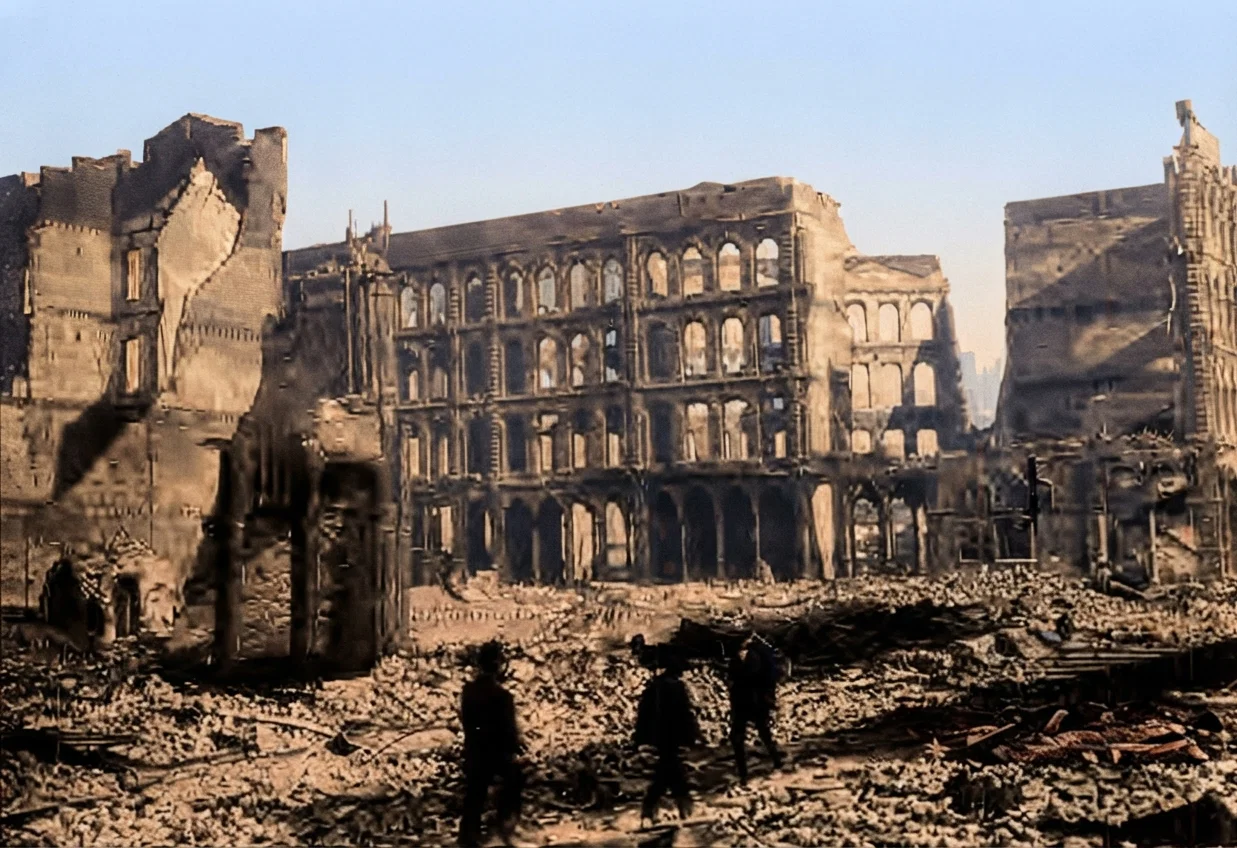
Board of Trade Building after the Fire in San Francisco. How quickly may the riches of this world pass away! What a lesson the calamities of the world ought to teach us of laying up treasure in heaven!
Prof. John C. Branner, of Stanford University, gives three causes of earthquakes: Explosions, slipping of rocks one against another, and fractures in the earth's crust, the very heavy pressure brought to bear upon the mass of rock to cause it to break. The slipping of rocks is the cause, he thinks, of the California earthquake. As to the cause of the slipping, he gives three theories: expansion of rock, contracting of rock by cooling, and the shifting of the load upon the top of the earth.
Prof. J. C. Hartzel, Geological Department of University of the Pacific, declares that it is owing to the more rapid cooling of the surface of the earth. The contracting of the cooler part pushes inward, causing distortion of the strata of the earth's surface. This earthquake, he thinks, was simply the slipping of the surface strata in this vicinity.
Charles Buckner, of Oakland, contends that the center of the earth is a mass of solid rock covered with an elastic bark, and in this bark the earthquakes originate; pent-up gases force openings; coal oil and gas in the cavities of the earth combine with other material, or the falling of a rock in the porous section produces sparks, and that produces gas.
There are all these and still other theories, of which one can take his choice. Suffice to say, every one knows there was an earthquake.

THE BOAST OF THE "GRASSHOPPER."

AMONG the sad things connected with San Francisco's disaster is the defiant spirit in which the determination to rebuild is expressed. It may be courageous and enterprising to begin building before the embers are cool, but to assume that man is above the power of nature's forces, and can defy the earthquake and the flames is sheer presumption. One capitalist declares that "San Francisco came into existence at the command of commercial and industrial forces, potencies which earthquake and fire can not move or destroy. Cities merely measure the potency of the commercial and industrial forces which create them. . . . The elements may destroy buildings, but they can not destroy the primal causes at whose command cities came into being."
But neither commercial nor industrial force is invincible. One wonders if the aforesaid capitalist ever read of Tyre, of Babylon, of Nineveh, and other world centers of commerce and industry. Tyre was the great commercial mart of the world; but what is she to-day? what has she been for centuries? The boasting capitalist of San Francisco says that city's "position on the commercial map of the world is indestructible by fire or earthquake;" but there are other forces that may alter these. The merchants of Tyre thought their position on the commercial map of the world was invincible, but the God of heaven, whose law was defied by her corruptions, found a way to change the map.
The Lord foretold the ultimate permanent fall of that proud city: "When thy wares went forth out of the seas, thou fillest many people; thou didst enrich the kings of the earth with the multitude of thy riches and of thy merchandise. In the time when thou shalt be broken by the seas in the depths of the waters thy merchandise and all thy company in the midst of thee shall fall." All this prophecy has been history for many centuries, but it has been "written for our learning" (Rom. 15:4), "for our admonition, upon whom the ends of the world are come" (1 Cor. 10:11). But, regardless of the lesson and its admonition, men continue to regard their positions invincible and themselves able to rear buildings that the forces of the Almighty can not throw down.
And the mighty One whose powers are so flippantly ignored, and whose Word is so lightly regarded, "is He that sitteth upon the circle of the earth, and the inhabitants thereof are as grasshoppers; that stretcheth out the heavens as a curtain, and spreadeth them out as a tent to dwell in; that bringeth the princes to nothing; He maketh the judges of the earth as vanity."

A REMARKABLE ADMISSION.

It has long been a query how ministers of the Gospel can conscientiously base their argument for Sunday observance upon the Fourth Commandment of the Decalogue. It will be a source of interest to many to read the following remarkable admission made by Rev. Lichliter, at Olean, N. Y., in a sermon delivered before the Epworth League on the subject of Sabbath observance, and reported in the Rochester Herald of May 20. Here is what he says:
"This matter of Sabbath observance is a practical question, and must be treated in a practical manner. Our ministers have been basing their arguments for Sunday observance upon the Fourth Commandment. What is the use? What good does it do to base our arguments upon a thing which technically is not binding, which the Jewish rabbis and Socialist organizations know is not, and laugh to scorn any arguments upon that ground. We must base our arguments upon something besides the Fourth Commandment, for they know that that is Jewish in spirit and temper, and laugh us to scorn for quoting a commandment which we do not obey and will not."
While all lovers of truth should be thankful for this admission so frankly made, yet it would have been more satisfactory had the admission embraced the whole Bible as being an unwarranted basis for Sunday observance. It is to be regretted, however, that the Rev. Lichliter has associated with such a noble admission the statement that the Fourth Commandment is Jewish in spirit; for there is no more foundation for such a statement than there is for its being a basis for Sunday observance. Jesus Christ is the one who gave the law, as can be proven from the Scriptures. In Heb. 12:26 we read of Christ: "Whose voice then [at the time the law was given] shook the earth; but now he hath promised, saying, Yet once more I shake not the earth only, but also the heaven." Also in Isa. 33:22 the same truth is emphasized, "For the Lord is our Judge, the Lord is our Lawgiver, the Lord is our King; He will save us." The apostle Paul, in Rom. 7:14, says, "We know that the law is spiritual."
These and many other scriptures plainly indicate that the law of God is not possessed of a Jewish spirit, but the Holy Spirit, and Christ is its author; therefore it is His law.
K. C. RUSSELL.

SUNDAY ENFORCEMENT ITEMS.

THE merchants of Glen Roy, Ohio, were recently notified by the prosecuting attorney "to do no business on Sunday."
AN agreement "to close their drug-stores on Sunday, except for the filling of bona fide prescriptions from physicians," has been signed by all the druggists of Bessemer, Ala.
AT Walla Walla, Wash., on February 10, County Attorney Wilson "served notice on all proprietors of cigar stands, book stores, and confectionery parlors that if their doors were not closed on Sundays he would file complaints against them." The druggists were also notified not to dispose of any article except drugs. This action was taken in response to the demand of the liquor dealers of the city, that the Sunday law be enforced to the letter, and that all places of business coming under the scope of the law be compelled to obey it;" and this demand was in retaliation for the action of the city council in causing the saloons to close on Sunday.
A MEASURE taking Sunday baseball and theaters from under the restrictions of the Sunday law and giving city councils the power to regulate these amusements, known as the Adler bill, was "stamped to death" in the lower house of the Ohio Legislature on February 15. "The right of the author to be heard on the measure was denied, an unusual procedure," and on a motion for its indefinite postponement, made the moment it was called up, the measure was rejected by a vote of 84 to 8. Immediately following this action of the house, a statement was issued on the authority of Governor Pattison, who has taken such a decided stand for the enforcement of the Sunday laws, declaring that "the defeat of the Adler bill by a vote of 84 to 8 in the House of Representatives, which measure sought to interfere with the American Sabbath and existing Sunday laws, may be considered an accurate reflection of public sentiment on the subject, and an indorsement of the governor's attitude." The governor "insists that the Sunday laws shall be obeyed to the letter," and it is even rumored that he will call out the state militia if necessary to prevent Sunday baseball playing in the big cities this spring and summer. Evidently there are to be lively times in the Sunday-enforcement line in Ohio.
"ANY enforcement of Sunday as the Sabbath, or a religious institution, is contrary to the principles of our government; for religion is a personal matter." Such is the declaration of Mr. Karl A. M. Scholz, of the Independent Citizens' Union of Maryland, which organization is attempting to secure the repeal of the "Sabbath" laws of that state. Mr. Scholz declares that these laws do not reflect the opinion of the time, and are obsolete. And correctly does he affirm that "hypocrisy and corruption are fostered by these ancient statutes, openly and avowedly enacted as compulsory church-attendance laws, which men generally disregard, but have not the moral courage to repeal." He also declares that the low and degrading Sunday resorts for liquor and their consequences "are the direct outgrowth of our present unholy Puritan 'Sabbath laws.'"
IN resolutions adopted at the annual meeting of the Christian Endeavor Unions of Springfield, Mass., and vicinity, held on March 13, the members of the Massachusetts Legislature from that section of the state were urged "to help to secure the passage of the bill recently introduced in the interest of Sabbath observance. The resolutions were presented by the treasurer of the United Society of Christian Endeavor, who explained "that the bill was to prevent fake benevolent schemes from desecrating the Sabbath by holding their unholy gatherings and amusements on that day, particularly in the theaters." It was set forth in the resolutions that they were the expression of "seven hundred Christian Endeavors, representing thirty societies in Springfield and vicinity."
MINNESOTA newspapers are noting that the new code of that state which went into effect on March 15 "changes the Sunday law in that persons of certain faiths who, according to their religious belief, observe Saturday or some other day than Sunday as the Sabbath, may resume their usual work and business on Sunday." The Owatonna Journal says this change "will be a great boon to many of the Hebrew people who conduct stores and who worship on Saturday," and that thereby "religious freedom is provided by the new code" for the observers of other days than Sunday. It seems, then, that hitherto religious freedom has not been granted in this matter to such citizens in Minnesota.
FIFTY of the theatrical people arrested at Toledo, Ohio, on March 11 on the charge of violating the Sunday law in connection with theatrical performances were tried in a justice's court on March 14, and "a fine of $1.00 was assessed on each actor and actress." Immediately, on warrants "secured by the Law and Order League of the Federation of Churches," all were brought before the city court and there "bound over to the Probate Court" for trial on the same charge. It appears that two sets of warrants were secured, and that those from the justice's court were issued on complaint of the theater managers themselves, who evidently expected thereby to outwit the church people in the matter, knowing that only a small fine would be imposed in the justice's court. But it seems that the church people want to have a sorer penalty inflicted. Church bigotry is always characterized by unchristian vindictiveness.

PERVERSION OF LAW BY SENATORS.

WHILE the recent Railroad Rate Bill was under consideration in the United States Senate, a member offered the following as an amendment:
It shall be unlawful for any common carrier engaged in interstate commerce to operate as such interstate common carrier for compensation any steam-propelled vehicle of transportation of passengers or freight between sunrise and sunset on the Sabbath day.
In support of the proposed amendment the member said: "I want to read verses 8, 9, 10, and 11 of the twentieth chapter of Exodus, so that when a senator, if there is a senator here who has not read this, comes to vote on this amendment, if he votes against it, he may know that he is voting against one of the Ten Commandments, and one that is also germane to this bill." Then he read:
"Remember the Sabbath day, to keep it holy. Six days shalt thou labor, and do all thy work; but the seventh day is the Sabbath of the Lord thy God; in it thou shalt not do any work, thou, nor thy son, nor thy daughter, thy manservant, nor thy maidservant, nor thy cattle, nor thy stranger that is within thy gates; for in six days the Lord made heaven and earth, the sea, and all that in them is, and rested the seventh day; wherefore the Lord blessed the Sabbath day, and hallowed it."
Being asked if he would stop telegraphic messages and mails on Sunday, too, the senator replied:
"I would stop the whole business and let everybody rest. I would let the telegraph operators and the railroad employees—the men who run the trains on Sunday and never get a Sunday and never know what a Sunday is—rest. I would stop all those trains. I would allow the train crews and laborers a rest of one day in seven, as commanded by the Almighty. That is what the Almighty, through Moses, commanded, and I would give Moses a fair chance in this."
This is a specimen of the confusion that arises when men undertake to legislate religious institutions into the laws of the state. When senators quote the law of God concerning one day of the week as applying to another day, they are treating that law in a manner that they would not for a moment tolerate in respect to their own laws. And no court would so construe a state law. When men in the national Legislature undertake to enforce by statute the dogmas of the Papacy, through perversion of the law of God, the result must soon be Babylon. In the instance above cited, however, to the credit of the majority, the project failed.

Religious Liberty and Government

The Constitution regards the conscience of the Jew as sacred as that of the Christian, and gives no more authority to adopt a measure affecting the conscience of a solitary individual than that of a whole community.—Report of House of Representatives, 1830.
Among all the religious persecution with which almost every page of modern history is stained, no victim ever suffered but for the violation of what government denominated the law of God.—United States Senate Report, 1829.
If the principle is once established that religion, or religious observances, shall be interwoven with our legislative acts, we must pursue it to its ultimatum.—United States Senate Report, 1829.
Let the national Legislature once perform an act which involves the decision of a religious controversy, and it will have passed its legitimate bounds. The precedent will then be established, and the foundation laid, for that usurpation of the divine prerogative in this country which has been the desolating scourge to the fairest portions of the Old World.—United States Senate Report, 1829.

Independence Day.

The date of this paper is July 4, 1906, just one hundred and thirty years since the founders of this Republic signed the charter of its liberties, and launched upon the great political sea an independent nation. A derelict barque many thought it would prove; but they knew not the principles which gave it birth. These principles are set forth in the first article in this issue. Upon these principles, or, rather, striving to realize these ideal principles, America reached her pinnacle of greatness. In her origin she stood for "a church without a pope, a state without a king." In her borders has been demonstrated that a pope is not necessary to make or maintain righteous character, nor a king necessary to preserve government.

EARTHQUAKE AND FIRE SPECIAL.

Signs of the Times Souvenir Edition.
THIS is our third and last and best edition on the great misfortune which came to the Pacific Coast. It is of much more than ordinary interest; it is the best thing yet gotten out. Let us tell you a few things it contains:

I. In Art and Illustrations.

  1. A fire picture of the burning of the city in colors.
  2. Two two-page panoramic views—one of the great fire and the other of the ruins, in colors.
  3. A portrait of the governor of California, Hon. Geo. C. Pardee.
  4. A whole page (seven views) of Stanford University buildings before and after the great temblor.
  5. A whole page (six views) of refugee scenes, camps, etc.
  6. A page on areas covered by earthquake and fire, including a relief map of San Francisco, with burned district in red.
  7. A fine page-view of fire and ruins, looking up California Street.
  8. Twenty-four other illustrations of graphic earthquake scenes, seismographic records, ruins of noted places, such as San Francisco City Hall, Palace and Fairmont hotels, eruption near Healdsburg, safe-opening scene, etc., etc., etc., with interesting stories of each. A total of forty-seven illustrations. The six seismographic records alone, including tracings taken in California, New York, and Austria, are worth the price of the paper, as are several of the other illustrations.

II. The Articles.

  1. "California: Her Condition and Resources," by Governor Geo. C. Pardee.
  2. An article on This Issue.
  3. "The Earthquake."
  4. "The Queen City of the West in Sackcloth and Ashes."
  5. "Oakland, Berkeley, and Alameda." By A. J. S. Bourdeau.
  6. "Stanford University." By President David Starr Jordan.
  7. "How San Jose Fared." By C. M. Snow.
  8. "Mountain View's Experience." By W. N. Glenn.
  9. "What Do These Things Mean?" By J. O. Corliss.
  10. "Santa Rosa's Sad Story." Mostly from the pen of Mr. Geo. E. Peery.
  11. "Some Direct Causes of the Earthquake." From "Patriarchs and Prophets."
  12. "A Mighty Ruin—Sure Trust," by C. M. Snow.
  13. "Divine Law—Normal and Abnormal."
  14. "The Eruption in Alexander Valley." By Prof. L. A. Reed.
  15. "Some Graphic Descriptions." A few extracts from Hewitt's and Hopper's articles on the earthquake and fire.
  16. A list of contributions to the Relief Funds.
  17. Some Disasters of the present year.
  18. Increase of Earthquakes, a list of the most destructive.
  19. Destructive Fires in the United States.
  20. Fire Losses in the United States from 1875 to 1905.
  21. Tornado Statistics in this country to 1888.
This paper will be an issue which you will wish to keep. Twenty-four pages, price 10 cents; in lots of 5 to 500, SIX cents each; 500 and upward, FIVE cents each. Mailed direct from this office to lists of names furnished in lots of five or more, six cents each. Address, SIGNS OF THE TIMES, Mountain View, Cal.

CONTAINED IN THIS NUMBER.

Poetry.
A Singing Heart, FRANCES E. BOLTON . . . . . . . . . . . 7 Our Day, ELIZA H. MORTON . . . . . . . . . . . . . . . . 9 God's Holy Day, IVA A. CLUTE . . . . . . . . . . . . . . 10 Out of Egypt, E. R. BUTTON . . . . . . . . . . . . . . . 12
Editorial.—American Liberty—Jesus and the Teachings of His Time—Prayer as a Privilege . . . . . . . . . . . . . . . . 3-5
Question Corner.—Nos. 1840-1843 . . . . . . . . . . . . . 5
General.
Temporal Power of the Papacy, C. E. MILTON . . . . . . . . 6 Music, LINA HALL . . . . . . . . . . . . . . . . . . . . 7 The Royal Law, F. C. GILBERT . . . . . . . . . . . . . . 8 Nazarites, A. CARTER . . . . . . . . . . . . . . . . . . 9 Our Great Treasure-House, MRS. E. G. WHITE . . . . . . . . 9
The Home.—How Rodney Celebrated the "Fourth," BENJAMIN KEECH . . . . . . . . . . . . . . . . . . . . . . . 10, 11
Missions.—Chile, WM. STEELE . . . . . . . . . . . . . . 12, 13
Outlook.—A French Statesman on the Separation of Church and State—Causes of Earthquakes—The Boast of the "Grasshopper"—Perversion of Law by Senators—A Remarkable Admission—Sunday Enforcement Items . . . . . . . . . . . . 14, 15
Publishers . . . . . . . . . . . . . . . . . . . . . . 2

Change of Field.

Before this paper reaches its readers the SIGNS OF THE TIMES will have lost one of its valuable helpers. Mr. Charles M. Snow leaves our editorial staff to take a position on the editorial staff of the Review and Herald at Washington, D. C. In 1901 Brother Snow became one of the editors of the SIGNS OF THE TIMES. He connected with the office in 1892, as a member of our office force, acting as stenographer and assisting in editorial work. We can truly say that we do not wish to lose him. He has been an efficient co-worker, as he is an earnest Christian, an agreeable companion, a loyal brother, and whole-souled gentleman. He goes to a field of greater opportunity in some respects. It is at the headquarters of our work and at the capital of the nation, the center of the arena, where men struggle and grow. We wish him noble success in his future field, constant growth in his work, and health and blessing, both here and hereafter. Mrs. Snow was for many years connected with the office, serving as one of our most efficient proof-readers.
A pleasant occasion to afford his fellow-workers in office and church to bid God-speed to himself and family was held in the office chapel (the only place sufficiently commodious), on the evening of June 23, on which occasion, as a token of regard, was presented to Brother Snow an American Standard Revised Version Bible.

The Death of Senator Gorman

The death of Hon. A. P. Gorman, United States Senator from Maryland, removes a prominent politician from the ranks of national statesmen. He had served in the Senate from 1881 to 1899, and had but recently taken his seat for another term. No earthly position, however high, or however honorably it may be filled, can save the occupant from the inevitable goal. “For all flesh is as grass, and all the glory of man as the flower of grass. The grass withereth, and the flower thereof falleth away; but the Word of the Lord endureth forever.”

Patriotism and Principles

It is well that Americans should remember these principles. Some seem to solace themselves by the noise of the Fourth, by the bombs and anvils and cannon and fireworks and the cheering, thinking that if we demonstrate as did those in 1776 we are as good patriots as they. But they shouted and screamed and celebrated because of the principles, and not merely to have a good time. They had the principles of liberty and equality with a lot of boyish exuberance and foolish noise. We have the foolish noise, and that is about all. Many, very many, utterly repudiate the principles. Read them, dear friends, as set forth in the article above referred to and as printed in black type in this issue. "Are these being repudiated?" you ask.—We reply, They are, by a continually growing constituency with little or no protest.

Church and State in the Republic

In the early days of the Republic there were strong, clear-visioned men who saw the dangers and felt the bondage of a church-and-state government. They kept the young Republic clear of it in its organic law. Its wise men stood as bulwarks of strength in resisting all influences to the contrary. As late as 1829 to 1831 both houses of Congress took clear, strong ground, and turned the tide against Sunday-closing of post-offices and post-roads. Some of their utterances are printed in black type in this issue. Read them, ponder them, and appropriate them.

Remember the Foundations of Government

America is not the same to-day that she was then. In 1892 and 1893 all these principles were repudiated by all three of the coordinate branches of our Federal government,—legislative, judicial, and executive; in the matter of closing the Columbia Exposition on Sunday and in the Trinity-Church case decision. Since that time the foundation principles of this government have been repudiated again and again. And now there will be brought to bear upon every branch of government the tremendous force of the National Federation of Churches. In the blare of trumpet and flare of torch, in the sound of drum and fife and cannon, we need to remember these things, and act accordingly.

Here and Elsewhere

Here and Elsewhere.—"Do you not wish to leave California now?" we are asked by friends; and we reply, Not at all. "Are you not afraid?"—Not at all. "But there may come another earthquake."—Very likely; but it may come first in Texas or Nebraska or Michigan or Pennsylvania. If not an earthquake, a tornado or cyclone may do equal damage. We are not afraid. From a purely worldly point of view we would to-day invest and build in California as quickly as in any other state of the Union. From a Christian view-point the safest place in the world is where God wants us to be, doing the thing He would have us do.

The Center of the Earthquake.

A gentleman from San Jose writes to the Independent an article on the earthquake in which he declares that the greatest intensity of the earthquake was at San Jose. Surely, he had not visited Santa Rosa and some other places. It reminds us of the remark of a lady in Mountain View. She concluded, from what she actually felt, that the most intense and severest shock was directly under her bed. There were some mighty results in various places.

No Postage Stamps

No Postage Stamps.—Now that the warm weather is here it is especially requested by the publishers that our patrons do not send postage stamps, as they stick together and become useless by the time they reach us. Remit by bank draft, express order, post-office order, or by registered letter. Please oblige us.

Earthquake and Cyclone

Earthquake and Cyclone.—It is reported that a family on their way to California from the East heard of the earthquake, feared to come, and turned aside into Texas. A day or so later the fearful cyclone which destroyed the town of Bellevue killed the whole family.

You have reached the end of this edition.

Signs of the Times · Jul 4, 1906