The Youth's Instructor, Vol. LI, No. 18

The Ocean Voyage

The Youth's Instructor

May 7, 1903

Review and Herald Publishing Company · Battle Creek, Michigan · May 7, 1903

The Ocean Voyage

COME with me, if you please, and I will give you a brief introduction to a voyage across the Atlantic. Our good ship, the “Oceanic,” will sail from Pier 45, New York Harbor, at three o’clock this afternoon. We have spent the night at Smith and McNeal’s Hotel, corner of Fulton and Jefferson streets, and this morning we must organize carefully if we would have all the trunks and luggage on board, and everything “ship-shape” for the voyage.

Attention to Details

Some one is detailed to transfer the baggage from the railway station to the wharf, and see that it is properly marked with labels at least two hours before sailing. Another collects the tickets, and takes them to the head office of the White Star Company to be countersigned. The man who has been appointed as treasurer and financier of the party receives all the money, from each of the party, with the exception of a dollar or two to spend on shipboard. This he takes to the exchange office, and secures English sovereigns at the rate of about $4.88 each. It is better to get one’s money exchanged in New York than to wait until reaching London; for British money is at a discount in New York, and it can, therefore, be purchased at a more favorable rate.
With all these details carefully arranged, we collect the hand baggage, “count noses” to make certain that no one is being left, and hurry off to the steamer, accompanied by a few friends from among the New York workers, who are always interested in seeing the missionaries off.
The stewards direct us to our cabins. We open the door and look inside, and then look at the hand luggage, and then at one another. Some one says: “What a cute little room! Doesn’t it look like a playhouse?” “Where do you think we are to put this luggage?” says the practical member of the party. The bed isn’t big enough for one to sleep in, but it looks as if we would have to share our eighteen-inch beds with the valises.
But necessity is the mother of invention. Little by little the parcels are packed away under the berths. The coats and hats are hung on the hooks; and the little box (called a “Stateroom”!) begins to look as if people are really going to live in it. As soon as the boxes are adjusted, we go outside to make certain that the trunks have all been put on board.

Good-by! Bon Voyage!

All these details have occupied the larger part of the day, and the time appointed for the good ship to sail has come. The first, second, and third gongs have sounded, warning the visitors that they must go ashore.
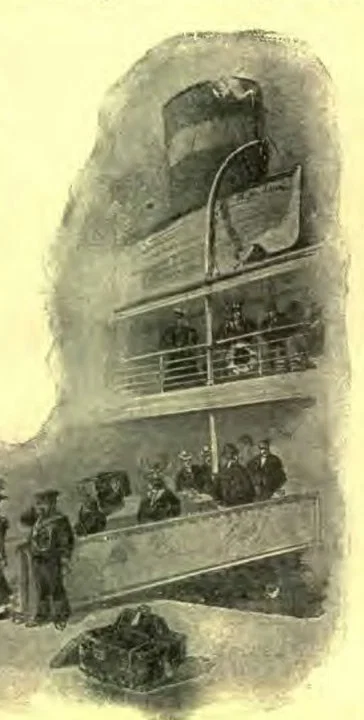
Now the last straggler is off. The gangplanks are hauled down; the great ropes and cords are thrown off; and the old ship begins to swing, almost imperceptibly, away from her moorings. “Good-by!” “Good-by!” “Shake the end of my finger if you can.” “No, I can’t.” “Reach down the end of your umbrella.” And so we shake the umbrella at each end so as to extend the good-by as far as possible. “Bon voyage!” “Did you take your lemons?” “Oh, yes, I have the lemons and the crackers and the smelling-bottle, which you say are sure remedies for seasickness, under my pillow, all ready for use if they are needed.” We who are on the ship climb into prominent positions, some on the rope-ladders and others on the railing, where we wave good-bys until the ship glides around the pier out of sight.
SIGHTING A SHIP
SIGHTING A SHIP

Sunshine and Shadow

What a mingling of joy and sorrow is seen at these partings! Some are going home, and their joy is unbounded. Others are parting with dear friends, whom they may never meet again. We would that all who are thus compelled to part with their loved ones could have the blessed comfort and assurance enjoyed by our missionaries, who know that God has called them to the work, and that they are followed by the prayers and blessings of all who are dear to them.
But now we are gliding quietly out of the harbor; and we watch with thrilling interest the most striking landmarks as we pass. Behind us are the great sky-scrapers of New York, towering high above the surrounding city. On either side are the forts, the fine buildings, and hundreds of crafts of every conceivable size and shape.
CONVALESCENT
CONVALESCENT

Rocked on the Deep

We have passed the Goddess of Liberty and Sandy Hook; and the old ship begins to change her bearings, and “stand out” for the open sea. How delightful the first swing of the vessel as she responds to the heaving rollers! The first motions are so agreeable we begin to gain confidence, and talk with much assurance of our enjoyment of the sea; but little by little the motion becomes monotonous, and the crowds on deck begin to thin out. A lady remembers that she left her baby in care of the stewardess, and hastens down to look after it; but she doesn’t come back. The gentleman who talked so loudly, and affirmed that he was never sick at sea, must go down to get his cap; but he doesn’t come back. By the time the ship has rolled for two hours, all the passengers, with the exception of a dozen really good sailors, are in their bunks, having their first experience in being “rocked in the cradle of the deep.”
GAMES ON DECK
GAMES ON DECK

Seasickness

I will not attempt to describe seasickness. It must be experienced to be appreciated; and, in fact, when it is experienced, one knows very little about it. Hundreds of remedies have been recommended for it; and some of them prove helpful on one voyage, and hurtful on another. An eminent physician whose name is well known tried various experiments in harmony with his theories when he first crossed the Atlantic. The experiments were successful; and he wrote an extended article giving various “sure cures for seasickness.” On his second voyage all his remedies failed, and he was wholly “at sea.”
It is a sickness that everybody is ashamed of. The patient hurries to his cabin, or goes behind the masts or funnel of the steamer, or looks over the edge of the vessel with a studied expression,—anything to convey the impression that he is all right. The experience is very unpleasant, but the result is seldom serious. Perhaps no other sickness could make a man so thoroughly miserable and do him so little harm. He is dizzy and confused. The sky is in the water, and the water is in the sky. First, the door is in the side of his cabin; then it is in the top, and next in the bottom; and he finds himself in a cold perspiration, clinging to his berth, or hanging on to the floor. He is wretchedly miserable. He is positive that he has lost four times as much dinner as he ever ate; and his stomach seems to be the only thing that refuses to come up.

Remedies

After the first sickness wears away, some are able to read and study; others seem wholly incapacitated for doing anything except to lie flat on their backs.
IN THE LIBRARY
IN THE LIBRARY
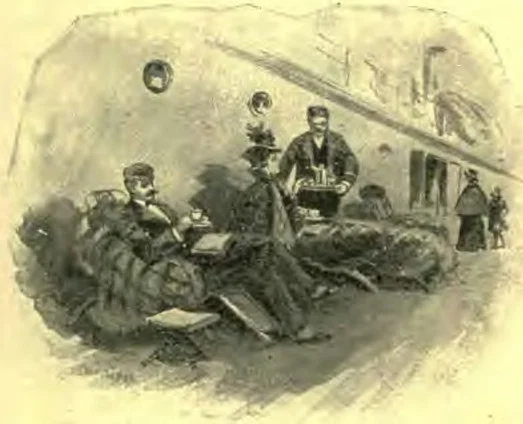
It is amusing to see the various remedies that are tried. One tries lemons; another keeps one eye shut, or bandages it, which, by the way, is a very sensible thing to do. A great scientist has recently affirmed that seasickness can be prevented by looking in a mirror. The paper which makes the statement, however, adds that the only difficulty with the remedy is that it doesn’t work when it is tried. Unfortunately, that is the chief difficulty with all remedies. The only sure cure is to reach land. Bits of ice held in the mouth, or a cold cloth or ice on the back of the neck will sometimes give relief. Undoubtedly the best remedy is activity in the open air—on deck. An experienced steward once told me that he had seen many remedies tried; but he was certain that nothing was more successful than marching, playing games, and indulging in various active diversions on deck. Those travelers who are able to overcome the almost unconquerable desire to keep perfectly still in the bunk, and who persevere in activity on deck, usually enjoy the voyage after the first day or two. Men who are experienced in traveling pace the decks for hours; and after the first unpleasantness has passed away, it becomes a most enjoyable exercise.

Games

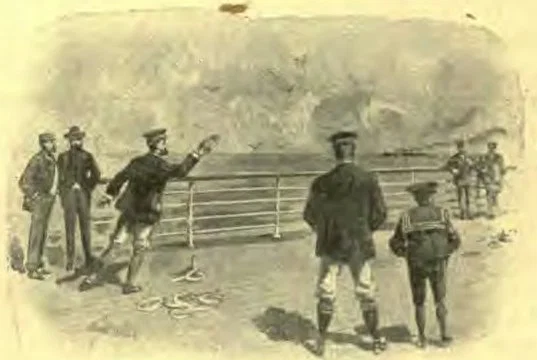
Then there are games, such as quoits, potato races, and all manner of little sports such as children enjoy on land. If, as the poet says, “men are only boys grown tall” when on land, they are emphatically boys at sea. They are cut off from the world; and a very little thing affords amusement, and becomes a pleasant pastime. I have seen the most dignified clergymen with their boots off, running enthusiastically in a potato race or in an egg race on deck. The more quiet members collect in companies on deck and sing; others go to the smoking-room and play cards and gamble; and still others spend most of their time in the library, reading and writing.

The Monotony of a Voyage

Life on an ocean steamer, after the novelty of the situation has worn off, becomes very monotonous. There are no points of land or other objects to mark the progress of the vessel. The horizon is a perfect circle, and seems only a mile or two away. It seems impossible that the ship is really making progress. She seems to be always struggling in the center of a small circle, but never advancing.
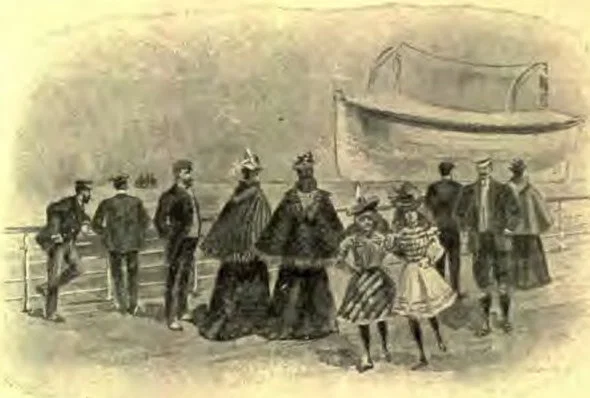
To be sure, there are variations in the sea: the ever-changing waves and the white, foamy wake of the ship are always interesting. The appearance of any kind of craft is a signal for a general rush to the ship’s side; and the boat is the subject of conversation and speculation until out of sight. A watchful eye will occasionally see a beautiful nautilus, a school of flying fish, or perhaps a floating spar from a stranded vessel. All such items are watched for with interest.

Concerts

Toward the close of the journey, when the passengers are nearly all able to be out, concerts are held in the dining-saloons, and frequently the fact is developed that there is most excellent talent on board; but more frequently the speaking and singing are rather inferior because of the fact that people with very little talent are often most willing to volunteer to “help out.”
Collections taken on such occasions are given to the Seamen’s Refuge in New York and Liverpool.

In the Hollow of His Hand

While much is said about the unpleasantness of sea voyages and the dangers of the sea, there is no good reason why we should fear. The dangers are no greater than on land. The arm of the Most High is as strong to support his children and care for them on the water as on the land. He says: “They that go down to the sea in ships, that do business in great waters; these see the works of the Lord, and his wonders in the deep.” “When thou passest through the waters, I will be with thee.” David said, “If I take the wings of the morning, and dwell in the uttermost parts of the sea; even there shall thy hand lead me, and thy right hand shall hold me.” E. R. PALMER.

The White Robin

In the summer of 1900 some friends of mine came to me with a story of a strange white bird that had been seen several times among the trees of a small grove which formed a part of the fair-grounds of the county in which I live. They described it to me as closely as they could, but I could not identify it as any of the birds which may be found in southern Ohio, the State in which my home county is. Finally another friend told me that he had seen a pair of robins feeding it, and, between us, we agreed that it must be a white robin — an albino.
An albino among men is a person whose skin and hair are unnaturally white. Among birds and animals an albino is one which is white, differing from others of its species. A bird or animal the normal color of which is white, or which changes to white feathers or fur for winter, is not an albino. The perfect albino has pink eyes, and no color about it. The white robin I saw was a perfect albino.
The rest of the brood, of which the albino was one, had scattered, and were looking out for themselves; but the parent birds were still feeding their white fledgling. The other birds in the grove took a great deal of interest in the strange inhabitant, especially the purple grackles. As the white robin sat on a bough, the grackles would perch near it, looking at it with their heads turned shrewdly to one side, or hopping from place to place, as if to get a better view. All the time they kept up a blackbird conversation about the object of their curiosity, clucking and chuckling away at a great rate.
The white robin did not hunt food for itself, although it was fully old enough to do so, but depended on its parents. When it flew, it did so awkwardly and blunderingly, and generally seemed to prefer staying in one place.
A day or two afterward two boys brought to my office the white robin, dead. One of the local papers had said that an albino robin might be sold to a museum, and I accused the boys of having killed the bird on the chance of selling it. This they stoutly denied, saying that they found it dead. I took off the skin for the purpose of mounting it, and found that the boys had been telling the truth, for there was no sign of an injury. The poor robin was very thin, and its stomach was almost empty, except for the remains of one bug. I wondered if its parents had grown tired of feeding it. I found, also, that the reason it flew so poorly was because its eyes were defective, and that it must have been almost blind. Had its parents fed it until the time of the fall migration southward, the white robin could not have gone with the rest, and must have starved. The robin was entirely white, with pink eyes, a pinky-white beak, and pinkish legs.—Henry Holcomb Bennett, in St. Nicholas.

— Selected

Lilacs

“Sweet lilacs—lilacs!” This the cry I heard Above the city street’s unceasing roar; So keen its sudden cadence, that it stirred My heart to quickened beats. I saw once more An old brown house beside a sleeping lane, A gate moss-misted and a velvet lawn, And ah! with joy that faltered into pain, A cloud of lilacs purple as the dawn!
The robin’s flute their only heralding, Ere yet the cowslips margined every brook, They came with all the rapture of the spring, And sprays of tender amethyst they shook Full gently on the casement opened wide; They bent in beauty toward my eager hand, And flung upon the air a perfume-tide More subtile sweet than musk from Samarcand.
“Sweet lilacs—lilacs!” Still that thrilling cry; I beckon, and the odorous blooms are mine; I marvel that a tarnished coin may buy So much of beauty and a joy so fine! God gave his flowers no voices, yet to me They speak through all the silence of the years Of childhood’s glad content—till Memory Blots out the present in a mist of tears.

— Selected

A Little Girl's Good Sportsmanship at Croquet

“WHAT a delightful spirit was exhibited by a little girl, who, when defeated at a game of croquet, came dancing over the lawn, clapping her hands and shouting, ‘Ethel has won! Ethel has won!’ It is a small nature that sulks when surpassed by others.”

Do the Hard Things

“DIFFICULT WORK SOLICITED” was the sign put up by a young man who opened a shop for the repairing of sewing machines and bicycles. He had prepared himself to take jobs that were beyond the ordinary workman. The easy work in life is the work that is poorly paid. Whatever calling you select, put yourself to do that which is most difficult in it.”—Selected.

“One of the Family”

DOLLIE wished to join the church, and it was a keen disappointment to her when she was told that she was too young, and must wait a few years.
Mama tried to explain that it really made very little difference; that she could love and follow Jesus just as well without being a member of the church for the present. But though Dollie was used to yielding her wishes to mama’s judgment when the two did not agree; and though she honestly tried with all her might to give up this one cheerfully, she could not help feeling that somehow it was not “just the same.”
One day Dollie and her cousin Belle, who had come from New York to make her a long visit, and Nannie Cole, who lived next door, were playing together on the piazza, when a strange man came to the house. He had a book and a pencil, and he asked a great many questions of mama, writing down her answers as she gave them.
The little girls were full of curiosity, and when the man was gone, Dollie asked mama who he was.
“He is the census-taker,” said mama. Then she explained how he had been appointed to go from house to house, and find out just how many people lived in each one, and in the whole town, and how this was done in all the cities and towns, until the whole population of the country had been counted.
This was very interesting to Dollie.
“Did he count me?” she asked, eagerly.
“Certainly.”
“I was afraid I was too little,” she said, in a tone of relief. “You are sure he did?”
“Yes.” Mama could not help smiling.
“Did he count Nannie, too?”
“No; she would be counted with Mrs. Cole’s family.”
“Nor Belle?”
“No, for Belle does not live in this town.”
“Oh!” Dollie’s eyes were big with interest.
She thought a good deal about the “census-man” during the rest of the day. At bedtime she began to talk about him again.
“He counted me here because I am one of the family, didn’t he, mama?”
“Yes.”
“Did he have to count me, no matter how little I was?”
“Yes.”
“I wish it was like that in the church,” Dollie said, wistfully. “It seems as if I ought to be counted, if I’m one of the family, even if I am little. Don’t you think it seems so, mama?”
Somehow mama was beginning to think so; and the more she thought about it, the more she felt that Dollie ought to be counted; for she had been observing the little girl closely during these weeks, and was convinced that she was indeed “one of the family.” She became so sure of it, indeed, that very soon the name of Dorothy May Tracy was added to the list of church-members, and mama was as glad and happy as Dollie herself. How happy that was, you had only to look into Dollie’s shining eyes to know.—Western Christian Advocate.

In the Woods—The Flowers of May

May and June are the royal months for wild flowers. There are no such showy masses of color as come in July with the daisies, or in August with the goldenrod; but all the wonderful lower world of the woods, which later sobers down to the cool summer greenness, is twinkling with countless delicate flowers, and overhead the flowering trees—shadbush and cherry and hawthorn—are breaking into blossom.
Most of these beautiful little wild flowers can be easily distinguished by striking color or shape—the violets, purple or yellow, the rose-pink fringed polygala (sometimes given the name “lady’s-slipper,” to which it has not the smallest resemblance); but there are five or six small white flowers, blossoming at about the same time, that are enough alike to be often mistaken for one another, though when you once know and love them, you will never confuse them. Last spring a little girl—quite a big little girl—asked me to tell her the name of “that little starry white thing that grows in the woods.” Going out to look for it, I found she was not quite sure which of four flowers she meant.
The best known of these small white blossoms is the anemone (Anemone nemorosa, crow-foot family), which nearly every child has seen and picked. The plant, which grows for the most part in open pastures, forming little colonies about old stumps and sunken boulders, is from four to six inches high. It has a straight, slender stem, crowned with a whorl of three very smooth, trifoliate (that is, having three separate leaflets), deeply notched leaves, from the middle of which springs the still more slender flower-stem. Each plant has one flower. The small, tightly closed buds vary in color from purple and pink to blue, which fades as the flower opens. They hang their heads very low, hiding the mass of stamens in the middle, until they open fully, when they stand erect, pure white, five-pointed stars.
The starflower, perhaps the most beautiful of these delicate white wood-flowers (Trientalis Americana, heath family), is somewhat like the anemone in growth, but it has a whorl of many leaves instead of only three, and the leaves are uncut, pointed, and of a beautiful, warm, light-green. Sometimes you will find three flowers to a plant, sometimes only one, but the common number is two—twin white stars. The blossoms, like those of the anemone, spring from the center of the whorl of leaves, on stems as slender as a thread; they are white as snow, with delicately pointed petals, and tiny yellow or orange anthers setting off the whiteness.
Still another plant grows in much the same way as the anemone, though, like the starflower, it is of an entirely different family. This is the dwarf ginseng or groundnut (Aralia trifolia, ginseng family). It has the same whorl of three leaves, each leaf having three, sometimes five, leaflets; but the leaflets are only notched, not deeply cut, like those of the anemone, and they are of quite a dark-green. The many small feathery flowers are clustered together into a head—an umbel, as it is properly called. Most of the ginseng family have spicy, aromatic roots. Those of one variety are used by the Chinese to mix with opium, and so they bring a large price.
The dwarf ginseng and the starflower both like the deep woods, though they are also found in open pastures. They do not grow in close groups, but are scattered freely through the forest, springing up between the dead leaves; only, the starflower likes a rather dry, open wood, a young beech-growth for instance, while the ginseng chooses moister places.
The little goldthread (Coptis trifolia, crowfoot family, the English name coming from the bright yellow, thread-like roots) is so small, so fine and delicate in growth, and so near the ground, that without looking closely you will scarcely notice it. The whole tiny plant (it is only four inches high) seems to shine; the petals look as if polished; the stamens are like spun glass. The leaves shine; they have three rounded leaflets; notched along the edge with slender, juicy stems, looking somewhat like young celery plants in the garden. The plant is evergreen, and you can find the bright-green leaves under the snow.
The maianthemum (Maianthemum Canadense, lily family) takes us back to open pastures, where it grows in close colonies through the sweet-fern, and about old stumps and ant-hills. It is a small plant, about five inches high. The creamy white flowers grow in a sort of close spike or raceme; the leaves are broad and shining, of a beautiful warm green. It is pretty stiff in growth, but this is made up for by its lovely contrast of color. I do not know any English name for the maianthemum, though it is sometimes mistakenly called wild lily-of-the-valley.
False miterwort is too clumsy a name for almost the most delicate of all the spring flowers. It seems better to keep to the Latin, Tiarella—as pretty a name as could well be found (Tiarella cordifolia, saxifrage family). This flower you will find in rich woods, or sometimes by the roadside where there has been a trickle of water. It often grows as high as ten inches, though usually not more than six. The leaves, a light, warm green, are very soft and downy, shaped a little like those of the white maple, and the stems have soft white hairs. The flowers are pure white, with ten long, slender stamens, and bright-yellow or orange anthers, growing in an open raceme. Anything more graceful, more feathery and delicate, it would be impossible to imagine.
All through May the wild flowers are almost countless, each more lovely than the last, and your walks through the woods can not help being a delight. Here is a suggestion. If you know some one who cares for wild flowers, and is not able to go hunting for them in the woods, bring home with you a quantity of tiarella and of that beautiful little straw-colored lily, Clintonia borealis, and arrange them—not too many for the size of the bowl—lightly together in a finger-bowl. You will find that no tropical display of orchids can be more beautiful than these delicate, every-day flowers, to be found not far from your own home, in the May-time.—Rosalind Richards.

Making Others Happy Through Comfort and Kindness

“LET it be our happiness this day to add to the happiness of those around us,—to comfort sorrow, relieve want, and add strength to our neighbor’s virtue.”

Snuggle Close to Jesus

Two little babes so fair, one bitter, stormy night, Were tucked away, with mother’s care, in dainty beds of white. One was timid little May, with hair a golden crown; And one brave little Bert, with hair and eyes of brown.
“I don’t like storms,” said May; “I’m ’fraid of lightning, too; Thunder re’ly hurts me,—I wish ’twould stop; don’t you?” “We prayed to-night, dear sister, to be kept safe from harm. Don’t you know that Jesus can save us from the storm? So I’m not ’fraid of storms at all.” Thus answered Bert,— “Just snuggle close to Jesus, and you won’t get hurt.”
Both little babes that stormy night were made to see That very close to Jesus is the safest place to be. But, in the stormy days of life, there’s greater danger dire, As Satan brings temptation in poisoned darts of fire: And so, in all life’s storms, the safest place to hide, For old, as well as young, is close at Jesus’ side; And he who stilled the tempest once, on raging Galilee, Can deliver from temptations that come to you and me. Then let’s remember, in the storms, the words of little Bert, “Just snuggle close to Jesus, and you won’t get hurt.”
W. C. DALBEY.

Thoughts That Help

Does your Young People’s meeting run itself? Or are you planning, working, and praying to make each service such that it may have an uplifting influence upon all who attend it? H. Clay Trumbull says that the only thing that runs of itself is running down hill. Which way is your Society going?
If we only knew that the loaning or selling of a single book, tract, or paper would result in the salvation of a soul, what a determined effort we would make! It is well to remember that while God gives the increase, he depends upon us to sow the seed. We must sow bountifully, or we shall certainly reap sparingly.
Many people are proud,—proud of their smartness, proud of their money, proud of their clothes, proud of their beauty, proud of their friends, proud of what they have done,—too proud to do much that ought to be done. It is this pride that keeps many from God, for “the wicked, through the pride of his countenance, will not seek after God: God is not in all his thoughts.” Ps. 10: 4.
“What kind of weather do you think we shall have to-morrow?” was asked a devout Christian. “It will be just such weather as pleases me,” was the surprising answer. When asked how he knew that, he said: “Because it will be just such weather as pleases God, and what pleases him, will please me.” If that spirit ruled in the hearts of all professed Christians, what a vast amount of grumbling, faultfinding, and discontent would melt away!
One of our missionaries in China writes of the terrible conditions there. The failure of the rice crops in some places has made the people desperate. It is perilous to travel through some of the provinces. In the midst of dangers of all kinds this missionary writes: “It is very sweet to read, ‘His kingdom ruleth over all.’” Some of us who lead easy lives hardly know what it is to appropriate such a promise, and risk life upon it. Just such tests will come to every one of us. Begin now to believe and act upon the promises, else in the hour of need you will not know how. MRS. L. FLORA PLUMMER.

Young People's Missionary Band at Bozeman, Montana

From Bozeman, Montana

SHORTLY after the opening of the conference intermediate school at Bozeman, Montana, last September, a number of the young people of that place met to form themselves into a missionary society. It was the purpose to finally organize into a regular Young People’s Society; but in order that the mistake, which so often occurs, of letting form and machinery of organization take the place of actual work, might not be made here, it was thought best to form first into a missionary band, and get started to actual work, and let the minutia of organization follow as it was needed.
The first thing was to look over the work that could be done, and lay plans whereby each one could have an active part in it. It was decided that the tract work would be a good line to begin with, as in this way we could come in contact with the people and get acquainted with them. A leader was chosen to have supervision of the work, and such other officers were elected as were necessary to carry everything on in an orderly manner. A number of tracts were ordered, and most of the young people were glad to get started to doing real work.
One of the poorer parts of the town was divided into districts, and each person given territory in which to begin. One reason for selecting this poorer district was that there the workers would be more likely to find those who were in need of physical as well as spiritual aid. Some work has been done in this direction, and has been thankfully received. The better class of the city people seem willing to do what they can to help by giving clothes, etc., to those who are found in need.
The Society is also taking a small club of the Signs. These papers are mailed each week, or distributed to those whom the tract workers find interested in such reading. A few papers have also been taken from time to time to the county and city jails here.
Eight or ten of the children are much interested in selling The Life Boat, and have taken a number of subscriptions for it.
While up to the present time there have been no visible results of the work done in the city, a number are much interested in the reading, and we have the satisfaction of knowing that we have done our part in sowing the seed, and that God will water it, and give the increase in his own good time. It is such an encouragement to know that God is watching over even the weakest of his children, and smiles with approval on every effort put forth for the advancement of his cause in the earth.
From the simple missionary band the organization has grown into a regular Young People’s Society, with over twenty members, most of whom, and a number of others besides, are interested in doing some of the lines of work mentioned above.
Our meetings are held each Sunday evening, and consist of Bible lessons and missionary studies on different fields where work is being done. Our own work is discussed and planned for, and occasionally the meeting is given up to reports and experiences of the different workers here. The reports, with the earnest prayers that are offered, are an encouragement to all. May the Lord watch tenderly over the small beginning that has been made in the work here, and gather souls into his kingdom.
We are all glad for the privilege of having a part in this work, and trust that by being faithful here, we may be prepared for greater usefulness in the Master’s vineyard.
CLAUDE CONARD.

Working Together

ALL things working together! Ah! Past, and present, and yet to be. Truth, and error, and wrong, and right, Deeds of darkness, and deeds of light, Cause for singing, and cause for moan, Forces and powers that are yet unknown, All that our senses can hear or see Working together resistlessly!
Working together! Not brass or steel Guided and moved by a central rod, Blindly weaving—a mighty loom— Fateful patterns of joy or doom; But “All Things,” under the eye of One Who but commanded, and it was done, As servants obeying their Master’s nod, Working together the will of God. Naught can question that potent word, Naught can hinder that royal will. Though the forces of evil wage Puny war in their helpless rage, Though they ponder, and plan, and plot Ever and ever,—it matters not; God’s right arm will be mighty still All his purposes to fulfil.
And I love God! and since I am his, I’m safe and glad for eternity! What for better or what for worse Time may bring to this universe,— Let my portion be what it will Of earthly suffering, pain, and ill,— All things are, and shall ever be, Working together for good to me! —Mary E. Albright.
Continue reading: THE WEEKLY STUDY