The Youth’s Instructor, Vol. 51, No. 18.

The Ocean Voyage
Earlier text: THE WEEKLY STUDY

Bishop Warren Leads India Service With 1,339 Baptisms

At a service in India in which Bishop Warren was the leader, there were 1,339 converts baptized.

Philadelphia Woman Perfects Bread-Making Machine

A MACHINE that will make bread, and the very best bread at that, has been perfected by a Philadelphia woman. Not only is bread made by this process the most cleanly possible, but it is much more digestible than that made in the old way. One of these machines, with a capacity for turning out twelve hundred loaves at one operation, has just been purchased by the United States government for use in the navy.

Teaching Good Manners in the School-Room

The Saturday Evening Post very sensibly suggests that good manners should be taught in the school-room. It says:—
“There are a thousand little customs or rules which a well-bred man observes when he walks or talks or eats, in the house or the street or the train. If he has learned them in his childhood, he is as unconscious of them as he is of the act of breathing. But he can not sit in a room or a car near you for a half-hour, though he does not speak a word, without betraying whether he has learned them or not.”
“In our schools we teach boys and girls science, literature, and countless ways of earning their living. Why do we refuse to teach them the little observances which will win for them friends, influence, and power? We open to all of them the way to the position and the power of ‘ladies’ and ‘gentlemen.’ Why not fit them to fill the parts? No success will compensate them for want of good breeding.”

The Everlasting Catalpa

THE Department of Agriculture henceforth will urge upon farmers throughout the United States the economic value of planting groves of the hardy catalpa.
It is an almost indestructible timber. Representatives of the Government Bureau of Forestry have been making detailed study of the uses to which the wood may be put. In Southeastern Missouri they secured a post which for fifteen years served as a fence post on a farm at Charleston, Missouri, and was then turned over to the St. Louis, Iron Mountain, and Southern Railway, where it played its part sturdily in another fence for twenty-three years more. To-day it shows not the slightest traces of decay. A tie which had been in actual use on the lines of the Louisville and Nashville for eighteen years was found to be in perfect condition. Even where the spikes had pierced the tie, the wood was thoroughly sound.
For telegraph and telephone poles the hardy catalpa is unequaled. The few groves in the West are speedily making their owners rich, and the government experts are urging farmers to devote as much land as possible to the cultivation of this profitable tree.
These groves can be cultivated with little trouble and expense, and if ordinary vigilance is taken to protect growing trees from certain parasites, the hewn wood becomes practically indestructible; for nothing, the scientists say, can successfully attack the cut timber. It is the hope of the Bureau of Plant Industry that a realization of the great market for the hardy catalpa timber, which at present is very scarce, will result in vast tracts of artificial forests on the now treeless plains of the West.—Saturday Evening Post.

Newspaper as Time-Wasters

I was much impressed one day by a very simple sight. A hack stood at our suburban railway station, waiting for a chance passenger. In the hack sat the driver, a young man of some ability. And he was reading the daily paper. That was all.
That was all, but it set me to thinking seriously. For only the night before I had had a long talk with that young man. He had told me how little pay he got, and what a dreary life he led. Some days he would sit on his hack from six in the morning till midnight, and have not a single fare. Absolutely nothing to break up the monotony of his existence.
Nothing, I say, except the daily paper.
What an opportunity that young man had! Hugh Miller, Horace Mann, Abraham Lincoln, Benjamin Franklin, Thomas Edison, with far less opportunity for reading and study, became world leaders of thought and action. In the time that young man had at his absolute disposal, he could read a library a year. He could master a new language every twelvemonth. He could become an authority on the history of his native land. He could study every science. He could grow learned in mathematics. He could surround himself for life with the great figures of the world, its Shakespeares, its Miltons, its Bacons, its Macaulays, its Ruskins. If that young man had a little pocket in his coat, and that little pocket had always some little book, it would not be many years before he would graduate from the hack, and be riding in a carriage of his own to the Supreme Court, perhaps, or the halls of Congress, or the State university.
But instead of all this—the daily paper! One big fire and three little ones. Five social scandals and six political disgraces. A hanging, a divorce suit, a jail broken, four embezzlements. This man's chances for the office of mayor, that man's chances for the post of sheriff. A miscellany of jokes and short paragraphs and stories and scraps of information that remain in one's head about as long as one reads them. It is for this that the young man has bartered Scott, and Tennyson, and Carlyle, and Motley, and Hawthorne, and Bunyan, and Parkman, and Burroughs—the riches of science, literature, and art—for this gossip, and sensationalism, and inanity!
Of course I would have him—and you—read the newspapers. But fifteen minutes is long enough time to spend upon the average newspaper. And if some unusually good thing causes you to make it twenty minutes, then get through in ten next time. You can do it in this time, and less, if you stop to ask yourself as you note the successive titles, “Is this worth while?” “Is this going to give me anything that will make me more of a man, and fit me better for life's duties?” And if the answer is “No,” resolutely pass it by unread.
And if you have enough good sense and sturdy resolution to do this, you will have sense enough and determination enough to use in the best way the enormous amount of time you will save. I am not afraid of that.— Caleb Cobweb.
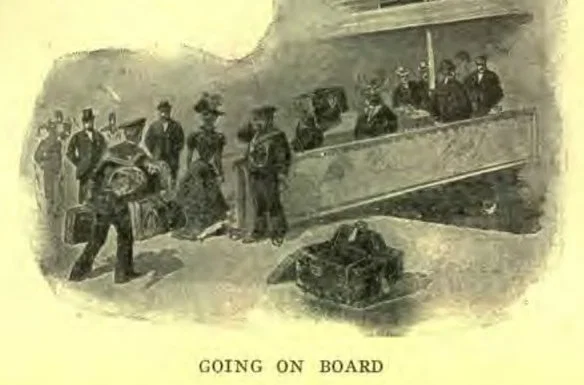
GOING ON BOARD
GOING ON BOARD

You have reached the end of this edition.

The Youth’s Instructor · May 7, 1903