The Youth’s Instructor, Vol. 34, No. 11.

THE INVENTOR OF PRINTING
Earlier text: THE INVENTOR OF PRINTING

SOME THINGS ABOUT ALASKA.

The territory of Alaska, lying in the north-western part of North America, Russia claimed by right of discovery; but about 1867, they ceded it to the United States. Explorers observe many things of interest in their travels through the country; and thinking sometimes to give you extracts from their writings, it may be well for you to take your maps and study up the geographical features of the territory. Naturally, it is divided into three great divisions,—the Yukon district, between the Alaskan Mountains and the Arctic Ocean; the Aleutian district, comprising the Alaskan peninsula and the Aleutian Islands, and the Sitka district, which includes all the main-land and the islands south of the peninsula.
A remarkable feature of the country is the great Yukon River, which is 2,000 miles long, and navigable for steamers 1,500 miles. It is one of the great rivers of the world.
The Japan Current affects the climate, so that it is much milder on the coast than inland in all the districts. The northern parts of Alaska are very cold, the ground being frozen all summer; but the southern coast and archipelago have a climate milder than that of New York City.
In 1880, the population consisted of about 25,000 native Indians, a few hundred Russians, and about 500 Americans and others. The Indians may be divided into three great divisions, corresponding to the divisions of the territory. Then these are divided and subdivided into many tribes, settlements, and families. One writer has given some things characteristic of them as follows:—
“Each family has its badge. Their badges are the whale, porpoise, eagle, coon, wolf, and frog. These crests extend through different tribes, and their members have a closer relation to one another than the tribal connection. For instance, members of the same tribe may marry, but not members of the same badge. Thus, a wolf may not marry into the wolf family, but may into that of the whale.
“Upon all public occasions they seat themselves according to their rank, which is distinguished by the height of a pole erected in front of their houses. The greater the chief, the higher his pole. Some of these poles are over 100 feet high. - A missionary relates how, upon one occasion, a chief of the Nasse River Indians put up a pole higher than his rank would allow. The friends of the chiefs whose heads he would thus step over made fight with guns, and the over-ambitious chief was shot in the arm, which led him to quickly shorten his stick. Their houses are from 25 to 40 feet square, without a window, the only opening being a small door for an entrance, and a hole in the roof for the escape of smoke. The walls and frequently the roofs are made of cypress plank, from two to five feet wide, and two to three inches thick. These are made by first splitting the trees into great planks and smoothing them with a small adz. In front of their leading houses and at their burial places are sometimes immense timbers covered with carvings, which are the genealogical records of the family. The child usually takes the totem, or picture, of the mother’s tribe. For instance, at the bottom of the post may be the carving of a whale, over that a fox, a porpoise, and an eagle—signifying that the great grandfather of the present occupant of the house, on his mother’s side belonged to the whale family, the grandfather to the fox family, the father to the porpoise, and he himself to the eagle family. These standards are from two to five feet in diameter, and often over 60 feet in height, and sometimes cost from $1,000 to $2,000.”

THE AMERICAN DOLLAR SIGN: AGAIN.

The Christian Union gives another as the origin of the American dollar sign. As the subject is still being agitated, we trust the correct theory will eventually be reached. In the meantime let us ransack the records ourselves for its origin. Here is the latest rendering of the sign:—
“A correspondent gives the following as the true origin of the $ sign, in correction of the fanciful theory mentioned in ‘Fact and Rumor,’ that it was taken from the scroll about the pillars of Hercules on the Spanish dollar. He says: ‘The Spanish dollar was equal to eight “reals.” It was called “the piece of eight,” when first coined, and later, was given the name of dollar, from its similarity to the Joachim thaler of Bavaria. The old coins, with the pillars as described, bear on them the figure and word, “8 Reals.” In designating them in commercial practice as pieces of eight, it was usual to use the figure 8; and to prevent the risk of including the figure as part of the enumeration of the pieces, it was written, not 810, for ten dollars, but $10. This is said to be the origin of the sign, and it seems the more probable when the history of the coin is considered.’”

Eighteenth-Century Stagecoach Advertised as the Flying Machine

In 1772 there was a stage for passengers advertised to run from New York to Philadelphia, making each trip (according to the advertisement) “In the remarkably short time of two days.” It was called “The Flying Machine.”

THE BIRD AND THE LOOKING-GLASS.

Do you know that the little canaries you keep in cages are fond of mirrors? We have seen little girls, and older ones, too, who were fond of mirrors; but who ever heard of birds that used them? I will tell you about a little canary that lives at the house where I board.
Some time ago our landlady got a canary, and put it in a cage alone. The little bird was taken from a large cage holding a dozen birds. He was very homesick and lonesome, just as you would be if taken away off among entire strangers, away from mamma, papa, sisters, brothers, and everybody you ever knew.
Just so our little birdie cried and moaned, and would not eat nor sing. It wanted to go home, and see its mamma. That was too bad, wasn’t it? The lady did all she could to comfort it, and make it feel at home. She talked to it and petted it, giving it clean water, good seeds, apples, and everything she thought it would like. But it was of no use; birdie kept crying, and wouldn’t make friends, but wanted to go home.
One day his mistress brought him a large piece of a broken mirror, as big as my two hands, and placed it on one side of his cage, where he could see it readily. Do you suppose he cared anything for that?—Indeed he did. He hopped down, and going up close, looked in, appearing to be perfectly delighted. He chirped, and hopped about, singing and putting on all the airs he was master of. He was not homesick at all after that. He evidently thought that the canary in the glass was another little bird come to visit him, and he need not be lonesome any longer.
He spends much of his time before the glass; and when he goes to sleep at night, he will cuddle down just as close to the glass as he can get. You see, he thinks he is sleeping close beside that other little bird.
His mistress often lets him out into the room where he, can have more liberty. She may put that glass anywhere in the room, and he will find it, and spend most of his time before it.
One day the little fellow acted very naughty. I think I shall have to tell it just as it was. He got real angry, and tried to get into a fight! It all happened because he wanted his own way, and could not get it. He went up to the glass so lovingly, and tried to coax the other bird to come and play with him somewhere else. The looking-glass bird would not follow him, but went the other way every time. Then the canary got provoked, and flying at the bird in the glass, tried to have a real fight with him. He tried it only once, and then he looked so ashamed of it. The blame, you see, was all on one side, and shows how foolish it is to get angry and pick a quarrel.
Like all folks that spend so much time before the glass, he is getting very vain. He washes himself before the large mirror in the room, pluming his feathers, and making his toilet with much satisfaction. He spends such a long time at it, looking at himself, first over one shoulder, then over the other! Vain little fellow, isn’t he? Don’t you think he acts a good deal like a human being? Did you ever see any one do as he does?
D. M. CANRIGHT.

Letter Budget.

FIRST we have a letter from LENNIE K. SAMPLE, of Nelson Co., Ky. She says: “I have been so much interested in reading the letters in the Budget I thought I would try to write one. We have been taking the INSTRUCTOR for many years, and think it is a splendid paper. I am eleven years old, but my left arm has been paralyzed since I was about a year and a half old, so I cannot use it much. Mamma says she wants me to have a good education so I may be useful in some way. She thinks I might be cured if I could stay awhile at the Sanitarium. I did not have a missionary garden, as the chickens would destroy it; but we are to have some eggs, and get some missionary money in that way. Our house is in Bullitt Co., on the top of a hill almost like a mountain, which makes it very cold in winter; but in summer it is delightful, and the scenery is so charming it makes one wish it could be always pleasant weather. We live near the line of two other counties,—Spencer and Nelson. Our post-office is in the latter. I send love to all the INSTRUCTOR family. Pray for me that I may be an overcomer.”
Shall we not all sympathize with Lennie, and remember to pray for her; for it must be a great misfortune to lose the use of a limb? No doubt she is thankful that she can run about, and that it is her left rather than her right arm which is afflicted. We wish she might try the effect of good Sanitarium treatment. Your letter was quite interesting, Lennie.
MAUDIE D. CURTIS writes from Crow Wing Co., Minn. She says: “Dear Editor, I am a little girl six years old. I live among the pines of Minnesota; and my little brother, who is four years old, and I have fine times in summer gathering wintergreen berries. Do you have any in Michigan? If not, I would like to send you some next summer. We have named our place ‘Evergreen Dale.’ Don’t you think it is a nice name? I keep the Sabbath with my parents, grandma, and little brother. We live several miles from the place of meeting, but we go nearly every Sabbath. We do not like to miss our good Sabbath-school. I learn my lesson in Book No. 1. The first Sabbath in the new year our teacher asked us to learn the commandments this quarter, and grandma said she would write me a letter for the Budget when I could say them all without prompting. I learned them all in the month of January, and on the last Sabbath repeated them in the general exercises of our Sabbath-school. How many little girls who read the INSTRUCTOR will learn the commandments with me? and how many will try to keep them? My grandma is going to teach me the names of the twelve disciples. I want to be a good girl, so that when Jesus comes he will give me an immortal body such as Enoch had. If you print my letter, I may write again sometime.”
You have given your place a very pretty name, Maudie, and we should be very happy to be there in the summer and pick wintergreen berries with you. We have never seen any growing in Michigan, but as wintergreens are sometimes brought about to sell, the berries must grow here too. Your grandma’s nice letter came with yours, but as it is in verse, we shall have to keep it until we do not have so many letters for the Budget.
CHARLIE SMITH, writing from Pierce Co., Wis., says: “As I read the children’s letters, I thought perhaps you would like to hear something from this place. I am twelve years old. I have one brother, named Frankie, and two sisters younger. It is a little over a year since we commenced to keep the Sabbath. There is but one other family of Sabbath-keepers in this neighborhood. We have Sabbath-school, and enjoy it much although but few in number. My brother and I are breaking a pair of steers one year old. They mind quite well. We hitched them to our hand sled and took mother to our neighbors visiting. If you will print this, I will tell you something about this country. Love to all.”
Charlie will remember his promise,—sometime “to tell something about this country.”

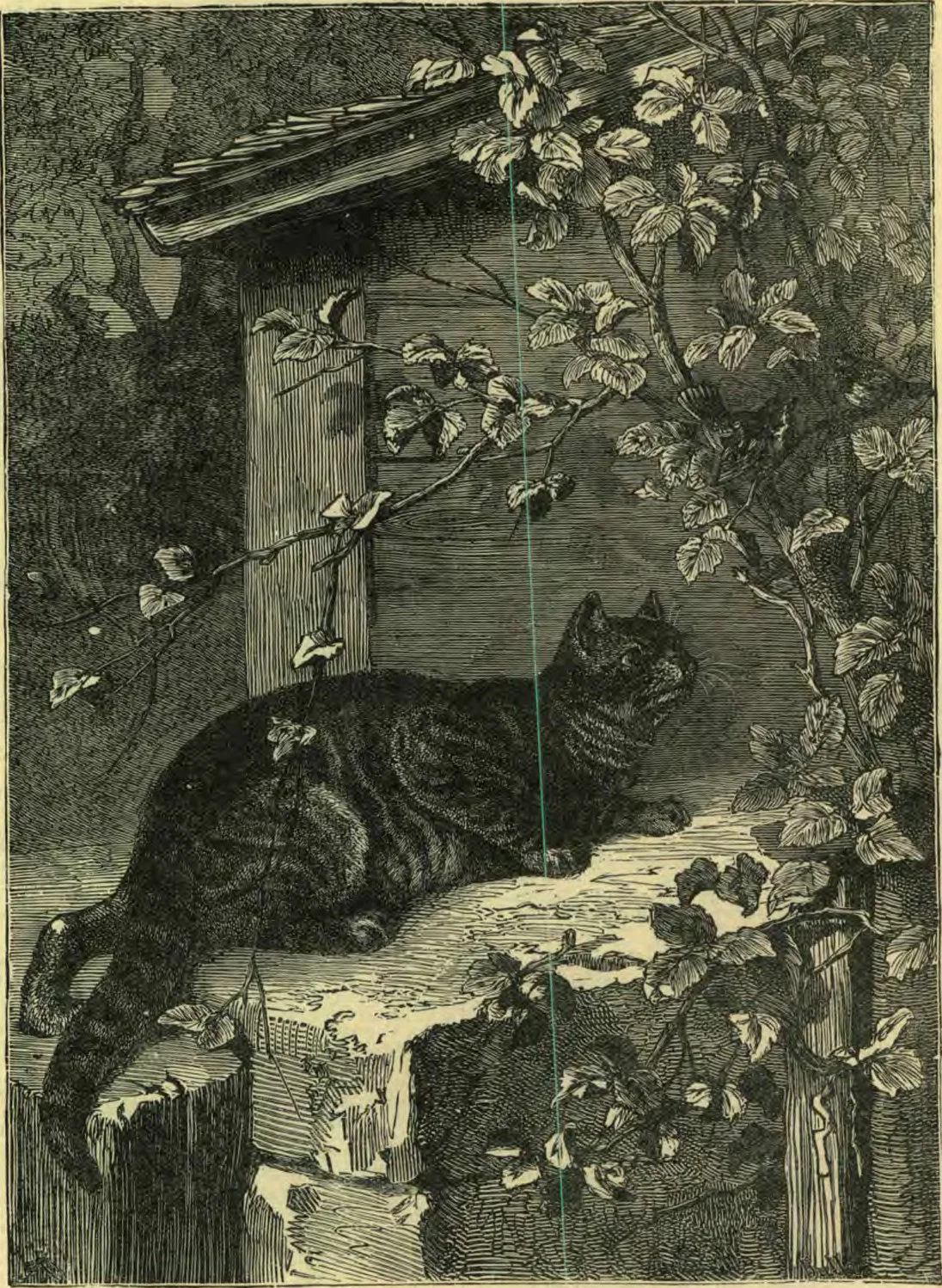
THE KITTEN'S STORY.

I'm a gray-eyed little kitten; I'm pretty roguish, too, But, ah! I'm always busy— I've lots of work to do.
I chase the little chickens, I scamper up the tree, And frighten off the robins,— Ah, that's the work for me.
I get in mistress's basket, And throw her spools away; And get my little ears boxed A dozen times a day.
Out in the flower-garden, I chase the butterflies; And, when they're upward flying, I jump 'most to the skies.
One day I caught a sparrow, And brought it proudly in; But mistress took it from me, And said it was a sin.
A sin to kill a sparrow! A tiny little bird! I think they're made for kittens! I do, upon my word.
Last week Nellie had a party Of little folks to dine; Then mistress killed a chicken, And had it cooked up fine.
I sat beneath the table While they discussed the meat, And every one pronounced it Nice, excellent, and sweet!
But when I kill a sparrow, They make it out a crime! I ask them to explain it; But no—they haven't time!
Although I'm but a kitten, And never learned to read, I can't agree with mistress, I can't—I can't, indeed!

You have reached the end of this edition.

The Youth’s Instructor · Mar 17, 1886