The Youth’s Instructor, Vol. 34, No. 11.

THE INVENTOR OF PRINTING

The Youth’s Instructor

Mar 17, 1886

S. D. A. Publishing Association · Battle Creek, Mich. · Mar 17, 1886

THE INVENTOR OF PRINTING.
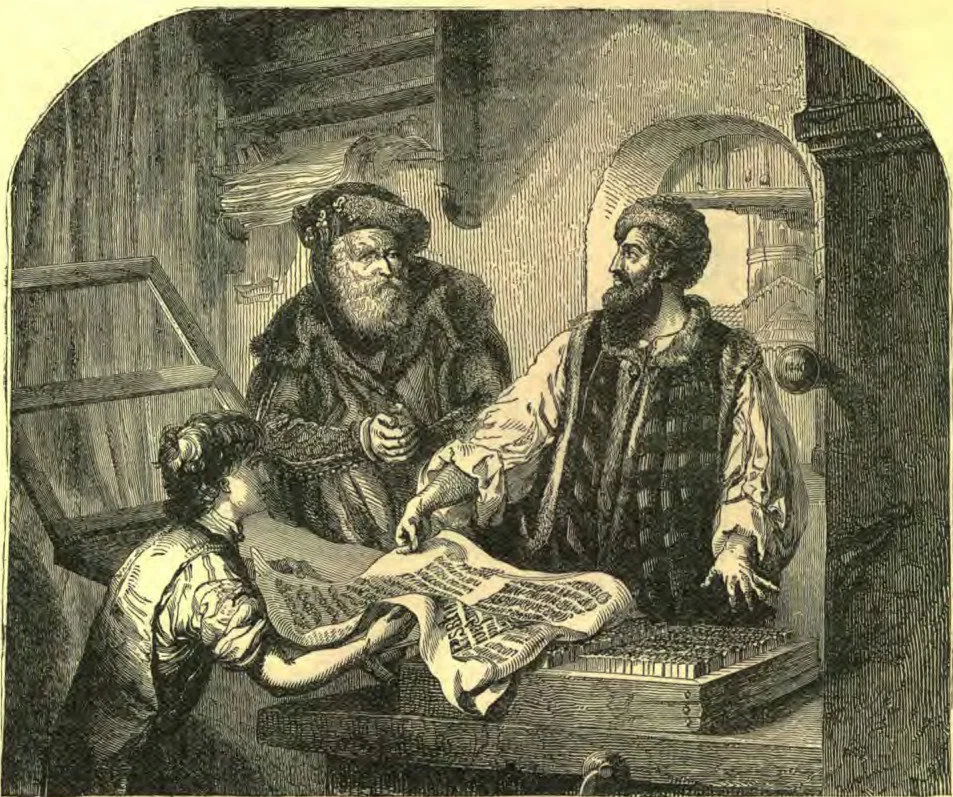
In the heart of Central Europe flows the majestic Rhine, past fair meadowlands, pleasant villages, and clustering vineyards, or by steep, wooded slopes crowned by grim castles, hoary with age. On the banks of this broad river, and amid this beautiful scenery, lies the free city of Mentz, where, four hundred and eighty six years ago, John Gutenberg, the inventor of printing was born.
It would be pleasant, indeed, if we could know all about the boyhood and youth of this remarkable man; but history has left us only a few facts of his early life that we can depend upon. He is represented as a high-spirited, thoughtful youth, early possessed with a desire to bring books into more common use; and, as one has remarked, “he said to himself, from his earliest years, God suffers in the great multitudes whom his Sacred Word cannot reach. Religious truth is captive in a small number of manuscript books, which guard the common treasure, instead of diffusing it. Let us break the seal which holds the holy things; give wings to the truth, that by means of speech, no longer written at great expense by the hand that wearies itself, but multiplied as the air by an unwearied machine, it may fly to seek every soul born into the world!” It was a noble aspiration; how well he fulfilled it we shall see.
In his early manhood, the city of Mentz was embroiled in political quarrels between the nobility, the burghers, and the working people; and Gutenberg, who was of the nobility, lost all his property, and was driven from the city. He fled sixty miles up the Rhine to Strasbourg which was now to be his home for many years. His mother, who was allowed to keep her property, sent him secretly from time to time a part of the revenue that accrued from her lands, and thus he was enabled to live comfortably.
Here he married Anna von Isernen Thür, the daughter of a nobleman, to whom he was betrothed before his fortune was wrested from him. Almost the only item in his early life which we may know of with any certainty, occurred in connection with his marriage. It seems that Gutenberg, sensitive in regard to his shattered fortunes, hesitated to ask the Lady Anna to share his poverty with him; but she, sure of his affection for her, persuaded her father to sue him for failing to marry her when he agreed to, whereupon Gutenberg ended the matter by wedding the fair plaintiff in the lawsuit. This record still remains among the documents of Strasbourg. They were devotedly attached to each other, and were very happy in their humble home.
Gutenberg found it necessary to provide some way for his support; so he learned the trade of lapidary, or polisher of precious stones. Tradesmen were not as common then as now. Many of the trades had only begun to be practiced, and those who plied them were often wealthy and influential persons; so that artificers then held about the same social position that sculptors and artists do at the present time. Day after day Gutenberg toiled in the front room of the cottage, which served him for a shop, cutting precious jewels and polishing mirrors for the nobility and the wealthy monks; and here he gained that skill in handicraft that was to serve him such good turn in benefiting the world.
While he was plying his trade, he did not forget his early desire to multiply books; and his mind was actively engaged in devising some way by which it could be done. You will perhaps better realize what great difficulties stood in his path, when you learn that no such thing as a printing press or type of any description was then known, and paper had not come into common use. There were only a few books in the world, and these were carefully guarded from the common people, and chained in the libraries of the monasteries, or were owned only by the learned among the nobility. All these books had to be written by hand; and it was very tedious business, for in a whole lifetime the swiftest and most diligent scribe could not reproduce two copies of the Sacred Book.
The art of wood engraving, then in its infancy, first suggested to Gutenberg the idea of printing. If the common play-cards could be imprinted on paper, he thought, why could not the letters on a page be engraved on a block and imprinted in a like manner? Happy thought! no doubt he talked it over with his beloved Anna, when he sat in their quiet home that evening; and Anna was as enthusiastic over the plan as Gutenberg himself. All day he worked at his trade, his hand growing more swift and skillful that he might have time to devote to his new project; and all the evening he busily plied his graver’s tools, till at last he had finished an engraving of St. Christopher bearing the infant Christ across the dark stream. Then, linking the raised parts of the wood, he carefully pressed the paper to the surface, and rubbing it with a burnisher, drew off his first copy!—the beginning of greater things than he had yet dreamed of. He printed several copies, and sold them to the monks in the different monasteries. But he had to be careful not to display too many copies at once, or the shrewd monks would rightly guess that he had some quicker way of making them than by the usual slow process of the pen.
But there is scarcely room to tell you of all the trials and successes he met in his undertaking. At length he found it necessary to introduce several workmen into his shop to attend to the increasing work in polishing, while he could devote more time to his engraving. He was now toiling on the “History of St. John the Evangelist,” a small book that the prior of the monastery had lent him. He was obliged to keep this business a profound secret; for there was no patent office to guard against an infringement of his rights; and as soon as it should become known that books had been made by engraving, artisans all over would immediately engage in the work, and thus flood the market.
One evening, while he was working away, he was suddenly surprised by the abrupt entrance of Dritzh and Hielman, two of his workmen. Gutenberg immediately saw that his secret was out; and making the best of a bad matter, he, with not a few misgivings, took them into partnership, binding them by a solemn oath never to reveal the secret.
At first the new partners entered into the work with zeal; but they did not have Gutenberg’s noble enthusiasm to spur them on, and soon grew discontented.
One day, as he had nearly finished a block, his graver suddenly slipped, splitting the block in two. Days of labor thrown away! Gutenberg set his wits to work to fit the block together without having to make a new one. Was it an accident, or the guiding hand of Providence? The thought flashed across his mind, Why not have all the letters separate? then much labor could be saved, because the letters could be used over and over again, instead of being thrown away when one book was printed. He set immediately to work engraving the alphabet. This was the origin of movable type.
After a time the firm met with a great loss in the death of Dritzh, their most skillful workman. Two of Dritzh’s brothers, who came to the funeral, now demanded to be taken into partnership in their brother’s place; but as Gutenberg clearly convinced them that this was not in the agreement, they brought against him a lawsuit for all money their brother had invested in the firm. Now, indeed, Gutenberg was in trouble; for public curiosity was raised to the highest pitch, so that it was in vain he guarded his secret. Fearing discovery, he caused the types and two presses that he had invented to be broken up before his eyes; so that when a mob broke into his house a few days later, they were obliged to leave, with their curiosity unsatisfied.
“Ah!” said they, “it is a mystery! there is something wrong! he must be in league with the devil!”
“What is the use,” replied another, “of all this expense of multiplying books! No one except the monks can read them after they are printed!” With this opinion many doubtless concurred, and Gutenberg’s friends, one by one, dropped off, until only Anna was left to encourage him.
“Thou wert born a hundred years too soon For the comfort of thy days; But not too soon for human kind.”
It was useless to try again in Strasbourg to do anything at the printers’ trade, and so he moved to Mentz, his native town. Here, after a short time, he entered into partnership with Faust and Schoeffer, the two men who, aside from Gutenberg, did most of all to perfect the art of printing. Faust has often been called the “Patron of printing,” for he was a wealthy goldsmith, and furnished money for the new firm. Schoeffer is called the “Improver of printing,” for he originated the idea of using metal for type in the place of wood, which the ink soaked up and made too soft for use; and he also invented a method of casting it in molds, much as they do at the present day, thus making the letters faster and better. Gutenberg is called the “Inventor.” In the picture you can see the press and the wooden type used by them.
The new firm got along happily together, and had undertaken to print the Bible. But when about half way through this work, a cloud arose over the horizon, and soon darkened the whole heavens. Faust, who was somewhat embarrassed for means, grew dissatisfied with Gutenberg because money did not come in as fast as he supposed it would. Accordingly, he flattered Schoeffer, who was a young man, and ambitious of gaining fame and wealth. Moreover, he was in love with Faust’s daughter, and gave the readier ear to what this patron of printing had to say. It was proposed that Gutenberg should be compelled to leave the firm, and the business be carried on by the two remaining members. Consequently a lawsuit was brought against Gutenberg for money, which, according to the original agreement, Faust had no right to demand of him. The case was decided against Gutenberg, and Faust took possession of all the type and presses.
Once more the noble man was left destitute, and compelled to see the cherished work of years in other hands, and taken unjustly by his most trusted friends. He was nearly wild with grief, and unable to work for a long time. Just at this critical time his Anna suddenly died. He was stricken indeed. After awhile he rallied, and tried to do a little at printing, but at length gave it up. He died in February, 1468, poor, childless, and almost friendless; yet, we trust, not wholly unhappy; for he had learned, as one has said, “There is no other actual misfortune except this only, not to have God for our friend.”
W. E. L.

THE NORMAN CONQUEST.

“All’s well that ends well.”
A GREAT turning-point in England’s history, and one which changed her whole future, was her conquest by the Normans. Right across the English Channel there lived a people, the tall turrets of whose castles looked frowningly over at the pleasant land opposite. These people were the Normans. They were the descendants of a brave race, which had originally come from Norway, and, notwithstanding the greatest opposition, landed in France, and won from that country part of her most beautiful territory. This land which they wrested from the power of France, is to this day, on account of its great richness and fertility, known as the “Garden of France.”
But even here these people were not contented, and it was not long before they began to look with covetous eyes at the fair land to the northward; and to watch for some pretext by which they might claim her crown for their own. And such a pretext was not difficult to find.
It was in the year 1064 that Harold, the heir apparent to the English throne, while sailing with a small party of companions along the coast, was caught by a storm and blown across the Channel, thus falling into the hands of William, the seventh duke of Normandy. William, who was possessed of no small amount of cunning, was not slow to observe and utilize the immense advantage which thus, through chance, came into his hands. He did not, however, give Harold the slightest ground for suspicion, but treated him royally; and so, when he invited his English guest to remain with him, Harold, nothing loath, consented. They passed their time in hunting, games, and all other entertainments which could be devised, and now and then, by way of something of a more exciting nature, with a band of attendant knights they would make war-like incursions into the neighboring French territories, and come back laden with booty.
One day, after one of these expeditions, William broached to his guest the subject for which he had been planning so long, and invited Harold to resign his right to the English throne in favor of himself, William laying his claim on some promise which Edward the Confessor, who was then reigning, had made to him. What was Harold to do? If he valued his life, he certainly had no alternative but to assent, so he pretended to be much pleased with the proposition, and readily consented to the Duke’s plan. William then demanded, as further proof of his sincerity, that he should take a public oath, promising on the death of Edward to yield the English throne to William. Harold, entrapped in the midst of the Norman territory, had no choice but to submit, and so when he had sworn upon the Bible what he never meant to fulfill, the book was removed, and beneath it were found the bones of martyrs and saints, which were supposed to make the oath much stronger and more binding. After this was over, Duke William gave Harold permission to depart with his companions, which leave he must have been very glad to obtain.
Two years later the throne was made vacant by Edward’s death; and Harold, entirely disregarding the sacred oath he had taken, was crowned king of England. As soon as the news of these proceedings reached William, he sent an embassy to Harold, demanding the fulfillment of his promise. When this was refused on the ground that the oath was only given on compulsion, Duke William began preparations for the invasion of England, with a view of obtaining by the sword what he could not otherwise acquire. He hastily gathered around his standard an army of 60,000 men, and set sail for England on Sept. 28, 1066. On the fourteenth of the following month, the famous battle of Hastings, the decisive conflict, took place. The two opposing armies were arrayed on opposite hills, silently watching each other, when a minstrel, named Taillefer, rode proudly out from the Norman ranks, and challenged any knight from the English army to single combat. This was readily accepted, and so the battle commenced. The Normans were the assailants, and poured down from their camp to attack the English hosts. But in vain; they might as well have dashed against a wall, for as fast as they came up, they were cut down by the battle-axes of the English. From nine o’clock until three this kind of conflict was kept up, and the Normans had gained nothing. The victory seemed to be with Harold. But suddenly the Normans gave way and fell back. The English, breaking their impregnable wall, rushed impetuously after them. But the retreat was only feigned in order to draw the English down from their hill. The Normans turned and fell with renewed fury upon their opponents. At last an order from William brought his archers to the front, and the arrows, falling like hail, told heavily upon the masses crowded round the English king. As the sun went down, an arrow pierced Harold’s right eye. He fell, and England’s king was dead.
This ended the battle, and the shattered remnants of the English army left the field heaped, with slain, in possession of the victorious William.
True, the battle was won, but the conquest was by no means completed. It was but just begun. Many years of desolation and sorrow for England followed; for the people, notwithstanding their king was dead, and their noblest and bravest lost upon the field of Hastings, would not submit to the tyranny of the foreigners, but rebelled again and again. At last, however, they submitted to their conquerors.
Although the Norman Conquest brought such misery and distress upon the English people in the beginning, yet it was undoubtedly for the best, in the long run, for the union of the Norman and Saxon races made England a great and powerful nation.

The Gold Necklace.

Johnny was a bright lad of about twelve or thirteen years. He lived among the Green Mountains, where his father had a little farm, and where the great world was not very well known.
A peddler, whom they knew when a lad, and who had traveled that road for years, used to go round selling pretty things to the country folks. He took a liking to Johnny, and inspired him with a strong desire to try his hand in trade, which, he told him, was so much more profitable than farming. He wanted a boy to assist in carrying his merchandise; and Johnny thought that it was the beginning of great things when he was asked to travel with the peddler.
His father made no objection to the plan. Perhaps he thought it wise to let the boy have a trial of the life which appeared so charming. He therefore gave him permission to go, but added, as he bade him farewell, “Be a good boy, Johnny; and if you get tired, come back home.”
So, after kissing each one of the family, the little boy started with light spirits by the peddler’s side.
Johnny had quite a gay time, and the peddler’s lively companionship shortened the road. At length they approached a large house surrounded by handsome grounds, where they were received by two or three richly-dressed ladies, and presented their gay wares.
The peddler produced a gold necklace of pretty design, which he offered to the ladies at a great bargain. It was the last of a lot, he said, each of which had brought him a good price; he could therefore afford to sell this one without calculating profit; and especially as the ladies had bought several articles of him, he would let them have the necklace for two pounds, ten shillings, which he declared to be less than cost price. The ornament was purchased, the price paid, and the dealer withdrew. At a little distance from the house, however, he burst into a laugh, and slapping his young companion on the back, exclaimed: “There, my boy, that’s the way to do business! That necklace cost me about half a crown, and there’s not a bit of gold in it!”
Johnny stood still, staring with amazement. At length he spoke: “Father told me if I got tired to come home, and I believe I am tired now. Good-by.” And handing the pack which he carried to its owner, he turned away.
It was now the peddler’s turn to be astonished. The laugh was changed to an expression of concern, and, following the boy, he used every argument to induce him to proceed in his company; but Johnny had made up his mind. His sense of right had been thoroughly outraged, and no persuasion could keep him with a man who had thus shamelessly committed a wrong, and then boasted of his own dishonesty.
This decision of the boy was seed for a future harvest of character. He had begun to call things by their own right name; and he has never forgotten this impulse toward the right.—Selected.

HOW THE THIEF WAS CAUGHT.

In the days when inns were not so numerous as they now are, it was customary, in the highlands of Scotland, for travelers to ask lodgings at the houses by the way-side. At a lonely part of a highland road a weaver had his home. He was a very good man, and one who had real faith in God. He was poor, but hospitable, and kindly entertained belated strangers who asked to tarry for the night. But he was sometimes imposed upon by worthless characters, who rose early and made their escape with what they could most readily carry off. His wife frequently said to him that if he took in people he knew nothing of, after the way he had been doing, they would be ruined by their depredations; but he felt the necessity laid upon him, in his circumstances, to fulfill the Scripture command “to entertain strangers,” and, although he wished to discriminate, he could not think of giving up the practice.
A person presented himself at his door shortly after he had suffered at the hands of dishonest guests; and he, wishing to satisfy himself and his wife of the man’s goodness of character, said, “Well, now, you are a stranger to me; what security do you give that you are such a person as I ought to entertain?” Without a moment’s hesitation the man answered, “The Lord.” “That’s quite enough,” said the good man, opening his door wide to the wall. “Come in, come in. I receive you in the name of the Lord.” And so the stranger admitted was hospitably treated, and, after worship, was shown to bed; but he was a thorough rogue, and before the day dawned, he had left the house with a web the weaver had got ready the previous evening to carry to his employer.
When the weaver and his wife got up the next morning, and found the fellow gone, his wife was in great perplexity; and, in her anxiety, gave way to upbraiding her husband, saying, “Now, you see, it is just as I said; we shall certainly be ruined by this foolish practice of yours. What are we now to do? The web’s away, and how are we to live until you weave another!”
It was a dark day to her, but not so to him; for he said, “I got a good security, and I keep the security, and I am sure it will be all for the best. It was for the Lord’s sake I received him; and although he has proved unworthy of our hospitality, yet Jesus is worthy, and we shall yet lose nothing by it.”
As the thief was crossing a hill, shunning the usual road, God enveloped him in a misty covering. He wandered long upon the hill-side, this way and that, and at last got to the foot of the hill, and, knocking at a cottage, he asked if they would keep him for the night. The good man of the house recognized the voice, and said to him at once, “Come in, and down with the web!” The thief was thunderstruck, while the man said, “When you next intend to play similar pranks, mind not to give your security!”
Down fell the web, and the thief, in consternation, took to his heels.
The explanation of the matter is, that the thief got bewildered in the mist, and instead of going down, the farther side of the hill, he came down the same side, and knocked at the very cottage-door from which he had set out in the morning with the poor man’s web.—S. S. Classmate.

GENERAL WASHINGTON'S PUNCTUALITY.

You have all heard of General Washington’s answer to his private secretary, who had fallen into the habit of being unpunctual. He gave as his excuse for being tardy, almost every morning, “My watch must be a few minutes slow.”
The General bore with this for a time, when one morning he replied,—
“Either you must get a new watch, or I must get a new secretary.”
Once some company which had been invited to his house was late in arriving. But when the dinner hour came, those who were present sat down at the table, the General saying as they did so,—
“We are punctual here. Our cook never inquires, Has the company arrived? but, Has the hour arrived?”
Once he visited Boston after the war, and soldiers and citizens vied with one another in excelling to show him honor. He was to leave for Salem one morning, and a cavalry company sent word that they would escort him out of the city. Eight o’clock was the appointed hour; and as the clock in the Old South Common church struck that number, he was seating himself in the saddle. A quarter of an hour later, the cavalry were parading in front of the house where he had lodged, waiting for him to appear. When informed that he was gone, they hastened after him as fast as they could, but only overtook him as he was crossing the Charles River bridge. The officer in command had often been General Washington’s guest; and as he rode up, the General said,—
“Major, I thought you had lived long enough at my house to know when eight o’clock comes.”
Children, if you cannot be president, you can at least be punctual. Not to be punctual, is to be a thief; for you rob others of their time.—Selected.

SOLD HIMSELF.

A CORRECTIONVILLE farmer sold a load of corn in that town one day. When it was weighed, he slyly stepped onto the scales, and then drove off to unload. When the empty wagon was weighed, he took good care not to be in it, and congratulated himself that he had cheated the buyer in good shape.
The grain dealer called him in, and after figuring up the load, paid him in full.
As the farmer buttoned up his coat to go out, the buyer kindly asked him to smoke with him, and then talked over the crops, and the price of hogs, and the likelihood of the Maple Valley railroad building up that way, until the farmer fairly squirmed in his chair with uneasiness about his chores at home.
At last he could stand it no longer, and said he must go. The dealer quietly said that was not to be thought of; that he had bought the farmer at full weight, and paid him his own price, and that he would insist on doing as he pleased with his own property.
The raiser of the corn saw that he had indeed sold himself, in one sense at least. He acknowledged his cheat, and compromised the affair. Now, when he markets grain, he does not stand on the scales or sell himself with his load.
A good many boys sell themselves at a still cheaper rate. The boy who lies, cheats, swears, or steals, and thus loses his character, his reputation, and his prospect of prosperity in this life and blessing in the next, sells himself to sin and Satan; and though he may not get his pay, the buyer is likely to hold on to his purchase.—The Little Christian.

Praying Over Our Actions and Secrets

If you cannot pray over a thing, and cannot ask God to bless you in it, don't do that thing. A secret that you would keep from God, is a secret that you should keep from your own heart.

The Very Best Use of God's Gifts

A SUCCESSFUL man is one who makes the very best use of what God has given him.

SPURGEON ON PREPARATION.

Mr. SPURGEON, in a speech at a Sabbath-school meeting held in Edinburgh, uttered some thoughts worth the consideration of parents and teachers:—
“If we do not teach the children, Satan will teach them. I have heard of a father who objected to teaching his child to pray. The child broke his leg, and while the bone was being set, he continued to curse and swear all the time. ‘See,’ said the physician, ‘you have a point of conscience about not teaching the child to pray; but Satan has no conscience about teaching him to swear.’”
“I think that to make good Sabbath-school teachers, there must be thorough knowledge and appreciation in your souls of the things you have to teach. I was in Italy last year, and in crossing the Alps with my wife, the sun was so hot that it scorched her face. She asked me to get her some elder-flower water. I started off to a chemist’s, and as I did not know a word of the Italian language, I looked through the bottles and jars in his shop, but could not find anything of the kind. I tried to jabber something in French, but he did not understand me, because it was no language at all. I went down to a little brook that ran through the town, and walking along the edge, I came to an elder-flower tree. I got a handful of flowers, walked off to the shop, and held it up to the man; and he knew in an instant what I meant. I think it is not easy to convey the gospel to the heart by merely talking of it; but if you can say by your own life, ‘This is the life of Christ, this is the joy of the Christian,’ you will be much more likely to make converts.”
“The teacher who goes to his class thinking that he himself is always competent without preparation, is making, what I think, a gross mistake. It is well to preach without notes, no doubt; but a man who should preach purely extemporaneously, without thinking beforehand, would be an exceedingly dull and dry preacher.”
“‘Would you believe it, Sandy,’ said a divine, ‘that I never thought of the sermon before I went to the pulpit?’”
“‘Oh! that is exactly what Mr. MacKintosh and I have been saying while you were preaching.’”
“‘Now, if Sabbath-school teachers pride themselves in their extemporaneous teaching, their pride is peculiar to themselves, and the children will not take much pride in them.’”—Selected.

The Chestnut Trade.

MRS. M. F. BUTTS, writing for the Christian Weekly about nuts, says:—
“In certain European and Asiatic localities the chestnut crop is equal to the wheat crop in Ohio. Chestnut bread constitutes the principal food of more than 100,000,000 people. The chestnut will grow on a barren soil where corn could not be produced to any advantage; and this fact suggests a new industry which might grow to great importance in our Western States.
“The best chestnuts come from Italy and France; but the nut marketed in our northern cities comes chiefly from Louisiana and Virginia. It is said that the retail profits are not as large as formerly, some venders having made small fortunes in by-gone days, one owning three houses worth $30,000, and all from a chestnut burr.
“The chestnut harvest in October is the great event of the year in the Appenines. The schools then have their annual vacation, that the children may assist in the harvest, and they all go gypsying under the great spreading trees. There is a nut-gathering time appointed by municipal proclamation, commonly from Michaelmas day, September 29, to the feasts of St. Simon and Jude, October 28. After the legal term has expired, the woods are free to everybody, and troops of beggars glean such nuts as stay late on the trees. The chestnuts that drop in the public roads are also public property, and the peasants make the most of this license, gathering little harvests for themselves. Where the chestnut woods are so extensive that outside help must be obtained, girls are engaged to help, and each receives food and lodging for forty days, and on going away two sacks of chestnut flour. After their day's work in the woods, these girls are expected to spin or weave in the evening for the benefit of the housewife. The poorer girls look forward to the chestnut season as a great pleasure, and with good cause; for open-air life in that region is a constant delight in fine October weather. If, however, the season be wet, nothing could be much more uncomfortable than the nutting.
“The peasants consume great quantities of fresh chestnuts, plainly boiled and eaten hot. But the mass of the crop is spread on the floor of drying houses till ready to be ground into flour for the staple food of the population. From this flour polenta, or porridge, is made, as well as round cakes baked between chestnut leaves and cakes of a more delicate nature covered with chocolate and sugar.
“It is said that under favorable circumstances a bearing chestnut tree, twenty-five feet in height, can be grown from the seed in five years.”

IMPORTANT BIBLE SUBJECTS.

LESSON 13.—WARNINGS OF THE JUDGMENT.

1. What announcement was made to ancient Israel when the atonement was approaching? Lev. 23:24. Read also Num. 29:1; and Lev. 25:9.
2. What prophecy speaks of an alarm to be sounded in the last days? Joel 2:1.
3. How is this message of warning foretold in Rev. 14:7, 8?
4. Tell briefly how this warning was given.—During a series of years immediately preceding the opening of the Judgment in 1844, hundreds of ministers, and some in every part of the world, went forth proclaiming that the day of God was at hand.
5. What does our Saviour say of this preaching? Matt. 24:14.
6. What questions is our Lord answering in this chapter? Verse 3.
7. What did he give as signs of his coming and of the end of the world? Verse 29.
8. How has this prediction been fulfilled?—In the year 1780 there was the most remarkable darkening of the sun and moon ever known; and in the year 1833 there was such a meteoric shower as caused many to cry out, “The Lord is coming.”
9. Has the time of the Investigative Judgment been definitely foretold? Dan. 8:14, 27; 9:22-25.
10. Has the exact time of Christ’s second coming been revealed? Matt. 24:36.
11. Since the signs he gave have already been seen, how sure may we be that his appearing is at hand? Verses 32, 33.
12. Will the people of the world be expecting his advent? Verses 36-39.
13. How will they receive it? Verse 30.
14. What will be done when our Lord appears? Verse 31; 1 Thess. 4:16, 17.
15. What must take place preparatory to that event?—The Investigative Judgment, or cleansing of the Sanctuary. Dan. 8:14; 7:9, 10; Luke 20:35; 21:36.
16. What classes of people will God judge? Eccl. 3:17.
17. Upon which class will the work begin? 1 Pet. 4:17.
18. To whom must we all give account? 1 Pet. 4:5; Rom. 14:12.
19. What will be brought to light in that day? 1 Cor. 4:5.
20. What will God bring into judgment? Eccl. 12:14.
21. For what besides actual deeds will we have to give account? Matt. 12:36.
22. Who appears before God in behalf of penitent believers? Rom. 8:34; Heb. 7:25; 9:24; 1 John 2:1.
23. Whose sins alone, will be blotted out? Acts 3:19.
24. By what rule will our acts, thoughts, and motives be decided? Read Eccl. 12:13; Deut. 10:12, 13; Rom. 2:6-13.

THE DIAMOND.

It is well known that charcoal and diamond are precisely the same in chemical atoms. Some secret process of crystallization alone constitutes the difference between them, and when subjected to powerful and concentrated heat, the gem is reduced to mere carbon. Eliza Cook makes a happy use of the scientific fact in one of her poems:—
There lies the charcoal, dull and dark, With noxious breath and staining touch; Here shines the gem whose flashing spark, The world can never praise too much.
How worthless that—how precious this; How meanly poor—how nobly rich; Dust that a peasant would not miss— Crystal that claims a golden niche!
There lies the charcoal, dim and low, Here gleams the diamond high in fame; While well the sons of science know Their atom grains are all the same.
Strange alchemy of secret skill! What varied workings from one cause! How great the Power and the Will That prompts such ends and guides such laws!
It has long been laid down as an axiom in diamond lore that the precious stone was capable of absorbing rays of light and afterwards emitting them in the dark. While this was abundantly proved by theory, it has been difficult to put it to an actual test; for naturally the great diamonds of the world are not accessible for the purpose. Recently, however, a private person, the fortunate possessor of a stone of 92 carats, valued at £60,000, lent his diamond for scientific investigation. These have been very satisfactorily conducted, and the phosphorescent qualities of the stone may be regarded as proved. The stone was exposed for an hour to the direct action of the sun’s rays, and then removed to a dark room. For more than twenty minutes it emitted light strong enough to make a sheet of white paper held near it perfectly visible. A similar result was reached by generating the light by rubbing the stone with a piece of hard flannel.—Irish Christian Advocate.

KENTUCKY HIGHWAYS.

Sometimes letters appear in the Budget from boys and girls, describing their Kentucky homes. We have one in the present number of the INSTRUCTOR from a little girl who says the scenery in her Kentucky mountain home is charming. In Harper’s Magazine for February are some interesting items about Kentucky and its highways, which our young friends may like to read. We quote a few paragraphs, as follows:—
“You will not find elsewhere in America such highways as the Kentuckian has constructed all over the country—broad, smooth, level, white, glistening turnpikes of the macadamized limestone. It is a luxury to drive upon them, as well as an expense, as one will discover before he has passed through many toll-gates. He could travel more cheaply on the finest railway on the continent. What Richard Grant White thought it worth while to record as a rare and interesting sight—a man on an English highway breaking stones—is no uncommon occurrence here. All limestone for all these hundreds of miles of roads, having been quarried here and there, almost anywhere, near each of them, and then having been carted and strewn along the roadside, is broken by a hammer in the hand of a man. By the highway he sits—usually an Irishman—pecking away at a long, rugged pile as though he were good to live for a thousand years.”
“One cannot live long here without coming to conceive an interest in this limestone, and loving to meet its rich, warm hues on the landscape. It has made a deal of history; limestone blue-grass, limestone water, limestone roads, limestone fences, limestone bridges and arches, limestone engineering architecture, limestone water-mills, limestone spring-houses and homesteads. Outside of Scripture, no people were ever so like to be founded upon a rock. It might be well to note, likewise, that the soil of this region is what scientists call sedentary—called so because it sits quietly on the rocks; not because the people sit quietly on it.”
“Undoubtedly the most picturesque bits in the blue-grass country, architecturally, are those old stone water-mills and old stone homesteads—landmarks each for separate trains of ideas that run to poetry and to history. The latter, built some of them by descendants of pioneers nearly a hundred years ago, stand gray with years, but good for nameless years to come: great, low chimneys, deep little windows, thick walls, mighty fire-places; situated usually with keen discretion on an elevation near a spring, just as a Saxon forefather would have placed them centuries ago. Happily one will see the water of this spring issuing still from a recess in a hill-side, with an overhanging ledge of rock—the entrance to this cavern being walled across and closed with a gate, thus making, according to an ancient fashion, a simple, natural spring-house and dairy.”
Continue reading: SOME THINGS ABOUT ALASKA