It was well said of the Lord Jesus, “He hath done all things well.” Mark 7:37. Yet this same Jesus said, “I and My Father are one.” John 10:30. Putting these two statements together, one properly concludes that all Heaven has ever wrought for the durable uplift of humanity. Not only has this been the way in providing for the salvation of sinners, but it was so when the first man was called to see the light of life. He might have been created while the earth was “without form” and full of emptiness. Man might thus have been permitted to witness the unfolding of earth’s symmetry and loveliness from its bleak, chaotic stage. But in that case there would have lingered with him a sense of imperfection in creation, which might have furnished a foundation for attack upon his tenacity of purpose.
This, however, was not the course pursued. On the contrary, the six days of creative advancement went on, bringing forth every conceivable beauty of nature, until the earth was completely ready to welcome its princely superintendent. Then as the breath of life from God animated the human image of his Creator, everything that his opening eyes beheld could but delight his soul, and call forth glorious expressions of loving gratitude toward the Bestower of such startling munificence.
The Beauty of the Original Home
But since sin has made dense the human mind (Eph. 4:18), it is not possible to comprehend fully the plenitude of that which was lavished upon God’s first earthly representative. One may, however, read its brief description, and by comparing it with what he has seen of earth’s very best products, get a shadowy glint of the attractiveness of the first man’s Edenic surroundings. The story is that God planted a garden for the man, in which was every variety of graceful shrubbery, together with trees that produced every manner of serviceable food. A freely flowing river of sweet-scented water, portioned out in four channels, distributed itself to every part of the garden, and thus irrigated abundantly every nook of the delightful place.
The spot was also embellished with resplendent gold which emitted beams of glittering light. With this were correlated pillars of beautiful white pearls, and transcendently colored green beryl. Everything, indeed, that could charm the eye and delight the senses, was freely bestowed upon the Eden home of our first parents. Gen. 2:8-15. Even a “tree of life” was given, from which the race might eat and live eternally. Dominion over all this and over every living creature besides, was given to man. To him all earthly animation was to yield obeisance, and thus through him, as God’s representative, render homage to their Creator.
Of every tree in that charming home space man might freely eat, with a single exception. Gen. 2:16, 17. That one he was not permitted even to touch, if he would retain his God-given exaltation. But with continued fidelity to his Heaven-born trust, the blessing of Jehovah was his, and he was privileged also to bring into being numerous progeny to share jointly the wondrous blessings accorded him. Gen. 1:28. But best of all, the direct voice of the Eternal was pledged for comradeship to the newly begotten race, so long as heavenly allegiance was preeminent in its conduct.
With such indescribable privileges before man, what an unaccountable violation of fellowship, what a heinous exhibition of delinquency, must have seemed, to the Searcher of hearts, this treasonable turning of the back upon an infinite Benefactor! But what an awful reaction followed! At once, the glory of God with which the creature had been clothed (Heb. 2:7), departed, leaving the culprit denuded and defenseless, as he attempted to conceal his disgraceful condition from the Lord’s inquest.
Cursed for Man’s Sake
At this point the scene is shifted. The dreadful truth has been revealed and confessed, and the trembling, guilty one is arraigned for sentence. Will the decision be rendered in harsh, derisive words, or will it savor of grief and sorrow for the suffering offender? It is well to study the decree of the righteous Judge, and learn, if possible, the motive of its version. The man had said, in his confession, that he was tempted to his6wrong course. Then said the divine Arbitrator, Because you have thus yielded to temptation, “cursed is the ground for thy sake; . . . thorns also and thistles shall it bring forth to thee; . . . in the sweat of thy face shalt thou eat bread, till thou return unto the ground; for out of it wast thou taken: for dust thou art, and unto dust shalt thou return.” With this decision rendered, the man was next driven from his surroundings of matchless loveliness and positive plenty, to meet the realization of his doom. Gen. 3:17-24.
“In Adam all die.” 1 Cor. 15:22. The sentence against Adam was therefore a sentence against the entire race descended from him. The earth, which had before bloomed in profusion under the blessing of Heaven, for the joy and peace of its possessors, was now placed under the curse of barrenness for the man’s sake—that is, in his behalf. What a seeming travesty! How could such an extreme change—one so far dissociated in every way from the original choice of God for His earthly image—possibly be in the interest of fallen man, who, one might think, needed choice surroundings more in that stage of existence, than when in his perfect state? But no line of subtle reasoning is needed to convince one that had not this change come about, man’s case would have been about hopeless; for unless he had been given to battle with “thorns and thistles” for sustenance, and later with the grim enemy death against being given back to old earth, from whence he was taken, and over which he had been placed as a prince of God, he might have become content with his lowly state, and never aspired to something better. He certainly could not have comprehended fully the enormity of his sin, which so greatly involved the entire race of his kindred. But as it was ordained, earth’s later plight has caused its dwellers to long for a higher and holier existence.
Hence man’s hope of restoration to his original state and possession has been the theme of all ages. Patriarchs have entertained it, and prophets have predicted the probable time of its realization. Among the earliest recorded sayings of the Lord Jesus was this: “The meek . . . shall inherit the earth.” Matt. 5:5. This wonderful promise can not possibly meet its fulfilment so long as the original curse rests on everything earthly. But the time must certainly come when from the throne of heaven the announcement will issue, “Behold, I make all things new.” Rev. 21:5. Then Edenic beauty will reappear, and the saints of God will walk with Christ “in white” throughout the eternal ages. But when and how will this curseless age be revealed? It may be very near just now. Let us diligently study its prophetic herald, and be ready to meet this early changed condition.
Wholly Dependent
By Maggie A. Palmer
By Mrs. Maggie A. Palmer
Wholly dependent, O Lord, upon Thee,
Drifting each moment on time's fleeting tide!
Earth is a restless, tempestuous sea.
Safety I find only close by Thy side.
Hold me, O Lord—hold me fast, lest I fall,
Thou art so great, Lord, and I am so small.
Wholly dependent, O Lord, upon Thee!
Life is a battle, the enemy strong.
Fettered by sin inherent in me,
Wandering often, and prone to go wrong,
Shelter from danger 'neath Thy wing I seek,
Thou art so strong, Lord, and I am so weak.
Wholly dependent, O Lord, upon Thee,
Born into bondage, a captive by birth.
Now by the blood of my Saviour made free,
Heir of bright mansions not builded of earth!
Love, O, how fathomless! How could it be
That Thou wouldst die for a sinner like me!
Wholly dependent, where else could I go
But unto Thee, with my burden of grief?
Who would lend ear to my sad tale of woe?
Who from my sorrow would give me relief?
Only Thee, Saviour, so good and so wise!
My contrite heart, Lord, Thou wilt not despise.
Wholly dependent, Lord! Thou wilt not fail:
Thou wilt go with me, and hold my cold hand,
When in the shadow I reach the dark vale;
Mark my last resting-place in this dark land.
In life or death, Lord, I ever shall be
Wholly dependent, dear Lord, upon Thee.
The Change of the Sabbath
Who changed the Sabbath? The day originally observed was the seventh day of the week. The day observed by the majority of the Christian church is the first day of the week. Was it not Christ, therefore, who changed the Sabbath at His crucifixion or resurrection? And if He did not do it, was it not changed by apostolic authority? If neither Christ nor His apostles made such a change, who did? The Bible reading and the statement of facts which follow are designed to answer this question. Has the change been legitimate, or has a great crime been committed? What is the testimony of prophecy and history?
I. Prophecies of Christ and His Work
1. What prophecy of Christ was given through Moses?
“I will raise them up a Prophet from among their brethren, like unto thee, and will put My words in His mouth; and He shall speak unto them all that I shall command Him. And it shall come to pass, that whosoever will not harken unto My words which He shall speak in My name, I will require it of him.” Deut. 18:18, 19.
2. What did Isaiah prophesy of Christ?
“The Lord [Jehovah] is well pleased for His [Christ’s] righteousness’ sake; He [Christ] will magnify the law, and make it honorable.” Isa. 42:21.
3. As the Spirit of Christ spoke through the prophets (1 Peter 1:10, 11), what did the great Teacher say through David as to His attitude toward God’s law?
“Lo, I come: in the volume of the book it is written of Me, I delight to do Thy will, O My God: yea, Thy law is within My heart.” Ps. 40:7, 8. Compare with Heb. 10:5-10, where this scripture is applied to Christ.
II. Fulfilled in Christ’s Teaching and Example
4. Was it Christ’s purpose to present a law of His own, or a new law?
“I do nothing of Myself; but as My Father hath taught Me, I speak these things.” John 8:28.
“I have not spoken of Myself; but the Father which sent Me, He gave Me a commandment, what I should say, and what I should speak.” John 12:49.
5. What honor and regard did He show toward God’s law?
“Think not that I am come to destroy the law, or the prophets: I am not come to destroy, but to fulfil. For verily I say unto you, Till heaven and earth pass, one jot or one tittle shall in no wise pass from the law, till all be fulfilled.” Matt. 5:17, 18.
NOTE.—“Shall in no wise pass from the law.” The double negative here strengthens the sense so as to admit of no contradiction. And the word “shall,” it may be observed, is not barely future, declaring what WILL be, but has likewise the force of an IMPERATIVE, ordering what SHALL be. It is a word of authority, expressing the sovereign will and power of Him that spake,—of Him whose word is the law of heaven and earth, and stands fast forever.
“One jot or one tittle shall in no wise pass,” “till heaven and earth pass,” or as it is expressed immediately after, TILL ALL (or rather ALL THINGS) BE FULFILLED, till the consummation of all things. There is therefore no room for that poor evasion (with which some have delighted themselves greatly) that “no part of the law was to pass away till all the law is fulfilled, but it has been fulfilled in Christ, and therefore now must pass away for the gospel to be established.” Not so; the word “all” does not mean all the law, but all the things in the universe; as neither has the term “fulfilled” any reference to the law, but to all things in heaven and earth.”—John Wesley, on Matt. 5:17-19.
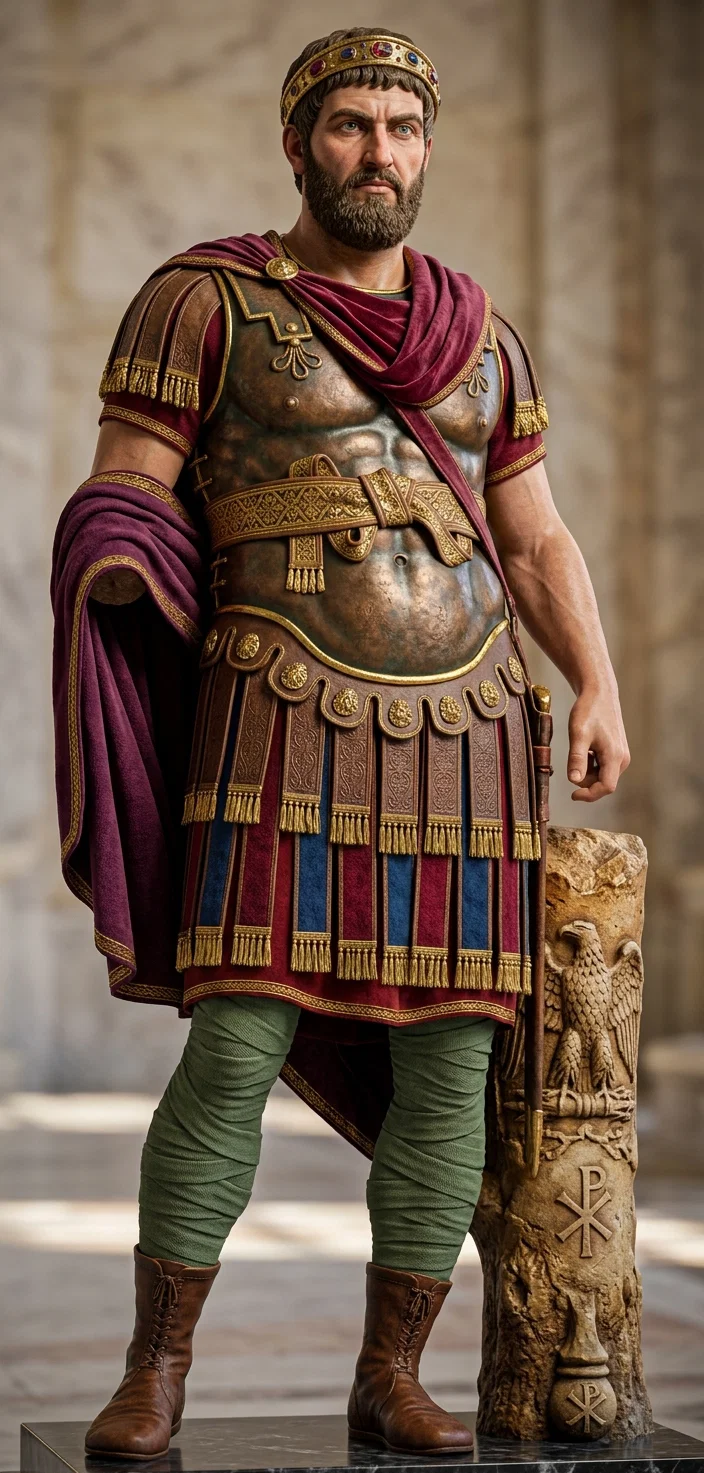
Statue of Constantine, in Rome, the author of the first Sunday law
6. How did He regard the law?
“I have kept My Father’s commandments, and abide in His love.” John 15:10.
“And He came to Nazareth, where He had been brought up: and, as His custom was, He went into the synagog on the Sabbath day.” Luke 4:16.
7. How did the holy women who followed Jesus regard the Sabbath, even after His death?
“They returned, and prepared spices and ointments; and rested the Sabbath day according to the commandment.” Luke 23:56.
8. What does the commandment enjoin?
“Remember the Sabbath day, to keep it holy. Six days shalt thou labor, and do all thy work; but the seventh day is the Sabbath of the Lord thy God.” Ex. 20:8-10.
9. What is the teaching of the apostles?
“Do we then make void the law through faith? God forbid: yea, we establish the law.” Rom. 3:31.
“If ye fulfil the royal law according to the Scripture, Thou shalt love thy neighbor as thyself, ye do well: but if ye have respect to persons, ye commit sin, and are convinced of the law as transgressors. For whosoever shall keep the whole law, and yet offend in one point, he is guilty of all. For He that said [margin, ‘that law which said’], Do not commit adultery, said also, Do not kill. Now if thou commit no adultery, yet if thou kill, thou art become a transgressor of the law. So speak ye, and so do, as they that shall be judged by the law of liberty.” James 2:8-12.
NOTE.—There can be no question as to the law here meant. (1) It is the royal law of the great King whose “kingdom ruleth over all.” (2) It is not a new law, but the law according to the Scriptures,—a law found in the Old Testament. (3) It is the law which contains the precepts, “Do not kill,” “Do not commit adultery.” This is the Ten-Commandment law. (4) It is the same law to which the wise man refers (Eccl. 12:13, 14), by which we must be judged.
From the above witnesses—and many more might be called—it is clearly evident that neither our Lord nor His apostles even presumed or thought to change God’s law. They knew, in the very nature of the case, that it could not be changed; that it was founded in the very character of God, and in the normal nature and needs of man. Therefore “an enemy hath done this.” A usurper, a traitor to God’s government, has sought to do what Christ would not, could not, do. We shall find this power predicted in the prophecy of God’s word; and we shall also find the open, clear acknowledgment by this power itself that it has sought to do, and seemingly accomplished, what the more sure word of prophecy declares. We shall test7the usurper by the same means as we did the great Teacher.
III. Prophecies of the Usurper
10. What does Daniel predict of the work of a certain apostate power?
“And he shall speak great words against the Most High, and shall wear out the saints of the Most High, and think to change times and laws; and they shall be given into his hand until a time and times and the dividing of time.” Dan. 7:25.
NOTE.—The Septuagint and the Revised Version, in fact most of the versions, read “THE LAW,” the law which he could not change, but could only THINK to change. Wintle and Spurrell read, “Shall presume to change the appointed times and the law.” The Douay, or Catholic, translation is, “He shall think himself able” to do this.
11. What does the apostle Paul say of the coming apostasy?
“For I know this, that after my departing shall grievous wolves enter in among you, not sparing the flock. Also of your own selves shall men arise, speaking perverse things, to draw away disciples after them.” Acts 20:29, 30.
“Let no man deceive you by any means: for that day shall not come, except there come a falling away first, and that man of sin be revealed, the son of perdition; who opposeth and exalteth himself above all that is called God, or that is worshiped; so that he as God sitteth in the temple [or church, see 1 Cor. 3:16; Eph. 2:20-22] of God, showing himself that he is God.” 2 Thess. 2:3, 4.
NOTE.—The great Head of the church is the Lord Jesus Christ (Eph. 1:22, 23), and the law of the church is the word of God, which came through Christ. Now, the only way for a power to OPPOSE God is to enact laws contrary to God’s law, and to demand obedience thereto. The only way in which it could exalt itself ABOVE God is to demand that ITS LAW shall be OBEYED in PREFERENCE to GOD’S LAW. The same law promulgated by two rival powers in the same territory would be an impossibility, and would show no distinction between the adherents of the two powers. There must be a difference in the laws; and therefore this power must seek to change God’s law, and this difference made by the change between the law of God and the law of this usurping power must be the very mark of opposition to God and exaltation above Him. There is no evading this conclusion.
IV. Confession of the Prediction
12. What did Eusebius, the apologist of the corrupt Constantine, say that Constantine, Pope Sylvester, and such bishops as himself had done?
“All things whatsoever that it was duty to do on the Sabbath, these we have transferred to the Lord’s day [Sunday].”
13. What do Roman Catholic authorities say as to this?
“Ques.—Have you any other way of proving that the church has power to institute festivals of precept?”
“Ans.—Had she not such power, she could not have done that in which all modern religionists agree with her,—she could not have substituted the observance of Sunday, the first day of the week, for the observance of Saturday, the seventh day, a change for which THERE IS NO SCRIPTURAL AUTHORITY.”
“Ques.—When Protestants do profane work upon Saturday, or the seventh day of the week, do they follow the Scripture as their only rule of faith?— do they find this permission clearly laid down in the Sacred Volume?”
“Ans.—On the contrary, they have only the authority of tradition for this practice. In profaning Saturday, they violate one of God’s commandments, which He has never clearly abrogated,—Remember that thou keep holy the Sabbath day.” See “Doctrinal Catechism,” pages 101, 174, 251-255.
“Ques.—How prove you that the church hath power to command feasts and holy days?”
“Ans.—By the very act of changing the Sabbath into Sunday, which Protestants allow of; and therefore they fondly contradict themselves by keeping Sunday strictly, and breaking most other feasts commanded by the same church.”—“Abridgment of Christian Doctrine.”
Read also the following letter from Cardinal Gibbons to Mr. John R. Ashley, of Rock Hall, Maryland:
“CARDINAL’S RESIDENCE, Baltimore, Maryland, February 25, 1892.”
“JOHN R. ASHLEY, ESQ.—Dear Sir: In answer to your first question, directed by the cardinal to reply to your letter, I will say:
“1. Who changed the Sabbath?”
“Ans.—THE HOLY CATHOLIC CHURCH.”
“2. Are Protestants following the Bible or the holy Catholic Church in keeping Sunday?”
“Ans.—The Protestants are following the CUSTOM INTRODUCED BY THE HOLY CATHOLIC CHURCH.”
“3. The Protestants do contradict themselves by keeping Sunday, and at the same time profess to be guided by the Bible only. I am faithfully yours,
“C. F. THOMAS, Chancellor.”
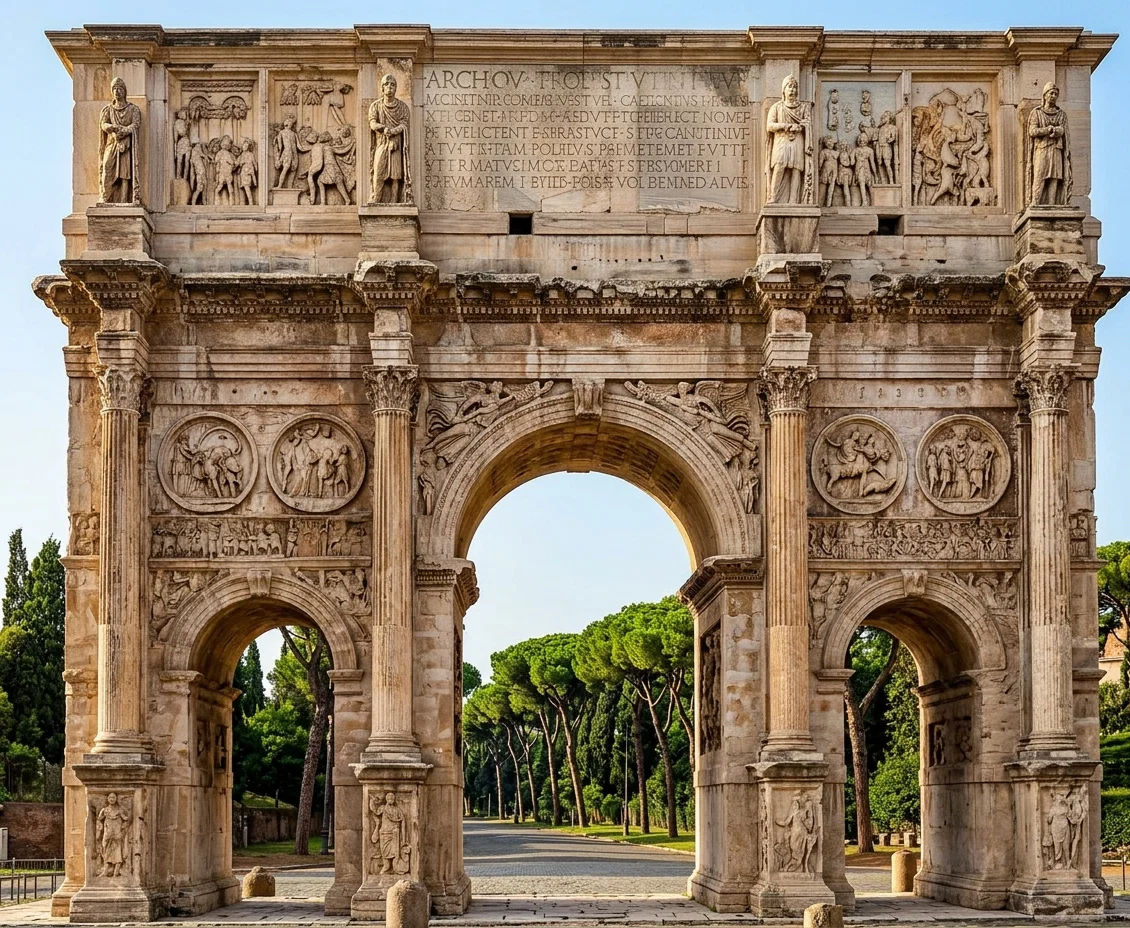
Arch of Constantine in Rome
NOTE.—Surely the above is sufficient to show (1) that neither Jesus nor His apostles had any part in the change of the Sabbath; and (2) that the apostasy, centering in the Papacy, did make the change. Yet there is much more testimony from other sources, Protestant writers, for instance, which shows the change to be gradual, as apostasy always is:
“Centuries of the Christian era passed away before the Sunday was observed as a Sabbath. History does not furnish us with a single proof or indication that it was at any time so observed previous to the Sabbatical edict of Constantine, in A.D. 321.”—Sir William Domville, “Examination of the Six Texts,” page 21.
“By none of the fathers before the fourth century is it [the first day of the week] identified with the Sabbath; nor is the duty of observing it grounded by them either on the fourth commandment or on the precept or example of Jesus or His apostles.
“Unquestionably the first law, either ecclesiastical or civil, by which the Sabbatical observance of that day is known to have been ordained, is the edict of Constantine, 321 A.D. . . .
“It was not till the year 538 that abstinence from agricultural labor on Sunday was recommended, rather than enjoined, by an ecclesiastical authority (the third council of Orleans).”—Chambers’s Cyclopædia, article “Sabbath.”
“Opposition to Judaism introduced the particular festival of Sunday very early indeed, into the place of the Sabbath. . . . The festival Sunday, like all other festivals, was always only a human ordinance; and it was far from the intention of the apostles to establish a divine command in this respect,—far from them, and from the early apostolic church, to transfer the laws of the Sabbath to Sunday.”—“Church History,” Rose’s Neander, page 168.
The Augsburg Confession, drawn up by Melanchthon, says:
“The observance of the Lord’s day [Sunday] is founded not on any command of God, but on the authority of the church.”—Cox’s “Sabbath Manual,” part 5, section 10; also “History of the Sabbath,” page 434.
Lyman Abbott, editor of the Christian Union, said in that paper of January 19, 1882:
“The current notion that Christ and His apostles authoritatively substituted the first day for the seventh is absolutely without any authority in the New Testament.”
The Protestant Episcopal Church says:
“The day is now changed from the seventh to the first day, . . . but as we meet with no Scriptural direction for the change, we may conclude it was done by the authority of the church.”—“Explanation of Catechism.”
The Christian at Work, in its issue of January 8, 1885, says:
“The selection of Sunday, thus changing the particular day designated in the fourth commandment, was brought about by the gradual concurrence of the early Christian church, and on this basis and none other does the Christian Sabbath, the first day of the week, rightly rest.”
The “Methodist Episcopal Theological Compendium” (page 103) says:
“It is true there is no positive command for infant baptism, . . . nor is there any for keeping holy the first day of the week.”
This is the evidence in part, reader. Which day will you choose? Will you stand on the authority of mere men, or will you stand on the firm foundation of the eternal word of God?
THE SABBATH OF THE APOSTASY AS GIVEN IN “BUTLER'S CATECHISM”
“Question.— Say the third commandment.”
“Answer.— Remember that thou keep holy the Sabbath day.”
“Question.— What is commanded by the third commandment?”
“Answer.— TO SANCTIFY THE SUNDAY.”
THE LORD'S SABBATH LAW, THE FOURTH COMMANDMENT OF THE DECALOGUE
“Remember the Sabbath day, to keep it holy. Six days shalt thou labor, and do all thy work; but THE SEVENTH DAY IS THE SABBATH OF THE LORD THY GOD: in it thou shalt not do any work, thou, nor thy son, nor thy daughter, thy man servant, nor thy maid servant, nor thy cattle, nor thy stranger that is within thy gates: for in six days the Lord made heaven and earth, the sea, and all that in them is, and rested the seventh day: wherefore the Lord blessed the Sabbath day, and hallowed it.”
Under Law or Grace — Which?
By K. C. Russell
One of the stock arguments against the observance of the seventh-day Sabbath is that we are not living under law, but under grace. It is evident that those who reason thus against the observance of the seventh-day Sabbath have not stopped to consider the correct application of the text. It will be observed, by considering the sixth chapter of Romans, that the apostle Paul is here addressing those who are Christians, and not mankind in general. It is difficult to conceive of an application more foreign to the text than the one that teaches we are not under obligations to obey God’s law. The only rational application that could be made of the text is that one who has accepted Christ is not under the condemnation of the law, because the receiving of Christ as his Saviour is an evidence that he has been saved from sin—transgressing the law, for we read in 1 John 3: 4 that “sin is the transgression of the law.”
It would also seem that the apostle Paul endeavored to forestall the prevailing false application that we are not now under obligations to obey the law; for after saying that the Christian is not “under law, but grace,” he exclaims: “What then? shall we sin, because we are not under the law, but under grace? God forbid.”
The person who employs this argument in order to escape the observance of the seventh-day Sabbath, stultifies himself; for should he wish to remonstrate sometime, when occasion demanded, with one who was guilty of blasphemy, bearing false witness,8or stealing, the accused could reply by saying, “I am not under law, but grace.”
Again it should be remembered that to be under grace is to be under the favor of God, for grace is the unmerited favor of God; and only those who are seeking to obey the law through faith in Christ are under grace, or God’s favor.
No one who loves his Saviour will try to escape obeying Him, by resorting to the specious argument that we are under no obligations to obey God’s law, because we are under grace.
K. C. Russell.
The Parable of the Rich Man and Lazarus—No. 2
By A. R. Bell
By A. R. Bell
[Last week Mr. Bell showed that the purpose of the parable was to reprove the covetousness and self-righteousness of the Jewish nation.]
“There was a certain rich man, which was clothed in purple and fine linen, and fared sumptuously every day; and there was a certain beggar named Lazarus, which was laid at his gate, full of sores, and desiring to be fed with the crums which fell from the rich man’s table; moreover the dogs came and licked his sores. And it came to pass, that the beggar died, and was carried by the angels into Abraham’s bosom: the rich man also died, and was buried; and in hell he lift up his eyes, being in torments, and seeth Abraham afar off, and Lazarus in his bosom. And he cried and said, Father Abraham, have mercy on me, and send Lazarus, that he may dip the tip of his finger in water, and cool my tongue; for I am tormented in this flame. But Abraham said, Son, remember that thou in thy lifetime receivedst thy good things, and likewise Lazarus evil things: but now he is comforted, and thou art tormented. And beside all this, between us and you there is a great gulf fixed: so that they which would pass from hence to you cannot; neither can they pass to us, that would come from thence. Then he said, I pray thee therefore, father, that thou wouldest send him to my father’s house: for I have five brethren; that he may testify unto them, lest they also come into this place of torment. Abraham saith unto him, They have Moses and the prophets; let them hear them. And he said, Nay, Father Abraham: but if one went unto them from the dead, they will repent. And he said unto him, If they hear not Moses and the prophets, neither will they be persuaded, though one rose from the dead.” Luke 16:19-31.
NOW we read further: “And it came to pass, that the beggar died, and was carried by the angels into Abraham’s bosom.” Luke 16:22.
Concerning this scripture, we read in Cruden’s Concordance, “Lazarus was in a place of rest, where he had communion with the saints, and enjoyed the same felicity with Abraham, the friend of God; and that place was heaven.”
In confirmation of this view, many refer to the words God spoke to Abraham, “And thou shalt go to thy fathers in peace; thou shalt be buried in a good old age” (Gen. 15:15), claiming for this scripture what Cruden claims for Luke 16:22.
We read in Joshua 24:2, R.V.: “And Joshua said unto all the people, Thus saith the Lord, the God of Israel, Your fathers dwelt of old time beyond the river, even Terah, the father of Abraham, and the father of Nahor: and they served other gods.”
This scripture declares the father of Abraham to be an idolater. The previous one tells us that Abraham was gathered to his fathers.
The same doctrine that places the worshiper of the true God in heaven at death, consigns the idolater to hell at that time.
Abraham went to his fathers when he was buried. Of David we read, “For David, after he had served his own generation by the will of God, fell on sleep, and was laid unto his fathers.” Acts 13:36. In other words, this is simply telling us, of both Abraham and David, that they died, and joined their fathers in death in the grave. And Job tells us of man when he dies, “So man lieth down, and riseth not; till the heavens be no more, they shall not awake, nor be raised out of their sleep.” Job 14:12. And we read from the words of Jesus Himself, that God, who “is not the God of the dead, but of the living,” and who says, “I am the God of Abraham,” etc., says this in view of and “as touching the resurrection of the dead.” Matt. 22:31, 32. This being true, the parable we are studying uses Abraham, the father of the faithful, as a type of the true Father in heaven.
We read a scripture: “No man hath seen God at any time; the only-begotten Son, which is in the bosom of the Father, He hath declared Him.” John 1:18.
Here John, writing many years after the ascension of Christ, tells us that Christ “is in the bosom of the Father.” How did He get there? Says the parable, He “was carried by the angels into Abraham’s bosom.” What are the facts? Luke, writing of the ascension of Christ, tells us, “While they beheld, He was taken up; and a cloud received Him out of their sight.” Acts 1:9. One of the angels who stood by said to the wondering disciples, “This same Jesus, which is taken up from you into heaven, shall so come in like manner as ye have seen Him go into heaven.” Verse 11.
The revelator, having in vision a glimpse of that event, tells us, “Behold, He cometh with clouds; and every eye shall see Him.” Rev. 1:7. And Jesus, speaking of the same event, says, “When the Son of Man shall come in His glory, and all the holy angels with Him, then shall He sit upon the throne of His glory.” Matt. 25:31. These scriptures prove conclusively that Jesus was carried to His Father by a cloud of angels. And John, writing long after that experience, tells us that He “is in the bosom of the Father.” The first meaning of the word “Abraham” is father.
“Lazarus” is the Greek form of the name “Eleazar.” “Whom God aids” is one definition of the name, “the help of God” is another, “God the helper” is another.
Christ, under the symbol of Lazarus in the parable, and in His own personal experience, was helped of God. God did aid Him. God received His work and sacrifice, honored Him by not leaving His soul in the grave, caught Him up to His throne, and John reveals Him in the bosom of His Father.
Now we read: “The rich man also died, and was buried; and in hell [hades] he lift up his eyes, being in torments, and seeth Abraham afar off, and Lazarus in his bosom. And he cried and said, Father Abraham, have mercy on me, and send Lazarus, that he may dip the tip of his finger in water, and cool my tongue; for I am tormented in this flame.” Luke 16:22-24.
Is It Only Partly Parable?
Somehow or other, this story of the rich man and Lazarus, in the minds of many, is surely and only a parable—an object-lesson—until they reach this part of it; and then, behold, it is not a parable, but a record of a real, literal experience, and is given to set the seal of the Scriptures to the doctrine of the immortality of the soul and the conscious state of the dead!
(Continued on page 13)9
The parable was set to teach nothing of the sort. The whole record of the chapter, up to the giving of the parable, shows clearly that Christ was reproving covetousness and self-justification (see verses 13-17); and surely there is nothing in the question of whether the dead are conscious or not, to rebuke those prevailing sins.
The record tells us the rich man “died,” and that he was “buried.” We read another scripture, which tells us, “The living know that they shall die; but the dead know not anything.” Eccl. 9:5. Another scripture, speaking of the man that is dead, informs us that “his sons come to honor, and he knoweth it not; and they are brought low, but he perceiveth it not of them.” Job 14:21. We read further of the man who goes down in death, “His breath goeth forth, he returneth to his earth; in that very day his thoughts perish.” Ps. 146:4. And Job asks the question, “But man dieth, and is cut off [margin]: yea, man giveth up the ghost, and where is he?” And answering his own question, he tells us, “As the waters fail from the sea, and the flood decayeth and drieth up; so man lieth down, and riseth not: till the heavens be no more, they shall not awake, nor be raised out of their sleep.” Job 14:10-12.
Now let us draw some conclusions. If a man is dead, he is not alive. If he is asleep, he is not awake. If he has no thoughts, then he is not thinking. If he knows nothing, then he is not intelligent.
But is that all there is of him?—O, no! for we read, “For as in Adam all die, even so in Christ shall all be made alive.” 1 Cor. 15:22. And we read further the words of Christ Himself, “The hour is coming, in the which all that are in the graves shall hear His voice, and shall come forth; they that have done good, unto the resurrection of life; and they that have done evil, unto the resurrection of damnation.” John 5:28, 29.
These scriptures, then, while they plainly teach that when man dies, in that state he does not know anything, teach also that there is a sure awakening for all from death, and that that awakening is the resurrection. We read in 1 Thess. 4:16, “The Lord Himself shall descend from heaven with a shout, with the voice of the Archangel, and with the trump of God: and the dead in Christ shall rise first.” And of that time we read, “Behold, I show you a mystery; we shall not all sleep, but we shall all be changed, in a moment, in the twinkling of an eye, at the last trump: for the trumpet shall sound, and the dead shall be raised incorruptible, and we shall be changed.” 1 Cor. 15:51, 52. This is the resurrection of the righteous; the dead in Christ shall rise first.
Of the other class—the wicked—we read, “But the rest of the dead lived not again until the thousand years were finished.” Rev. 20:5.
And as to the question of punishment or torment at death, we are told that the Lord reserves “the unjust unto the day of judgment to be punished” (2 Peter 2:9), the Scriptures teaching also that even the angels that sinned have not yet been punished. See Matt. 8:29 and 2 Peter 2:4.
With these truths in mind, let us go back to Luke 16:23. Here we are told that the rich man, being dead and buried, lifted up his eyes in hell—hades, the grave—“being in torments,” and that in that condition he sees Abraham and Lazarus. And verse 24 tells us that in that condition, and in that torment, he cries out for relief.