(1) PLEASE explain Heb. 4:1-12, verse 8 in particular. (2) Do you know how long ago the references were put in the Bible? F. B.
1. This department is too limited in space to comply with the request of our correspondent. In brief, the passage speaks of the eternal rest of God's people, of which the spiritual rest given by Christ is a pledge, and the Sabbath is a sign. Israel under Joshua (see verse 8, margin) did not enter into that rest because of unbelief, and God therefore has appointed another day. That rest, the true Sabbath-keeping, is found in Christ Jesus, the Lord of the Sabbath. In him the Sabbath is a delight, and a pledge of the future glorious inheritance, wherein is no sin, and where the Sabbath will be kept to all eternity. For a fuller exposition see Bible Students' Library, No. 101, “The Rest That Remains.”
2. Marginal references were first introduced by those who translated the Bible under order of James I., in 1611. “Such quotations of places to be marginally set down as may serve for fit reference of one scripture to another.” But, as says “McClintock & Strong's Biblical, Theological, and Ecclesiastical Cyclopædia” (article “English Versions”), “neither italics, nor references, nor readings, nor chapter headings, nor, it may be added, punctuation, are the same now as they were in the Authorized Version of 1611.” The chief alterations are said to have been first in 1683 and afterwards in 1798, by Dr. Blayney, under the sanction of the Oxford delegates of the press. (Gentlemen's Magazine, November, 1789.) Dr. Paris did a similar work about the same time at Cambridge.
No. 369. What Generation? Baptized with Fire.
(1) PLEASE explain Luke 21:32, “Verily I say unto you, This generation shall not pass away, till all be fulfilled.” (2) Also last clause of Luke 3:16, “baptize you with the Holy Ghost and with fire.” J. J. W.
1. The generation that saw the signs of Christ's coming. See verses 25-31. See also No. 339, in SIGNS of May 14.
2. Baptizing with the Spirit of God is illustrated by Acts 2:1-4. The disciples were literally immersed in Holy Spirit. See 1 Cor. 12:13. Baptizing with fire seems to refer to the wicked, of whom there were many then present. See Luke 3:7. The baptism by fire is their utter destruction, as explained in verse 17 and Matt. 3:12. But in fact God's unveiled presence is to the guilty a “devouring fire” as it will be at his coming (Ex. 24:17; Deut. 5:25; 2 Thess. 2:9), while to the righteous that glory of his presence saves them, to die no more, and changes them to immortality (Isa. 25:9; 1 Cor. 15:51-54). To the one, God's presence is life and peace forevermore; to the other, the fire of eternal perdition.
TRUTH LIVES ON.
THROUGH the rugged march of time, Marked with mis’ry, sin, and crime, Error stalks with upreared head O’er her fields of slaughtered dead; But beneath her bloody tread The truth lives on.
Warriors strong and brave of yore Drenched Judea’s plains with gore, And the land with war was rife, For his tomb who hated strife, In the teachings of whose life The truth lives on.
Progress rolls her car along, Slowly righting human wrong; Might the right may crucify, Nothing can her power defy; Tho Herod live and Jesus die, The truth lives on.
Burning fagots blazing high, Gibbets tow’ring to the sky, Inquisition’s rack and pain, Slavery clanking loud its chain, Falsehood triumphs still in vain; The truth lives on.
Underneath this load of wrong Truth eternal moves along; Every true heart’s mighty throe Rolls away some human woe; Error reels beneath the blow, And truth lives on.
—Selected.
OLD GLORY.
By James G. Clark
Knaves have stolen thee, Old Glory,
For their Babylonian bowers;
From their festal walls and towers
Droops the flag that once was ours.
O'er their crimes thy beauty trails,
And the old-time answer fails
When from chain-gangs, courts, and jails
Men appeal to thee, Old Glory.
—James G. Clark, in the Arena.
Answering Hatred with Kindness
“THE more your enemy hates you, the harder you can hit him with kindness and love.”
The Collection Box and Heaven
“THE man who likes to see the collection box coming his way is on the road to heaven.”
TO SAVE MEN’S LIVES.
By Ellen G. White
BY MRS. E. G. WHITE.
(Concluded.)
THE leper that returned to give glory to God was rewarded for his faith and gratitude. But how sad it is that only one of the ten appreciated the blessing that was bestowed upon them! In every age God has poured out his blessings upon men, and has healed and restored them as he healed the ten lepers. But how often the proportion of those who recognize and appreciate God’s mercies is even less than one to ten! The nine did not report themselves, but went on their way, satisfied that they were restored. They did not give honor to God, and to Jesus Christ, whom he had sent to be their healer. The Lord works continually to benefit mankind. He is continually imparting his bounties. He raises up the sick from beds of languishing, he delivers men from peril which they do not see; he commissions heavenly angels to save men from calamity, to guard them from the pestilence that walketh in darkness, and from the destruction that wasteth at noonday, but their hearts are unimpressed. They do not consider God’s blessings, they do not rejoice in his love. They center all their thoughts upon themselves. They do not appreciate Christ’s pitying tenderness and matchless love. Only a few discern that their blessings are the result of the never-failing mercies of God through Jesus Christ; but those who do discern this fact, make melody in their hearts to God, and, as did the cleansed leper, they offer to him a tribute of praise and thanksgiving.
There are many who claim that Jesus has cleansed them from the leprosy of sin. But how few continue to offer a tribute of praise, ascribing glory to God! The great gift that God has bestowed upon the world in his only-begotten Son, calls for as hearty a response of love and gratitude as that which fell from the lips of the Samaritan, who returned to give God glory. When our human friends bestow upon us gifts and favors, we feel an inclination to manifest gratitude, and to return gifts and favors to them. But how indifferent and careless, how unappreciative, are the hearts of men of the love of God! How little men seem to think of the blessings that are showered upon them by our kind heavenly Father! The Lord asked, “Where is my glory and my praise for the boundless love I have shown to men?” It is impossible for God to give a greater manifestation of his tender compassion and benevolent love. “For God so loved the world, that he gave his only-begotten Son, that whosoever believeth in him should not perish, but have everlasting life.” All heaven was comprised in that one gift. It is through the merits of the gift of Christ that we receive all our mercies. We may rejoice with heart and soul and voice as we partake of our daily food; for it is the gift of God through Jesus Christ.
In the councils of heaven the Lord planned to reshape the broken, perverted characters of man, and to restore to them the moral image of God. This work is termed the mystery of godliness. Christ, the only-begotten of the Father, assumed human nature, came in the likeness of sinful flesh to condemn sin in the flesh. He came to testify to the unchangeable character of the law of God that had been impeached by Satan. Not one jot or tittle of it could be changed to meet man in his fallen condition. Christ lived the law in humanity, in order that every mouth might be stopped, and that Satan might be proved an accuser and a liar. Christ revealed to the world the character of God as full of mercy, compassion, and inexpressible love. He came to lift up man. It was provided that whosoever should believe in Christ as his personal Saviour should be saved. In all his works he taught men that it was his mission not to destroy men’s lives, but to save them.
Through the plan of salvation, power was to operate in the re-creation of man. The remedy for the sinner was of a supernatural character. It was not essential that fallen man should understand the philosophy of the scheme of redemption, or comprehend how divinity and humanity were united in Christ. It was not essential that doctors of divinity, that men of learning, should be able through worldly wisdom to unfold all that pertained to the grand scheme of redemption. It was made plain that it was essential that fallen man should believe in the word of God, and obey to the letter his commandments. The word of God may be compared to a treasure-house, and the more we search it, the more we find its hidden riches. Here we may behold the Lamb of God, that taketh away the sin of the world. It is in the word of God that we find encouragement to turn our eyes to Christ, to lift up our voice in hope and expectation, saying, “Jesus, thou Son of David, have mercy on me.” It is in the word of God that we find what is the effectual remedy for the leprosy of sin. Here it is that we see the ransom that has been provided, hear the gracious invitation, and look upon the mercy of God, that has no parallel, toward those who are rebels and enemies.
As messengers that are chosen of God, we are to herald the glad news of salvation, and earnestly co-operate with him in saving perishing souls. We should seek to lead those who are bound in the slavery of sin, to accept the costly sacrifice that heaven has made for man. The conditions upon which salvation is assured are plain and simple, so that the wayfaring man need not err therein. To neglect or reject these conditions is to lose all hope of salvation. God alone is able to say on what terms fallen, rebellious man may be saved. How foolish it is for men to spend their energies in seeking to climb up some other way than that way which is so simple and so easy to be understood that the most illiterate may take advantage of its provisions. Professed theologians seem to take pleasure in making that which is plain, mysterious. They clothe the simple teachings of God’s word with their own dark reasonings, and thus confuse the minds of those who listen to their doctrines. Let the Lord explain what he would have the sinner do to inherit eternal life. He has furnished ample provision for his salvation; for he gave himself in Christ. He provided a salvation as full and complete as was the offering full and complete. A lawyer came to Christ asking what he should do to inherit eternal life, and Jesus said unto him, “What is written in the law? how readest thou? And he answering said, Thou shalt love the Lord thy God with all thy heart, and with all thy soul, and with all thy strength, and with all thy mind; and thy neighbor as thyself.”
The lawyer spoke just as he was convicted, and Christ confirmed him in his interpretation of the law. “And he said unto him, Thou hast answered right; this do, and thou shalt live.” How beautiful was this truth in its simplicity! This is what God requires of us. Through faith in Jesus Christ as our substitute, surety, and righteousness, we may lay hold upon divine power, so that the righteousness of the law may be fulfilled in us who walk not after the flesh, but after the Spirit. The keeping of God’s commandments is an evidence of our faith in Christ as our divine Saviour. John says, “This is the love of God, that we keep his commandments; and his commandments are not grievous.” Again he writes, “Blessed are they that do his commandments, that they may have right to the tree of life, and may enter in through the gates into the city.”
Number 2 of this series closed with a quotation from Dan. 8:14: “Unto two thousand and three hundred days; then shall the sanctuary be cleansed.” We now wish to inquire,
What Is the Sanctuary?
“Now of the things which we have spoken this is the sum: We have such an High Priest, who is set on the right hand of the throne of the Majesty in the heavens; a minister of the sanctuary, and of the true tabernacle, which the Lord pitched, and not man.” Heb. 8:1, 2. We have here two sanctuaries spoken of. One was pitched by the Lord, and one by man. The sanctuary built by man is the one built by the children of Israel after coming to Mount Sinai,—the earthly sanctuary. “And the Lord spake unto Moses, saying, Speak unto the children of Israel, that they bring me an offering; of every man that giveth it willingly with his heart ye shall take my offering.” “And let them make me a sanctuary; that I may dwell among them.” Ex. 25:1, 2, 8. The sanctuary built by Israel was patterned after the one in which Christ is High Priest, namely, the heavenly. See Ex. 25:9; Acts 7:24, and Heb. 8:1–5.
1844.
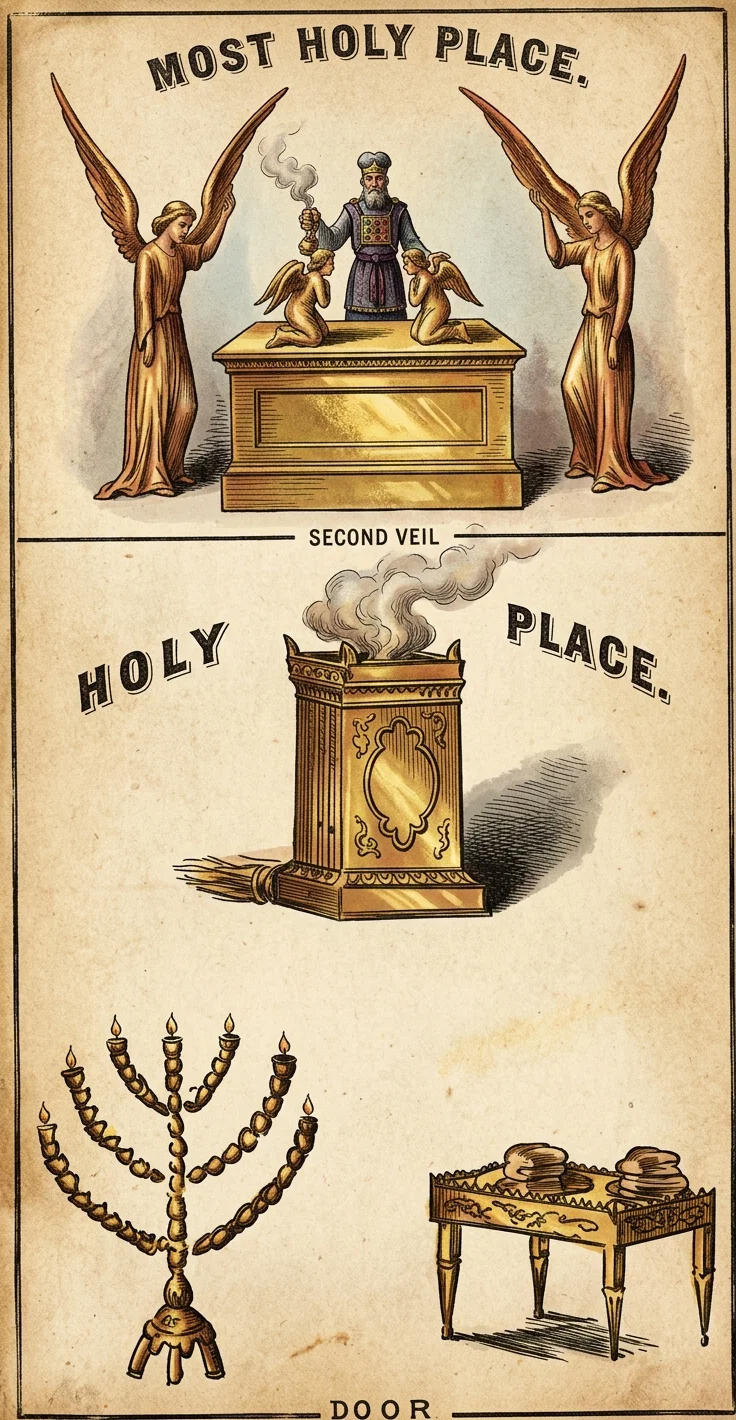
The earthly sanctuary had in it two apartments, called the “holy” and the “most holy” places. Ex. 26:33. These apartments were “figures of the true.” Heb. 9:23, 24. From these statements of God’s word we would conclude that there are in the heavenly temple, two apartments, and this will become more9evident as we consider the work of Christ as high priest. The “heavenly sanctuary,” or temple, has in it articles of furniture corresponding to the furniture in the “earthly,” built by Israel. “For there was a tabernacle made; the first [apartment], wherein was the candlestick, and the table, and the showbread; which is called the holy place [see margin]. And after the second veil, the tabernacle which is called the holiest of all [most holy place]; which had the golden censer, and the ark of the covenant overlaid round about with gold, wherein was the golden pot that had manna, and Aaron’s rod that budded, and the tables of the covenant; and over it the cherubim of glory shadowing the mercy-seat.” Heb. 9:2–5. A description of the golden candlestick is given in Ex. 25:31–40. The corresponding article of furniture in the heavenly sanctuary is shown in Rev. 4:1–5: “After this I looked, and, behold, a door was opened in heaven; . . . and, behold, a throne was set in heaven, and One sat on the throne. . . . And out of the throne proceeded lightnings and thunderings and voices; and there were seven lamps of fire burning before the throne, which are the seven Spirits of God.”
There was in the earthly sanctuary an altar of incense, and the priests burned incense thereon. Ex. 30:1–9. There is also in the heavenly sanctuary, in which Christ ministers, an altar of incense. “And when he had opened the seventh seal, there was silence in heaven about the space of half an hour. And I saw the seven angels which stood before God. . . . And another angel came and stood at the altar, having a golden censer; and there was given unto him much incense, that he should offer it with the prayers of all saints upon the golden altar which was before the throne. And the smoke of the incense, which came with the prayers of the saints, ascended up before God out of the angel’s hand.” Rev. 8:1–4. As the “ark of the testament” was the place where God “communed with the children of Israel,” and “gave commands to them,” so the “ark of his testament,” throne of God, is in the heavenly sanctuary, and is the place where he sits as ruler of the universe.
First let us notice the description of the ark, as found in Ex. 25:10–22. It was in form like a box, and was overlaid within and without with pure gold. It had two rings in each side of it, and “staves” passing through the rings, thus forming handles, by which it was borne by the children of Israel. Upon the ark, as a cover, was the “mercy-seat of pure gold.” Upon each end of the mercy-seat there was a “cherub” of pure gold, and the cherubim stretched “forth their wings on high, covering the mercy-seat,” and “their faces did look one to the other.” In the ark was the testament, or ten commandments. “And I turned myself and came down from the mount, and put the tables [of stone] in the ark which I had made; and there they be, as the Lord commanded me.” Deut. 10:5.
After giving the description of ark, mercy-seat, and cherubim, the Lord says: “And there I will meet with thee, and I will commune with thee from above the mercy-seat, from between the two cherubim which are upon the ark of the testimony, of all things which I will give thee in commandment unto the children of Israel.” Ex. 25:22.
Let us now turn our attention again to the heavenly sanctuary, and see if we can find anything that will correspond to the ark which was in the sanctuary built by man. “And the temple of God was opened in heaven, and there was seen in his temple the ark of his testament.” Rev. 11:19. How could the ark be seen in the temple of God, unless there was one there? and how could it be called the “ark of his testament,” unless the testament, the Ten Commandments, God’s will, was in the ark? This throws light upon the subject of the law of God. No wonder Christ should say, “It is easier for heaven and earth to pass, than one tittle of the law to fail.” Luke 16:17. The law of Ten Commandments is the foundation of God’s government; for they are in the ark, in the sanctuary of heaven, in which Christ ministers.
We have found the “ark” and the “testament” in the heavenly sanctuary; let us find the cherubim upon the mercy-seat, and God dwelling between them, ruling the universe. “The Lord reigneth; let the people tremble; he sitteth between the cherubim; let the earth be moved.” Ps. 99:1. “O Lord of hosts, God of Israel, that dwellest between the cherubim, thou art the God, even thou alone, of all the kingdoms of the earth; thou hast made heaven and earth.” Isa. 37:16.
We have produced abundant evidence to show that there is a similarity between the earthly sanctuary, built by man, and the heavenly, pitched by the Lord.
We now come to a very important question, namely, To which of these two sanctuaries did the “saint” refer, when he said, in Daniel’s vision, “Unto two thousand and three hundred days; then shall the sanctuary be cleansed”? Did he refer to the one built by Moses, or to the one in which Christ ministers as our high priest?
We have found that the 2,300 days, or years, ended in 1884, and the sanctuary built by Moses, or the temple built by Solomon, which took its place, was destroyed by the Romans in A.D. 70; so there was not left “one stone upon another.” Then the sanctuary to be cleansed at the end of the 2,300 days of Dan. 8:14, is the one in which Christ is acting as our high priest.
(To be continued.)
ROME AND ENGLAND.
By Editor
The Catholic Mirror of June 20 prints a letter from Hon. W. E. Gladstone to a high church prelate on the subject of the “Validity of English Orders and the Reunion of Christendom.” It is well known that for some time the Roman Curia, or papal cabinet, have had under investigation the subject of the validity of English orders, that is, whether the ordination of the English clergy, or priests, is valid. Hitherto when one has joined the ranks of Rome he has been reordained. Rome is looking for a solution of the difficulty, and an early finding is promised. It is expected by many that Rome will concede them to be valid, and will perhaps permit those Church of England “priests” now married to retain their wives and minister in the Catholic Church by special indulgence, but will prohibit marriage on the part of all others seeking orders in the Roman communion.
Of the effort of Pope Leo XIII. in this direction, and in that of Christian reunion, Mr. Gladstone speaks in unqualified praise, and with considerable hope. He refers to the pope as “one laden with the cares and responsibilities of the highest position in the Christian church.” Again he says: “It is the pope who, as the first bishop of Christendom, has the noblest sphere of action.” Of the pope’s work Mr. Gladstone thus speaks:—
“What courage must it require in a pope, what an elevation above all the levels of stormy partisanship, what genuineness of love for the whole Christian flock, whether separated or annexed, to enable him to approach the huge mass of hostile and still burning recollections in the spirit and for the purposes of peace. And yet that is what Pope Leo XIII. has done, first in entertaining the question of this inquiry, and secondly in determining and providing, by the infusion both of capacity and of impartiality into the investigation tribunal, that no instrument should be overlooked, no guarantee omitted, for the probable attainment of the truth. He who bears in mind the cup of cold water administered to ‘one of these little ones’ will surely record this effort stamped in its very inception as alike arduous and blessed.”
And whatever the conclusion of the Roman see may be, Mr. Gladstone considers the pope’s “attitude in the largest sense paternal; and while it may probably stand among the latest recollections of my lifetime, it will ever be cherished with cordial sentiments of reverence, of gratitude, and of high appreciation.”
There is much more for which we have not space. Of course the pope has the right to write as many letters and to investigate as many theological questions as he pleases, and Mr. Gladstone, or any other man, has a right to adopt, admire, reverence, or reject whatever the pope does. We quote these to show the change of sentiment that is taking place in the attitude of professed Protestants toward Rome, and the influence that such men as Mr. Gladstone have upon the unthinking masses. The indications in these things are that England is returning to Rome at a constantly accelerating speed. The Catholic Mirror, from which Mr. Gladstone’s remarks are taken, sees in all this a return to the Roman fold. After speaking of the divisions of Christendom resulting from “the revolt of Luther,” the contest between faith and unfaith, the marked falling off of Protestant10faith, the erroneous increase of agnostic and infidel teaching, and the necessity for union, the Mirror says:—
“Hence the anxious eyes of men like Lord Halifax, Mr. Gladstone, and others [are] turning constantly and almost involuntarily in the direction of Rome.
“Within the last year or two the movement for reunion has been astonishing. Honest, dispassionate and clear-sighted observers—professing no faith of any kind—have confessed candidly their conviction that in the future people must declare between the two camps—the Catholic Church and utter infidelity. Protestantism, without organization, or system, or definite principles, can offer no bulwark to the foe. Certainly the Catholic Church has not been indifferent to this cry for a burial of differences and a general rally once more under the banner of Christ.
“On the contrary, the supreme pontiff has urged its necessity with vehemence and has labored with a zeal that reached the point of intensity, in the hope of effecting it. No thought has been so constantly in his mind, no prayer for any other object has been so incessantly on his lips. That he has not prayed in vain is proved in many ways, and in a very impressive way by this letter from Mr. Gladstone.
“A reunion of England with Rome would be a tremendous step toward a general reunion of Christianity. No nation could fail to be impressed. And that reunion is slowly but distinctly approaching, as every discerning mind must perceive. On every hand there are evidences of a revival of Catholicism, even to pilgrimages and religious processions, such as that of Our Lady at Clapham in London a few weeks ago, in the streets. The conversions are very numerous; the so-called High Church party, which carries almost all power, pauses at the very brink. The Catholic feeling is universally in the air, and the queen herself is known to be a Catholic at heart, and rumor has lately said, even one to some extent in practice.”
"THAT LITTLE OLD MAID."
By Cora Bell
BY CORA BELL.
It was one of those bright, beautiful Sabbath mornings when the very atmosphere seems to be filled with the Spirit of God. Two young girls who were on their way to church were earnestly talking.
“All nature is in harmony this morning,” the younger one was saying. “Look at the mountains. I can almost hear them ‘break forth into singing.’ Isn’t it the very day for you to receive the Holy Spirit into your life, Effie?”
“O Jessie, you do not know what that would mean to me! I could not be a Christian and dance, and I could not give up dancing. I just love it. It gives me new life and strength.”
“But, Effie, the Lord gives new life and strength of which you do not know. He is Life, ‘The Way, the Truth, and the Life.’ Will you promise me this, that you will go to Miss Eaton this afternoon, and ask her to tell you about her life?”
“Why, Jessie, do you mean that little old maid, who is sub-editor in the Journal Office? A very queer request, but I will do as you wish me to.”
That afternoon Effie went to see Miss Eaton, as she had promised.
“I am afraid you will think it very strange when I tell you what my errand is, Miss Eaton, but Jessie Mills said it would be sure to help me if I could hear about your life. I hope you will not think me rude or curious.”
“Not in the least, and I hope that what I say may help you,” Miss Eaton answered simply.
“Until I was eighteen I received every comfort, luxury, and pleasure that money could secure; then I became a lonely, penniless orphan. Of the year that followed I can not speak. It was my time of toil and sadness. Then an uncle, who had not known of11my changed life before, wrote, urging me to come to them. I went, and on my arrival I found that they freely offered me, and fully expected me to share, home, money, society, and everything that they themselves enjoyed.
“Their only child was a girl of my own age, who had just entered society, and for a year we lived in a constant whirl of excitement and gaiety. I loved the bustle and excitement, and I used to say that dancing gave me new life.”
Here Miss Eaton paused, and Effie exclaimed:—
“Why, Miss Eaton, did it not seem perfectly delightful to be placed back in a position of wealth and enjoyment, after that year of toiling loneliness?”
“Yes, it seemed very delightful to me then, but one evening when we were returning from a brilliant ball, an accident occurred. Our carriage was overturned, and we were thrown into the street. I saw in those few frightful minutes what a useless, empty life I was living. I saw all the frivolous gaieties, which had seemed so delightful before, in their true light. I found that the new life I received from dancing all left me in the hour of danger; and suddenly I realized how much good might be done with the money that was being spent for things I did not need, of the many hungry mouths it would feed, of the little cold bodies it would make warm. Most of all I realized how unprepared I was to die, and I resolved that if I escaped from death, my life should be different. Then darkness settled over me, and I became unconscious. The next time I opened my eyes, I was in my own room, and the doctor was saying: ‘It was a very narrow escape. If she had fallen two inches nearer the track, it would have been certain death.’ It is a strange and great thing to be so very, very near to death.”
“The next day I was all right, and as no one else had been injured, every one seemed inclined to forget the unpleasant occurrence as soon as possible. But I could not forget, and when, after lunch, we were all sitting in the library, I told my kind relatives what my feelings were. Then came the greatest struggle of my life. My uncle begged me to put such thoughts away, and continue to be a daughter to them; my aunt said I was too young to think of such things, and spoke of my success in society; and Cousin Agatha painted in brilliant colors all the good times we would have during the trip abroad that we had been planning for the summer.”
“Just then the door-bell rang, and as the visitor was announced, my uncle said, ‘Go to your room, and think well before you make your decision; then come and tell us here; for it will mean more to him than it will to us.’”
“I went, glad of the opportunity, for I felt that in the presence of Clarence Willis I must yield. I thought that I could not do otherwise.”
“There friends, comfort, love, a happy home, and devoted husband awaited me; while if I went, it would be to a loveless, friendless life of work, not unlike that lonely, lonely year.”
“Suddenly the struggle ceased, and I cried, ‘Lord, what wilt thou have me to do?’”
“Peace came to me then, and it has never left me.”
“I returned to the library. I saw Clarence rise as if to come to me, but I could not speak. I went to the piano, and, as my fingers touched the keys, a sweet old hymn came to my mind, and seemed to fill my whole being. It just expressed what I wished to say, but could not, but I sang my answer to them then.”
“O Miss Eaton, please sing it to me, won’t you?” said Effie pleadingly.
“If you wish it,” she said; and as she sang, in a clear, sweet voice, her face shone with spiritual strength and joy:—
“Henceforth this vain world must all go;
Its claims I see are but dross;
For none but my Jesus I’ll know,
I’ll glory above in the cross.
I am thine, blessed Jesus, all thine,
The witness impart unto me;
The death that I die is to sin,
The life that I live is to thee.
“Go, friends that would keep me from him.
Go, joys that would share with his love.
Go, hopes that would drag me to sin.
Go, all that from him would remove.
Come, sorrow, if only in thee
I shall cling to my Saviour and God.
Come, scorn and reproach, if left free
To be drawn evermore to my Lord.”
When Miss Eaton had finished her “heart song,” Effie was crying silently.
“How could you do it? O Miss Eaton, I have been saying I could not be a Christian, because I could not give up dancing, and you gave up everything, and are not sorry or unhappy! I can not understand it.”
“I think you will understand it soon, dear. I am glad you came to me; for every time I hear young people say they can not give up worldly pleasures for Christ, I long to tell them how much sweeter the pleasure is that comes from serving him.”
“It makes one so happy to help feed the hungry, to give warm clothing to the cold, to be of service to the sick, to send light to the heathen, and to tell the poor prisoners of the happiness and rest of the Christian life. It is the only perfect life.”
“I am come that they might have life, and that they might have it more abundantly.”
“And the peace of God, which passeth all understanding, shall keep your hearts and minds through Christ Jesus.”
“These are the words he spoke, and they have been tried and proved by millions of trusting hearts.”
The day was ended. Darkness was creeping into the room. The “little old maid” had finished her story. Another gem had been added to her crown; another day had been spent in doing good, and another soul had come to know the fulness and joy of the “life hid with Christ in God.”—The Leader.