The coronation of the czar has occupied the attention of Europe to a remarkable degree; but while the leading nations have participated in these festivities abroad, they have had plenty of serious work at home.
The strong Social Democratic party in Germany keeps things lively at Berlin; and of late some of the pastors, led by Stocker, have made themselves particularly obnoxious to the government by advocating “Christian Socialist” sentiments. Concerning this movement, the emperor is reported to have said: “Political pastors are a monstrosity; whoever is a Christian is also ‘social;’ Christian Socialism is nonsense, and leads to self-exaltation and intolerance, both of which are diametrically opposed to Christianity. The reverend gentlemen should exercise concern for the salvation of their churches, and cultivate love for their neighbors, but leave politics entirely alone, because they are none of their business.”
This decision of the emperor virtually brands this “Christian Socialism” as a denial of Christianity, and may lead to serious consequences, for pastors and all participating in this movement. This movement has evidently reached a crisis, which may prove fatal; but it furnishes another illustration of the unsettled, dissatisfied condition of the people.
Italy has also seen exceedingly stormy times at home in consequence of the Abyssinian failure, and the smoke has not yet cleared away; and South African blunders have given England much extra work; while Spain’s troubles over Cuban affairs grow more complicated and difficult to settle with honor to herself.
How unsettled in their home affairs are the nations of Europe to-day! And yet they are constantly reaching out to other portions of the world, annexing more territory, assuming protectorates over other peoples, etc. The tide in this line has turned toward Africa, until very little of this large continent remains unoccupied by some nation of Europe. These nations have by agreements, deliberately divided the Dark Continent among themselves; but these divisions are not so well defined among the natives of Africa as on the maps; and the nations of Europe are quite likely to have considerable trouble among themselves before their respective rights and boundaries are settled and acknowledged.
According to latest statistics, France possesses the largest area, 9,600,000 square kilometers, with 35,000,000 inhabitants. England has but a little over 5,000,000 square kilometers, but her population is greatest,—38,000,000. Estimating by population, Belgian possessions, including the Kongo state, come next, with 10,000,000. Germany is fourth, having 8,650,000 subjects, but the area of German possessions is greater than that of Belgium. Portugal stands fifth, with 7,775,000 subjects. Egypt has 7,000,000 inhabitants and about 1,000,000 square kilometers. Italy, before its late defeats, had about the same as Egypt. Turkey has about 1,000,000 population and the same square kilometers of territory. Spain possesses the least of all in Africa,—500,000 square kilometers and 450,000 inhabitants.
Four states are considered independent,—Morocco, and the three republics of Liberia, Transvaal, and Orange Free State. This leaves but 2,500,000 square kilometers, with 12,000,000 inhabitants, not yet divided. This is less than one-twelfth of the entire population.
As stated, some of these divisions are only on paper; but the matter of defining them in the territory is being pushed with unusual vigor of late. France dreams of extending her possessions in North Africa through the Sahara, Eastern Soudan, Senegal, the Ivory Coast, etc., to the sources of the Nile, so that they may travel 6,000 kilometers south from Paris on French soil.
France will never be satisfied so long as England occupies Egypt. Add to this their encroachments in Africa, and their struggle for the supremacy in the Levant, there is room enough for difficulty. When we study the relation of the leading nations of Europe to Africa and Asia, their possessions in these two continents and the islands of the sea, and observe how often their several interests conflict, then add to this their daily increasing internal troubles, we ask, Was there ever a time when universal embroilment seemed so probable? Surely the way for a general conflict is prepared, as tho it had been studied with design.
That there will be a general gathering of nations to battle in the day of the Lord is a settled fact. Rev. 16:12-14. It is also a fact that this will be one of the last acts of earth’s history. The present political situation of the world being such as to indicate that this step is imminent, constitutes a prominent sign of the times, and should serve as an admonition to all. We may not know just when the great crisis will come; but we may always be ready, and thus not be taken unawares.
H. P. H.
Helsingfors, Finland, May 25.
The Caucus and the Prayer Meeting
In these days of “reform,” we often hear such expressions as the following, accredited to Dr. Bashford:—
“The time is coming when a Christian man will feel it as much his duty to attend the caucuses of his party as to attend the prayer-meetings of his church.”
Alas! the time has been here already too long when at least professed Christians have felt the caucus “duty” far more than that of the prayer-meeting. And the great so-called “Christian citizenship” craze is adding much to the imaginary importance of the party caucus. And as this interest increases, the prayer-meeting interest must decrease, excepting as the latter takes on the character of the caucus.
The Proper Term.
In speaking of a mob of Harvard students who resisted the officers of the law with great violence, shouting, “Kill the police,” the Independent justly remarks that while these students are called by their professors “young gentlemen,” they would be called on the frontier, or in some lumber camp, or in the slums of New York, “ruffians.” Ruffianism is the proper term for such conduct anywhere.
MARJORIE
By Wide-Awake
“O dear,” said Farmer Brown one day,
“I never saw such weather!
The rain will spoil my meadow hay,
And all my crops together.”
His little daughter climbed his knee;
“I guess the sun will shine,” said she.
“But if the sun,” said Farmer Brown,
“Should bring a dry September,
With vines and stalks all wilted down,
And fields scorched to an ember”—
“Why, then ’twill rain,” said Marjorie,
The little girl upon his knee.
“Ah, me!” sighed Farmer Brown that fall,
“Now what’s the use of living?
No plan of mine succeeds at all!”—
“Why, next month comes Thanksgiving,
And then, of course,” said Marjorie,
“We’re all as happy as can be.”
“Well, what should I be thankful for?”
Asked Farmer Brown. “My trouble
This summer has grown more and more,
My losses have been double,
I’ve nothing left!”—“Why, you’ve got me!”
Said Marjorie, upon his knee.
— Wide-Awake.
A BOAT FOR NEW YORK HARBOR.
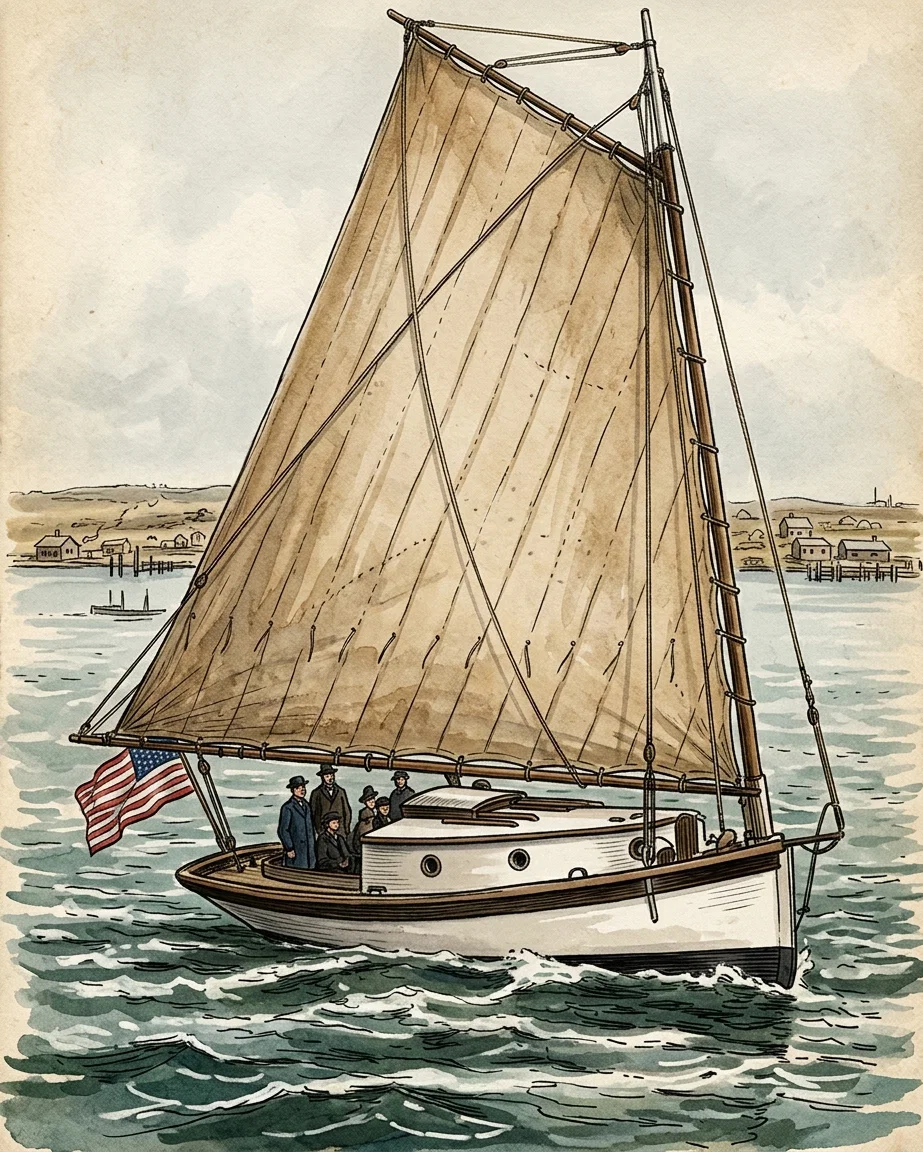
A LONG-FELT want has been filled by procuring a new boat for ship missionary work in New York Harbor. It is named “The Sentinel,” and is thus described by Capt. J. Christiansen, who has charge of the boat and of the ship missionary work in the harbor:—
“The Sentinel” under Sail.
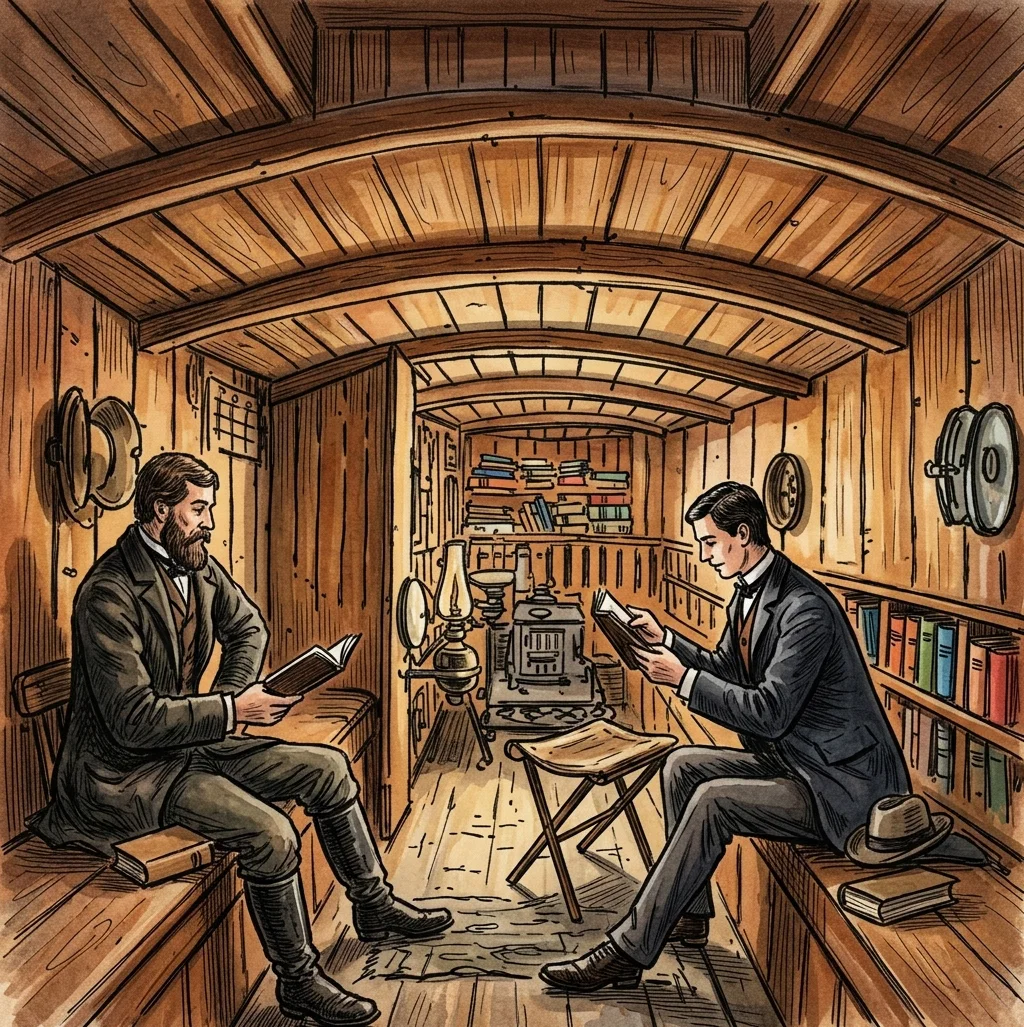
Inside of "The Sentinel" Cabin.
“The craft measures thirty feet from stem to stern, and nine and one-half feet beam. It has a cabin twelve feet long from the middle of the boat and forward. In the bow is placed a copper tank for gasoline large enough to hold about one hundred gallons. A six-horse-power engine of the value of $600 is placed in the after part of the boat. Mr. Wing, of New York, of whom the engine was bought, put it in its place free of charge. The machinery works well and propels the boat at the rate of about six miles per hour, and at the cost of only about two cents per mile. In case the engine gets out of order, the boat can be worked by a sail. The mast is so constructed, however, that it can be taken down. The entire cost of the boat complete, as seen in the illustration, is $1,350.”
We have information from Captain Christiansen that he can furnish excellent photos of the new boat for twenty-five cents each, postpaid. No doubt many of our readers would be glad to secure one, especially as the proceeds of the sale go to replace the expenditure of the General Conference in procuring the boat. Orders may be sent to Pacific Press Publishing Co., 39 Bond Street, New York City, N. Y.
THE WAY TO REST.
To UNDERSTAND this is of more importance than to know how to work. The latter can be learned easily; the former, it takes years to learn, and some people never learn the art of resting. It is simply a change of scenes and activities. Loafing may not be resting. Sleeping is not always resting. Sitting down for days with nothing to do, is not restful. A change is needed to bring into play a different set of faculties, and to turn the life into a new channel. The man who works hard, finds his best rest in playing hard. The man who is burdened with care, finds relief in something that is active, yet free from responsibility. Above all, keep good-natured, and don't abuse your best friend, the stomach.—Medical Brief.
GOING BAREFOOT.
There is a certain pedicure whose fortune is on the increase. Many women have him call on them frequently to beautify their feet. He says that New York women as a rule have very fine feet, and in most cases a little attention renders them beautiful. Some of his customers have adopted the custom of the ladies of the court of Dom Pedro, who never thought of wearing shoes and stockings in the family circle. In the seclusions of their rooms they go barefooted; their health is improved by the habit. Since they have become used to going barefooted at home, they find that they never have colds or fevers. Half the evils of life, says the pedicure, are due to confined feet. This is bringing the Kneipp cure into practical use in a winter land.—Selected.
Success in This World, Failure in the Next
“Success in this world may mean failure in the next.”
Thoroughness and Greatness
“A THOROUGHLY great man is one who does everything he undertakes thoroughly.”
35 “Again on the morrow John was standing, and two of his disciples; and he looked upon Jesus as he walked, and saith, Behold, the Lamb of God! And the two disciples heard him speak, and they followed Jesus. And Jesus turned, and beheld them following, and saith unto them, What seek ye? And they said unto him, Rabbi (which is to say, being interpreted, Master), where abidest thou? He saith unto them, Come, and ye shall see. They came therefore and saw where he abode; and they abode with him that day; it was about the tenth hour. One of the two that heard John speak, and followed him, was Andrew, Simon Peter’s brother. He findeth first his own brother Simon, and saith unto him, We have found the Messiah (which is, being interpreted, Christ). He brought him unto Jesus. Jesus looked upon him, and said, Thou art Simon the son of John; thou shalt be called Cephas (which is by interpretation, Peter). On the morrow he was minded to go forth into Galilee, and he findeth Philip; and Jesus saith unto him, Follow me. Now Philip was from Bethsaida, of the city of Andrew and Peter. Philip findeth Nathanael, and saith unto him, We have found him, of whom Moses in the law, and the prophets, did write, Jesus of Nazareth, the son of Joseph. And Nathanael said unto him, Can any good thing come out of Nazareth? Philip saith unto him, Come and see. Jesus saw Nathanael coming to him, and saith of him, Behold, an Israelite indeed, in whom is no guile! Nathanael saith unto him, Whence knowest thou me? Jesus answered and said unto him, Before Philip called thee, when thou wast under the fig tree, I saw thee. Nathanael answered him, Rabbi, thou art the Son of God; thou art King of Israel. Jesus answered and said unto him, Because I said unto thee, I saw thee underneath the fig tree, believest thou? thou shalt see greater things than these. And he saith unto him, Verily, verily, I say unto you, Ye shall see the heaven opened, and the angels of God ascending and descending upon the Son of man.” John 1:35-51.
QUESTIONS.
1. With whom was John the next day?
2. Whom did he see walking? What did he say of him?
3. What was the effect upon his two disciples?
4. What did Jesus do? What did he say to them? What inquiry did they make?
5. What was his reply? How did they respond to his invitation?
6. What was the name of one of these first disciples?
7. Whom did he at once seek for? What did he say to him? What did he do with him?
8. What did Jesus say to him?
9. What happened the next day?
10. Where did this fourth disciple live?
11. Whom did Philip find? What testimony did Philip bear to him?
12. What was Nathanael’s response? What was Philip’s reply?
13. With what salutation did Jesus greet Nathanael?
14. What question did Nathanael ask? What was the reply of Jesus?
15. To what confession of his faith did Nathanael then give utterance?
16. What inquiry did Jesus make in response? What assurance did He then give him?
17. What prophetic statement did He then make to him?
NOTES.
1. The work of John accomplished the right result,—his disciples heard him, but they followed Jesus. The great apostasy was caused by men winning disciples to themselves. Acts 20:30.
2. “In the calling of John and Andrew and Simon, of Philip and Nathanael, the foundation of the Christian church was laid. John directed two of his disciples to Christ. Then one of these, Andrew, finds his brother and brings him to the Saviour. Philip is then called, and he goes in search of Nathanael. These examples should teach us the importance of personal effort, or of making direct appeals to kindred, friends, and neighbors.” The testimony which brought both Simon and Nathanael to Jesus was, “We have found” him. This is the testimony which wins now.
3. “At the time when Philip called him, Nathanael had withdrawn to a quiet grove to meditate upon the announcement of John, and the prophecies concerning the Messiah. He prayed that if the one announced by John was the deliverer, it might be made known to him; and the Holy Spirit rested upon him with an overwhelming assurance that God had visited his people, and raised up a horn of salvation for them. Philip’s message seemed to Nathanael a direct answer to his prayer.”
4. “Like Nathanael, we need to study God’s word for ourselves, and pray for the enlightenment of the Holy Spirit. He who saw Nathanael under the fig tree, will see us in the secret places of prayer, if we seek him that we may know what is truth. Angels from the world of light will be near to those who in humility of heart pray for divine guidance.” “The tree has never grown which could conceal a soul from the eye of Jesus.”
Suggestions for Further Study.
1. Four new titles for Christ are mentioned in this lesson: Master (better, Teacher, R. V., margin), Messias, King of Israel, Son of man. What different ideas of the work of Christ are set forth in these titles?
2. Jesus “looked upon” Peter twice. Verse 42, R. V., and Luke 22:61. The two looks may be considered with profit.
3. What is the difference between Philip’s confession of Christ as “Jesus of Nazareth, the son of Joseph,” and Nathanael’s statement, “Thou art the Son of God”?
4. Note the new names and the new places introduced in this lesson.
5. See how readily these men recognized Jesus as the Son of God. Is not this the comment of Scripture upon the promise in Matt. 5:8?
INTERNATIONAL SUNDAY SCHOOL LESSON
“Take heed unto thyself; and unto the doctrine;” “that thy profiting may appear to all.”
1. Again, David gathered together all the chosen men of Israel, thirty thousand.
2. And David arose, and went with all the people that were with him from Baale of Judah, to bring up from thence the ark of God, whose name is called by the name of the Lord of hosts that dwelleth between the cherubim.
3. And they set the ark of God upon a new cart, and brought it out of the house of Abinadab that was in Gibeah; and Uzzah and Ahio, the sons of Abinadab, drave the new cart.
4. And they brought it out of the house of Abinadab which was at Gibeah, accompanying the ark of God; and Ahio went before the ark.
5. And David and all the house of Israel played before the Lord on all manner of instruments made of fir wood, even on harps, and on psalteries, and on timbrels, and on cornets, and on cymbals.
6. And when they came to Nachon's threshing floor, Uzzah put forth his hand to the ark of God, and took hold of it; for the oxen shook it.
7. And the anger of the Lord was kindled against Uzzah; and God smote him there for his error; and there he died by the ark of God.
8. And David was displeased, because the Lord had made a breach upon Uzzah; and he called the name of the place Perez-uzzah to this day.
9. And David was afraid of the Lord that day, and said, How shall the ark of the Lord come to me?
10. So David would not remove the ark of the Lord unto him into the city of David; but David carried it aside into the house of Obed-edom the Gittite.
11. And the ark of the Lord continued in the house of Obed-edom the Gittite three months; and the Lord blessed Obed-edom, and all his household.
12. And it was told king David, saying, The Lord hath blessed the house of Obed-edom, and all that pertaineth unto him, because of the ark of God. So David went and brought up the ark of God from the house of Obed-edom into the city of David with gladness.
Golden Text: “O Lord of hosts, blessed is the man that trusteth in thee.” Ps. 84: 12.
NOTE.—Parallel scriptures are 1 Chronicles 13, 15, and 16. The psalm, 1 Chron. 16: 7-36, which David gave to be sung on the occasion, reappears in part in Psalm 96, and 106: 1, 47, 48. 1 Chron. 23: 5 and 25: 1-7 describe the organization of the service of song. Between the previous lesson and13this, David has been called upon twice to defend his added authority against invasions of the Philistines. Read the entire sixth chapter in connection with the present lesson.
Suggestive Questions.
(1) Who and how many did David gather together? Verse 1. Note 1. (2) Where did they assemble, and for what purpose? Verse 2. Note 2. (3) How did they prepare to transport the ark? Verse 3. (4) Who had it in special charge? Same verse, and verse 4. (5) With what ceremonies was it accompanied? Verse 5. (6) What took place at Nachon's threshing floor? Verses 6, 7. Note 3. (7) How was David affected by this occurrence? Verse 8. Note 4. (8) What attitude did he assume respecting the Lord? Verse 9. (9) What was done with the ark? Verse 10. Note 5. (10) How long did the ark remain there, and what did the Lord do for that family? Verse 11. (11) What will he do for any one who receives his law and cherishes it? (12) What was told David? Verse 12. (13) What did he then do? Same verse. Note 6.
Notes.
1. Thirty thousand.—These were representatives of the whole people, and, according to Chronicles, they came as far as from Shihor, fifty miles south of Gaza, and from Hamath, in Lebanon, 250 miles north of Jerusalem.
2. The ark of God.—A description of the ark is found in Exodus 25. For seventy years it had lain in partial neglect at Kirjath-jearim (Baale of Judah), in the house of Abinadab, to which place it was brought after its experience in the hands of the Philistines, who captured it in battle. In the true worship of the Israelites, this was the central point, for it was from between the cherubim on the mercy-seat that God manifested his presence from time to time, while underneath the mercy-seat, and within the ark, were the tables of stone containing the ten commandments, God's moral law. It was preëminently fitting that the central worship of God should be at Jerusalem, and it was to revive religion and bring this about that David made this move.
3. God smote him.—The death of Uzzah was designed to teach an important lesson. Express directions had been given for the mode of moving the ark (Num. 4: 15; 7: 9), and there could be no excuse for departing from the law at this time. It was to be carried by means of the staves, and by the sons of Kohath, of the Levites. This, David and those caring for the ark should have known. It was the symbol of God's presence, and none but those designated of God could look upon it, much less lay hold of it, without peril to life. This was not merely an arbitrary requirement, but was to teach the people that God is not common, but exceeding holy. Uzzah stood in a representative position. What he did was in sight of all the people, and it was needful to impress this fact upon them, lest a small neglect lead to a greater. If the Lord was thus particular respecting the depository of his law, how much more particular is he regarding the observance of the law of ten commandments itself, the very foundation of his throne! See Ps. 97: 2; 119: 172. While there may be seen in the “anger of the Lord,” as recorded in those words, a righteous indignation and jealous care for his name, there may also be discovered a watchful care and love for his chosen people, that they might not stray from the paths of rectitude. Let us learn that the judgments of God, although severe, are actuated by infinite love,—for us.
4. David was displeased.—It does not state that David was displeased with the Lord. He could not afford to assume such an attitude, and the following verse shows his fear of the Lord. While the action of the Lord was the immediate cause of disturbing the ceremonies, Uzzah's course and the consequent delay were probably the chief objects of his displeasure, as the arrangements were very elaborate.
5. Obed-edom the Gittite.—He was a Levite, belonging to the family of Kohath. 1 Chron. 26: 1, 4-8; Num. 16: 1. He was called a Gittite, or Gathite, because he was a native of the Levitical city Gath-rimmon, in Manasseh, which belonged to the Kohathites. Josh. 21: 25. His home was about three or four miles from Jerusalem.
6. David went, etc.—He had an opportunity during this three months for remembering the requirements of God, and there was before him also the evidence, in the blessings received by Obed-edom, of the blessings accompanying the law. So he desired specially to have the ark in Jerusalem. Note that this time the ark was borne on the shoulders of Levites. 1 Chron. 15: 15.
OUR WORK AND WORKERS.
The organization of a church at Elsmore, Kansas, with fifteen members, is reported by Elder R. H. Brock.
A London paper of June 2 states that Elder J. O. Corliss’ daughter Lulu, who was taken from a steamer at Plymouth and confined in a hospital for a time, had so far recovered as to be released, and, after stopping in London for a few days, the family would resume their journey to America. Elder Corliss had preached some while in Plymouth. A growing interest is reported by laborers in that city.
Our good London paper, the Present Truth, is receiving very encouraging patronage in the world’s metropolis. Of course unpopular truth must needs meet many obstacles in gaining extended notice amid the varied prominent interests of the world’s market; but “truth is mighty,” altho sometimes apparently obscure and deemed insignificant. The influence of the paper is also being felt in other parts of the kingdom. A worker in Oldham reports that an evangelist who conducts a very large mission there has been taking the paper, and has introduced it from the pulpit.
Altho our brethren in Matabeleland have been obliged to leave the mission farm and seek safety in Buluwayo on account of the native uprising, and have lost most of their cattle, and some other property, it is reported that the Chartered Company, under whose government and assurance the country is being settled by foreigners, will recompense settlers for pecuniary damages resulting from the insurrection. The other losses will be made up by the Lord, who is “able to do exceeding abundantly above all that we ask or think, according to the power that worketh in us.”
Brother U. Hale, a laborer in the Gold Coast of Africa (popularly known as the white man’s grave), reports himself and four collaborators enjoying fairly good health, altho three of them had been attacked by the malignant fever, that carries so many to the grave on very short notice. When he wrote, they had been there seven months, and he says: “I have come here to glorify God, and my life is entirely in his hand. If he desires me to live and work, all the diseases of Africa can not kill me. A Baptist missionary here, a minister, has accepted our doctrines and has offered himself to the work.”
An instance showing how the message goes to the world is stated by Elder J. W. Westphal in the Review. He says: “At Wentz, Weld County, Colo., there is a company of ten keeping the Sabbath. Most of these accepted the truth three years ago as the result of missionary work done with our German papers in Russia seven years ago, and later canvassing work in Colorado.” Our literature is doing, and is destined to do, the principal work in giving the last message of mercy to the world; and among English-speaking people, especially in the Americas, the SIGNS OF THE TIMES is the recognized “pioneer.” It is especially designed for pioneer work, but “how shall they preach except they be sent?” They can not go of themselves.
PERIODICALS WANTED.
Miss Elizabeth W. Harris, of 2012 Brightwood Avenue, Washington, D. C., desires to obtain our papers in the various languages for hospital work. It is probably unnecessary to say that these papers should be clean and postpaid.
THE CHILDREN'S BOOK.
USEFUL as well as ornamental. Volume 6 of Our Little Friend is full of good stories, just such as children like. They can spend many an hour reading, with no danger of their minds being poisoned with such matter as many do read in other books and papers.
The bound volumes of Our Little Friend are just the books to place in the hands of our children. If we get books for our children, let us get good books for them. There are none better than the bound volumes of Our Little Friend, of which volume 6 is the latest. 416 pp., cloth; profusely illustrated.
It will be sent to any address for $1.00 postpaid.
Address, OUR LITTLE FRIEND, Box 548, Oakland, Cal.
ANGELS: THEIR NATURE AND MINISTRY.
Contains also some hints on the origin, history, and destiny of Satan as gleaned from the Scriptures. Bible Students' Library, No. 8. Pacific Press Pub. Co., Oakland, Cal. 140 pp.; 20 cents.