From the middle of the Red Sea to the equator, or over one thousand miles north and south and six hundred miles from west to east, extends the great coast line behind which Abyssinia towers to an elevation of about eight thousand feet, the vast Switzerland of Africa. Italy has acquired the largest share of this coast. Its northern colony, Eritrea, extends five hundred miles along the Red Sea; then come French and British Somaliland, occupying a strip of about three hundred miles in extent; then Italian Somaliland, bordering the Indian Ocean for another six hundred miles. As early as 1850 Italian statesmen had their eye on this long coast line. After England punished King Theodor of Abyssinia in 1869, the plan took tangible shape. As England was exceedingly sensitive on the subject of the Red Sea, Italy obtained its first footing only by diplomatic strategy.
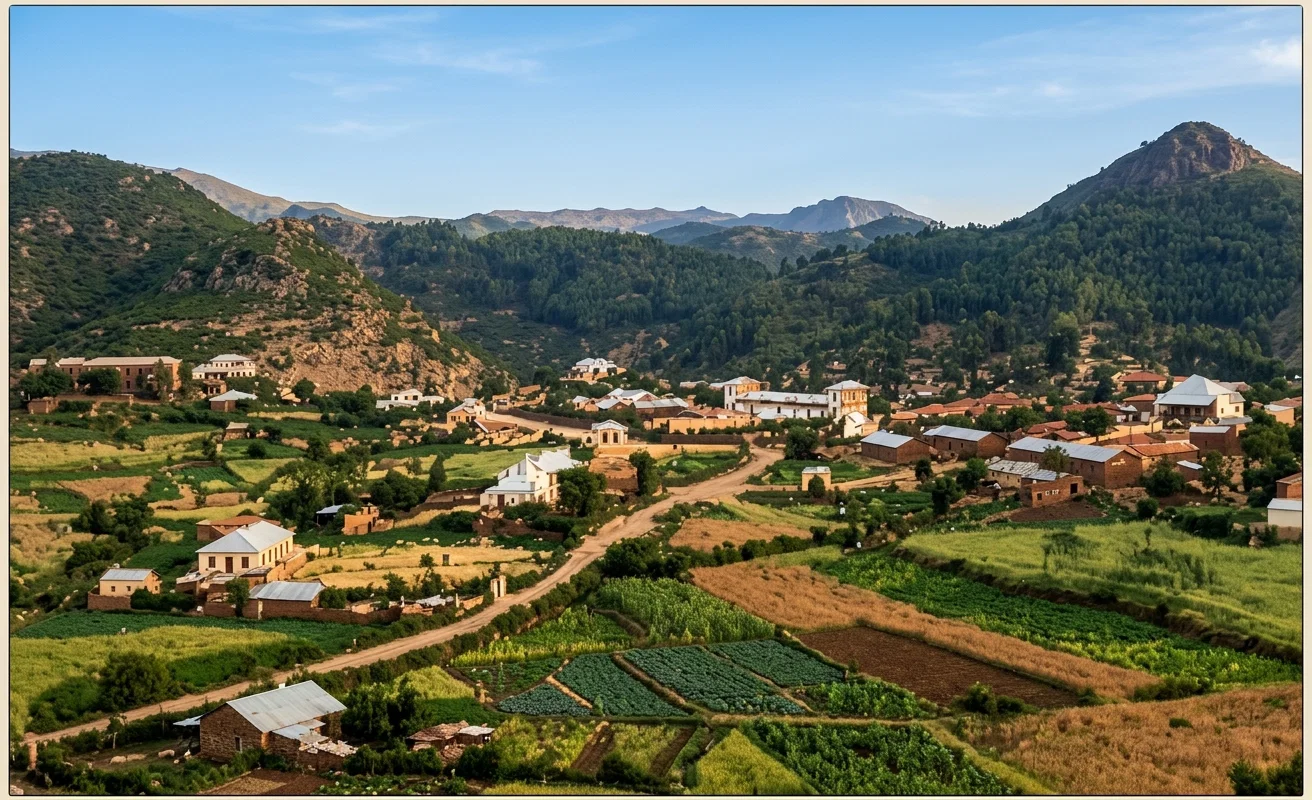
GHINDA, THE TERMINUS OF THE RAILWAY. ABOVE, ON THE MOUNTAINS, LIES ASMARA
On March 11, 1870, the Florio Rubattino Steamship Co., of Genoa, obtained from Sultan Rechambey, who claimed independence for both Turkey and Egypt, the bay of Assab and the island of Darmaba, as a commercial settlement. Though England and Egypt protested, yet in January, 1881, a commissioner was appointed. As his secretary and some seventy-five soldiers were killed on an exploration tour in the interior in June, Italy had now sufficient pretext to declare it an Italian colony.
Massawa, one hundred eighty miles north, had not been mentioned. As early as 1557 the Turks had taken this important seaport from the Arabs; in 1886 they, pressed by England, ceded it to Egypt. As late as 1884, the Abyssinian king, Theodor, demanded that Egypt should either cede it to Abyssinia, or else promise not to give it to any other European power. But when England was hard pressed by the Mahdi, she was anxious to obtain Italy's co-operation, and on Feb. 6, 1885, Admiral Caina issued this proclamation: “The Italian government, in friendship with England, Turkey, and Egypt, has commanded me to occupy the town.” In the following November the Italian commander simply asked the Egyptian governor to evacuate the forts, who quietly yielded. Abyssinia protested, but in spite of the protests, Italy erected strong forts on the mainland. The Italians lost over four hundred men in an engagement in January, 1887; then the government sent two thousand soldiers there under an experienced general, and sought the friendship of the Mohammedan Arabs along the coast. When King Theodor descended to the coast with some fifteen thousand men, the general wisely avoided a battle, and the king was obliged to return, losing his life, March 9, 1889, as a result of attacking the Mahdists. King Menelik succeeded him, and entered into a friendly agreement with Italy, September 21. This agreement was written in the Amharic; and then, in a French version, was brought by Italy to the notice of the European powers. But while the Amharic stated that the chief king of the Ethiopian kings might in future make use of the Italian diplomats in conducting its affairs with the European powers, the French version declared that he must, thus virtually declaring Abyssinia an Italian protectorate. Meanwhile Italy secured some strategic point farther inland, and by a royal decree of Dec. 20, 1889, all the long coast line was declared an Italian possession, and called “Colony Eritrea.” The Italian governor, without consulting Menelik, entered also into a friendly agreement with the governor of the adjoining Abyssinian province of Tigré. Menelik vainly protested; his letters were left without reply, and consequently, in a letter of February, 1893, he accused Italy of perfidy, and declared the agreement null and void. As the governor of Tigré had also broken friendship, General Baratieri, with over seventeen thousand Italian soldiers, advanced into the interior, the Abyssinians constantly retreating, until the general was far from his strong base of operation.
Meanwhile an army of one hundred twenty thousand Abyssinians, under Menelik himself, gathered about Adua, and as Baratieri, urged by wires from Rome, on Feb. 29, 1895, advanced into the mountains at the dawn of day, marching in three different columns, the Abyssinians swooped suddenly down upon them, inflicting the most terrible defeat any European army ever suffered in Africa. Several generals, four hundred officers, and over ten thousand soldiers lost their lives, and an immense quantity of ammunition and all the guns fell into the hands of Menelik. But still more terrible was the punishment inflicted by Menelik on the few thousand natives who fought in the Italian ranks; he simply had their left hand and right foot cut off. I met several of these survivors, showing their crippled limbs and asking for alms. Menelik has ever since been the undisputed ruler over eight and one-half millions of Abyssinians. But it is a fact, that if the general had avoided an engagement for a few days longer, Menelik, lacking any systematic organization for provision, would have been forced to disband his army.
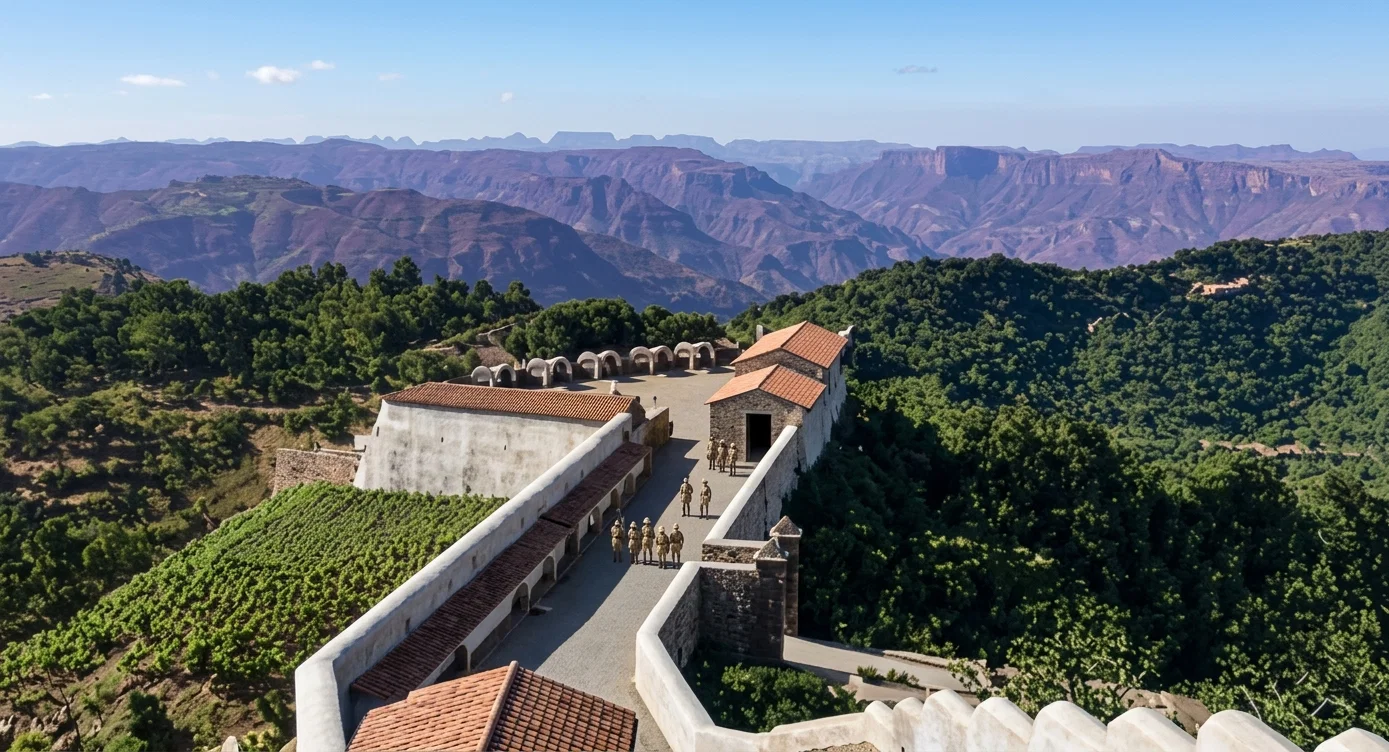
Italy sent Governor Martin to arrange for peace, who since has turned his attention to developing the colony. Nowhere in East Africa did I find such a fine system of roads as in Eritrea, and many of them lead over most difficult mountain passes. Massawa itself is an island, connected with the mainland by two moles,—a shorter one leading to the island, whence the railway starts, the other, a long one, being a path for the railway to reach the mainland. Thus far, the railway, a narrow gauge, has been completed up to Ghinda, three thousand feet above the Red Sea, a distance of fifty miles. There is but little vegetation, only in the watercourses, and they contain but little water most of the year. About fifteen miles inland, we passed Monkullo, where the Swedish Lutheran missionaries began their operations, the wooden house shipped from Sweden still standing near the Arab villages, on which they made but little impression. Farther on, Italian forts in the midst of the mountain desert were passed, and some monuments and graves12told of the early struggles to gain a foothold. A few hours' ride on the cars took us over a territory for whose possession the soldiers fought for years; and for an equal length of time the missionary struggled in the hot feverish plains below to gain an entrance among the Abyssinians as they came to the seashore with their merchandise. Quite a number of noble missionaries have lost their lives in this peaceful combat in behalf of the cross.
AN ITALIAN MOUNTAIN FORT
At the railway station a special mail-coach, drawn by mules, was awaiting us, to carry five of us the remaining thirty miles between here and Asmara. It was not so much the distance that made this journey remarkable as the fact that in this thirty miles we would ascend five thousand feet higher, up to the Abyssinian plateau. Leaving at noon, and changing mules every six miles, driving from three to five mules according to the steepness, we made this journey in six hours,—and a wonderful ride it was indeed! At one station, we could see right above us our next station, almost hidden in the clouds, and the road winding its way forward and backward to the summit. Then scarcely two hours later, we looked down, yes, looked seventy miles in the distance, and there, as a tiny white spot at the edge of the blue sea, saw the white houses of Massawa! The road was often only wide enough for one team, and as the mail-coach advanced, the driver would blow his bugle, and long rows of camels, or of heavy-loaded teams would halt and press against the edges of the rocks until we passed. Two years more and the bugle of the mail-coach will have given way to the shrill whistle of the engine, the rails being already laid nearly half of the distance. The tracks of the railway, in longer and easier bends through tunnels and viaducts, will climb up in hours, where camels and men before toiled days over dangerous mountain paths!
Africa is indeed opening up, and even the steep mountains of Abyssinia, which proved a mighty bulwark against the inroads of Islam for ten centuries, are conquered by modern technic; and as the railway advances, Abyssinia itself must open its doors, not only to the trader and tourist, but also to the missionary.
As the evening drew nigh, and we found ourselves in the midst of the clouds, our heavy overcoats proved none too warm. A ride of a few miles over the plateau, and the electric lights of Asmara greeted us—a modern town, and yet quite a share of it consists of the round huts, or tobals, of the Abyssinians. As our coach halted close to the post-office in the center of the town, Brethren A. Grundset and J. Persson bade us welcome to their hospitable homes—the end of our long journey had been reached, we were actually above and in the midst of the clouds of Africa, among our own brethren and sisters, and yet among the Abyssinians.
Hamburg, Germany.
WALTER G. BOND
By Walter G. Bond
Spain
WALTER G. BOND
It has been some time since I sent a message to the REVIEW from Spain, but it has not been because of a lack of something to report, for the work is onward here. No doubt you have all heard of Spain’s recent troubles, and the outbreak here in Barcelona. During the last week in July, in this city alone, forty-eight large churches and convents were burned, and hundreds of people were killed and wounded. We are glad to report that none of our members were injured. However, several of our acquaintances and friends were killed. For some time we were unable to hold any meetings, or even to visit the interested ones. But God was looking after the work, so that on August 21 we had the privilege of baptizing nine dear souls in the Mediterranean, just outside the city. It was a blessed occasion. A young man who was present was greatly impressed. He was a slave to tobacco, but after witnessing the baptism he took out his package of cigarettes and threw it into the sea. He had tried many times before to stop smoking, but all to no avail. He says that since that day he has not had the slightest desire to smoke. We trust that he will yet obey the entire message.
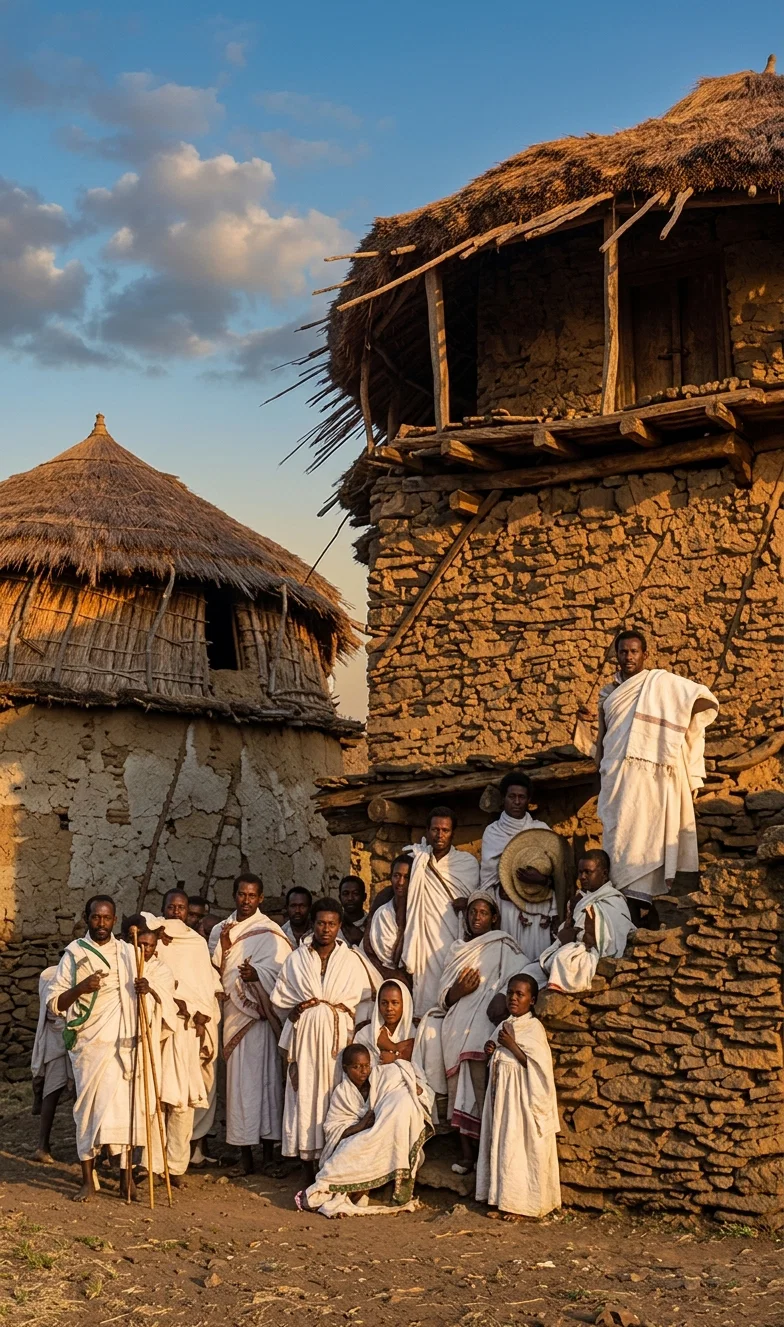
THE HOME OF AN ABYSSINIAN CHIEF
For many weeks in Barcelona there was an almost constant “reign of terror.” More than fifteen hundred suspected persons were imprisoned during the first two weeks in August. Many of these are still waiting to learn their fate. Some have been banished, and many have been shot. Public feeling is still running high, and it is believed by many that the worst is not yet passed.
In October my brother and I visited a small company in the province of Teruel, where he had been several times before. God specially blessed our efforts while there. Three men were baptized by my brother, and another, a Baptist, was accepted on former baptism. Many others seem deeply interested. My brother has also baptized a few in the city of Valencia. And here in Barcelona, in a public washhouse (lavadero publico, as it is called here), three more converts were baptized, all of whom were sisters.
A few days ago I received a letter from a woman in the province of Zaragoza, asking that some one be sent to baptize her. She had heard and accepted the truth here in Barcelona, but went away before having opportunity to be baptized.
We were very much pleased to have Elder N. Z. Town with us the last weeks of September. ‘He held an institute with our workers here, and I believe we were all benefited. All seemed to enjoy it. He gave special instruction on “Coming King.” I believe that the book work will prove a success here. Mrs. Bond has about twenty dollars’ worth of orders as the result of three hours’ work. We have made application to the government for the permission to enter “Coming King,” but as yet have not received an answer.
We are indeed thankful to have a part in this message. Our courage is good, and we are determined by God’s help to do faithfully the work he has entrusted to us.
About three years ago a box of “Patriarchs and Prophets” was sent us from London, but as we had no permission from the government to enter them, the authorities would not deliver them to us, and, besides, endeavored to fine us for an attempt at illegal traffic. The government seized the books, and declared its intention to burn them, but God was watching over them. In some manner the proprietor of a certain second-hand book-store obtained possession of them and put the books into circulation. So these have reached their destination in spite of the opposition. Surely the wrath of man is made to praise God. When you pray, do not forget to mention before the throne of grace the cause in benighted Spain.
Barcelona.
Nagasaki, Japan
By Walter L. Foster
WALTER L. FOSTER
JAPAN is one of the most interesting of mission fields. And the history of missionary endeavor in Nagasaki is especially so. Usually new visitors to Japan are at first unable to appreciate the scenery as much as they do later; but the pleasant and desirable things of life are so evenly mixed with the undesirable that it is a great wonder many are not seeking opportunity to labor here, where at present we hear of none. As I become acquainted with the people and their needs, the service grows dearer, and I only praise the Lord for a call to this land in such a time of need.
Friends, do the calls from an “enlightened13heathen land appeal to your hearts? When the writer made request for an appointment, Japan was not so much as mentioned; the request only expressed a sincere desire to go to the “most needy mission field.” “To Japan,” was the answer. That country had already waited two long years for help. Eighteen months have since passed. The needs here, like those of other lands, are increasing—but who is to supply them? Are there not many of those consecrated to the Lord and his service who would count it a great privilege to come to Japan?
Perhaps the difficulties encountered in the past have been made too prominent. Difficulties to be met exist in all lands. Japan is not without hers, but if we are faithful and diligent, most of them gradually fade away. Some, however, remain which are not to be overcome in that way. God has much for some one to do here in saving souls who are just as precious in his sight as are those on the opposite side of the great blue waters of the Pacific. Just half a century has passed since the first Protestant missionaries entered these islands; and still, less than one hundred thousand of these people are directly under the influence of Christianity. When will the remnant church arise in the strength of God and finish the work? We must not sit idly and say, “It is to be done quickly.” We must do all we can. God wants to use us.
For a number of years we have had interests in Nagasaki. This is a city of one hundred seventy thousand people, the largest on the island of Kiu-siu, which has a population of approximately six million five hundred thousand. Most of the different missionary societies in Japan have found it profitable to carry on quite extensive operations here. The message opened in Nagasaki almost of its own accord, when Elder Grainger was living, and quite a number have been gathered out as time passed. These have gone to other parts of the kingdom, and have been active agents in carrying the light to others. At present only two members remain. One of these was baptized less than one year ago, and gives promise of developing into an excellent laborer. Several have recently begun to keep the Sabbath. The brother mentioned above has a good education; had conducted a private school in the city for several years, but closed it in order to engage more actively in the spread of the message. Twelve are receiving instruction daily at his home from God’s Word. Our Sabbath-school is not large, but we have fifteen or sixteen in all. Brother Tsukamoto has many friends among the public-school teachers, some of whom have become interested. This gives me something to do each day, as they are able to understand some English. Brother Tsukamoto is acting as my language teacher. None of the believers on this island are able to use English, so this is proving to be a good place for us to study Japanese.
It was quite a disappointment when we were not permitted to enter Shikoku. That island and the Riu-kiu group remain untouched; and the great island Yezo is abandoned until more help comes. It is my fond hope that the new year will bring more new workers. But even if they come soon, it will be nearly two years before they can speak well enough to even begin labor in one of those places. We have four or five companies on the mainland, which might do much in their provinces if they only had shepherds over them. Some of these at present can not be visited more than once in six months.
Eleven have been baptized at Kobe recently. Our missionaries in all parts of the country seem to be of the best courage. We are looking forward to the finishing of the work.
Nagasaki.
The Sure Refuge
By Edith M. Divall
God will not change. The restless years may bring
Sunlight and shade, the glories of the spring,
And silent gloom of sunless winter hours,
Joy mixed with grief, sharp thorns with fragrant flowers,
Each light may shine awhile, and then grow dim;
But God is true; there is no change in him.
Rest in the Lord to-day, and all thy days;
Let his unerring hand direct thy ways
Through the uncertainty, and hope, and fear,
That meet thee on the threshold of the year;
And find, while all life’s changing scenes pass by,
Thy refuge in the love that can not die.
—Edith M. Divall.
To the Dear Missionaries in Distant Lands
By J. B. Reis
J. B. REIS
In Jesus’ worthy name, I will, through the REVIEW, express my heartfelt gratitude to my dear Heavenly Father for your many good letters which appear in the REVIEW from time to time. They are certainly a feast of good things. I can not express in words what a joy they bring to my soul. I wish I could say something to bring equal joy to your hearts.
I can not understand how any young man or woman can read such stirring appeals, and sit still; nor how any one who loves the truth can keep any money in his possession. Twenty odd years ago, when a call came, and our General Conference was saying, “Whom shall I send?” I responded, “Here am I; send me.” I was questioned about my age. Word came, “Your age is against you.” At that time I considered myself a young man. Now I am past the sixty-fifth mark, and have no more heart to respond. Why so?—“He is an old man.” But give me a pick, ground, seed, and the increase which the Heavenly Father gives, and I live, thanks be to him. I can say, with Caleb, I am as strong to-day as I was twenty-five years ago, and my interest in the message is unabated.
Dear young men and women, there is nothing that will give you a better fitting for the great harvest-field than the reading of these stirring appeals from our dear brethren in foreign lands, with two or three silent talks a day with Jesus, who said, “As my Father hath sent me, even so send I you.”
Though I may never be with you, dear missionary, in person, yet I am with you in spirit. You have a hold on my heart, and also on my purse-strings. When young, I studied geography, and learned outlines of countries, seas, lakes, rivers, etc., and became acquainted somewhat with the people inhabiting the earth. But your letters are the best geography any man can study. I am following you right along. Some Sabbaths I am in China, India, Japan; on others in Korea, Africa, Asia, and in South America. You can see what an old man can do. Let the young men do the same.
I thought I could do much through the Ingathering week, but in this I failed. I think I am living in as dark a corner of the earth as can be found; for men who love darkness rather than light are surely in gross darkness. What I collected will barely pay the expense for paper and ink. But as these people read your letters and your appeals, and see how the Chinaman, the Korean, the Indian, the African, and people of many other nationalities begin to keep the Sabbath of the Lord, it may open their eyes, and much good may result from the distribution of these copies of the REVIEW. May the Lord grant it, and to him we will ascribe all praise.
Lancaster, S. C.
How a Student Overcame Sin
A YOUNG university student in Japan, who had been a leader in his classes, near the end of his course gave way to temptation. After some time, eager to regain his self-respect and his lost position, he sought the priest of a famous Buddhist temple. To him he told his troubles and his longings. The priest said, “I can help you. If you will kneel with your thumbs together before the Buddha here, and remain absolutely motionless for three hours, you will be given strength to resist temptation.” The seeker obeyed. In spite of the fact that the mosquitoes annoyed him constantly, he knelt as nearly motionless as possible for the required time. Then he passed out of the temple—to fall before his temptation, as before. For two years he groped for help, but in vain, until he heard of Christ, who came into the world that the world through him might be saved. In Christ’s strength he was enabled to conquer temptation. To-day he is secretary of the Osaka Young Men’s Christian Association.—Christian Herald.
The Call of God
THE call of God is the call to service in the saving of souls.
Dominica
By Philip Giddings
CONTRARY to arrangements, we had to return to this place instead of proceeding to Guadeloupe. Realizing the need of our message in that French island without one Protestant denomination, and the seeming readiness of some to listen, we regret having to postpone the carrying out of our plans.
However, we set ourselves to the task that awaited us. We at once started revival meetings. A Sabbath for fasting and prayer was appointed. For weeks we wrestled with God in prayer over the existing condition. Rays began to pierce through, until there was light again in the church. We then appointed a praise service to thank the Lord for what he had done for us.
Our latest accession is an English proprietor of a neighboring estate. He said that for years he had wanted to make a systematic study of the Bible, and so was glad when he heard of our return.
His attention was particularly arrested by seeing a copy of the Family Bible Teacher, which he borrowed from a sister of the church. The more he studied it, the more interesting it became. He next borrowed the book, “Daniel and the Revelation,” and his interest grew. Then he asked if I would give an evening every week to study those things more closely with him. We arranged for Thursday at 4:30 P. M. Once or twice as we sat down to study, some one came to him to buy lumber, but he sent word that something more important was claiming his attention then, and requested his customer to call the next day.
From 4:30 P. M. until after 8 P. M., we would study. Nothing satisfies him until it is proved by a “Thus saith the Lord.” We took subject after subject until, after weeks of study, he said one evening: “There is not one missing link. The Bible is a new and interesting book to me now. I believe if others could see what I see in it to-day, they would like it as I do.”
He bought six sets of the Family Bible Teacher, and sent one to a brother in Paris, two to his mother and brother in London, one to a lady in Switzerland, and two elsewhere.
Already he has received letters from some, saying they are studying the leaflets with interest, and that it is quite a help to the study of the Bible.
He gave me the address of his mother, so that our London minister might be put in touch with her. Writing to her son of the Adventists she knows in England, she said, “They are good Christians;” and although she does not agree at present with them on the Sabbath question, she is studying the readings with care.
This gentleman is working far and near with rich and poor. He has ordered three copies of “Daniel and the Revelation” to loan, and has presented the “History of the Sabbath” to a woman of the first family in this town, who is now reading it.
This man has lived in London, Paris, Switzerland, Venezuela, Central America, and Mexico, and visited Germany, Austria, and Rome, and can speak English, French, Spanish, and German. Being a man of sound experience and intelligence, he can, with the grace of God, be a factor in the proclamation of this message. We continue our study every Thursday evening. May the Lord, who has begun a good work in him, carry it on to a finish. We ask the readers of the REVIEW to remember our work here at the throne of grace.
PHILIP GIDDINGS.
German East Africa
By A. C. Enns
MAJITA.—Our work here is prospering most encouragingly. I was just out to Brother J. D. Baker’s, at Wire (pronounced weary) Hill mission, where he began work in March, 1909. Here I was most favorably impressed when I heard the Luo boys—who, less than a year ago, were in dense darkness of heathenism and superstition—pleading in childlike faith with the great Creator of the universe for help, wisdom, and power to know him, and to be able to overcome Satan and self. I was profoundly touched with the glorious success with which Brother and Sister Baker have been blessed in their short stay at that place. May the God of peace encourage them to go forward in their faithful and self-sacrificing labors.
How precious is the privilege of carrying the gospel of salvation to Africa; and how often do the natives repeat in their prayers, “O God, we thank thee that thou hast sent the white men to tell us of thee!” The boys never tire of telling us how much they love God.
Brother Baker is just up from a bad attack of stomach trouble. He had a severe hemorrhage of the stomach. During his illness the boys had been earnestly pleading for his recovery; and when he was first able to appear at evening worship again, their joy was unbounded, and they thanked God that he had heard their prayers and healed him.
We do not know how much effect our feeble efforts to spread the truth in heathen lands have. Very often we see no results. But then so much more should we work. And when results do appear, so much more will be the joy. “They that sow in tears shall reap in joy. He that goeth forth and weepeth, bearing precious seed, shall doubtless come again with rejoicing, bringing his sheaves with him.”
A. C. ENNS.
The Ohio Conference
By B. G. Wilkinson
THE annual session of the Ohio Conference was one of the most interesting and the most inspiring ever held in the State. One hundred eight delegates, representing seventy-eight churches, were present. The good will, the hearty unanimity, the manifest consecration on the part of all assembled, brought near the presence of God, and bright rays of hope for the future of the work remain. The workers reported one hundred nineteen baptisms and one hundred thirty accessions to the church. The tithe for the year ($29,572) was the largest paid in the past four years; while the offerings rose to $10,983, making a total, in tithes and offerings, of $40,555.
Resolutions were enthusiastically passed, favoring the payment of the debt upon Mount Vernon College, adopting the Ohio quota of the $300,000 Fund, indorsing the sanitarium relief campaign, indorsing the Columbia Union Visitor, favoring the revival of the tract and missionary work and the medical work and the work among the foreign population. When the resolution relating to the liquidation of the Mount Vernon College debt was under discussion, the audience responded in a practical manner by contributing three hundred sixty-one dollars as an earnest of what was to follow.
One incident occurred which demonstrated the presence of God and his willingness to bless his people. A sister, who is also one of the workers of the conference, was accidentally thrown down a long flight of stairs. It was a mystery to the attending physician how the sister could have passed through so perilous an accident without receiving fatal injury. While the sufferer lay in a critical condition, prayer was offered by the assembled church. Immediately the healing power of God was felt, the patient arose from bed, and from that moment all weakness and suffering began to disappear. The next morning she was present at the devotional meeting, and testified to the unmistakable goodness of God.
The officers chosen for the ensuing15year are as follows: President, H. H. Burkholder; vice-president, R. G. Patterson; treasurer, H. D. Holton; tract society secretary, J. I. Cassel; medical missionary secretary, Dr. H. M. Jump; educational superintendent, Bessie E. Acton; educational secretary, Bessie E. Russell; religious liberty secretary, A. C. Shannon; field missionary agent, F. B. Numbers; field missionary secretary, F. H. Henderson. Credentials were granted to thirteen, ministerial licenses to eight, and missionary licenses to twelve.
Excellent reports were given, showing the growth and progress of the educational work, the unusual success of the canvassers, the live interest in the medical work, and the good results in the Sabbath-school, the Missionary Volunteer, and the Religious Liberty departments.
The laborers present from outside the conference were Elders W. A. Spicer, and A. G. Haughey of West Michigan, and the writer.
B. G. WILKINSON.
General Meetings in Brazil
By F. W. Spies
FROM December 24-26 a general meeting was held in Rio de Janeiro and Nichteroy. The Sabbath morning meeting was held in Rio, but the other meetings were held in Nichteroy. For some time there has been quite an interest in this latter place. Friends of the truth, who are not yet obeying the truth, helped provide a hall and furnish it. But unfortunately we lack the workers to follow up the interest as it should be. The general meeting was a source of encouragement to the brethren, and we hope that we may soon have more help here. All our people are anxious to see this hope realized.
From Dec. 29, 1909, to Jan. 2, 1910, a further meeting was held in Rio Claro. The brethren at this place had long desired to have a general meeting in their city, and they made every effort to have the meeting a success. The evening services were well attended by the people of the city. Elders J. C. Kroeker and H. S. Prener remained to follow up the interest. We hope that some who, night after night, have listened to the truth will decide to cast their lot with God's people. At the meeting, instruction on various subjects was given to our own people, which we hope was meat in due season.
That the Lord's people may grow in grace and in the knowledge of the truth, and thus be prepared for Jesus' coming, is our ardent desire and prayer.
F. W. SPIES.
Western New York
By H. W. Carr
THIS conference was separated from the New York Conference and was organized four years ago. It has an area of 13,436 square miles, with a population of one and one-half million people, about one million of these living in the cities. The city of Buffalo has a population of about five hundred thousand, who speak many languages. Representatives of the message here have been endeavoring to reach some of this great multitude for more than thirty years. Our last two annual camp-meetings have been held in this city, and thus many have become acquainted with our work. The great daily newspapers have contained favorable reports, which have gone to thousands more.
Recently our people in Buffalo purchased a church building in a desirable place. Elder T. B. Westbrook is laboring there, and is of good courage. We are now holding a canvassers' institute in the city, and believe that the Lord will enable us to extend the knowledge of present truth.
Rochester, the finest city in the East, with its two hundred thousand people, is sixty-nine miles east of Buffalo. The second volume of the REVIEW AND HERALD was published here fifty-eight years ago. Elder James and Sister E. G. White, Elder J. N. Loughborough, and others maintained the headquarters of this great movement here under adverse circumstances. Ohio and Michigan were “the far West” to this message in those days. When the Review and Herald moved to Battle Creek, the work in Rochester came to a standstill. Individuals have continued to hold up the light of truth, but the work has moved slowly. We held two of our annual camp-meetings there, preceding the Buffalo meetings, with similar results. As the earnest appeals have been coming from the Lord's servant for the message to return to the Eastern cities, Elder J. F. Piper and wife of Iowa were impressed to enter this great field. They answered the call, and with what help we can furnish they are making progress. A commodious church building has been bought, located on Bronson Avenue. We have now, after sixty years, a memorial building in this great city, where this winter a regular course of lectures, health demonstrations, and Sabbath services are held. The work in these cities is a great undertaking, and it has called upon our faith and courage, but the Lord has said that this message must enter the cities, and we, his messengers, must move on, trusting the Great Shepherd for guidance and results.