The Youth’s Instructor, Vol. 36, No. 23.

CLOVER AND GRASSES
Earlier text: CLOVER AND GRASSES

A PERIL.

SAID Dr. John Hall, in an address before a convention of Sunday-school teachers:— “Do not substitute, dear fellow-workers, your careful preparation for the lesson which you are to teach, for your own devotional reading of the Holy Scriptures. It is one thing to prepare by an intellectual effort to be a teacher; it is another thing for your own hungry soul to feed upon the living bread. Do not let the one thing be a substitute for the other. Do not suppose that your Christian activity in this department of Christian work is a substitute for your own close walking with God, for your own imitation of Christ. There is always danger of that. Let me illustrate it to you. I once saw an intelligent man on his dying bed—taken to see him at the request of a friend. He was well enough to talk freely. I asked him about his church relations. Yes, he said, he had been a member of the church. Where? Well, it was not recently; it was a good while ago. How was that? Well, he said, he attended such and such a church, and they were building a new edifice; and they made him chairman of the building committee, and he was very active then, and enjoyed it very much; but when the building was completed, and there wasn't any thing particular for him to do, then he got out of the way of going. Ah! there is the peril in this so-called active age. We fuss and run about, and are active, and associate ourselves with our fellows, and join in social co-operation; and we are tempted to make that a substitute for a personal growth in grace, for a personal fighting the good fight of faith, for the personal putting-on of Christ, and becoming a living epistle of Christ, known and read of all.”

GENERAL SUMMARY OF S. S. REPORTS

For Quarter Ending March 31, 1888.
Names of States Names of State Secretaries No. Schools reported Membership Average Attendance New Members Enrolled Dropped from Roll Scholars Church Members Number of Classes Number of Members in Senior Division Lesson Book No. One Number Two Number Three Number Four Number Five Number Six Number Seven Number of Teachers Taken Contributions Received Missions Amount Sent State Association Amount Sent Inter. Association
Canada Emma Dingman 4 107 58 8 3 51 15 67 1 1 3 3 3 1 — 41 $3.00 $6.00 $40 —
California Jessie F. Waggoner 65 2201 1700 535 890 1076 360 1202 248 274 180 65 37 80 — 1811 836.80 327.86 75.86 7.50
Colorado Cora M. Jones 10 319 224 71 80 128 52 104 85 24 38 27 1 3 — 151 64.57 19.45 6.83 .70
Dakota Ella L. Ransom 25 541 367 63 81 289 83 263 62 55 40 12 40 18 — 214 72.29 57.57 8.14 .81
Brit. Mis’n. Mrs. J. H. Boyland 10 210 169 18 4 51 27 100 41 10 17 3 9 12 — 92 26.70 — 3.20 —
Florida Lyle Reynolds — — — — — — — — — — — — — — — — — — — —
Indiana Allie Lewis 51 1214 858 113 111 545 199 475 253 136 100 45 20 8 7 656 140.01 60.00 4.58 1.50
Illinois Mrs. A. B. Tait 42 868 618 94 84 508 145 396 117 56 48 11 33 11 4 404 179.72 99.10 5.80 3.00
Iowa Mrs. L. T. Nicola 73 1819 1183 161 163 817 315 782 218 158 75 64 39 40 28 790 200.08 131.56 20.57 2.09
Kansas Josephine Gibbs — — — — — — — — — — — — — — — — — — — —
Kentucky S. M. Bradford 4 67 35 1 5 28 7 30 13 — 4 — — — — 20 4.06 2.00 .35 .25
Michigan Vesta D. Miller 142 1777 4498 1140 561 1075 712 2892 750 478 901 181 135 146 42 2602 907.58 402.60 55.60 5.56
Missouri Vita Morrow 21 579 465 133 65 248 83 290 83 75 29 12 30 2 5 987 56.93 33.98 4.73 1.03
Maine Jennie R. Bates 15 942 152 14 9 109 53 131 33 14 6 3 8 — — 106 31.53 18.42 3.30 .33
Minnesota Hattie E. Harris 67 1790 1171 227 207 642 253 808 265 183 115 74 47 38 5 681 207.86 118.87 29.78 —
New York Mary W. Kelm 27 475 313 39 51 290 77 272 55 33 33 10 18 2 3 944 89.14 36.92 7.85 .79
N. Pacific Carrie L. Brooks 24 568 430 55 35 188 97 245 117 54 49 16 5 40 — 276 136.73 56.67 17.68 1.83
N. England Ella M. Graham 23 744 515 86 100 364 110 470 87 17 33 39 5 21 8 579 297.98 105.84 21.40 2.14
N. Zealand — — — — — — — — — — — — — — — — — — — — —
Nebraska W. D. Chapman 30 896 615 115 120 414 118 382 156 68 53 25 20 14 — 300 92.68 32.84 9.05 —
Ohio Nellie Boettcher 45 1144 708 128 94 629 178 581 197 108 82 38 8 9 — 619 156.92 54.26 16.25 1.65
Penn. Mary E. Simkin 50 210 688 42 71 884 159 447 104 108 32 38 8 9 — 887 135.49 69.79 13.39 1.38
Switzerland — — — — — — — — — — — — — — — — — — — — —
Tennessee W. D. Dortch 8 149 104 29 8 51 19 84 31 8 — 4 — — — 51 10.02 — .87 .10
Texas Mrs. Mamie Cruzan 11 363 259 31 32 100 47 100 41 30 17 15 7 6 — 75 6.30 2.90 1.36 .12
Vermont Mrs. F. S. Porter 23 432 258 23 9 325 64 265 48 81 36 20 — — — 149 58.37 44.80 5.77 .70
Virginia Amy A. Neff 4 102 61 9 5 50 15 31 26 14 4 2 — — — 31 4.69 1.49 .21 .07
West Va. Nellie M. Stone 6 191 112 69 11 67 20 71 53 19 8 7 — — — 70 11.49 2.65 1.15 .13
Wisconsin Nellie C. Taylor 79 1795 1189 132 141 788 275 695 340 178 152 45 50 24 5 614 206.87 131.49 22.06 2.20
U. Columbia Mrs. M. A. Kerr 24 608 270 37 44 192 49 200 83 31 15 26 — 5 — 175 82.37 52.23 8.32 .83
Isolated — 6 138 90 26 19 35 17 48 16 19 7 3 — — — 87 42.96 26.57 — —
Totals — 889 22957 17090 3372 2463 10183 3526 10748 3544 2176 1323 734 547 474 107 11507 4077.78 2897.13 344.24 34.72

TO THE SCHOOLS IN MISSOURI.

Perhaps a word of explanation is due in regard to the tardy appearance of the Missouri report for the quarter ending Dec. 31, 1887. As we were not aware of the change of State secretary, the blanks for reporting were sent to the wrong person. This mistake was not discovered until it was too late to print the report with the others for that quarter; hence it appears in this number, together with the report for the present quarter. We make this explanation in order to free the State secretary from any suspicions of unfaithfulness that might otherwise rest upon her.
A word in regard to the donations to the missions. It will be seen that but 30 cents is credited for the quarter ending March 31, 1888. The secretary writes: “None of the money reported as ‘donated to missions’ was sent to me, except the 30 cents, and I was not informed through whom, or to whom it was sent.”
Now we have no doubt that the amounts which these schools said they donated was really sent somewhere, either through the Tract Society, or to the Review office; but we do not know that it was sent, only as faith in your word leads us to affirm it. We shall therefore insist that you do not place your State secretary in the embarrassing position of reporting that she has received money which was never sent to her. All contributions from the Sabbath-schools to the missions should be sent to the State secretary and nowhere else. This may make you some additional trouble, but it will save a great deal of perplexity for other people; and therefore we know you are willing to comply with this request.

Teachers' Responsibility for Scholars' Learning

A TEACHER ought to teach, and a scholar ought to learn. And a teacher has a responsibility both for his own teaching and for his scholar’s learning; for unless the scholar learns, the teacher does not teach. Comenius, the famous Moravian teacher of three centuries ago, said: “Pupils should be punished for offenses against morals only. If they do not learn, the fault is with their teacher.” There is a hint from this suggestion of COMENIUS for Sabbath-school teachers of to-day.

EXPLANATORY NOTES.

The wording of Ex. 4:30, which conveys the idea that Aaron both spake the words of the Lord to the assembly of Israel and performed the signs, is agreed by commentators to be incorrect. Aaron spake the words, and Moses performed the miracles, in accordance with the instruction God had previously given.
“Who is the Lord?” The word “lord” is not a name, but a title of the deity, and might thus be applied to the Egyptian deities as well as to the true God. Moses, therefore, probably referred to God by his name Jehovah, and this word should take the place of the last two words in the reply of Pharaoh quoted above.
It would be incorrect to infer from Pharaoh’s reply that he was an atheist, since he doubtless believed implicitly in the gods of Egypt, and faithfully paid them reverence and worship; and he probably did not question the fact of the existence of the God of Israel. But he greatly underestimated the character and power of the being whose demands Moses presented before him. Bush says: “From the degraded and despised character of the people of Israel, he no doubt formed his estimate of the God whom they professed to serve, and concluded that he was no more entitled to reverence as a deity than they were to respect as a people.”
“In the wilderness.” A retired place was rendered proper from the peculiar religious usages of the Hebrews, which were different from those practiced or allowed among the Egyptians.—Bush.
“The task-masters of the people and their officers.” The task-masters were Egyptians; the officers, Hebrews. The word task-master, as used in Chap. 1, signifies princes of the burdens or taxes. In Chap. 5 another word is used, meaning exactors or oppressors. The officers were beneath the task-masters, and are supposed to have been something like our sheriffs.
The bricks used by the ancient Egyptians differed very materially from those commonly used in modern architecture. Dr. Shaw, speaking of the bricks found in one of the Egyptian pyramids, says: “The composition is only a mixture of clay, mud, and straw, slightly blended and kneaded together.” They were not burned like our brick, but simply dried in the sun.
“And the officers . . . were beaten.” The common method of punishment in Egypt for minor offenses is by the bastinado, and it is supposed that the beating given the officers of the Israelites was of a similar nature. The culprit is compelled to lie on the ground, face downwards, and the executioner administers a certain number of blows with a stick upon the soles of the feet, which are turned up behind erect. The usual effect of this punishment is to render the victim unable to walk for several weeks afterward, and sometimes it produces permanent lameness.

BE NOBLE.

Be noble! And the nobleness that lies In other men, sleeping, but never dead, Will rise in majesty to meet thine own: Then wilt thou see it gleam in many eyes, Then will pure light around thy head be shed, And thou wilt never more be sad and lone. —James Russell Lowell.

IS THERE ANY NEW THING?

It appears that the principle of the telephone has been known in India and Burmah for 2,000 years. Mr. Fred Amesbury, of New York, who has just returned from a two years' sojourn in that country, says that the communication is confined entirely to the temples, the natives believing it to be the “governing spirit.” The wire was some kind of metal, but neither steel, copper, nor brass, although it closely resembled the latter. The transmitter was of wood and about the size of the head of a flour barrel; and to establish connection, instead of ringing a bell, the person wishing to attract attention at the other end, stood close to the curious looking thing and shouted, “Ooey! ooey! ooey!” The sound is faint but distinct. The telephone which Mr. Amesbury describes has been in use thirty years, and he was shown worm-eaten transmitters and conduits that must have been 200 years old.—Christian Weekly.

BREAD DAY IN NORMANDY.

A WRITER in the Epoch gives an interesting account of bread-making in a French peasant’s family, and it is one which will, no doubt, arouse in the American housewife an increased attachment to her own methods of work. The writer says:—
“On calling at the farm-house, the travelers were offered a lunch, consisting of cider, goats’ cheese, and hard, heavy bread. The loaf placed upon the table was one of a half-dozen, resembling cart-wheels, which had been leaning against the wall, and was cut with a small saw made for the purpose. These loaves are baked but once a month, bread day in a Norman peasant’s family somewhat resembling washing-day with us. After luncheon the daughter of the house took the visitors to a picturesque stone building where the bread was made, and where several pairs of sabots, or wooden shoes, hung against the wall, looking as white as if they had been painted. In one corner of the place was a large inclosure surrounded by boards, which were also snow-white. This was the dough-trough. Once a month the father of the family and his hired man here set the yeast rising. Flour and water are stirred together with huge wooden spades, and when it approaches the proper consistency, the men put on the sabots, jump in, and begin kneading. They hop and prance, stamp and kick, until they have no strength left, and when that process is finished, the dough is baked in a huge oven.
“‘In America, bread-making is woman’s work,’ remarked a visitor.
“‘Ah,’ exclaimed the little Norman girl, ‘how cruel you men are! I would rather shoe horses!’”—Selected.

HEATHEN SUPERSTITION.

Some of its effect upon the Turks is well portrayed in the following clipping from the S. S. Classmate:—
“Notwithstanding the progress the Turks have made of late years in the arts of civilization, all, from the highest to the lowest, over the length and breadth of the Ottoman Empire, are a prey to the devoutest superstition. The office of Munedjim Bashi, or Court Astrologer, still exists. The man's duties are not of a very complex kind, but they have an important bearing on political and social movements. For every action of the Sultan and his ministers he has to calculate the most propitious day, hour, and even minute; and he publishes annually an almanac, in which, for the benefit of the whole Mohammedan population, the days are specified on which it is best to have the hair cut or the nails trimmed, to take medicine or to be bled, to visit friends, to buy houses, lands, or slaves, to undertake a journey, and even to do nothing. Next to the Koran no work is more widely studied among the Sultans' subjects, and it is very doubtful whether even the great Evangel of the Prophet is more scrupulously obeyed.”
“But it is all absurd. We want nothing to do with luck, or chance, or magic. Let every one do his duty in the daily events of life, and leave the results to God, who will see that every thing is overruled for good.”

Long-Lived and Prolific Orange Trees

It is said that an orange-tree will bear fruit till it is one hundred and fifty years old; and there are recorded instances of orange-trees bearing when five hundred years old. One in Seville is five hundred and twenty years old, and others in different parts of Spain are three hundred and fifty years old. In Malta and Naples fifteen thousand oranges have been picked from a single tree, and one tree in the Sandwich Islands was estimated to bear twenty thousand. In two instances in Southern Europe thirty-eight thousand were picked from one tree.—Sel.

OLD TESTAMENT HISTORY.

LESSON 25.—GOD'S REQUIREMENT FOR ISRAEL.

INTRODUCTION.—The preceding lesson brought us to the close of the interview between God and Moses at the burning bush. Continuing the narrative, this lesson considers the meeting of Moses and Aaron and their return to Egypt, their reception by the elders of Israel, first interview with Pharaoh and its result, and the facts which indicate the existence of the Sabbath institution among the Israelites at the time of the bondage in Egypt.
In connection with this lesson read “Great Controversy,” Vol. 1, Chap. 15.

ANALYSIS.

I. The Narrative: Moses’ Return to Egypt.
  1. Meeting of Moses and Aaron.
  2. Their address to the elders of Israel, and its effect.
  3. First interview with Pharaoh.
a. The request for Israel’s release. b. Pharaoh’s refusal. c. Further efforts of Moses and Aaron. d. Unjust charge of Pharaoh against them. e. His unreasonable inference from their words. 4. Result of the interview to the Israelites.
II. Applications.
  1. Exhortation to the Israelites based on their bondage in Egypt.
  2. Purpose of their deliverance.
  3. Fact indicated thereby.
  4. Effect of their bondage as related to the Sabbath.

QUESTIONS.

1. Who met Moses as he was on his way to Egypt? Ex. 4:27.
2. What did Moses tell Aaron? Verse 28.
3. When they reached Egypt, what did they do? Vs. 29, 30.
4. How did the people receive the message, and what did they do? Verse 31.
5. With what words did Moses and Aaron greet Pharaoh? Ex. 5:1.
6. What reply did Pharaoh make? Verse 2.
7. What further statement did Moses and Aaron make, showing the urgency of the case? Verse 3.
8. Had God told Moses to make this request? Ex. 3:18.
9. Do you think that Moses expected Pharaoh to grant this request? Verse 19.
10. Then why was he directed to make it, and why did he ask that the people might be allowed to go and sacrifice, when they wanted complete deliverance? See note.
11. What did Pharaoh charge Moses and Aaron with doing? Ex. 5:4, 5.
12. What did he say was the reason that the people wanted to go and sacrifice? Verses 8, 17.
13. How were their burdens increased in consequence? Verses 6, 7, 17–19.
14. After the Israelites had been delivered, what exhortation was given to them, based on their hard usage in Egypt? Deut. 5:14, 15.
15. What were they told to remember, in order that they might not be led to require their servants to work on the Sabbath? Verse 15.
16. For what purpose did God deliver them from bondage? Ex. 4:23; Ps. 105:43–45.
17. What does this indicate?—That they could not properly serve him in Egypt.
18. What may we conclude from this fact, and Pharaoh’s statement to Moses and Aaron that they made the people “rest from their burdens,” and the exhortation in Deut. 5:14, 15?

PRACTICAL NOTES.

It is not in accordance with God's plan to punish any man, no matter how wicked he may be, without warning him, and giving him a chance to repent. Therefore, although he knew that Pharaoh was so churlish and stubborn that he would not listen to reason, he did not begin to send judgments upon him, at first, to force him to let Israel go, but sent a simple request instead. Thus his justice was manifested. In the demand, “Let my people go, that they may hold a feast unto me in the wilderness,” an opportunity was offered to Pharaoh to recognize the God of Israel as the true God. It was, in fact, Pharaoh's chance for repentance. If Pharaoh had granted the simple request which Moses brought to him from the Lord, it would have indicated that he recognized the authority of God; and in that case he would have been willing to grant whatever else the Lord might demand.
“Ye are idle . . . therefore ye say, Let us go and do sacrifice.” It is common for those who feel unconcerned about their own souls to attribute the religious earnestness of others, who feel the importance of eternal things, to idleness or a disregard of their secular concerns. Strange that they cannot see that there is a medium! He who has commanded them to be diligent in business, has also commanded them to be fervent in spirit, serving the Lord. He whose diligence in business is not connected with a true religious fervor of spirit, is a lover of the world; and whatever form he may have, he has not the power of godliness, and therefore is completely out of the road to salvation.—Clarke.
The Israelites were greatly disheartened over the apparent failure of the plan for their deliverance, and even Moses, prepared as he was to expect an adverse reply from Pharaoh, seems to have had his confidence somewhat shaken by the immediate outcome of his efforts. It is very often the case that even the most faithful and enlightened of God's servants fail to comprehend the breadth of God's plans, and the necessities of the work he is accomplishing through them, and think the outcome should appear sooner than it does. As it was with Moses and the Israelites, so has it been with the people of God many times since. When in trying circumstances, the immediate result of their efforts to move forward in the counsel of God has been to make matters worse, apparently, than before; but the darkest hour of their trial has usually been that which immediately preceded the dawn of their deliverance.
From Ex. 4: 23 and Ps. 105: 43–45 we learn that the children of Israel could not serve the Lord in Egypt. In Deut. 5: 14, 15 we find special emphasis given to that portion of the fourth commandment requiring the man-servant and the maid-servant to rest, and the Israelite was told to remember that he had been a servant in the land of Egypt; also in Ex. 5: 5 we learn that Moses and Aaron made the people “rest from their burdens.” From these facts we may conclude that the Sabbath was one of the things in which they could not serve the Lord in Egypt; and when Moses and Aaron came with the message of God (Ex. 4: 29–31), they attempted a reform, which only increased their oppression. The Israelites were delivered, that they might observe the statutes of the Lord, including the Sabbath, and this placed upon them an additional obligation to keep the Sabbath strictly, as well as to keep all the commandments. Compare Deut. 24: 17, 18.

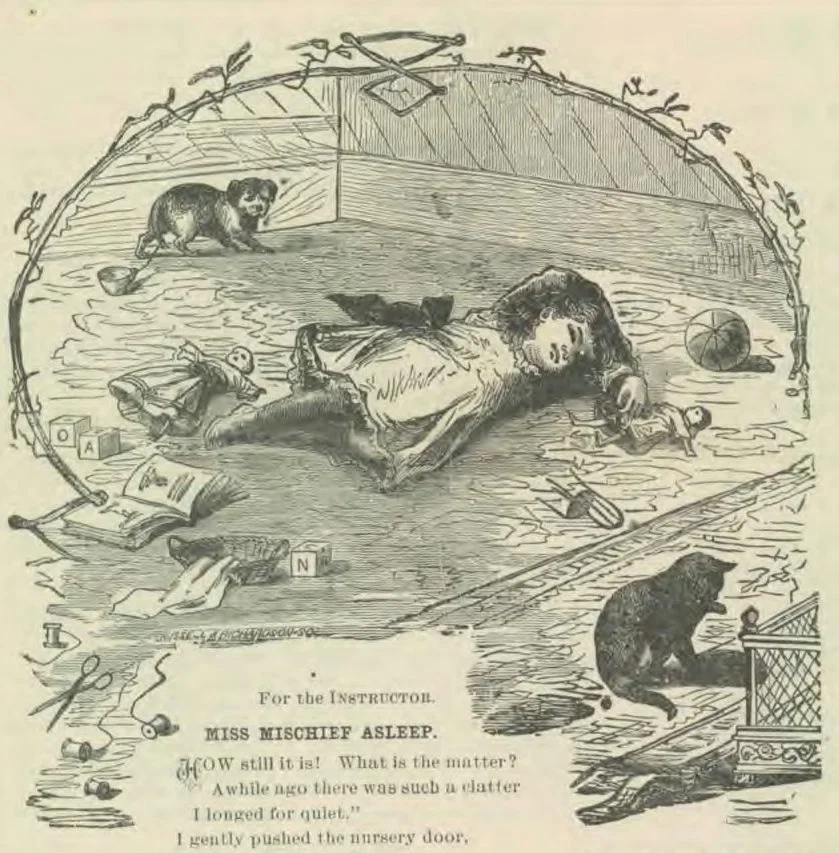
MISS MISCHIEF ASLEEP.

“How still it is! What is the matter? Awhile ago there was such a clatter I longed for quiet.”
I gently pushed the nursery door, And fast asleep upon the floor, Found Katie. ’Round her—riot!
On either hand her dollies lay, Balls, blocks, and books with pictures gay Scattered on every side; My work-basket had lent its store To deck the already well-strewn floor; My spools rolled far and wide.
Poor Fido whining came to me, That I his luckless tail might free From the tin cup it bore; While pussy, grateful for release, Her rumpled fur smoothed down in peace, And thought her troubles o’er.
Then gently, for I feared she’d waken, Miss Mischief to her crib was taken, And left in mother’s keeping. Yet as I wound my tangled thread, “How still it is!” again I said, “I’m glad she’s only sleeping.”
MISS MISCHIEF ASLEEP.

HOW DO WE KNOW?

For a long time I have been very much interested in the children's letters, because in almost all of them I read of the determination to do right, and by so doing to “gain at last a home in the new earth.” This is indeed good, and it is to be hoped that all who have such good desires may receive the reward promised to the overcomer.
We just picked up one of the INSTRUCTORS, and we read: “I love the INSTRUCTOR, and am going to try to meet its readers in the new earth.” Now we want to ask the children one or two questions. How do you know that there will be a “new earth,” and that you can all have a place in it? Are you sure that there is to be such a thing? We have looked in ever so many books written by good men, but they say nothing about such a wonder. We have asked some ministers about it, and they tell us that there won't be any real new earth, and when we die, our souls go off to live in a place that we do not know anything much about. When we asked our friend, he told us that the world would forever remain as it now is, filled with sin and death; and that when we die, that will be the end of us, for Jesus never will come to call us from the grave.
These things cannot all be true. Would it not be better, then, to give up, and say that this story of eternal life is not so?—No, never. Why not?—Because the Bible says it is true. But did you ever read such a thing in the Bible? This is what we want you to think of. If we could call the INSTRUCTOR family together, and ask the members to show us a text that said Jesus was coming again, how many could do it?
The Bible is the word of God, and in it God has told us a great deal about a “new earth” and the beautiful “city of God.” But you all know that the Bible is only a book, and cannot talk to us unless we open it and read it. Not only should we read it, but we must also study it; and when we have done this, we shall know these wonderful truths for ourselves, because the Bible has told us so. And may we be sure about it?—Yes, always; for God told holy men what to write in the Bible, and we know that he cannot lie. We know the Bible is true, because everything it ever promised has been given just at the time it said it should. We know it is true because it promised that Jesus would die that we might live; and he did die. So when the Bible tells us that Jesus will come, and that the earth shall be made new, we know that this is true too.
How we ought to love and study this wonderful Book! It is like a great gold mine with all the precious gems of truth buried far beneath the surface. We have to dig and search to find these truths, just as the miner does to find the gold. How many wonders there are in the Bible we never could tell you; but one is, it tells you just how to live that you may find that “new earth.” Were it not for the Bible, we should all lose our way, and not only for a little time, but for all eternity. A little Sabbath-school scholar has said: “There is everything in it, isn't there?” And it is true.
Just read it a little, and see what some of the wonders are. When you are all tired out, the Bible tells you how to go to Jesus and find rest. When you are sad, it tells you how to be happy. If you are sick, it tells you how to get well, and also that sometime you shall be well, never to get sick any more. If father and mother have been torn from you by death, that grand book shows you that you shall soon meet them again. When you are poor, and when your friends forsake you, the Bible tells you of “a friend that sticketh closer than a brother.” Are not these “pearls of great price” worth all the searching we can give? Who can afford to be without them? Could not all the children better afford to give up some of the time devoted to playing, and use it in studying how to make these things theirs? If you cannot read yourself, ask mother or sister to read for you. Then you can tell us that you know there will be a “new earth,” because the Bible has told you so, and that you know Jesus is coming, for he says so in the Bible. C. L. TAYLOR.

ROB'S OWN WAY.

“Mother,” said Rob, “can I have these pieces of paper to make a carpet for my express wagon?”
The mother was busy making a pudding for dinner, but she stopped to answer Rob's question. “No, my son,” she said, looking at what he held in his hands, “those are your brother Fred's sheets; don't you see he has printed one side of them in his press? No doubt he laid them out to dry; go and put them back just where you found them.”
Rob knew it would be of no use to discuss the matter, as mother's “no” never meant “yes;” but he was very cross about it.
“I never do have my own way,” he grumbled, going back to his play. “I just believe I'll have them anyhow; I won't hurt them.”
So, listening to the tempter, he laid the sheets in his wagon, and put Nimrod, his little dog, in for a ride. But Nimrod was very much opposed to riding in the express-wagon, and jumped out many times. Every time he jumped out, he got dusty; and every time Rob put him in, he soiled the papers.
Presently Rob got tired of trying to make Nim ride, and began to wonder what his mother would do about his disobedience. “I'll put the papers back now,” he said to himself.
But they were very dirty. “I must wash them,” said foolish little Rob; so he took his mother's clothes' brush and a mug of water and tried to scrub them. Alas! it only made them dirtier than before, and presently they melted into big holes. Now his sin had found him out.
Fred was angry, and mamma was distressed. “Bring me your purse, Rob,” she said gravely.
“O mamma,” cried the little boy, “I'm saving money to buy Nim a new collar.”
“Don't take his pennies, mother,” said good-natured Fred. “I don't mind.”
“When I do my own way instead of God's,” she said, counting out the pennies, “he makes me suffer to show me his way is best. Now, when Rob does his own way instead of mine, I must teach him as God teaches me. Here is the price of the spoiled papers, Fred; you and I are both sorry for Rob, but we can't save him from paying the penalty of doing wrong.”—Sunbeam.

Letter Budget.

The readers of the Budget will remember ELLA MANLEY, of Snohomish Co., Wash. Ter., to whom the Bible Lesson Books were sent some time ago. She writes again, and says: “Will you please permit me to write another letter, as I wish to thank the children for the nice Sabbath-school books I have received? I have received two books,—the first was No. 1, which I received about a year ago. The other was No. 3, and had the names Lillie and Alice written in it. It came a few days ago; but perhaps it was sent some time ago, as it had been missent. I am very thankful for the books; and now, with the Bible and these, mother says we can have Sabbath-school at our house this summer.”
FLOY E. WILLIAMSON, of Steele Co., Minn., writes: “I am a little girl eight years old. I have a pleasant home, a dear papa and mamma, and three loving sisters. My oldest sister is married and lives in Minneapolis. I went up to visit her last summer, and staid two weeks. I had a lovely time. There are many nice things to be seen in that large city. I do not keep the Sabbath, but Auntie Allen, who boards with us, keeps it. She is not my real auntie, but I call her so because I think so much of her. I went with her to Sabbath-school when Elda Schram and Gregory were here with the tent. I liked it very much, and would like to go again sometime. I go to Sunday-school in the M. E. church. I would like to see some of the little boys and girls who write for the INSTRUCTOR. Please print this so I can see it, I mean while Auntie Allen is here; for she lets me read her papers when she comes home from Sabbath-school. I don’t know just how long she will stay. I hope I may meet all the little readers in heaven if not on this earth. Pray for your little friend.”
ELLA MACALLAN sends some money to the African Mission, and at the same time a letter to the Budget. She says: “I have seen so many nice letters in the Budget I thought I would write one. I am a little girl eight years old, and I live in Montana. I have one brother and one sister, Judy and Lena are their names. There are no Sabbath-keepers here only our family, and papa does not keep it. I study Book No. 1 at home, and mamma is our teacher. I am trying to be a good girl and to help mamma do the work. I study in first reader at day school. My brother and I have four hens, and we are going to raise some chickens for the missionary work. Pray for my papa, so he may be saved. In my next letter I will write about the Indians out here. I can’t write very good, so mamma copies my letter for me. I want to live so I can meet the INSTRUCTOR family in the new earth.”
A letter from Webster Co., Neb., reads: “I am eleven years old. My name is ALICE MUFFORD. I have two brothers and one sister, and we all love to keep God’s commandments. My brother Jesse is nine years old, but he is as large as I am. He wants you to print this letter in partnership for us, as there are no letters written from this part of the country. At day school I read in second reader, and at Sabbath-school study in Book No. 1. I get my lessons good, and learn a verse to repeat besides. At the Christmas meeting here, I put my money into the foreign mission, so some poor boy or girl might learn the truth and gain a home in heaven. We want to be good boys and meet you all there.”
HELEN C. ENNEY, of Steele Co., Minn., writes: “I am a little girl thirteen years old. I live in town with my cousin, and go to school here; but my mother lives in the country. My papa died about two years ago. I have one brother. I study Book No. 2 at Sabbath-school. The Lord has been very good to his people here. Though none have accepted the truth the last year, they have hope, and are determined to live nearer to the Saviour in the year before us. I read the INSTRUCTOR and like it much. As I read the Budget, I often wish I could get acquainted with some of the girls; but if we don’t meet here, I hope we will meet where we may enjoy each other’s company forever.”

You have reached the end of this edition.

The Youth’s Instructor · Jun 6, 1888