The Youth’s Instructor, Vol. 36, No. 23.

CLOVER AND GRASSES

The Youth’s Instructor

Jun 6, 1888

S. D. A. Publishing Association · Battle Creek, Mich. · Jun 6, 1888

CLOVER AND GRASSES.
I WILL search the world for the flower That haunteth my dreams, white and stilly, I will gather the Master a lily To add to his beauty and power."
But the poor flowers of my finding Were clover and grasses:—"But these Cannot fill the great Master's needs!" I cried, hot tears my eyes blinding. I dropped the tall grass and the clover— "I will find for the Master a lily, Though the pathway be rugged and hilly. I will search for the flower the world over."
But vain all my tears and complaining; No lily spire gladdens my sight; "Now near to me draweth the night!" I said, my weak fears still retaining.
But the birds sang: "The clover and grasses Are meet for thy small hands to weave In a garland all fragrant, to leave At His feet, if perchance the Lord passes."
So day after day I am twining My wreaths of sweet clover and grass, To give if the Master should pass This way, in His robes white and shining. —Margaret Lippincott.

ARAB BOYS.

“Papa, write about boys.” So pleaded my little laddie one day not long ago, and here is what I can say about some of the boys I have seen in Egypt, Arabia, and Palestine. The Egyptian boys are as bright, sharp, and enterprising as can be found anywhere. The afternoon that I landed at Alexandria, a crowd of donkey boys met me at the dock, and each made frantic efforts to get me to take his donkey. They called them Grant, Mark Twain, Bill Tweed, Lincoln, Blaine, Logan, and other such names to attract the traveling American. They caught me by the hands and coat tails, and fairly forced me onto a donkey. When I finally made my exit from the crowd, there went up a frantic cry from the young fellows I passed by. They prophesied that all manner of evil would overtake me for using that particular donkey.
The favored boy pattered along behind his patient little beast, urging him to greater speed with queer cries and punches with a sharp stick, scolding him all the time. We were soon on the best of terms. That boy helped eat my lunch, showed me the sights of Alexandria like a good fellow, and then cursed me and my grandfather to the lowest depths because I would not pay his exorbitant overcharges. Still I bear him no ill will. He was the product of the time and place, and was as much a curiosity in his way as Cleopatra’s needle or Pompey’s pillar. He dressed like his father, and was a full-fledged man in all except stature. He wore baggy trousers, a short monkey jacket of a coat, a red fez cap on his head, and a brilliant colored scarf wound round his waist for a belt. He was a Mohammedan, of course, and said his prayers wherever he was six times a day. He was faithful to few; a liar, oh, what a liar! and he was so cruel to his poor little donkey that it made my heart ache sometimes. But, after all, he had only learned well and improved on the lessons taught him by his elders and parents.
At Cairo another sort of Arab boy made his appearance at the carriage as I started from the hotel to go to the pyramids. He had the universal red fez on his head, but was otherwise clothed with sandals and a big sheet, gathered with a rope around his waist. He ran ahead of the carriage, carrying a stick, with which he dealt blows right and left, all the while shouting: “Make room for the howadji! His excellency cometh! Room for the rich American! Bow the knee!” Thus he cleaved the narrow way. He came without being asked or needed, his only hope of reward being such cold victuals as were left from lunch and such backsheesh as I chose to give him.
Arab boys’ parents are usually very poor, and an American boy would not think they had any fun at all; but they do have plenty of it. They have a game they play with bright stones, or almond nuts when they can get them, just like hully-gully. They play tag just as you do. They play ball much the same as old-fashioned town ball. Their balls and bats do not cost any money, nor does anything else they play with. I doubt if the average Arab boy has twenty-five cents a year that he can invest in playthings. Like “Little Miss Muffet,” he lives on curds and whey. With a bright, cheerful disposition, he makes the most of his hard life, and grows up to be a self-reliant, resourceful man, one who, when he has half a chance, makes his way in the world, and is a credit to the country in which he lives; for, faulty as he is, it would be worse without him.
Up the Nile the boys are very poor, and they have hard times. If it were not that the sun is warm, and they have plenty to eat, their life would be a burden to them. They have to watch the flocks of goats and sheep, stone the birds off the growing grain fields, fetch and carry till their poor little backs must ache. They have hardly any clothes; no shoes, no books, no playthings, no nice home—and their father beats them as he would a dog.
As for the Arab boy in Palestine, he has on the whole rather a better time of it, thanks to the English and French soldiers and the Bibles of the missionaries. There are numerous schools in Palestine, and their influence reaches the boys. Many of the boys can read and write, and the printing-presses in Beirut furnish them with books, picture-papers, and Sunday-school songs, all in their own tongue. One of the most delightful men I ever met is there, devoting his grand talents to the good of the boys. Dr. Jessup is his name, and I’ve seen the boys in Beirut follow him about the streets; they love him so.
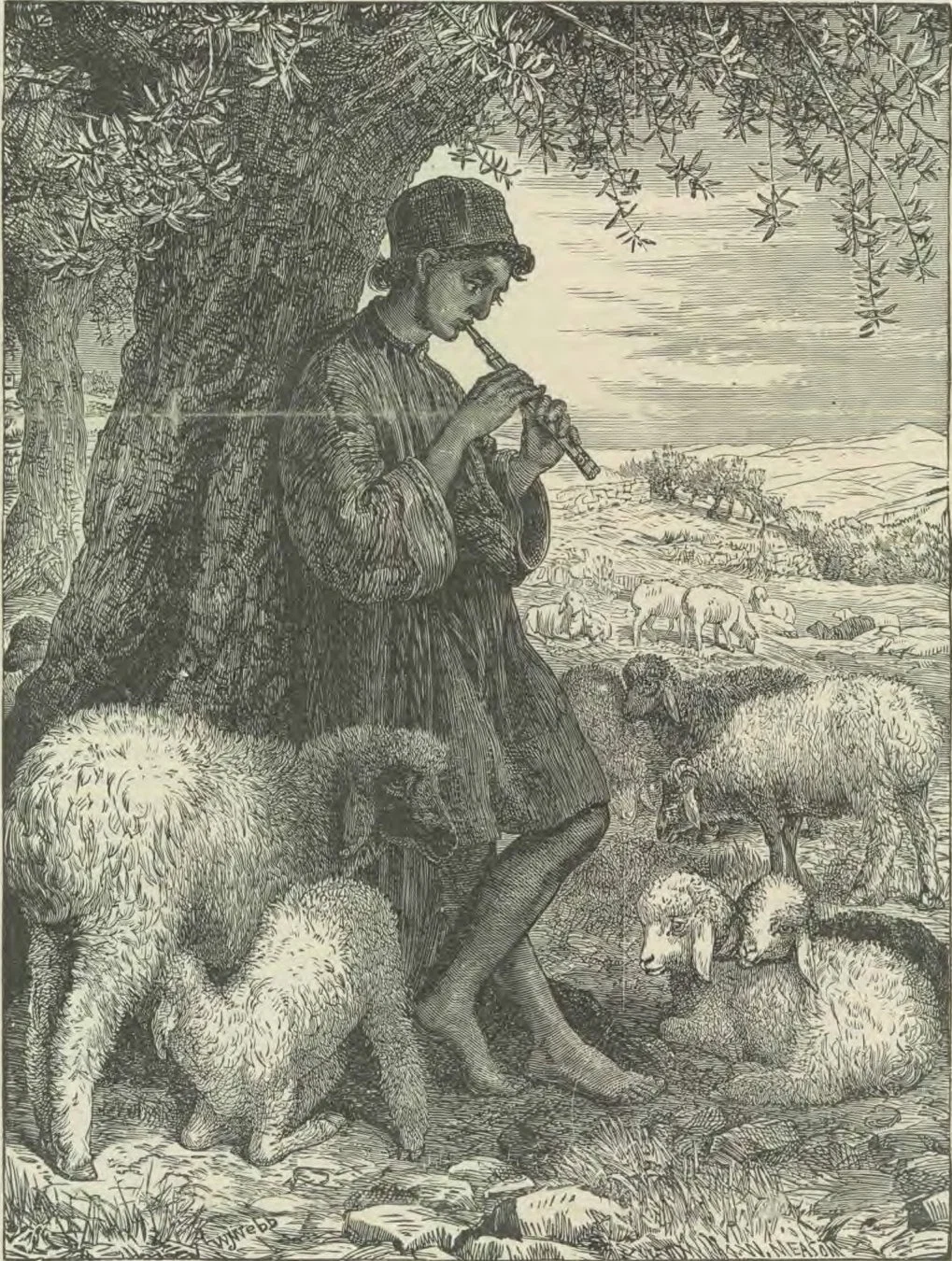
Coming down Mt. Lebanon one night, I could hardly believe my ears as from out the darkness I heard, with a clear, melodious note, some one whistling “In the sweet bye-and-bye.” I soon found it was an Arab boy, guarding a sheep-fold. His father and mother and he had all been to school in Beirut, and there, way up on that sacred old mountain, they had a happy Christian home! If any one ever asks you what good the missionaries do, you can tell them that for one thing they make a boy’s life happier, make a better man of him, and raise him from the low level of little better than a brute to be respected and loved. They make his home a home indeed, where he has kisses instead of curses, and, best of all, a father’s and a mother’s love.—Stanley Du Bois, in the Interior.

A TELEGRAM FROM HEAVEN.

There was a young man once employed in a telegraph office in England. In some way or other God had led him to see that he was a sinner, and this caused him great distress of mind. He could not tell where to find the Good Shepherd, or how to get back to his fold. But Providence took a singular way to find him and bring him back.
The young man went to his office one morning in great distress of mind from the burden of his sins. He was lifting up his heart in secret, saying: “God, be merciful to me a sinner,” when the click of the telegraph machine before him told him that a message was coming. He looked and saw that it came from Windermere, up among the beautiful lakes of England. There was first the name and residence of the person to whom the telegram was sent, and then followed these words from the Bible: “Behold the Lamb of God that taketh away the sins of the world;” “in whom we have redemption through his blood, the forgiveness of sins according to the riches of his grace.” And then followed the name of the person sending it.
This was a strange message to send by telegraph. The explanation of it was this: The telegram was sent to a servant-girl living in that town. She was in distress of mind about her sins, and trying to find Jesus. She had a brother who was a Christian; he was a servant in the family of a gentleman who was spending the summer at the Lakes. This poor girl had written to her brother, telling the trouble she was in, and asking him the great question, “What must I do to be saved?” Her brother had no time to write to her just then, so he sent this telegram, The poor girl found the way to Jesus through those words from her brother. And so did that young man in the telegraph office. This was a telegram from heaven to him. Those precious words, “Lamb of God,” “sin taken away,” “redemption through his grace,” brought him to Jesus, and he found peace in him. The Good Shepherd made use of the telegraph wire to bring one of his lost sheep to himself.—Sel.

BEAUTIFUL WITHIN.

“O MOTHER, what a sweet face that lady has! I never saw a lovelier. Who is she?” cries Alice Hart, as the door closed on some callers.
“It is Mrs. Taylor, one of my school-girl friends,” answers Mrs. Hart. “I thought I had told you about her.”
“She has such charming manners!” continues Alice, enthusiastically, “and such a sweet smile, and such kind eyes and musical voice, and she is so winning in every way. Don’t you think so, mother?”
“Indeed I do, my child. I am glad you like her looks,” says Mrs. Hart, looking into the eager face of her daughter, as Alice goes on:—
“How well her dresses suit her too! so soft and subdued and so very becoming. Is she as nice as she looks, mother?”
“She is just as nice as she looks; yes, and even better,” replies Mrs. Hart.
“Do tell me about her, mother. Tell me now,” asks Alice, earnestly.
“I knew her,” replies Mrs. Hart, “a long time ago when we were both school-girls. I have known her long and loved her well”—
“I wish I could have seen her when she was a girl,” interrupts Alice. “She must have been a perfect beauty.”
“Oh, no,” says Mrs. Hart, soberly, “not a perfect beauty. I will show you her picture taken when she was fifteen. It is in the drawer of my chamber closet; run and get it, dear.”
Alice goes quietly and eagerly for the picture, and as she returns, she says, “O mamma! you must have made a funny mistake. There is only this horrid daguerreotype of the crossest, coarsest girl I ever saw. Just see her! I’d be ashamed to have a picture like that. See, her forehead is all in a scowl, and her eyes look daggers at you. Her mouth is one great pout. I never saw so dreadful a picture! Whose is it?”
“It is the picture of a school-mate of mine. The artist took it one day when she did not know it, but it is a faithful likeness.”
“Do look, mamma,” says Alice, interrupting, “her dress is every which way, and the buttons are half-off! Why did you keep such a picture? How did you get it?”
“The girl gave it to me herself, several years ago,” replies Mrs. Hart.
“But who is it, mamma?” insists Alice.
“It is that beautiful Mrs. Taylor who just called,” answers Mrs. Hart.
“Mrs. Taylor!” cries Alice, incredulously; “are you sure, mother?”
“I am sure, Alice.”
“But it doesn’t look a bit like her,” says Alice, wonderingly.
“It isn’t like her now,” replies Mrs. Hart, looking thoughtfully at the queer old picture.
“But how did she grow so beautiful, mamma?” inquires Alice.
“From within, my child,” says the mother, tenderly. “She saw this picture. Hearing some of her school-mates say it was a perfect likeness, she was astonished and ashamed. She declared she would never go to school again, or anywhere else if she looked like that, and if she were ‘such a fright and slattern and cross-patch,’ as some of the girls had said. She even made herself sick with anger and crying. Her teacher went to see her and tried to coax her back to school, but could not succeed.”
“‘It is a bad picture,’ said the teacher, ‘but I can tell you how to make it better.’”
“The poor girl listened eagerly as the teacher gently yet faithfully showed her that the source of all her ugliness was from within. Soon she saw her own sinful heart, and asked the Saviour to make it pure and white. He heard her prayer. By and by, ere she herself knew it, a new light came into her eyes, and a sweet smile took the place of the scowl and the pout. The new love suffusing her shone out in her whole manner. Her very tone was changed, so that the loud, harsh voice became soft and agreeable. But she was so full of the new joy inside she did not know of the outward change. She did not know that, having grown beautiful within, this new beauty was manifest in every feature. In a month or so she went back to school. So great was the transformation that her school-mates, who knew nothing of the change, read its reflection in her joy-bearing face. At first sight of her, one of them stepped back, saying,—
“‘Louie! what is the matter? What has made this difference?’”
“‘I have a great joy in my heart,’ she answered; ‘but I did not think you could see it in my face.’”
“‘But we could; and day after day she grew more and more lovely. The ugly face had been made so by its expression, and, as the weeks and months passed, as kind looks and sweet thoughts were stamped on the face, the ugliness vanished altogether. Now every one exclaims, as you did, “How lovely!”’”
“Truly, if the King’s daughter is all beautiful within, some of the beauty will creep out, and none of us need be ugly.”—The Well-Spring.

A NOBLE EXAMPLE.

It is encouraging to read of those noble examples of fidelity to the principles of truth and righteousness which we occasionally find in the annals of ancient and modern history; especially so when we learn of youth, who, surrounded by unfavorable circumstances, struggle manfully on, overcoming poverty, opposition, temptation, and hardships, and pressing to the front, with a faith undimmed, and courage undaunted.
I recently read an account of a youth whose mother, on her death-bed, placed in his hand a leaf from the Bible on which was printed the third chapter of Proverbs. It was her dying request that he should make the lessons of that chapter his guide through life. Soon he was left an orphan, without relatives, and not more than twenty dollars in money, the savings of little sums she had from time to time given him.
He started from his native town to seek a livelihood in that great metropolis of America, New York City. But although alone in the world, he felt that he was not alone, for the eye of God was upon him, and many were the tokens of divine care and protection. Through all his early trials he made the commandments of God his rule of action. Often was he placed in positions of trust and responsibility; where his course had a mighty influence upon the lives of others; and many, even rich employers, learned by his holy conversation and his unswerving integrity to principle and duty, to turn their feet into the narrow, upward way.
At one time a wealthy merchant for whom he was working, ordered Henry—for this was his name—to make out some bills and write a number of letters on the Sabbath-day. This the young man could not do, and in consequence received a dismissal. His manner was so Christ-like, his reasons for disobeying this order were given in such a firm, yet humble way, that his employer was deeply moved. Before the morning arrived on which Henry was told to call for the balance due him for work, the merchant had not only resolved to take him back, but had himself given his heart to God. What a noble example! He had put his trust in the God of heaven, his mother's God. He loved him and feared to disobey. In every hour of temptation, and of trial, he still looked up and struggled on, undefiled in the heart and honored in life. God was with him. His friends multiplied, and their attachment grew stronger, and the end of his life was one of blessedness and peace.
Thus we have the assurance to believe it will be with all who choose Israel's God for their guide. “Trust in the Lord with all thine heart; and lean not unto thine own understanding. In all thy ways acknowledge him, and he shall direct thy paths.”
J. M. HOPKINS.

KEEP IT BACK.

KEEP back that ugly frown, my dear, A smile will better grace The dimpled cheeks, and eyes of blue, And rosy lips, that make for you A bonny little face. Just try it on, and you will see How much the sweeter it will be.
Hold fast that angry word, my boy. Hold fast—you surely know That nothing, nothing you can do Will ever bring it back to you When once you let it go. A pleasant word will do as well; Just try it, and you soon can tell. —Sydney Bayne.

FILIAL HONOR.

Young people sometimes know so very much more than their elders! at least, according to their own estimate of their knowledge. They pride themselves on advanced methods of thought, and freedom from “old fogy notions,” but possibly they will find, on reaching middle age, that years do bring their own peculiar teachings, which youth is not yet capable of receiving. Said an overworked mother once, in a moment of bitterness:—
“I’m afraid I don’t enjoy my children as much as I did when they were little. Then they were merely clinging, affectionate creatures; they never judged what I did, or doubted that I was the most remarkable woman in the world. Now they seem so much wiser than I, that it appears to be natural for them to find fault with me.
“Nothing I do is considered very praiseworthy. In fact, I am almost always in the wrong. If I try to join in their conversation, they evidently think ‘mother’s opinions aren’t worth much; she hasn’t had the latest advantages.’
“It’s true I haven’t. I’ve been too busy to become a very cultivated woman, but it seems to me affection, taken by itself, ought to count for something in this world.”
Yet her children did love her; they only omitted to “honor” her in daily life. The next day after her death her son stood beside her coffin, looking at the worn, placid face, and said, through his tears,—
“I never could understand why mother wasn’t happier. She had every comfort in her later years, but she always looked worn and discouraged.”
Had he been of clearer vision, he need not have sought far for the reason. It is usually our own warmth or lack of tenderness which makes the faces about us bright or gloomy—a truth to be remembered before it is forever too late.—Companion.

SATISFIED

WERE you ever satisfied? Did you ever have enough of everything, so that you did not want anything more? Perhaps you have been satisfied with your food, but wanted some new clothes. Perhaps you had all the clothes you wanted, but you were not well. Perhaps you were well, but some dear friend was gone—had died—and you were sorrowful. We think you were never yet satisfied in all things.
To be satisfied is to have all things just right; to have them as God would have them. The worldly-minded person is never satisfied with the things of this world, for where death is, no one can be satisfied. And the Christian, who has great joy in the Lord, can certainly not be satisfied in this world; if he could be, then he need not seek the “world to come.”
In the heavenly home, the “new earth,” people will be satisfied. There will be nothing there to cause sorrow or dissatisfaction. Eternal life, joy, peace, righteousness,—these are some of the things that will satisfy. No death nor sinning there! What a blessed home! The Psalmist wrote, “I shall be satisfied when I awake with thy likeness.” Psalms 17:15.—The Young Pilgrim.

THE TEACHER'S OTHER WORK THAN TEACHING.

THAT teacher who does not become personally acquainted with his pupils, who neglects to learn all he can concerning their home life, their character, and their disposition, has failed in one important part of the work of preparation.
The question may be asked, Why has he failed? If he learns his lesson thoroughly, and knows how to teach it, is not that all he needs to do?
Whoever speaks in this way certainly does not understand the relation that the teacher bears to the students. Let us notice this relation for a moment. For what purpose is the pupil placed in the Sabbath-school class? It is that he may be instructed in Bible knowledge, that he may receive mental discipline and culture in morals and manners, and that he may be strengthened and awakened spiritually. The student is placed under the care of the teacher for him to direct into better paths, and to guide to a purer life; to seek to strengthen the weak points of his character, to remove his bad traits, and to encourage self-improvement in every direction. How can the teacher do this when he is not thoroughly acquainted with his students?
Here is a boy in some class in our Sabbath-school. His lessons are poorly learned, and his deportment is bad. Some time ago he entered the school. He came from a home where the parents profess to be Christians, but are more of the world than of Christ. The boy received no encouragement at home to study, but rather discouragement. As might be expected, he entered the class without a lesson. The teacher made excuse for him, and treated him kindly, hoping he would have his lesson next time. The next Sabbath came, and the boy had no lesson. He had little inclination to learn it, had obtained no help from his teacher during the week, and had received no encouragement at home. The teacher rebuked him mildly for not learning it, and gave attention to the others of the class. The boy, neglected, became restless, and did something which annoyed the teacher, and brought upon him some cutting words. Each succeeding Sabbath he took less interest, and behaved worse than before, and the teacher became more disheartened, not knowing what to do.
I now ask, Who was most to blame for this state of affairs, the teacher or the boy? and am free to say that the teacher is the one who should receive the censure. It is true that the boy should have learned his lesson and behaved better in his class. But is there nothing that the teacher ought to have done? If the boy had been visited at his home the first or second week, while he still had respect for his teacher, and had there been talked to kindly, and, if need be, helped to learn his lesson, how different his course might have been. Instead of a soured, unruly boy, the teacher might have had a faithful, obedient student. But this is only one case out of many that might be given.
There are very many things that the teacher needs to know about his students that he will not be able to find out during class recitation. Has the pupil a good home and godly parents? What are his surroundings where he daily works? Who are his associates? and what is their influence? How does he spend his spare moments? Is he truthful? Has he any bad habits which do not show themselves particularly in the Sabbath-school? What are his peculiar tastes? and what is his ambition? To find out all these and many other things concerning a scholar, the teacher must see the pupil alone, he must be acquainted with his parents, and know something about his associates. He must take pains to learn in every way possible all about his pupil; for unless he fully knows the mind he is laboring for, how can he be able to adapt the lesson to its particular wants? Here is one pupil untruthful, another negligent, a third misused at home, a fourth disobedient to his parents, in fact, every one with some peculiar trait. If the teacher only knows all this, how much better he may adjust his teaching to his pupil's needs.
Yet there are many teachers who neglect all this work of which I am speaking. They think their task done when the lesson is learned and taught. They forget the worth of the precious charge placed under their care. “But,” says one, “I have not the time to do the work in this way; my time is too valuable.” Do you have time to visit about worldly affairs? Are you seeking the treasures of this earth? Better is it to lay up for yourselves treasures in heaven. “As often as ye have done it unto one of the least of these, my brethren, ye have done it unto me,” said Christ.
In the affairs of the world we can spend time and take the greatest pains. When the diamond cutter receives a precious stone in the rough, how carefully he studies it, scanning its every flaw and seam and noticing its perfect points. He will know all about it before he begins the process of making it a precious gem; he takes plenty of time. Then with what care he cuts and polishes it! Yet of how little value is the most precious gem when compared with the human mind. If you would polish and refine minds, become master workmen; for God will hold you accountable for what he places under your care.
Another says that he has no inclination to visit his pupils, and does not know how to do that kind of Sabbath-school work. And the very reason for this may be that he has never done any of it. How is it with the teachers in your school? Ask yourself, if you are one. Ask the superintendent. I venture to say that the teachers among us fail as much in this kind of preparation as in any other. They fail to know the pupil they are teaching because they have not studied him. And they fail to teach him properly because they do not know him.
The subject has been noticed so far only as the cause of the pupil and the school seemed to demand it. But let us go still farther. The teacher needs to do this kind of work for his own benefit, if for no other reason. It is the best kind of missionary work. And if any teacher finds that he has no love for it, he may be sure that he is not prepared for his work, nor for any other missionary work in the cause of God. It is work well adapted to strengthen the young disciple of Christ. Many workers in our Sabbath-schools seem anxious that the Lord should call them to fill some position in his cause among the missionary laborers in the field, and yet many of these very ones are careless in regard to their little flock. How can God give them charge of a larger one? When we are ready, God will furnish more work, and we will only be ready for more when we have faithfully performed that already given us.
E. B. MILLER.

PREREQUISITES FOR A SUCCESSFUL RECITATION.

MEMORY is exercised either for the retention of knowledge, or for its recollection. The retentive function of the memory must precede the recollective, and the success of the latter depends upon two conditions; viz., the manner and completeness of the first, and the recurrence of circumstances or incidents similar in character to those that occurred while the retentive exercise was in process. It is possible for one to so thoroughly memorize a lesson or composition that the same can be reproduced at any time by mere force of will power; but as a rule, the successful recitation of Sabbath-school lessons, as indeed of all lessons, is dependent upon a series of suggestive questions from the teacher. These questions serve as so many signals or notifications to the memory, causing it to reproduce what it has previously stored up pertaining to the point involved in the question. These questions may be likened to the act of one who lights a fuse leading to the blast that has been placed in the rock. If no blast has been placed in the rock, the lighting of the fuse avails nothing. Just so in the asking of questions during the recitation of a lesson. If the memory has had no primary retentive exercise upon the point called for by the question, it has nothing to reproduce. Or it may occur that the primary exercise was but a feeble, partial effort, or made under unfavorable conditions; the result is that the impression upon the memory is only dimly made, and the secondary, or recollective, exercise will be correspondingly dim, and the reply to the question meager and unsatisfactory.
There is, however, one cause for imperfect replies that should be stated, in order to avoid misapprehension: A good command of language is not always present even when deep, lasting, and intelligent impressions have been made upon the memory. Many people thoroughly know and remember many things that they are not able to express intelligently because they have little or no command of language.
The rule may be stated as well-nigh universal, that in the acquirement of knowledge, it is all-important that first impressions be clearly defined, well comprehended, and deeply made. By first impressions is meant those that are received during the retentive exercise of the memory. If a tack be slightly pressed into a board, it may be displaced by a trivial accident; but if, after it has been thus slightly impressed, it be struck with a hammer and driven in its entire length, it will remain, and cannot be removed without considerable effort. This illustrates the reception of ideas by the memory. If the ideas be only slightly impressed upon memory's tablets, they are subject to displacement by very slight causes; but if they be driven deeply, they are not easily withdrawn, and remain ready for service or reproduction at all times.
Ideas may be deeply impressed upon the memory by at least three methods; viz., (1) The power of attention; (2) extended repetition; (3) the contemporaneous occurrence of striking or peculiar circumstances. Nothing, however, can compare in value to the power of attention as a condition of the mind which should exist in order that lasting impressions may be made. The third method mentioned may be equally as effectual, but as it does not require the voluntary exercise of the power of attention, is not as valuable.
There is still another important principle that governs in the acquirement of knowledge. It is this: The larger the number of avenues or lines along which or by way of which a lesson is considered, and the more numerous, decided, attractive, and impressive the pertinent incidents and circumstances attending such consideration of a lesson, the more completely will that lesson be learned. If the incidents are only slightly impressive, or such as to call into exercise only a very limited number of one's faculties, the chances are that the retentive function of the memory will be but feebly exercised, and consequently the lesson only slightly learned. If the retentive function be thus feebly exercised, the recollective function will be still less so. But every time the former is brought into active exercise, the broader and deeper become the results.
The foregoing principles can be utilized in Sabbath-school work in many ways. Senior pupils can readily appropriate and utilize them in the preparation of their lessons, and the youth and children can do so, though less extensively, if aided by their teachers and parents.
All Sabbath-school teachers who are worthy of the name, desire good recitations from their classes. But a good recitation, as previously shown, is largely dependent upon the recollective function of the memory, and this in turn is chiefly dependent upon the primary exercise of the memory retentively. Hence, it is not only within the teacher's province, but it is his duty to secure to his pupils the best possible methods and conditions of home study. But this requires that teachers be thoroughly conversant with the lesson at least one week previous to the time of its recitation. That teachers should be thus familiar with the succeeding lesson is susceptible of the clearest demonstration by considerations other than the necessity of being competent to give directions for the study of that lesson. A few may be named: 1. There are very few lessons that are not in some way related to the succeeding lesson, and teachers should understand that relation in order to properly conduct a recitation of the lesson in hand. 2. If teachers do not begin the study of the succeeding lesson until the pupils commence the same, they have no advantage over them in this respect. 3. Teachers cannot secure and retain that degree of confidence from their pupils that they should have, unless they are actually in advance of them in the work. 4. Pupils have a right to look up to their teachers as leaders; but what right has a teacher to be considered a leader who is not in advance of his pupils? 5. In our public schools a person will not be tolerated as a teacher who is not perfectly familiar with the succeeding lessons of his classes, and not only one succeeding lesson, but many. Are not Sabbath-school lessons as important and valuable as secular school lessons? Why suffer the standard of qualifications for Sabbath-school teachers to be so much lower than it need be?
If the teacher is well informed upon the succeeding lesson, he is prepared to assign the same intelligently, and give his pupils valuable suggestions regarding its study and preparation. If the successful recitation of a lesson is worth having, it is worth providing for.
We offer a few suggestions concerning the manner of providing for a successful recitation:—
1. Request all members of the class to prepare and bring to the class a brief outline of the next lesson, containing a mention of the principal parts of the same, in proper order. If preferable, the pupils may simply be requested to give such outline from memory, omitting the written work; but written work is especially valuable, and is sure to lead to a higher grade of study.
2. If occasion is afforded by the lesson, let maps be drawn of the regions of country mentioned in the lesson, locating the places named, showing distances, etc.
3. If pertinent to the theme of the lesson, information may be compiled concerning the countries or places of the lesson.
4. The dates of events considered in the lesson, or periods of time passed over, may be arranged in a systematic manner.
5. A list of all the individuals mentioned in the lesson may be made, and in some cases further information concerning them than is given in the lesson may be called for. Such information may be sought for in works of reference.
6. A list of events mentioned in the lesson may be compiled.
7. As many additional and supplementary questions, pertinent to the theme of the lesson, may be prepared as is deemed judicious.
8. The doctrines inculcated by the lesson, or dwelt upon, may be called for.
9. The duties impressed or suggested by the different parts of the lesson will form an interesting and profitable topic to assign.
10. Practical applications to every-day life of the principles taught by the lesson.
Here is certainly a wide and varied field for the enterprising teacher to occupy in setting his pupils to work upon the lesson for next Sabbath. It will open before them something of the length, breadth, height, and depth of the succeeding lesson; and every pupil to whom a specialty has been thus assigned, will realize that a responsibility has been placed upon him which he cannot ignore without liability of being considered a “shirk.” But in order that a teacher may intelligently assign special features to the members of his class, as has been mentioned, it is evident that he must, at the time of doing so, have a complete understanding of the lesson. It does not seem as though any can dispute that the prospective gain abundantly warrants the early and thorough study necessary to be competent to assign work as suggested. Teachers as well as pupils will be large gainers by so doing.
All should be required to learn the lesson according to the requirements of the questions, as thoroughly as is in their power, regardless of any special features that may be assigned. In assigning special topics, if any, regard should be had for the age, capacity, and opportunities of the pupils. In some cases, only one special topic should be assigned to a pupil, while in others, several may be assigned. By this means a strong incentive will be supplied for the pupils to begin early in the week to prepare their lessons, and to continue such study during the week. By assigning special topics as suggested, the demand is quite imperative for written work, and this of itself is an invaluable consideration. If pupils can be induced to employ this means largely in the preparation of their lessons, the results will be highly advantageous.
Teachers who are anxious for the best good of their pupils, and to secure successful and satisfactory, recitations, will certainly show that anxiety by embracing such opportunities as exist for the promotion of those ends. It is believed that the foregoing suggestions are feasible, and if acted upon, will accomplish much good. A trial, at least, will do no harm. The writer speaks from personal experience, and can confidently recommend the methods given. G. W. MOORE.

UNCONSCIOUS ELEMENT IN TEACHING.

No greater mistake, says the Baptist Teacher, can be made than to measure the probable success of a teacher solely by an intellectual standard. There is a sacrificial element in real teaching, which is the very soil in which all the rest must grow. Truth never can be imparted with the highest success unless one learns, like Jesus Christ, honestly and really to “give himself.” It is important that a man should know what he teaches. He may talk about the love of Christ, his humility and self-sacrifice, and it may be like talking about the fragrance of the orange-blossom. What the scholar needs is to have that fragrance done up in a bundle—personified. The man must be love; he must be self-sacrifice; he must be humility.
This explains the success of many an untutored teacher, and the failure of many a learned one. The first has been on the mountain-top, and, coming down, he is like Moses “when his face shone, and he knew it not.” That which we chiefly impart, in our intercourse with others, is not what we say, but what we are. And this is a thought which may carry hope to many a discouraged superintendent or pastor, when he sees the comparative intellectual inability of the average teacher. These people are teaching better than they know. They are able to read the lines and not much more perhaps, judged by a distinctively critical standard, but all this time the children are reading between the lines. If the teacher is genuinely pure and devoted, the silent gospel, which goes all unuttered, will speak a thousand-fold more eloquently than that which is expressed. It always does. That which has caused the work of our divine Lord to mold the ages lies not so much in what he taught; rather may it be found in that single description of Paul: “Christ hath loved us, and hath given himself for us, an offering and a sacrifice to God, for a sweet-smelling savor.”
Continue reading: A PERIL