BECAUSE Mary S—— worked in Los Angeles, she took the short line cars from Pasadena every morning. She was used to having every kind of seat mate, so was not surprised one morning to have an elderly woman with gray hair take the seat beside her. She spoke to her when she sat down, and soon they were engaged in a pleasant conversation, which ended only when Mary left the car in Los Angeles. A few mornings later the woman boarded the car again at or near Oneonta, and again sat with Mary. The third time the lady was on the same car with Mary she told her that she had a daughter who was away at college, but was soon coming home.
“I am to have a party for her next Saturday, and I should so like to have you there,” said the lady. “We are to have a lot of Mabel’s friends, and I am sure you would enjoy them, and they would enjoy you. Do come and stay all night with us. Of course I am not in the habit of inviting strangers,” she added with a smile, “but I am sure I am making no mistake in inviting you. Do say you’ll come.”
“Oh,” said Mary, “I should be delighted to do so, but fear I cannot fit in to your crowd! I am only a working girl you see, and your girl is a college girl.”
“Oh, Mabel is a dear girl, and so sweet and common, and I am sure you would just suit Mabel. She is so particular about her friends! It is just an informal party to welcome her home. Do say you will come.”
So Mary promised to think of it and to ask her folks, and perhaps she would come. So that night Mary spoke again of the nice lady she had met on the cars, and of the pleasant conversation they had.
“And, O mamma! she wants me to come to the party she is going to have for her daughter. She says she knows I’ll just suit Mabel. She said I should go there right after office hours and stay all night. Do say I can go, mamma. She gave me her address, do you see?”
“Why, Mary, I guess you can go,” said the flattered mother, “you can take your dress with you and change after you get there.”
“Mary, I do not like the looks of it,” said Mr. S——. “It appears to me as if there is something about it not just right. I don’t believe you would better go. There are lots of traps set for girls these days. No, don’t go, Mary.”
Of course Mary was disappointed, and later she talked it over again with her mother, and they decided that Mary could go. Of course father spoke hastily and would decide with them if he just knew the lady!
On Saturday Mr. S—— went to his work as usual, but felt restless and uneasy. What was the matter? He thought of Mary, and at last went to the telephone.
“Hello, is this mother? Well, where is Mary? Oh, she has gone to the city? Was she going to stay for that party tonight? She was! Why I thought that was off! Well, I’m so uneasy I can’t work. I am coming home and going down to the city after her. Oh, yes, I know you thought it was all right, but I don’t, so I am going down! Good-by!”
Mr. S—— hastened home, and getting ready, he started for Los Angeles. Fortunately Mary had left the address of the woman with her mother. When Mr. S—— reached the city, he sought a policeman to direct him to the place. The policeman looked at the man and gave a low whistle of surprise.
“Whew! What do you want to go there for? That is one of the worst houses in the city.”
Mr. S——, now thoroughly alarmed, explained hastily how his daughter had been trapped and was doubtless at that place. The policeman looked serious and said:—
“Well, Mister, all I can say is, you would better get her out of there, and do it quick.”
Mr. S—— hastened to the place to which the policeman directed him, and upon reaching there demanded his daughter. After some parleying Mary was brought to her father, thoroughly frightened and very glad to be again restored to liberty. She said that when she had been in the house only a few minutes, she discovered that she had been trapped. She tried to gain her liberty, but was balked at every turn, and when Mr. S—— arrived was locked in a room. She was trying every way to find a way of escape, but could not find one, and but for the timely arrival of Mr. S—— would doubtless have been a victim of the white slave traffic.
This is a true story, written as a warning to other girls who work in Los Angeles or other large cities. It is vouched for by a neighbor of the writer.— Selected.
The “Going To” Family
By A. B. E.
“WILL you work on the yard tonight, John?” asked Mrs. Arnold of her husband as he stood by his bicycle in the back yard.
“No, not tonight, Mary, but I am going to get that done soon,” he replied, as he mounted and started to town.
The Arnold family had moved to their present location three weeks before. The landlord had the yard plowed, and said he would furnish the grass seed if Mr. Arnold would prepare the soil and sow the seed. It was early spring, and a good time to start a lawn, which would add much to the looks of the place and the comfort of the family.
Across the street the Goodmans had built a neat house, and had moved into it the same time the Arnolds had moved. Unlike Mr. Arnold, however, was Mr. Goodman; for instead of going to, he immediately seeded his yard, and gave it the best of care. In a few weeks there was a nice green growth, and fair prospects for a beautiful lawn.9
The weeks passed, and in spite of all the suggestions and entreaties of Mrs. Arnold, her husband had not done anything toward preparing the soil for the seed. He excused himself by saying he was “too tired,” or he “had to go to town,” where he usually spent his evenings. He was always “going to” tomorrow or next week. The time for him to perform that task was ever in the future.
Thus the summer passed, and the leaves of autumn fell, and still the Arnold yard was as unsightly as ever. The neighbors across the street had a beautiful green lawn. Why the contrast? All because one firmly decided to “do,” and the other was “going to.”
Paul met one of the “Going To” family. He was summoned to speak before the governor and his wife. “As he reasoned of righteousness, temperance, and judgment to come,” the governor trembled. Regardless of the striving of the Spirit, the convictions of his conscience, and his trembling body, Felix would not yield now to the Lord, but answered, “Go thy way for this time; when I have a convenient season, I will call for thee.” There is no record that a more “convenient season” came to Felix. At the time when Paul reasoned with him, his heart was somewhat tender; for he commanded a centurion to keep Paul, and to let him have liberty, and that he should forbid none of his acquaintances to minister or come to him. By his not yielding to the Lord then, his heart was hardened; we read that “after two years Porcius Festus came into Felix’s room: and Felix, willing to show the Jews a pleasure, left Paul bound.”
Another illustration of the “Going To’s” is taken from life in India:—
* “I have come home from vainly trying to help another child. She had heard of the children’s Saviour, and I think she would have come to him, but they suffered her not. She was, when I first saw her, sweet and innocent, with eyes full of light—great, glancing, dancing eyes, which grew wistful for a moment sometimes, and then filled with a laugh again. She told me her mother lived very near, and asked me to come and see her; so I went.
“The mother startled me. Such a face, or such a want of a face. One was looking at what had once been a face, but was now a strange, spoiled thing, with strange, hard eyes, so unlike the child’s. There was no other feature fully shaped; it was one dreadful blank. She listened that day with almost eagerness. She understood so quickly, too, one felt she must have heard before. But she told us nothing about herself, and we only knew that there was something very wrong. Her surroundings told us that.
“Before we went again, we heard who she was—a relative of one of our most honored pastors. . . . This time the mother welcomed us, and told us how our words had brought back things she had heard when she was young. ‘But now it is all different, for I am different,’ and she told us her story. . . . ‘So I took poison, but it acted not as I intended. It only destroyed my face.’ . . . We besought her then and there to give up the life, and let us help her and that dear little one. She seemed moved. . . . Tears filled those hard eyes, and rolled down her cheeks as we pleaded with her. . . . At last she yielded, promised that if in one week’s time we would come again she would give the little girl up to us, and as for herself, she would think of it, and perhaps she also would give up the life. She hated it, she said.
“There was another girl there, a fair, quiet girl of fifteen. She was ill and suffering, and we tried to get her, too; but there seemed no hope. ‘Take the little one; you are not too late for her,’ the mother said, and we went with the promise, ‘One more week, and she is yours.’
“The week passed, and every day we prayed for that little one. Then when the time came, we went. Hope and fear alternated within us. One felt sick with dread lest something had happened to break the mother’s word, and yet we hoped. The house door was open. . . . The mother was there: in a corner, crouching in pain, was the girl; on the floor asleep, drugged, lay the child with her little arms stretched out. . . .
“The child stirred in her sleep and turned. ‘Will you go?’ said the mother very roughly in her ear. She opened listless, senseless eyes. She had no wish to go. ‘She wanted to come last week,’ we said. The mother hardened, and pushed the child, and rolled her over with her foot. She will not go now, she said. Oh, it did seem pitiful! One of those pitiful, pitiful things which never grow less pitiful because they are common everywhere. That little girl and this! . . .
“At last they asked us to go. The girl in the corner would not speak,—could not, perhaps,—she only moaned; we passed her and went out. The mother followed us. . . . ‘You will never see her again,’ she said, and she named the town, one of the Sodoms of this province, to which the child was soon to be sent.”—“Things as They Are,” pages 256-259.
You say, “How sad! Had the mother allowed the missionary to take the child when she first asked for her, perhaps she would have been converted and become a worker in the Lord’s service.” Yes, it is a dangerous thing not to grasp the present opportunity. The enemy gets his work in between times, and the second opportunity may not appeal to you with such force, or it may never come again.
There are many, even among the well-meaning young people, who are allowing procrastination to rob them of their God-given opportunities. They are permitting the characteristic manifest in Mr. Arnold’s experience to fasten its clutches upon them. It is preventing some from taking the Reading Course. They are “going to” take it next year. But like tomorrow, next year never comes; it is always in the future.
Every Missionary Volunteer should take the Reading Courses, not only to aid in reaching our goal, but for the benefit personally received. That old adage, “Where there’s a will, there’s a way,” will work out in the Reading Course. Those who have not enrolled to take one of the Reading Courses should quickly do so. It is late, but “better late than never.”
The story mentioned, of the mother and little child, is taken from one of the books of Senior Course No. 9. It is a book that contains something for the student, the teacher, the youth, the parent, the worker in the field, the “stay-at-homes,” and others. Most books deal largely with the successes, the bright side of foreign mission work, but “Things as They Are” gives also the reverses. Miss Carmichael seems to have at least partly lifted the curtain so as to give us a glimpse of what she had to contend with when snatching the “prey of the terrible” in caste-bound India.
The reading of the book will give you a hunger and thirst for benighted souls; it will deepen your sincerity; it will give you a prayerful spirit. The heart is10surely of stone that will not be touched and have its interest increased in missions by reading that book.
Be sure to read not only that book, but also “History of William Miller” and “History of the Sabbath.” Don’t give up until you have finished the course and secured your certificate, and then only give up to take the next course.
The books of the Junior Course are of equal interest. The first in the course, “Livingstone the Pathfinder,” will be of interest and help to every boy and girl. Besides being an interesting story, it is a book of information. By beholding we become changed, and the reading of this story will doubtless give the youth an inspiration to be used in the service of the Lord, and arouse in their hearts a determination to go “anywhere” in his service, “provided it be forward.” It will help them better to appreciate the pioneers of missions.
“Friends and Foes in Field and Forest” and “Sketches of Bible Child Life” are the other books of the Junior Course, and will surely meet with favor among the Juniors.
Do not longer delay, and be compelled to say, as was one girl, “I did not know what I was missing by not taking the Reading Course.” Order your books now, and inform your Missionary Volunteer secretary that you have left the “Going To’s” and have joined the “Doers.”
A. B. E.
The First Thanksgiving Day
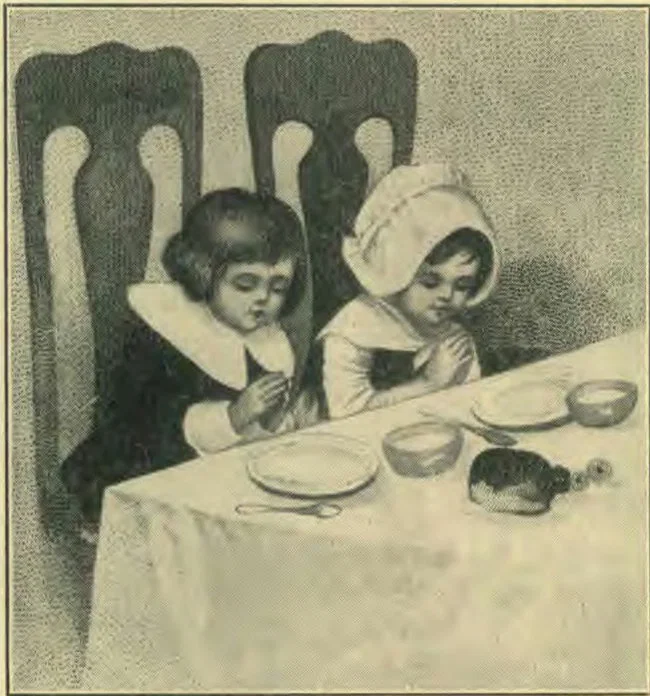
NEARLY three hundred years ago a great many of the people in England were very unhappy because their king would not let them serve God as they liked. The king said they must worship just as he did. Many who would not do this were thrown into prison, or perhaps driven away from home.
“For all thy gifts, so great, so good,
We thank thee, Lord!
For home and friends, for clothes and food,
We thank thee, Lord!
For work and play, for this dear day,
For church and Sabbath school alway,
For Jesus teaching us the way,
We thank thee, Lord!”
“Let us go away from this country,” said the unhappy Englishmen. So they left their homes, and went to Holland. It was about this time that they began to call themselves “Pilgrims.” Pilgrims, you know, are persons who are always traveling to find something they love, or to find a land where they can be happier; and these English men and women were journeying, they said, “from place to place, toward heaven, their dearest country.”
In Holland, the Pilgrims were quiet and happy for a while, yet they were very poor. When the children began to grow up, they were not like English children, but talked Dutch, like the little ones of Holland, and some grew naughty, and did not want to go to church any more.
“This will never do,” said the Pilgrim fathers and mothers; so after much talking and thinking and writing, they made up their minds to come to America. They hired two vessels, called the “Mayflower” and the “Speedwell,” to take them across the sea; but the “Speedwell” was not a strong ship, and the captain had to take her home again before she had gone very far.
The “Mayflower” went back, too. Part of the “Speedwell’s” passengers were given to her, and then she started alone across the great ocean.
There were one hundred persons on board—mothers and fathers, brothers and sisters. They were very crowded; it was cold and uncomfortable; the sea was rough, and pitched the “Mayflower” about, and they were two months sailing over the water.
At last the “Mayflower” came in sight of land; but if the children had been thinking of grass and flowers and birds, they must have been very much disappointed, for the month was cold November, and there was nothing to be seen but rocks and sand and hard, bare ground.
Some of the Pilgrim fathers, with brave Capt. Miles Standish at their head, went on shore to see if they could find any houses or white people. But they saw only some wild Indians, who ran away from them, some Indian huts, and some corn buried in holes in the ground. Later they made other excursions into the near-by country, till by and by they found a pretty place to live, where there were “fields and little running brooks.”
Then at last all the tired Pilgrims landed from the ship on a spot now called Plymouth Rock, and the first house was begun on Christmas Day. But when I tell you how sick they were, and how much they suffered that first winter, you will be very sorry for them. The weather was cold, the snow fell fast and thick, the wind was icy, and the Pilgrim fathers had no one to help them cut down the trees and build their church and their houses.
The Pilgrim mothers helped all they could; but they were tired with the long journey, and cold, and hungry, too, for no one had the right kind of food to eat, nor even enough of it.
First one of the little company was taken sick, and then another, until half of them were in bed at the same time. Brave Miles Standish and the other soldiers nursed them as well as they knew how; but before spring half of the people died.
But by and by the sun shone more brightly, the snow melted, the leaves began to grow, and sweet spring had come again.
Some friendly Indians had visited the Pilgrims during the winter, and Captain Standish, with several of his men, had returned the visit. One of the kind Indians was called Squanto, and he came to stay with the Pilgrims, and showed them how to plant their corn and their peas and wheat and barley.
When it was autumn, the fathers gathered the barley and wheat and corn that they had planted, and found that it had grown so well that they would have enough for the long winter that was coming.
“Let us thank God for it all,” they said. “It is he who has sent the sunshine and the rain, and made the corn grow.” So they thanked God in their homes and in their little church; and the fathers and the mothers and the children thanked him.
Then the Pilgrim mothers said, “Let us have a great thanksgiving party, and invite the friendly Indians, and all rejoice together.”
So they had the first thanksgiving party, and a grand one it was! Four men went out shooting one whole11day, and brought back so many wild ducks and geese and great wild turkeys that there was enough for almost a week. There was deer meat, also, of course, for there were plenty of fine deer in the forest. Then the Pilgrim mothers made the corn and wheat into bread and cakes, and they had fish and clams from the sea, besides.
The friendly Indians all came with their chief, Massasoit. Every one came that was invited, and more, I dare say, for there were ninety of them altogether. They brought five deer with them, which they gave to the Pilgrims; and they must have liked the party very much, for they stayed there three days.
The Pilgrim mothers and fathers had been sick and sad many times since they landed from the “Mayflower.” They had worked very hard; often they had not had enough to eat; and they were mournful indeed when their friends died. But now they tried to forget all this, and think only of how good God had been to them; and so they all were happy together at the first Thanksgiving party.
All this happened nearly three hundred years ago. Ever since that time, sometimes every year, and sometimes skipping a year or two,—sometimes appointed by the church and sometimes by the state,—Thanksgiving Day has been kept in our country. Since 1865 it has been an annual national holiday, appointed by the President, and announced by him in a proclamation. Then the governors of all States, when they have received the President’s proclamation, issue their own, naming the same day.
Always our fathers and grandfathers and great-grandfathers have “rejoiced together” like the Pilgrims, and have had something to be thankful for each time.
Every year some father has told the story of the brave Pilgrims to his little sons and daughters, and has taught them to be very glad and proud that the “Mayflower” came sailing to our country so many years ago.—Selected.
A Brave Little Soldier
By Francis McKinnon Morton
A GREAT surgeon from across the sea was visiting in a small Southern city; and because he knew so much about some kinds of disease, all the hospitals and doctors within reach wanted his help.
One morning he was visiting, with a doctor, the different wards of a children’s hospital. The morning was close and warm, and the sky was heavy and gray, as if a storm might break at any minute.
The sick children were nervous and restless and fretful, while the crippled ones complained of everything, and soon grew tired of books and pictures.
The hospital was not out in the green fields or down by the seashore, but right in the heart of the city, where low roofs and other houses and a strip of blue sky made up the outlook from the windows.
Even the house doctors and the nurses looked fagged out and tired, and the great surgeon seemed depressed by it all.
“You’ve no business with a hospital down here in the city,” he said, sharply, “and especially a hospital for children!”
“Well, you mustn’t blame me for that!” said the doctor irritably, and they might have gone on and said more that was quite as useless, only just then a wonderful mocking bird poured out his rich whistling song all through the dark building.
The surgeon stopped short and listened, and soft lights came into his steely-blue eyes, and little tender smiles began settling down on his rugged face. “A nightingale, here in this country?” he said wonderingly. “No, it must be your Southern mocking bird that I’ve read so much about. How wonderful it is! It makes one believe in angels!”
“It’s a little human bird,” answered the doctor with a tender softness in his voice. “That’s our Little Soldier.”
“A soldier in a children’s hospital?” asked the surgeon. “I don’t understand that.”
“Well, you know there are two kinds of soldiers,” said the doctor. “One kind wear bright uniforms with gold lace and shining swords, and go marching off to war; and the other kind wear no uniforms at all, but just stay at home and face their duty every day as it comes along. Our Little Soldier is one of this kind.”
Then the doctor led the way to where a small boy with a thin white face sat by an open window. One leg was all bound up in an iron brace, and little twinges of pain now and then flew over his sensitive face, but a brave light shone out of his true blue eyes, and the most beautiful bird music came out of his little whistling throat.
The great surgeon tiptoed softly over to where the Little Soldier sat, and touching him gently on the arm, said, “How do you do it, my lad?”
“Oh,” said the boy, smiling as best he could, “it’s the pain that makes me do it so much! You know when you are hurting very, very much you just can’t be quiet, and if you don’t whistle you have to groan, and whistling seems much braver, and then it’s much nicer for other people who have to listen to you. On days when the leg doesn’t hurt so much I can read to the other fellows in here, or I can paint pictures; but when the pain is too bad, I can’t do anything but whistle and groan, and whistling seems better!”
Then the great surgeon from over seas threw his head back to keep some tears from spilling out of his steely-blue eyes, and taking a small iron cross from the inside of his coat, he stooped over and pinned it on the shabby little coat of the brave Little Soldier.
“There, my boy,” he said tenderly, “there’s the Cross of the Legion of Honor from my country. My king gave it to me for a trifling service, and I thought I was proud of it; but today I have met a man who shames my courage, and deserves it more than I.”
The Little Soldier said, “Thank you!” very sweetly; and then as the two men left the building, they noticed the other children had quit fretting, and the house doctors and the nurses were smiling or chatting good-naturedly together, while the golden music filled the place with happiness.
“It’s always that way,” said the doctor, with a little choke in his voice. “We are doing what we can for the little chap, and hoping and praying for him to get well, but all we can do isn’t half what he does for us.”—Francis McKinnon Morton, in Sunday School Times.
Two Attendant Angels
By Prince
MAN hath two attendant angels
Ever waiting by his side,
With him wheresoe’er he wanders,
Wheresoe’er his feet abide;
One to warn him when he darkleth,
And rebuke him if he stray;
One to leave him to his nature,
And so let him go his way.
—Prince.
Prairie Fires
By Vida V. Young
VIDA V. YOUNG
LOOK at the fire, girls!” cried Mrs. Boston excitedly as she came hurrying up to our little shack late one autumn afternoon. As our eyes followed the direction of her waving hands, we could see columns of smoke rising near Widow Gilbertson’s claim, about a mile distant, where our brother Cypert had gone earlier in the day to burn an old flax straw stack. Hastily catching up something to protect our heads from the sun and wind, we rushed across the meadows, and soon found what we feared — the fire had got beyond our brother’s control and was rapidly making its way across the prairie. He had tried to carry fire from the straw stack to burn a back fire, but the wind was blowing such a gale that the fire he was carrying would go out, while the fire that was well under way would spread most rapidly. The neighbors quickly gathered, and soon the fire was under control, but not until it had destroyed about fifty dollars’ worth of hay.
My sister and I walked slowly back to our little car-roofed home, feeling sorry for our brother, from whose pocket the fifty dollars must come to repair the loss, and yet thankful indeed that the fire had caused no greater devastation.
The next morning my sister was to leave for a town about one hundred miles away, where she had engaged to teach in an academy; and in our preparation for her departure, the fire was soon out of mind. Cypert came home late that evening, having, as he thought, entirely extinguished the fire. The next morning he and my sister left early to catch the morning train which was to take her to her school. It was past noon when my brother returned, and I urged him against his wish to leave the pony hitched, and not keep dinner waiting longer. Just as we were about to sit down to the table, I noticed smoke again not very far from the place we had seen it the day before, and my brother seemed a trifle anxious as he said, “You don’t think it could possibly be from that old straw stack again, do you?” I assured him that such a thing was utterly impossible, the straw stack was too far away, and insisted on his eating the dinner, which was now getting cold. There was no window in the side of the shack in the direction of the fire; and when we had finished our dinner and again looked out of our one little door, we were startled at the inroads the fire had made. As Kit, the pony, was still hitched to the buggy, we decided to go to see if we could help. My brother did not say much, but I noticed that the nearer we got to the fire, the more anxious he became, and his gaze went rapidly from the place where the old straw stack stood to the lurid flames now shooting up in the air. It was plain to him that the fire from the smoldering old flax straw had again broken out. Kit seemed to understand that something was wrong, and with but little urging struck into a gallop, and away we went, avoiding the coulees as best we could, and stopping only to reach out and grab a pail of water that the little Widow Gilbertson had ready for us as we passed; for water was scarce on those plains, and must be hauled long distances in barrels.
All the neighbors had turned out for miles around and were furiously fighting for their homes, for prairie fires at that time of year meant more than mere loss of hay. The settlers knew well that before night their homes might be swept away, and that even their families might have a narrow escape.
Our cousin Wilse, who lived several miles away, had already arrived on the scene, and was now issuing orders as he dipped the strips of old carpet he had brought into a barrel of water, and with the aid of another man to drag one end of the strip, attempted to smother the flames. Others had grain sacks and a pail of water with which they were making desperate efforts. Quickly I followed suit, and fought until the flames seemed almost to suck me up; for was not this my brother’s fire that was making all this trouble and threatening even the very lives of the homesteaders’ children? How long I should have struggled on, with the hot flames taking my breath, I do not know, had it not been for Cousin Wilse’s voice, which now rose clear and peremptory: “Let the women keep out of the way. This is no place for womenfolk; keep your skirts out of the fire!” I resented his commanding tone at the time, but well he knew that we could accomplish nothing by our strenuous efforts.
I looked anxiously toward my brother. He was trying to beat out the fire at every place he could, and in the meantime give directions to every one else. Finally, when he saw that even the most strong and united efforts were useless in whipping out the fire, which leaped from one haystack to another, giving no heed to the firebreaks, he mounted a fresh horse and gave orders that men take their plows, and a distance from the fire, in the direction it was advancing, make such an immense firebreak that the flames could not leap it. This was done, and the flames were reigned in just in time to save a settler’s shack near where the men were plowing.
Only those who have witnessed prairie fires can realize the intense relief of us homesteaders when those clouds of smoke died down and left the little shacks dotted here and there for the settlers to return to. My cousin, who had taken such an active part in putting out the fire, was now his old genial self again, but he was so afraid that the fire would again break out that he kept his team hitched up the next day, that he might gallop away at a moment’s notice if need be.
All that remained to be done was for my brother to make complete reparation, and see that the fire was entirely out. This he endeavored to do before going home; but so anxious was he about the fire that he would not go to bed that night until he had again hitched up little Kit and driven to the place where the old straw stack had stood, and there among the ashes he raked around to see if any coals were still smoldering, ready to be fanned into flame when the wind arose next day.
Prairie fires are dreadful, but there are other fires that are even worse. The fires smoldering away in that old flax straw were ready to work terrible havoc when fanned by the winds which swept unhindered over that prairie; but what about the ruin that may be wrought by the fires of scandal which smolder away in the rubbish of our minds, ready to be fanned into flame by the winds of gossip which sweep unrestrained through our land? Any one can start these fires; it does not take any great powers, physical or mental, to set them going; but it does often take the greatest courage and heroism to put them out.13
What would the settlers have thought in those days of wild grass and prairie fires to see some one creeping along carrying fire from one homestead to another, with no other motive than to spread the flames? Suppose we should have caught such a one in those days and asked him what he was doing, and he had said, “O, I did not set the fire going, I am simply carrying around a little that some one else started.” Did you ever see anything like that in older, more thickly settled countries?
If we ourselves have started any fires of scandal or have been guilty of carrying around such fires after they were started, let us see to it that the last ember dies out, even though it may take a complete humbling of self. We may have to get down in the ashes and rake around among the coals, but let us make sure that no smoldering ember will burst into flame tomorrow, leaving sorrow and heartache in its blackened way. And as we rake around among the ashes, determined that never again shall such a fire be started from our kindling, let us be just as decided that no fire which some one else sets shall gain fresh impetus by coming our way. There is no other sure way but to “break up the fallow ground,” see that all the wild grass is turned under, plow wide and deep, until we have made such an immense firebreak that it is impossible for any flame of scandal to leap over.
Missionary Volunteer Society Programs for Week Ending November 27
The special Thanksgiving program will be left for each society to arrange. In addition to the material given in the Gazette, a poem entitled “Thanksgiving,” by Frances Ridley Havergal, will be found in this INSTRUCTOR. This is suitable for either reading or recitation by the Seniors. An excellent reading for the Juniors, “The First Thanksgiving Day,” is also found in this number.
Psalms 148 and 150 are appropriate for responsive reading in a Thanksgiving program.
Missionary Volunteer Reading Courses
Senior No. 9 — Lesson 8: “History of the Sabbath,” Pages 312-405
1. How far back may sun worship be traced? Mention seven ancient kingdoms that were sun worshipers. How are sun worship and Sun-day observance related? Name the seven deities to whom the Chaldeans dedicated the days of the week.
3. How was Sunday first observed? When was it first considered a day of Christian worship? Why? What is Bishop Taylor’s reply to one of these so-called reasons?
4. How was seventh-day observance crowded out? What was the Easter controversy? What was the earliest instance of papal assumption?
5. What may we learn from the Council of Nicaea? Why may the second century after Christ be called the genesis of the Catholic Church?
6. Who was Clement? Tertullian? Origen? Cyprian? What do they say concerning the origin of Sunday?
7. What argument does Tertullian use for accepting oral tradition? What is the Magna Charta of the Roman primacy?
8. What day did the church Fathers consider the Sabbath during the first five centuries? What does Liebetruit say of the attitude of the church Fathers toward Sunday?
9. What two days are spoken of as identical? Mention six points of similarity. What does Cyprian say of the inroads of apostasy in the church?
10. How did Constantine become the “Augustus of the West”? What was his attitude toward Christianity? Why? What toward paganism? Why?
11. What was the edict of Milan? Whom did it favor?14What edicts did Constantine issue in 321? How was Sunday observed in his army?
12. What was the outward seal of the union between Christianity and paganism?
13. How is the Council of Nicea regarded by popes and others? What were its leading problems? What part did Constantine take in the council? When did civil punishment of heresy begin?
14. What is a theocracy? How did Constantine attempt to establish one? What was claimed to be a fulfillment of Dan. 7:18?
1. WHEN did Samuel begin to work for Jesus? Why did Eli enjoy his help so much?
2. Who spoke to Samuel one night? What did he tell him? What became of Eli and his sons? What schools did Samuel open?
3. What have you learned about Jewish homes in Palestine? For what is the roof often used?
4. Why did the Lord send a drought during Ahab’s reign? How was Elijah’s life preserved? What wonderful miracle was wrought at Zarephath?
5. Why did Elisha often pass through Shunem? How was the Shunammite’s son restored to life? How did the Lord provide for this woman during a famine? after it was over?
6. How came the little Hebrew maid to be away off in Syria? In whose home was she living? How did she prove a blessing to this family? What lesson may we learn from this little girl?
7. Why did Naaman take costly presents with him to Judah? How was he cured?
8. How old was Joash when he began to reign? What had become of his brothers? What preparations were made when he was crowned? What became of his grandmother?
9. What was done just after Joash was made king? Why were the first years of his reign very good and the last very bad?
10. What wicked thing did Joash do after Jehoiada died? What finally became of Joash?
11. What have you learned about Shiloh? Ahab? Gehazi? Jehoiada? Zechariah?
Seed Thoughts
By J. W. Lowe
SOCRATES said, “He who knows what is good and chooses it, who knows what is bad and refuses it, is learned and temperate.”
True temperance means nothing less than temperance in all things. It means the proper use of all things intrinsically good, and total abstinence from all things intrinsically bad.
No one can reasonably make a claim of being temperate while he is using liquor, tobacco, tea, coffee, or other things that are detrimental to health.