Several years ago the managers and teachers of this school were convinced that a change must be made respecting the class of students drawn to it, and that efforts must be made to interest an older and more mature class of young people. Plans were carefully made and earnestly and steadily carried forward until it is now possible to see something of the fruit of this change of policy, the year just closing having been an especially successful one.
Our students are not only older and more mature, but also more thoroughly in earnest in the matter of preparation for God's work, than formerly; and while we believe that the Lord has given this spirit of earnestness, so that the glory is all his, it is also a fact that he has in a large measure given to the youth a realization of their ambition, both in personal experience and also in opportunity for engaging in the work of helping others. While the young people have been imbued with a desire to prepare to take a place in the Master's vineyard, they have also realized that here and now opportunities are presenting themselves which they should in no wise fail to improve; and while seeing this, they have believed that the best way of laboring for their unconverted associates was to live the life of Christ, rather than personally to importune them to make a profession of religion. This idea has borne excellent fruit, not alone in the influence exerted on the unconverted, but just as truly in the lives of the young men and women who have been desirous of doing something for the Master, so that those who are Christians have been privileged to drink more deeply of the waters of salvation, while a large number of those who came to the school out of Christ have yielded their hearts to him, and are now rejoicing in his service.
Perhaps the most marked feature of our school work during the present year has been the missionary spirit which has been with us practically from the beginning of the year, and which has deepened from week to week as time has advanced. The fact that Professor Field was called from the school to engage in the work in Japan naturally caused the attention of many of the students who had known him to be fixed upon the foreign fields, with the result that they began studying mission effort and outlook; and the more recent call of Elder Wakeham to the work in Egypt has accentuated this spirit in a large degree. While we have all regretted losing these two men from our faculty, we believe that their call to these foreign fields has been blessed of God to the deepening of the missionary spirit in the school. Now that the year is drawing to a close, many of the students are inquiring earnestly what they can do for the Lord during the vacation or in their future lives, as quite a proportion of the students will not be back another year; and having reached that time in life when their maturity is such as to enable them not only to hold the attention of the people, but also to command their respect, they are able to engage in different lines of denominational effort, some going into the ministry, others into the Bible work, some into the canvassing work, others into the medical work and the church schools.
One of the most interesting and promising features of the school this year has been the organization of two self-improvement societies, one for the young women, the other for the young men, the object being to afford opportunity for the study and public presentation of Biblical truth. The societies meet each Sabbath afternoon, and every third Sabbath hold a union service, the result being most pleasing in the development of ability to stand before an audience and present such lessons as the Lord has impressed upon their own hearts. The interest in these societies has been developed and maintained in a very gratifying manner, and the membership has increased as the year advanced, although the work of the societies has been taxing, and of such a nature as to cause one to shrink from it unless under the influence of the overmastering purpose to prepare for such labor.
The Tuesday and Friday evening prayer meetings have been seasons of great refreshing, and it has been no uncommon experience in these meetings for a student who made no profession to express a desire to have the life and power of God bestowed upon him, and to ask that the prayers of all might be offered in his behalf. Not one who has so moved out has gone backward, and all have moved steadily forward in the service of the Lord. It has been felt that there was a constant and upward influence pervading the school all through the year, which we who have had more experience in the work of the Lord recognize as the result of the abiding presence of the Spirit of God.
The Lord has spoken good concerning this school, and the history of several years past has demonstrated the fact that he is working out his plans and purposes; and as we have stood face to face with this manifest purpose, it has been the desire of all humbly and reverently to say, "Speak, Lord; for thy servant heareth," not simply that we may be blessed by hearing, but that we may have a part in the more blessed work of doing his will; and while he has wrought marvelously for the school far beyond what we had hoped, we as workers in the school can only unite in ascribing praise and thanksgiving to him who is the author of it all.
Avondale School for Christian Workers
By C. W. Irwin
C. W. IRWIN
The Avondale school was especially founded in the providence of God to be a training school in which workers might be fitted to carry the gospel in the Australasian field. From its inception, it has been the aim of its promoters to conduct it in harmony with the great flood of light that has constantly been coming from the Lord relative to its policy and management.
It is a matter of growth, however, to realize all that the Lord has in store for such an institution. During the present school year the teachers have given earnest thought to the inculcation of right principles. These efforts might be summarized under the following heads:—
Basis of Admission
To make the school what its name implies, a school for Christian workers, those known to have no desire for Christian training must not be admitted.12In harmony with this principle, some have been advised not to enter, and others have been refused admission because of their known violation of the principles for which the institution stands. The result has been that a larger per cent of the students than ever before are fitting themselves for definite work in the Lord’s cause. A company of consecrated young people are preparing themselves to enter the medical and nurses’ courses, while many others are receiving a training as teachers, Bible workers, ministers, printers, canvassers, matrons, cooks, business men, bookkeepers, stenographers, etc. In short, we believe that the hope of the Australasian field lies in the education of its own workers.
Discipline
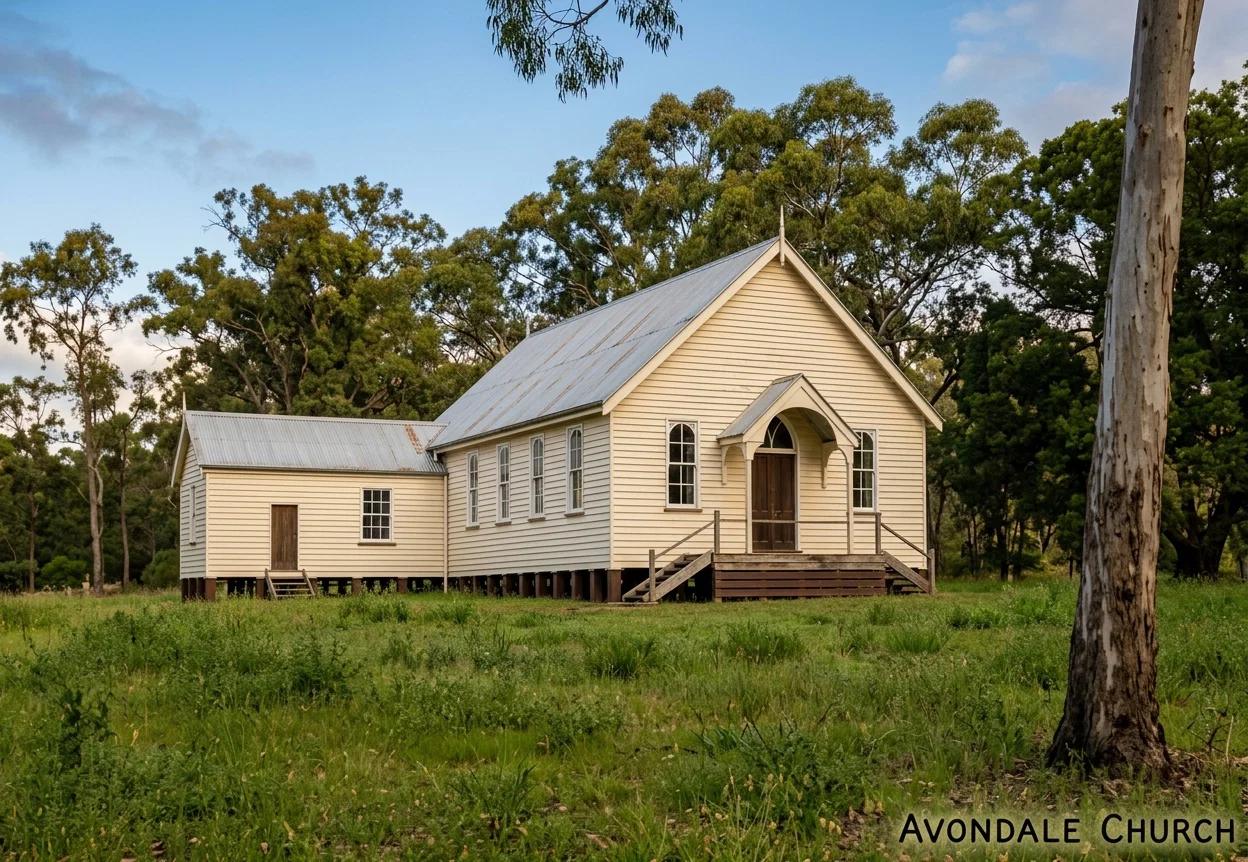
AVONDALE CHURCH
It has been the constant effort to teach the students that they should serve principle, not men; that they should be obedient in all things, “not with eyeservice, as men-pleasers; but in singleness of heart, fearing God.” This is producing fruit in a well-ordered school.
Financial
“Owe no man anything” has been kept in darkness regarding the heavy debt of the school and the lessons to be learned from it. The necessity of adopting right methods of business dealing and promptness in settling accounts has been enforced as an essential element in the training of the Christian worker. This individual business responsibility, when fully realized and acted upon by every employee and student in the institution, cannot fail to place the school upon a paying basis. So far this plan has proved successful to the extent that the running expenses of the school have been met, many costly improvements made, and a considerable sum appropriated from the current earnings toward the liquidation of debts.
Industrial
ROAD TO SUNNYSIDE
Industrial training as an important factor in education has received considerable attention. All lines of manual labor have been carefully systematized in order to make all work as productive as possible. Those in charge of the different branches of work have continually aimed to follow the light given on this point: “We need schools in this country to educate children and youth that they may be masters of labor, and not slaves of labor.” The special instruction given regarding the Avondale farm has been studied, and followed as far as possible. Special blessings have attended the farm work, as is evidenced by the fact that the school land, almost without exception, has yielded good crops in great variety, while the surrounding country has suffered from an unprecedented drought in many places, causing utter failure of crops and great suffering to man and beast.
“Christ’s Object Lessons”
DORA CREEK BRIDGE
The enterprise for the sale of “Christ’s Object Lessons” was started in this field less than a year ago, and yet a good beginning has been made. The people have responded nobly in donations to the Material Fund. The students and teachers alone have given about thirteen hundred dollars to this fund. The book is now being sold, and we hope for the early completion of this work, and the consequent liquidation of the school’s indebtedness. Attention was recently called to the importance of our school’s doing its part in this matter, and thus setting an example before the brethren in the churches. A few days later, a paper was presented to the faculty, signed by all but three of the students in the advanced department, expressing their willingness and desire to lay aside school work for a time in order that they might go out to sell “Christ’s Object Lessons.” This means much to these young people, as it will be necessary for every member of the church to sell, on an average, ten copies of the book. They will be given the chance, and we feel confident that they will succeed.
Spiritual
It is a recognized fact that a live church is a working church, and experience has fully proved that a live school is a working school. In harmony with this, the students of the Avondale school have been encouraged to conduct meetings in the vicinity, hold mission Sabbath schools, distribute tracts and papers, visit with the people in their homes, sacrifice time and labor in forwarding the medical work, and in many little ways emulate the example of Jesus Christ, who went about doing good. This has been found to be far more effectual than any artificial means of imparting spiritual fervor. The missionary and social meetings have been seasons of great interest and profit.
We are of good courage. We earnestly solicit the prayers of our brethren beyond the seas that the workers here may be given wisdom more fully to bring this school into harmony with the Lord’s mind, and that an army of workers may here be trained in such a way that they can properly carry the message to the perishing millions in the islands of the Pacific.
Sheridan Industrial School, Sheridan, Ill.
By N. W. Kauble
N. W. KAUBLE
DURING the year 1901-02 seventy students were enrolled, the average attendance being about thirty. This enrollment includes ten students who really belong to the church school rather than to an intermediate school. The work in the schoolroom embraced the sixth, eighth, tenth, and twelfth grades, with numerous drills. Outside, the work consisted of clearing ground, broom making, house building, blacksmithing, horticulture, and general agriculture. The work has been almost wholly done by students and teachers. A hired carpenter, assisted by students, did a few days' work on the cottage, after which the building was completed by students and teachers. Thirteen acres are cleared ready for the plow. There are three acres of orchard, consisting of apples, plums, pears, and peaches. The trees were planted one year ago, and show a remarkable growth. Between the rows of fruit trees, three13quarters of an acre of strawberries was grown and planted, and we are now gathering a large crop of fine berries, which are selling for best prices.
The greatest obstacle we met with in the industrial department was the withdrawal of the students when the time came for farm work. During the winter months, when there is but little to be done in their homes, we were crowded to our utmost capacity; but as soon as farm work opened, we were left with few competent helpers, consequently our industrial effort has been greatly crippled. However, with the few and the blessing of the Lord, we have succeeded in clearing several acres of heavily timbered land, and have planted ten acres.
At no time has there been any extraordinary spiritual move on the part of the students, and yet we are thankful to say that, with scarcely an exception, there has been a marked spiritual growth.
When all accounts are settled, and all expenses for the year paid, we shall have a small remainder.
The School in South Africa
By W. A. Ruble
W. A. RUBLE
We have great reason to thank the Lord for what he is doing for the educational work in South Africa. The past year, ending with the calendar year of 1901, was a prosperous one in many ways. The attendance was larger than it had been for some time, there being about ninety in the school, and over fifty in the home. Knowing the growing interest in church-school work in other countries, we had been planning for years to start a teachers’ course, but there were no young people to take it until the past year, when three very promising students who had been with us for years were prepared to teach.
There had been several calls for schools throughout the colony, but we were not able to meet the call until the beginning of this year, when two new schools were started, one at Uitenhage and one in Cape Town. We had one14school in Kimberley. A member of our last year’s class was retained as a teacher in this school, one went to teach in Cape Town, and one has engaged in a number of conference work. They are all doing excellent work. This class has been a source of much encouragement to us.
This year we are conducting the Teachers’ course, although there is but one taking it. We have a fairly large class in preparation for the course another year. The students who take this course have all completed the ninth standard, which is somewhat higher than the ninth grade in America.
We have more calls for teachers than we can fill, but we hope soon to be able to meet all such requirements. The attendance this year is not quite as large as it was last year. The second term opened yesterday with an attendance of eighty-three in the school, and about forty-five in the home.
The spiritual condition of the school has been good, considering the age of the children. Our constituency being small in South Africa, our students vary greatly in age. All the older ones take part in the Sabbath evening social meetings, and most of those who are old enough have been baptized.
Financially we are struggling under a large debt of about £2,800, or $14,000. The interest on this, together with the high prices, the result of the war in this country, makes it very hard for us to meet expenses; but notwithstanding all these difficulties, we have been able to pay every penny of our expenses as fast as the bills came in. We thank the Lord for this as well as other blessings, and are encouraged to press on. During our last conference a fund of about four hundred dollars was raised with which to purchase “Christ’s Object Lessons” for the relief of this school. These books are being sold, and the proceeds are to go toward the paying of the debt. This will relieve us somewhat, and we hope in time will lift the debt.
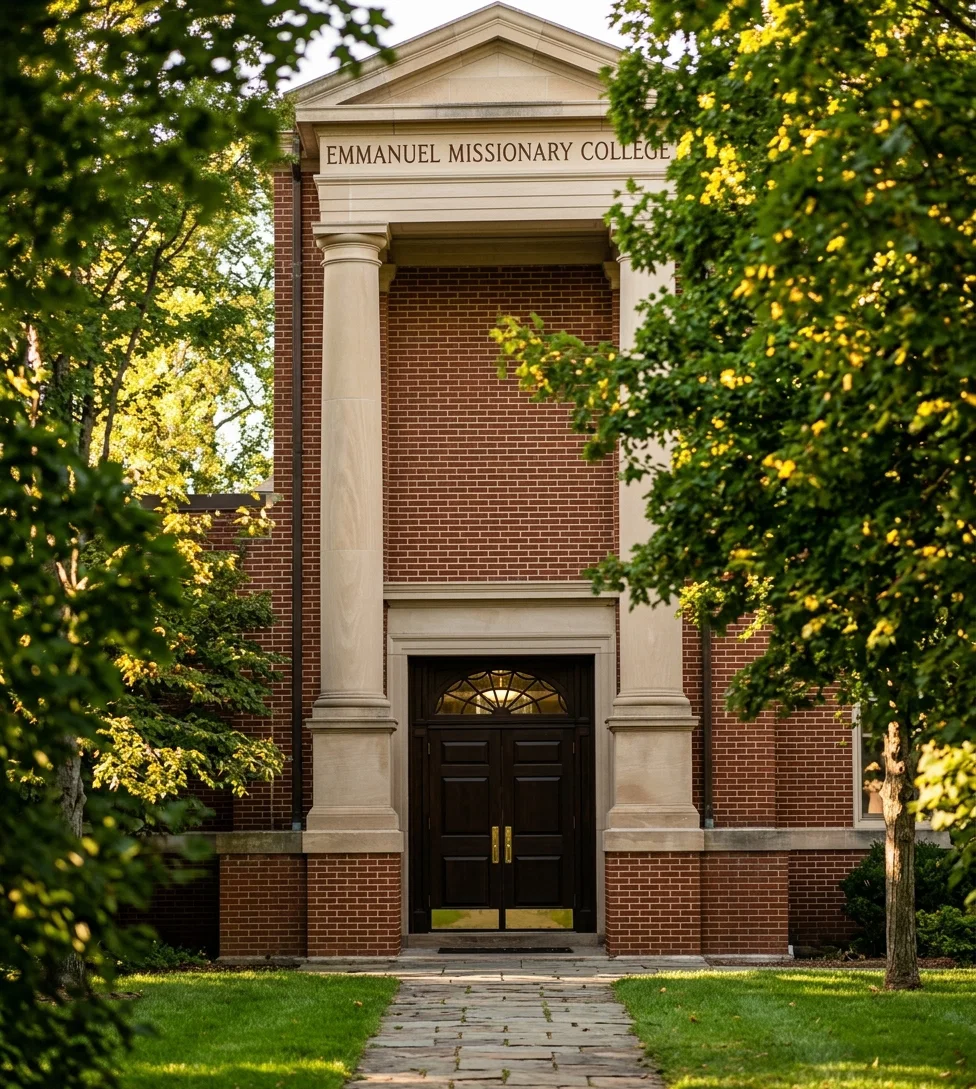
Emmanuel Missionary College
By E. A. SUTHERLAND
E. A. SUTHERLAND
A REPORT of Emmanuel Missionary College necessarily embraces much more than the work done under the immediate supervision of the college faculty and possibly within the walls of the school buildings.
The system known as Christian education because of its breadth, includes schools of three grades,—schools where primary instruction is given to the children, intermediate industrial schools for youth, and training schools for mature students, preparing men and women for service in all departments of gospel work. The college is the center of such a system of affiliated schools, and from this center workers proceed to the other grades; the condition at this center affects materially the work done in the other schools, and a strong pulse here means healthy growth in all other parts. This is the position occupied by Emmanuel Missionary College.
Nearly thirty years ago the Seventh-day Adventist denomination founded its first school at Battle Creek, Mich. That college was established for the training of Christian workers. Owing to a combination of circumstances, that object was to a degree hidden from view. In order to return to the original plan, and more fully develop the principles of education underlying the growth of Protestantism, the location of the school was changed one year ago, and the name was changed to Emmanuel Missionary College.
The summer school for teachers held during the months of July and August, 1901, was the first work done after the changed location. As a result of that term's work, about sixty young people were added to the corps of church-school teachers.
The autumn of 1901 found the school without buildings, and it was counseled by some that it would be impracticable to attempt to conduct the class work for a year. Others, however, thought that to postpone the opening until the erection of buildings would prove disastrous to the interests of all concerned. Consequently, the fall term opened October 30, and the work of the year was carried on in rented buildings. In spite of apparent disadvantages, the attendance reached one hundred during the winter.
The plan of work was materially different from former years. It is the policy of the college to deal exclusively with mature students, who are Christians, and who desire special preparation for a definite line of evangelistic work. The fact that three intermediate industrial schools have already been established—one at Bethel, Wis., one at Sheridan, Ill., and a third at Cedar Lake, Mich.—has made it possible for the college to adhere closely to its policy concerning students. Those needing preparatory subjects are recommended to one of the intermediate schools. The consequence is that it is possible to conduct the class work of the college on the intensive plan. Students carry but one principal subject at a time. This requires vigorous application, and is a plan adapted only to mature minds. For those qualified to enter a training school, the plan has proved entirely satisfactory. The advantages over the ordinary plan are many: A subject requiring an entire year in any other school may here be finished in one term. Students unable to spend a year in school can in one term complete a definite amount of work. Teachers are able to carry on laboratory work, original research, or field work with an entire class without interfering with the class work of any other teacher. The correlation of related subjects becomes an easy problem.
In the erection of buildings, which has already begun, the principles underlying Christian education are closely followed. The spirit of consolidation and centralization so often followed in educational work is here counteracted. In place of large and costly buildings, which develop the institutional spirit, the new college buildings will be small and well scattered. The study hall will be a one-story building; the domestic arts building containing the dining hall, kitchen and serving rooms, has a second floor, which will be devoted to class work in cooking, sewing, and related subjects. The manual arts, such as carpentry, printing, agriculture, blacksmithing, etc., will receive attention equal to that shown any other class work. Suitable buildings will be erected for these departments.
The substitution of a number of small buildings, simple in construction, for a few large ones whose structure is complex, enables the management to follow the instruction given concerning the use of student labor. All buildings, from the study hall to the cottages for faculty and students, will be built by students, under the direction of competent overseers and instructors.
The Summer Assembly will this season be conducted in the fifty-acre grove on the college farm. But it is expected that at the opening of the fall term, work will begin in the new buildings.
There is a consistency about the plan and surroundings which appeals forcibly even to those unacquainted with our work. The beauty of the present location, with the variety of natural scenery presented by the river, the grove, the brook, springs, bluffs, and lowlands; the richness of the soil, and its adaptability to the purposes of an educational institution; the variety of buildings of moderate size, erected by students; the number of young men and women sent forth from the institution as active missionaries,—these things show unmistakably that God's plans of education, if followed, produce the strongest and best results.
The past year has been an eventful one; the future holds out many inducements. The college advocates universal free education, and it, with its affiliated schools, offers instruction from infancy to maturity. Its doors are open to all who are seeking a preparation for gospel work.