Will had been sent to school; but when he reached the field that he crossed on the way to school, and that took off quite a little of the distance, he noticed how thick were the tiny bluish flowers that are called “bluets.”
Will knew there was no time to spare; but all at once he thought it would be a great deal more fun to stop and pick some of the pretty little flowers, than to sit in school all the afternoon with a spelling-book in his hands.
Of course Will knew what was right just as well as any little boy knows; but all at once he made up his mind to pick the little Mayflowers, and let school go. So down he went on his naughty little knees, and pick, pick, with his fingers until his small back ached, and his fingers were stiff. But in one hand he held a large, thick bunch of the bluets.
“Now I’ll take them home, and put them in water,” Will said to himself, “and then perhaps mama will want to put them on the supper table.”
Then Will thought it would never do to go home quite so early because—because—mama would want to know how it happened, and she might not just like it, having her little boy stay out of school picking little blue-and-white blossoms, without her saying he might.
So Will made up his mind to creep round very carefully; and if no one was looking, he would get into his own room, and stay there until it was time for school to be out. And so he did. And he put the bluets into a glass of water, sat down in his comfortable chair, and watched the little blue-whitish flowers until—why, what surprise was this? One of the bluets all at once had a little face, and what was more, it began talking to Will.
“We never should have dared do it,” the bluet said.
“Shouldn’t have dared do what?” asked Will.
“To disobey.”
“Who did disobey?”
“You did. You know you did.”
“How did I disobey?”
“You were sent to school. You should have gone to school. Now you are afraid to have the truth known that you ran away from your lessons, and stopped to pick us in the field.”
A COUNCIL OF WAR
Will opened wide his eyes, and thought, in astonishment: “But why wouldn’t you dare disobey? What difference would it make to little bluets whether or not they disobeyed? And whom do you have to obey?”
“Our Maker,” said the little flower. “We have to obey his laws; and if we didn’t, we should die.”
“You’re joking,” said Will. “Flowers can’t have laws. They’re too small. They just come up out of the earth, look round, and then by and by drop back to the earth. The idea of flowers having to obey!”
“You had better listen to me,” said the bluet, “for small as I am, I can teach you something you ought to know. Everything has laws. When we are down under the ground, all at once we can feel a moisture or dampness reaching us. Then we know the frost of winter has melted away, and that the time has come when the April showers and the May sun are reaching the earth, and it is time for us to look up. We obey this call, and go to work. Soon we peep up above the soil into the beautiful light.
“Then more than ever we feel the laws that are within us. We must lift our heads to receive the dew that comes morning and evening to refresh us. We must lift our faces to receive the sunlight that helps keep us alive. We must drink in the showers that sometimes fall, and must stand up bravely when the wind comes sweeping across our little forms.
“Oh, dear, no! A bluet wouldn’t dare disobey the way you did. Such a little thing would take our life away. If we would not take the dew, we should wither away. If we turned away from the sunshine, we should droop and fall. If we246refused to stand upright when the wind swept by, down we should go, and out would go our little life. We must either obey or die.”
“Dear me! I’m glad I’m not a bluet,” said Will.
“It’s a far grander thing to be a boy,” sighed the flower. “I think if I had been made a boy, I would be a good, true one, not a naughty, disobedient one. I know we have the same Maker, and it is just as bad for a boy to do what is wrong as it is for a little flower.”
Then the bluet closed its little mouth and seemed to fade from sight just as the door opened, and there was Will’s mama coming in.
Edith E. Adams.
WHICH?
Calls mother: “Why, it’s nearly eight!
For shame! Get up, or you’ll be late.”
But Johnny Sleepyhead moans, “Oh,
That clock is much too fast, I know.”
And when at noon he lingers round
Until the dinner-bell shall sound,
He says: “Oh, dear, it seems to me
That clock’s as slow as it can be.”
But when at night some one declares,
“Come, Johnny, time to go up-stairs;
Just see! your bedtime hour is past.”
This Johnny vows: “That clock is fast!”
Now what a funny clock, indeed,
To go with such erratic speed!
Would you another clock employ?
Or would regulate the boy?
— St. Nicholas.
BABY CAMEL IN LINCOLN PARK
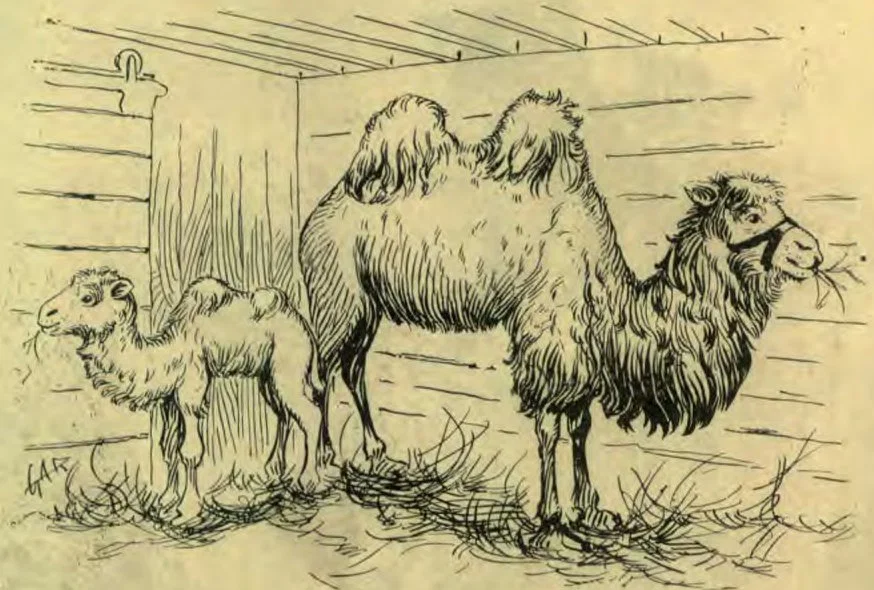
THERE is now a cunning baby camel at the Lincoln Park Zoo. When this sketch was made, it was nearly two weeks old, and could walk almost as well as its mother.
The coming of this ugly but funny little creature gives Lincoln Park the distinction of being the birthplace of the first camel born in the West. It is a shaggy little baby, and its fur is of a dark-gray hue. Its long, awkward legs are quite firm. Somehow they look as if they were stilts under a full-grown dog.
THE BABY CAMEL AND ITS MOTHER
There was a great deal of talk between the keeper and the park attendants as to what they should name the baby. Some one suggested a long, Asiatic name, but the keeper said, “Certainly not.” The baby’s mother had been called plain Judy, and his father Punch. Finally the matter was settled by calling the little fellow Buddy.
The keeper is besieged by eager boys and girls, who want just a peep at the baby camel, which for the present is kept inside the barn.
A LITTLE GOLDEN GIRL
When five-year-old Phyllis got up one morning, her hair was long and golden; but when she went to bed that night, it was short and almost black. This is how it happened.
The weather was very warm, and the little girl was so uncomfortable with such long curls and so many of them, that her mama decided that the hot little head and the sweet little neck would be happier without the curls; so she sent the little girl to visit Mr. Bobbs, the barber.
While the pretty hair was very light at the ends, it was quite dark close to the little maid’s head, but nobody realized how very dark it was.
Perhaps the barber, who was in the habit of cutting little boys’ hair, was absent-minded, and forgot that Phyllis was not a little boy, too; for he cut her hair very short indeed.
Even Mr. Bobbs was surprised at the result. A little golden-headed girl had climbed into his chair; but it was a little black-headed one that climbed down.
“Dear me!” said her mother, looking in dismay at the little dark head. “I wouldn’t have known the child if I had met her in the street. Who would suppose that a little hair could make such a difference! I should have liked it better if Mr. Bobbs had cut the black end off.”
“Why,” laughed Phyllis, “he couldn’t do that, because the golden end wasn’t fastened in. It seems funny to be two kinds of a little girl all in one day, but I’m just as comfortable as I can be. My neck is so nice and cool.”
“But,” mourned her mother, “I’ve lost all my gold.”
“Oh, no, you haven’t,” cried Phyllis. “Mr. Bobbs said he knew you’d want those old curls. I can’t see why,—such hot, tangling things,—but I brought them home in my blouse, and here they are, all done up in paper. I guess I’m your little golden girl inside anyway.”
“Why, so you are,” said her mother, feeling quite comforted. “I’m so glad I still have a little golden girl.”—Young People’s Weekly.
THE JANET-LOUISE LETTERS
By Janet
I
MY DEAR COUSIN: I want to tell you what mother said to me last evening. I was nodding over my schoolbooks, trying to keep awake to study, when she aroused me by saying, “Why don’t you go to bed, Jane? You are too sleepy to study. Don’t sit up any longer, dear; for to do so will injure your health.”
At that I laughed outright. “Injure my health”! Well, that was an idea, surely. I was wide-awake then, wanting to know how it could injure my health to sit up at night: so I asked her, and she told me that the habit of fighting off sleep, and trying to keep the brain active when it needs rest, is an unnatural thing, and if persisted in long enough, will induce a disease called “insomnia,” or sleeplessness, which is often hard to cure. She said that persons who have this disease find it impossible to sleep when they would be glad to do so.
Isn’t that strange, Louise? Did you ever hear of such a thing? I never did before; but I believe that mother is right, and I thought I’d write to you about it, for I know you used to study late, and dread going to bed, putting it off as long as you could. I wonder why people do such things, anyway. I heard our teacher say that heredity is the cause of much intemperance, and that some people inherit their disposition from their parents or grandparents. If that’s the case, all we can do is to ask our Heavenly Father to take the evil out of our hearts, and gives us new desires.
Lovingly yours,
JANET.
THE FIRST MIRACULOUS DRAFT OF FISHES
By W. S. Sadler
IV
Henceforth Thou Shalt Catch Men.—Christ used this recently wrought miracle and the work of the fisherman as an illustration of the work to which he had called the disciples, because it had been their daily occupation. The difficulties, the trials, and the triumphs of the greatest of all work—soul-saving—were here symbolized. Henceforth they were to catch men. They were to hunt for souls; not, however, as the huntsmen and sportsmen catch their prey, driving it before them into the corral; nor by striking it down in death; nor yet by the cruel, piercing bullet; but as the fisherman catches his fish, letting down his net, dependent upon Providence to fill it. As a type of the soul-saving work, Christ chose the net; for by this process the fish are caught and saved alive. The fisherman catches his fish, not by his own sagacity. Circumstances contribute largely to his success; he must use judgment in choosing the right bait to catch a particular kind of fish; he must choose the proper time of day, as well as the most promising fishing grounds. When he has carefully regarded these matters, it remains for him to keep quiet,—to keep himself out of sight.
Thus in the life of a successful fisherman we have much that teaches us how to succeed in soul-winning. We should be sure to use the right bait; that is, the divine word. The gospel is the power of God unto salvation, to every one that believeth. The gospel net is the only soul-saving agency. Tell the story of the cross in plain, simple language. Spread salvation’s net as best you can; then lift up in your daily life the One who said, “I, if I be lifted up, . . . will draw all men unto me.” The fisherman keeps self in the background. Just as unnecessary noise would frighten the fish from the carefully baited hook, so the demonstration of self is sure to frighten away many eager souls, who are hungering and thirsting for light and truth. Put forth every effort to do your work without a single thread of selfishness being woven into it; but if after you have worked in faith and labored in love, the Holy Spirit should disclose to your view threads not of divine origin, woven into the pattern of your work, do not be discouraged.
In these solemn times when darkness covers the earth and gross darkness the people, many so-called Christian workers, instead of the gospel net, seek to use logic and rhetoric, and other nets, to catch fame, worldly honor, and vainglory; while souls are perishing on every hand. These nets are so loosely and carelessly made that the majority of the fish slip through, and are not caught. Such decry the uselessness of church organizations, and would make us believe that we need no nets to catch fish. Those have gone far beyond the Man of Galilee; for when he was catching fish, even by a miraculous draft, he told the disciples to launch out, and let down the nets. Universalism constructs a net so loose and broad and wide, that we might well wonder if any fish would ever be taken in it. To many persons, God is not very real; and religion is regarded as a code of general moral ethics, which almost any one can keep, and which it is unnecessary for anybody in particular to obey.
Again: there are those who lean toward ceremony and formality, weaving their net so closely that but few fish are caught. To some, the machinery of church government is of more importance than the souls it was constructed to save,247while others go to the opposite extreme, and are like those whose nets are broad and loose. Such toil all night and catch nothing. Let us seek not only to launch out into the deep at the Master’s word, not only to let down the net at his command, but to have a net woven in the looms of heaven. Let us study, work, and pray, that we may be workmen that need not be ashamed, rightly dividing the word of truth; that is, employing right methods of labor.
It is necessary that the word of truth, the gospel net, be wisely used in order to catch and hold the particular class of people whom we may be seeking. The Saviour’s words, “I will make you fishers of men,” suggest that we must take our nets, and go where the men are; we must not wait for souls to come to us for the gospel, but we must take the gospel to them. If we are to be fishers of men, we must study their habits, their modes of life, and learn how to reach them in their own environment. Soul-saving can not be learned in the class-room any more than successful angling can be taught in the colleges. The Christian worker must learn to save souls as the angler learns to catch fish,—just where the souls are. We must reach men and women in the every-day walks of life if we would become successful soul-winners. We can not catch fish by experimenting on dry land with a net, however good the net may be; neither can we expect to win souls where there are no souls to be won. We must go, like Jesus, to those who are lost, if we would be used as instruments for saving souls.
Be sure you use the bait for which every sinful mortal is hungry, the righteousness of Christ. Then when, by precept and example, you have preached Jesus Christ as the Saviour of men, those who are hungering and thirsting after righteousness will be attracted by the Man of Calvary; for it is written that he who hungers and thirsts after righteousness shall be filled. Launch out into the deep, cast out the net, and then trust—not in your own experience and ability as a soul-winner, but in the Holy Spirit of God, to do for you what you are unable to do for yourself. W. S. SADLER.
1. When the angel told the prophet to eat the book, what did he say the result would be? Rev. 10:9.
2. How true did the words prove to be? V. 10; note 1.
3. What did the angel say the prophet, who represented God’s people, was still to do? V. 11.
4. Were these words understood? Note 2.
5. Instead of coming to the earth in 1844, to what place did Jesus come? Dan. 7:13; note 3.
6. While the work of judgment, of cleansing, is going forward in heaven, what does Jesus do for his praying people on the earth? Mal. 3:2, 3.
7. To those who were so disappointed, and to all God’s people, what comforting words does the Lord send? Heb. 10:35–38.
8. The angel said they were to prophesy again. What is the work that was spoken of? Rev. 11:1; note 4.
9. What message contains the truth they are to teach? Rev. 14:9–12.
10. What will take place when this message has been given to the world? Rev. 14:14–16; note 5.
NOTES
1. When Wm. Miller, and the thousands of others who so earnestly studied, found the truth in the prophecies of Daniel, their hearts leaped for joy. Nothing had ever seemed so precious. Day by day and hour by hour they rejoiced. The truth was in their mouth “sweet as honey.” And for the sake of what they believed, they gave up all their worldly hopes, and put everything on the altar for Christ Jesus. Laying aside all selfishness, they went out from home to make known to others the blessed hope they enjoyed. Never before had people had a grander, deeper experience. They ate the book indeed, and it was in their heart everything that was needed to make them holy and glad. But after the sweetness came the bitterness. They were disappointed. The Lord did not come as they had expected. They had made a mistake. They had not understood the meaning of the words, “Unto two thousand and three hundred days; then shall the sanctuary be cleansed.” They thought the sanctuary was the earth, and that its cleansing would be by fire at the coming of the Lord. But, while they were exactly right in regard to the time, they were mistaken in regard to the event. The sanctuary is not the earth, and therefore its cleansing is not by fire. The sanctuary is in heaven, and its cleansing is performed by the blood of Jesus. The mistake was, therefore, great, and the trial very, very bitter; but God saw what was best, and he permitted it for their good. Out of that disappointment he has brought great blessings.
2. The words of the angel seem very plain, and yet they were not understood. It was not in God’s providence for the people to know their meaning at that time. The Lord put his hand over them, as it were, until after the disappointment came; but when the trial was past, he took his hand away, and showed to the people that he still had work for them to do. This encouraged them to trust the Lord.
3. In 1844 Jesus came into the most holy place of the heavenly sanctuary. He came to the Ancient of Days, his Father, to assist in the judgment work, the work of cleansing.
4. “Thou must prophesy again.” The Lord’s people had prophesied, or preached, once; now they were to preach again. They were to go out once more, and tell the good news of the gospel. And the particular truth they were to talk about is the sanctuary in heaven; or, as we now speak of it, the third angel’s message. In the sanctuary in heaven is the law of God, and to this wonderful law and the Sabbath, which is a part of it, the people of God were to call the attention of the whole world. This work began soon after the disappointment came.
5. The third angel’s message is the last message to be preached to the world. Those who accept the truth, and keep the whole law of God, are sealed with the seal of God; they live to see the Lord come, and are taken to heaven without seeing death. The very next thing, therefore, after the message, is the coming of Christ and the reaping of the harvest of the earth.
AS OAKS GROW
THE builder idly picked up a piece of wood, as he stood chatting with a friend. He turned it over in his hands, and when a pause occurred in the conversation, he said: “See what a beautiful bit of oak this is. Note the fineness of its grain. This wood will take a higher polish than a bit of ordinary oak. Can you guess why this is?” The builder’s companion expressed himself as being altogether in the dark.
“Well, it is because the tree of which this bit of wood was once a part had to stand a good deal of buffeting. This tree did not grow in a forest, where it was sheltered by its neighbors. It stood apart in some field, solitary, and it gets its delicate grain from the struggle with the elements which it had throughout its life. It was blown upon from every side, and the story of its resistance is now written in its very fiber.”
The man of affairs did not extend his philosophizing any further, though a spiritual analogy was evidently in his mind. He was doubtless thinking of the characters which come to strength and beauty by way of hard buffetings. It is a universal law of life, with countless other illustrations besides the bit of oak wood, that through contest comes might; through trials, growth; through tribulation, perfection.—Well Spring.
Altitude Is Not Ability
“ALTITUDE is not the same thing as ability. Position does not bring merit. A small boy astride of the ridge-pole of the highest barn in the country is as much a small boy as ever—with increased capacity for mischief. Which thing is a parable.”
Speaking the Truth in Love
SPEAKING the truth is not enough. It may be spoken in unkindness, as when an enemy reproaches us for sin. But speaking the truth in love is at once the safeguard and the promise of our Christian fellowship. Love shuts malice out, and opens wide the door for service.—From “Closet and Altar.”
SELF-PRONOUNCING S.S. Teachers’ Reference Bible
By Editor
Contains the Celebrated Teachers’ Helps,
Comprising nearly 400 pages. Also a complete series of fifteen new maps.
DESCRIPTION
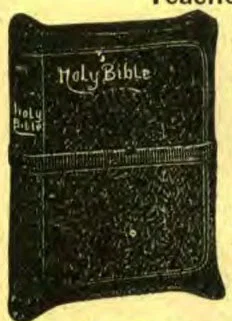
Imperial Seal Binding, Tuck Edges, known as “Divinity Circuit,” Rounded Corners, Full Red Under Gilt Edges.
We offer this Bible, postpaid, for only six new yearly subscriptions at 75 cents; or twelve new six months’ subscriptions at 40 cents.
We will also send it, postpaid, with the INSTRUCTOR one year for $2.25. For 20 cents extra we will stamp your name in gold upon the cover. Address—
THE YOUTH’S INSTRUCTOR,
Battle Creek, Mich.
GRAND TRUNK R'Y. SYSTEM.
By W. C. Cunliffe
Taking Effect June 2, 1901.
Trains leave Battle Creek.
WEST-BOUND.
No. 9, Mail and Express, to Chicago — 12.15 P. M.
No. 7, Limited Express, to Chicago — 7.00 A. M.
No. 1, Chicago Express, to Chicago — 9.23 A. M.
No. 3, Lehigh Valley Express, to Chicago — 3.50 P. M.
No. 5, International Express — 2.17 A. M.
No. 75, Mixed, to South Bend — 7.30 A. M.
Nos. 9 and 75, daily, except Sunday.
Nos. 1, 3, 5, and 7, daily.
EAST-BOUND.
No. 10, Mail and Express, East and Detroit — 3.45 P. M.
No. 8, Limited Express, East and Detroit — 4.50 P. M.
No. 4, Lehigh Express, East and Canada — 8.29 P. M.
No. 6, Atlantic Express, East and Detroit — 2.10 A. M.
No. 2, Express, East and Detroit — 7.00 A. M.
No. 74, Mixed (starts from Nichols yard) — 7.15 A. M.
Nos. 10 and 74, daily, except Sunday.
Nos. 4, 6, 8, and 2, daily.
W. C. CUNLIFFE, Agent,
BATTLE CREEK.
Baby’s First Wardrobe
Complete outfit based on healthful principles—22 Neat Patterns—with full instructions for making, and an illustrated booklet on baby’s care and clothing. All sent in a plain envelope for 50 cents in stamps or silver. If interested in the best books, patterns, materials, garments, and accessories for mothers or children, send a stamp for information, or remit for patterns to—
Mrs. F. M. Kellogg, 36 Washington Ave., Battle Creek, Mich.
HEARD AT BERRIEN SPRINGS
A SOWER went forth to sow.
PLOW in hope, sow in assurance, and God will give the increase.
FAMILIARITY with God's word is the secret of power in God's work.
It is our business to make difficulties turn into opportunities.
JESUS is the Saviour of those who, of themselves, can do nothing.
It is difficult to give to another what one does not himself possess.
We lose a great deal in the service of God because we do not count on enough.
WHEREVER we are on the earth, there is our field of ministry spread wide before us.
It is not the studied effort, but the love of Jesus flowing out in the life, that wins souls.
We look with a feeling of loathing at a thief; yet we are daily robbing ourselves of the priceless blessings of Heaven by refusing to receive them.
It is not necessary to wait for an introduction before speaking a message of courage and cheer to those around us.
GALILEE, constantly pouring out its blue waters, refreshing the thirsty land,—Galilee, bright, sparkling,—how many hallowed memories cluster about that little lake in Palestine! What a contrast is the Dead Sea, constantly receiving, always hoarding, yet never having enough! This is a parable that God himself has set in the earth to show to all who behold it the folly of selfishly hoarding the blessings received.
A SUGGESTION
A BRIGHT young girl in Kansas is earning a small fortune by making corn-husk dolls, which she sells for twenty-five cents apiece. She is an expert at this art, and the dolls she sends out are really beautiful to look at. At first she sold them to her friends, but by and by she began to receive orders from a distance, and now she has more than she can fill. So far she has found no one skillful enough to help her. The dolls and the manner of their making are thus described by an exchange: “There is a peculiar knack of putting the husks together, which is exceedingly difficult of imitation. About as many husks as one finds on an ordinary ear of corn are all that are required for one doll. The cob serves for the body. The face is covered with a husk, and the features are painted on. The silk of the corn is used for the hair. The skirt is made of the widest husks, and a shirt-waist and jacket come out of the softest pieces. A corn-husk sash encircles the waist. The hat is a big scoop-bonnet, trimmed with tassels. The dolls are furnished with parasols made of straw, with silky husks for the covering.” We wonder if there are not some of the INSTRUCTOR girls who could learn to make these pretty little dolls, and thus perhaps earn money to pay for a year at school. Perhaps if you can not do this, you can think of something else that you have or can make, that other people would be glad to buy. Opportunities as well as talents are given us to improve. Keep your eyes open, and you will find yours.
FOR EVERY DAY OF THE WEEK
Sunday:
There is nothing insignificant — nothing.— Coleridge.
Monday:
Reach up as far as you can, and God will reach down all the rest of the way.—Bishop Vincent.
Tuesday:
Every man is bound to aim at the possession of a good character as one of the highest objects of life.—Smiles.
Wednesday:
“Every life, even the lowliest, which fulfils the divine thought for it, adds its little measure to the joy and treasure of other lives.”
Thursday:
Once a single word of the Saviour suddenly calmed a furiously agitated sea; one look of him at us, and of ours toward him, ought always to perform the same miracle within us.—C. H. Fowler.
Friday:
“Obliterate everything disagreeable from yesterday; start out with a clean sheet for to-day, and write upon it, for sweet memory’s sake, only those things which are lovely and lovable.”
Sabbath:
“Ye are the light of the world. A city that is set on a hill can not be hid.” Matt. 5:14.
OUR MISSION FUND FOR INDIA
By Editor
As the time draws near when we must raise the amount to pay for the club of thirty Instructors that goes week by week to a mission school in far-off India, we are encouraged to receive two contributions to that fund from readers of the Instructor. We trust that others, young and old, will add their mite till the amount is made up. This is a very worthy cause, and one in which, we are sure, you all feel an interest. The mission school mentioned, while not conducted by our people, finds so much help in the Instructor that those in charge cheerfully pay for a club of fifteen copies, to which, through the gifts of our readers, twenty-five free copies are added. From returns from this work we learn that the Instructor is read and appreciated by those who attend this school, and by others to whom it is sent.
This week we have received from Brice Morrow, Lead Hill, Neb., one dollar for this fund; and from Mrs. C. Steele, Grunda, Cal., fifty cents.
We are glad that the needs of this field, and our special opportunity to send literature in this way, are not forgotten by our friends.
VERY SPECIAL TO ALL MEMBERS OF OUR SABBATH-SCHOOLS
By Editor
According to our usual custom, one number of the INSTRUCTOR will be omitted during the time of the Michigan State meeting. As this meeting is set somewhat earlier this year than formerly, the paper to be dropped will be that which would, in the natural order, bear the date of August 15.
But that there may be no confusion in regard to the Sabbath-school lessons, or the weekly studies for the Young People's companies, there will be printed, in the issue of August 8, or next week's paper, two lessons and two studies,—one each for Sabbath, August 17, and Sabbath, August 24. It will therefore be necessary to preserve the paper carefully, in order to make it do service for two weeks in this way.
In former years there has usually been more or less confusion in regard to this matter; and so we speak of it thus early that all may be prepared. We trust that all Sabbath-school workers, especially, will see to it that the members of their schools understand the arrangement, in order that there may be no break in the lines of study carried on in the INSTRUCTOR.
Remember, the next paper you receive, No. 32, will be dated August 8, and will contain two Sabbath-school lessons and two Studies in the Christian life. No paper will be given out on the following Sabbath. Further mention next week.