The Youth’s Instructor, Vol. 49, No. 31.

THE ROYAL GORGE OF THE ARKANSAS

The Youth’s Instructor

Aug 1, 1901

Review and Herald Publishing Company · Battle Creek, Mich. · Aug 1, 1901

THE ROYAL GORGE OF THE ARKANSAS

I SUPPOSE if you were to ask any one who has traveled over the length and breadth of our wonderful country, to name some of the most noted and magnificent places on the American continent he would be likely to mention as foremost in the list the wonderful Gorge of the Arkansas, known as the Royal Gorge. In point of grandeur and solitude, surely this place stands without a peer among the sublime works of nature having the grand old Rockies as a background.
The view from both above and below is almost indescribable in its majesty. Standing at the top, and gazing down three thousand feet,—if one has the nerve to do so,—one can see the dashing, hurrying waters of the Arkansas, with a fall of about seventy feet to the mile, on one side, while on the other, in and out among the rocks wind two tiny, shining ribbons, like long, slender serpents. Almost before you know it, you are asking what those are. But even as you gaze and wonder, a shrill whistle echoes through the mountains. Look!—but be careful not to get too near the edge in your eagerness. It would be well to lie flat down upon your stomach, and ask your companion to grasp your foot or ankle firmly, while you gaze into the dizzy depth in search of the train. See! there it comes, looking for all the world like a toy train, as it gracefully winds its way among the rocks, and finally hides itself behind a precipitous cliff.
Here and there among the rocks, sometimes forcing their way between immense boulders, grow stunted and dwarfed trees,—a species of pine. They are very hardy; for there is seemingly not a spoonful of soil to nourish them. Their trunks and stems are as twisted and bent as if they had been the playthings of a hundred cyclones.
Pike’s Peak is not visible from the Gorge, though it is not many miles distant; the nearer hills and overhanging precipices shut its snowy summit from our view. Here and there—everywhere—are other depths inviting us to explore the immense abyss from a new standpoint.
As if Nature feared that her most awe-inspiring scenes would not be appreciated were they too easy of access, she usually chooses inaccessible places in which to display them. She often demands a generous entrance fee into her gallery of wonders,—not yellow gold nor shimmering silver,—for her deep and spacious pockets are full of glittering metals and precious stones,—but a resolute will, untiring muscles, and, above all, an appreciative spirit.
The Royal Gorge is distant about six miles from Cañon City; but in order to reach the top, one must take a circuitous route of about twelve miles. However, the scenery along the way is such as amply repays the tourist for hiring a team and driver.
To reach the bottom of the Gorge, there is no other way than to walk the six miles over the winding railroad track, or, if one has the nerve, he may mount his bicycle, and by using great care, ride most of the way. But as the narrow path is close to the railroad on one side, and nearly as close to the steep, rocky banks of the noisy Arkansas on the other, he must run the risk of receiving an impromptu ducking in the icy waters, or of being run over by the flying train, upon whose tract he is trespassing. While we are carefully picking our way lest our treacherous wheel strike a stone, and we be hurled into the water, some one shouts, “Here comes the train!” and almost before we can reach a place of safety, it goes tearing past.
Standing on a narrow shelf of rock, and high above the river, on the opposite bank, are two miners, working with pick and shovel. In answer to our call, they take a specimen of ore from their sack, and throw it over the river to us, for the stream is quite narrow at this point. When, at last, we stand on the hanging bridge at the foot of the Gorge, and look up at the masses of craggy rock, it seems impossible that only a few days before we stood upon that dizzy height. We are tired and hungry, and after building a fire, we eat our dinner, seated in a grander and more stupendous dining-hall than the guests of the proudest monarch.
Branching off from the main gorge is a curious defile, narrow and winding. Here visitors from all over the world have left their names, and in some instances a few lines expressive of their appreciation and astonishment at the wonders of nature with which they were surrounded. These cards are left in a natural receptacle of solid rock, and most of them have been there a long time.
After we have each written our names, and an appropriate verse of Scripture, and added them to the motley collection, we lift our eyes to the top of the strange hallway in which we are standing. There is a queer-looking mass of rock of many tons’ weight, which at some time has been rolled from the top of the Gorge. This has lodged in mid-air, there not being room enough between the sides of the ravine for it to reach the bottom. It looks like an enormous human face, distorted with pain. Here and there some tourist bolder than others has inscribed his name far up on the overhanging rocks. We can not but wonder if he escaped without any broken bones. We were told that somewhere hereabouts a woman, intent upon making herself famous, undertook to descend the three thousand feet from the top to the bottom of the Gorge. She succeeded in walking part of the way, and in falling the rest of the distance. Astonishing to relate, she lived, at least long enough to tell her story to her rescuers.
Comparing the most stupendous works of man with this mighty pile, this monument of God’s handiwork, we reverently exclaim: “What is man that thou art mindful of him?”
Mrs. L. D. Avery-Stuttle.

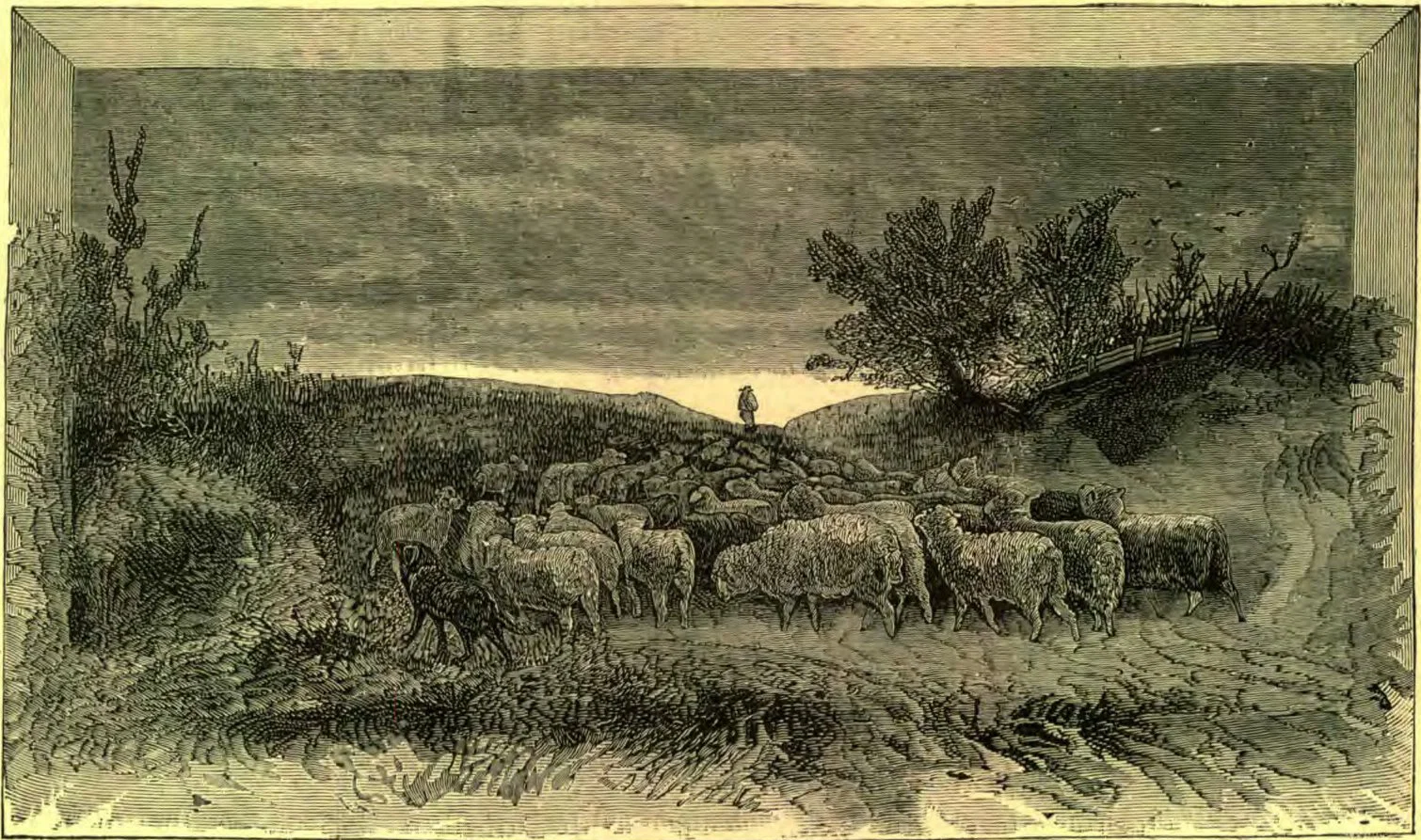
THE LORD IS MY SHEPHERD

The Lord is my shepherd; what is there to fear? Do sheep fear the storm when their shepherd is near? They follow serenely where'er he may lead, And trust in his love to supply all their need.
Though pathways be rough, and the journey be far, They know it will end where the green pastures are, And waters flow stilly the sweet banks between: Their faith in their leader is perfect, I ween.
E'en thus may I follow thee, heavenly Guide, Secure from all danger with thee by my side; For thou knowest the way—thou hast trod it before— To highlands of glory, where trials are o'er.
VIOLA E. SMITH.
THEY FOLLOW SERENELY WHERE'ER HE MAY LEAD

THE YOUNG MAN

A GERMAN professor once said, “Whenever I appear before my pupils, I feel like making them a respectful bow.” When asked the reason for this statement, he replied, “Because I see before me the men of the future—the power of the state and of their age.”
It has been said that “secular history is philosophy teaching by example.” Then sacred history is a higher philosophy; that is, religion, teaching in the same manner. The biographies of the Scriptures are simply the outgrowth, or practical illustration, of its teaching—like a kind of experimental garden where we are shown first the seeds, and then, side by side, the sweet and bitter fruits of truth and error, holiness and sin.
The young men of the Bible were like the young men of to-day, possessing all their susceptibilities and passions, and liable to the same temptations that attack the youth of every age and land. And as he sometimes escapes a bitter experience who is willing to accept the hard-earned lessons of other lives, so we may profitably study the paths of those who have gone before us, and thus gain instruction which is sometimes acquired only from the wreck of a shattered life.
Each young man whose life is recorded in the Bible stood at one time where the path of life seemed to divide into two ways, and he had to choose which way he would take. Whether a Joseph, a David, a Daniel, or a Paul, the choice had to be made. While at the fork of the road, the path of truth and right seemed hedged by thorns of trials, while the path of error gave every indication of ease and pleasure. He who stood at the fork of the road could not see far into the misty future to look beyond the entrance of the two ways, unless he relied entirely on the eternal principles of truth.
If he boldly faced all the apparent difficulties, and moved in the path of right, he found there was strength to conquer them all, and to come out triumphant. If he turned to the rose-strewn path because it appeared easy, he soon learned that its roses had thorns, and that the path was downward, urging him on to ruin.
Every young man has to stand at the fork of the road, and make his choice. Only a few choose the right until their feet are pierced with the thorns, and they find themselves pushed downward by the pressure that is ever upon them. Others devote the strength and beauty of manhood to the vices that lie along the wrong way, until the marks of sin are indelibly impressed upon mind and features. This may be done until, as long as they live, even the reformed life is beset with the ugly phantoms of the road to death. Discouragements, doubts, and anxieties are pressed upon them through the doors that have been made while on the wrong road.
He who never travels on that road is free from many of the temptations that beset the other class. He is ignorant of many of the snares, and this ignorance is bliss. The boy who says, “I wish I could see what the play is like, how a saloon looks inside, what the dance is like, what is the sensation of the tobacco smoke,” is standing at the fork of the road; and when he investigates, he permits doors to be opened that will, during his life, invite temptation, which will be a struggle for him to fight.
“Wherewithal shall a young man cleanse his way? by taking heed thereto according to thy word.” J. H. DURLAND.

TOM'S AWAKENING

IN one of the suburbs of Boston lives a boy whom we will call Thomas Stone. He is a lad of about sixteen, quick, intelligent, and an only son. From his earliest childhood he remembers that, whatever happened, nothing was allowed to interfere with the daily family prayers.
His father is a well-known merchant, of definite and well-fixed religious ideas. Every morning after breakfast the whole family—guests, servants, and all—assemble in the drawing-room. There the head of the family reads a passage from the Bible, and then offers a simple petition, which invariably concludes with the Lord’s prayer, in which the whole family joins.
To the lively, impatient boy this sacred family custom was at times a bore. It interfered with so many things that might be done. But his father never allowed him to absent himself except for an imperative reason. So it frequently happened that he fretted, and showed more or less impatience when the few minutes devoted to family prayers arrived.
His father tried all sorts of plans,— punishments, rebukes,— but could do nothing to check this spirit of revolt.
Finally, one morning just after prayers, while the family were all present, he said: “My boy, you are now sixteen,—old enough to take a prominent part in the management of the home,—and I propose that once a week you shall lead our family prayers.”
The boy was taken by surprise, and flushed deeply. But he had courage, and so said, with apparent composure, “All right, father.” But his heart beat tumultuously.
The next morning his father handed him the Bible, and told him he was to lead the family worship.
“But I can’t make a prayer as you do,” whispered the son.
“You can repeat the Lord’s prayer,” said his father, gently.
Tom read the Bible very well. Then they all knelt down, and followed him as he led them in the Lord’s prayer. It was noticed that his voice became more unsteady as he went on. Finally, when he came to “and forgive us our trespasses as we—” he burst into tears, and jumping up, rushed up-stairs to his room, and flung himself on the bed, weeping bitterly.
The father knew that something serious was the matter, but did not know what. He gave the lad time to compose himself a little, and then followed him up-stairs. He leaned over, and patted his boy upon the head. “What is the matter, my son? Tell me all about it. I will help you.”
“Father,” sobbed the boy, “I couldn’t lead in prayers! I saw my teacher before me all the time. I told him a lie yesterday. I—I had forgotten all about it, but it came up when I was praying. I don’t think I ever realized what that prayer meant before.”
“You had better tell your teacher to-day, Tom.”
“I will, I promise you!” was the emphatic answer. Then raising himself, he looked his father in the eye, and said: “I don’t see how any one can pray aloud before people, unless he can wash everything off the slate, and know that it is clean.”
Much moved, his father laid his hand upon his shoulder. “My dear boy,” he said, “you have stumbled upon the vital truth in prayer. It is not that one can not go to his Heavenly Father until ‘the slate is clean,’ as you say; but it is because prayer shows him when it is not clean, and helps to make it clean, that it draws us nearer to God and makes us better.”—Selected.

CHOOSE WISELY

How many of the INSTRUCTOR family like books? There are good books and bad books; and as our reading is a fair index to our characters, we should be careful of the kind of books we choose. On the pages of some we find expression given only to what is false and weak; and if we form a taste for this kind of literature, we ourselves shall be false and weak. We should always reject the inferior, and read only books of the right character. These inform the mind, and, better, the heart. The book containing the most instructive and sublime thoughts ever written is the Bible. Other books are the works of men, but the “Scripture is given by inspiration of God, and is profitable for doctrine, for reproof, for correction, for instruction in righteousness.” We should make the Bible our daily study; for whatever our condition or calling, it will help us to keep in view the whole object of our life here; and by taking heed to its instruction, we shall live not for the little span of time allotted us in this world, but for eternity.
Daisy Tyler.

FEAR NOT

O TRAVELER! on the road of life, Dost find thy journey dark? Canst thou no ray of morn discern? No sure, familiar mark? Thy Father's eye doth pierce the gloom, He knoweth all thy way; And he will safely guide thy steps Into the light of day.
O TRAVELER! dost thou suffer loss? Are pain and toil thy lot? Trust in thy Father's loving care, Nor deem he knoweth not. His hand hath hewn thy cross for thee, His hand hath shaped thy yoke; And if his rod chastising fall, He weigheth every stroke.
Do sore temptations thee beset, And almost cause thy fall? And when the enemy assails, Dost find thy strength is small? Relying on the strength he gives, He bids thee still to stand; Assured that nothing thee can harm, Or pluck thee from his hand.
ELIZABETH ROSSER.

ONE WAY TO WORK

THOSE of you who read the Missionary Magazine for July—and we hope you all did read it—perhaps noticed among the editorial articles a little note concerning one of our number who very recently left this country to take up mission work in India. Her early life was spent in the South, and until she reached the years of young womanhood, her opportunities for reading were very limited. Then in some way her name was placed on several lists, and a number of story papers and books came to her every week. At last she found, among the other papers, fresh copies of the Signs and the Review. She began to read, her heart was touched, and she responded to the call to accept the truth set forth, and to give it to others. Her parting word to all who remain in the home field is to be faithful in carrying on the work that brought this precious truth to her.
And this is a work in which all the young people can engage. In your own church missionary society you are needed—take hold and lift in it, and God will give you fruit for your labor. If you are not connected with any missionary society, you can carry on the work alone. Our papers contain the truth for this time, and the Lord is honoring their use. The work of writing missionary letters is one that requires tact, study, and earnest prayer. Often the counsel of those who have had experience will be a great help to the beginner; but if the work is faithfully carried on, and done from love to God and a sincere desire to bring the truth to others, both the work and the worker will be blessed.
There are many children and young people who, from sickness and other causes, are shut in and away from the privileges that others enjoy. Such would be cheered, and their lives would be brightened, by receiving the Little Friend or the INSTRUCTOR. The younger members of our young people's companies could send these papers to such, and occasionally a bright, friendly letter, to tell of their interest and sympathy. In this way the older members of the family might perhaps be interested: and whether or not results could be always seen and counted up, the effort would not be lost.
Those whose object is to give “the Advent message to the world in this generation” will lose no opportunity to sound it forth. If we give the message faithfully, we may safely trust our Leader to make it effective.

STUDIES IN THE CHRISTIAN LIFE

Chapter VI—Faith and Acceptance

(August 4-10)
1. WHAT is faith? Give Paul's definition, and one of your own.
2. Can men, by the power of their own will, exercise faith? Can they give it to one another?
3. How alone is it received? Eph. 2:8; Matt. 16:16, 17; John 6:44; 1 Cor. 12:9. How may it be increased? Luke 17:5.
4. Has God bestowed the gift of faith on only a few chosen persons, whom he loves better than others? Rom. 12:3.
5. Since God has given to every soul a “measure of faith,” and since he is constantly revealing himself to all by the things that he has made, are any excused from serving him? Rom. 1:20.
6. Name four things that faith does for those who exercise it. Acts 15:9; Rom. 1:12; Acts 26:18; Rom. 5:1.
7. What simple thing is required of those who have confessed their sins, in order that they may receive a new heart?
8. How do we know that the prayer for forgiveness will surely be answered? Mark 11:24.
9. Find examples of unswerving faith in the lives of Enoch (Gen. 5:24; Heb. 11:5); Noah (Gen. 6:14–22); Abraham (Gen. 12:1–4; 12:7; 15:4–8; 22:1–10); Joseph (Gen. 50:20; Heb. 11:22); Moses (Heb. 11:24–28); Caleb (Num. 13:30; 14:6–9); and Elijah. 1 Kings 18:22–28.
10. Name two men who are spoken of as being “full of faith.” Acts 6:8; 11:24. How did one of these prove his faith?
11. By healing men and women of their physical diseases, what did Jesus show himself able to do? Matt. 9:6.
12. What one thing was always necessary in order that Jesus might exercise his healing power? Matt. 9:28, 29.
13. In order, then, to be cleansed from the sickness of sin,—a sickness so terrible that it is compared to leprosy,—what must we do? See pages 62 and 63 of “Steps to Christ.”
14. When by faith our sins have been forgiven, and we have been adopted into the household of our Heavenly Father, how do we live day by day? Gal. 2:20; 1 John 5:4. Find other texts that answer this question.

SUGGESTIONS ON THE TOPIC

1. Read the chapter in “Steps to Christ” slowly and carefully many times during the week, and so fix its precious words in your mind. It would be a good plan to read it each morning, and think of it often during the day.
2. Faith is defined as “a union of belief and trust;” it is taking God at his word—believing and appropriating his promises of forgiveness and acceptance.
3. “Through faith we understand”—and it is only through faith that we can understand—the mysteries of God,—of his power, as exercised in creation, and of his love, as manifested to his sinful children. These subjects—the power and the love of God, as shown in creation and redemption—will be the themes of study and praise through endless ages. Even now, by faith, we may begin to understand these things.
4. Faith kept Enoch pure while he was surrounded by evil associates; it kept Noah at work, preaching and building, for one hundred and twenty years; it led Abraham to forsake friends and home and country, to go out “not knowing whither he went,” and later to lay his beloved son upon the altar for God; it caused Moses to forsake the splendor and honors of an earthly court, and cast in his lot with a despised people; it parted the waters of the sea, and fed Israel in the wilderness; by it faithful Caleb, looking above the giants of Canaan and their walled cities, saw a power that was “well able” to give them the land. Faith threw down the walls of Jericho; it made the heart of the boy David strong to meet the giant enemy of Israel; it brought down fire from heaven at the word of Elijah; it preserved the three Hebrews in the furnace, and Daniel in the den of hungry lions. Faith in the power of Jesus cleansed the lepers, opened the eyes of the blind, cast out evil spirits, made the lame walk and the dumb sing, and raised the dead to life. It gave the martyr Stephen a view of the glory of heaven; and if allowed to have its full work in us, will make it possible to overcome sin, and to gain the crown of glory, that fadeth not away. As it led those whose lives are recorded for our inspiration to turn away from the inducements and allurements of the world, to go forward relying on the naked word of God, and to count not their lives precious to themselves, so will it lead us to make the cause and glory of God first in everything.

FAITH VERSUS FEELING.

There is scarcely any word that is used in speaking of religious things that has been so warped and distorted from its real meaning as the word “faith.” Faith is grasping the real plan which God has for us. It is not, as is popularly supposed, a peculiar tension or twisted condition of the mind, which will bring something when it is exercised. It is based upon universal principles rather than feeling.
Recently a patient came to be examined, feeling, however, little or no distress. He was found to have an enormous cancer of the stomach, and will probably be dead within six months. The same day a woman came to have her chest examined, feeling very ill, and therefore supposing she was looking into the open grave, but a careful examination showed that her lungs were perfectly sound, she having been simply annoyed with a troublesome intercostal neuralgia.
Many Christians suffer with spiritual neuralgia, and imagine they are just about lost, when, as a matter of fact, if they had faith,—if they knew how good God is to them every moment,—they would go right along, and accept the glorious blessings that hang above their heads. Their “faith,” in other words, would make them “whole;” that is, accept the wholeness they already have, and do not know they possess, just as the woman went away happy when she learned there was nothing the matter with her lungs.
There is another class of young people who are suffering with spiritual cancer, and their very vitals are being destroyed; but they do not feel bad. If, instead of depending upon their feelings, they could grasp by faith the actual seriousness of their spiritual malady, they would cry out for God to save them from their spiritual leprosy, and the divine Surgeon would remove the sin from their lives. “Faith,” again, would make them “whole.”
DAVID PAULSON, M. D.

TO-DAY

By a smile, by a word, By a sympathetic tear, Help me, Lord, to give some heart E’en a little cheer.
By a look, by an act— It will but a moment take— May I not in some one’s breast Soothe the bitter ache?
—Selected.

WHAT CAN YOUNG PEOPLE DO?

The avowed object of the Young People's Work is Christian service. How shall we begin? and, What shall we try to do? are questions that many are asking. And they are important questions, too, and deserving of careful study. Some of these companies of young workers are in large cities, others in small towns, and quite a few are in rural districts. But to each one the Master is saying, “Go work to-day in my vineyard.” If the Young-People's-Work movement has any life and power attending it, it will be because the young people heed this command. The real work that is to be done is the important part of this question, and the form of the organization is incidental. We only need meetings, and of course leaders and secretaries and committees to plan for meetings, that the work may be done.
So let us consider the work. We shall have space only for a statement of a few general principles that should not only guide, but encourage us; for they show how easily within the reach of each one the work is. Here is a statement from the newly published “Testimonies for the Church,” Vol. VI, which tells us where to begin: “Let those who desire to work for God begin at home, in their own household, in their own neighborhood, among their own friends. Here they will find a favorable missionary field.” Another statement from the same volume is this: “We need in our churches, youth who are working upon the Christian-endeavor principles, and the beginning must be made at home. The faithful performance of home duties has a reflex influence upon the character.” Upon the same point I quote the following from the same author: “Every follower of Jesus has a work to do as a missionary for Christ, in the family, in the neighborhood, in the town or city where he lives.”
This is sufficient to show to all who desire “to work in the cause” that the “cause” is right where they are. Then, is it not evident that the first work of our companies of young people is the planning of active missionary work in the home, in the neighborhood, in the town or city where they are? In planning for this work, do not attempt the impossible. It is the simple plans of work that succeed best. On page 432 of Vol. VI, this instruction is given: “Do not pass by the little things, and look for a large work. You might do successfully the small work, but fail utterly in attempting a larger work, and fall into discouragement. Take hold wherever you see that there is work to be done. It will be by doing with your might what your hands find to do that you will develop talents and aptitude for a larger work. It is by slighting the daily opportunities, neglecting the little things, that so many become fruitless and withered.”
MRS. L. FLORA PLUMMER.

THE TRUTH

The Saviour said of himself, “I am the way, the truth, and the life.” When an object is named, and modified only by the definite article “the,” no other explanation or definition being understood or expressed, it places that object in a pre-eminent position as the one object of its class. That is, Jesus is not simply a way, a truth, or a life, but the only way, the only truth, the only life. All ways, all truths, all lives, are emblematic or tributary to the one great reality, which is Christ. There are deceptive ways, falsehoods that appear to be truth; but every right way leads to a good end, and in every good end is Christ. Christ is the only way that leads to Christ.
Take this in its most literal sense: Here is a plain road, good people travel that road in pursuit of good objects. But the only good is Christ. Hence every road, or path, is tributary to the one true way, which is Jesus, the Christ.
Jesus says, “I am the true Vine.” How many true vines are there, then?—Just one. What are all other vines?—Emblems, or figures, to illustrate the true. The clusters of grapes are figures of spiritual life; and spiritual things are the true things. All tangible and visible things are transitory and figurative, while the things which the Spirit of God reveals are the only realities in existence. For this reason we are asked and urged to seek for the things which lie beyond the range of our natural senses. The true bread is Christ, of which he that eateth lives forever. The water which Jesus gives becomes flowing fountains of living grace, forever refreshing our own souls, and flowing out to all around us. Our clothing, which so soon grows old and wears out, is to remind us of the glorious, imperishable robes with which Christ clothes all who come to him. The money we handle represents the imperishable gold, which the Faithful Witness asks us to buy of him without money or price. The houses we live in but poorly represent that grand spiritual temple of which the final overcomer becomes a part. Our earthly homes grow old and perish; but the home above is “eternal in the heavens.” Our clothing wears out, our money vanishes, our bread perishes, the water we drink satisfies but a little while, the flowers around us fade, the trees, and even the rocks, decay. All things we see or handle are passing away; but the unseen things of faith are real, they are true, they are eternal. They are all vested in Christ. He, the maker of all, is the embodiment of all. He is the truth, he only is the true. Let us live for him.
G. C. Tenney.

PLAYING POSSUM

“Isn’t it—” The remark I was mentally making was never finished. Standing in the depth of a wood, I had laid my finger-tips lightly on a dome-shaped nest that rested on a poison-ivy vine.
“Isn’t it soft?” I was going to say. At that moment, out of the nest, and out upon the vine, shot a mother mouse and her five young ones.
There was then given me an example of the wonderful quickness with which instinct works. For, after the desperate dash from their endangered home, every one of those animals apparently realized that on a vine, with no chance of running away, its only hope was to “play possum.” And so each lay as if dead. It was only by the frightened eye and heaving side that one knew of the agitation within.
Slowly I stepped back a few paces, crouched down, and began my play of possum. Only the day before a bird had kept me waiting twenty minutes until he moved. How long would the feigning mice keep me waiting?
Minutes passed; there was no movement, except on the part of two young mice, which had dashed ahead of the others upon the vine, where it slanted sharply downward, and being unable to retain their hold, they began to slip, a fraction of an inch at a time. But even their slipping was like that of inanimate things; there was no violent movement of the body to recover its position. One at last fell to the ground. It might have been an acorn or a piece of bark, so far as any sign of life was concerned. It remained where it fell.
Ten minutes passed; six seemingly dead mice in front of me. Absolute silence.
Fifteen minutes. A rustle, the flash of a cottontail, and again silence.
Twenty minutes. There was noticeable among the lower tree-branches on my left a curious, undulating movement, which came toward me. There was a cautious whispering. The author of it, a red squirrel, appeared on the tree-trunk in full view. The whispering became a chattering. He ran up and down the tree; he jumped to the ground, and into a mass of dried leaves just behind my back, stirring things up so one would have thought a large man was raking. I remained motionless. The squirrel grew excited. He rushed around and upon a small stump at my right; he sat up, he drummed with his feet, he scolded.
Through all this excitement my eyes had not left the mice. I looked again at my watch. For half an hour those six mice had remained motionless. The sun was down. I was growing tired, and also felt that the poor mother mouse had been kept in suspense long enough. I decided to leave them.
An impulse seized me. Reaching forward with a stick, I lightly touched the mouse that had fallen from the vine. It was as if the shadow of a flying bird passed over the ground. The mouse was no longer to be seen.
I turned, and waved my hand toward that chattering squirrel. For the moment I was the magician; there was no more sound, no squirrel, only again that undulating movement among the branches, this time receding.
I looked up; around me the curious quiet of a wood-interior at twilight. I walked slowly away.
“I wonder how much longer mother mouse will play possum?” I looked back, and straining my eyes through the gathering darkness, I saw that she had turned, and was cautiously moving toward the nest.
Her “playing possum” was at an end.—George F. Muendel, in St. Nicholas.

THE EARTH-STAR, OR THE FAIR-WEATHER TRAVELER

EARTH-STARS are members of the plant kingdom, and are closely related to the puff-balls with which all country boys and girls and all frequenters of the woods are familiar: they ripen their spores, or puff-ball seed, in round brown balls as the puff-balls do, but are unique in their wonderful manner of scattering their spores. For this purpose the plant develops a tough outer coat to the ball, which on a damp day, when the spores are ripe, swells up, splits, and rolls back from the summit to the base, to form a star about the ball. The round ball at the center of the star then opens at its summit, and waits quietly for fair weather favorable for traveling.
The first day after these preparations the earth-star breaks its connections with the part of the plant which is in the ground, and which up to this time has fed and nourished it, and held it firmly in the ground; curls up the rays of the star over the puff-ball; and lets the wind roll it over the fields and wherever it will, while it puffs out the spores, and scatters them far and wide.
Some observers have stated that when the dews of evening fall, the plant unrolls the star-points until they again lie flat upon the ground, and firmly anchor the ball where it may rest until another fair day comes round in which, in company with the wind, it may resume its travels.
The earth-stars are not common, but still one on the alert may expect to find them on damp wood roads, and will be well rewarded if he takes one home to watch the rays of the star curl and uncurl when subjected at first to dry and then to moist air.—Selected.

Possessions Versus Being Possessed by Things

It is one thing to have possessions, and quite a different matter to be possessed by what one has. The one may mean a degree of content and happiness that shall make you a blessing wherever you are; the other will not only make you unhappy yourself, but will effectually keep you from being a blessing to others. It is sad when one gives up the greatest blessings of life for the sake of “having things,”—only to find, too late, that the “things” have him. The grace of contentment not only insures happiness to its possessor, but keeps him from laying hold of what would make him all his life a veritable bond-slave in mind and body.

HOPE

To-morrow — to-morrow — ’tis cloudy to-day; To-morrow will scatter the shadows away; To-morrow will brighten, with blue all above, And birds singing praises from blossoms of love.
Pain touches, but O! ’twill be joy afterwhile! We see how the gladness, with radiant smile, Illumines; but an hour in the distance — and see! The pleasures I longed for are waiting for me.
Across the far bounds,— yet they may not be far,— Above the clear light of yon silvery star, The loved and the lost in my visions I see; Hope calls me to meet them; they beckon to me.
Hope! hope! see how fair are the skies of the west; They tell of the sinking of life to its rest; And then — O the morrow! what breaking of day! Love offers a mansion, and calls, “Come away!”
B. F. M. SOURS.

EARNEST WORKERS

Let us look about a little, Let us look about, and see What the busy world's great workshops Have for you and me.
There's not one of us so tiny, There's not one of us so small, But the Master surely findeth Something for us all;—
Something kind to do for others, Something kind and sweet to say, Something that will make us better, Truer, every day.
Let us look about a little, Every one to do his share, Ready, earnest, always busy,— Busy everywhere.
FRANK WALCOTT HUTT.
Continue reading: What the Bluet Said