RING the school bells, and remember
Did it thrill you last September
When the bells began to ring
With their merry ting-a-ling?
Swing them, ring them, start them singing,
Happy groups of children bringing
From their homes, of every kind,
To the nursery of mind.
Ring the school bells till their chiming
Starts the young ambition climbing,
Till the wind their music swells,
Till the echoes join the bells.
Ring them. Memories are clinging;
While the merry bells are ringing
Only for the children's ears,
Others love them through the years.
Ring the bells, and keep them going
Sunny days, and when it's snowing,
For a weighty message dwells
On the cadence of the bells.
Ring them. Let their call to duty
Lead young lives to love and beauty,
Till earth's gloom of care dispels
At the sound of heaven's bells.
B. F. M. SOURS.
Mechanicsburg, Pennsylvania.
A New Society
VIOLET KERR was excited about something, that was clear. Her cheeks were flushed, and her eyes were bright.
“Girls! Girls!” she exclaimed, as soon as she could recover her breath after her hurry to overtake the group who were walking along a pleasant street. “What do you think I heard Miss Baker say just now?”
“We can’t think at all, because we don’t know, of course. Tell us,” chimed two or three voices.
“Well, you know I ran back for my book, and when I got it, I started out the front way. Miss Baker and Mr. Clark were talking in the hall, and I heard Miss Baker say, ‘I’m just discouraged. I wonder if some one else could do better with my class?’ and I wouldn’t go past them for anything, so I came back as softly as I could, and ran out the other way; and, girls, whatever should we do if Miss Baker wouldn’t teach us any more?” Violet’s blue eyes opened wide as she asked the question.
“I don’t know what she’s discouraged about,” said May Grant, the youngest scholar.
“Well, I know,” said Violet. “It is the way we’ve been behaving lately. I feel ashamed of myself.”
“It’s too bad,” said Grace Bell. “We haven’t learned our memory verses, or studied our lessons as we should have done.”
“It would be dreadful if Miss Baker gave us up,” said Susie Gray. “She’s the best teacher we ever had. I don’t know why we’ve been doing as we have in the class and not minding her. It’s certainly not right.”
“I wonder if it would encourage her if we’d all change right off?” said little May.
“Of course it would,” exclaimed Grace, who was the oldest, “and, oh, girls! I’ve thought of something. Let’s be a society to help Miss Baker and encourage her. We won’t need any officers nor anything like that. We’ll only promise to help Miss Baker, every one of us. How’ll we do it?”
“We’ll be in time, for one thing. We’ve been lazy lately,” said one.
“We must study our lessons,” said another.
“And get new scholars if we can.”
“Jennie Green and Maud Harper were absent to-day. We must tell them, so that they’ll help, too.”
This wonderful list of things to do to help Miss Baker showed plainly enough that the girls knew very well what was needed.
Did they wait until the next Sabbath to begin? Oh, no, indeed! That very day they looked over the lesson for the next week. That was a good beginning.
Then they told Jennie and Maud of the new society, and reminded one another through the week of their promise. They might have called their new circle the Teacher’s Aid Society, but they did not think of it. They simply did what they banded themselves together to do, and it was much better to do this without a fine name than to have a fine name and do nothing.
You should have seen Miss Baker’s face the next Sabbath after the well-learned lesson had been recited by the well-behaved class. It was plain to be seen that she was “encouraged,” as May had said. She did not refer to their previous carelessness and inattention, but she said, in the gladdest tone: “Girls, you have helped me so much to-day. I have enjoyed every minute of the hour.”—The Round Table.
Two Boys—Two Men
By Ada D. Wellman
“How are you getting along, Henry?”
The questioner was a teacher, and the person interrogated was a rustic German boy. Should I give his family name, some of you would know who he is; but to disclose his identity thus might be a betrayal of confidence, hence I use only his Christian name.
In response to the question asked him, Henry replied, “Pretty well, thank you.”
The teacher inquired what “pretty well” signified, and the boy answered, “I have been working on this problem for a week, but I have not solved it yet.”
Many would hardly regard that as getting along “pretty well;” yet I half believe that the boy spoke truly; for though he was not making much progress in mathematics, he was developing a habit of application which has done him good service.
The teacher sat down with the young student, and explained to him some of the principles involved in the problem. A revelation opened to the boy’s mind. Mathematics, which had seemed to him a mass of arbitrary puzzles, now appeared the exact science that it is.
Dull, stupid, slow, he had been regarded; but thereafter he outsped all his classmates.
However, it is not as a mathematician that Henry has won greatest success. But success he surely has won, and that success is due in great degree to the spirit of cheerful perseverance which prompted him to say that he was doing “pretty well” when he had worked for a week on one problem without obtaining a solution. In sooth, he was doing “pretty well” to keep courage and determination notwithstanding the lack of favorable results.
Of boy number two I will not give even one name, lest some should recognize him. This boy was evidently proud of his superior mentality. He was wont to remark the little time he required to learn his lessons, and he evinced contempt for those of his fellow students who required much more time.
He did not excel in thoroughness, nor did he accomplish more work than did his classmates. His claim to excellence rested on the fact that what he did, he did with little effort. The time thus gained he spent idly.
Later in life, the lack of a habit of application became disastrously apparent. His sheer undisciplined wit could not cope with trained minds. It was then somewhat late to begin to cultivate industry and persistence, even had he been thus inclined; and as he was not thus inclined, he applied his keenness of intellect to devising means of avoiding laborious work. He contrived diverse such; but they were not of a character to bring renown, and the only fame they brought him was infamy.
Verily, the race is not always to the swift.
MRS. ADA D. WELLMAN.
Alameda, California.
The Law of God
By Emma S. Newcomer
1. What is said of those who refuse to hear God's law?
“He that turneth his ear away from hearing the law, even his prayer shall be an abomination.” Prov. 28:9.6
2. How are persons who break one of the commandments to be regarded?
“Whosoever therefore shall break one of these least commandments, and shall teach men so, he shall be called the least in the kingdom of heaven.” Matt. 5:19, first clause.
3. How are those regarded who do and teach them?
“But whosoever shall do and teach them, the same shall be called great in the kingdom of heaven.” Matt. 5:19, last clause.
4. By what are we to be judged?
“So speak ye, and so do, as they that shall be judged by the law of liberty.” James 2:12.
5. Are we guilty before violating the whole law?
“For whosoever shall keep the whole law, and yet offend in one point, he is guilty of all.” James 2:10.
6. What, then, is man's duty?
“Let us hear the conclusion of the whole matter: Fear God, and keep his commandments: for this is the whole duty of man.” Eccl. 12:13.
7. Will God's people be keeping the commandments when Jesus comes?
“Here is the patience of the saints: here are they that keep the commandments of God, and the faith of Jesus.” Rev. 14:12.
EMMA S. NEWCOMER.
Two Ways
By Mary Martin Morse
BALMY was the summer air when two little
maidens,
Smiling like buttercups, set out for school;
One with the dinner pail, the other book laden,
Both dressed so neatly you’d think it by rule.
Laura had the brown hair, eyes dark as berries,
Lena the light, like a butterfly’s wings;
Both had some pink cheeks and lips like the
cherries,
And on they are hastening,—but now the
bell rings.
Then Lena the light one, and Laura the dark,
Stood a moment in terror of that clanging bell;
For not yet had either the least tardy mark,
And the words, hard or easy, were ready to
spell.
Said Laura, in sadness, “Let’s kneel down and
pray
We may get there while yet the bell’s singing
its song.”
A fresh grip on dinner pail, out and away,
Said Lena, “Let’s pray after, and skim right
along.”
How often we ask the Lord to do
That which he expects of me and you.
MARY MARTIN MORSE.
Insect Life
By Estella L. Murphy
FROM the observance and study of the life of insects, we may learn many lessons of truth. By beholding God’s care for these tiny creatures, we are encouraged to be patient, and to trust him to protect and to provide for us; for, “Are ye not much better than they?”
Let us not think that insects live by chance, that God has no direct care for them. David said of beasts and creeping things innumerable, “These wait all upon thee; that thou mayest give them their meat in due season.”
Of insects there are more than a hundred thousand recorded species. In whatever light we view this great number, whether we consider their curious transformations, their varied forms and colors, their remarkable instincts, or their effect upon our persons or property, we find much to command our admiring attention.
Insects, in their perfect state, are distinguished from other articulate animals by the possession of six legs and two antennae, or “feelers,” and by the division of the body into three distinct parts, the head, thorax, and abdomen. The organs of locomotion are borne by the thorax.
Insects generally have wings, and almost always undergo a process of transformation, called metamorphosis, before arriving at their mature and reproductive form. Their bodies are composed of rings, or segments, which are generally of a horny texture, united to one another by a membranous skin, in such a way as to admit of motion.
Insects breathe in a very curious way. They have no lungs nor gills, but the whole body is permeated with a network of tubes, called trachea, through which the air is conveyed, and by means of which the blood is brought in contact with the oxygen of the atmosphere. These air tubes penetrate to the extremities of the limbs, the antennae, and even the wings. Their external openings are called spiracles, and are set along the sides.
The eyes of insects are among the most wonderful objects in nature. They are composed of thousands of little lenses, which really are perfect eyes. The eye of the common house-fly has four thousand of these lenses; that of a dragon-fly more than twelve thousand; of a butterfly seventeen thousand; and of a small species of beetle, no less than twenty-five thousand.
In addition to these compound eyes, many insects possess two or three simple eyes, placed on the head between the compound ones.
The antennae, commonly called feelers, are usually attached to the front of the head between the eyes. They vary greatly in form, and probably to quite an extent in function, although their general office seems to be that of organs of touch.
Marked modifications are exhibited in the structure of the mouth. In some it is formed exclusively for biting, in others for suction, while in still others it is fitted to perform both these actions.
The wings, legs, and feet are variously adapted to the different species.
The nervous system of insects consists generally of a brain, placed above the esophagus, with ganglia distributed according to the species. The organs of sense vary in acuteness in the different classes.
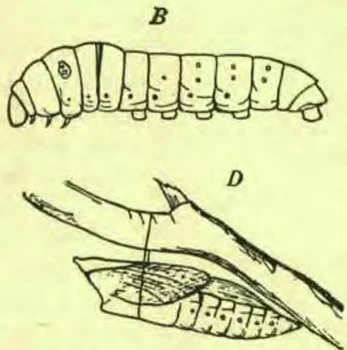
The metamorphosis of insects has from earliest ages been noted as one of the most remarkable phenomena in nature, and well deserves our attention. This transformation, in its most complete form, as exemplified in the butterflies, moths, beetles, and many other insects, takes place in three distinct stages. In the first, or larva state, the insect has the form of a caterpillar or a grub. During this period of its existence, its whole business seems to be eating. And this business it performs usually with the greatest voracity, changing its skin repeatedly to allow for its rapid increase in bulk.
B LARVAL STAGE D PUPA OR CHRYSALIS
After remaining in this condition for a time, it passes into the second period of its existence, when it is called a pupa, or chrysalis. In this state the insect is quiescent, neither eating nor moving. It is enclosed in a case, usually of a horny substance, which serves to protect its tender and helpless inmate, until, after a longer or shorter period, the insect, arrived at maturity, bursts from its prison in the full enjoyment of all its faculties. It is then in the imago, or perfect state.
To see the same animal, first as a soft, worm-like creature, crawling slowly along, greedily devouring everything that comes in its way, and then, after an intermediate period of deathlike repose, emerging from its sleep, furnished with wings, adorned with brilliant colors, and confined in its choice of foods to the most delicate fluids of the vegetable kingdom, is a spectacle of the highest interest. Although the majority of insects undergo a complete change of this kind, there are many in which the only transformation consists in a series of changes of skin, without any period of rest or sleep between. In this case the larva gradually acquires the organs which it originally lacked.
The immense number of insects and their diversified forms and habits, render their classification a matter of difficulty. So without attempting to classify, we will consider some of the interesting features of a few of the more prominent orders.
Let us begin with the Orthoptera, or strait-winged insects. This class includes the cockroaches, crickets, grasshoppers, locusts, praying-mantis, and leaf insects. The cockroach is very familiar, and though now so common over Europe and America, it is supposed to have been originally a native of India, and to have been gradually carried west by the progress of commerce. These insects are nocturnal in their habits, concealing themselves in dark places during the day, and making their ravages in the night. Where they exist in large numbers, as they usually do in ships, they become a nuisance.
We have all seen and heard the noisy cricket, that short, stumpy insect with large hind legs. The field-cricket lives in burrows made at the foot of hedges or old walls, and sits at the mouth of the burrow to chirp, if a sound caused by friction can be called chirping. The house-cricket is much like the field-cricket, and both are so familiar as to need no description.
The mole-cricket is one of the oddest-looking of insects, and gets its name from its burrowing habits and altogether mole-like aspect. This cricket is common, and destructive to vegetation in the warmer portions of the United States.
Locusts and grasshoppers are interesting families of the Orthoptera class. They feed on vegetables; and where they exist in large numbers, they often destroy every vestige of vegetation, and devastate the country as if a fire had swept over it. This is especially true of the migratory locust, which congregates in vast armies, and flies like winged clouds over the earth, making a noise like the roaring of the sea. Wherever they alight, they strip every plant of its verdure.
A prominent class of insects is the Hymenoptera, which includes the bees, ants, and wasps. These insects have four wings, which are transparent and membranous, with comparatively few veins, and the fore pair larger than the others. The honey-bee, from earliest ages, has excited man’s admiration by its industry and its wonderful instincts. To it he is indebted for honey and wax. In the year 1850, fifteen million pounds of honey and wax were gathered from bees in the United States only. The quantity obtained annually throughout the world amounts to hundreds of millions of pounds. These little creatures are said to be natives of Greece, but have since spread all over the world. They live in colonies of from ten to thirty thousand neuter, or working, bees; from six to eight hundred males, called drones; and a single female, which seems to reign as queen. They make their dwelling in the trunk of an old tree, or in the hive which man prepares for them. There is a division of labor among the working bees. Some are the wax gatherers, which collect material for the construction of the comb; some are nurses, to which is assigned the task of watching over and feeding the young; and others are the honey gatherers, whose work is familiar to us.
We might well heed Solomon’s advice to go to the ant and consider her ways. Many interesting things might be said of this wonderful little insect. We have not space to do it justice, and so will attempt no description of it.
A familiar class of insects is the Diptera. These have but two wings. The common gnats and flies are examples of the class.
Lastly we shall mention the Lepidoptera, that class which includes the most beautiful of all the insects, the butterflies and moths. They have four wings of richly varied hues. Those species which take any nourishment in the imago state subsist entirely upon liquid food, which is drawn into the system by suction. Butterflies and moths may generally be distinguished from each other by the form of the antennae, those of butterflies having knobs at their tips, while those of the moths are usually pointed or feathery.
Let us acquaint ourselves with our little insect neighbors, and humbly learn from them the lessons they teach. ESTELLA L. MURPHY.
12. How did they select a time for the destruction of the Jews? Verse 7; note 4.
13. What reasons did Haman give for asking that the Jews be destroyed? Verse 8.
14. Who was the author of this wicked plan? John 8:44. Is there a similar work being carried on to-day? Note 5.
Notes
1. Mordecai could not bow to Haman without dishonoring God; for God had declared “war with Amalek from generation to generation.” Ex. 17:16. He also told his people not to “forget it.” Deut. 25:19. The evil nature of Haman would naturally lead him to require more than other men. He required “reverence.” Mordecai “refused to show him reverence, which belongs only to God.”
2. The Protestant world to-day sees, in the little company keeping the Sabbath, “a Mordecai in the gate.”
3. “Satan will excite indignation against the humble minority who conscientiously refuse to accept popular customs and traditions.” “The same masterful mind that plotted against the faithful in ages past, is still seeking to rid the earth of those who fear God and obey his law.”
4. According to custom, lots were cast to determine the time for the destruction of the Jews. This was done in the first month of the year, to select, according to their superstitious ideas, a propitious and fortunate day for this massacre. While Haman no doubt would have been glad to have their destruction take place at an earlier date, he thought himself bound to submit to the “Pur,” or lot. Perhaps this was a providence of God in delaying the execution of the Jews, and giving a chance for the nature of the plot to be learned and a counter-edict issued.
5. “While men are sleeping, Satan is actively arranging matters so that the Lord’s people may not have mercy or justice. The Sunday movement is now making its way in darkness. The leaders are concealing the true issue, and many who unite in the movement do not themselves see whither the under-current is tending.” “Men of position and reputation will join with the lawless and vile to take counsel against the people of God.”
MEMORY VERSE: “Whosoever doth not bear his cross, and come after me, can not be my disciple.” Verse 27.
“And it came to pass, as he went into the house of one of the chief Pharisees to eat bread on the Sabbath day, that they watched him. . . .
“And he put forth a parable to those which were bidden, when he marked how they chose out the chief rooms; saying unto them, When thou art bidden of any man to a wedding, sit not down in the highest room; lest a more honorable man than thou be bidden of him; and he that bade thee and him come and say to thee, Give this man place; and thou begin with shame to take the lowest room. But when thou art bidden, go and sit down in the lowest room; that when he that bade thee cometh, he may say unto thee, Friend, go up higher: then shalt thou have worship in the presence of them that sit at meat with thee. For whosoever exalteth himself shall be abased; and he that humbleth himself shall be exalted.
“Then said he also to him that bade him, When thou makest a dinner or a supper, call not thy friends, nor thy brethren, neither thy kinsmen, nor thy rich neighbors; lest they also bid thee again, and a recompense be made thee. But when thou makest a feast, call the poor, the maimed, the lame, the blind: and thou shalt be blessed; for they can not recompense thee: for thou shalt be recompensed at the resurrection of the just.
“And when one of them that sat at meat with him heard these things, he said unto him, Blessed is he that shall eat bread in the kingdom of God.
“Then said he unto him, A certain man made a great supper, and bade many: and sent his servant at supper time to say to them that were bidden, Come; for all things are now ready. And they all with one consent began to make excuse. The first said unto him, I have bought a piece of ground, and I must needs go and see it: I pray thee have me excused. And another said, I have bought five yoke of oxen, and I go to prove them: I pray thee have me excused. And another said, I have married a wife, and therefore I can not come. So that servant came, and showed his lord these things. Then the master of the house being angry said to his servant, Go out quickly into the streets and lanes of the city, and bring in hither the poor, and the maimed, and the halt, and the blind. And the servant said, Lord, it is done as thou hast commanded, and yet there is room. And the lord said unto the servant, Go out into the highways and hedges, and compel them to come in, that my house may be filled. For I say unto you, That none of those men which were bidden shall taste of my supper.
“And there went great multitudes with him: and he turned, and said unto them, If any man come to me, and hate not his father, and mother, and wife, and children, and brethren, and sisters, yea, and his own life also, he can not be my disciple. And whosoever doth not bear his cross, and come after me, can not be my disciple. For which of you, intending to build a tower, sitteth not down first, and counteth the cost, whether he have sufficient to finish it? Lest haply, after he hath laid the foundation, and is not able to finish it, all that behold it begin to mock him, saying, This man began to build, and was not able to finish. Or what king, going to make war against another king, sitteth not down first, and consulteth whether he be able with ten thousand to meet him that cometh against him with twenty thousand? Or else, while the other is yet a great way off, he sendeth an ambassage, and desireth conditions of peace. So likewise, whosoever he be of you that forsaketh not all that he hath, he can not be my disciple.”
Questions
1. Where do we find Jesus in this lesson? What does his presence in the homes of the people—rich and poor alike—show?
2. What did Jesus notice on the part of the guests who were bidden with him? What did he tell them not to do when they were bidden to a wedding? Why? What should they do? What would be the result of such a course?
3. What lesson does this parable teach? What did Jesus say of those who seek to exalt themselves? Of those who humble themselves?
4. To whom did Jesus now speak? Whom did he tell the chief Pharisee to invite when he made a feast? When would he be recompensed for his kindness? Why should he not invite his kinsmen and rich neighbors?
5. To whom was the parable of The Great Supper spoken? What had this man just said? Who made this supper? Who were invited? What did the guests neglect to do? At supper time where did the man send his servant? What message did he carry to those who had been bidden?
6. What did the guests immediately begin to do? What excuse did the first offer? What did he wish to do? What did another say? What excuse did the third make? What does this “Great Supper” represent? Rev. 19:9. What kind of things occupied the minds and time of those who had been bidden to this supper?
7. When the servant heard these excuses, what did he do? What command was then given to the master of the feast? When this command had been carried out, what word did the servant bring to his lord?
8. Where was the servant now sent? How was the house to be filled? What solemn word was spoken by the master of the feast concerning those who were first bidden to the supper?
9. As Jesus went away, who followed him? What did Jesus say of the place he must occupy in the hearts of all who would be his true disciples? What does this mean? What must be done by all who would be disciples of Jesus? Memory verse.
10. How did Jesus now speak to his hearers? Relate the parable of the man who built a tower. Of the king who went to make war. What lesson were these parables given to impress?
Sentence Sermons
By Henry F. Cope
Hope always helps.
Petulance is self-punishment.
Opportunity wears rubber shoes.
Better a sweet failure than a sour success.
Nothing fights age better than happiness.
The open heart always finds the open heart.
The best-eyed people are those who are blind to some things.
Nothing is easier than being benevolent with other people's money.
Friendships sown in youth furnish the sweetest fruits for old age.
Men show their conceit of themselves by their criticism of others.
Sow the seeds of sin, and the fruits of sorrow will take care of themselves.