The Youth’s Instructor, Vol. LIII, No. 42

The Pure in Heart

The Youth’s Instructor

Oct 17, 1905

Review and Herald Publishing Assn. · Washington, D. C. · Oct 17, 1905

The Pure in Heart

SOME hearts within this sinful world Are sweet and pure and fair, Free from all thoughts of sin and shame, And free from stain and snare; Whose lightest notes are set to joy, Whose strings are frail and pure. And roughly swept by earth’s rude hand, They would not long endure.
They carry in their loving deeps The freshness of the morn,— The innocence of early years, The rose without the thorn; And dreams, too beautiful for earth, Repose in fragrance there, Some, happy with a sinless mirth, And some, embalmed in prayer.
As lovely as the flowers of morn, Where crystal dewdrops lie, Theirs is the purity of heaven, Reflected from the sky. He who ascended up on high, Where steps of sin ne’er trod, Said, “Blessed are the pure in heart, For they shall see our God.”
L. D. SANTEE.
Dixon, Ill.

Suffer the Little Children

SOME years ago I accompanied a young minister to his church meeting in the country. It was a double service, with dinner between, and quite a company of the neighborhood people were on hand. At the close of the afternoon service I invited confessions of Christ. As I descended from the stand to the floor, a suspiciously diminutive boy came forth to meet me, and with flowing tears took my hand and stood silently before me. The scene was touching, and yet the smallness of the boy excited a doubt which could be read on the faces of the congregation.
Just then a gentleman arose in the rear of the house, came up the aisle, and stopped near the lad and myself. Turning to the audience, he said: “My friends, this is a mighty little boy to be professing religion, and I suspect that you think he doesn’t know what he is about. But let me tell you that this is my boy, and I believe in him as much as I believe in anybody in this church. I know him, and I know he is in earnest.” Then, bending down, he kissed the little fellow and took him in his arms. The benediction of that loving act lingers with me yet. The father’s faith in the child helped its own.
In one of our large Southern Baptist churches, a small boy appeared before the church, asking for baptism. After examination he was accepted for membership, and the pastor made reference to his youth and smallness of stature, and expressed hope that he might be at home in the church. Just then the oldest member of the church left his seat quite far back in the room, and appeared at the pastor’s side and asked that he might speak.
“My little brother,” he said, addressing the lad, “you will be the youngest member of this church, and I am the oldest, and I propose that we be partners. Both of us are weak—I from age, and you from youth. Both of us need help; you must help me, and I will try to help you.”
— Courtesy of the Rotary Magazine
The incident was simple enough, but it thrilled the little believer with a wondrous sense of fellowship, and as he took the old man’s outstretched hand, his eyes were full of tears. O, welcome the lambs to the fold of Christ!—William E. Hatcher.

A Remarkable Movement

THE most startling announcement this sinful world has heard since Noah, Lot, Jonah, and Christ bore their messages of impending judgment is, “Fear God, and give glory to him; for the hour of his judgment is come.” When William Miller and his associates, after a careful study of the prophecies, assured themselves that this work of judgment must begin on the tenth day of the seventh month in 1844, at the conclusion of the twenty-three hundred days of Daniel 8, they addressed themselves to the work of giving that message. Their conviction was deep, their preaching simple and direct, and their zeal and confidence so unbounded that it challenged the attention and admiration of the world. It did more, it carried with it a conviction that was irresistible, and thousands were converted in a short time.
As they neared the appointed time, they sold their earthly possessions, and laid all upon the altar of service to carry that truth to the world. As if their zeal, ardent as it was, was not in keeping with the momentous announcement they were making, God placed his Spirit upon little children, and with logic, clearness, and power equal to that of able ministers, they arose and presented the thrilling cry, “The hour of his judgment is come.” Was this fanaticism? was it fanaticism when babes and sucklings who had never lisped a word annoyed the staid scribes and Pharisees by crying hosannas to Christ as he made his triumphal ride into Jerusalem? Let the Master answer. “If these should hold their peace, the stones would immediately cry out.” No; it was not fanaticism, but it was God’s announcement that the work of judgment was about to begin in heaven.
With what fervor and confidence their work was carried is well illustrated by the following quotations from the last number of The Advent Herald and Signs of the Times Reporter issued before the tenth day of the seventh month, when they looked for Christ to come. William Miller says, “I am strong in my opinion that the next will be the last Lord’s day sinners will ever have in probation; and within ten or fifteen days from thence, they will see him, whom they have hated and despised, to their shame and everlasting contempt. O, what will then become of nominal cold-hearted scoffers and professors? Have mercy, O God! have mercy upon them!”
An editorial note by J. V. Himes states: “As the date of the present number of the Herald is our last day of publication before the tenth day of the seventh month, we shall make no provision for issuing a paper the week following. And as we are shut up to this faith by the sounding of this cry at midnight, during the tarrying of the vision when we all slumbered and slept, and at the very point when all the periods, according to our chronology and date of their commencement, terminate, we feel called upon to suspend our labors and await the result. ‘Behold, the Bridegroom cometh; go ye out to meet him,’ is the cry that is being sounded in our ears; and may we all, with our lamps trimmed and burning, be prepared for his glorious appearing.”
But they were disappointed, for the Lord did not come. Yet they announced the fact that “the hour of his judgment is come,” with great power, and that was their message.
The work of judgment began then, so the judgment cry they carried was timely. In the tenth chapter of Revelation, where the Lord gives the history of this movement, he very beautifully acknowledges it as his own work, and then predicts the disappointment of those who should proclaim this judgment message. They would expect the coming of Christ too soon after the beginning of the work of judgment, and their disappointment would be bitter. All that they had said of the soon-coming Saviour was true, only a little more time must be allowed for the work of judgment. During this time he says, “Thou must prophesy again before many peoples, and nations, and tongues, and kings.” The very fact of their disappointment confirms the identity of that movement as the one recognized by God as giving the announcement of his work of judgment begun.
What now remains before the coming of Christ?—Prophesy again. Give the third angel’s message. The Lord would have us become as enthusiastic in our work as that people were in theirs. He tells us that his unmingled wrath awaits all who refuse the message we bear, and that when this gospel of the kingdom shall have been preached in all the world for a witness unto all nations, then shall the end come. He pleads that we arise to a condition called “hot,” from a state of lukewarmness, lest he spew us out of his mouth as not meeting the requirements of his work in our time. As if this were insufficient to properly hasten our footsteps in this closing work, he cries in our hearing to the four angels standing upon the four corners of the earth, to hold the four winds of war and strife, that they blow not upon the earth until the servants of God are sealed with the seal of the living God in their foreheads. This scene should thrill the heart of every young person with renewed zeal to hasten with the message while the angels hold the winds; but more than this, a mighty angel is sent from heaven to join the third angel and lighten the earth with his glory. Then comes the last rallying cry, “Arise, shine; for thy light is come, the glory of the Lord is risen upon thee.” “Go out quickly and compel them to come in that my house may be filled.” There is no longer time for vanity; no longer time to seek earth’s treasures; no longer time for half-hearted labor in the Master’s cause. Cut loose! cut loose! cut loose! is the call of the hour. Nothing less will satisfy the waiting Saviour, who longs to receive his people. Who will respond to this call to whole-hearted service? R. C. PORTER.

Reading for Profit

THE faculty of observation should be cultivated in general by all, but perhaps this art needs to have special attention from young people with regard to their reading. Too many skim lightly over the books they “read,” without really seeing and absorbing what is before their eyes. This is to be regretted when we consider how exceedingly valuable as an educational factor reading may be. Let us study a few of the ways in which our reading may be genuinely helpful, and not merely a means of passing the time.
The matter of increasing one’s supply of words is a great thing. Whenever you meet a new word whose meaning is doubtful to you, look it up in a dictionary. In doing that, note particularly the spelling, the meaning, and the correct use of it in the sentence. Some dictionaries give examples of the use of words, which is very useful. At any rate, study the particular use of it when you meet with it. Never leave a newly found word until you can use it properly yourself. If this is done for a few months, the vocabulary will be found to be considerably enlarged, and a far greater pleasure will be derived from your reading. There is really no more interesting and practically useful way of learning new words than to read books likely to contain them.
Whenever we see a word, we should look at it closely enough also to know of what it is composed, what letters are employed, and their order. This habit gives the secret of ability to spell, and the failure to observe makes the poor speller. How very common it is to hear persons say “prespiration” instead of perspiration. Frequently we see written the syllable “per” changed into “pre.” This defect need not exist, and would not if the persons really looked at the words when they read anything. The habit can be easily formed, and it will become so much a natural act that you will instantly detect the correct arrangement of the letters composing a word. Rules for spelling are few and of little value; but the art of acute observation is of vastly more worth than all the rules that ever existed. Sometimes errors in spelling are made, even in good printed matter, so it is well sometimes to verify words by a reference to the dictionary. But this is not necessary as a rule.
Another point of importance is the punctuation problem. This is really difficult, but possibly the best way of acquiring the ability to punctuate is by studying punctuation as we meet with it, rather than by attempting to learn a set of cut and dried propositions about it. Take a piece of good prose, look carefully at the punctuation marks, and then try to justify the use of each; or ask some one to dictate an article to you, writing it and supplying the marks yourself. The cultivation of this method will be of the utmost value in learning this difficult art. But be sure to use matter of high quality, or the marks used by the printer may not be correct in the model you use. Standard works are the best for such a purpose. Prose is to be preferred rather than poetry, as meeting every-day needs much better.
Another valuable thing in this connection is the looking up of references to other writers and works. A great deal of useful knowledge may be acquired by doing this. Literature covers such a wide realm that in almost everything we read there are references made to what others have written, and in very many instances the matter in hand can not be fully understood or adequately enjoyed without some acquaintance with what is referred to. References to Biblical subjects and persons are extremely common in standard works, and such allusions should be well understood. The great classical authors are full of such references and quotations.
Reading affords another source of instruction, apart from what is contained in the matter itself; that is, the examples we find of good English composition. Take a paragraph from some good book, and study minutely how it is put together. Compare the adjectives used, see how the appropriate adverbs are attached to the verbs they modify, and see what instances there are of striking and picturesque combinations of nouns with adjectives. In this way alone a great deal of solid pleasure and true benefit may be derived. Language study will be found most entrancing if learned and followed up diligently in this way. Notice, again, the arrangement of the words, and what words are used. Be on the watch for musical sentences, rhyme and rhythm, and other details which make prose so attractive and enjoyable. When you have trained eye and ear to detect and discover these little adornments of the tongue, you will find a great storehouse of wealth undreamed of, in the reading-matter that you have hitherto merely skipped lightly through.
Once more, there is the art of remembering what you read. Choose some page or chapter, and after reading it spend ten minutes at something else, and then sit down and try to write out the substance of what you last read. This is a most valuable exercise, and if persevered in, will produce gratifying results.
R. E. PORTER.

On the Desert

MARTENIS is a large Indian reservation ten miles north of Mecca. The government has established here an industrial school, and put up a church building. It has provided seeds, implements, and water for agricultural purposes. As we drove through this settlement, we could see everywhere evidences of thrift and prosperity. The people seemed to take pride in their gardens and farms. Basket-making is also an important industry with them, some of their best-made baskets bringing ten dollars apiece.
We will describe more particularly the little settlement just south of us, as I have become better acquainted with its people. They are a remnant of several tribes that have escaped destruction by water. The only history they have of their ancestors and of this country is the record of the Gulf waters rushing in at two different times and sweeping away most of the inhabitants. They can not tell whether it was one hundred or five hundred years ago. Most of the Indians can talk English, and some read well. They are honest and agreeable, and the most of them are Catholics. They are becoming more and more like the white man in their habits of eating; they use dried and canned fruit, also fresh fruits in warm weather, but more heat-producing foods in winter. They use much soap, and keep their clothes very respectable. Their houses are made by skilfully working arrow weed into a frame of timber and wire, which is so tight that they will turn water and keep out dust, and indeed they trim off the rough edges so neatly and nicely that they look quite homelike. Their houses are always built beneath some large shade trees, as cottonwood, willow, palms, or pala verde, and then they are sure to be near water. They spend most of their time out in the shade of their yard trees.
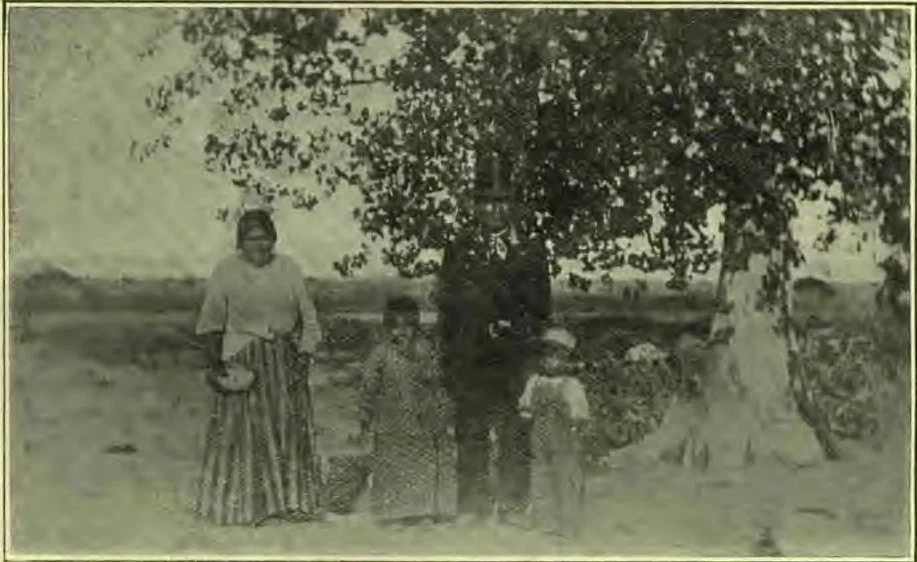
FIG TREE JOHN AND FAMILY
One old Indian chief known as Fig Tree John got his name from the large old fig-trees which he has. Thirty of his trees are at least thirty years old, then he has quite an orchard of younger ones. He says he once found a little wild tree and got a start from its cuttings; however, his trees are now of the finest and earliest bearing of the country. The figs are about the size and shape of a turkey egg, and delicious in flavor, being very sweet. They ripen the first of May. and his son ships them to the Los Angeles market at twenty-five cents a pound. The picture is of Fig Tree John, his wife, and two of his grandchildren. Indians do not like to have their pictures taken, but as we visited them, gave them some oranges, admired the fig-trees and baskets, we gained the old man's good graces. Still when he heard the word pictures he began to move toward his cabin, but on the offer of money he soon made ready, and having the dollar safely in his own hand, he stood up for the picture.
One of Fig Tree John's sons spent five years in the Kansas and Arizona school, and he seems quite intelligent. After he had read several copies of the YOUTH'S INSTRUCTOR, Signs, and Life Boat, he told me that he loved to study the good things in my papers, and if I did not care, he would like to rent or borrow my Bible, as his had been stolen from him by another Indian. I put him off, and began to plan and pray to see what I should do, and at last I decided to give up my cherished treasure, which was the first Bible I ever called my own, having worked hard when but a child to earn it as a premium. I gave it to him the next time he came, and the many “Thank you’s” and happy smiles more than paid me for the Bible, as I have a new one. Since then he told me that it taught him to be good, and he loved it very much. He has also ordered “Steps to Christ.” Now the other poor Indians are asking if I have any more Bibles for them. I have given away many tracts and papers to both Indians and passing white people. I leave the results with God, and let all praise be given to him, for it is he that worketh in us.
An old Indian woman who has lost all her own children comes over and spends hours watching my little Bertha. Though the child is but four years old, she shows the old woman her Little Friend, points out Jesus’ picture, and sings “God Is Love,” “Little Feet, Be Careful,” and “Two Little Hands for Jesus,” which the woman seems to enjoy very much. She can not read, and talks very little English; but every time she comes, she asks Bertha to “sing Jesus,” and as soon as one song is finished, she says, “Sing Jesus more,” till the three are finished. She seems to understand that the child knows no more; so she waits till her next visit, when she repeats her requests.
There are so many hearts waiting to learn of the wonderful love of Jesus, from the highest classes of humanity to the poor ignorant Indians. May we each keep ourselves on the altar of sacrifice continually so that we may be used to help some soul to the kingdom.
MRS. JOCIE WALLACE.

Your Life: What Shall You Do with It?

Wise Counsel from a Young Man
Nowadays a great deal of advice is given to young people who are starting to find their life-work. They are informed to choose the occupation for which they have the most preference, and to stick to that vocation whatever may come. Success, they are told, comes only by diligent application to the trade or profession in which they wish to excel. This is all true, as far as it goes; but young persons of to-day are likely to get a false idea of what real success is.
They see that money counts for a great deal, and covers a host of errors. They see that the rich man, in spite of his probable shortcomings, is looked up to and copied, whereas the humble mission worker, for instance, receives only a passing glance. And yet which of the two would our pattern, Christ, most laud? If we are Christians, and know the Saviour through his Word, there will be no difficulty in finding the answer in our hearts.
But let it not be understood that money is to be shunned simply because it is money. It is the worldliness, the selfishness, the wrong ideas of pleasure and happiness that riches bring that should be guarded against. And let it not be thought that a “moneyed man” can not be a Christian. He can if he will.
Wealth can be a great blessing to one; but it is often a curse. It all depends on the person who possesses it. Therefore, if in your life-work, the Lord sees fit to place money in your hands, make good use of it. Remember that one tenth of your income should be returned to him, and that he also requires voluntary offerings.
An old gentleman of my acquaintance says that hoarding money is one form of enjoyment, but it is a very low form, as all true men and women will attest. Hoarding or injudicious saving is likely to make one selfish, if not miserly. Such a fate is not desirable. So we see that accumulating money solely for the sake of seeing how high a pile we can build is no success at all. Likewise, any vocation followed only to gratify one’s self and the foolish world is also a failure.
This being the case, what is true success? What work will be sure to bring it? With joy I answer that any work, done with heart and soul for Christ, and after his method, will bring absolutely pure success. It is true that the world does not reward most of the Lord’s workers as they should be rewarded, but what of that? Think of the glorious pay he is going to give the faithful in that land of light and beauty. Is it not worth working for? The saints in our large cities who go patiently from day to day among the lowly and fallen are the ones who, in the end, shall inherit great riches—not the one who, in his “narrowing lust of gold,” crushes the outcast.
The evangelistic and the medical missionary work seem very attractive to me. I hope many of my readers have similar desires. Think of the good one can do in either calling. Still, any work fully consecrated to God, will bring his choicest blessings. It may be that your life-work is to be done in the little village or on the farm where God originally placed you. Each one must prayerfully decide for himself. This is a serious problem, and divine wisdom is required to solve it. Therefore, when it comes time to answer the question, “What shall I do with my life?” send earnest prayer to the throne of grace, and you shall receive a definite, satisfactory reply. Perhaps your real life-work will not begin for many years. Maybe God desires to prepare you for it, in the place where you now live. In this event, shirk no duty that the days bring. Wherever you are, there do a portion of your life-work.
The real, vital point is to consecrate yourself to God, and stand ready for service. Surrender to him the first moment you hear his call in your heart. If you are in earnest, he will use you. When and how, he alone knows. If he sees fit to employ you in your own home, be brave and take up your duties with a joyous heart, realizing that the place in which you find yourself is the best place, else he would not have put you there.
One of the persons that I most admire is a literary acquaintance who has been “the head of the family” almost since she was a girl. She has “baked the wedding cakes for the other sisters,” and is now helping a niece and a nephew with their life-work. Her hair has turned gray in loving service to the members of her home, and she has ungrudgingly tended an invalid mother when she might have been writing stories and poems.
Such are the saints whose lives are truly noble. Would that their virtues were more frequently extolled. Do you suppose that, if God gives you similar tasks and burdens, you will meet them as bravely? I hope you may. When we are children of God, he gives us nothing but what is for our good; and if we rebel, and perhaps fail, we are acting foolishly. It is always the “breaking in” that is hardest, especially if one has been living a life of ease. After one gets started and reconciled, it is possible to find joy and pleasure in tasks that at first seemed hard and unlovely.
After it is clear what you should do with your life, “be not weary in well-doing,” but keep right on. Remember that every one must experience hardships in some form. As soon as you see a difficulty looming up ahead of you, prepare to wrestle with it, and don’t give up until through Christ you are victor.
Young persons generally take disappointment more keenly than older ones, and each failure seems to be the end of all endeavor. They should “cheer up,” and cultivate hope and optimism. It is well to realize that “a poor beginning” often results in “a good ending;” and as long as it is true that “whatsoever a man soweth, that shall he also reap,” there is no reason why the coming years should not be full of true happiness.
If you are inclined to regard your days as dull, profitless, and uneventful, it is your duty to sow a large quantity of first-class seed, that you may reap with thanksgiving in time to come. If the young persons of your acquaintance have joys that you have not, then make some for yourself. Wherever you are, you can do Christ’s work. Then why not do it? If you don’t know how to start, take the difficulty to God, and he will show you.
In doing work for Christ, we meet with pleasant happenings as well as with unpleasant ones; and these cheer us and help us, only in a little different way than do rebuffs and disappointments, which spur us on and make us determined; that is, they have power to do so; but if we refuse to let them work, they can not help us. Everything benefits a person who is bound to do good. Nothing can stop him. He has God and all of God’s good forces on his side.
One of the most pleasing things about a real Christian is that he inspires others to “go and do likewise.” “Influence counts,” and “example is the best argument.” Start the journey for a successful life to-day. Don’t let petty hindrances prevent you from being the earnest disciple of Christ that the hour demands.
Every one desires to succeed. No one would willingly be a failure. And it is possible for each young person to be a real success. Even though the world may count us dismal failures, in the eyes of the Lord we are counted successes.
BENJAMIN KEECH.

“My Friend”

MISS GRAHAM had just been trying to impress upon her pupils the meaning of the expression “a friend of God,” as applied to Abraham. She thereupon asked each little one this question: “Who is your friend,—the one you love most of all?”
Each one responded by repeating the name of some dear friend, until she came to one little boy about five years of age.
“And who is your friend, Robbie?” his teacher asked him.
Robbie hesitated a moment, then asked, with a queer little blush, “Can we name a girl?”
His teacher smiled, somewhat amused, thinking probably he had some little girl sweetheart in mind, but she answered, heartily, “Of course, dear, whoever is your friend.”
But what was Miss Graham’s surprise as well as pleasure to hear little Robbie say, “Mama.”
EMMA J. DUGAN.

No Battle Was Ever Won by Words

“No battle was ever won by words.”

Little Courtesies Are the Wayside Flowers of Life

“LITTLE courtesies are the wayside flowers of life.”

The Sweetness of Faith

“THE world will not be convinced of the sweetness of your faith by the sourness of your face.”

Christ's Self-Denying Love: A Poem

“He might have reared a palace at a word, Who sometimes had not where to lay his head. Time was when he who fed the crowds with bread Would not one meal unto himself afford. He healed another’s scratch, his own side bled— Side, hands, and feet, with cruel piercings gored. Twelve legions, girded with angelic sword, Stood at his back, the scarred and buffeted. O wonders left undone! and not less wonderful Than those he wrought! O self-denying love that thought alone On needs of others, never for his own!”

Our Convention

THE annual convention of the Young People’s Societies of southern California was held in the camp pavilion, August 17. On a large blackboard, beyond a palm-leaf decoration, were the words of our motto, “For the Love of Christ Constraineth Us,” and of our aim, “The Advent Message to All the World in This Generation.”
After the opening exercises, Brother Silsbee spoke of the influence of our motto upon our past work, and of its living value in our future endeavors.
Reports from the several Societies were then given. To their combined effort is to be accredited a sale of 54 books and 1,313 papers, 28 books loaned, 3,342 papers distributed, and 14 subscriptions taken. The cash donations amounted to $98.60, sent to different parts of the field. Many tracts had been distributed, letters written, Bible readings held, and missionary visits made, but one feature of special interest was the sending of bouquets to invalids, and the singing of hymns to the aged, by the very youngest members.
The Los Angeles Society sold twelve hundred copies of the Life Boat for the support of a student in the Avondale school.
The Fernando Society (our largest) reported $27.57 from their missionary acre, $32.07 from their Self-denial boxes, besides 114 articles of clothing sent to Huntsville. Three yearly subscriptions of the Life Boat were sent to San Quinten, four to the Mare Island Navy Yard, and twelve to the State prison at Salem, Oregon.
One Society sent its funds to India, one to China, and others to the South. A large part of the work was not reported in a definite way.
After some special music, the order of the meeting was changed, some of the subjects planned for discussion being taken up. They were as follows: “Responsibility of the Youth,” “Information Essential to Christian Life—Ignorance Not an Excuse,” “Social Intercourse,” “Work of the Youth for Their Fellow Youth,” “Is there Danger of Giving Too Much Time and Attention to the Organizations and Meetings of the Societies to the Neglect of Their Spiritual Interests?” “Popularity and True Greatness,” “Work for the Isolated Youth,” “The World’s Greatest Need Is Young Men and Women of Stability.”
Among thoughts emphasized were the following:—
True education fits us not only to perform a line of work, but becomes a safeguard in temptation.
God has made every possible provision for the salvation of every soul.
There is danger of giving time and thought to the organization of our work to the neglect of its spiritual interests.
The most entertaining programs are those composed of reports of actual experience in the work.
Our object in meeting together is to encourage one another to put forth greater efforts for the salvation of souls.
How can we consider the things we give up for Christ’s sake a sacrifice?
We must have influence,—overcoming power, in our lives. Let not our lives shake the confidence of others in God’s power to save from sin.
Our daily life should manifest Christ.
It is only what one really is that can be of benefit to another.
Success depends upon the use one makes of his opportunities.
A special meeting was called for the election of a field secretary, but as the conference offered to appoint and sustain our leader, a motion made to leave the matter with the conference was unanimously carried.
The desire of every heart present at the convention was expressed in the words of one of the hymns sung:— “If I could only tell Him as I know him, My Redeemer who has brightened all my way; If I could tell how precious is his presence, I am sure that you would make him yours to-day.”
We were glad to welcome to our number two new Societies recently organized. Let us ever press onward! WILLIAM YARNELL.

THE WEEKLY STUDY

Paul's Last Letter

OPENING EXERCISES.
TEXTS FOR PERSONAL STUDY: Heb. 13:5.
SCRIPTURE FOR STUDY: Read second epistle to Timothy.
REFERENCE STUDY: “Sketches from the Life of Paul,” pages 318-328.
TOPICS FOR STUDY:—
Circumstances under which epistle was written.
Paul's age.
Relation to Timothy.
Exhortations.
Apostasies mentioned.
Last-day admonitions.
Confidence expressed.

Note

“From the judgment-hall of Cesar, Paul returned to his prison-house, knowing that he had gained for himself only a brief respite; his enemies would not rest until they had secured his death. Yet he knew that truth had triumphed for the time, and that to have proclaimed a crucified and risen Saviour before the vast throng who had listened to his words, was in itself a victory. A work had that day begun which would increase and prosper, and which the emperor of Rome, with all his pomp and power, would seek in vain to destroy or hinder.”
“And now, sitting day after day in his gloomy cell, knowing that at a word or nod from the tyrant Nero his life may be sacrificed, Paul thinks of Timothy, and determines to send for him. Under the most favorable circumstances, several months must elapse before Timothy can reach Rome from Asia Minor. Paul knows that his own life, for even a single day, is uncertain, and he fears that Timothy may arrive too late, or may hesitate through fear of the dangers to be encountered. He has important counsel and instruction for the young man to whom so great responsibility is entrusted, and while urging him to come without delay, he dictates the dying testimony which he may not be spared to utter. His soul is filled with loving solicitude for his son in the gospel, and for the church under his care, and he earnestly seeks to impress upon him the importance of fidelity to his sacred trust.”
“As the faithful, toil-worn standard-bearers are offering up their lives for the truths' sake, who will come forward to take their places? Will our young men accept the holy trust at the hand of their fathers? Are they now preparing to fill the vacancies made by the death of the faithful? Will the apostle's charge be heeded, the call to duty be heard, amid the incitements to selfishness and ambition which allure the youth?”
G. B. T.

MRS. L. FLORA PLUMMER

Massachusetts

An interesting letter has been received reporting the work of the young people at South Lancaster. The Society is composed largely of students at the academy. During the last school year there were one hundred eighty members. The past summer the young people living there have kept up the work and the interest. Bands were formed, and the members engaged in different kinds of missionary work. Each week sixty-five Signs and seventy-five Watchman have been sent out. One week seven hundred extra papers were used. Correspondence has been carried on with the persons to whom the papers are sent. Quite a number of these seem to be really interested. One member of the Society has been corresponding for more than a year with two persons whom she has reason to believe will accept the message. One of them became attracted to the truth by finding “Greatest Event” in her hallway. Ten of the young people have been selling Bible Training School, and have met with excellent success. A quartet visits the hospital each week. The secretary says, “A number are interested in the truth as a direct result of our work.” They are also making an effort to secure the money to send Dr. Marsh to India this coming year.
There is also a little band of faithful workers at Worcester. The oldest is only sixteen, and there are but twelve members. They have distributed a number of tracts in the city. The little girls sold mats for the support of the church-school. A number of the Life Boat, Life and Health, and Bible Training School were sold for the same purpose. The boys have carried papers to the jail each week. With the help of some of the older ones a Sunday-school for the children of the neighborhood has been held in the church-school room. The attendance and interest are excellent.
At Lowell the Society numbers fifteen members, nearly all of whom are children. They have been steadily at work for six months under a suitable leader who is one of the older members of the church. Their work for six months is summarized as follows:—
Missionary letters written ................ 23 Missionary letters received ................. 22 Missionary visits .......................... 107 Papers sold ................................ 100 Books sold ................................... 2 Pages of tracts distributed .............. 7,016 Persons supplied with food .................. 23 Offerings for home mission work .......... $3.31 Offerings for foreign mission work .......... 2.05
The leader writes: “The interest is excellent. The children are always ready for whatever they are asked to do. We feared that children so young would grow weary after a season, but their interest is increasing. One boy gave all he earned selling papers. Our Birthday Box earned eighty-six cents.”

MRS. L. FLORA PLUMMER

Standing on the Threshold of Solemn Events

WE are standing on the threshold of great and solemn events. Prophecies are fulfilling. Strange, eventful history is being recorded in the books of heaven. Everything in our world is in agitation. There are wars and rumors of wars. The nations are angry, and the time of the dead that they should be judged has come. Events are changing to bring about the day of God, which hasteth greatly. Only a moment of time as it were yet remains.—Mrs. E. G. White.
Continue reading: School Bells