All birds must know. Who wisely
sings
Will sing as they.
The common air has generous
wings:
Songs make their way
No messenger to run before,
Devising plan;
No mention of the place or hour
To any man;
No waiting till some sound betrays
A listening ear:
No different voice, no new delays,
If steps draw near.
“What bird is that? The song is good.”
And eager eyes
Go peering through the dusky wood
In glad surprise.
Then, late at night, when by his fire
The traveler sits,
Watching the flame grow brighter, higher,
The sweet song flits
By watches through his weary brain,
To help him rest.
When next he goes that way again,
An empty nest
On leafless bough will make him sigh:
“Ah me! last spring,
Just here I heard, in passing by,
That rare bird sing.”
But while he sighs, remembering
How sweet the song,
The little bird, on tireless wing,
Is borne along
In other air; and other men
With weary feet,
On other roads, the simple strain
Are finding sweet.
The birds must know. Who wisely sings
Will sing as they.
The common air has generous wings;
Songs make their way.
— Helen Hunt Jackson.
BEDTIME
Three little girls are weary,
Tired of books and play;
Sad is the world, and dreary,
Slowly the time slips away;
Six little feet are aching,
Bowed is each little head;
Yet they are up and shaking,
When there is mention of bed.
Bravely they laugh and chatter,
Just for a minute or two;
Then, when they end their clatter,
Sleep comes quickly to woo.
Slowly their eyes are closing,
Down again drops each head;
Three little maids are dosing,
Though they’re not ready for bed.
That is their method ever:
Night after night they protest,
Claiming they’re sleepy never,
Never in need of their rest;
Nodding and almost dreaming,
Drowsily each little head
Still is forever scheming
Merely to keep out of bed.
— Chicago Post.
THE GIRL AND THE WATER-POT
If you were a girl in Nazareth, or in any other place in Syria, you would have to carry a water-pot. A little pot for a little girl, a big pot for a big girl, but a water-pot for every girl. For thousands of years it has been the duty of the girls and women to carry the water from the fountain for the family.
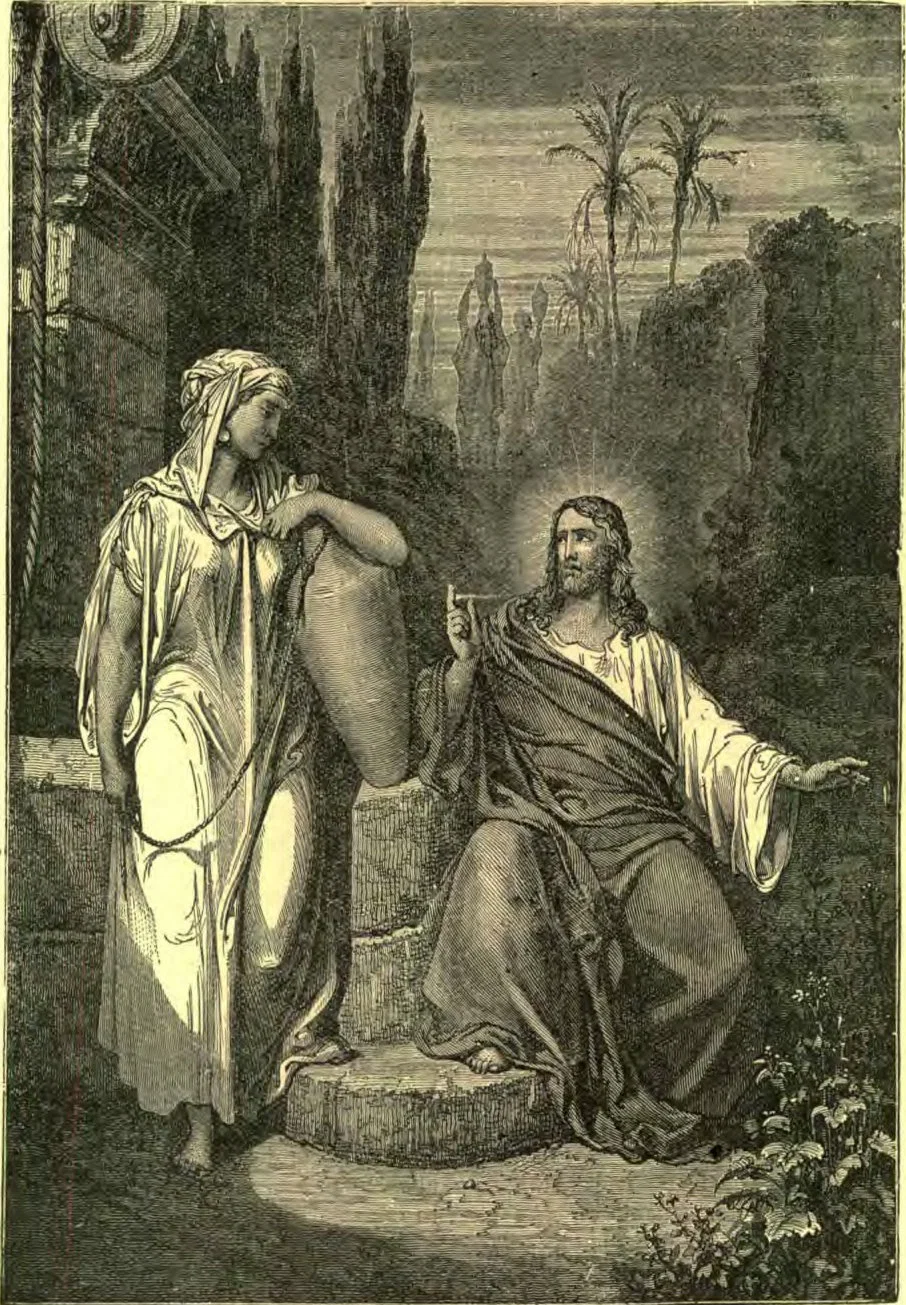
You remember how the woman of Sychar came to Jacob’s well with her water-pot to draw water, and there met Jesus. When he told her of the living water he could give, she left her water-pot, and went to spread the good news.
'THE WOMAN AT THE WELL.
Flowing from under the hills of Nazareth, and gushing out right in the midst of the town, is a fine spring of clear water. It is the only spring in or near the town. It has always been there. To that spring every morning and evening went Mary with her water-pot. There, when she was no longer a girl, but the wife of Joseph and the mother of Jesus, she still went to draw water. There her little Son must often have gone with her. There the girls of Nazareth go to-day with their water-pots.
Little water-pots for little girls, big water-pots for big girls,—a water-pot for every girl. Just as true for the United States as for Syria.
“What? Do you mean to say we should carry the water for the family?”
Yes, misses, that is just what I mean.
“But we don’t need to. The pipes bring the water right into the house here. And those of us who live in the country let the men do that sort of thing.”
Yes, but think a moment. Jesus says that if any one will give even a cup of cold water to a thirsty person, as a service done to him, he will reward it. Think of that! Now, would you not like to carry a water-pot?
You would be amazed, if you would look around, to see how much need there is of that service. So many thirsty people all about us—thirsty for a kind word, thirsty for a smile, thirsty for a merry laugh, thirsty for the water of life.
When you see that tired look on mother’s face, did it ever occur to you that a kiss might refresh her, and make her feel young and strong again? When the corners of baby’s mouth droop sadly because he is tired of his play, did you ever look in your water-pot to see if there were not five minutes of some nice game that would make his eyes dance again?
Did you notice how discouraged your teacher was? Did you think to bring her a cup of cold water in the shape of telling her how her lessons helped you, or how you were trying to follow her teaching? Did you?
Can’t you start a water-pot brigade,—a little water-pot for a little girl, a big water-pot for a big girl, a water-pot for every girl?—Our Boys and Girls.
ANIMAL INSTINCT
By Uncle Will
Now that the late autumn months are here, and winter will soon be upon us, all thrifty persons begin to lay in stores of provision to last during the months when nothing grows. Especially is this true in the country, where there are few shops. This does not seem strange when done by those who have learned by experience what they must expect during the winter months, but is it not surprising that the young squirrels, that never saw a winter day, should start in at the same time to gather nuts and other things for their winter food, hiding them away in a hollow tree, or at the root of an old stump, or under a pile of leaves? This is what they actually do, and they never fail to gather a good supply. More than this, they never hide all their store in one place. Can you guess why?
Now, children, how do squirrels know that they ought to provide a supply of food for winter? When I was a boy, I used to think they learned it from the old squirrels; but as I have grown older, I have learned that the Lord, who made the squirrel, tells him what to do, and when to do it. And the squirrel always does as he is bid, without any complaining. Men call this obedience “instinct.” Look up the definition of this word in the dictionary, and see what it means.
There is another strange thing: Nearly all the nuts that the squirrels live on have hard, thick shells. There is no knife made that could be used very long to open these nuts as the squirrels do without getting so blunt that it would cut nothing without being sharpened. Have you not sometimes wondered how the squirrels can do this work all the autumn and winter, and their teeth not break off and thus get useless? Here, again, nature comes in, and gives the squirrel teeth of such shape, and of such peculiar formation, that as a rule the use of them in this way really sharpens them. But this is not always the case, and then squirrels have to sharpen their teeth in some other way. I will tell you how I once saw a squirrel sharpen his teeth.
It was in the pine woods, where the only winter food the squirrels had was the little seeds found in the pine cones. The squirrels would bite off these cones, and let them drop to the ground, afterward carrying them off and placing them in piles. I have sometimes seen these piles as large as a good-sized wash-tub.
At this particular time, I was lying under a pine-tree, reading. All at once I heard a chattering noise close by; and turning my head, I saw a plump little red squirrel coming toward the tree, up the trunk of which he ran, and out on a branch, and began to bite off the cones. One fell to the ground. He tried two or three others, and failed.
He stopped short, and stood up on his hind legs, as if planning what to do next. Then with a shrill “chickaree-chickaree-quilch-quilch” he ran down the tree, and across to a pile of dirt that had been made by the upturning of a tree. Here he picked up a little flat stone, and ran back up the tree again, and530out on a branch, in plain view, not more than ten feet above me.
Taking the stone in his fore-paws, he rubbed his teeth backward and forward over it, just as you would sharpen a knife, but many times faster. While still holding the stone, he tried his teeth on a cone stem, but they were apparently not sharp enough, for he again whetted them. After this he dropped the stone (which I picked up and carried in my pocket for many years), and then a cone dropped at every snap of his teeth. I watched him as long as I cared to, then made a motion, at which he ran away.
UNCLE WILL.
THREE WISHES
It was down at the orphan asylum one day,
That three little maids sat round the fire,
Each telling the thing she wished for most,
If she only could have her heart's desire.
“I’d like a pony as white as snow,”
Said Maude, “and I’d ride it each day, of course;
And people would stop, as I rode along,
And say: ‘Look at that child on the snow-white horse.’”
Said Alice: “I’d like to own a ship,
And I’d sail clear ’round the world, I guess,
And bring back presents for all the girls,
And a beautiful crutch for dear little Bess.”
Then little lame Bess, with her gentle voice,
Said, looking round from one to the other,
“I’ll wish for the loveliest thing in the world —
That every one of us might have a mother.”
— Little Folks.
In the Whir of Wheels
In the great power-house at Niagara, one of the largest in the world, where the whir of huge, rushing dynamos causes the air constantly to vibrate as with life, and where great water-wheels crash continually with deafening roar, a small wooden box has been placed close to the heavy, rolling machinery; and there a mother cat is peacefully raising her family of fluffy kittens. Downy, helpless things they are; yet in the midst of the tumult, fanned by the furious motion of the nearest dynamo, they sleep as snugly and serenely as if they were in some sweet-scented hay-loft.
Great pets the mother cat and her kittens have become; and many visitors stop to stroke caressingly the soft fur of the latter, while bottles of milk and extra pieces of meat find their way daily into the lunch-boxes of the employees for the grateful little mother. Freely she goes to and fro, leaving her little ones fearlessly in their cozy home among the mighty machines. It is certainly an incongruous place for a nursery; yet the mother cat is much attached to her surroundings and friends, and her touching confidence appeals to every heart.
It does not matter, after all, where our lot in the world is cast, if only we try to make the best of it. Happiness comes from within, and contentment may be ours even in the most trying surroundings.—Young People's Weekly.
(November 11, 1899.)
SABBATH-SCHOOL LESSON—NO. 6
(November 11, 1899.)
THE QUESTIONS OF THE SADDUCEES, LAWYERS, AND PHARISEES
Time: A. D. 31. Place: Jerusalem. Persons: Sadducees, Pharisees, lawyers, Jesus.
QUESTIONS
1. When the Pharisees had been defeated in their efforts to entrap Jesus, who immediately came? Matt. 22: 23; note 1. To what circumstance did they refer as the basis for asking a question? Mark 12: 19-22. With what question did they seek to entangle him? Luke 20: 33.
2. With what words did Jesus first respond? Mark 12: 24. What did he then say to show that they were in error? Luke 20: 34-36. To what scripture did Jesus appeal in proof of his statement? Mark 12: 26. In conclusion what did he say concerning all who have died? Luke 20: 38; note 2.
3. Upon the silencing of the Sadducees, who again came to Jesus? Matt. 22: 34. In what customary manner did the scribes begin the conversation? For what purpose? V. 35.
4. What was the question proposed? V. 36. Repeat the comprehensive answer given by Jesus. Vs. 37-40. What sincere confession did the lawyer then make? Mark 12: 32, 33. What blessed benediction did Jesus then utter in his hearing? V. 34.
5. Reversing the order, and beginning to question his enemies, what query did Jesus raise? What answer did he receive? Matt. 22: 42. With what question and statement did he then seek to show them that Christ is more than the fleshly son of David? Vs. 43-45; note 3.
6. Realizing that they were only condemned by Jesus' words, what change came over these Jewish leaders? V. 46. In contrast with their position, what spirit was manifested by the people? Mark 12: 37.
NOTES
1. The Sadducees were a small, but wealthy class among the Jews, and from them came most of the priests who officiated in the temple. In the time of Jesus the high priest was a Sadducee. In belief these priests were bitter opposers of the Pharisees, and rejected much that was held by them as especially sacred. They were, professedly, great lovers of the Scriptures, but practically they were skeptical, and almost infidel. Denying, as they did, the ideas of a future life, the existence of heavenly beings, and the resurrection of the dead, they were cold and unfeeling in disposition, and found their whole joy in worldly pride and ambition. They were very particular to preserve their family genealogies, showing themselves to be the descendants of Abraham; but in life they knew almost nothing of that Spirit which alone can make one a true child of Abraham. They professed to believe in God, but held that he had nothing to do with the affairs of man.
2. God counts the things that are not as if they were. He sees the end from the beginning, and beholds the result of his work as if it were now accomplished. The precious dead, from Adam down to the last saint who dies, will hear the voice of the Son of God, and will come forth from the grave to immortal life. God will be their God, and they will be his people. There will be a close and tender relationship between God and the risen saints. This condition, which is anticipated in his purpose, he beholds as if it were already existing. The dead live unto him. See “The Desire of Ages,” page 606. In the light of the thought that God counts the things that are not as if they were (Rom. 4:17), we may understand why death is so often called sleep (John 11:11-14; Mark 5:39), and why Jesus could say that they who believe in him should never die (John 11:26); for while physical life is taken away, their real life is hid with Christ in God. They die in the Lord (Rev. 14:13), and sleep in Jesus. 1 Thess. 4:14.
3. It is plain to see that if David called Christ Lord, then David regarded Christ as divine. It was Jesus' purpose to lead his people to see what David had seen before them. As they had acknowledged him to be the son of David (Matt. 15:22; 21:9), he would have them know that he was the true Messiah, of whom David had spoken. His mighty miracles had convinced them that he was the son of David, and by these questions he would have them believe him to be the Son of God.
Chapter XX
By Sarah M. I. Henry
FROM SINAI TO OLIVET
Chapter XX
If Aunt Nell had ever desired that poverty and affliction might come to her brother-in-law, she was not getting her wish. Even Mr. Goss was filled with wonder at his own “good fortune:” he would not have been so much surprised had some terrible disaster happened to him, as he was that everything he touched seemed to prosper.
First of all in his home life. He had never had so little cause for friction. He could see that if he chose to do his share, all would go smoothly about the house. His known wishes and preferences were carefully regarded,—he smiled grimly to himself sometimes to see how carefully,—and while he accepted the attention as a concession to his selfishness, he was both gratified and vexed by it. His clothing was kept in the most perfect order. If he threw a pair of muddy trousers or boots down anywhere, he was sure to find them clean and waiting for him in his closet. Never had rents and buttons been so industriously pursued, and never had his favorite dishes been more toothsomely served. Sometimes he wondered a little just where the child found time to do all these things, but he did not dare allow himself to think much about that part of it.
And then about the farm: crops had never been better, the stock never in better condition; and when at last, in sheer bravado, he went out to the Board of Trade, and began to deal in margins, his success was phenomenal.
He began to be the envy and admiration of his neighbors as the most prosperous man in the county, on the highroad to wealth: and Shirley found new trials springing up in her path, such as would naturally beset a prospective heiress in a world where men stop at nothing to get hold of a fortune. But through it all she walked steadily on, with the humble, quiet grace of a consecrated child of God. As she laid her burden off upon the Lord, she grew in strength and winsome beauty. She became an inspiration of help to her mother; and at last had the satisfaction of seeing her arise from her infirmities, and take her usual place in the home.
The Sabbath became a delight to these three women. They spent it together; and after a while, Will made it a point, if possible, to get home for the day, and they had a Bible study in the parlor. Mrs. Adams learned of it, and531asked to join them. Seth came with her, then others, until at last the room was filled every Sabbath morning at eleven with a thoughtful company of listeners; while each in turn—Will, or Aunt Nell, or Shirley—led the study.
Mr. Goss seemingly took no note of this growing interest. If he ever remembered that the meetings were held, he gave no sign. But one Sabbath he had gone to the city on an early train on business, returning about one o’clock. As he came home, he heard Shirley’s voice in song. It was wonderfully clear, and full, and sweet. He had not noticed how it had grown in power, and how grand it was in that old, old melody,—he knew it well, words and music. She was on the third line of the first stanza:—
“My richest gain I count but loss,
And pour contempt on all my pride.”
He stopped and listened as she sang it through:—
“See, from His head, his hands, his feet,
Sorrow and love flow mingled down;
Did e’er such love and sorrow meet?
Or thorns compose so rich a crown?”
“Since I, who was undone and lost,
Have pardon through his name and word,
Forbid it, then, that I should boast,
Save in the cross of Christ, my Lord.
“Were the whole realm of nature mine,
That were a tribute far too small;
Love so amazing, so divine,
Demands my life, my soul, my all.”
That was the hymn that his mother sang most often, and to-day there was a strange echo of his mother’s voice in some notes that came from Shirley’s; and for some reason they moved him as he had not been moved in years, if ever in his life,—moved him out of, and away from, the demoniac self that had ruled him all these last months,—and he saw his hateful treatment of his child, and her patience under it all, in a new light. The long, cruel summer passed in rapid review before him; the light that had suddenly fallen athwart his way showed him everything in such relations that he could feel only respect for Shirley and shame for himself. He could not account for it. A strange, subduing influence came over him, like a breath from some other clime: what did it portend?
He came into the house, feeling half abashed that he had not come with contention in his heart or reproof on his tongue. He sat down near the door, and remained during the closing hymn, and prayer by Will; and as the little audience arose, he mingled with and greeted them. He had always been courteous to callers, though of late he had avoided any except those who came on business; but there was something about him now that made those who knew him best look at one another in wonder. Shirley looked on with a glad sense of victory, like the robin’s rain-song, in her soul; and soon sought an opportunity to say to her mother, “O mother! I have been praying that the ministers sent forth to minister, you know, might be sent to father, and I believe that my prayer is heard.”
Mr. Goss did not have a word of fault to find with his supper that night; and he talked so kindly to Shirley, as she went about the “after-the-Sabbath” work, that she was encouraged to slip up to him with a touch of caress, which for the first time in months he did not resent; and this fact opened her heart to cry out, “Dear old daddy! I am so glad I’ve got you.”
“Now, you really don’t mean that,” he said, and his lips and chin drew down sharply as his heart pulled upon them, and his eyes grew moist.
“Indeed I do mean it. What should I do without you?”
Then he suddenly let his heart out in one little sentence: “But you’ll have to, sometime,—in the earth made new, for instance.”
“O father! father!—dear old daddy! no, no, no!” and she threw her face upon his breast, her arms about his neck, and held him, while her whole being trembled with the power of the overmastering faith that took possession of her. “No, no, no! I shall hold on to you then forever! I shall hold on to God for you all my life long. I will never, never, let go; and all heaven knows it, father. Mother and I must have you,—God knows we must,—and you must have us. God gave us to one another, and gave us his own dear Son to bind us together forever, and, O father!”
Benjamin Goss could endure no more; and putting Shirley gently away, first, however, touching his lips to her forehead, he went hastily out to find again the farmer’s secret place—the haymow or the open field.
He had for the first time in many a day tasted of the sweetness of love. He could not understand why it had come about that this cup had been pressed to his lips again, but there was no mistaking its genuine bouquet. Love,—that is the name of God, he thought. God, the Unapproachable—was he all like this, of which he had just been made to know the richness? What was life without it? What were all these broad acres, the thousands he had made in speculation,—what was anything, anywhere, that the world could offer, compared to love? He had lately seen men spend marvelous sums of money for a little sensual delight, that must end in pain; and here was love, deep, true, abiding as eternity, being almost forced upon him. What would he not give for it? There was but one thing to give,—his own empty measure, and let love flow in and fill it! Would he give it?
He had been sitting on the hay, but had come out again under the open sky, into which the stars were just beginning to appear as the afterglow of the autumnal sunset faded slowly away; and looking up toward the heavens, he answered: “I will do it! O Love! thou hast conquered. I yield, I yield.”
MRS. S. M. I. HENRY.
(Concluded next week.)
A TIGER SPIDER
A GENTLEMAN who has spent several years traveling in South America has in his cabinet a curious specimen, about which he tells an interesting story.
He was wandering through the forest one day looking for a rare humming-bird that he was anxious to secure, when a fluttering and faint chirping close by his side attracted his attention. A small, hollow tree was near him, with an opening in the side about eight inches across, and spread over this was a dense white web. The upper part of the web was broken a little, but securely fastened in it was a dead humming-bird of the very kind the explorer had been seeking. It had been dead but a short time. Near the bottom of the web a small gray bird was entangled—a tomtit, spending its winter among the tropics, only to meet such a fate as this.
Its wild flutterings had entangled it more and more; but the huge gray monster, back in the dark, evidently fearing that its prey would escape, had waited its opportunity; and just as the traveler looked around, it sprang full upon the poor bird’s breast, clasping its hairy arms around the little, fluttering body, and buried its horrible fangs in the tender throat. For an instant the observer stood still, too much startled to move, while the little head of the bird dropped helplessly, and it ceased to struggle; then, recovering himself, the gentleman hastily prepared his chloroform, and taking advantage of the spider’s preoccupation, brought it gradually near.
So intent was the creature on holding the bird until it was quite dead, that it did not attempt to escape. Its legs relaxed a little presently, but its fangs remained buried in the bird’s throat, and so it died.
The gentleman had the section of the tree trunk carefully cut above and below the opening; and that section stands in his cabinet to-day, with the strong white web, the withered birds entangled in it, and the great hairy spider still clinging to the breast of one.
This hairy monster is known as the Mygale Avicularia. Its body is two inches long, and its great legs cover an expanse of seven inches. It has terrible fangs folded under its head; and when angered or in pursuit of prey, it will leap great distances, and sink those fangs in the object of its attack.—Sabbath Recorder.
HAVE YOU EVER BEEN THUS DECEIVED?
Wise Words for Women
THE gullibility of the average consumer of merchandise of all kinds is well known, and the ability of “shrewd” (we should say dishonest) merchants to palm off imitations of articles which have gained a reputation, and are demanded by name, is also well known. In making small and insignificant purchases, it is not to be wondered at that consumers can often be induced to accept substitutes, or articles which are claimed to be “just as good” by the interested merchant; but when it comes to articles of value, which are likely to be used the greater part of a lifetime, we think the purchasers of such goods are as foolish as the merchant is dishonest if they allow themselves to buy anything but just exactly what is asked for by name. As a glaring instance of what can be done in this connection, we desire to name one well-known article of household use, to show what is often attempted and sometimes accomplished. As long ago as 1882, the Michigan Stove Company of Detroit, Chicago, and Buffalo placed upon the market a complete line of cooking and heating apparatus for all kinds of fuel, and of the highest possible degree of merit, which they marketed under the name of “Garland” Stoves and Ranges; and as this name was applied to only the highest grade or quality of each type of stove or range, their products were an electric success, and the name “Garland” has always stood as a symbol of goods of first grade only—goods which to-day are the only goods of their kind sold under any trade name, which are not made in several qualities. Other stovemakers, counting no doubt upon the credence of the public, began to apply a trade name to lines of goods varying in quality from very good down to the cheapest and most inferior grades, and then imitated the shape and style of the “Garland” trade-mark, even to the shape and arrangement of the lettering,—copying even the colors in “Garland” posters, imitating the designs of “Garlands,”—with the result that many unscrupulous stove merchants have been successful in selling third and fourth grade imitations of “Garlands” upon the statement that what they offered was “just as good,” etc. The courts have closed the factories of some of the most shameless of these imitators, enjoined others, and yet there are those who escape the pale of the law, and continue to dupe the public,—who, we repeat, are themselves to blame for not insisting upon having a “Garland” and nothing else.
This is but one of many instances that might be cited; but it is sufficient to show that it is not only upon small articles of merchandise upon which consumers can be deceived, but large and important ones as well. When will the buying public learn to protect itself?
HOW TO BE HEALTHY
The rules for health have been summed up as follows:—
Drink less; breathe more.
Eat less; chew more.
Clothe less; bathe more.
Ride less; walk more.
Sit less; dig more.
Worry less; work more.
Waste less; give more.
Read less; write more.
Preach less; practise more.
To Reach BATTLE CREEK
FROM
CHICAGO, BUFFALO, DETROIT, OR TOLEDO,
Purchase Tickets Reading over the MICHIGAN CENTRAL
“The Niagara Falls Route.”
A First-class Line for First-class Travel between Chicago and New York and Boston. Elegantly equipped through trains pass Battle Creek in each direction daily.
R. N. R. WHEELER, O. W. RUGGLES, Ticket Agent, Battle Creek. Gen’l P. and T. Agt., Chicago, Ill.
Cincinnati Northern Railroad Co.
TIME TABLE NO. 3.
In Effect Sept. 24, 1899.
Trains Pass Battle Creek, as follows:
WEST-BOUND.
Train
Time
No. 21, Mail and Express
6.58 P. M.
No. 23, Accommodation
2.07 P. M.
No. 27, Local Freight
8.25 A. M.
EAST-BOUND.
Train
Time
No. 22, Mail and Express
8.25 A. M.
No. 24, Accommodation
1.45 P. M.
No. 28, Local Freight
5.30 P. M.
Direct connections are made at Toledo with all roads diverging. Close connections for Detroit and Cincinnati.
J. L. READE, Ticket Agt., Battle Creek.
E. R. SMITH, City Pass. Agt., 6 West Main St.
GRAND TRUNK RAILWAY SYSTEM.
Time-Card in Effect October 9, 1899.
C. & G. T. DIVISION.
WEST-BOUND FROM BATTLE CREEK.
No. 9, Mail and Express, to Chicago. 12.15 P. M.
No. 1, Chicago Express, to Chicago. 9.00 A. M.
No. 3, Lehigh Valley Express, to Chicago. 3.40 P. M.
No. 5, Pacific Express, to Chicago, with sleeper. 1.10 A. M.
No. 76, Mixed, to South Bend. 8.20 A. M.
Nos. 9 and 75, daily, except Sunday.
Nos. 1, 3, and 5, daily.
EAST-BOUND FROM BATTLE CREEK.
No. 8, Mail and Express, to Pt. Huron, East and Detroit. 3.45 P. M.
No. 4, Lehigh Express, to Port Huron, and East. 8.27 P. M.
No. 6, Atlantic Express, to Port Huron, East, and Detroit. 2.25 A. M.
No. 2, Leh. Exp., to Saginaw, Bay City, Pt. Huron, and East. 6.50 A. M.
No. 74, Mixed, to Durand, (starts at Nichols). 7.35 A. M.
Nos. 8 and 74, daily, except Sunday.
Nos. 4, 6, and 2, daily.
GEO. T. BELL, 1st A. G. P. & T. Agent, Chicago, Ill.
A. S. PARKER, Agent, Battle Creek.
TAKE THE Canadian Pacific Railway
for . . . CHATHAM, LONDON, WOODSTOCK, PORTLAND, OTTAWA, GALT, TORONTO, and MONTREAL, QUEBEC, BOSTON,
All points in New England, the Maritime Provinces, Great Britain, and the Continent.
Illustrated literature, time-tables, and full particulars, upon application to—
J. FRANCIS LEE, GEN. AGENT,
Passenger Dept. 228 SOUTH CLARK ST., CHICAGO
Branch Offices: 76 Ottawa St., Grand Rapids, Mich.; Room D, Chamber of Commerce, Cincinnati, Ohio; 315 Chestnut St., St. Louis, Mo.